Covering Trauma
   Being ethical, staying safe
Exposure to trauma
Public health officials regard violence as an
epidemic
Studies suggest extensive exposure
  40 to 80 percent of population has
  experienced a traumatic event
  Perhaps a quarter of those exposed suffer
  emotional injury
                         William Coté & Roger Simpson, Covering Violence
Exposure to trauma

More central to our existence than we
acknowledge
Prime time television: five to six violent acts
each hour
Children’s programs more violent (by 18 years of
age 200,000 acts of violence)

                          William Coté & Roger Simpson, Covering Violence
Topics on TV News
                         Local                              National
50%


                                                                                41%
38%
                                                                                      36%


25%                      26%
      24%
                                        21%

13%
                                                12%
                  10%
            7%                                                    7%   6%
                                  5%                  4%
0%
       Crime     Gov & Politics   Foreign/Mil   Disasters         Business        Other


                                                        Project for Excellence in Journalism 2003
Crime Trend
       Local TV News        Network TV News


                                                      24%

                       21%
19%
            18%


                                                       7%

                       4%
3%           3%

1999        2000       2001                           2003


                               Project for Excellence in Journalism
Trauma & Journalism
“If truth is the first casualty of war, privacy is
the first casualty of any devastating,
unexpected event.”
Crime as a formula for news
Live television coverage exacerbates situation
Media portrays escalating crime at a time crime
rate has actually fallen
                           William Coté & Roger Simpson, Covering Violence
Television News

Violence is the currency of competition
Emphasis is on crimes and events – not
punishments or outcomes
The accused dominate stories, victims fade from
view
Violence explained simplistically
                         William Coté & Roger Simpson, Covering Violence
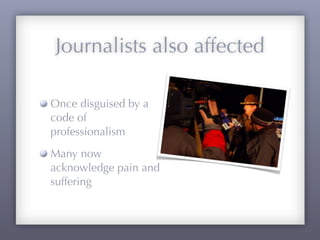
Journalists also affected

Once disguised by a
code of
professionalism
Many now
acknowledge pain and
suffering
Journalists also affected

Once disguised by a
code of
professionalism
Many now
acknowledge pain and
suffering
Trauma & Journalism
          How do journalists
          usefully report violence
          to audience already
          saturated by violent
          media?
          What are the personal
          and professional costs
          of trading in injuries of
          hurts of other humans?
          William Coté & Roger Simpson, Covering Violence
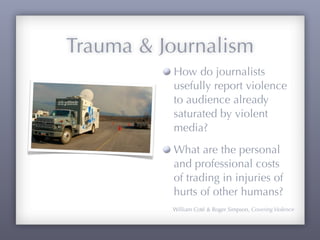
Trauma & Journalism
          How do journalists
          usefully report violence
          to audience already
          saturated by violent
          media?
          What are the personal
          and professional costs
          of trading in injuries of
          hurts of other humans?
          William Coté & Roger Simpson, Covering Violence
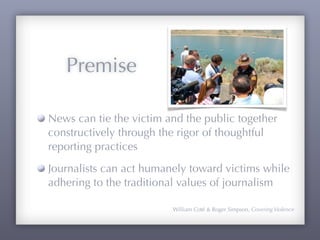
Premise

News can tie the victim and the public together
constructively through the rigor of thoughtful
reporting practices
Journalists can act humanely toward victims while
adhering to the traditional values of journalism

                         William Coté & Roger Simpson, Covering Violence
Premise

News can tie the victim and the public together
constructively through the rigor of thoughtful
reporting practices
Journalists can act humanely toward victims while
adhering to the traditional values of journalism

                         William Coté & Roger Simpson, Covering Violence
Ethical goals
1. Search responsibly for the truth
2. Keep the public interest in mind
3. Care for the people in the story and
   others close to them
4. Respect the voices of people at the
   center of an event
5. Know that storytellers are also at risk
6. Do no harm
                        William Coté & Roger Simpson, Covering Violence
Journalistic treatment of
  criminals & victims
  Do not glamorize the criminal
  Give victim “equal space”
    Not minutes or column inches
    Fair, thoughtful, humane
    Recognize that the trauma victim has
    become a different person
                      William Coté & Roger Simpson, Covering Violence
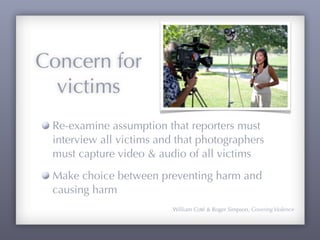
Concern for
  victims
 Re-examine assumption that reporters must
 interview all victims and that photographers
 must capture video & audio of all victims
 Make choice between preventing harm and
 causing harm
                          William Coté & Roger Simpson, Covering Violence
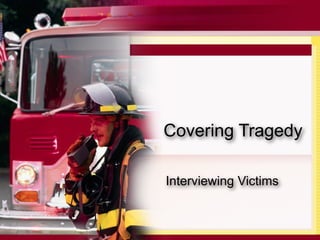
Covering Tragedy

Interviewing Victims
Interviewing victims

   • Treat victim with dignity and respect
     – Know when and how to “back off”
   • Clearly identify yourself
     – Don’t be surprised if you receive a harsh
       reaction (particularly from parents of child
       victims)
     – Do not respond with your own harsh
       reaction


        Dart Center, University of Washington: “Tragedies and Journalists: A Guide for More Effective Coverage,” 2003.
Interviewing victims

   • You can say you’re sorry for the person’s loss
   • Never say “I understand” or “I know how you
     feel.”
      – Do not be surprised with response “Sorry
        isn’t good enough.”
   • Don’t start with the hardest question.
      – “Can you tell me about Jerry’s life?”
      – “What did Jerry like to do?”
   • Listen
        Dart Center, University of Washington: “Tragedies and Journalists: A Guide for More Effective Coverage,” 2003.
Interviewing victims

   • When interviewing relatives of a missing
     person emphasize you seek to profile their
     lives before the person went missing – not an
     obituary.
   • Leave your card in case they want to talk later.


        Dart Center, University of Washington: “Tragedies and Journalists: A Guide for More Effective Coverage,” 2003.
Covering Tragedy

 Writing the story
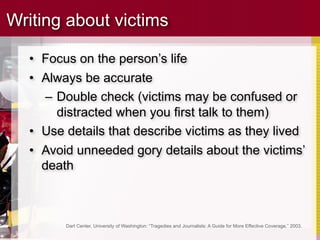
Writing about victims

  • Focus on the person’s life
  • Always be accurate
     – Double check (victims may be confused or
       distracted when you first talk to them)
  • Use details that describe victims as they lived
  • Avoid unneeded gory details about the victims’
    death


        Dart Center, University of Washington: “Tragedies and Journalists: A Guide for More Effective Coverage,” 2003.
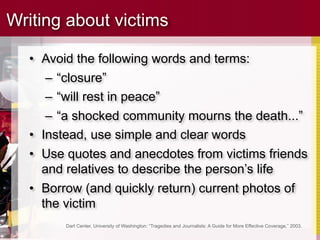
Writing about victims

  • Avoid the following words and terms:
     – “closure”
     – “will rest in peace”
     – “a shocked community mourns the death...”
  • Instead, use simple and clear words
  • Use quotes and anecdotes from victims friends
    and relatives to describe the person’s life
  • Borrow (and quickly return) current photos of
    the victim
        Dart Center, University of Washington: “Tragedies and Journalists: A Guide for More Effective Coverage,” 2003.
Covering Tragedy

 The visual story
The visual story

  • Journalists often are the first to arrive on the
    scene
     – Be aware of dangerous situations
     – Be ready for harsh reactions from law
       enforcement and public
     – Stay calm
     – Leave scene if too dangerous


         Dart Center, University of Washington: “Tragedies and Journalists: A Guide for More Effective Coverage,” 2003.
The visual story

  • If you record bloody images, ask yourself
    whether these are important enough for
    historical purposes or too graphic for your
    readers and viewers
  • Do everything possible to avoid violating
    someone’s private grieving
     – Distinguish between emotion at public
        scenes and a private grieving process on
        private property

        Dart Center, University of Washington: “Tragedies and Journalists: A Guide for More Effective Coverage,” 2003.
Covering Tragedy

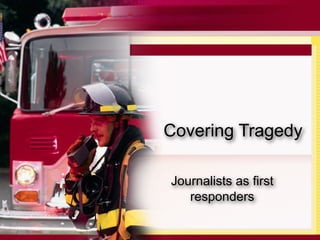
Journalists as first
   responders
Journalists as first responders

   • Know your limits
   • Take breaks
   • Realize that you are a human being who must
     take care of your mind
   • Find a sensitive listener
   • Talk about your experience, admit your
     emotions
   • Seek comfort from the Gospel
   • If necessary, seek professional counseling
         Dart Center, University of Washington: “Tragedies and Journalists: A Guide for More Effective Coverage,” 2003.
http://dartcenter.org
Reporting trauma
Reporting trauma

Reporting trauma

  • 2.
    Covering Trauma Being ethical, staying safe
  • 3.
    Exposure to trauma Publichealth officials regard violence as an epidemic Studies suggest extensive exposure 40 to 80 percent of population has experienced a traumatic event Perhaps a quarter of those exposed suffer emotional injury William Coté & Roger Simpson, Covering Violence
  • 4.
    Exposure to trauma Morecentral to our existence than we acknowledge Prime time television: five to six violent acts each hour Children’s programs more violent (by 18 years of age 200,000 acts of violence) William Coté & Roger Simpson, Covering Violence
  • 5.
    Topics on TVNews Local National 50% 41% 38% 36% 25% 26% 24% 21% 13% 12% 10% 7% 7% 6% 5% 4% 0% Crime Gov & Politics Foreign/Mil Disasters Business Other Project for Excellence in Journalism 2003
  • 6.
    Crime Trend Local TV News Network TV News 24% 21% 19% 18% 7% 4% 3% 3% 1999 2000 2001 2003 Project for Excellence in Journalism
  • 7.
    Trauma & Journalism “Iftruth is the first casualty of war, privacy is the first casualty of any devastating, unexpected event.” Crime as a formula for news Live television coverage exacerbates situation Media portrays escalating crime at a time crime rate has actually fallen William Coté & Roger Simpson, Covering Violence
  • 8.
    Television News Violence isthe currency of competition Emphasis is on crimes and events – not punishments or outcomes The accused dominate stories, victims fade from view Violence explained simplistically William Coté & Roger Simpson, Covering Violence
  • 9.
    Journalists also affected Oncedisguised by a code of professionalism Many now acknowledge pain and suffering
  • 10.
    Journalists also affected Oncedisguised by a code of professionalism Many now acknowledge pain and suffering
  • 11.
    Trauma & Journalism How do journalists usefully report violence to audience already saturated by violent media? What are the personal and professional costs of trading in injuries of hurts of other humans? William Coté & Roger Simpson, Covering Violence
  • 12.
    Trauma & Journalism How do journalists usefully report violence to audience already saturated by violent media? What are the personal and professional costs of trading in injuries of hurts of other humans? William Coté & Roger Simpson, Covering Violence
  • 13.
    Premise News can tiethe victim and the public together constructively through the rigor of thoughtful reporting practices Journalists can act humanely toward victims while adhering to the traditional values of journalism William Coté & Roger Simpson, Covering Violence
  • 14.
    Premise News can tiethe victim and the public together constructively through the rigor of thoughtful reporting practices Journalists can act humanely toward victims while adhering to the traditional values of journalism William Coté & Roger Simpson, Covering Violence
  • 15.
    Ethical goals 1. Searchresponsibly for the truth 2. Keep the public interest in mind 3. Care for the people in the story and others close to them 4. Respect the voices of people at the center of an event 5. Know that storytellers are also at risk 6. Do no harm William Coté & Roger Simpson, Covering Violence
  • 16.
    Journalistic treatment of criminals & victims Do not glamorize the criminal Give victim “equal space” Not minutes or column inches Fair, thoughtful, humane Recognize that the trauma victim has become a different person William Coté & Roger Simpson, Covering Violence
  • 17.
    Concern for victims Re-examine assumption that reporters must interview all victims and that photographers must capture video & audio of all victims Make choice between preventing harm and causing harm William Coté & Roger Simpson, Covering Violence
  • 18.
  • 19.
    Interviewing victims • Treat victim with dignity and respect – Know when and how to “back off” • Clearly identify yourself – Don’t be surprised if you receive a harsh reaction (particularly from parents of child victims) – Do not respond with your own harsh reaction Dart Center, University of Washington: “Tragedies and Journalists: A Guide for More Effective Coverage,” 2003.
  • 20.
    Interviewing victims • You can say you’re sorry for the person’s loss • Never say “I understand” or “I know how you feel.” – Do not be surprised with response “Sorry isn’t good enough.” • Don’t start with the hardest question. – “Can you tell me about Jerry’s life?” – “What did Jerry like to do?” • Listen Dart Center, University of Washington: “Tragedies and Journalists: A Guide for More Effective Coverage,” 2003.
  • 21.
    Interviewing victims • When interviewing relatives of a missing person emphasize you seek to profile their lives before the person went missing – not an obituary. • Leave your card in case they want to talk later. Dart Center, University of Washington: “Tragedies and Journalists: A Guide for More Effective Coverage,” 2003.
  • 22.
  • 23.
    Writing about victims • Focus on the person’s life • Always be accurate – Double check (victims may be confused or distracted when you first talk to them) • Use details that describe victims as they lived • Avoid unneeded gory details about the victims’ death Dart Center, University of Washington: “Tragedies and Journalists: A Guide for More Effective Coverage,” 2003.
  • 24.
    Writing about victims • Avoid the following words and terms: – “closure” – “will rest in peace” – “a shocked community mourns the death...” • Instead, use simple and clear words • Use quotes and anecdotes from victims friends and relatives to describe the person’s life • Borrow (and quickly return) current photos of the victim Dart Center, University of Washington: “Tragedies and Journalists: A Guide for More Effective Coverage,” 2003.
  • 25.
  • 26.
    The visual story • Journalists often are the first to arrive on the scene – Be aware of dangerous situations – Be ready for harsh reactions from law enforcement and public – Stay calm – Leave scene if too dangerous Dart Center, University of Washington: “Tragedies and Journalists: A Guide for More Effective Coverage,” 2003.
  • 27.
    The visual story • If you record bloody images, ask yourself whether these are important enough for historical purposes or too graphic for your readers and viewers • Do everything possible to avoid violating someone’s private grieving – Distinguish between emotion at public scenes and a private grieving process on private property Dart Center, University of Washington: “Tragedies and Journalists: A Guide for More Effective Coverage,” 2003.
  • 28.
  • 29.
    Journalists as firstresponders • Know your limits • Take breaks • Realize that you are a human being who must take care of your mind • Find a sensitive listener • Talk about your experience, admit your emotions • Seek comfort from the Gospel • If necessary, seek professional counseling Dart Center, University of Washington: “Tragedies and Journalists: A Guide for More Effective Coverage,” 2003.
  • 30.