Supervisor: Dr. Saad
Done by: Saja Jameel Lamam
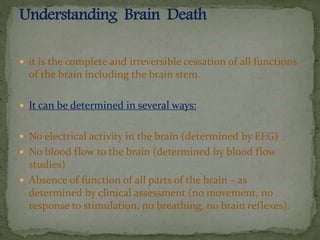
 it is the complete and irreversible cessation of all functions
of the brain including the brain stem.
 It can be determined in several ways:
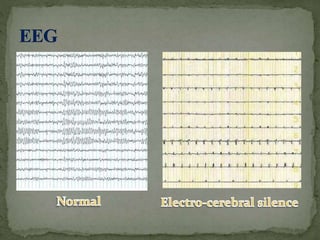
 No electrical activity in the brain (determined by EEG)
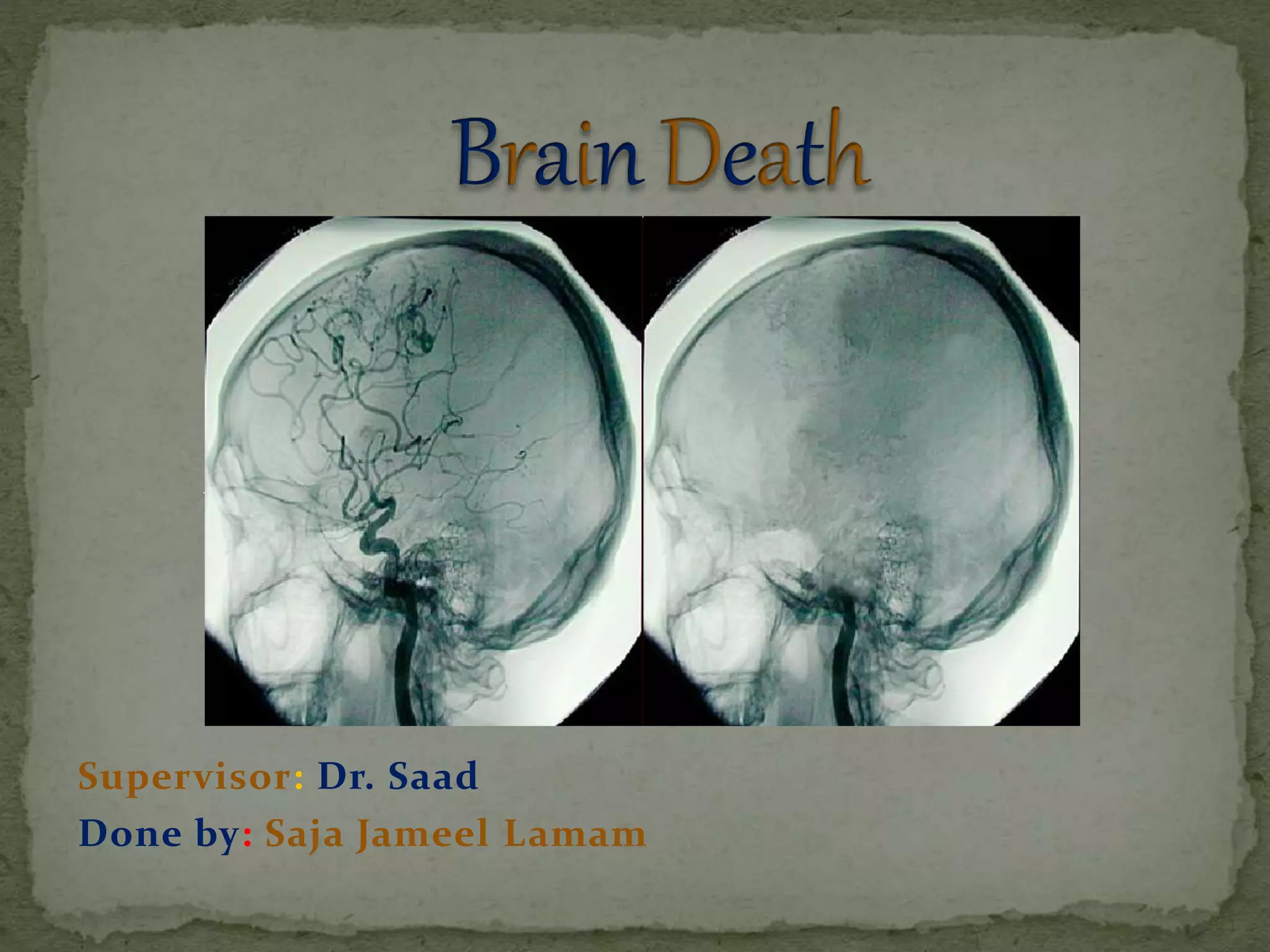
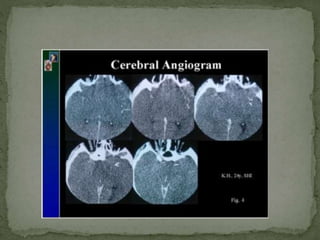
 No blood flow to the brain (determined by blood flow
studies)
 Absence of function of all parts of the brain – as
determined by clinical assessment (no movement, no
response to stimulation, no breathing, no brain reflexes).
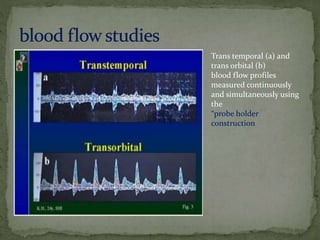
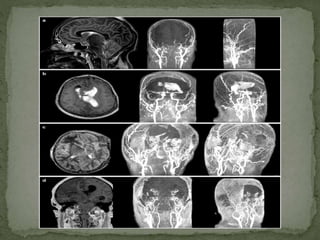
Trans temporal (a) and
trans orbital (b)
blood flow profiles
measured continuously
and simultaneously using
the
“probe holder
construction
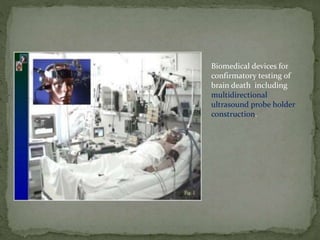
Biomedical devices for
confirmatory testing of
brain death including
multidirectional
ultrasound probe holder
construction.
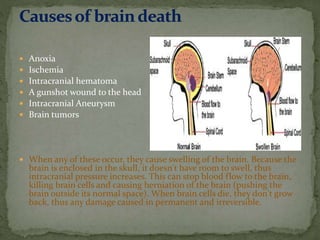
 Anoxia
 Ischemia
 Intracranial hematoma
 A gunshot wound to the head
 Intracranial Aneurysm
 Brain tumors
 When any of these occur, they cause swelling of the brain. Because the
brain is enclosed in the skull, it doesn't have room to swell, thus
intracranial pressure increases. This can stop blood flow to the brain,
killing brain cells and causing herniation of the brain (pushing the
brain outside its normal space). When brain cells die, they don't grow
back, thus any damage caused in permanent and irreversible.
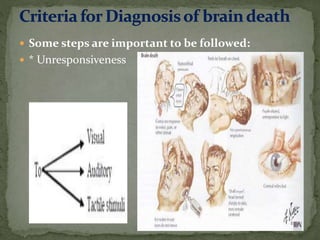
 Some steps are important to be followed:
 * Unresponsiveness
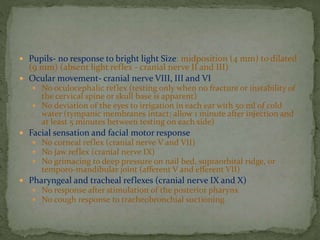
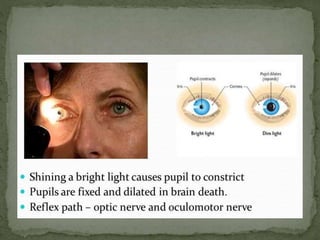
 Pupils- no response to bright light Size: midposition (4 mm) to dilated
(9 mm) (absent light reflex - cranial nerve II and III)
 Ocular movement- cranial nerve VIII, III and VI
 No oculocephalic reflex (testing only when no fracture or instability of
the cervical spine or skull base is apparent)
 No deviation of the eyes to irrigation in each ear with 50 ml of cold
water (tympanic membranes intact; allow 1 minute after injection and
at least 5 minutes between testing on each side)
 Facial sensation and facial motor response
 No corneal reflex (cranial nerve V and VII)
 No jaw reflex (cranial nerve IX)
 No grimacing to deep pressure on nail bed, supraorbital ridge, or
temporo-mandibular joint (afferent V and efferent VII)
 Pharyngeal and tracheal reflexes (cranial nerve IX and X)
 No response after stimulation of the posterior pharynx
 No cough response to tracheobronchial suctioning
 Brain death needs to be certified by a board of doctor's
consisting of:
 Registered Medical Practioner (RMP) in charge of hospital
where brain death has occurred.
 An independent RMP –a specialist.
 A Neurologist / Neurosurgeon nominated by panel.
 RMP treating the patient.
 The patient must be examined by team of doctor's at least
trice with a reasonable gap of time in between (at least 6
hours).
 None of the doctor's who participate in diagnosis of brain
death should have any interest in transplantation or organ
removal from cadaver.
 There is a line of demarcation i.e. when the artificial
aids should be stopped so that the doctor may not get
involved in the offence of culpable homicide not
amounting to murder or one of rash and negligent act,
if he has removed the aids indiscriminately. Thus he
should first consult with other doctors.
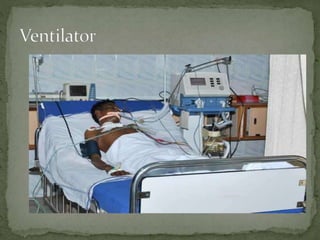
 Clinician should make it clear to the relatives that
ventilation is not being withdrawn to let the patient
die but because continued ventilation is immaterial for
a patient who is already dead except in case of organ
transplant.
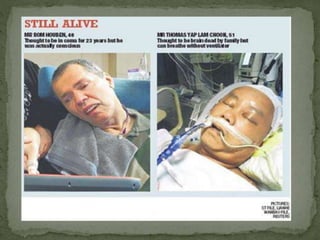
 "There is no possibility of recovering from brain death,"
 "Brain death recovery suggests a misdiagnosis. If you
recovered, it was something else"-possibly a coma or
vegetative state. Too often, people confuse those situations
with brain death
 Coma is distinguished from brain death by the fact that you
can elicit responses from the brain, detect movements in
response to pain, and it is not irreversible,”
 . "You can wake up from a coma.” The term vegetative state
refers to patients "who have a severe impairment of
consciousness but have progressed to a state where they
begin to open their eyes. In medical speech we say that they
have elements of arousal but there is no awareness." This
condition also has the potential for reversal.
 Indian Journal of Critical Care Medicine
 NCBI , Diagnosis of brain death, Published online 2010
Jun 2
 Brain death. In Wynn gaarden JB, Smith L H, Bennet JC
(eds): Cecil Test book of Medicine, 2 other editions, WB
Saunders Company, 1996.
 National Geographic .com
 Internet scientific publication. Com
Brain death

Brain death

  • 1.
    Supervisor: Dr. Saad Doneby: Saja Jameel Lamam
  • 2.
     it isthe complete and irreversible cessation of all functions of the brain including the brain stem.  It can be determined in several ways:  No electrical activity in the brain (determined by EEG)  No blood flow to the brain (determined by blood flow studies)  Absence of function of all parts of the brain – as determined by clinical assessment (no movement, no response to stimulation, no breathing, no brain reflexes).
  • 4.
    Trans temporal (a)and trans orbital (b) blood flow profiles measured continuously and simultaneously using the “probe holder construction
  • 5.
    Biomedical devices for confirmatorytesting of brain death including multidirectional ultrasound probe holder construction.
  • 8.
     Anoxia  Ischemia Intracranial hematoma  A gunshot wound to the head  Intracranial Aneurysm  Brain tumors  When any of these occur, they cause swelling of the brain. Because the brain is enclosed in the skull, it doesn't have room to swell, thus intracranial pressure increases. This can stop blood flow to the brain, killing brain cells and causing herniation of the brain (pushing the brain outside its normal space). When brain cells die, they don't grow back, thus any damage caused in permanent and irreversible.
  • 11.
     Some stepsare important to be followed:  * Unresponsiveness
  • 12.
     Pupils- noresponse to bright light Size: midposition (4 mm) to dilated (9 mm) (absent light reflex - cranial nerve II and III)  Ocular movement- cranial nerve VIII, III and VI  No oculocephalic reflex (testing only when no fracture or instability of the cervical spine or skull base is apparent)  No deviation of the eyes to irrigation in each ear with 50 ml of cold water (tympanic membranes intact; allow 1 minute after injection and at least 5 minutes between testing on each side)  Facial sensation and facial motor response  No corneal reflex (cranial nerve V and VII)  No jaw reflex (cranial nerve IX)  No grimacing to deep pressure on nail bed, supraorbital ridge, or temporo-mandibular joint (afferent V and efferent VII)  Pharyngeal and tracheal reflexes (cranial nerve IX and X)  No response after stimulation of the posterior pharynx  No cough response to tracheobronchial suctioning
  • 14.
     Brain deathneeds to be certified by a board of doctor's consisting of:  Registered Medical Practioner (RMP) in charge of hospital where brain death has occurred.  An independent RMP –a specialist.  A Neurologist / Neurosurgeon nominated by panel.  RMP treating the patient.  The patient must be examined by team of doctor's at least trice with a reasonable gap of time in between (at least 6 hours).  None of the doctor's who participate in diagnosis of brain death should have any interest in transplantation or organ removal from cadaver.
  • 15.
     There isa line of demarcation i.e. when the artificial aids should be stopped so that the doctor may not get involved in the offence of culpable homicide not amounting to murder or one of rash and negligent act, if he has removed the aids indiscriminately. Thus he should first consult with other doctors.  Clinician should make it clear to the relatives that ventilation is not being withdrawn to let the patient die but because continued ventilation is immaterial for a patient who is already dead except in case of organ transplant.
  • 18.
     "There isno possibility of recovering from brain death,"  "Brain death recovery suggests a misdiagnosis. If you recovered, it was something else"-possibly a coma or vegetative state. Too often, people confuse those situations with brain death  Coma is distinguished from brain death by the fact that you can elicit responses from the brain, detect movements in response to pain, and it is not irreversible,”  . "You can wake up from a coma.” The term vegetative state refers to patients "who have a severe impairment of consciousness but have progressed to a state where they begin to open their eyes. In medical speech we say that they have elements of arousal but there is no awareness." This condition also has the potential for reversal.
  • 19.
     Indian Journalof Critical Care Medicine  NCBI , Diagnosis of brain death, Published online 2010 Jun 2  Brain death. In Wynn gaarden JB, Smith L H, Bennet JC (eds): Cecil Test book of Medicine, 2 other editions, WB Saunders Company, 1996.  National Geographic .com  Internet scientific publication. Com