The UCSD NSFGreenLight Project
UCSD NSF GreenLight Project:  Focus First on University Closet Clusters Compute energy/rack : 2 kW (2000) to 30kW (in 2010) Cooling and power issues now a major factor in campus clusters But  academic clusters are often small: departmental closets Energy use of departmental computers is increasing fast creating crises of space, power, and cooling Energy caps are coming! Unfortunately, almost nothing is known about how to make these shared virtual clusters energy efficient, since there has been no financial motivation to do so
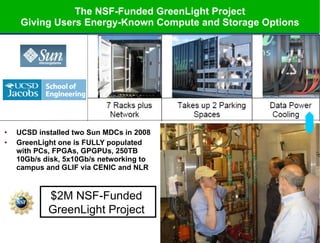
The NSF-Funded GreenLight Project Giving Users Energy-Known Compute and Storage Options UCSD installed two Sun MDCs in 2008 GreenLight one is FULLY populated with PCs, FPGAs, GPGPUs, 250TB  10Gb/s disk, 5x10Gb/s networking to campus and GLIF via CENIC and NLR $2M NSF-Funded  GreenLight Project
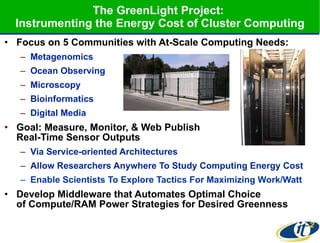
The GreenLight Project:  Instrumenting the Energy Cost of Cluster Computing Focus on 5 Communities with At-Scale Computing Needs: Metagenomics Ocean Observing Microscopy  Bioinformatics Digital Media Goal: Measure, Monitor, & Web Publish  Real-Time Sensor Outputs Via Service-oriented Architectures Allow Researchers Anywhere To Study Computing Energy Cost Enable Scientists To Explore Tactics For Maximizing Work/Watt Develop Middleware that Automates Optimal Choice  of Compute/RAM Power Strategies for Desired Greenness
Example: Improve Mass Spectrometry’s Green Efficiency  By Matching Algorithms to Specialized Processors  Inspect application implements the  very computationally intense  MS-Alignment algorithm for discovery of unanticipated rare or uncharacterized Post-Translational Modifications Solution: Hardware acceleration with a FPGA-based co-Processor (Convey Architecture) Results:  300x  Speedup with hand FPGA coding Increase in work/watt? Increase in work/$ (purchase, life-cycle)?
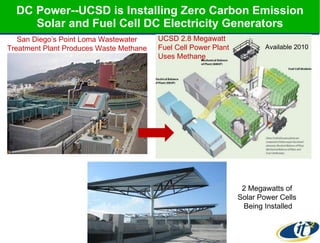
DC Power--UCSD is Installing Zero Carbon Emission Solar and Fuel Cell DC Electricity Generators San Diego’s Point Loma Wastewater Treatment Plant Produces Waste Methane UCSD 2.8 Megawatt  Fuel Cell Power Plant  Uses Methane 2 Megawatts of  Solar Power Cells  Being Installed Available 2010
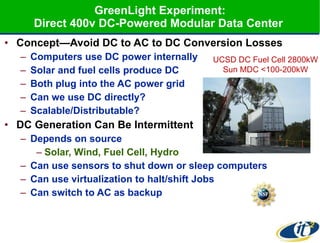
GreenLight Experiment: Direct 400v DC-Powered Modular Data Center  Concept—Avoid DC to AC to DC Conversion Losses Computers use DC power internally Solar and fuel cells produce DC Both plug into the AC power grid Can we use DC directly? Scalable/Distributable? DC Generation Can Be Intermittent  Depends on source  Solar, Wind, Fuel Cell, Hydro Can use sensors to shut down or sleep computers Can use virtualization to halt/shift Jobs Can switch to AC as backup UCSD DC Fuel Cell 2800kW Sun MDC <100-200kW
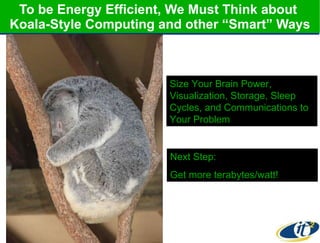
To be Energy Efficient, We Must Think about  Koala-Style Computing and other “Smart” Ways Size Your Brain Power, Visualization, Storage, Sleep Cycles, and Communications to Your Problem Next Step:  Get more terabytes/watt!
GLIF: Thank You Very Much! My planning, research, and education efforts are made possible, in major part, by funding from:   US National Science Foundation (NSF) awards  ANI-0225642,  EIA-0115809, SCI-0441094, and CNS 0821155  State of California, Calit2 UCSD Division State of Illinois I-WIRE Program, and major UIC cost sharing University of Illinois at Chicago, Argonne National Laboratory, and Northwestern University for StarLight networking and management National Lambda Rail, Pacific Wave and CENIC NTT Network Innovations Lab Cisco Systems, Inc. Pacific Interface, Inc. Darkstrand, Inc. KAUST-US Sharp Labs of America

GreenLight: GLIF 2009

  • 1.
  • 2.
  • 3.
    UCSD NSF GreenLightProject: Focus First on University Closet Clusters Compute energy/rack : 2 kW (2000) to 30kW (in 2010) Cooling and power issues now a major factor in campus clusters But academic clusters are often small: departmental closets Energy use of departmental computers is increasing fast creating crises of space, power, and cooling Energy caps are coming! Unfortunately, almost nothing is known about how to make these shared virtual clusters energy efficient, since there has been no financial motivation to do so
  • 4.
    The NSF-Funded GreenLightProject Giving Users Energy-Known Compute and Storage Options UCSD installed two Sun MDCs in 2008 GreenLight one is FULLY populated with PCs, FPGAs, GPGPUs, 250TB 10Gb/s disk, 5x10Gb/s networking to campus and GLIF via CENIC and NLR $2M NSF-Funded GreenLight Project
  • 5.
    The GreenLight Project: Instrumenting the Energy Cost of Cluster Computing Focus on 5 Communities with At-Scale Computing Needs: Metagenomics Ocean Observing Microscopy Bioinformatics Digital Media Goal: Measure, Monitor, & Web Publish Real-Time Sensor Outputs Via Service-oriented Architectures Allow Researchers Anywhere To Study Computing Energy Cost Enable Scientists To Explore Tactics For Maximizing Work/Watt Develop Middleware that Automates Optimal Choice of Compute/RAM Power Strategies for Desired Greenness
  • 6.
    Example: Improve MassSpectrometry’s Green Efficiency By Matching Algorithms to Specialized Processors Inspect application implements the very computationally intense MS-Alignment algorithm for discovery of unanticipated rare or uncharacterized Post-Translational Modifications Solution: Hardware acceleration with a FPGA-based co-Processor (Convey Architecture) Results: 300x Speedup with hand FPGA coding Increase in work/watt? Increase in work/$ (purchase, life-cycle)?
  • 7.
    DC Power--UCSD isInstalling Zero Carbon Emission Solar and Fuel Cell DC Electricity Generators San Diego’s Point Loma Wastewater Treatment Plant Produces Waste Methane UCSD 2.8 Megawatt Fuel Cell Power Plant Uses Methane 2 Megawatts of Solar Power Cells Being Installed Available 2010
  • 8.
    GreenLight Experiment: Direct400v DC-Powered Modular Data Center Concept—Avoid DC to AC to DC Conversion Losses Computers use DC power internally Solar and fuel cells produce DC Both plug into the AC power grid Can we use DC directly? Scalable/Distributable? DC Generation Can Be Intermittent Depends on source Solar, Wind, Fuel Cell, Hydro Can use sensors to shut down or sleep computers Can use virtualization to halt/shift Jobs Can switch to AC as backup UCSD DC Fuel Cell 2800kW Sun MDC <100-200kW
  • 9.
    To be EnergyEfficient, We Must Think about Koala-Style Computing and other “Smart” Ways Size Your Brain Power, Visualization, Storage, Sleep Cycles, and Communications to Your Problem Next Step: Get more terabytes/watt!
  • 10.
    GLIF: Thank YouVery Much! My planning, research, and education efforts are made possible, in major part, by funding from: US National Science Foundation (NSF) awards ANI-0225642, EIA-0115809, SCI-0441094, and CNS 0821155 State of California, Calit2 UCSD Division State of Illinois I-WIRE Program, and major UIC cost sharing University of Illinois at Chicago, Argonne National Laboratory, and Northwestern University for StarLight networking and management National Lambda Rail, Pacific Wave and CENIC NTT Network Innovations Lab Cisco Systems, Inc. Pacific Interface, Inc. Darkstrand, Inc. KAUST-US Sharp Labs of America