Project GreenLightPresentation for the……Dr. Gregory HidleyCalifornia Institute for Telecommunications and Information Technology, UCSD
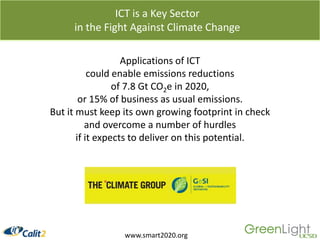
ICT is a Key Sector in the Fight Against Climate ChangeApplications of ICT could enable emissions reductions of 7.8 Gt CO2e in 2020, or 15% of business as usual emissions. But it must keep its own growing footprint in check and overcome a number of hurdles if it expects to deliver on this potential.www.smart2020.org
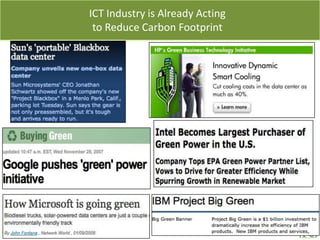
ICT Industry is Already Actingto Reduce Carbon Footprint
Application of ICT Can Lead to a 5-Fold GreaterDecrease in GHGs Than its Own Carbon Footprint“While the sector plans to significantly step up the energy efficiency of its products and services, ICT’s largest influence will be by enabling energy efficiencies in other sectors, an opportunity that could deliver carbon savings five times larger than the total emissions from the entire ICT sector in 2020.”--Smart 2020 ReportMajor Opportunities for the United States*Smart Electrical GridsSmart Transportation SystemsSmart BuildingsVirtual Meetings           * Smart 2020 United States Report Addendum                                 www.smart2020.org
GreenLight Motivation: The CyberInfrastructure (CI) ProblemCompute energy/rack : 2 kW (2000) to 30kW in 2011Cooling and power issues now a major factor in CI designIT industry is “greening” huge data centers … but today every $1 spent on local IT equipment will cost $2 more in power and overheadAcademic CI is often space constained at departmental scaleEnergy use of growing departmental facilities is creating campus crises of space, power, and coolingUnfortunately, little is known about how to make shared virtual clusters energy efficient, since there has been no campus financial motivation to do soChallenge: how to make data available on energy efficient deployments of rack scale hardware and components?
The NSF-Funded GreenLight ProjectGiving Users Greener Compute and Storage OptionsPI is Dr. Thomas A. DeFanti$2.6M over 3 Years to construct GreenLight InstrumentStart with Sun Modular Data CenterSun Has Shown up to 40% Reduction in EnergyMeasures Temperature at 5 Levels in 8 RacksMeasures power Utilization in Each of the 8 RacksChilled Water Cooling input and output temperaturesAdd additional power monitoring at every receptacleAdd web and VR interfaces to access measurement dataPopulate with a variety of computing clusters and architecturesTraditional compute and storage serversGP GPU arrays and specialized FPGA based coprocessor systemsDC powered serversSSD equipped systemsTurn over to investigators in various disciplines Measure, Monitor and Collect Energy Usage dataWith the goal of maximizing work/watt
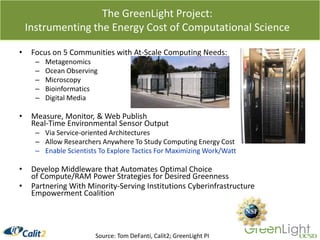
The GreenLight Project: Instrumenting the Energy Cost of Computational ScienceFocus on 5 Communities with At-Scale Computing Needs:MetagenomicsOcean ObservingMicroscopy BioinformaticsDigital MediaMeasure, Monitor, & Web Publish Real-Time Environmental Sensor OutputVia Service-oriented ArchitecturesAllow Researchers Anywhere To Study Computing Energy CostEnable Scientists To Explore Tactics For Maximizing Work/WattDevelop Middleware that Automates Optimal Choice of Compute/RAM Power Strategies for Desired GreennessPartnering With Minority-Serving Institutions Cyberinfrastructure Empowerment Coalition Source: Tom DeFanti, Calit2; GreenLight PI
UCSD Energy Instrumented CyberinfrastructureActive Data Replication10 Gigabit L2/L3 SwitchEco-Friendly Storage and ComputeN x 10 GbitN x 10 GbitWide-Area 10GCenic/HPR
 NLR Cavewave
Cinegrid
 Cisco
…“Network  in a box “ > 200 Connections
 DWDM or Gray OpticsOn-Demand Physical ConnectionsYour Lab HereMicroarraySource:Phil Papadopoulos, SDSC/Calit2
GreenLight Goals: More Work/WattBuild a full-scale virtualized device, the GreenLight InstrumentMeasure then minimize energy consumptionDevelop middleware to automate optimal choice of compute/RAM power strategiesDiscover better power efficiency configurations and architectures Teach future engineers who must scale from an education in Computer Science to a deeper understanding in engineering physicsMeasure, monitor, and make publicly available, via service-oriented architectures, real-time sensor outputsFocus on 5 communities: metagenomics, ocean observing, microscopy, bioinformatics, and digital mediaAllow researchers anywhere to study the energy cost of at-scale scientific computing
GreenLight Research activitiesLeading to Greener CI DeploymentsComputer Architecture – FPGA, GP GPU systems Rajesh Gupta/CSESoftware Architecture – Virtualization, memory management, networking and modelingAmin Vahdat, Ingolf Kruger/CSECineGrid Exchange – mixed media storage, streaming, and managementTom DeFanti/Calit2Visualization – Using 2D and 3D modeling on display walls and CAVEs Falko Kuster/Structural Engineering, Jurgen Schulze/Calit2Power and Thermal Management Tajana Rosing/CSEDC Power DistributionGreg Hidley/Calit2http://greenlight.calit2.net
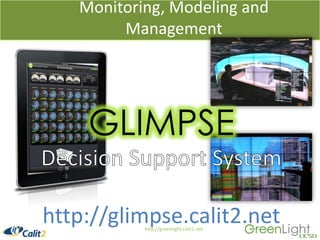
Calit2/UCSD [http://greenlight.calit2.net]Monitoring, Modeling and ManagementGLIMPSEDecision Support Systemhttp://glimpse.calit2.net
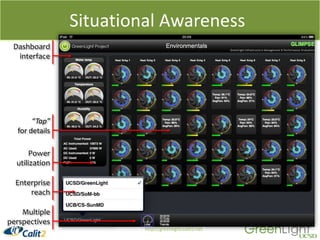
Situational AwarenessCalit2/UCSD [http://greenlight.calit2.net]12Dashboard interface“Tap”for detailsPower utilizationEnterprise reachMultiple perspectives
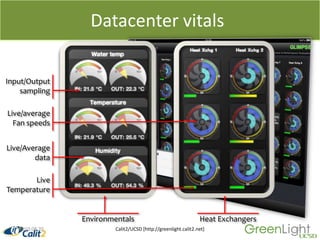
Datacenter vitals2010.08.20Calit2/UCSD [http://greenlight.calit2.net]13Input/OutputsamplingLive/average Fan speedsLive/AveragedataLive TemperatureHeat ExchangersEnvironmentals
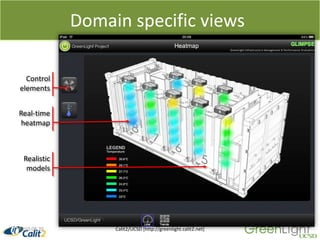
Domain specific views2010.08.20Calit2/UCSD [http://greenlight.calit2.net]14Control elementsReal-time heatmapRealistic models
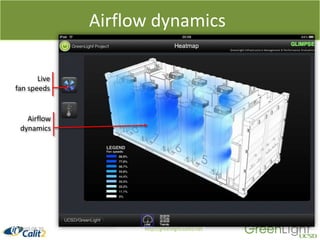
Airflow dynamics2010.08.20Calit2/UCSD [http://greenlight.calit2.net]15Live fan speedsAirflow dynamics
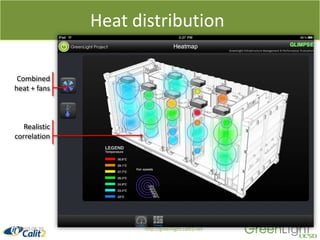
Heat distribution2010.08.20Calit2/UCSD [http://greenlight.calit2.net]16Combined heat + fansRealistic correlation
Heat TrendsCalit2/UCSD [http://greenlight.calit2.net]17Heat exchangersHotspot identificationTrends over past 24h
Past changes in airflowCalit2/UCSD [http://greenlight.calit2.net]18Fan slicesrpmHeat distribution changesPotential for failuresTrends over past 24h
Power spikesCalit2/UCSD [http://greenlight.calit2.net]19IT assetsComputation zoneUnused assetAverage loadPeak computation1 minuteresolution
Zoom-in AnalysisCalit2/UCSD [http://greenlight.calit2.net]20History over several days.Zoom on desired time range.Hint on each sample point.Automatic average area.Multiple sensors per asset with up to 1 min sampling resolution.
The GreenLight Project Focuses on Minimizing Energy for Key User CommunitiesMicrobial MetagenomicsOcean ObservingMicroscopyBioinformaticsDigital Media—CineGrid ProjectCalit2 will Host TBs of Media Assets in GreenLightCineGrid Exchange to Measure and Propose Reductions in the “Carbon Footprint” Generated by:File Transfers and Computational Tasks Required for Digital Cinema and Other High Quality Digital Media Applications
GreenLight Project: Putting Machines To Sleep Transparently22Rajesh Gupta, UCSD CSE; Calit2LaptopNetwork interfacePeripheralLow power domainSecondary processorNetwork interfaceManagementsoftwareMain processor,RAM, etcSomniloquyEnables Servers to Enter and Exit Sleep While Maintaining Their Network and Application Level Presence
Improve Mass Spectrometry’s Green Efficiency By Matching Algorithms to Specialized Processors Inspect Implements the Very Computationally Intense MS-Alignment Algorithm for Discovery of Unanticipated Rare or Uncharacterized Post-Translational ModificationsSolution: Hardware Acceleration with a FPGA-Based Co-ProcessorIdentification and Characterization of Key Kernel for MS-Alignment AlgorithmHardware Implementation of Kernel on Novel FPGA-based Co-Processor (Convey Architecture)Results: 300x Speedup & Increased Computational EfficiencyLarge Savings in Energy Per Application Task

Project GreenLight

  • 1.
    Project GreenLightPresentation forthe……Dr. Gregory HidleyCalifornia Institute for Telecommunications and Information Technology, UCSD
  • 2.
    ICT is aKey Sector in the Fight Against Climate ChangeApplications of ICT could enable emissions reductions of 7.8 Gt CO2e in 2020, or 15% of business as usual emissions. But it must keep its own growing footprint in check and overcome a number of hurdles if it expects to deliver on this potential.www.smart2020.org
  • 3.
    ICT Industry isAlready Actingto Reduce Carbon Footprint
  • 4.
    Application of ICTCan Lead to a 5-Fold GreaterDecrease in GHGs Than its Own Carbon Footprint“While the sector plans to significantly step up the energy efficiency of its products and services, ICT’s largest influence will be by enabling energy efficiencies in other sectors, an opportunity that could deliver carbon savings five times larger than the total emissions from the entire ICT sector in 2020.”--Smart 2020 ReportMajor Opportunities for the United States*Smart Electrical GridsSmart Transportation SystemsSmart BuildingsVirtual Meetings * Smart 2020 United States Report Addendum www.smart2020.org
  • 5.
    GreenLight Motivation: TheCyberInfrastructure (CI) ProblemCompute energy/rack : 2 kW (2000) to 30kW in 2011Cooling and power issues now a major factor in CI designIT industry is “greening” huge data centers … but today every $1 spent on local IT equipment will cost $2 more in power and overheadAcademic CI is often space constained at departmental scaleEnergy use of growing departmental facilities is creating campus crises of space, power, and coolingUnfortunately, little is known about how to make shared virtual clusters energy efficient, since there has been no campus financial motivation to do soChallenge: how to make data available on energy efficient deployments of rack scale hardware and components?
  • 6.
    The NSF-Funded GreenLightProjectGiving Users Greener Compute and Storage OptionsPI is Dr. Thomas A. DeFanti$2.6M over 3 Years to construct GreenLight InstrumentStart with Sun Modular Data CenterSun Has Shown up to 40% Reduction in EnergyMeasures Temperature at 5 Levels in 8 RacksMeasures power Utilization in Each of the 8 RacksChilled Water Cooling input and output temperaturesAdd additional power monitoring at every receptacleAdd web and VR interfaces to access measurement dataPopulate with a variety of computing clusters and architecturesTraditional compute and storage serversGP GPU arrays and specialized FPGA based coprocessor systemsDC powered serversSSD equipped systemsTurn over to investigators in various disciplines Measure, Monitor and Collect Energy Usage dataWith the goal of maximizing work/watt
  • 7.
    The GreenLight Project:Instrumenting the Energy Cost of Computational ScienceFocus on 5 Communities with At-Scale Computing Needs:MetagenomicsOcean ObservingMicroscopy BioinformaticsDigital MediaMeasure, Monitor, & Web Publish Real-Time Environmental Sensor OutputVia Service-oriented ArchitecturesAllow Researchers Anywhere To Study Computing Energy CostEnable Scientists To Explore Tactics For Maximizing Work/WattDevelop Middleware that Automates Optimal Choice of Compute/RAM Power Strategies for Desired GreennessPartnering With Minority-Serving Institutions Cyberinfrastructure Empowerment Coalition Source: Tom DeFanti, Calit2; GreenLight PI
  • 8.
    UCSD Energy InstrumentedCyberinfrastructureActive Data Replication10 Gigabit L2/L3 SwitchEco-Friendly Storage and ComputeN x 10 GbitN x 10 GbitWide-Area 10GCenic/HPR
  • 9.
  • 10.
  • 11.
  • 12.
    …“Network ina box “ > 200 Connections
  • 13.
    DWDM orGray OpticsOn-Demand Physical ConnectionsYour Lab HereMicroarraySource:Phil Papadopoulos, SDSC/Calit2
  • 14.
    GreenLight Goals: MoreWork/WattBuild a full-scale virtualized device, the GreenLight InstrumentMeasure then minimize energy consumptionDevelop middleware to automate optimal choice of compute/RAM power strategiesDiscover better power efficiency configurations and architectures Teach future engineers who must scale from an education in Computer Science to a deeper understanding in engineering physicsMeasure, monitor, and make publicly available, via service-oriented architectures, real-time sensor outputsFocus on 5 communities: metagenomics, ocean observing, microscopy, bioinformatics, and digital mediaAllow researchers anywhere to study the energy cost of at-scale scientific computing
  • 15.
    GreenLight Research activitiesLeadingto Greener CI DeploymentsComputer Architecture – FPGA, GP GPU systems Rajesh Gupta/CSESoftware Architecture – Virtualization, memory management, networking and modelingAmin Vahdat, Ingolf Kruger/CSECineGrid Exchange – mixed media storage, streaming, and managementTom DeFanti/Calit2Visualization – Using 2D and 3D modeling on display walls and CAVEs Falko Kuster/Structural Engineering, Jurgen Schulze/Calit2Power and Thermal Management Tajana Rosing/CSEDC Power DistributionGreg Hidley/Calit2http://greenlight.calit2.net
  • 16.
    Calit2/UCSD [http://greenlight.calit2.net]Monitoring, Modelingand ManagementGLIMPSEDecision Support Systemhttp://glimpse.calit2.net
  • 17.
    Situational AwarenessCalit2/UCSD [http://greenlight.calit2.net]12Dashboardinterface“Tap”for detailsPower utilizationEnterprise reachMultiple perspectives
  • 18.
    Datacenter vitals2010.08.20Calit2/UCSD [http://greenlight.calit2.net]13Input/OutputsamplingLive/averageFan speedsLive/AveragedataLive TemperatureHeat ExchangersEnvironmentals
  • 19.
    Domain specific views2010.08.20Calit2/UCSD[http://greenlight.calit2.net]14Control elementsReal-time heatmapRealistic models
  • 20.
  • 21.
  • 22.
    Heat TrendsCalit2/UCSD [http://greenlight.calit2.net]17HeatexchangersHotspot identificationTrends over past 24h
  • 23.
    Past changes inairflowCalit2/UCSD [http://greenlight.calit2.net]18Fan slicesrpmHeat distribution changesPotential for failuresTrends over past 24h
  • 24.
    Power spikesCalit2/UCSD [http://greenlight.calit2.net]19ITassetsComputation zoneUnused assetAverage loadPeak computation1 minuteresolution
  • 25.
    Zoom-in AnalysisCalit2/UCSD [http://greenlight.calit2.net]20Historyover several days.Zoom on desired time range.Hint on each sample point.Automatic average area.Multiple sensors per asset with up to 1 min sampling resolution.
  • 26.
    The GreenLight ProjectFocuses on Minimizing Energy for Key User CommunitiesMicrobial MetagenomicsOcean ObservingMicroscopyBioinformaticsDigital Media—CineGrid ProjectCalit2 will Host TBs of Media Assets in GreenLightCineGrid Exchange to Measure and Propose Reductions in the “Carbon Footprint” Generated by:File Transfers and Computational Tasks Required for Digital Cinema and Other High Quality Digital Media Applications
  • 27.
    GreenLight Project: PuttingMachines To Sleep Transparently22Rajesh Gupta, UCSD CSE; Calit2LaptopNetwork interfacePeripheralLow power domainSecondary processorNetwork interfaceManagementsoftwareMain processor,RAM, etcSomniloquyEnables Servers to Enter and Exit Sleep While Maintaining Their Network and Application Level Presence
  • 28.
    Improve Mass Spectrometry’sGreen Efficiency By Matching Algorithms to Specialized Processors Inspect Implements the Very Computationally Intense MS-Alignment Algorithm for Discovery of Unanticipated Rare or Uncharacterized Post-Translational ModificationsSolution: Hardware Acceleration with a FPGA-Based Co-ProcessorIdentification and Characterization of Key Kernel for MS-Alignment AlgorithmHardware Implementation of Kernel on Novel FPGA-based Co-Processor (Convey Architecture)Results: 300x Speedup & Increased Computational EfficiencyLarge Savings in Energy Per Application Task

Editor's Notes

  • #9 Packet network in a box --- E1200. Passive DWDM enables huge bandwidth.