Project GreenLight February 25, 2009 Dr. Gregory Hidley California Institute for Telecommunications and Information Technology, UCSD
ICT is a Key Sector  in the Fight Against Climate Change Applications of ICT  could enable emissions reductions  of 7.8 Gt CO 2 e in 2020,  or 15% of business as usual emissions.  But it must keep its own growing footprint in check  and overcome a number of hurdles  if it expects to deliver on this potential. www.smart2020.org
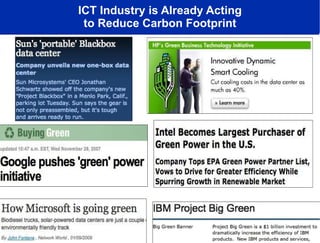
ICT Industry is Already Acting to Reduce Carbon Footprint
The CyberInfrastructure (CI) Problem Compute energy/rack : 2 kW (2000) to 30kW in 2010 Cooling and power issues now a major factor in CI design IT industry is “greening” huge data centers … but today every $1 spent on local IT equipment will cost $2 more in power and overhead Academic  CI is often too small: departmental closet scale Energy use of departmental facilities is exponentiating creating campus crises of space, power, and cooling Unfortunately, little is known about how to make shared virtual clusters energy efficient, since there has been no financial motivation to do so Challenge: how to make data available on energy efficient deployments of rack scale hardware and components?
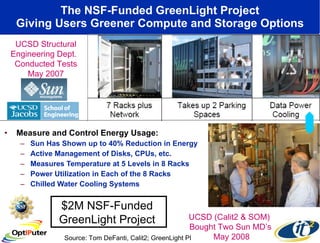
The NSF-Funded GreenLight Project Giving Users Greener Compute and Storage Options Measure and Control Energy Usage: Sun Has Shown up to 40% Reduction in Energy Active Management of Disks, CPUs, etc. Measures Temperature at 5 Levels in 8 Racks Power Utilization in Each of the 8 Racks Chilled Water Cooling Systems UCSD Structural Engineering Dept.  Conducted Tests May 2007 UCSD (Calit2 & SOM)  Bought Two Sun MD’s May 2008 $2M NSF-Funded  GreenLight Project  Source: Tom DeFanti, Calit2; GreenLight PI
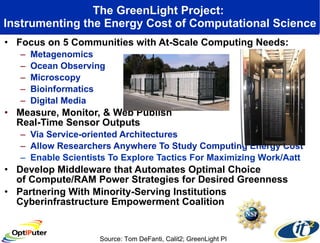
The GreenLight Project:  Instrumenting the Energy Cost of Computational Science Focus on 5 Communities with At-Scale Computing Needs: Metagenomics Ocean Observing Microscopy  Bioinformatics Digital Media Measure, Monitor, & Web Publish  Real-Time Sensor Outputs Via Service-oriented Architectures Allow Researchers Anywhere To Study Computing Energy Cost Enable Scientists To Explore Tactics For Maximizing Work/Aatt Develop Middleware that Automates Optimal Choice  of Compute/RAM Power Strategies for Desired Greenness Partnering With Minority-Serving Institutions Cyberinfrastructure Empowerment Coalition  Source: Tom DeFanti, Calit2; GreenLight PI
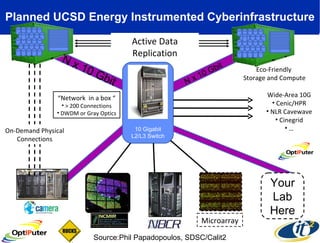
Planned UCSD Energy Instrumented Cyberinfrastructure N x 10 Gbit N x 10 Gbit 10 Gigabit L2/L3 Switch Eco-Friendly  Storage and Compute Microarray Your Lab Here On-Demand Physical Connections “ Network  in a box “ > 200 Connections DWDM or Gray Optics Active Data Replication Source:Phil Papadopoulos, SDSC/Calit2 Wide-Area 10G Cenic/HPR NLR Cavewave Cinegrid …
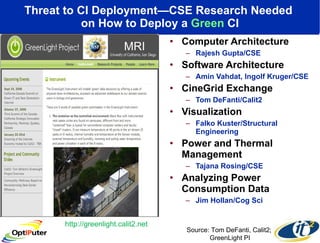
Threat to CI Deployment—CSE Research Needed  on How to Deploy a  Green  CI Computer Architecture  Rajesh Gupta/CSE Software Architecture  Amin Vahdat, Ingolf Kruger/CSE CineGrid Exchange  Tom DeFanti/Calit2 Visualization  Falko Kuster/Structural Engineering Power and Thermal Management  Tajana Rosing/CSE Analyzing Power Consumption Data  Jim Hollan/Cog Sci http://greenlight.calit2.net MRI Source: Tom DeFanti, Calit2;  GreenLight PI
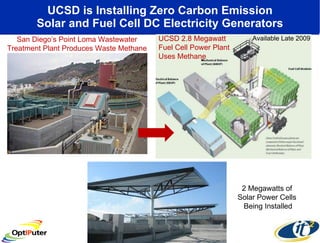
UCSD is Installing Zero Carbon Emission Solar and Fuel Cell DC Electricity Generators San Diego’s Point Loma Wastewater Treatment Plant Produces Waste Methane UCSD 2.8 Megawatt  Fuel Cell Power Plant  Uses Methane 2 Megawatts of  Solar Power Cells  Being Installed Available Late 2009
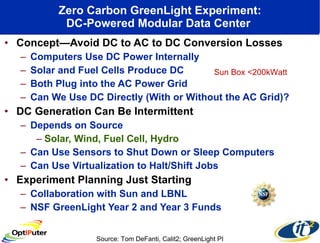
Zero Carbon GreenLight Experiment: DC-Powered Modular Data Center  Concept—Avoid DC to AC to DC Conversion Losses Computers Use DC Power Internally Solar and Fuel Cells Produce DC Both Plug into the AC Power Grid Can We Use DC Directly (With or Without the AC Grid)? DC Generation Can Be Intermittent  Depends on Source  Solar, Wind, Fuel Cell, Hydro Can Use Sensors to Shut Down or Sleep Computers Can Use Virtualization to Halt/Shift Jobs Experiment Planning Just Starting Collaboration with Sun and LBNL NSF GreenLight Year 2 and Year 3 Funds  Source: Tom DeFanti, Calit2; GreenLight PI Sun Box <200kWatt
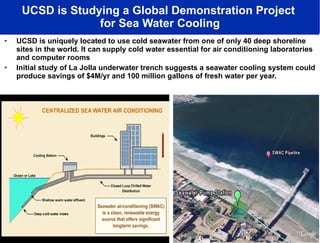
UCSD is Studying a Global Demonstration Project  for Sea Water Cooling UCSD is uniquely located to use cold seawater from one of only 40 deep shoreline sites in the world. It can   supply cold water essential for air conditioning laboratories and computer rooms Initial study of La Jolla underwater trench   suggests a seawater cooling system could produce savings of $4M/yr and 100 million gallons of fresh water per year.
GreenLight Goals: More Work/Watt Measure then minimize energy consumption Develop middleware that automates optimal choice of compute/RAM power strategies Discover better power efficiency configurations and architectures  Teach the next generation of engineers who must scale from an education in Computer Science to a deep understanding in engineering physics Build a full-scale virtualized device,   the GreenLight Instrument Measure, monitor, and make publicly available, via service-oriented architectures, real-time sensor outputs Focus on 5 communities: metagenomics, ocean observing, microscopy, bioinformatics, and digital media Allow researchers anywhere to study the energy cost of at-scale scientific computing
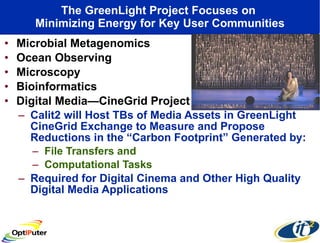
The GreenLight Project Focuses on  Minimizing Energy for Key User Communities Microbial Metagenomics Ocean Observing Microscopy Bioinformatics Digital Media—CineGrid Project Calit2 will Host TBs of Media Assets in GreenLight CineGrid Exchange to Measure and Propose Reductions in the “Carbon Footprint” Generated by: File Transfers and  Computational Tasks  Required for Digital Cinema and Other High Quality Digital Media Applications
Improve Mass Spectrometry’s Green Efficiency  By Matching Computational Proteomics Algorithms to Specialized Processors  INSPECT Implements the  Very Computationally Intense  MS-Alignment Algorithm for Discovery of Unanticipated Rare or Uncharacterized Post-Translational Modifications Solution: Hardware Acceleration with a FPGA-Based Co-Processor Identification and Characterization of Key Kernel for  MS-Alignment Algorithm Hardware Implementation of Kernel on Novel FPGA-based Co-Processor (Convey Architecture) Results:  300x  Speedup & Increased Computational Efficiency Large Savings in  Energy Per Application Task
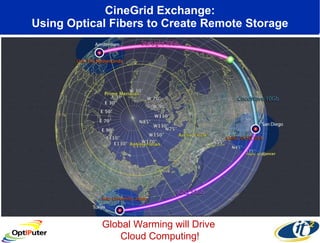
CineGrid Exchange: Using Optical Fibers to Create Remote Storage Global Warming will Drive  Cloud Computing!
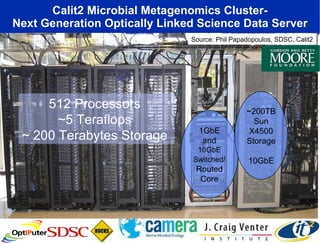
Calit2 Microbial Metagenomics Cluster- Next Generation Optically Linked Science Data Server 512 Processors  ~5 Teraflops  ~ 200 Terabytes Storage  1GbE and  10GbE Switched / Routed Core ~200TB Sun X4500 Storage 10GbE Source: Phil Papadopoulos, SDSC, Calit2
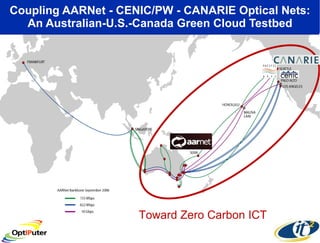
Coupling AARNet - CENIC/PW - CANARIE Optical Nets: An Australian-U.S.-Canada Green Cloud Testbed Toward Zero Carbon ICT
Application of ICT Can Lead to a  5-Fold Greater Decrease in GHGs Than its Own Carbon Footprint Major Opportunities for the United States* Smart Electrical Grids Smart Transportation Systems Smart Buildings Virtual Meetings * Smart 2020 United States Report Addendum www.smart2020.org While the sector plans to significantly step up  the energy efficiency of its products and services,  ICT’s largest influence  will be by enabling  energy efficiencies in other sectors, an opportunity  that could deliver  carbon savings five times larger  than  the total emissions from the entire ICT sector in 2020. --Smart 2020 Report

GreenLight Project Overview

  • 1.
    Project GreenLight February25, 2009 Dr. Gregory Hidley California Institute for Telecommunications and Information Technology, UCSD
  • 2.
    ICT is aKey Sector in the Fight Against Climate Change Applications of ICT could enable emissions reductions of 7.8 Gt CO 2 e in 2020, or 15% of business as usual emissions. But it must keep its own growing footprint in check and overcome a number of hurdles if it expects to deliver on this potential. www.smart2020.org
  • 3.
    ICT Industry isAlready Acting to Reduce Carbon Footprint
  • 4.
    The CyberInfrastructure (CI)Problem Compute energy/rack : 2 kW (2000) to 30kW in 2010 Cooling and power issues now a major factor in CI design IT industry is “greening” huge data centers … but today every $1 spent on local IT equipment will cost $2 more in power and overhead Academic CI is often too small: departmental closet scale Energy use of departmental facilities is exponentiating creating campus crises of space, power, and cooling Unfortunately, little is known about how to make shared virtual clusters energy efficient, since there has been no financial motivation to do so Challenge: how to make data available on energy efficient deployments of rack scale hardware and components?
  • 5.
    The NSF-Funded GreenLightProject Giving Users Greener Compute and Storage Options Measure and Control Energy Usage: Sun Has Shown up to 40% Reduction in Energy Active Management of Disks, CPUs, etc. Measures Temperature at 5 Levels in 8 Racks Power Utilization in Each of the 8 Racks Chilled Water Cooling Systems UCSD Structural Engineering Dept. Conducted Tests May 2007 UCSD (Calit2 & SOM) Bought Two Sun MD’s May 2008 $2M NSF-Funded GreenLight Project Source: Tom DeFanti, Calit2; GreenLight PI
  • 6.
    The GreenLight Project: Instrumenting the Energy Cost of Computational Science Focus on 5 Communities with At-Scale Computing Needs: Metagenomics Ocean Observing Microscopy Bioinformatics Digital Media Measure, Monitor, & Web Publish Real-Time Sensor Outputs Via Service-oriented Architectures Allow Researchers Anywhere To Study Computing Energy Cost Enable Scientists To Explore Tactics For Maximizing Work/Aatt Develop Middleware that Automates Optimal Choice of Compute/RAM Power Strategies for Desired Greenness Partnering With Minority-Serving Institutions Cyberinfrastructure Empowerment Coalition Source: Tom DeFanti, Calit2; GreenLight PI
  • 7.
    Planned UCSD EnergyInstrumented Cyberinfrastructure N x 10 Gbit N x 10 Gbit 10 Gigabit L2/L3 Switch Eco-Friendly Storage and Compute Microarray Your Lab Here On-Demand Physical Connections “ Network in a box “ > 200 Connections DWDM or Gray Optics Active Data Replication Source:Phil Papadopoulos, SDSC/Calit2 Wide-Area 10G Cenic/HPR NLR Cavewave Cinegrid …
  • 8.
    Threat to CIDeployment—CSE Research Needed on How to Deploy a Green CI Computer Architecture Rajesh Gupta/CSE Software Architecture Amin Vahdat, Ingolf Kruger/CSE CineGrid Exchange Tom DeFanti/Calit2 Visualization Falko Kuster/Structural Engineering Power and Thermal Management Tajana Rosing/CSE Analyzing Power Consumption Data Jim Hollan/Cog Sci http://greenlight.calit2.net MRI Source: Tom DeFanti, Calit2; GreenLight PI
  • 9.
    UCSD is InstallingZero Carbon Emission Solar and Fuel Cell DC Electricity Generators San Diego’s Point Loma Wastewater Treatment Plant Produces Waste Methane UCSD 2.8 Megawatt Fuel Cell Power Plant Uses Methane 2 Megawatts of Solar Power Cells Being Installed Available Late 2009
  • 10.
    Zero Carbon GreenLightExperiment: DC-Powered Modular Data Center Concept—Avoid DC to AC to DC Conversion Losses Computers Use DC Power Internally Solar and Fuel Cells Produce DC Both Plug into the AC Power Grid Can We Use DC Directly (With or Without the AC Grid)? DC Generation Can Be Intermittent Depends on Source Solar, Wind, Fuel Cell, Hydro Can Use Sensors to Shut Down or Sleep Computers Can Use Virtualization to Halt/Shift Jobs Experiment Planning Just Starting Collaboration with Sun and LBNL NSF GreenLight Year 2 and Year 3 Funds Source: Tom DeFanti, Calit2; GreenLight PI Sun Box <200kWatt
  • 11.
    UCSD is Studyinga Global Demonstration Project for Sea Water Cooling UCSD is uniquely located to use cold seawater from one of only 40 deep shoreline sites in the world. It can supply cold water essential for air conditioning laboratories and computer rooms Initial study of La Jolla underwater trench suggests a seawater cooling system could produce savings of $4M/yr and 100 million gallons of fresh water per year.
  • 12.
    GreenLight Goals: MoreWork/Watt Measure then minimize energy consumption Develop middleware that automates optimal choice of compute/RAM power strategies Discover better power efficiency configurations and architectures Teach the next generation of engineers who must scale from an education in Computer Science to a deep understanding in engineering physics Build a full-scale virtualized device, the GreenLight Instrument Measure, monitor, and make publicly available, via service-oriented architectures, real-time sensor outputs Focus on 5 communities: metagenomics, ocean observing, microscopy, bioinformatics, and digital media Allow researchers anywhere to study the energy cost of at-scale scientific computing
  • 13.
    The GreenLight ProjectFocuses on Minimizing Energy for Key User Communities Microbial Metagenomics Ocean Observing Microscopy Bioinformatics Digital Media—CineGrid Project Calit2 will Host TBs of Media Assets in GreenLight CineGrid Exchange to Measure and Propose Reductions in the “Carbon Footprint” Generated by: File Transfers and Computational Tasks Required for Digital Cinema and Other High Quality Digital Media Applications
  • 14.
    Improve Mass Spectrometry’sGreen Efficiency By Matching Computational Proteomics Algorithms to Specialized Processors INSPECT Implements the Very Computationally Intense MS-Alignment Algorithm for Discovery of Unanticipated Rare or Uncharacterized Post-Translational Modifications Solution: Hardware Acceleration with a FPGA-Based Co-Processor Identification and Characterization of Key Kernel for MS-Alignment Algorithm Hardware Implementation of Kernel on Novel FPGA-based Co-Processor (Convey Architecture) Results: 300x Speedup & Increased Computational Efficiency Large Savings in Energy Per Application Task
  • 15.
    CineGrid Exchange: UsingOptical Fibers to Create Remote Storage Global Warming will Drive Cloud Computing!
  • 16.
    Calit2 Microbial MetagenomicsCluster- Next Generation Optically Linked Science Data Server 512 Processors ~5 Teraflops ~ 200 Terabytes Storage 1GbE and 10GbE Switched / Routed Core ~200TB Sun X4500 Storage 10GbE Source: Phil Papadopoulos, SDSC, Calit2
  • 17.
    Coupling AARNet -CENIC/PW - CANARIE Optical Nets: An Australian-U.S.-Canada Green Cloud Testbed Toward Zero Carbon ICT
  • 18.
    Application of ICTCan Lead to a 5-Fold Greater Decrease in GHGs Than its Own Carbon Footprint Major Opportunities for the United States* Smart Electrical Grids Smart Transportation Systems Smart Buildings Virtual Meetings * Smart 2020 United States Report Addendum www.smart2020.org While the sector plans to significantly step up the energy efficiency of its products and services, ICT’s largest influence will be by enabling energy efficiencies in other sectors, an opportunity that could deliver carbon savings five times larger than the total emissions from the entire ICT sector in 2020. --Smart 2020 Report

Editor's Notes

  • #8 Packet network in a box --- E1200. Passive DWDM enables huge bandwidth.
  • #15 Mass Spectromety
  • #17 This is a production cluster with it’s own Force10 e1200 switch. It is connected to quartzite and is labeled as the “CAMERA Force10 E1200”. We built CAMERA this way because of technology deployed successfully in Quartzite