Download to read offline


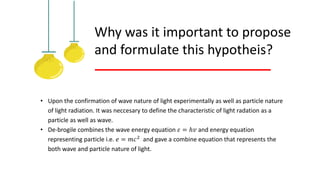
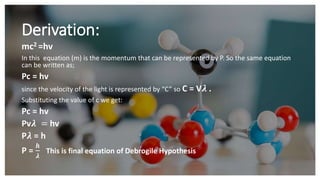


The De Broglie hypothesis proposes that all matter exhibits wave-particle duality, with the wavelength of the matter wave inversely proportional to momentum. Louis De Broglie formulated this hypothesis in 1924 to explain the wave and particle nature of light observed experimentally. In 1927, the Davisson-Germer experiment demonstrated the diffraction of electrons from a crystal surface, confirming De Broglie's hypothesis experimentally. This established wave-particle duality as a fundamental principle of both radiation and matter, allowing quantum mechanics to describe material behavior using wave equations.


![The Heisenberg Uncertainty Principle[1]](https://cdn.slidesharecdn.com/ss_thumbnails/theheisenberguncertaintyprinciple1-091020215730-phpapp01-thumbnail.jpg?width=640&height=640&fit=bounds)


![Polymer [ बहुलक ] Chemistry Notes PDF - Irfanullah Mehar - JJ Sir Chemistry.pdf](https://cdn.slidesharecdn.com/ss_thumbnails/polymerchemistrynotespdf-irfanullahmehar-jjsirchemistry-260210172118-3f9b37f7-thumbnail.jpg?width=640&height=640&fit=bounds)


