VALUATION Basic Concepts & Models M.S.Narasimhan Indian Institute of Management, Bangalore
Basic Valuation Models Value of an asset is present value of future cash flows discounted at the required rate of return Cash flow definition is bit complex for an equity investment Valuation Models based of cash flow definition Dividend Capitalization Model Earning Capitalization Model (or Price-Earnings Multiplier)
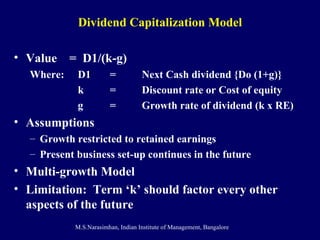
Dividend Capitalization Model Value  =  D1/(k-g) Where:  D1  = Next Cash dividend {Do (1+g)} k = Discount rate or Cost of equity g = Growth rate of dividend (k x RE) Assumptions Growth restricted to retained earnings Present business set-up continues in the future Multi-growth Model Limitation:  Term ‘k’ should factor every other aspects of the future
Dividend Capitalization Model : Application Exercise  Compute the value of five stocks (having a P/E of around 20) using Dividend Capitalization Model Analyze why there is a significant difference between the CMP and DCM value Using DCM and CMP, find the denominator of the DCM equation (k-g);  Note:  k-g = k - (k x RE) = k(1-RE) = k x Pay-out ratio; For an assumed pay-out ratio (current), evaluate k to justify the CMP. For an assumed k, compute and evaluate “g”
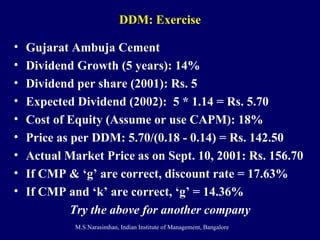
DDM: Exercise Gujarat Ambuja Cement  Dividend Growth (5 years): 14% Dividend per share (2001): Rs. 5 Expected Dividend (2002):  5 * 1.14 = Rs. 5.70 Cost of Equity (Assume or use CAPM): 18% Price as per DDM: 5.70/(0.18 - 0.14) = Rs. 142.50 Actual Market Price as on Sept. 10, 2001: Rs. 156.70 If CMP & ‘g’ are correct, discount rate = 17.63% If CMP and ‘k’ are correct, ‘g’ = 14.36% Try the above for another company
Multi-growth model Simple DDM assumes that firm is in maturity stage and hence growth is restricted Firms in monopoly and emerging industry would grow at a rate much higher than normal growth rate Use Multi-growth DDM If growth rate is above cost of equity, DDM expressed in equation form fails Use expanded discounted cash flow model Note beyond a point of time (say after 20 years), the present value of cash flow would be negligible.
When firms grow at a rate above Discount Rate Consider stocks like Infosys, whose ‘g’ is 60% How do you value such stocks? Do you think that software companies will grow forever 100%; Not likely; many of them reported lower growth Follow the following assumptions Assume the current growth rate will sustain for next 5 yrs Assume the growth rate will come down by 50% of the current growth rate for year 6 to 10. - 30% Assume from year 11 to 15, it is still 50% down - 15% Assume from year 16 onwards, the firm grow at 7.5% Use cash profit for computing the value;  current Cash Profit per share is Rs. 112.5
Present Value of Growth Opportunities (PVGO) Suppose EPS & dividend Rs. 10 & Rs. 8 and k=10% If retained earnings invested at a rate equal to 10%, then Value of the firm is equal to  D 1 /(k-g)  = 8/(.10-.02) = 100 E 1 /k   = 10/.10  = 100 If retained earnings are invested suboptimally or higher rate of return  Value =  (EPS 1  / r) + PV of return arising out of RE   =  (EPS 1  / r) + [NPV 1  /(r-g)] - Example follows….
PVGO - Example If retained earnings are invested at higher rate of return say 20% against cost of equity of 10% Value  =  (EPS 1  / r) + NPV 1  /(r-g)   =  (10/.10) + [2/(.10-.04)] = 100+33.33 = 133.33 where NPV 1  =  -2 + [(.2*2)/.10] = 2; g = 20%*20% If retained earnings are invested at lower rate of return say 5% against cost of equity of 10% Value  =  (EPS 1  / r) + NPV 1  /(r-g)   =  (10/.10) + [-1/(.10-.01)]=100-11.11 = 88.89 where NPV 1  = -2 + [(.05*2)/.10] = -12.50; g = 5%*20%
PVGO - Lessons Firms increase the value of earnings to the shareholders by investing retained earnings at a rate greater than cost of equity such firms can pay a dividend less than earnings Firms destroy the value of earnings to the shareholders by investing retained earnings at a rate less than cost of equity such firms have no right to pay dividend less than earnings; they need to pursue 100% payout policy
Earnings Capitalization Model Current Earning is certain; Future earnings may increase or decrease Instead of forecasting future earnings, adjust the required rate of return depending on the future outlook on the earnings Value  = Earnings/Required rate of return Earnings can be broken into two component namely normal earnings and uncertain component;  Different required rate of return can be used, lower rate for normal and higher rate for uncertain values
Earning Capitalization and P/E Multiplier Inverse of capitalization ratio is P/E P/E defines risk associated with the earnings; low P/E indicates high risk Like capitalization rate, P/E has different component - basic P/E for the market, Changes for industry and individual companies depending on current outlook  Compute Market Value using revaluation or replacement cost basis; Apply P/E on excess earnings and add it to the revaluation value
Analyzing P-E Multiplier Exercise Compare the average and the largest company in terms of sales or income of the industry P-E ratios of different industries - auto HCV, fertilizer, cement, food processing, software, banks; Do you get any insight on risk associated with different industries? Analyze P-E of top five companies (in terms of sales or asset) of any industry of your choice.  Explain the differences in the P-E through some financial ratios and other market inputs.
Other Models Price to Book Ratio Many recent studies shows P/B is one of the best methods of picking up under-valued stocks Replacement cost Compute replacement cost of the firm based on the current cost of constructing such a firm Replacement cost can be much higher than book value Useful in valuation of old-economy stocks Multi-factor model (use a large number of financial ratios and others qualitative factors)
Reasons for Differences in Valuation Differences in the estimated corporate earnings Lack of knowledge or understanding on impact of new developments on corporate earnings Time horizon used in estimating the earnings Differences in the estimated risk  Failure to recognize important economic developments Forecasting industrial recovery or recession Knowledge on competition and margin Differences in incorporating risk on return Ability to bear the risk Alternative investment opportunities (FII vs. Domestic Investor)

Valuation of equity (session 10)

  • 1.
    VALUATION Basic Concepts& Models M.S.Narasimhan Indian Institute of Management, Bangalore
  • 2.
    Basic Valuation ModelsValue of an asset is present value of future cash flows discounted at the required rate of return Cash flow definition is bit complex for an equity investment Valuation Models based of cash flow definition Dividend Capitalization Model Earning Capitalization Model (or Price-Earnings Multiplier)
  • 3.
    Dividend Capitalization ModelValue = D1/(k-g) Where: D1 = Next Cash dividend {Do (1+g)} k = Discount rate or Cost of equity g = Growth rate of dividend (k x RE) Assumptions Growth restricted to retained earnings Present business set-up continues in the future Multi-growth Model Limitation: Term ‘k’ should factor every other aspects of the future
  • 4.
    Dividend Capitalization Model: Application Exercise Compute the value of five stocks (having a P/E of around 20) using Dividend Capitalization Model Analyze why there is a significant difference between the CMP and DCM value Using DCM and CMP, find the denominator of the DCM equation (k-g); Note: k-g = k - (k x RE) = k(1-RE) = k x Pay-out ratio; For an assumed pay-out ratio (current), evaluate k to justify the CMP. For an assumed k, compute and evaluate “g”
  • 5.
    DDM: Exercise GujaratAmbuja Cement Dividend Growth (5 years): 14% Dividend per share (2001): Rs. 5 Expected Dividend (2002): 5 * 1.14 = Rs. 5.70 Cost of Equity (Assume or use CAPM): 18% Price as per DDM: 5.70/(0.18 - 0.14) = Rs. 142.50 Actual Market Price as on Sept. 10, 2001: Rs. 156.70 If CMP & ‘g’ are correct, discount rate = 17.63% If CMP and ‘k’ are correct, ‘g’ = 14.36% Try the above for another company
  • 6.
    Multi-growth model SimpleDDM assumes that firm is in maturity stage and hence growth is restricted Firms in monopoly and emerging industry would grow at a rate much higher than normal growth rate Use Multi-growth DDM If growth rate is above cost of equity, DDM expressed in equation form fails Use expanded discounted cash flow model Note beyond a point of time (say after 20 years), the present value of cash flow would be negligible.
  • 7.
    When firms growat a rate above Discount Rate Consider stocks like Infosys, whose ‘g’ is 60% How do you value such stocks? Do you think that software companies will grow forever 100%; Not likely; many of them reported lower growth Follow the following assumptions Assume the current growth rate will sustain for next 5 yrs Assume the growth rate will come down by 50% of the current growth rate for year 6 to 10. - 30% Assume from year 11 to 15, it is still 50% down - 15% Assume from year 16 onwards, the firm grow at 7.5% Use cash profit for computing the value; current Cash Profit per share is Rs. 112.5
  • 8.
    Present Value ofGrowth Opportunities (PVGO) Suppose EPS & dividend Rs. 10 & Rs. 8 and k=10% If retained earnings invested at a rate equal to 10%, then Value of the firm is equal to D 1 /(k-g) = 8/(.10-.02) = 100 E 1 /k = 10/.10 = 100 If retained earnings are invested suboptimally or higher rate of return Value = (EPS 1 / r) + PV of return arising out of RE = (EPS 1 / r) + [NPV 1 /(r-g)] - Example follows….
  • 9.
    PVGO - ExampleIf retained earnings are invested at higher rate of return say 20% against cost of equity of 10% Value = (EPS 1 / r) + NPV 1 /(r-g) = (10/.10) + [2/(.10-.04)] = 100+33.33 = 133.33 where NPV 1 = -2 + [(.2*2)/.10] = 2; g = 20%*20% If retained earnings are invested at lower rate of return say 5% against cost of equity of 10% Value = (EPS 1 / r) + NPV 1 /(r-g) = (10/.10) + [-1/(.10-.01)]=100-11.11 = 88.89 where NPV 1 = -2 + [(.05*2)/.10] = -12.50; g = 5%*20%
  • 10.
    PVGO - ExampleIf retained earnings are invested at higher rate of return say 20% against cost of equity of 10% Value = (EPS 1 / r) + NPV 1 /(r-g) = (10/.10) + [2/(.10-.04)] = 100+33.33 = 133.33 where NPV 1 = -2 + [(.2*2)/.10] = 2; g = 20%*20% If retained earnings are invested at lower rate of return say 5% against cost of equity of 10% Value = (EPS 1 / r) + NPV 1 /(r-g) = (10/.10) + [-1/(.10-.01)]=100-11.11 = 88.89 where NPV 1 = -2 + [(.05*2)/.10] = -12.50; g = 5%*20%
  • 11.
    PVGO - LessonsFirms increase the value of earnings to the shareholders by investing retained earnings at a rate greater than cost of equity such firms can pay a dividend less than earnings Firms destroy the value of earnings to the shareholders by investing retained earnings at a rate less than cost of equity such firms have no right to pay dividend less than earnings; they need to pursue 100% payout policy
  • 12.
    Earnings Capitalization ModelCurrent Earning is certain; Future earnings may increase or decrease Instead of forecasting future earnings, adjust the required rate of return depending on the future outlook on the earnings Value = Earnings/Required rate of return Earnings can be broken into two component namely normal earnings and uncertain component; Different required rate of return can be used, lower rate for normal and higher rate for uncertain values
  • 13.
    Earning Capitalization andP/E Multiplier Inverse of capitalization ratio is P/E P/E defines risk associated with the earnings; low P/E indicates high risk Like capitalization rate, P/E has different component - basic P/E for the market, Changes for industry and individual companies depending on current outlook Compute Market Value using revaluation or replacement cost basis; Apply P/E on excess earnings and add it to the revaluation value
  • 14.
    Analyzing P-E MultiplierExercise Compare the average and the largest company in terms of sales or income of the industry P-E ratios of different industries - auto HCV, fertilizer, cement, food processing, software, banks; Do you get any insight on risk associated with different industries? Analyze P-E of top five companies (in terms of sales or asset) of any industry of your choice. Explain the differences in the P-E through some financial ratios and other market inputs.
  • 15.
    Other Models Priceto Book Ratio Many recent studies shows P/B is one of the best methods of picking up under-valued stocks Replacement cost Compute replacement cost of the firm based on the current cost of constructing such a firm Replacement cost can be much higher than book value Useful in valuation of old-economy stocks Multi-factor model (use a large number of financial ratios and others qualitative factors)
  • 16.
    Reasons for Differencesin Valuation Differences in the estimated corporate earnings Lack of knowledge or understanding on impact of new developments on corporate earnings Time horizon used in estimating the earnings Differences in the estimated risk Failure to recognize important economic developments Forecasting industrial recovery or recession Knowledge on competition and margin Differences in incorporating risk on return Ability to bear the risk Alternative investment opportunities (FII vs. Domestic Investor)