DC MOTOR
1Electrical Machines
INTRODUCTION
A motor is a machine which converts
electrical energy into mechanical energy. A
DC motor finds application in rolling
mills, in traction system and overhead
cranes. The principle of operation of DC
motor is that when a current carrying
conductor is kept in a magnetic field, a
force is produced in that conductor.
2Electrical Machines
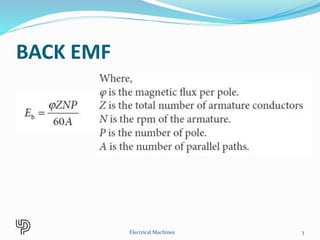
BACK EMF
3Electrical Machines
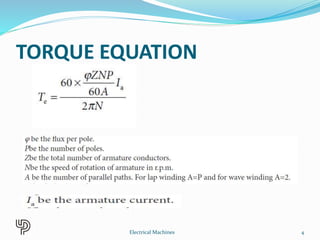
TORQUE EQUATION
4Electrical Machines
ARMATURE REACTION
If the magnetic field windings of a DC machine
are connected to the power source and the
rotor is turned by an external means, a voltage
will be induced in the conductors of the rotor.
5Electrical Machines
ARMATURE REACTION
This voltage is rectified and can be supplied to
external loads. However, if a load is connected, a
current will flow through the armature winding.
This current produces its own magnetic field
that distorts the original magnetic field from the
machine’s poles. This distortion of the machine’s
flux as the load increases is called armature
reaction.
6Electrical Machines
TYPES OF DC MOTOR
i) Permanent magnet DC motor
ii) Separately excited DC motor
iii) Series DC motor
iv) Shunt DC motor
v) Compound DC motor
7Electrical Machines
Permanent Magnet DC Motor
In this type of DC motor, the field is
made up of permanent magnet and
hence, it requires no field winding.
8Electrical Machines
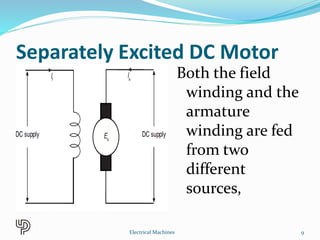
Separately Excited DC Motor
Both the field
winding and the
armature
winding are fed
from two
different
sources,
9Electrical Machines
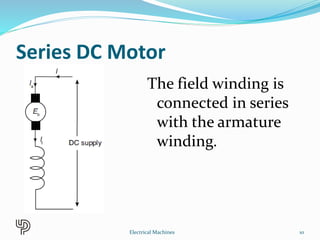
Series DC Motor
The field winding is
connected in series
with the armature
winding.
10Electrical Machines
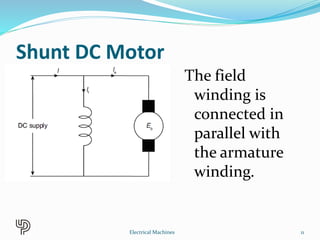
Shunt DC Motor
The field
winding is
connected in
parallel with
the armature
winding.
11Electrical Machines
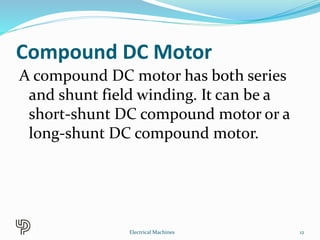
Compound DC Motor
A compound DC motor has both series
and shunt field winding. It can be a
short-shunt DC compound motor or a
long-shunt DC compound motor.
12Electrical Machines
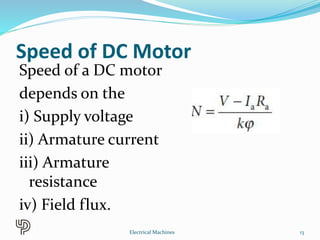
Speed of DC Motor
Speed of a DC motor
depends on the
i) Supply voltage
ii) Armature current
iii) Armature
resistance
iv) Field flux.
13Electrical Machines
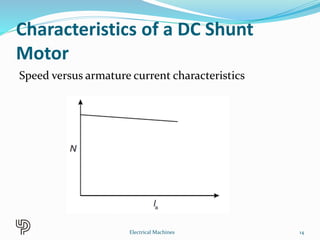
Characteristics of a DC Shunt
Motor
Speed versus armature current characteristics
14Electrical Machines
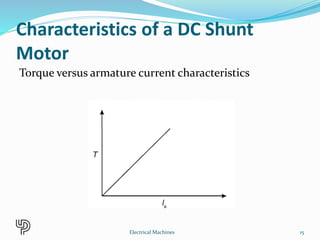
Characteristics of a DC Shunt
Motor
Torque versus armature current characteristics
15Electrical Machines
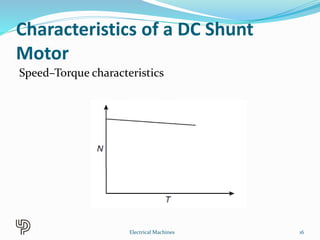
Characteristics of a DC Shunt
Motor
Speed–Torque characteristics
16Electrical Machines
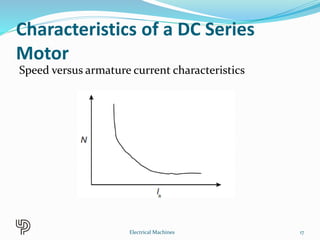
Characteristics of a DC Series
Motor
Speed versus armature current characteristics
17Electrical Machines
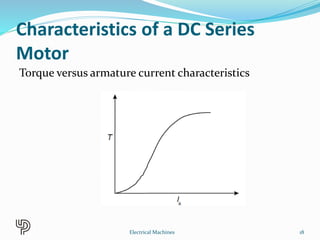
Characteristics of a DC Series
Motor
Torque versus armature current characteristics
18Electrical Machines
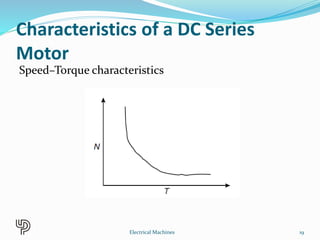
Characteristics of a DC Series
Motor
Speed–Torque characteristics
19Electrical Machines
Characteristics of a DC Compound
Motor
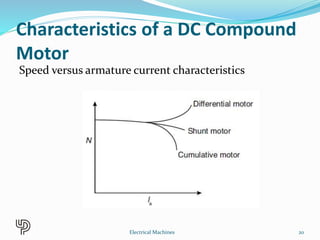
Speed versus armature current characteristics
20Electrical Machines
Characteristics of a DC Compound
Motor
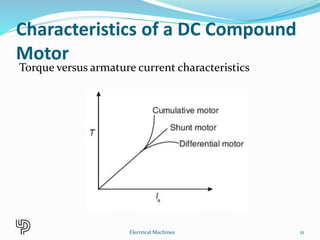
Torque versus armature current characteristics
21Electrical Machines
Characteristics of a DC compound
Motor
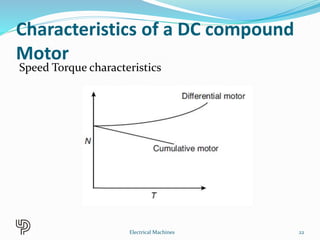
Speed Torque characteristics
22Electrical Machines
DC MOTOR STARTER
Since the armature resistance is small, generally
less than 1Ω, the current through the armature
at the time of starting will be very high. This
large current may damage the armature winding,
brushes and commutator segments
23Electrical Machines
DC MOTOR STARTER
Due to the high inrush of current at the time of
starting the motor, it becomes necessary to limit
this current to a safe value, which is generally
obtained by connecting an extra resistance in
series with the armature winding.
24Electrical Machines
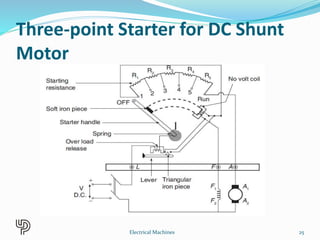
Three-point Starter for DC Shunt
Motor
25Electrical Machines
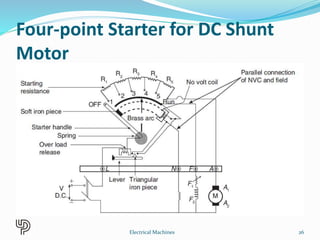
Four-point Starter for DC Shunt
Motor
26Electrical Machines
SPEED CONTROL OF DC SHUNT
MOTOR
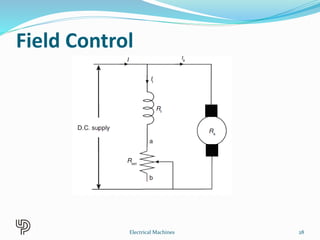
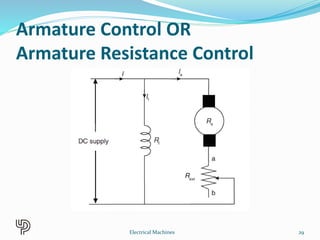
The different methods of speed control of DC shunt
motor are as follows:
i) Shunt field control or flux control method.
ii) Armature resistance control or armature control
method.
iii) Voltage control method.
27Electrical Machines
Field Control
28Electrical Machines
Armature Control OR
Armature Resistance Control
29Electrical Machines
SPEED CONTROL OF DC SERIES
MOTOR
There are three methods of speed control for DC series
motor, namely,
i) Flux control method
ii) Armature control method
iii) Series-parallel control.
30Electrical Machines
ELECTRIC BRAKING
 Braking is used to stop the motor quickly.
There are three types of electric braking.
i) Rheostatic or dynamic braking
ii) Braking by plugging
iii) Regenerative braking
31Electrical Machines

Dcmotor

  • 1.
  • 2.
    INTRODUCTION A motor isa machine which converts electrical energy into mechanical energy. A DC motor finds application in rolling mills, in traction system and overhead cranes. The principle of operation of DC motor is that when a current carrying conductor is kept in a magnetic field, a force is produced in that conductor. 2Electrical Machines
  • 3.
  • 4.
  • 5.
    ARMATURE REACTION If themagnetic field windings of a DC machine are connected to the power source and the rotor is turned by an external means, a voltage will be induced in the conductors of the rotor. 5Electrical Machines
  • 6.
    ARMATURE REACTION This voltageis rectified and can be supplied to external loads. However, if a load is connected, a current will flow through the armature winding. This current produces its own magnetic field that distorts the original magnetic field from the machine’s poles. This distortion of the machine’s flux as the load increases is called armature reaction. 6Electrical Machines
  • 7.
    TYPES OF DCMOTOR i) Permanent magnet DC motor ii) Separately excited DC motor iii) Series DC motor iv) Shunt DC motor v) Compound DC motor 7Electrical Machines
  • 8.
    Permanent Magnet DCMotor In this type of DC motor, the field is made up of permanent magnet and hence, it requires no field winding. 8Electrical Machines
  • 9.
    Separately Excited DCMotor Both the field winding and the armature winding are fed from two different sources, 9Electrical Machines
  • 10.
    Series DC Motor Thefield winding is connected in series with the armature winding. 10Electrical Machines
  • 11.
    Shunt DC Motor Thefield winding is connected in parallel with the armature winding. 11Electrical Machines
  • 12.
    Compound DC Motor Acompound DC motor has both series and shunt field winding. It can be a short-shunt DC compound motor or a long-shunt DC compound motor. 12Electrical Machines
  • 13.
    Speed of DCMotor Speed of a DC motor depends on the i) Supply voltage ii) Armature current iii) Armature resistance iv) Field flux. 13Electrical Machines
  • 14.
    Characteristics of aDC Shunt Motor Speed versus armature current characteristics 14Electrical Machines
  • 15.
    Characteristics of aDC Shunt Motor Torque versus armature current characteristics 15Electrical Machines
  • 16.
    Characteristics of aDC Shunt Motor Speed–Torque characteristics 16Electrical Machines
  • 17.
    Characteristics of aDC Series Motor Speed versus armature current characteristics 17Electrical Machines
  • 18.
    Characteristics of aDC Series Motor Torque versus armature current characteristics 18Electrical Machines
  • 19.
    Characteristics of aDC Series Motor Speed–Torque characteristics 19Electrical Machines
  • 20.
    Characteristics of aDC Compound Motor Speed versus armature current characteristics 20Electrical Machines
  • 21.
    Characteristics of aDC Compound Motor Torque versus armature current characteristics 21Electrical Machines
  • 22.
    Characteristics of aDC compound Motor Speed Torque characteristics 22Electrical Machines
  • 23.
    DC MOTOR STARTER Sincethe armature resistance is small, generally less than 1Ω, the current through the armature at the time of starting will be very high. This large current may damage the armature winding, brushes and commutator segments 23Electrical Machines
  • 24.
    DC MOTOR STARTER Dueto the high inrush of current at the time of starting the motor, it becomes necessary to limit this current to a safe value, which is generally obtained by connecting an extra resistance in series with the armature winding. 24Electrical Machines
  • 25.
    Three-point Starter forDC Shunt Motor 25Electrical Machines
  • 26.
    Four-point Starter forDC Shunt Motor 26Electrical Machines
  • 27.
    SPEED CONTROL OFDC SHUNT MOTOR The different methods of speed control of DC shunt motor are as follows: i) Shunt field control or flux control method. ii) Armature resistance control or armature control method. iii) Voltage control method. 27Electrical Machines
  • 28.
  • 29.
    Armature Control OR ArmatureResistance Control 29Electrical Machines
  • 30.
    SPEED CONTROL OFDC SERIES MOTOR There are three methods of speed control for DC series motor, namely, i) Flux control method ii) Armature control method iii) Series-parallel control. 30Electrical Machines
  • 31.
    ELECTRIC BRAKING  Brakingis used to stop the motor quickly. There are three types of electric braking. i) Rheostatic or dynamic braking ii) Braking by plugging iii) Regenerative braking 31Electrical Machines