UNIT 1
Lecture 7
E R Model
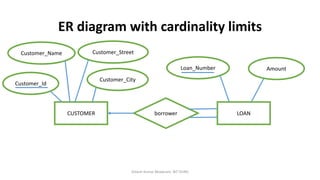
ER diagram with cardinality limits
• E-R diagrams also provide a way to indicate more
complex constraints on the number of times each
entity participates in relationships in a relationship
set.
• An edge between an entity set and a binary
relationship set can have an associated minimum and
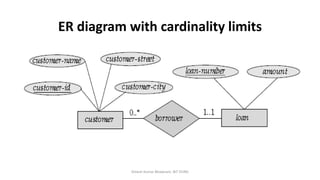
maximum cardinality, shown in the form m..n, where
m is the minimum and n the maximum cardinality.
Dinesh Kumar Bhawnani, BIT DURG
ER diagram with cardinality limits
• A minimum value of 0 indicates partial participation of the
entity set in the relationship set.
• A minimum value of m indicates total participation of the
entity set in the relationship set.
• A maximum value of m indicates that the entity participates
in at most one relationship, while a maximum value *
indicates no limit.
• Note that a label m..* on an edge is equivalent to a double
line.
Dinesh Kumar Bhawnani, BIT DURG
ER diagram with cardinality limits
Dinesh Kumar Bhawnani, BIT DURG
ER diagram with cardinality limits
Dinesh Kumar Bhawnani, BIT DURG
CUSTOMER LOANborrower
Customer_Id
Customer_Name Customer_Street
Customer_City
Loan_Number Amount
Weak and Strong Entity Sets
• An entity set may not have sufficient attributes to form a primary
key. Such an entity set is termed a weak entity set.
• An entity set that has a primary key is termed a strong entity set.
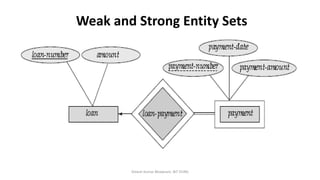
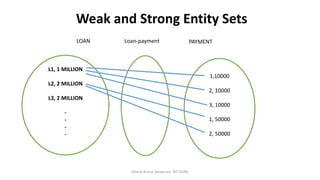
• For e.g., consider the entity set payment, which has the three
attributes: payment-number, payment-date, and payment-
amount. Payment numbers are typically sequential numbers,
starting from 1, generated separately for each loan. Thus,
although each payment entity is distinct, payments for different
loans may share the same payment number. Thus, this entity set
does not have a primary key; it is a weak entity set.
Dinesh Kumar Bhawnani, BIT DURG
Weak and Strong Entity Sets
Dinesh Kumar Bhawnani, BIT DURG
Weak and Strong Entity Sets
Dinesh Kumar Bhawnani, BIT DURG
L1, 1 MILLION
L2, 2 MILLION
L3, 2 MILLION
-
-
-
-
1,10000
2, 10000
3, 10000
1, 50000
2, 50000
LOAN Loan-payment PAYMENT
Weak and Strong Entity Sets
• For a weak entity set to be meaningful, it must be
associated with another entity set, called the
identifying or owner entity set.
• Every weak entity must be associated with an
identifying entity; that is, the weak entity set is said to
be existence dependent on the identifying entity set.
• The identifying entity set is said to own the weak
entity set that it identifies.
Dinesh Kumar Bhawnani, BIT DURG
Weak and Strong Entity Sets
• The relationship associating the weak entity set with the
identifying entity set is called the identifying relationship.
• The identifying relationship is many to one from the weak
entity set to the identifying entity set, and the participation
of the weak entity set in the relationship is total.
• In our example, the identifying entity set for payment is loan,
and a relationship loan-payment that associates payment
entities with their corresponding loan entities is the
identifying relationship.
Dinesh Kumar Bhawnani, BIT DURG
Weak and Strong Entity Sets
• Although a weak entity set does not have a primary key, we
nevertheless need a means of distinguishing among all those
entities in the weak entity set that depend on one particular
strong entity.
• The discriminator of a weak entity set is a set of attributes
that allows this distinction to be made.
• For e.g., the discriminator of the weak entity set payment is
the attribute payment-number, since, for each loan, a
payment number uniquely identifies one single payment for
that loan.
Dinesh Kumar Bhawnani, BIT DURG
Weak and Strong Entity Sets
• The discriminator of a weak entity set is also called the
partial key of the entity set.
• The primary key of a weak entity set is formed by the
primary key of the identifying entity set, plus the weak entity
set’s discriminator.
• In the case of the entity set payment, its primary key is {loan-
number, payment-number}, where loan-number is the
primary key of the identifying entity set, namely loan, and
payment-number distinguishes payment entities within the
same loan.
Dinesh Kumar Bhawnani, BIT DURG
Weak and Strong Entity Sets
• The identifying relationship set should have no descriptive attributes, since
any required attributes can be associated with the weak entity set.
• A weak entity set can participate in relationships other than the identifying
relationship.
• A weak entity set may participate as owner in an identifying relationship
with another weak entity set.
• It is also possible to have a weak entity set with more than one identifying
entity set. A particular weak entity would then be identified by a
combination of entities, one from each identifying entity set.
• The primary key of the weak entity set would consist of the union of the
primary keys of the identifying entity sets, plus the discriminator of the
weak entity set.
Dinesh Kumar Bhawnani, BIT DURG
GATE Question
• Which of the following is used to represent the supporting many-one
relationships of a weak entity set in an entity-relationship diagram?
A. Diamonds with double/ bold border
B. Rectangles with double/ bold border
C. Ovals with double/ bold border
D. Ovals that contain underlined identifiers
[GATE 2020 CS/ IT, IIT DELHI]
Dinesh Kumar Bhawnani, BIT DURG
Steps in ER Modelling
•Usually the following five steps are followed to
generate ER models
1.Identify the entity set.
2.Identify the relevant attributes.
3.Identify the prime attribute.
4.Find relationships between entity set.
5.Draw a complete ER model.
Dinesh Kumar Bhawnani, BIT DURG
Question 1
• Draw an ER Model for an University database application
where
a) A University has many departments.
b) Each department has multiple instructors; one among
them is the head of the department.
c) An instructor belongs to only one department.
d) Each department offers multiple courses, each of which
is taught by a single instructor.
e) A student may enroll for many courses offered by
different departments.
Dinesh Kumar Bhawnani, BIT DURG
Step 1: Identify the entity set
• From the given question, we can identify the following entity
sets.
1. DEPARTMENT
2. COURSE
3. INSTRUCTOR
4. STUDENT
• “Head of the department” is NOT an entity set; it is
relationship between the INSTRUCTOR and DEPARTMENT
entities.
Dinesh Kumar Bhawnani, BIT DURG
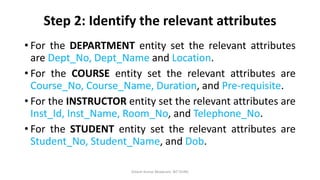
Step 2: Identify the relevant attributes
• For the DEPARTMENT entity set the relevant attributes
are Dept_No, Dept_Name and Location.
• For the COURSE entity set the relevant attributes are
Course_No, Course_Name, Duration, and Pre-requisite.
• For the INSTRUCTOR entity set the relevant attributes are
Inst_Id, Inst_Name, Room_No, and Telephone_No.
• For the STUDENT entity set the relevant attributes are
Student_No, Student_Name, and Dob.
Dinesh Kumar Bhawnani, BIT DURG
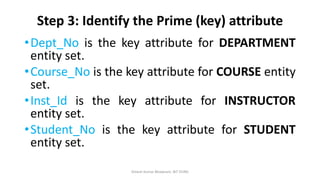
Step 3: Identify the Prime (key) attribute
•Dept_No is the key attribute for DEPARTMENT
entity set.
•Course_No is the key attribute for COURSE entity
set.
•Inst_Id is the key attribute for INSTRUCTOR
entity set.
•Student_No is the key attribute for STUDENT
entity set.
Dinesh Kumar Bhawnani, BIT DURG
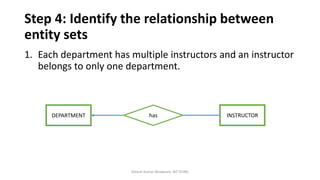
Step 4: Identify the relationship between
entity sets
1. Each department has multiple instructors and an instructor
belongs to only one department.
Dinesh Kumar Bhawnani, BIT DURG
DEPARTMENT INSTRUCTORhas
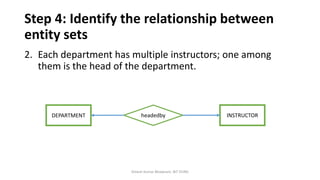
Step 4: Identify the relationship between
entity sets
2. Each department has multiple instructors; one among
them is the head of the department.
Dinesh Kumar Bhawnani, BIT DURG
DEPARTMENT INSTRUCTORheadedby
Step 4: Identify the relationship between
entity sets
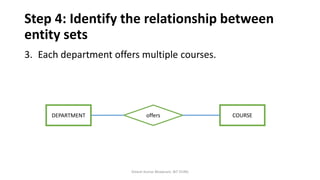
3. Each department offers multiple courses.
Dinesh Kumar Bhawnani, BIT DURG
DEPARTMENT COURSEoffers
Step 4: Identify the relationship between
entity sets
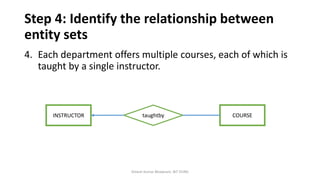
4. Each department offers multiple courses, each of which is
taught by a single instructor.
Dinesh Kumar Bhawnani, BIT DURG
INSTRUCTOR COURSEtaughtby
Step 4: Identify the relationship between
entity sets
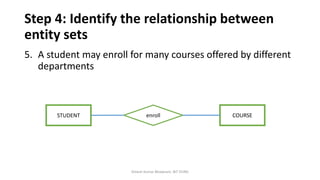
5. A student may enroll for many courses offered by different
departments
Dinesh Kumar Bhawnani, BIT DURG
STUDENT COURSEenroll
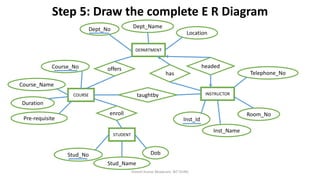
Step 5: Draw the complete E R Diagram
Dinesh Kumar Bhawnani, BIT DURG
STUDENT
DEPARTMENT
INSTRUCTORCOURSE
Inst_Id
Inst_Name
Room_No
Telephone_No
Stud_No
Stud_Name
Dob
Course_Name
Course_No
Duration
Dept_No Dept_Name
Location
Pre-requisite
enroll
has
headedoffers
taughtby
University Questions
1. Write short notes on
Dinesh Kumar Bhawnani, BIT DURG
For Video lecture on this topic please subscribe to my youtube channel.
The link for my youtube channel is
https://www.youtube.com/channel/UCRWGtE76JlTp1iim6aOTRuw?sub
_confirmation=1
Dinesh Kumar Bhawnani, BIT DURG

Database management system Lecture 7 : Strong and weak entity sets

  • 1.
  • 2.
    ER diagram withcardinality limits • E-R diagrams also provide a way to indicate more complex constraints on the number of times each entity participates in relationships in a relationship set. • An edge between an entity set and a binary relationship set can have an associated minimum and maximum cardinality, shown in the form m..n, where m is the minimum and n the maximum cardinality. Dinesh Kumar Bhawnani, BIT DURG
  • 3.
    ER diagram withcardinality limits • A minimum value of 0 indicates partial participation of the entity set in the relationship set. • A minimum value of m indicates total participation of the entity set in the relationship set. • A maximum value of m indicates that the entity participates in at most one relationship, while a maximum value * indicates no limit. • Note that a label m..* on an edge is equivalent to a double line. Dinesh Kumar Bhawnani, BIT DURG
  • 4.
    ER diagram withcardinality limits Dinesh Kumar Bhawnani, BIT DURG
  • 5.
    ER diagram withcardinality limits Dinesh Kumar Bhawnani, BIT DURG CUSTOMER LOANborrower Customer_Id Customer_Name Customer_Street Customer_City Loan_Number Amount
  • 6.
    Weak and StrongEntity Sets • An entity set may not have sufficient attributes to form a primary key. Such an entity set is termed a weak entity set. • An entity set that has a primary key is termed a strong entity set. • For e.g., consider the entity set payment, which has the three attributes: payment-number, payment-date, and payment- amount. Payment numbers are typically sequential numbers, starting from 1, generated separately for each loan. Thus, although each payment entity is distinct, payments for different loans may share the same payment number. Thus, this entity set does not have a primary key; it is a weak entity set. Dinesh Kumar Bhawnani, BIT DURG
  • 7.
    Weak and StrongEntity Sets Dinesh Kumar Bhawnani, BIT DURG
  • 8.
    Weak and StrongEntity Sets Dinesh Kumar Bhawnani, BIT DURG L1, 1 MILLION L2, 2 MILLION L3, 2 MILLION - - - - 1,10000 2, 10000 3, 10000 1, 50000 2, 50000 LOAN Loan-payment PAYMENT
  • 9.
    Weak and StrongEntity Sets • For a weak entity set to be meaningful, it must be associated with another entity set, called the identifying or owner entity set. • Every weak entity must be associated with an identifying entity; that is, the weak entity set is said to be existence dependent on the identifying entity set. • The identifying entity set is said to own the weak entity set that it identifies. Dinesh Kumar Bhawnani, BIT DURG
  • 10.
    Weak and StrongEntity Sets • The relationship associating the weak entity set with the identifying entity set is called the identifying relationship. • The identifying relationship is many to one from the weak entity set to the identifying entity set, and the participation of the weak entity set in the relationship is total. • In our example, the identifying entity set for payment is loan, and a relationship loan-payment that associates payment entities with their corresponding loan entities is the identifying relationship. Dinesh Kumar Bhawnani, BIT DURG
  • 11.
    Weak and StrongEntity Sets • Although a weak entity set does not have a primary key, we nevertheless need a means of distinguishing among all those entities in the weak entity set that depend on one particular strong entity. • The discriminator of a weak entity set is a set of attributes that allows this distinction to be made. • For e.g., the discriminator of the weak entity set payment is the attribute payment-number, since, for each loan, a payment number uniquely identifies one single payment for that loan. Dinesh Kumar Bhawnani, BIT DURG
  • 12.
    Weak and StrongEntity Sets • The discriminator of a weak entity set is also called the partial key of the entity set. • The primary key of a weak entity set is formed by the primary key of the identifying entity set, plus the weak entity set’s discriminator. • In the case of the entity set payment, its primary key is {loan- number, payment-number}, where loan-number is the primary key of the identifying entity set, namely loan, and payment-number distinguishes payment entities within the same loan. Dinesh Kumar Bhawnani, BIT DURG
  • 13.
    Weak and StrongEntity Sets • The identifying relationship set should have no descriptive attributes, since any required attributes can be associated with the weak entity set. • A weak entity set can participate in relationships other than the identifying relationship. • A weak entity set may participate as owner in an identifying relationship with another weak entity set. • It is also possible to have a weak entity set with more than one identifying entity set. A particular weak entity would then be identified by a combination of entities, one from each identifying entity set. • The primary key of the weak entity set would consist of the union of the primary keys of the identifying entity sets, plus the discriminator of the weak entity set. Dinesh Kumar Bhawnani, BIT DURG
  • 14.
    GATE Question • Whichof the following is used to represent the supporting many-one relationships of a weak entity set in an entity-relationship diagram? A. Diamonds with double/ bold border B. Rectangles with double/ bold border C. Ovals with double/ bold border D. Ovals that contain underlined identifiers [GATE 2020 CS/ IT, IIT DELHI] Dinesh Kumar Bhawnani, BIT DURG
  • 15.
    Steps in ERModelling •Usually the following five steps are followed to generate ER models 1.Identify the entity set. 2.Identify the relevant attributes. 3.Identify the prime attribute. 4.Find relationships between entity set. 5.Draw a complete ER model. Dinesh Kumar Bhawnani, BIT DURG
  • 16.
    Question 1 • Drawan ER Model for an University database application where a) A University has many departments. b) Each department has multiple instructors; one among them is the head of the department. c) An instructor belongs to only one department. d) Each department offers multiple courses, each of which is taught by a single instructor. e) A student may enroll for many courses offered by different departments. Dinesh Kumar Bhawnani, BIT DURG
  • 17.
    Step 1: Identifythe entity set • From the given question, we can identify the following entity sets. 1. DEPARTMENT 2. COURSE 3. INSTRUCTOR 4. STUDENT • “Head of the department” is NOT an entity set; it is relationship between the INSTRUCTOR and DEPARTMENT entities. Dinesh Kumar Bhawnani, BIT DURG
  • 18.
    Step 2: Identifythe relevant attributes • For the DEPARTMENT entity set the relevant attributes are Dept_No, Dept_Name and Location. • For the COURSE entity set the relevant attributes are Course_No, Course_Name, Duration, and Pre-requisite. • For the INSTRUCTOR entity set the relevant attributes are Inst_Id, Inst_Name, Room_No, and Telephone_No. • For the STUDENT entity set the relevant attributes are Student_No, Student_Name, and Dob. Dinesh Kumar Bhawnani, BIT DURG
  • 19.
    Step 3: Identifythe Prime (key) attribute •Dept_No is the key attribute for DEPARTMENT entity set. •Course_No is the key attribute for COURSE entity set. •Inst_Id is the key attribute for INSTRUCTOR entity set. •Student_No is the key attribute for STUDENT entity set. Dinesh Kumar Bhawnani, BIT DURG
  • 20.
    Step 4: Identifythe relationship between entity sets 1. Each department has multiple instructors and an instructor belongs to only one department. Dinesh Kumar Bhawnani, BIT DURG DEPARTMENT INSTRUCTORhas
  • 21.
    Step 4: Identifythe relationship between entity sets 2. Each department has multiple instructors; one among them is the head of the department. Dinesh Kumar Bhawnani, BIT DURG DEPARTMENT INSTRUCTORheadedby
  • 22.
    Step 4: Identifythe relationship between entity sets 3. Each department offers multiple courses. Dinesh Kumar Bhawnani, BIT DURG DEPARTMENT COURSEoffers
  • 23.
    Step 4: Identifythe relationship between entity sets 4. Each department offers multiple courses, each of which is taught by a single instructor. Dinesh Kumar Bhawnani, BIT DURG INSTRUCTOR COURSEtaughtby
  • 24.
    Step 4: Identifythe relationship between entity sets 5. A student may enroll for many courses offered by different departments Dinesh Kumar Bhawnani, BIT DURG STUDENT COURSEenroll
  • 25.
    Step 5: Drawthe complete E R Diagram Dinesh Kumar Bhawnani, BIT DURG STUDENT DEPARTMENT INSTRUCTORCOURSE Inst_Id Inst_Name Room_No Telephone_No Stud_No Stud_Name Dob Course_Name Course_No Duration Dept_No Dept_Name Location Pre-requisite enroll has headedoffers taughtby
  • 26.
    University Questions 1. Writeshort notes on Dinesh Kumar Bhawnani, BIT DURG
  • 27.
    For Video lectureon this topic please subscribe to my youtube channel. The link for my youtube channel is https://www.youtube.com/channel/UCRWGtE76JlTp1iim6aOTRuw?sub _confirmation=1 Dinesh Kumar Bhawnani, BIT DURG