INHERITANCE IN C++
Inheritance is the process by which new classes called derived
classes are created from existing classes called base classes.
The derived classes have all the features of the base class and the
programmer can choose to add new features specific to the newly
created derived class.
The idea of inheritance implements the is a relationship. For
example, mammal IS-A animal, dog IS-A mammal hence dog IS-A
animal as well and so on.
WHAT IS AN INHERTANCE?
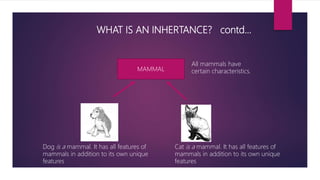
WHAT IS AN INHERTANCE? contd…
MAMMAL
All mammals have
certain characteristics.
Dog is a mammal. It has all features of
mammals in addition to its own unique
features
Cat is a mammal. It has all features of
mammals in addition to its own unique
features
Reusability of Code
Saves Time and Effort
Faster development, easier maintenance and easy
to extend
Capable of expressing the inheritance relationship
and its transitive nature which ensures closeness
with real world problems .
FEATURES /ADVANTAGES OF
INHERITANCE
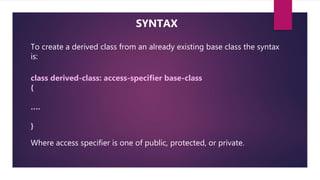
To create a derived class from an already existing base class the syntax
is:
class derived-class: access-specifier base-class
{
….
}
Where access specifier is one of public, protected, or private.
SYNTAX
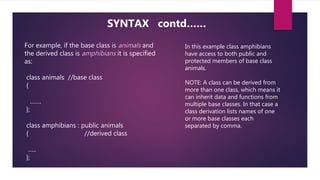
For example, if the base class is animals and
the derived class is amphibians it is specified
as:
class animals //base class
{
…….
};
class amphibians : public animals
{ //derived class
…..
};
SYNTAX contd……
In this example class amphibians
have access to both public and
protected members of base class
animals.
NOTE: A class can be derived from
more than one class, which means it
can inherit data and functions from
multiple base classes. In that case a
class derivation lists names of one
or more base classes each
separated by comma.
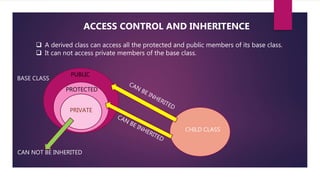
 A derived class can access all the protected and public members of its base class.
 It can not access private members of the base class.
ACCESS CONTROL AND INHERITENCE
PRIVATE
PROTECTED
PUBLIC
BASE CLASS
CHILD CLASS
CAN NOT BE INHERITED
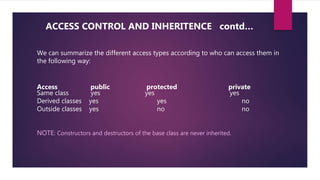
We can summarize the different access types according to who can access them in
the following way:
Access public protected private
Same class yes yes yes
Derived classes yes yes no
Outside classes yes no no
NOTE: Constructors and destructors of the base class are never inherited.
ACCESS CONTROL AND INHERITENCE contd…
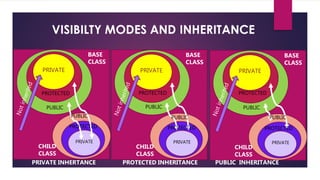
VISIBILTY MODES AND INHERITANCE
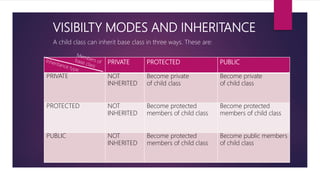
A child class can inherit base class in three ways. These are:
PRIVATE PROTECTED PUBLIC
PRIVATE NOT
INHERITED
Become private
of child class
Become private
of child class
PROTECTED NOT
INHERITED
Become protected
members of child class
Become protected
members of child class
PUBLIC NOT
INHERITED
Become protected
members of child class
Become public members
of child class
PRIVATE
BASE
CLASS
PRIVATE
CHILD
CLASS
PRIVATE
BASE
CLASS
PRIVATE
CHILD
CLASS
PRIVATE
BASE
CLASS
PRIVATE
CHILD
CLASS
PROTECTED
PROTECTED PROTECTED
PROTECTEDPROTECTED
PROTECTED
PUBLIC
PUBLIC PUBLICPUBLIC
PUBLICPUBLIC
PRIVATE INHERTANCE PROTECTED INHERITANCE PUBLIC INHERITANCE
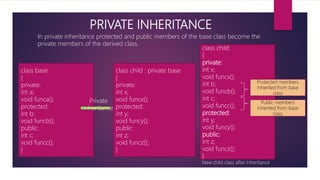
PRIVATE INHERITANCE
class child : private base
{
private:
int x;
void funcx();
protected:
int y;
void funcy();
public:
int z;
void funcz();
}
class child
{
private:
int x;
void funcx();
int b;
void funcb();
int c;
void funcc();
protected:
int y;
void funcy();
public:
int z;
void funcz();
}
In private inheritance protected and public members of the base class become the
private members of the derived class.
class base
{
private:
int a;
void funca();
protected:
int b;
void funcb();
public:
int c;
void funcc();
}
Private
inheritance
New child class after inheritance
Protected members
inherited from base
class
Public members
inherited from base
class
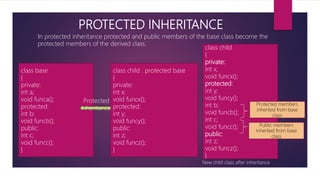
PROTECTED INHERITANCE
class child : protected base
{
private:
int x;
void funcx();
protected:
int y;
void funcy();
public:
int z;
void funcz();
}
class child
{
private:
int x;
void funcx();
protected:
int y;
void funcy();
int b;
void funcb();
int c;
void funcc();
public:
int z;
void funcz();
}
In protected inheritance protected and public members of the base class become the
protected members of the derived class.
class base
{
private:
int a;
void funca();
protected:
int b;
void funcb();
public:
int c;
void funcc();
}
Protected
inheritance
New child class after inheritance
Protected members
inherited from base
class
Public members
inherited from base
class
PUBLIC INHERITANCE
class child : public base
{
private:
int x;
void funcx();
protected:
int y;
void funcy();
public:
int z;
void funcz();
}
class child
{
private:
int x;
void funcx();
protected:
int y;
void funcy();
int b;
void funcb();
public:
int z;
void funcz();
int c;
void funcc();
}
In protected inheritance protected members become the protected members of the base class and
public members of the base class become the public members of the derived class.
class base
{
private:
int a;
void funca();
protected:
int b;
void funcb();
public:
int c;
void funcc();
}
Public
inheritance
New child class after inheritance
Protected members
inherited from base
class
Public members
inherited from base
class
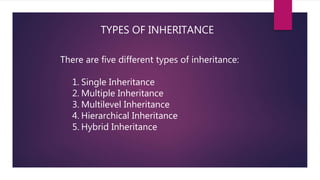
TYPES OF INHERITANCE
There are five different types of inheritance:
1. Single Inheritance
2. Multiple Inheritance
3. Multilevel Inheritance
4. Hierarchical Inheritance
5. Hybrid Inheritance
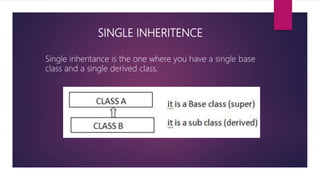
SINGLE INHERITENCE
Single inheritance is the one where you have a single base
class and a single derived class.
EXAMPLE
class student
{
private:
char name[20];
float marks;
protected:
void result();
public:
student();
void enroll();
void display();
}
class course : public student
{
long course_code;
char course_name;
public:
course();
void commence();
void cdetail();
}
STUDENT
COURSE
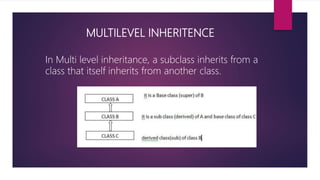
MULTILEVEL INHERITENCE
In Multi level inheritance, a subclass inherits from a
class that itself inherits from another class.
EXAMPLE
class furniture
{
char type;
char model[10];
public:
furniture();
void readdata();
void dispdata();
}
class sofa: public furniture
{
int no_of_seats;
float cost;
public:
void indata();
void outdata();
};
class office: private sofa
{
int no_of_pieces;
char delivery_date[10];
public:
void readdetails()
void displaydetails();
}
FURNITURE
OFFICE
SOFA
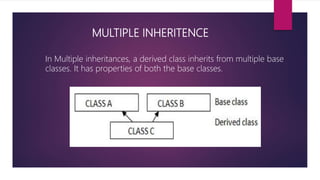
MULTIPLE INHERITENCE
In Multiple inheritances, a derived class inherits from multiple base
classes. It has properties of both the base classes.
MULTIPLE INHERITENCE
EXAMPLE
class chaiperson
{
long chairid;
char name[20];
protected:
char description[20];
void allocate();
public:
chairperson();
void assign();
void show();
};
class director
{
long directorid;
char dname[20];
public:
director();
void entry();
void display();
};
class company: private
chairperson, public director
{
int companyid;
char city[20];
char country[20];
public:
void ctentry();
void ctdisplay();
};
COMPANY
CHAIRPERSON DIRECTOR
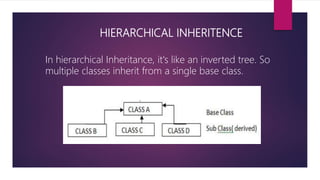
HIERARCHICAL INHERITENCE
In hierarchical Inheritance, it's like an inverted tree. So
multiple classes inherit from a single base class.
HIERARCHICAL INHERITENCE
EXAMPLE
class toys
{
char tcode[5];
protected:
float price;
void assign(float);
public:
toys();
void tentry();
void tdisplay();
};
class softtoys: public toys
{
chat stname[20];
float weight;
public:
softtoys();
void stentry();
void stdisplay();
};
class electronictoys: public
toys
{
char etname[20];
int no_of_batteries;
public:
void etentry();
void etdisplay();
};
TOYS
ELECTRONIC
TOYS
SOFT
TOYS
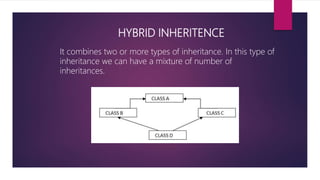
HYBRID INHERITENCE
It combines two or more types of inheritance. In this type of
inheritance we can have a mixture of number of
inheritances.
CONSTRUCTORS AND DESTRUCTORS IN
BASE AND DERIVED CLASSES
 Derived classes can have their own constructors and
destructors.
 When an object of a derived class is created, the base
class’s constructor is executed first, followed by the derived
class’s constructor.
 When an object of a derived class goes out of scope, its
destructor is called first, then that of the base class.
IMPROTANT POINTS TO
NOTE Calculating the size of the object of the child class:
 While calculating the size of the object of the child class, add the size of all data members
of base class including the private members of the base class and the child class.
 If child class is inheriting from multiple base classes, add the size of data members of all
base classes and the child class.
 In case of multilevel inheritance the size of all base classes(directly /indirectly) inherited by
child class is added to the size of child class data members
 Members accessible to the object of the child class:
Only public members of the new modified child class(after inheritance) are accessible to the
object of the child class.
 Members accessible to the functions of the child class:
All members: public, protected, private, of the new modified child class(after inheritance)
are accessible to the functions of the child class.
If a base class has parametrized constructor then it is the duty of child class to pass the
parameters for base class constructor also at the time of creation of object.
PASSING ARGUMENTS TO BASE CLASS CONSTRUCTOR
class student
{
private:
char name[20];
float marks;
protected:
void result();
public:
student(char nam[20], float mar);
void enroll();
void display();
}
class course : public student
{
long course_code;
char course_name[20];
public:
course(long cc, char cn[20],char nam[20], float mar ) :
student(char nam[20], float mar);
void commence();
void cdetail();
}
course c1(01,”CS”,”Naman”, 460);
Base class
constructor
Child class
constructor
Base class constructor
parameters

Inheritance in c++

  • 1.
  • 2.
    Inheritance is theprocess by which new classes called derived classes are created from existing classes called base classes. The derived classes have all the features of the base class and the programmer can choose to add new features specific to the newly created derived class. The idea of inheritance implements the is a relationship. For example, mammal IS-A animal, dog IS-A mammal hence dog IS-A animal as well and so on. WHAT IS AN INHERTANCE?
  • 3.
    WHAT IS ANINHERTANCE? contd… MAMMAL All mammals have certain characteristics. Dog is a mammal. It has all features of mammals in addition to its own unique features Cat is a mammal. It has all features of mammals in addition to its own unique features
  • 4.
    Reusability of Code SavesTime and Effort Faster development, easier maintenance and easy to extend Capable of expressing the inheritance relationship and its transitive nature which ensures closeness with real world problems . FEATURES /ADVANTAGES OF INHERITANCE
  • 5.
    To create aderived class from an already existing base class the syntax is: class derived-class: access-specifier base-class { …. } Where access specifier is one of public, protected, or private. SYNTAX
  • 6.
    For example, ifthe base class is animals and the derived class is amphibians it is specified as: class animals //base class { ……. }; class amphibians : public animals { //derived class ….. }; SYNTAX contd…… In this example class amphibians have access to both public and protected members of base class animals. NOTE: A class can be derived from more than one class, which means it can inherit data and functions from multiple base classes. In that case a class derivation lists names of one or more base classes each separated by comma.
  • 7.
     A derivedclass can access all the protected and public members of its base class.  It can not access private members of the base class. ACCESS CONTROL AND INHERITENCE PRIVATE PROTECTED PUBLIC BASE CLASS CHILD CLASS CAN NOT BE INHERITED
  • 8.
    We can summarizethe different access types according to who can access them in the following way: Access public protected private Same class yes yes yes Derived classes yes yes no Outside classes yes no no NOTE: Constructors and destructors of the base class are never inherited. ACCESS CONTROL AND INHERITENCE contd…
  • 9.
    VISIBILTY MODES ANDINHERITANCE A child class can inherit base class in three ways. These are: PRIVATE PROTECTED PUBLIC PRIVATE NOT INHERITED Become private of child class Become private of child class PROTECTED NOT INHERITED Become protected members of child class Become protected members of child class PUBLIC NOT INHERITED Become protected members of child class Become public members of child class
  • 10.
  • 11.
    PRIVATE INHERITANCE class child: private base { private: int x; void funcx(); protected: int y; void funcy(); public: int z; void funcz(); } class child { private: int x; void funcx(); int b; void funcb(); int c; void funcc(); protected: int y; void funcy(); public: int z; void funcz(); } In private inheritance protected and public members of the base class become the private members of the derived class. class base { private: int a; void funca(); protected: int b; void funcb(); public: int c; void funcc(); } Private inheritance New child class after inheritance Protected members inherited from base class Public members inherited from base class
  • 12.
    PROTECTED INHERITANCE class child: protected base { private: int x; void funcx(); protected: int y; void funcy(); public: int z; void funcz(); } class child { private: int x; void funcx(); protected: int y; void funcy(); int b; void funcb(); int c; void funcc(); public: int z; void funcz(); } In protected inheritance protected and public members of the base class become the protected members of the derived class. class base { private: int a; void funca(); protected: int b; void funcb(); public: int c; void funcc(); } Protected inheritance New child class after inheritance Protected members inherited from base class Public members inherited from base class
  • 13.
    PUBLIC INHERITANCE class child: public base { private: int x; void funcx(); protected: int y; void funcy(); public: int z; void funcz(); } class child { private: int x; void funcx(); protected: int y; void funcy(); int b; void funcb(); public: int z; void funcz(); int c; void funcc(); } In protected inheritance protected members become the protected members of the base class and public members of the base class become the public members of the derived class. class base { private: int a; void funca(); protected: int b; void funcb(); public: int c; void funcc(); } Public inheritance New child class after inheritance Protected members inherited from base class Public members inherited from base class
  • 14.
    TYPES OF INHERITANCE Thereare five different types of inheritance: 1. Single Inheritance 2. Multiple Inheritance 3. Multilevel Inheritance 4. Hierarchical Inheritance 5. Hybrid Inheritance
  • 15.
    SINGLE INHERITENCE Single inheritanceis the one where you have a single base class and a single derived class.
  • 16.
    EXAMPLE class student { private: char name[20]; floatmarks; protected: void result(); public: student(); void enroll(); void display(); } class course : public student { long course_code; char course_name; public: course(); void commence(); void cdetail(); } STUDENT COURSE
  • 17.
    MULTILEVEL INHERITENCE In Multilevel inheritance, a subclass inherits from a class that itself inherits from another class.
  • 18.
    EXAMPLE class furniture { char type; charmodel[10]; public: furniture(); void readdata(); void dispdata(); } class sofa: public furniture { int no_of_seats; float cost; public: void indata(); void outdata(); }; class office: private sofa { int no_of_pieces; char delivery_date[10]; public: void readdetails() void displaydetails(); } FURNITURE OFFICE SOFA
  • 19.
    MULTIPLE INHERITENCE In Multipleinheritances, a derived class inherits from multiple base classes. It has properties of both the base classes.
  • 20.
    MULTIPLE INHERITENCE EXAMPLE class chaiperson { longchairid; char name[20]; protected: char description[20]; void allocate(); public: chairperson(); void assign(); void show(); }; class director { long directorid; char dname[20]; public: director(); void entry(); void display(); }; class company: private chairperson, public director { int companyid; char city[20]; char country[20]; public: void ctentry(); void ctdisplay(); }; COMPANY CHAIRPERSON DIRECTOR
  • 21.
    HIERARCHICAL INHERITENCE In hierarchicalInheritance, it's like an inverted tree. So multiple classes inherit from a single base class.
  • 22.
    HIERARCHICAL INHERITENCE EXAMPLE class toys { chartcode[5]; protected: float price; void assign(float); public: toys(); void tentry(); void tdisplay(); }; class softtoys: public toys { chat stname[20]; float weight; public: softtoys(); void stentry(); void stdisplay(); }; class electronictoys: public toys { char etname[20]; int no_of_batteries; public: void etentry(); void etdisplay(); }; TOYS ELECTRONIC TOYS SOFT TOYS
  • 23.
    HYBRID INHERITENCE It combinestwo or more types of inheritance. In this type of inheritance we can have a mixture of number of inheritances.
  • 24.
    CONSTRUCTORS AND DESTRUCTORSIN BASE AND DERIVED CLASSES  Derived classes can have their own constructors and destructors.  When an object of a derived class is created, the base class’s constructor is executed first, followed by the derived class’s constructor.  When an object of a derived class goes out of scope, its destructor is called first, then that of the base class.
  • 25.
    IMPROTANT POINTS TO NOTECalculating the size of the object of the child class:  While calculating the size of the object of the child class, add the size of all data members of base class including the private members of the base class and the child class.  If child class is inheriting from multiple base classes, add the size of data members of all base classes and the child class.  In case of multilevel inheritance the size of all base classes(directly /indirectly) inherited by child class is added to the size of child class data members  Members accessible to the object of the child class: Only public members of the new modified child class(after inheritance) are accessible to the object of the child class.  Members accessible to the functions of the child class: All members: public, protected, private, of the new modified child class(after inheritance) are accessible to the functions of the child class.
  • 26.
    If a baseclass has parametrized constructor then it is the duty of child class to pass the parameters for base class constructor also at the time of creation of object. PASSING ARGUMENTS TO BASE CLASS CONSTRUCTOR class student { private: char name[20]; float marks; protected: void result(); public: student(char nam[20], float mar); void enroll(); void display(); } class course : public student { long course_code; char course_name[20]; public: course(long cc, char cn[20],char nam[20], float mar ) : student(char nam[20], float mar); void commence(); void cdetail(); } course c1(01,”CS”,”Naman”, 460); Base class constructor Child class constructor Base class constructor parameters