UNIT 1
Lecture 3
Dinesh Kumar Bhawnani, BIT DURG
Database Users
•Users are differentiated by the way they
expect to interact with the system. They fall
into the following categories :
a) Application Programmers
b) Sophisticated User
c) Specialized User
d) Naïve User
Dinesh Kumar Bhawnani, BIT DURG
Application Programmer
• They are computer professionals interacting with the system through
DML calls embedded in a program written in a host language (e.g. C,
PL/1, Pascal).
• These programs are called application programs.
• The DML pre-compiler converts DML calls (prefaced by a special character like
$, #, etc.) to normal procedure calls in a host language.
• The host language compiler then generates the object code.
• Some special types of programming languages combine Pascal-like control
structures with control structures for the manipulation of a database.
• These are sometimes called fourth-generation languages.
• They often include features to help generate forms and display data.
Dinesh Kumar Bhawnani, BIT DURG
Sophisticated Users
Dinesh Kumar Bhawnani, BIT DURG
•They interact with the system without writing
programs.
•They form requests by writing queries in a
database query language.
•These are submitted to a query processor that
breaks a DML statement down into instructions
for the database manager module.
Specialized Users
•They are sophisticated users writing special
database application programs. These may be
CAD systems, knowledge-based and expert
systems, complex data systems (audio/video),
etc.
Dinesh Kumar Bhawnani, BIT DURG
Naive Users
•They are unsophisticated users who interact with
the system by using permanent application
programs (e.g. automated teller machine).
Dinesh Kumar Bhawnani, BIT DURG
Database Administrator
• The database administrator is a person having central
control over data and programs accessing that data.
• He coordinates all the activities of the database
system;
• The database administrator has a good understanding
of the enterprise’s information resources and needs.
Dinesh Kumar Bhawnani, BIT DURG
Functions of a DBA
a) Schema definition : the creation of the original database
schema. This involves writing a set of definitions in a DDL (data
storage and definition language), compiled by the DDL compiler
into a set of tables stored in the data dictionary.
b) Storage structure and access method definition : writing a set of
definitions translated by the data storage and definition language
compiler.
c) Schema and physical organization modification: writing a set of
definitions used by the DDL compiler to generate modifications
to appropriate internal system tables (e.g. data dictionary). This
is done rarely, but sometimes the database schema or physical
organization must be modified.
Dinesh Kumar Bhawnani, BIT DURG
Functions of a DBA
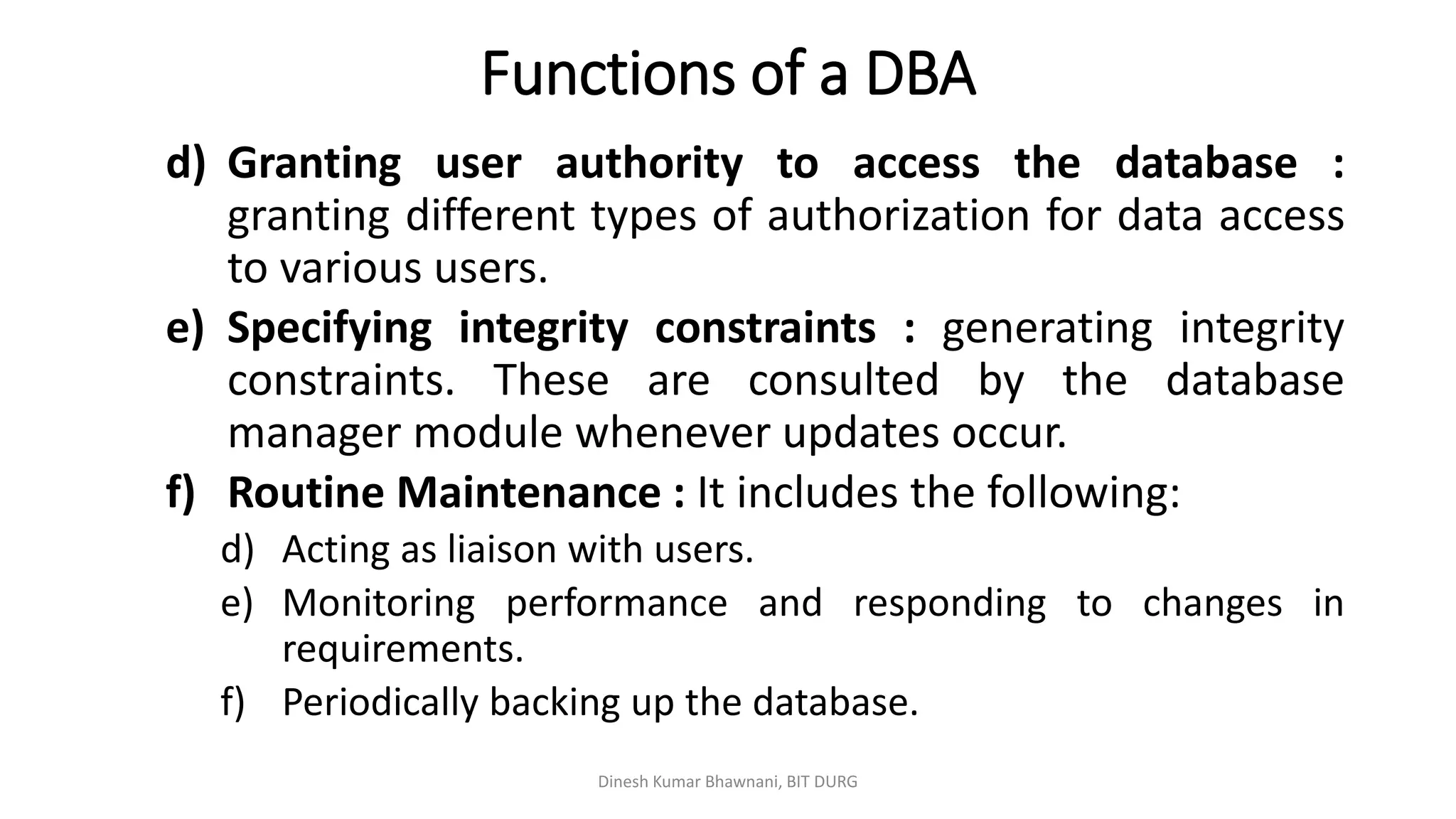
d) Granting user authority to access the database :
granting different types of authorization for data access
to various users.
e) Specifying integrity constraints : generating integrity
constraints. These are consulted by the database
manager module whenever updates occur.
f) Routine Maintenance : It includes the following:
d) Acting as liaison with users.
e) Monitoring performance and responding to changes in
requirements.
f) Periodically backing up the database.
Dinesh Kumar Bhawnani, BIT DURG
DBMS System Structure and its Components
• Database systems are partitioned into modules for
different functions. Some functions (e.g. file systems)
may be provided by the operating system.
• Broadly the functional components of a database
system are :
• Query Processor
• Storage Manger (Database Manager)
Dinesh Kumar Bhawnani, BIT DURG
Query Processor
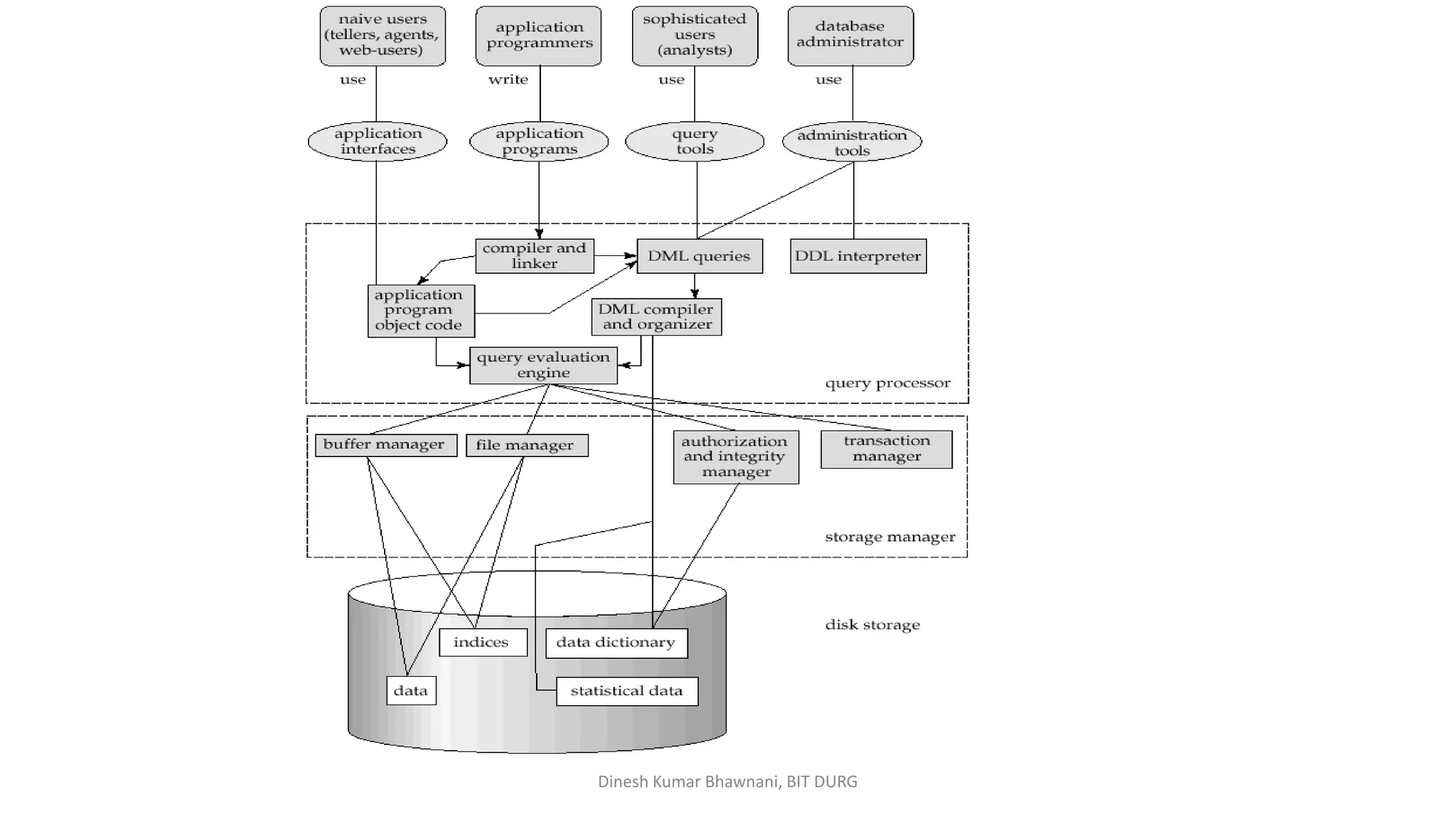
• It is one of the functional components of DBMS. It translates statements in
a query language into low-level instructions the database manager
understands. It may also attempt to find an equivalent but more efficient
form.
• It contains following components:
• DML compiler - It translates DML statements in a query language into an evaluation
plan consisting of low-level instructions that the query evaluation engine
understands. A query can usually be translated into any of a number of alternative
evaluation plans that all give the same result. The DML compiler also performs query
optimization, that is, it picks the lowest cost evaluation plan from among the
alternatives.
• DDL interpreter – It interprets DDL statements and records definitions into data
dictionary.
• Query evaluation engine – It executes low-level instructions generated by DML
compiler.
• They mainly deal with solving all problems related to queries and query
processing. It helps database system simplify and facilitate access to data.
Dinesh Kumar Bhawnani, BIT DURG
Storage Manager (Database Manager)
Dinesh Kumar Bhawnani, BIT DURG
• Storage manager is a program module that provides
the interface between the low-level data stored in the
database and the application programs and queries
submitted to the system.
• The storage manager is responsible to the following
tasks:
• interaction with the file manager
• efficient storing, retrieving and updating of data
Storage Manager (Database Manager)
Dinesh Kumar Bhawnani, BIT DURG
•The important components include:
a) Authorization and integrity manager, which tests
for the satisfaction of integrity constraints and
checks the authority of users to access data.
b) Transaction manager, which ensures that the
database remains in a consistent (correct) state
despite system failures, and that concurrent
transaction executions proceed without conflicts.
Storage Manager (Database Manager)
Dinesh Kumar Bhawnani, BIT DURG
• The important components include:
c) File manager, which manages the allocation of space on
disk storage and the data structures used to represent
information stored on disk.
d) Buffer manager, which is responsible for fetching data
from disk storage into main memory, and deciding what
data to cache in main memory. The buffer manager is a
critical part of the database system, since it enables the
database to handle data sizes that are much larger than
the size of main memory.
DBMS System Structure and its Components
Dinesh Kumar Bhawnani, BIT DURG
• In addition, several data structures are required for physical
system implementation:
a) Data files : They store the database itself.
b) Data dictionary : It stores information about the structure of the
database. It is used heavily. Great emphasis should be placed on
developing a good design and efficient implementation of the
dictionary. In short, it stores metadata.
c) Indices : They provide fast access to data items holding particular
values.
University Questions
• What are the different types of Database Users that
will access the data in the database?
• What are the duties of DBA?
• Explain the complete architecture of DBMS.
• Explain DBMS System Structure and its Components.
• What is data dictionary?
• What is meta data?
Dinesh Kumar Bhawnani, BIT DURG
University Questions
• Which type of user (database user) would perform the following
function for a billing system in a large company :
a) Write a program to generate monthly bills.
b) Develop schema for new kind of billing system?
[CSVTU CSE Dec 2007]
Dinesh Kumar Bhawnani, BIT DURG
For Video lecture on this topic please subscribe to my youtube channel.
The link for my youtube channel is
https://www.youtube.com/channel/UCRWGtE76JlTp1iim6aOTRuw?sub
_confirmation=1
Dinesh Kumar Bhawnani, BIT DURG

Dbms Notes Lecture 3 : Types of database users

  • 1.
    UNIT 1 Lecture 3 DineshKumar Bhawnani, BIT DURG
  • 2.
    Database Users •Users aredifferentiated by the way they expect to interact with the system. They fall into the following categories : a) Application Programmers b) Sophisticated User c) Specialized User d) Naïve User Dinesh Kumar Bhawnani, BIT DURG
  • 3.
    Application Programmer • Theyare computer professionals interacting with the system through DML calls embedded in a program written in a host language (e.g. C, PL/1, Pascal). • These programs are called application programs. • The DML pre-compiler converts DML calls (prefaced by a special character like $, #, etc.) to normal procedure calls in a host language. • The host language compiler then generates the object code. • Some special types of programming languages combine Pascal-like control structures with control structures for the manipulation of a database. • These are sometimes called fourth-generation languages. • They often include features to help generate forms and display data. Dinesh Kumar Bhawnani, BIT DURG
  • 4.
    Sophisticated Users Dinesh KumarBhawnani, BIT DURG •They interact with the system without writing programs. •They form requests by writing queries in a database query language. •These are submitted to a query processor that breaks a DML statement down into instructions for the database manager module.
  • 5.
    Specialized Users •They aresophisticated users writing special database application programs. These may be CAD systems, knowledge-based and expert systems, complex data systems (audio/video), etc. Dinesh Kumar Bhawnani, BIT DURG
  • 6.
    Naive Users •They areunsophisticated users who interact with the system by using permanent application programs (e.g. automated teller machine). Dinesh Kumar Bhawnani, BIT DURG
  • 7.
    Database Administrator • Thedatabase administrator is a person having central control over data and programs accessing that data. • He coordinates all the activities of the database system; • The database administrator has a good understanding of the enterprise’s information resources and needs. Dinesh Kumar Bhawnani, BIT DURG
  • 8.
    Functions of aDBA a) Schema definition : the creation of the original database schema. This involves writing a set of definitions in a DDL (data storage and definition language), compiled by the DDL compiler into a set of tables stored in the data dictionary. b) Storage structure and access method definition : writing a set of definitions translated by the data storage and definition language compiler. c) Schema and physical organization modification: writing a set of definitions used by the DDL compiler to generate modifications to appropriate internal system tables (e.g. data dictionary). This is done rarely, but sometimes the database schema or physical organization must be modified. Dinesh Kumar Bhawnani, BIT DURG
  • 9.
    Functions of aDBA d) Granting user authority to access the database : granting different types of authorization for data access to various users. e) Specifying integrity constraints : generating integrity constraints. These are consulted by the database manager module whenever updates occur. f) Routine Maintenance : It includes the following: d) Acting as liaison with users. e) Monitoring performance and responding to changes in requirements. f) Periodically backing up the database. Dinesh Kumar Bhawnani, BIT DURG
  • 10.
    DBMS System Structureand its Components • Database systems are partitioned into modules for different functions. Some functions (e.g. file systems) may be provided by the operating system. • Broadly the functional components of a database system are : • Query Processor • Storage Manger (Database Manager) Dinesh Kumar Bhawnani, BIT DURG
  • 11.
  • 12.
    Query Processor • Itis one of the functional components of DBMS. It translates statements in a query language into low-level instructions the database manager understands. It may also attempt to find an equivalent but more efficient form. • It contains following components: • DML compiler - It translates DML statements in a query language into an evaluation plan consisting of low-level instructions that the query evaluation engine understands. A query can usually be translated into any of a number of alternative evaluation plans that all give the same result. The DML compiler also performs query optimization, that is, it picks the lowest cost evaluation plan from among the alternatives. • DDL interpreter – It interprets DDL statements and records definitions into data dictionary. • Query evaluation engine – It executes low-level instructions generated by DML compiler. • They mainly deal with solving all problems related to queries and query processing. It helps database system simplify and facilitate access to data. Dinesh Kumar Bhawnani, BIT DURG
  • 13.
    Storage Manager (DatabaseManager) Dinesh Kumar Bhawnani, BIT DURG • Storage manager is a program module that provides the interface between the low-level data stored in the database and the application programs and queries submitted to the system. • The storage manager is responsible to the following tasks: • interaction with the file manager • efficient storing, retrieving and updating of data
  • 14.
    Storage Manager (DatabaseManager) Dinesh Kumar Bhawnani, BIT DURG •The important components include: a) Authorization and integrity manager, which tests for the satisfaction of integrity constraints and checks the authority of users to access data. b) Transaction manager, which ensures that the database remains in a consistent (correct) state despite system failures, and that concurrent transaction executions proceed without conflicts.
  • 15.
    Storage Manager (DatabaseManager) Dinesh Kumar Bhawnani, BIT DURG • The important components include: c) File manager, which manages the allocation of space on disk storage and the data structures used to represent information stored on disk. d) Buffer manager, which is responsible for fetching data from disk storage into main memory, and deciding what data to cache in main memory. The buffer manager is a critical part of the database system, since it enables the database to handle data sizes that are much larger than the size of main memory.
  • 16.
    DBMS System Structureand its Components Dinesh Kumar Bhawnani, BIT DURG • In addition, several data structures are required for physical system implementation: a) Data files : They store the database itself. b) Data dictionary : It stores information about the structure of the database. It is used heavily. Great emphasis should be placed on developing a good design and efficient implementation of the dictionary. In short, it stores metadata. c) Indices : They provide fast access to data items holding particular values.
  • 17.
    University Questions • Whatare the different types of Database Users that will access the data in the database? • What are the duties of DBA? • Explain the complete architecture of DBMS. • Explain DBMS System Structure and its Components. • What is data dictionary? • What is meta data? Dinesh Kumar Bhawnani, BIT DURG
  • 18.
    University Questions • Whichtype of user (database user) would perform the following function for a billing system in a large company : a) Write a program to generate monthly bills. b) Develop schema for new kind of billing system? [CSVTU CSE Dec 2007] Dinesh Kumar Bhawnani, BIT DURG
  • 19.
    For Video lectureon this topic please subscribe to my youtube channel. The link for my youtube channel is https://www.youtube.com/channel/UCRWGtE76JlTp1iim6aOTRuw?sub _confirmation=1 Dinesh Kumar Bhawnani, BIT DURG