Designing a database system for department
management system
Identifying entities and attributes:
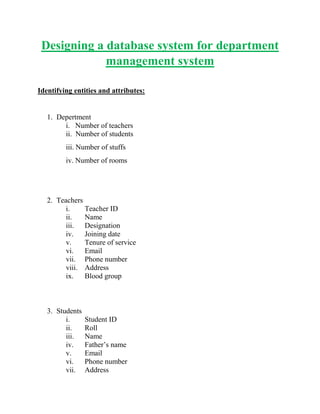
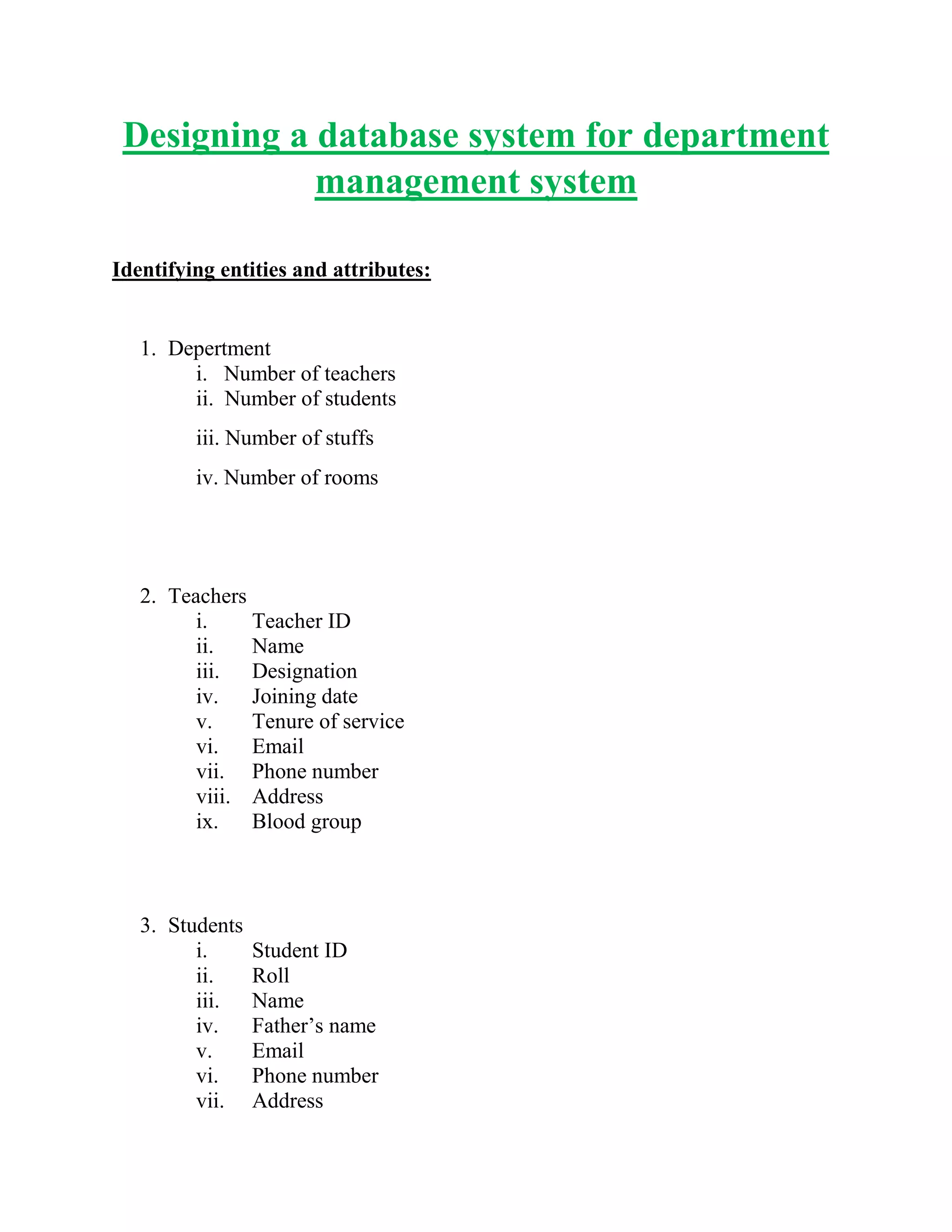
1. Depertment
i. Number of teachers
ii. Number of students
iii. Number of stuffs
iv. Number of rooms
2. Teachers
i. Teacher ID
ii. Name
iii. Designation
iv. Joining date
v. Tenure of service
vi. Email
vii. Phone number
viii. Address
ix. Blood group
3. Students
i. Student ID
ii. Roll
iii. Name
iv. Father’s name
v. Email
vi. Phone number
vii. Address
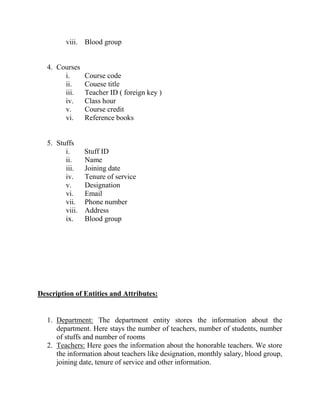
viii. Blood group
4. Courses
i. Course code
ii. Couese title
iii. Teacher ID ( foreign key )
iv. Class hour
v. Course credit
vi. Reference books
5. Stuffs
i. Stuff ID
ii. Name
iii. Joining date
iv. Tenure of service
v. Designation
vi. Email
vii. Phone number
viii. Address
ix. Blood group
Description of Entities and Attributes:
1. Department: The department entity stores the information about the
department. Here stays the number of teachers, number of students, number
of stuffs and number of rooms
2. Teachers: Here goes the information about the honorable teachers. We store
the information about teachers like designation, monthly salary, blood group,
joining date, tenure of service and other information.
3. Stuffs: Here goes the information of the stuffs. Stuffs’ information like their
name, designation, joining date, salary etc.
4. Courses: Information about the courses that are offered by the department are
stored in this entity.
5. Students: Here goes the information like their name, father’s name, phone no,
email address, etc.
Calculating relationships:
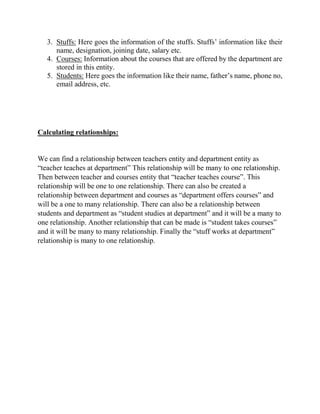
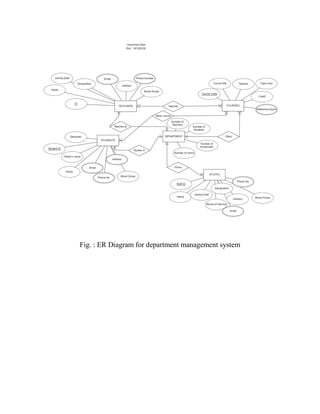
We can find a relationship between teachers entity and department entity as
“teacher teaches at department” This relationship will be many to one relationship.
Then between teacher and courses entity that “teacher teaches course”. This
relationship will be one to one relationship. There can also be created a
relationship between department and courses as “department offers courses” and
will be a one to many relationship. There can also be a relationship between
students and department as “student studies at department” and it will be a many to
one relationship. Another relationship that can be made is “student takes courses”
and it will be many to many relationship. Finally the “stuff works at department”
relationship is many to one relationship.
Fig. : ER Diagram for department management system
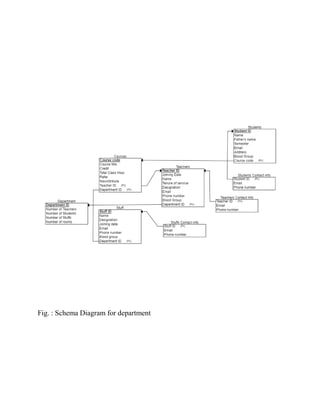
Fig. : Schema Diagram for department

DBMS for Department management system.

  • 1.
    Designing a databasesystem for department management system Identifying entities and attributes: 1. Depertment i. Number of teachers ii. Number of students iii. Number of stuffs iv. Number of rooms 2. Teachers i. Teacher ID ii. Name iii. Designation iv. Joining date v. Tenure of service vi. Email vii. Phone number viii. Address ix. Blood group 3. Students i. Student ID ii. Roll iii. Name iv. Father’s name v. Email vi. Phone number vii. Address
  • 2.
    viii. Blood group 4.Courses i. Course code ii. Couese title iii. Teacher ID ( foreign key ) iv. Class hour v. Course credit vi. Reference books 5. Stuffs i. Stuff ID ii. Name iii. Joining date iv. Tenure of service v. Designation vi. Email vii. Phone number viii. Address ix. Blood group Description of Entities and Attributes: 1. Department: The department entity stores the information about the department. Here stays the number of teachers, number of students, number of stuffs and number of rooms 2. Teachers: Here goes the information about the honorable teachers. We store the information about teachers like designation, monthly salary, blood group, joining date, tenure of service and other information.
  • 3.
    3. Stuffs: Heregoes the information of the stuffs. Stuffs’ information like their name, designation, joining date, salary etc. 4. Courses: Information about the courses that are offered by the department are stored in this entity. 5. Students: Here goes the information like their name, father’s name, phone no, email address, etc. Calculating relationships: We can find a relationship between teachers entity and department entity as “teacher teaches at department” This relationship will be many to one relationship. Then between teacher and courses entity that “teacher teaches course”. This relationship will be one to one relationship. There can also be created a relationship between department and courses as “department offers courses” and will be a one to many relationship. There can also be a relationship between students and department as “student studies at department” and it will be a many to one relationship. Another relationship that can be made is “student takes courses” and it will be many to many relationship. Finally the “stuff works at department” relationship is many to one relationship.
  • 4.
    Fig. : ERDiagram for department management system
  • 5.
    Fig. : SchemaDiagram for department