DATABASE DESIGN USING
THE REA DATA MODEL
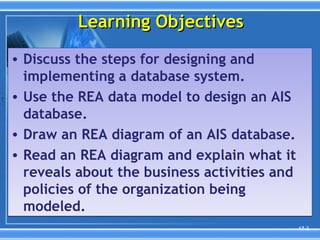
• Discuss the steps for designing and
implementing a database system.
• Use the REA data model to design an AIS
database.
• Draw an REA diagram of an AIS database.
• Read an REA diagram and explain what it
reveals about the business activities and
policies of the organization being
modeled.
• Discuss the steps for designing and
implementing a database system.
• Use the REA data model to design an AIS
database.
• Draw an REA diagram of an AIS database.
• Read an REA diagram and explain what it
reveals about the business activities and
policies of the organization being
modeled.
Learning ObjectivesLearning Objectives
17-2
Database Design ProcessDatabase Design Process
17-3
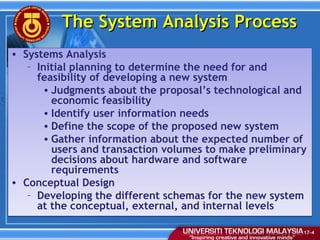
• Systems Analysis
– Initial planning to determine the need for and
feasibility of developing a new system
• Judgments about the proposal’s technological and
economic feasibility
• Identify user information needs
• Define the scope of the proposed new system
• Gather information about the expected number of
users and transaction volumes to make preliminary
decisions about hardware and software
requirements
• Conceptual Design
– Developing the different schemas for the new system
at the conceptual, external, and internal levels
• Systems Analysis
– Initial planning to determine the need for and
feasibility of developing a new system
• Judgments about the proposal’s technological and
economic feasibility
• Identify user information needs
• Define the scope of the proposed new system
• Gather information about the expected number of
users and transaction volumes to make preliminary
decisions about hardware and software
requirements
• Conceptual Design
– Developing the different schemas for the new system
at the conceptual, external, and internal levels
The System Analysis ProcessThe System Analysis Process
17-4
• Physical Design
– Translating the internal-level schema into the actual
database structures that will be implemented in the
new system
– New applications are developed
• Implementation and Conversion
– Includes all the activities associated with transferring
data from existing systems to the new database AIS
– Testing the new system
– Training employees
• Maintaining the New System
• Physical Design
– Translating the internal-level schema into the actual
database structures that will be implemented in the
new system
– New applications are developed
• Implementation and Conversion
– Includes all the activities associated with transferring
data from existing systems to the new database AIS
– Testing the new system
– Training employees
• Maintaining the New System
The System Analysis Process (cont’d)The System Analysis Process (cont’d)
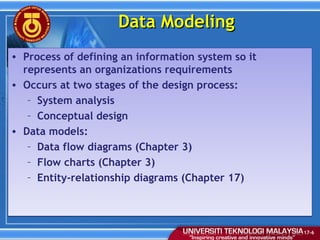
• Process of defining an information system so it
represents an organizations requirements
• Occurs at two stages of the design process:
– System analysis
– Conceptual design
• Data models:
– Data flow diagrams (Chapter 3)
– Flow charts (Chapter 3)
– Entity-relationship diagrams (Chapter 17)
• Process of defining an information system so it
represents an organizations requirements
• Occurs at two stages of the design process:
– System analysis
– Conceptual design
• Data models:
– Data flow diagrams (Chapter 3)
– Flow charts (Chapter 3)
– Entity-relationship diagrams (Chapter 17)
Data ModelingData Modeling
17-6
• Used to graphically represent a database
schema
• Depicts entities
– Anything an organization wants to collect
information about
• Relationships between entities
• Used to graphically represent a database
schema
• Depicts entities
– Anything an organization wants to collect
information about
• Relationships between entities
Entity-Relationship DiagramsEntity-Relationship Diagrams
17-7
E-R Diagram Variations
17-8
• Developed for designing AIS
– Categorizing entities into:
• Resources
– Things that have economic value
• Events
– Business activities
•Management wants to manage and control
• Agents
– People and organizations that participate in
events
• Developed for designing AIS
– Categorizing entities into:
• Resources
– Things that have economic value
• Events
– Business activities
•Management wants to manage and control
• Agents
– People and organizations that participate in
events
Resources-Events-Agents DiagramResources-Events-Agents Diagram
17-9
1. Each event is linked to at least one resource
that it affects.
2. Each event is linked to at least one other event.
– Types of links (relationships):
• Get events
• Give events
• Participation events
1. Each event is linked to at least two
participating agents.
1. Each event is linked to at least one resource
that it affects.
2. Each event is linked to at least one other event.
– Types of links (relationships):
• Get events
• Give events
• Participation events
1. Each event is linked to at least two
participating agents.
REA Diagram RulesREA Diagram Rules
17-10
Business Cycle Give–Get
Relationships
17-11
Revenue Cycle REA Diagram
17-11
1. Identify the events about which management wants to
collect information.
2. Identify the resources affected by each event and the
agents who participate in those events.
– What economic resource is reduced by the “Give”
event?
– What economic resource is acquired by the “Get”
event?
– What economic resource is affected by a
commitment event?
1. Determine the cardinalities of each relationship.
1. Identify the events about which management wants to
collect information.
2. Identify the resources affected by each event and the
agents who participate in those events.
– What economic resource is reduced by the “Give”
event?
– What economic resource is acquired by the “Get”
event?
– What economic resource is affected by a
commitment event?
1. Determine the cardinalities of each relationship.
Developing an REA DiagramDeveloping an REA Diagram
17-13
• Describe the nature of relationships between entities
– How many instances of one entity can be linked to each
specific instance of another entity
– Minimum can be: 0 or 1
– Maximum can be: 1 or Many
• Describe the nature of relationships between entities
– How many instances of one entity can be linked to each
specific instance of another entity
– Minimum can be: 0 or 1
– Maximum can be: 1 or Many
CardinalitiesCardinalities
17-14
17-15
Cardinalities (contd)Cardinalities (contd)
• Relationship type is based on maximum
cardinality:
– One-to-One:
– One-to-Many:
– Many-to-Many:
• Relationship type is based on maximum
cardinality:
– One-to-One:
– One-to-Many:
– Many-to-Many:
Three Types of RelationshipsThree Types of Relationships
17-16

Database Design

  • 1.
  • 2.
    • Discuss thesteps for designing and implementing a database system. • Use the REA data model to design an AIS database. • Draw an REA diagram of an AIS database. • Read an REA diagram and explain what it reveals about the business activities and policies of the organization being modeled. • Discuss the steps for designing and implementing a database system. • Use the REA data model to design an AIS database. • Draw an REA diagram of an AIS database. • Read an REA diagram and explain what it reveals about the business activities and policies of the organization being modeled. Learning ObjectivesLearning Objectives 17-2
  • 3.
  • 4.
    • Systems Analysis –Initial planning to determine the need for and feasibility of developing a new system • Judgments about the proposal’s technological and economic feasibility • Identify user information needs • Define the scope of the proposed new system • Gather information about the expected number of users and transaction volumes to make preliminary decisions about hardware and software requirements • Conceptual Design – Developing the different schemas for the new system at the conceptual, external, and internal levels • Systems Analysis – Initial planning to determine the need for and feasibility of developing a new system • Judgments about the proposal’s technological and economic feasibility • Identify user information needs • Define the scope of the proposed new system • Gather information about the expected number of users and transaction volumes to make preliminary decisions about hardware and software requirements • Conceptual Design – Developing the different schemas for the new system at the conceptual, external, and internal levels The System Analysis ProcessThe System Analysis Process 17-4
  • 5.
    • Physical Design –Translating the internal-level schema into the actual database structures that will be implemented in the new system – New applications are developed • Implementation and Conversion – Includes all the activities associated with transferring data from existing systems to the new database AIS – Testing the new system – Training employees • Maintaining the New System • Physical Design – Translating the internal-level schema into the actual database structures that will be implemented in the new system – New applications are developed • Implementation and Conversion – Includes all the activities associated with transferring data from existing systems to the new database AIS – Testing the new system – Training employees • Maintaining the New System The System Analysis Process (cont’d)The System Analysis Process (cont’d)
  • 6.
    • Process ofdefining an information system so it represents an organizations requirements • Occurs at two stages of the design process: – System analysis – Conceptual design • Data models: – Data flow diagrams (Chapter 3) – Flow charts (Chapter 3) – Entity-relationship diagrams (Chapter 17) • Process of defining an information system so it represents an organizations requirements • Occurs at two stages of the design process: – System analysis – Conceptual design • Data models: – Data flow diagrams (Chapter 3) – Flow charts (Chapter 3) – Entity-relationship diagrams (Chapter 17) Data ModelingData Modeling 17-6
  • 7.
    • Used tographically represent a database schema • Depicts entities – Anything an organization wants to collect information about • Relationships between entities • Used to graphically represent a database schema • Depicts entities – Anything an organization wants to collect information about • Relationships between entities Entity-Relationship DiagramsEntity-Relationship Diagrams 17-7
  • 8.
  • 9.
    • Developed fordesigning AIS – Categorizing entities into: • Resources – Things that have economic value • Events – Business activities •Management wants to manage and control • Agents – People and organizations that participate in events • Developed for designing AIS – Categorizing entities into: • Resources – Things that have economic value • Events – Business activities •Management wants to manage and control • Agents – People and organizations that participate in events Resources-Events-Agents DiagramResources-Events-Agents Diagram 17-9
  • 10.
    1. Each eventis linked to at least one resource that it affects. 2. Each event is linked to at least one other event. – Types of links (relationships): • Get events • Give events • Participation events 1. Each event is linked to at least two participating agents. 1. Each event is linked to at least one resource that it affects. 2. Each event is linked to at least one other event. – Types of links (relationships): • Get events • Give events • Participation events 1. Each event is linked to at least two participating agents. REA Diagram RulesREA Diagram Rules 17-10
  • 11.
  • 12.
    Revenue Cycle READiagram 17-11
  • 13.
    1. Identify theevents about which management wants to collect information. 2. Identify the resources affected by each event and the agents who participate in those events. – What economic resource is reduced by the “Give” event? – What economic resource is acquired by the “Get” event? – What economic resource is affected by a commitment event? 1. Determine the cardinalities of each relationship. 1. Identify the events about which management wants to collect information. 2. Identify the resources affected by each event and the agents who participate in those events. – What economic resource is reduced by the “Give” event? – What economic resource is acquired by the “Get” event? – What economic resource is affected by a commitment event? 1. Determine the cardinalities of each relationship. Developing an REA DiagramDeveloping an REA Diagram 17-13
  • 14.
    • Describe thenature of relationships between entities – How many instances of one entity can be linked to each specific instance of another entity – Minimum can be: 0 or 1 – Maximum can be: 1 or Many • Describe the nature of relationships between entities – How many instances of one entity can be linked to each specific instance of another entity – Minimum can be: 0 or 1 – Maximum can be: 1 or Many CardinalitiesCardinalities 17-14
  • 15.
  • 16.
    • Relationship typeis based on maximum cardinality: – One-to-One: – One-to-Many: – Many-to-Many: • Relationship type is based on maximum cardinality: – One-to-One: – One-to-Many: – Many-to-Many: Three Types of RelationshipsThree Types of Relationships 17-16