Dimension Decisions:Dimension Decisions:
A Guide to Defining Dimensions for YourA Guide to Defining Dimensions for Your
Oracle EPM SolutionOracle EPM Solution
November 16November 16thth
, 2011, 2011
RJ LinehanRJ Linehan
rj@innovuspartners.comrj@innovuspartners.com
Presentation AgendaPresentation Agenda
 Presenter Biography
 Dimensional Modeling Concepts
 Oracle EPM Dimensional Requirements
 Financial Management (HFM)
 Planning
 Essbase
 Common Design Scenarios
 Questions
Presenter BiographyPresenter Biography
 RJ Linehan, Innovus Partners
 Eleven Years experience consulting in the EPM/BI Space
 Expertise in functional and technical requirements gathering
 Deployed over 30 EPM/BI solutions
 Key Industry experience
 Consumer Packaged Goods
 Retail
 Insurance and Financial Services
 Primary Application Experience
 Management Reporting Applications
 Budget & Forecasting Solutions
 Workforce and Capital Asset Planning Models
 Customer/Product Profitability Models
 Executive Dashboards
Dimensional Modeling ConceptsDimensional Modeling Concepts
 A single set of common data that satisfies the following user
requirements
 Ability to make informed business decisions based on the right
data
 Expectation of accurate data provided at the correct grain
 Delivery of the data in a secure and timely fashion
 Capacity to change with business requirements
What is a dimensional model?
(Borrowed from "The Data Warehouse Toolkit" by Ralph Kimball and Margy Ross)
Dimensional Modeling ConceptsDimensional Modeling Concepts
• A fact is a business measure that is typically numeric
• A fact is the numerical data stored in an EPM application
• A fact can be additive or non-additive
• The list of dimensions that encompass an EPM application
defines the grain of the fact and the scope of measurement
What is a Fact?
(Borrowed from "The Data Warehouse Toolkit" by Ralph Kimball and Margy Ross)
Dimensional Modeling ConceptsDimensional Modeling Concepts
• A dimension and its attributes describe the facts
stored in an EPM application
• Dimension attributes define the 'By' in a report
(Revenue by Quarter by Region)
• A dimension is a type of Metadata
What is a Dimension?
(Borrowed from "The Data Warehouse Toolkit" by Ralph Kimball and Margy Ross)
Dimensional Modeling ConceptsDimensional Modeling Concepts
• Insist on complete functional/business requirements
• Know the data that will encompass the subject area
• Engage and learn from the business users
• Provide detailed pre-design questions for the business
and IT
• Request sample dimensions from legacy applications
Successfully Defining Dimensions During Design
Dimensional Modeling ConceptsDimensional Modeling Concepts
 Existing User Reports
 Leverage existing user reports to ensure the design supports
reporting requirements
 MS Excel
 Employ MS Excel to illustrate sample report layouts
 Outline Editor
 Utilize an outline editor and the MS Excel Add-in / Smart View
 The business user
 Your ears
Design Tools Used to Define Dimensions
Dimensional Modeling ConceptsDimensional Modeling Concepts
DEMONSTRATION
Successfully Defining Dimensions During Design
Oracle EPM Dimensional RequirementsOracle EPM Dimensional Requirements
• Oracle EPM applications support standard and custom
dimensions
• A dimension member is an attribute of the dimension that is
typically unique to the application
• A hierarchy denotes a roll-up of dimension members within
a dimension that is either aggregating or non-aggregating
• Fact data must be loaded to a member from each dimension
in the EPM application
• Dimensions are often shared across EPM applications
Dimension Definitions for Oracle EPM Applications
Oracle EPM Dimensional RequirementsOracle EPM Dimensional Requirements
• A standard dimension is a required dimension in an
EPM Application
• A standard dimension offers consistency
• A standard dimension provides out-of-the-box
functionality for select features of an EPM
Application
Standard Dimensions in an Oracle EPM Application
Oracle EPM Dimensional RequirementsOracle EPM Dimensional Requirements
• A custom dimension is typically not a required
dimension in an EPM Application
• A custom dimension provides for customization to
satisfy reporting requirements
• A custom dimension expands the perspective of
data stored in an EPM Application
Custom Dimensions in an Oracle EPM Application
Oracle EPM Dimensional RequirementsOracle EPM Dimensional Requirements
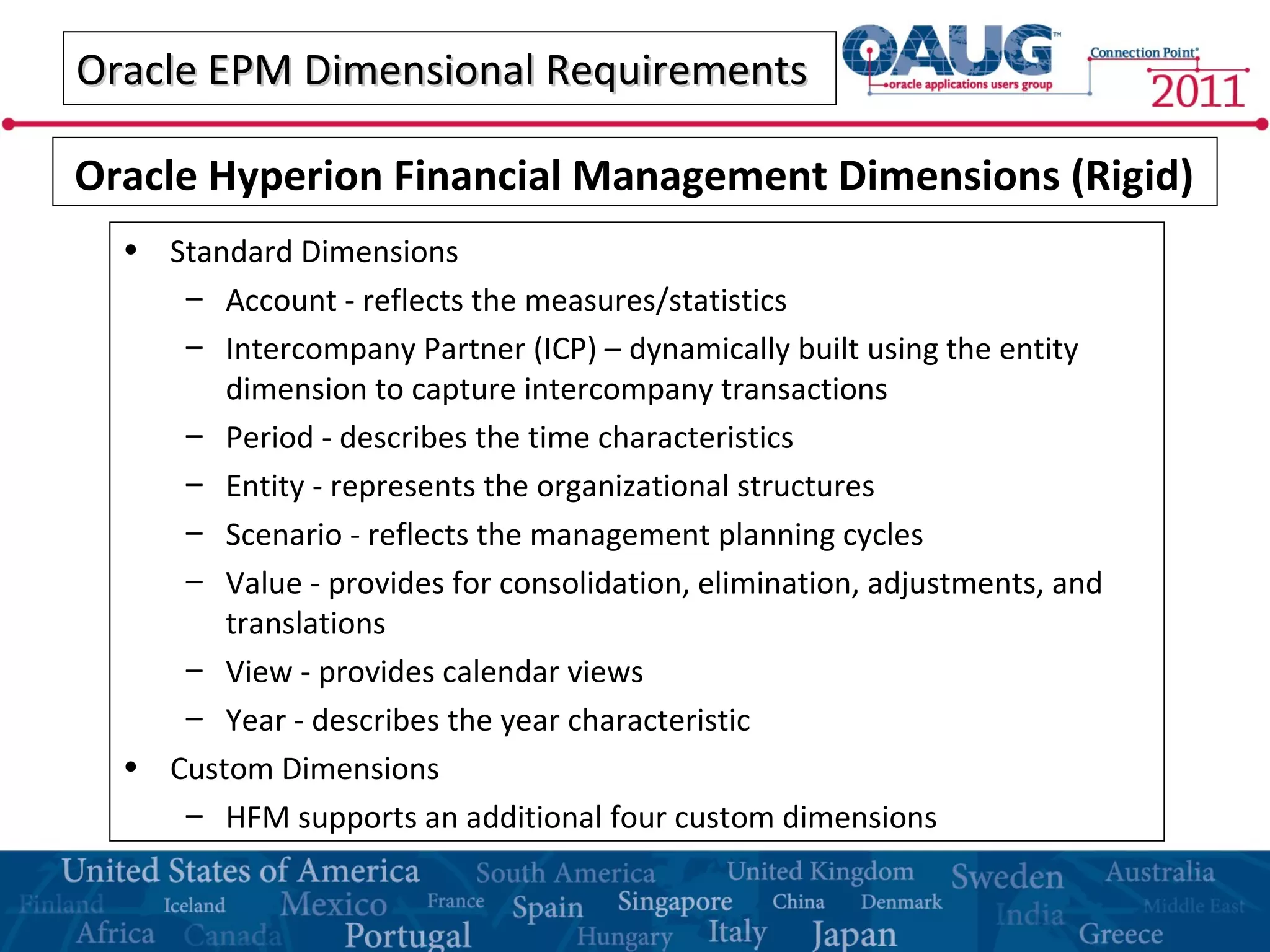
• Standard Dimensions
– Account - reflects the measures/statistics
– Intercompany Partner (ICP) – dynamically built using the entity
dimension to capture intercompany transactions
– Period - describes the time characteristics
– Entity - represents the organizational structures
– Scenario - reflects the management planning cycles
– Value - provides for consolidation, elimination, adjustments, and
translations
– View - provides calendar views
– Year - describes the year characteristic
• Custom Dimensions
– HFM supports an additional four custom dimensions
Oracle Hyperion Financial Management Dimensions (Rigid)
Oracle EPM Dimensional RequirementsOracle EPM Dimensional Requirements
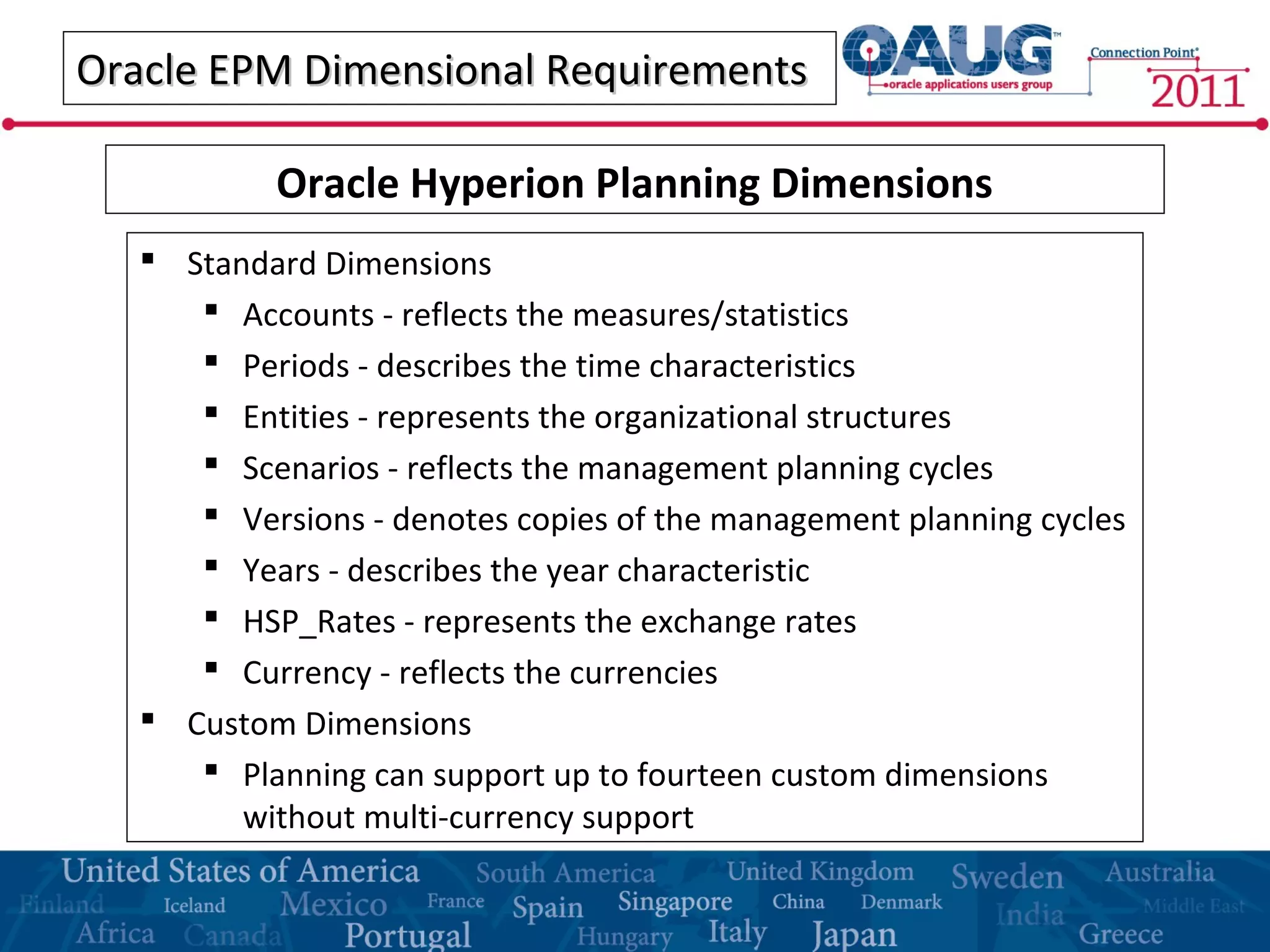
 Standard Dimensions
 Accounts - reflects the measures/statistics
 Periods - describes the time characteristics
 Entities - represents the organizational structures
 Scenarios - reflects the management planning cycles
 Versions - denotes copies of the management planning cycles
 Years - describes the year characteristic
 HSP_Rates - represents the exchange rates
 Currency - reflects the currencies
 Custom Dimensions
 Planning can support up to fourteen custom dimensions
without multi-currency support
Oracle Hyperion Planning Dimensions
Oracle EPM Dimensional RequirementsOracle EPM Dimensional Requirements
• Standard dimensions do not apply to Essbase
Applications
• Flexibility of Essbase offers extreme dimensional
customization
• Offers support for Planning and Financial
Management applications as well as most other
reporting solutions
Oracle Essbase Dimensions
Common Design ScenariosCommon Design Scenarios
• Organize data sets that will be planned into
groups of common dimensionality
• Avoid building one application with many
dimensions to support all planned data
• Leverage a separate application to support
consolidated reporting
• Consider loading data instead of deriving it when
calc inputs are not dimensionally relevant
Dimensional Design for Budget & Forecasting Applications
Common Design ScenariosCommon Design Scenarios
Dimensional Design for Budget & Forecasting Applications
DEMONSTRATION
Common Design ScenariosCommon Design Scenarios
 Dimensional Challenge
 When consolidation occurs in HFM, eliminations for
intercompany transactions are stored at the parent with the
first common currency
 Shared Dimensions
 Accounts Dimension
 Entities Dimension
 ICP Dimension
 Value Dimension
 Other Dimensions
 Data Type Dimension
 Version Dimension
Dimensional Design for Integrating HFM Dimensionality within a Planning
Application
Common Design ScenariosCommon Design Scenarios
Dimensional Design for Integrating HFM Dimensionality
within a Planning Application
DEMONSTRATION
Common Design ScenariosCommon Design Scenarios
 Types of Audit Trails
 User
 Track data entry by user
 Entity
 Track data movement across entities
 Scenario/Version
 Track data movement across data sets
such as allocations
Dimensional Design to Support Audit Trails
Common Design ScenariosCommon Design Scenarios
Dimensional Design to Support Audit Trails
DEMONSTRATION
Common Design ScenariosCommon Design Scenarios
 The view dimension provides alternative perspectives of the
data stored in the EPM Application
 View examples
 Scaling
 Percent of Sales
 Utilization
 Conversion
 Careful attention to implementation is required to avoid
performance issues and/or inaccurate results
View Dimension
Common Design ScenariosCommon Design Scenarios
View Dimension
DEMONSTRATION
Common Design ScenariosCommon Design Scenarios
 Standard time dimensions
 Years
 Periods
 Days
 Calendar-based time dimensions
 Custom calendar dimension
 Date-Time Dimension
Time-Based Dimensions
Common Design ScenariosCommon Design Scenarios
Time-Based Dimensions
DEMONSTRATION
Common Design ScenariosCommon Design Scenarios
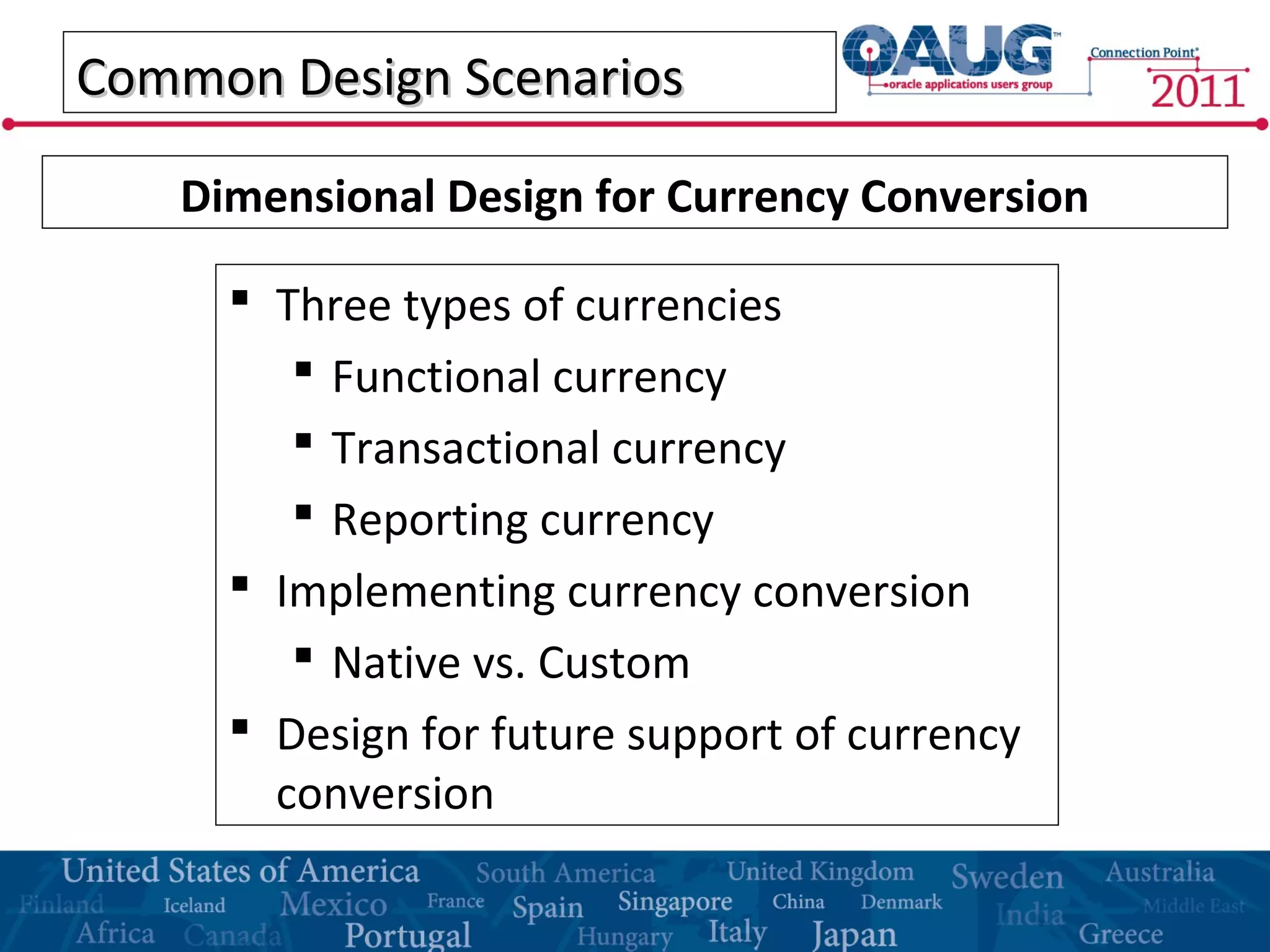
 Three types of currencies
 Functional currency
 Transactional currency
 Reporting currency
 Implementing currency conversion
 Native vs. Custom
 Design for future support of currency
conversion
Dimensional Design for Currency Conversion
Common Design ScenariosCommon Design Scenarios
DEMONSTRATION
Dimensional Design for Currency Conversion
Common Design ScenariosCommon Design Scenarios
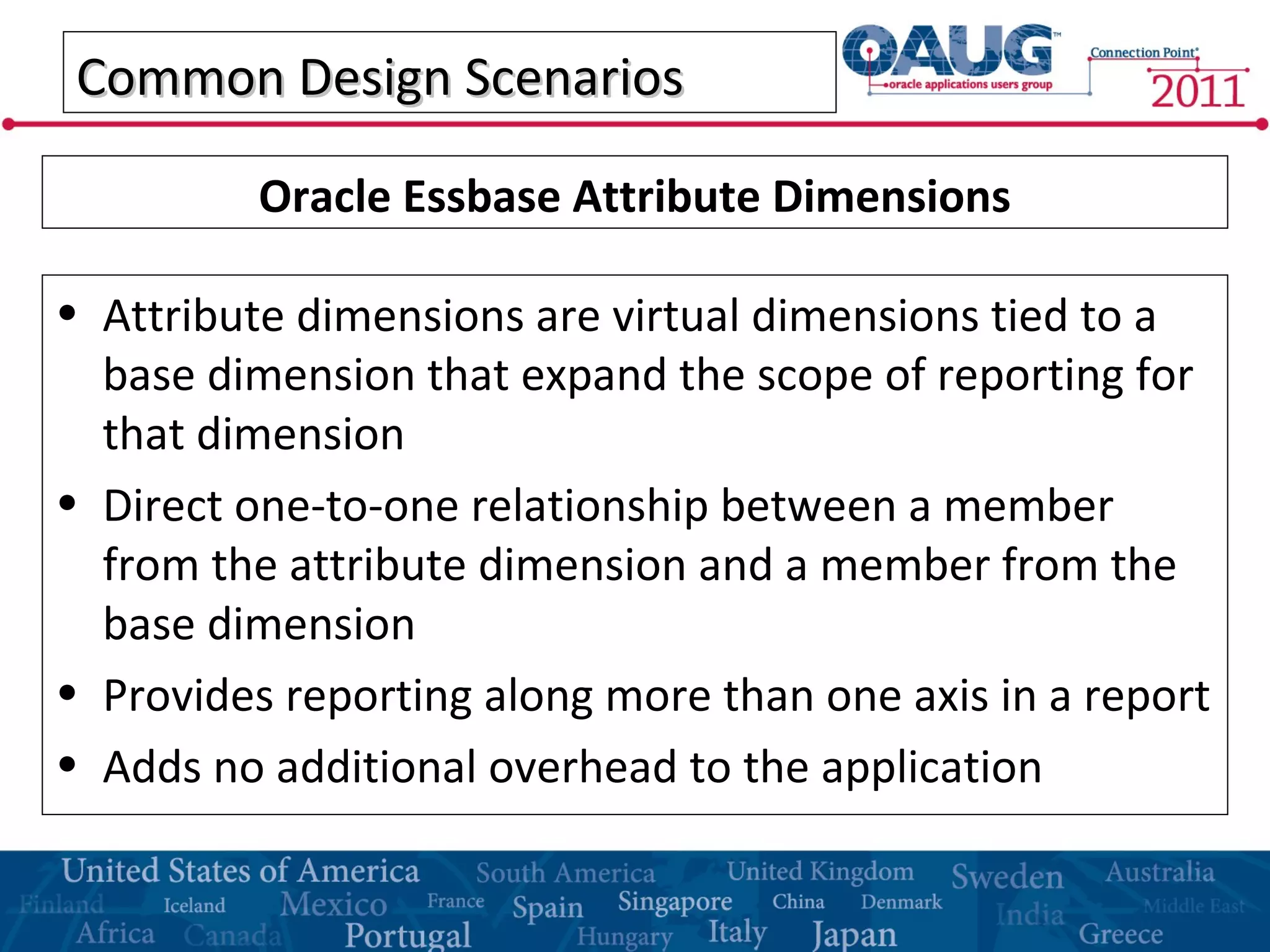
• Attribute dimensions are virtual dimensions tied to a
base dimension that expand the scope of reporting for
that dimension
• Direct one-to-one relationship between a member
from the attribute dimension and a member from the
base dimension
• Provides reporting along more than one axis in a report
• Adds no additional overhead to the application
Oracle Essbase Attribute Dimensions
Dimension Decisions:Dimension Decisions:
A Guide to Defining Dimensions for YourA Guide to Defining Dimensions for Your
Oracle EPM SolutionOracle EPM Solution
November 16November 16thth
, 2011, 2011
RJ LinehanRJ Linehan
rj@innovuspartners.comrj@innovuspartners.com

Dimension Decisions: A Guide to Defining Dimensions for Your Oracle EPM Solution

  • 1.
    Dimension Decisions:Dimension Decisions: AGuide to Defining Dimensions for YourA Guide to Defining Dimensions for Your Oracle EPM SolutionOracle EPM Solution November 16November 16thth , 2011, 2011 RJ LinehanRJ Linehan rj@innovuspartners.comrj@innovuspartners.com
  • 2.
    Presentation AgendaPresentation Agenda Presenter Biography  Dimensional Modeling Concepts  Oracle EPM Dimensional Requirements  Financial Management (HFM)  Planning  Essbase  Common Design Scenarios  Questions
  • 3.
    Presenter BiographyPresenter Biography RJ Linehan, Innovus Partners  Eleven Years experience consulting in the EPM/BI Space  Expertise in functional and technical requirements gathering  Deployed over 30 EPM/BI solutions  Key Industry experience  Consumer Packaged Goods  Retail  Insurance and Financial Services  Primary Application Experience  Management Reporting Applications  Budget & Forecasting Solutions  Workforce and Capital Asset Planning Models  Customer/Product Profitability Models  Executive Dashboards
  • 4.
    Dimensional Modeling ConceptsDimensionalModeling Concepts  A single set of common data that satisfies the following user requirements  Ability to make informed business decisions based on the right data  Expectation of accurate data provided at the correct grain  Delivery of the data in a secure and timely fashion  Capacity to change with business requirements What is a dimensional model? (Borrowed from "The Data Warehouse Toolkit" by Ralph Kimball and Margy Ross)
  • 5.
    Dimensional Modeling ConceptsDimensionalModeling Concepts • A fact is a business measure that is typically numeric • A fact is the numerical data stored in an EPM application • A fact can be additive or non-additive • The list of dimensions that encompass an EPM application defines the grain of the fact and the scope of measurement What is a Fact? (Borrowed from "The Data Warehouse Toolkit" by Ralph Kimball and Margy Ross)
  • 6.
    Dimensional Modeling ConceptsDimensionalModeling Concepts • A dimension and its attributes describe the facts stored in an EPM application • Dimension attributes define the 'By' in a report (Revenue by Quarter by Region) • A dimension is a type of Metadata What is a Dimension? (Borrowed from "The Data Warehouse Toolkit" by Ralph Kimball and Margy Ross)
  • 7.
    Dimensional Modeling ConceptsDimensionalModeling Concepts • Insist on complete functional/business requirements • Know the data that will encompass the subject area • Engage and learn from the business users • Provide detailed pre-design questions for the business and IT • Request sample dimensions from legacy applications Successfully Defining Dimensions During Design
  • 8.
    Dimensional Modeling ConceptsDimensionalModeling Concepts  Existing User Reports  Leverage existing user reports to ensure the design supports reporting requirements  MS Excel  Employ MS Excel to illustrate sample report layouts  Outline Editor  Utilize an outline editor and the MS Excel Add-in / Smart View  The business user  Your ears Design Tools Used to Define Dimensions
  • 9.
    Dimensional Modeling ConceptsDimensionalModeling Concepts DEMONSTRATION Successfully Defining Dimensions During Design
  • 10.
    Oracle EPM DimensionalRequirementsOracle EPM Dimensional Requirements • Oracle EPM applications support standard and custom dimensions • A dimension member is an attribute of the dimension that is typically unique to the application • A hierarchy denotes a roll-up of dimension members within a dimension that is either aggregating or non-aggregating • Fact data must be loaded to a member from each dimension in the EPM application • Dimensions are often shared across EPM applications Dimension Definitions for Oracle EPM Applications
  • 11.
    Oracle EPM DimensionalRequirementsOracle EPM Dimensional Requirements • A standard dimension is a required dimension in an EPM Application • A standard dimension offers consistency • A standard dimension provides out-of-the-box functionality for select features of an EPM Application Standard Dimensions in an Oracle EPM Application
  • 12.
    Oracle EPM DimensionalRequirementsOracle EPM Dimensional Requirements • A custom dimension is typically not a required dimension in an EPM Application • A custom dimension provides for customization to satisfy reporting requirements • A custom dimension expands the perspective of data stored in an EPM Application Custom Dimensions in an Oracle EPM Application
  • 13.
    Oracle EPM DimensionalRequirementsOracle EPM Dimensional Requirements • Standard Dimensions – Account - reflects the measures/statistics – Intercompany Partner (ICP) – dynamically built using the entity dimension to capture intercompany transactions – Period - describes the time characteristics – Entity - represents the organizational structures – Scenario - reflects the management planning cycles – Value - provides for consolidation, elimination, adjustments, and translations – View - provides calendar views – Year - describes the year characteristic • Custom Dimensions – HFM supports an additional four custom dimensions Oracle Hyperion Financial Management Dimensions (Rigid)
  • 14.
    Oracle EPM DimensionalRequirementsOracle EPM Dimensional Requirements  Standard Dimensions  Accounts - reflects the measures/statistics  Periods - describes the time characteristics  Entities - represents the organizational structures  Scenarios - reflects the management planning cycles  Versions - denotes copies of the management planning cycles  Years - describes the year characteristic  HSP_Rates - represents the exchange rates  Currency - reflects the currencies  Custom Dimensions  Planning can support up to fourteen custom dimensions without multi-currency support Oracle Hyperion Planning Dimensions
  • 15.
    Oracle EPM DimensionalRequirementsOracle EPM Dimensional Requirements • Standard dimensions do not apply to Essbase Applications • Flexibility of Essbase offers extreme dimensional customization • Offers support for Planning and Financial Management applications as well as most other reporting solutions Oracle Essbase Dimensions
  • 16.
    Common Design ScenariosCommonDesign Scenarios • Organize data sets that will be planned into groups of common dimensionality • Avoid building one application with many dimensions to support all planned data • Leverage a separate application to support consolidated reporting • Consider loading data instead of deriving it when calc inputs are not dimensionally relevant Dimensional Design for Budget & Forecasting Applications
  • 17.
    Common Design ScenariosCommonDesign Scenarios Dimensional Design for Budget & Forecasting Applications DEMONSTRATION
  • 18.
    Common Design ScenariosCommonDesign Scenarios  Dimensional Challenge  When consolidation occurs in HFM, eliminations for intercompany transactions are stored at the parent with the first common currency  Shared Dimensions  Accounts Dimension  Entities Dimension  ICP Dimension  Value Dimension  Other Dimensions  Data Type Dimension  Version Dimension Dimensional Design for Integrating HFM Dimensionality within a Planning Application
  • 19.
    Common Design ScenariosCommonDesign Scenarios Dimensional Design for Integrating HFM Dimensionality within a Planning Application DEMONSTRATION
  • 20.
    Common Design ScenariosCommonDesign Scenarios  Types of Audit Trails  User  Track data entry by user  Entity  Track data movement across entities  Scenario/Version  Track data movement across data sets such as allocations Dimensional Design to Support Audit Trails
  • 21.
    Common Design ScenariosCommonDesign Scenarios Dimensional Design to Support Audit Trails DEMONSTRATION
  • 22.
    Common Design ScenariosCommonDesign Scenarios  The view dimension provides alternative perspectives of the data stored in the EPM Application  View examples  Scaling  Percent of Sales  Utilization  Conversion  Careful attention to implementation is required to avoid performance issues and/or inaccurate results View Dimension
  • 23.
    Common Design ScenariosCommonDesign Scenarios View Dimension DEMONSTRATION
  • 24.
    Common Design ScenariosCommonDesign Scenarios  Standard time dimensions  Years  Periods  Days  Calendar-based time dimensions  Custom calendar dimension  Date-Time Dimension Time-Based Dimensions
  • 25.
    Common Design ScenariosCommonDesign Scenarios Time-Based Dimensions DEMONSTRATION
  • 26.
    Common Design ScenariosCommonDesign Scenarios  Three types of currencies  Functional currency  Transactional currency  Reporting currency  Implementing currency conversion  Native vs. Custom  Design for future support of currency conversion Dimensional Design for Currency Conversion
  • 27.
    Common Design ScenariosCommonDesign Scenarios DEMONSTRATION Dimensional Design for Currency Conversion
  • 28.
    Common Design ScenariosCommonDesign Scenarios • Attribute dimensions are virtual dimensions tied to a base dimension that expand the scope of reporting for that dimension • Direct one-to-one relationship between a member from the attribute dimension and a member from the base dimension • Provides reporting along more than one axis in a report • Adds no additional overhead to the application Oracle Essbase Attribute Dimensions
  • 29.
    Dimension Decisions:Dimension Decisions: AGuide to Defining Dimensions for YourA Guide to Defining Dimensions for Your Oracle EPM SolutionOracle EPM Solution November 16November 16thth , 2011, 2011 RJ LinehanRJ Linehan rj@innovuspartners.comrj@innovuspartners.com

Editor's Notes

  • #3 Provide you with a brief background on my experience Touch on basic concepts in dimensional modeling Discuss the dimensional requirements for each of the applications in the EPM Stack Dive into the meat of the presentation and walk through common design scenarios that you will encounter when building an EPM application
  • #4 11 years consulting, 13 years working with the products Can do front-line consulting, Expertise in project management / Starting number 32 next month CPG, Retail, Ins/Fin Mgt Rpt, Budg/Fcst, Capex, WrkFrc, Profitability, Exec Dashboards
  • #5 Not covering all facets of RG and Design Dimensional Design is most important concept for EPM If not done properly -> user responses The reports do not provide the answers I'm looking for The data is not available when I need it I don't have access to the data that I need to do my job The reports and calculations take too long to execute, it would be faster if I did it manually in Excel All existing features and functionality of EPM tool set will not be meaningful to the user if not properly designed Dimensional design of an EPM solution and how Kimball's Dimensional Modeling techniques are related Talk about the book you read and the class you took With the wrong data, the business user cannot do his or her job To the user, the inability to get to the level-of-detail required for reporting and validation becomes unusable data That truth is magnified when it is inaccurate or incorrectly pulled from the source system Data is a valuable company asset that needs to be protected and secure Out-of-date data will cause delays in reactions to ever changing market conditions and prevent an organization from being proactive Organization Changes/Industry Changes All these changes drive changing reporting requirements
  • #6 Before we dive into our discussion on dimensions, we need to talk about 'What is a fact?' For the purposes of this discussion around Oracle EPM, a fact is numeric Typed measures in Essbase, Smart Lists in Planning, Annotations in WorkSpace are all examples of metadata Additive Accounts GL accounts that roll-up to a P&L line item Measures that aggregate along the time dimension (months->quarters->totalyear) Non-Additive Accounts Balance sheet accounts with EOM balances do not aggregate along the time dimension Percent variance calculation that compares Current Year to Prior Year This statement further demonstrates why dimensional design is SO important to dimensional design because it drives the architectural core of the dimensional model
  • #7 For example, The source system furnishes a numerical value (our fact) to be loaded to an EPM application This numerical value, let's say it is $1,000 will have qualities that describe it It was money spent to a laptop computer for an employee It was an actual expense incurred by the organization - Scenario, Act It is an expense booked to the Computer Hardware expense account in the GL - Accounts, Computer Hardware Expense The computer was purchased in June of 2011 - Year, 2011 / Periods, Jun The employee works for HR - Entity, HR Department The attributes or members (in EPM terms) make-up the dimension and the dimension describes the facts loaded to an EPM application For example, I would like to rank sales by region and quarter I would like to track salaries by employee I would like to report billing by client and attorney Metadata is not a dimension, often the terms are used interchangeably, which is not entirely incorrect There are other types of metadata besides dimensions Annotations and commentary Security Form definition Business logic / Calc scripts
  • #8 Preface with the challenge of setting expectations and ensuring all parties (IT, Business, Sponsors, Consultants) understand the deliverables and sign-off on them Step back and review the overall state of a company's management reporting environment, take stock of what is available, what is usable, what the business users desire Without proper requirements you are setting up yourself for failure Confirm that the data exists and is in a state that it can be delivered by the source system within the parameters defined by the project Make sure it is the correct data and supports the reporting requirements defined by the users I always provide a list of questions specific to the solution being implemented to be answered by the business and IT This information supplements the business requirements document during design to ensure nothing is missed Request sample dimensions from legacy applications Used to build out an outline before design Working with the outline editor and excel to demonstrate reporting during design is useful in providing the business with a taste of what the solution will deliver and validate the requirements This is a form of "Rapid BI" This rule is used to determine if a two attributes of a fact should be in the same dimension or separate dimensions Can be a challenge when defining dimensions during design if reporting needs are not clearly defined
  • #9 Let's discuss in more detail what tools are available during design Leverage existing user reports to ensure the design supports reporting requirements Great source of information and assists with dimension design because the reports axis's and content provide clues into what dimensions are required Accountants/Analysts will NOT give up Excel, it is a tool they understand, are used to, and embrace Use it during design It will reduce the chance that a disconnect on meaning and interpretation will occur between you and the business during design Visually, the outline editor is the best way to present the dimensions during design, People tend to better understand the design when they see it in the outline editor Immediate retrieval of data into excel also helps validate the design Information from the user and endorsement of the design is a valuable tool Listen, listen, listen Ask to repeat if necessary Remember, the people in the room, especially the business users, are experts in their field, they know there data, and have been working with it a lot longer than you In most cases, people naturally appreciate when you take a genuine interest in what it is they do and you show that by listening to them and asking questions
  • #10 Walk through the approach to defining dimensions from existing user report Call out the distinction between content that relates to a dimension vs. metadata Show the output from investigating the user report and how the dimensional design is validated through the that report build
  • #11 What are standard and custom dimensions? I'll explain in the next two slides Essbase can support duplicate member names, but that design approach is normally discarded because of the challenges it poses to reporting Examples include June Sales FY11 Examples include YearTotal is a popular roll-up that includes months, quarters, and yeartotal All Years represents a non-aggregating roll-up of the year members If there are 10 dimensions in an EPM application, each data point will have 10 members that describe it, one from each dimension Important consideration for design because you want to build a solution that standardizes dimensions ensuring that the definition of that dimension is carried across applications Of course there are times when a dimension may have different meanings to different units within an organization, but that usually identifies the need for additional attributes or hierarchies within that dimension
  • #12 Users familiar with one application will have an easier time learning a new one with the same standard dimensions Those dimensions that are common across applications can be created once and recycled for other applications Workforce Planning includes the Employee dimension Capex Planning includes the Asset Class and Line Items dimensions These standard dimensions assist with providing out-of-the-box features such as pre-defined business rules and forms to streamline the build process
  • #13 As we'll discuss, HFM requires that an application be deployed with all four of its custom dimensions These dimensions offer the uniqueness required for each EPM application At times loading more than one type of data to the same EPM application is justified and the use of custom dimensions allows for that to happen
  • #14 Most rigid of the EPM application types (HFM, Planning, and Essbase) because it requires you to deploy an application with 12 dimensions This is not a bad thing, in fact for what HFM is designed to do, financial consolidations, it is a VERY good thing because it does it well The reason I included HFM in this discussion is because 3 projects of worked on in the past two years sourced actuals from HFM and had lots of intercompany transactions and eliminations
  • #18 Demo Demonstrate how the dimensional design handles the different grains and scope of data across applications Currency Dimension Currently not used, but created a hook for currency to be used in the near future BalanceSheetRoles Dimension Support for security and auditing Modeling Dimension Utility dimension to support different attributes of data In Workforce it supported the loading of bonus data and combo codes (job codes) in PS HR In IncSt it supported additional reporting required for supply chain, marketing, and advertising
  • #19 What are they? Intercompany Transactions An accounting transaction created from activity between two entities in same company Eliminations Offset of Intercompany Txn via HFM Consolidation Pose a consolidation problem in Planning Called the ReportCurrency dimension and supported load of both base entity elimination data as well as data in report currency
  • #22 Demo Use of User dimension Track who makes changes, security designed around this dimension Use of two entity dimensions One supports the Use of Restatement roll-up in the scenarios dimension TotRst must equal Actual to ensure accuracy A calc script is executed to derive the offsetting record stored in the RstFrom member
  • #23 Typically used in read-only reporting Adds support for reporting on a different axis of the report
  • #25 Very often, implementing the time attribute of a fact in an EPM solution is a straightforward procedure Typically, the calendar element of the time dimension if separated into another dimension to minimize size, simplify use, and provide for extended reporting
  • #26 Walk through the reporting samples that demonstrate the time-based analytic features available to the user
  • #28 Walk through the reporting samples that demonstrate the time-based analytic features available to the user