Data Warehouse: 13
Data Transformation
Prof Neeraj Bhargava
Vaibhav Khanna
Department of Computer Science
School of Engineering and Systems Sciences
Maharshi Dayanand Saraswati University Ajmer
Data Transformation
• Data transformation enables organizations to
alter the structure and format of raw data as
needed.
• Definition: Data transformation is the process
of changing the format, structure, or values of
data.
Types of Data Transformation
• Data transformation may be:
– constructive (adding, copying, and replicating
data),
– destructive (deleting fields and records),
– aesthetic (standardizing salutations or street
names), or
– structural (renaming, moving, and combining
columns in a database)
Benefits of Data Transformation
• Data is transformed to make it better-organized.
Transformed data may be easier for both humans and
computers to use.
• Properly formatted and validated data improves data
quality and protects applications from potential
landmines such as null values, unexpected duplicates,
incorrect indexing, and incompatible formats.
• Data transformation facilitates compatibility between
applications, systems, and types of data. Data used for
multiple purposes may need to be transformed in
different ways..
Data Transformation
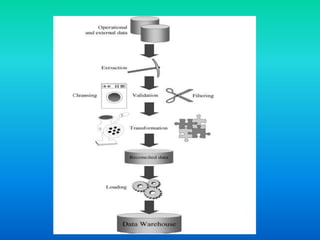
The main transformation processes aimed at
populating the reconciled data layer are:
• Conversion and normalization, that operate on
both storage formats and units of measure to
make data uniform
• Matching, that associates equivalent fields, in
different sources
• Selection, that reduces the number of source
fields and records
Data Transformation Processes
• Extraction and parsing:
• Initial transformations are focused on shaping the
format and structure of data to ensure its
compatibility with both the destination system
and the data already there.
• Translation and mapping :
• Some of the most basic data transformations
involve the mapping and translation of data. For
example, a column containing integers
representing error codes can be mapped to the
relevant error descriptions
Data Transformation Processes: Cont…
• Filtering, aggregation, and summarization
• Data transformation is often concerned with
whittling data down and making it more
manageable. Data may be consolidated by
filtering out unnecessary fields, columns, and
records.
• Enrichment and imputation
• Data from different sources can be merged to
create de normalized, enriched information.
Data Transformation Processes: Cont…
• Indexing and ordering
• Data can be transformed so that it’s ordered
logically or to suit a data storage scheme.
Creating indexes can improve performance or
improve the management of relationships
between different tables.
• Anonymization and encryption
• Data containing personally identifiable
information, or other information that could
compromise privacy or security, should be
anonymized before propagation.
Data Transformation Processes: Cont…
• Modeling, typecasting, formatting, and
renaming
• Finally, a whole set of transformations can
reshape data without changing content. This
includes casting and converting data types for
compatibility, adjusting dates and times with
offsets and format localization, and renaming
schemas, tables, and columns for clarity.
Assignment
What do You understand by data transformation?
Discuss the various data transformation processes
Thank You

Data warehouse 13 data transformation

  • 1.
    Data Warehouse: 13 DataTransformation Prof Neeraj Bhargava Vaibhav Khanna Department of Computer Science School of Engineering and Systems Sciences Maharshi Dayanand Saraswati University Ajmer
  • 2.
    Data Transformation • Datatransformation enables organizations to alter the structure and format of raw data as needed. • Definition: Data transformation is the process of changing the format, structure, or values of data.
  • 3.
    Types of DataTransformation • Data transformation may be: – constructive (adding, copying, and replicating data), – destructive (deleting fields and records), – aesthetic (standardizing salutations or street names), or – structural (renaming, moving, and combining columns in a database)
  • 4.
    Benefits of DataTransformation • Data is transformed to make it better-organized. Transformed data may be easier for both humans and computers to use. • Properly formatted and validated data improves data quality and protects applications from potential landmines such as null values, unexpected duplicates, incorrect indexing, and incompatible formats. • Data transformation facilitates compatibility between applications, systems, and types of data. Data used for multiple purposes may need to be transformed in different ways..
  • 6.
    Data Transformation The maintransformation processes aimed at populating the reconciled data layer are: • Conversion and normalization, that operate on both storage formats and units of measure to make data uniform • Matching, that associates equivalent fields, in different sources • Selection, that reduces the number of source fields and records
  • 7.
    Data Transformation Processes •Extraction and parsing: • Initial transformations are focused on shaping the format and structure of data to ensure its compatibility with both the destination system and the data already there. • Translation and mapping : • Some of the most basic data transformations involve the mapping and translation of data. For example, a column containing integers representing error codes can be mapped to the relevant error descriptions
  • 8.
    Data Transformation Processes:Cont… • Filtering, aggregation, and summarization • Data transformation is often concerned with whittling data down and making it more manageable. Data may be consolidated by filtering out unnecessary fields, columns, and records. • Enrichment and imputation • Data from different sources can be merged to create de normalized, enriched information.
  • 9.
    Data Transformation Processes:Cont… • Indexing and ordering • Data can be transformed so that it’s ordered logically or to suit a data storage scheme. Creating indexes can improve performance or improve the management of relationships between different tables. • Anonymization and encryption • Data containing personally identifiable information, or other information that could compromise privacy or security, should be anonymized before propagation.
  • 10.
    Data Transformation Processes:Cont… • Modeling, typecasting, formatting, and renaming • Finally, a whole set of transformations can reshape data without changing content. This includes casting and converting data types for compatibility, adjusting dates and times with offsets and format localization, and renaming schemas, tables, and columns for clarity.
  • 11.
    Assignment What do Youunderstand by data transformation? Discuss the various data transformation processes Thank You