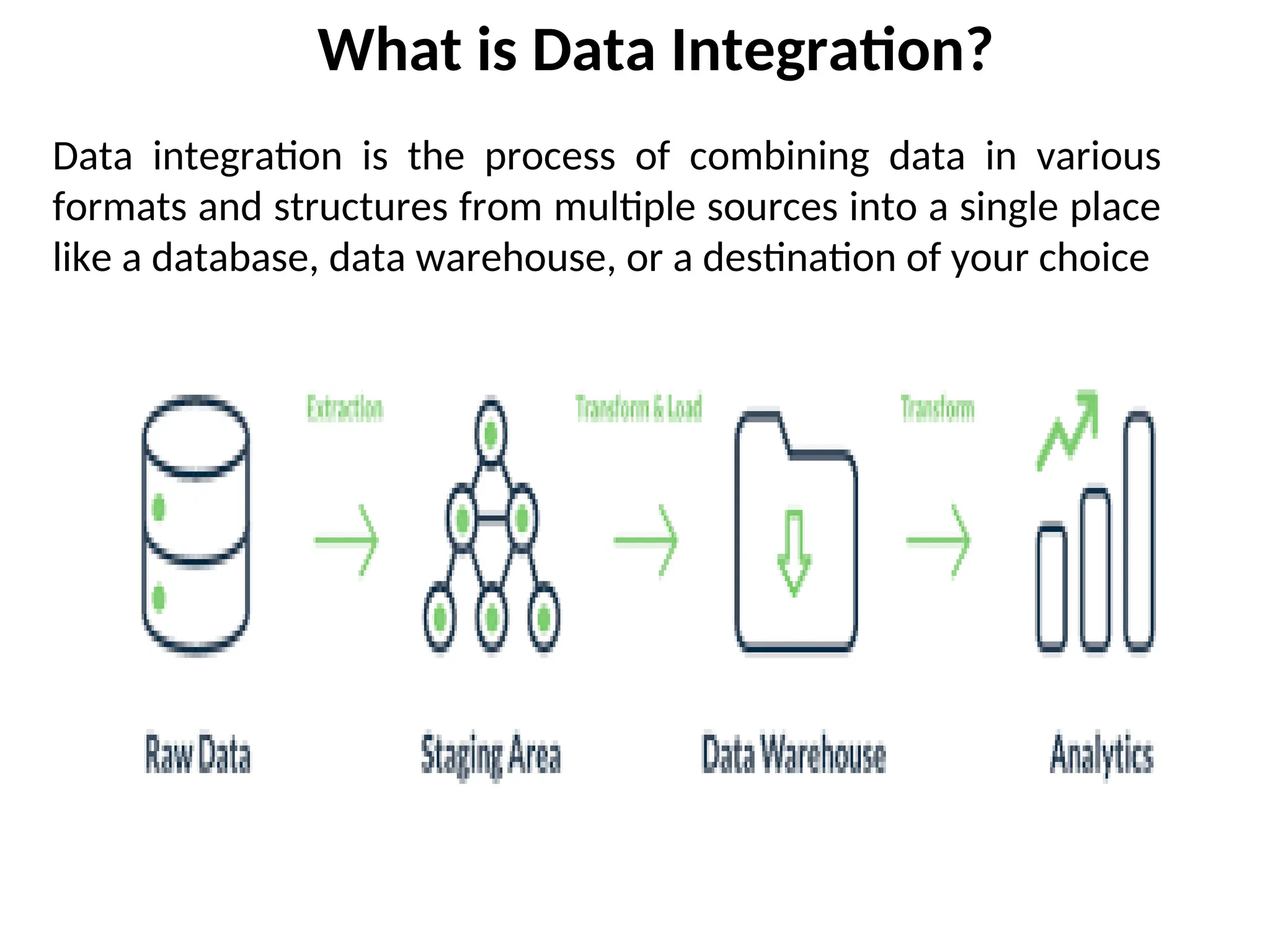
Data integration isthe process of combining data in various
formats and structures from multiple sources into a single place
like a database, data warehouse, or a destination of your choice
What is Data Integration?
2.
Data Integration Architecture
•Data Integration architecture is a defined
structure for designing, organizing, and
managing a fluid flow between IT systems
across your firm to form a single unified view
of your business.
Data Integration Challenges
DiverseData Sources: Data present in multiple sources have different
formats, structures, and schemas. They generally need significant
transformation and mapping in order to integrate data from all your sources.
Data Quality: Data usefulness and reliability are often hampered by
outdated, inaccurate, incomplete, and poorly formatted data.
Data Security: Ensuring the security and privacy of data is a major concern
when integrating data from multiple sources. It is important to have robust
security measures in place to protect sensitive data.
Ineffective Integration Solutions: Poorly designed or implemented
integration solutions may have issues such as poor performance during
fluctuating workloads, difficulty in mapping data from different sources, or a
lack of support for different data formats or structures.
Hybrid Cloud On-Premise Systems: It becomes a complex task to integrate
the data stored in multiple locations, such as on-premise infrastructure and
cloud systems and networks.
5.
Data Integration vsData Migration
Data migration often aims to upgrade data
management and ease access by moving data to a
more modern or better-suited system.
data integration is focused on improving decision-
making and enabling data-driven insights by
combining data from multiple sources that provide
users with a unified view.
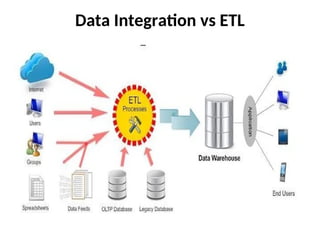
• Extract, Transform,and Load(ETL) is the most
versatile technique used for extracting data from
multiple sources, applying rules or transformations
to make data consistent with the target data system,
then loading it to a data warehouse or a destination
of your choice.
• Data Integration is a parent process that includes
multiple activities such as data ingestion, data
cleansing, data transformation, and data
distribution. When comparing data integration vs
ETL, ETL can be termed as a subset of data
integration that focuses on the extraction,
transformation, and loading of data.
What is DataTransformation?
• Data transformation is a critical step in data analysis
process, encompassing the conversion, cleaning, and
organizing of data into accessible formats.
• Simple Data Transformations include straight
forward procedures including data cleansing,
standardization, aggregation, and filtering.
• Complex Data Transformations include more
advanced processes such data integration, migration,
replication, and enrichment
10.
Importance of DataTransformation
• Improved Data Quality: Data transformation
eliminates mistakes, inserts in missing information,
and standardizes formats, resulting in higher-quality,
more dependable, and accurate data.
• Enhanced Compatibility: By converting data into a
suitable format, companies may avoid possible
compatibility difficulties when integrating data from
many sources or systems.
• Simplified Data Management: Data transformation is
the process of evaluating and modifying data to
maximize storage and discoverability, making it
simpler to manage and maintain.
11.
• Broader Application:Transformed data is
more useable and applicable in a larger
variety of scenarios, allowing enterprises to
get the most out of their data.
• Faster Queries: By standardizing data and
appropriately storing it in a warehouse, query
performance and BI tools may be enhanced,
resulting in less friction during analysis.
12.
Key Data TransformationOperations for
Effective Analysis
• Normalization: Modifying data scales, such as scaling values
from 0 to 1, to enable comparisons.
• Standardization: Transforming data to have a unit variance
and zero mean, which is frequently required before using
machine learning methods.
• Encoding: Transforming categorical data into numerical
representations using label or one-hot encoding, for example.
• Discretization: Converting continuous data into discrete bins,
which in some circumstances can facilitate analysis and
enhance model performance.
• Attribute Generation: Creating new variables from existing
data, such as deriving an ‘age’ variable from a date of birth.
13.
• Revising: Ensuringthat the data supports its intended usage
by deleting duplicates, standardizing the data collection, and
purifying it.
• Manipulation: Creating new values from existing ones or
changing the state of data through computing.
• Separating: Splitting down data values into component for
filtering on certain values.
• Combining/Integrating: Bringing together data from several
tables and sources to provide a comprehensive picture of an
organization.
• Binning or Discretization: Continuous data can be grouped
into discrete categories, which is helpful for managing noisy
data.
• Smoothing: Methods like moving averages can be applied to
reduce noise in time series or create smoothed data.
14.
Advantages of DataTransformation
• Enhanced Data Quality: Data transformation
aids in the organisation and cleaning of data,
improving its quality.
• Compatibility: It guarantees data consistency
between many platforms and systems, which is
necessary for integrated business
environments.
• Improved Analysis: Analytical results that are
more accurate and perceptive are frequently
the outcome of transformed data.
15.
Limitations of DataTransformation
• Complexity: When working with big or varied
datasets, the procedure might be laborious
and complicated.
• Cost: The resources and tools needed for
efficient data transformation might be
expensive.
• Risk of Data Loss: Inadequate transformations
may cause important data to be lost or
distorted.