Introduction
•In this chapter,we gonna learn more about
•data science
•Data Vs Information
•Data types and representation
•Data value chain and
•Basic concept of Big data
3.
After completing thischapter, the students will be able to:
• Describe what data science is and the role of data
scientists.
• Differentiate data and information.
• Describe data processing life cycle
• Understand different data types from diverse perspectives
• Describe data value chain in emerging era of big data.
• Understand the basics of Big Data.
• Describe the purpose of the Hadoop ecosystem components.
4.
2.1. An Overviewof Data Science
Self test Exercise
•What is data science?
•Can you describe the role of data in
emerging technology?
• What are data and information?
•What is big data?
5.
Con’t…
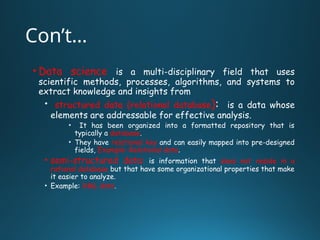
• Data scienceis a multi-disciplinary field that uses
scientific methods, processes, algorithms, and systems to
extract knowledge and insights from
• structured data (relational database): is a data whose
elements are addressable for effective analysis.
• It has been organized into a formatted repository that is
typically a database.
• They have relational key and can easily mapped into pre-designed
fields, Example: Relational data.
• semi-structured data: is information that does not reside in a
rational database but that have some organizational properties that make
it easier to analyze.
• Example: XML data.
6.
Con’t…
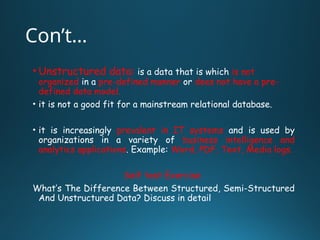
• Unstructured data:is a data that is which is not
organized in a pre-defined manner or does not have a pre-
defined data model.
• it is not a good fit for a mainstream relational database.
• it is increasingly prevalent in IT systems and is used by
organizations in a variety of business intelligence and
analytics applications. Example: Word, PDF, Text, Media logs.
Self test Exercise
What’s The Difference Between Structured, Semi-Structured
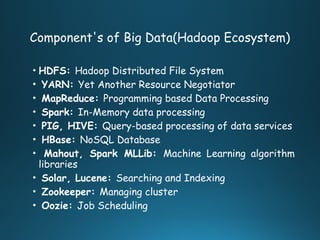
And Unstructured Data? Discuss in detail
7.
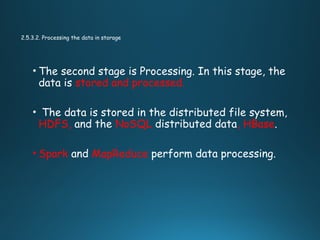
Con’t…
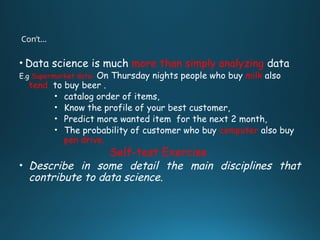
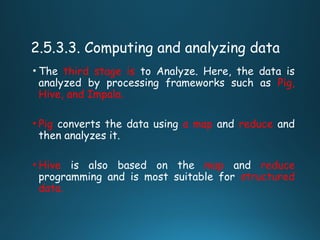
• Data scienceis much more than simply analyzing data
E.g Supermarket data- On Thursday nights people who buy milk also
tend to buy beer .
• catalog order of items,
• Know the profile of your best customer,
• Predict more wanted item for the next 2 month,
• The probability of customer who buy computer also buy
pen drive.
Self-test Exercise
• Describe in some detail the main disciplines that
contribute to data science.
8.
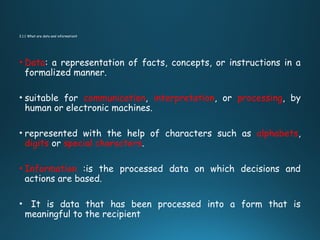
2.1.1 What aredata and information?
• Data: a representation of facts, concepts, or instructions in a
formalized manner.
• suitable for communication, interpretation, or processing, by
human or electronic machines.
• represented with the help of characters such as alphabets,
digits or special characters.
• Information :is the processed data on which decisions and
actions are based.
• It is data that has been processed into a form that is
meaningful to the recipient
9.
Con’t…
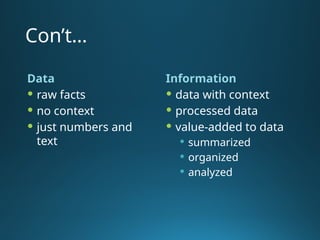
Data
raw facts
no context
just numbers and
text
Information
data with context
processed data
value-added to data
summarized
organized
analyzed
10.
Can't…
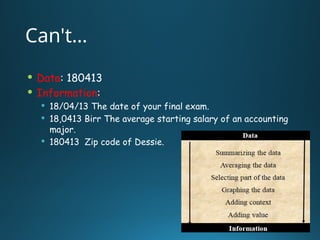
Data: 180413
Information:
18/04/13 The date of your final exam.
18,0413 Birr The average starting salary of an accounting
major.
180413 Zip code of Dessie.
11.
2.1.2. Data ProcessingCycle
• Data processing is the re-structuring or re-ordering of data
by people or machines to increase their usefulness
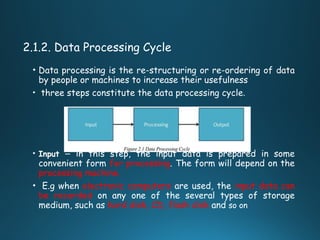
• three steps constitute the data processing cycle.
• Input − in this step, the input data is prepared in some
convenient form for processing. The form will depend on the
processing machine.
• E.g when electronic computers are used, the input data can
be recorded on any one of the several types of storage
medium, such as hard disk, CD, flash disk and so on
12.
Can't…
• Processing −in this step, the input data is changed to
produce data in a more useful form.
• For example, interest can be calculated on deposit to a bank,
or a summary of sales for the month can be calculated from
the sales orders.
• Output − at this stage, the result of the proceeding
processing step is collected.
• The particular form of the output data depends on the use
of the data. For example, output data may be payroll for
employees.
13.
Self Test Exercise
•Discuss the main differences between data and
information with examples
• Can we process data manually using a pencil and
paper?
• Discuss the differences with data processing using
the computer with manually.
14.
2.3 Data typesand their representation
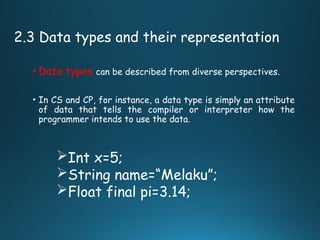
• Data types can be described from diverse perspectives.
• In CS and CP, for instance, a data type is simply an attribute
of data that tells the compiler or interpreter how the
programmer intends to use the data.
Int x=5;
String name=“Melaku”;
Float final pi=3.14;
15.
2.3.1. Data typesfrom Computer programming
perspective
• What is Programming language?
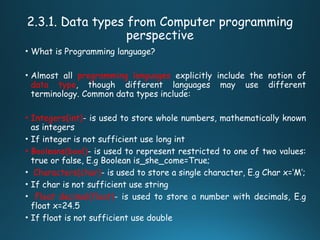
• Almost all programming languages explicitly include the notion of
data type, though different languages may use different
terminology. Common data types include:
• Integers(int)- is used to store whole numbers, mathematically known
as integers
• If integer is not sufficient use long int
• Booleans(bool)- is used to represent restricted to one of two values:
true or false, E.g Boolean is_she_come=True;
• Characters(char)- is used to store a single character, E.g Char x=‘M’;
• If char is not sufficient use string
• Float decimal(float)- is used to store a number with decimals, E.g
float x=24.5
• If float is not sufficient use double
16.
Can't
• Explain typesof Programming language.
• A data type makes the values that expression, such as a
variable or a function, might take.
• This data type defines the operations that can be done on
the data, the meaning of the data, and the way values of
that type can be stored.
17.
2.3.2. Data typesfrom Data Analytics
perspective
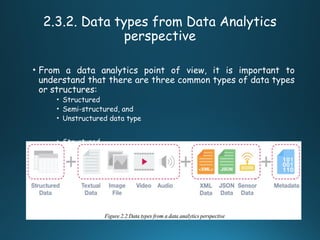
• From a data analytics point of view, it is important to
understand that there are three common types of data types
or structures:
• Structured
• Semi-structured, and
• Unstructured data type
• Structured
18.
Can't…
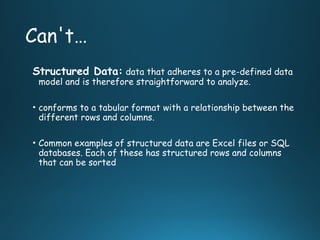
Structured Data: datathat adheres to a pre-defined data
model and is therefore straightforward to analyze.
• conforms to a tabular format with a relationship between the
different rows and columns.
• Common examples of structured data are Excel files or SQL
databases. Each of these has structured rows and columns
that can be sorted
19.
Can't…
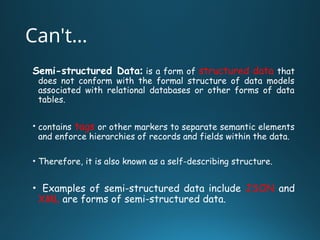
Semi-structured Data: isa form of structured data that
does not conform with the formal structure of data models
associated with relational databases or other forms of data
tables.
• contains tags or other markers to separate semantic elements
and enforce hierarchies of records and fields within the data.
• Therefore, it is also known as a self-describing structure.
• Examples of semi-structured data include JSON and
XML are forms of semi-structured data.
20.
Can't…
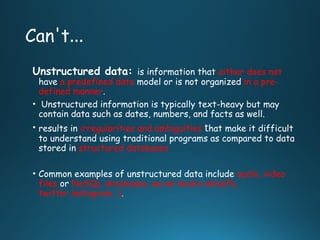
Unstructured data: isinformation that either does not
have a predefined data model or is not organized in a pre-
defined manner.
• Unstructured information is typically text-heavy but may
contain data such as dates, numbers, and facts as well.
• results in irregularities and ambiguities that make it difficult
to understand using traditional programs as compared to data
stored in structured databases
• Common examples of unstructured data include audio, video
files or NoSQL databases, social media data(fb,
twitter,instagram…).
21.
Can't…
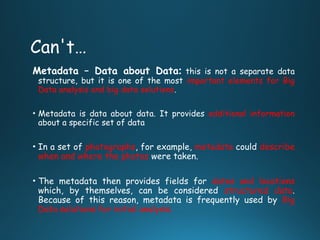
Metadata – Dataabout Data: this is not a separate data
structure, but it is one of the most important elements for Big
Data analysis and big data solutions.
• Metadata is data about data. It provides additional information
about a specific set of data
• In a set of photographs, for example, metadata could describe
when and where the photos were taken.
• The metadata then provides fields for dates and locations
which, by themselves, can be considered structured data.
Because of this reason, metadata is frequently used by Big
Data solutions for initial analysis.
22.
Can't…
Self Test Exercise
oDiscuss data types from programming and
analytics perspectives.
o Compare metadata with structured,
unstructured and semi-structured data
o Given at least one example of structured,
unstructured and semi-structured data types
23.
2.4. Data valueChain
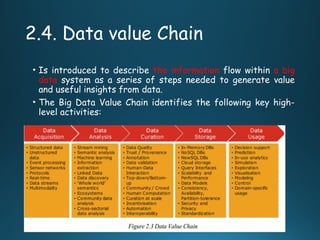
• Is introduced to describe the information flow within a big
data system as a series of steps needed to generate value
and useful insights from data.
• The Big Data Value Chain identifies the following key high-
level activities:
24.
2.4.1. Data Acquisition
•It is the process of gathering, filtering, and
cleaning data before it is put in a data warehouse .
• Data warehouse is a repository of information
collected from multiple sources, stored under a
unified schema, and which usually resides at a
single site.
• A data warehouse is a decision support
database that is maintained separately from
the organization’s operational database.
25.
Can't…
• Data acquisitionis one of the major big data
challenges in terms of infrastructure requirements.
• The infrastructure required to support the
acquisition of big data must deliver low, predictable
latency in both capturing data and in executing
queries.
• be able to handle very high transaction volumes,
often in a distributed environment; and support
flexible and dynamic data structures.
26.
2.4.2. Data Analysis
•It is concerned with making the raw data acquired amenable
to use in decision-making as well as domain-specific usage.
• Data analysis involves exploring, transforming, and modeling
data with the goal of highlighting relevant data, synthesizing
and extracting useful hidden information with high potential
from a business point of view.
• Related areas include data mining, business intelligence, and
machine learning
27.
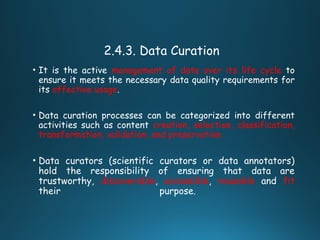
2.4.3. Data Curation
•It is the active management of data over its life cycle to
ensure it meets the necessary data quality requirements for
its effective usage.
• Data curation processes can be categorized into different
activities such as content creation, selection, classification,
transformation, validation, and preservation.
• Data curators (scientific curators or data annotators)
hold the responsibility of ensuring that data are
trustworthy, discoverable, accessible, reusable and fit
their purpose.
28.
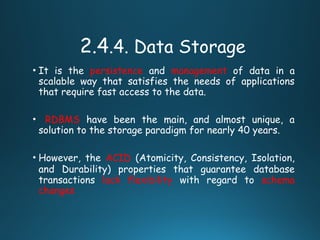
2.4.4. Data Storage
•It is the persistence and management of data in a
scalable way that satisfies the needs of applications
that require fast access to the data.
• RDBMS have been the main, and almost unique, a
solution to the storage paradigm for nearly 40 years.
• However, the ACID (Atomicity, Consistency, Isolation,
and Durability) properties that guarantee database
transactions lack flexibility with regard to schema
changes
29.
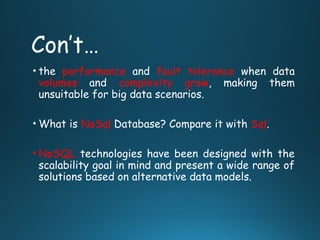
Con’t…
• the performanceand fault tolerance when data
volumes and complexity grow, making them
unsuitable for big data scenarios.
• What is NoSql Database? Compare it with Sql.
• NoSQL technologies have been designed with the
scalability goal in mind and present a wide range of
solutions based on alternative data models.
30.
2.4.5. Data Usage
•It covers the data-driven business activities that
need access to data, its analysis, and the tools
needed to integrate the data analysis within the
business activity.
• Data usage in business decision-making can
enhance competitiveness through the reduction of
costs, increased added value, or any other
parameter that can be measured against existing
performance criteria.
31.
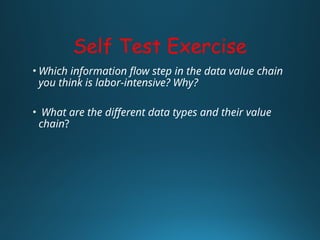
Self Test Exercise
•Which information flow step in the data value chain
you think is labor-intensive? Why?
• What are the different data types and their value
chain?
32.
2.5. Basic conceptsof big data
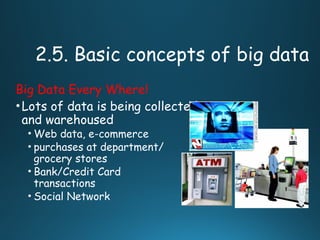
Big Data Every Where!
•Lots of data is being collected
and warehoused
• Web data, e-commerce
• purchases at department/
grocery stores
• Bank/Credit Card
transactions
• Social Network
33.
Can't…
• Big datais a blanket term for the non-traditional
strategies and technologies needed to gather,
organize, process, and gather insights from large
datasets.
• While the problem of working with data that
exceeds the computing power or storage of a
single computer is not new, the pervasiveness,
scale, and value of this type of computing have
greatly expanded in recent years.
34.
2.5.1. What IsBig Data?
• is the term for a collection of data sets so large and
complex that it becomes difficult to process using on-
hand database management tools or traditional data
processing applications.
• a “large dataset” means a dataset too large to reasonably
process or store with traditional tooling or on a single
computer.
• the common scale of big datasets is constantly shifting
and may vary significantly from organization to
organization
35.
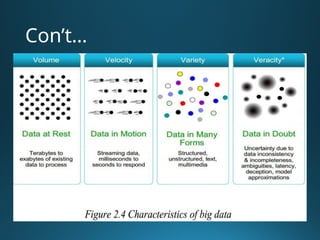
Bigdata: 4/5 V’s
•Big data is characterized by 4V and more:
• Volume: Machine generated data is produced in larger
quantities than non traditional data.
• large amounts of data Zeta bytes/Massive datasets
• Velocity: the speed of data processing.
• Data is live streaming or in motion
• Variety: large variety of input data which in turn
generates large amount of data as output.
• data comes in many different forms from diverse sources
• Veracity: can we trust the data? How accurate is it? etc.
• Value: for what purpose we are going to use data
2.5.2. Clustered Computingand Hadoop
Ecosystem
2.5.2.1.Clustered Computing
• To better address the high storage and
computational needs of big data, computer clusters
are a better fit.
• Big data clustering software combines the resources
of many smaller machines, seeking to provide a
number of benefits:
• Resource Pooling: Combining the available storage
space to hold data is a clear benefit, but CPU and
memory pooling are also extremely important.
38.
Con’t…
• High Availability:Clusters can provide varying levels
of fault tolerance and availability guarantees to
prevent hardware or software failures
• Easy Scalability: Clusters make it easy to scale
horizontally by adding additional machines to the
group.
• clusters requires a solution for managing cluster
membership, coordinating resource sharing, and
scheduling actual work on individual nodes.
39.
Con’t…
• Cluster membershipand resource allocation can be
handled by software like Hadoop’s YARN (which
stands for Yet Another Resource Negotiator).
• assembled computing cluster often acts as a
foundation that other software interfaces with to
process the data.
•
40.
Self Test Exercise
•List and discuss the characteristics of big data ➢
Describe the big data life cycle. Which step you think
most useful and why?
• List and describe each technology or tool used in the
big data life cycle.
• Discuss the three methods of computing over a large
dataset.
41.
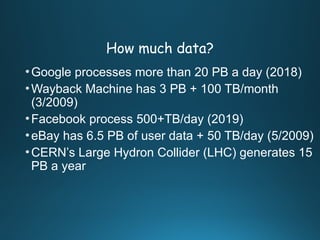
How much data?
•Googleprocesses more than 20 PB a day (2018)
•Wayback Machine has 3 PB + 100 TB/month
(3/2009)
•Facebook process 500+TB/day (2019)
•eBay has 6.5 PB of user data + 50 TB/day (5/2009)
•CERN’s Large Hydron Collider (LHC) generates 15
PB a year
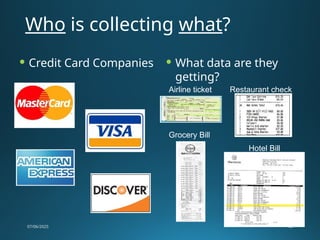
Who is collectingwhat?
07/06/2025 43
Credit Card Companies What data are they
getting?
Restaurant check
Grocery Bill
Airline ticket
Hotel Bill
44.
How Can YouAvoid Big Data?
• Pay cash for everything!
• Never go online!
• Don’t use a telephone! How????
• Don’t fill any prescriptions!
• Never leave your house!
45.
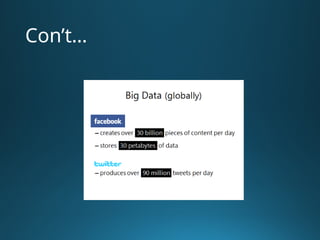
Examples of bigdata…..
• Walmart handles more than 1 million customer
transactions every hour, which is imported into
databases estimated to contain more than 2.5
petabytes * of data — the equivalent of 167 times
the information contained in all the books in the
US Library of Congress.
• FICO Credit Card Fraud Detection System
protects 2.1 billion active accounts world-wide.
46.
Examples of bigdata…..
• NASA Climate Simulation
32 petabytes
• The Large Hadron Collider
25 petabytes annually, 200 petabytes after
replication
• Wall mart
2.5 petabytes per hour
47.
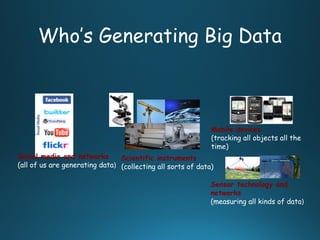
Who’s Generating BigData
Social media and networks
(all of us are generating data)
Scientific instruments
(collecting all sorts of data)
Mobile devices
(tracking all objects all the
time)
Sensor technology and
networks
(measuring all kinds of data)
48.
2.5.2.2.Hadoop and itsEcosystem
• Hadoop is an open-source framework intended to
make interaction with big data easier.
• It is a framework that allows for the distributed
processing of large datasets across clusters of
computers using simple programming models.
• Designed to answer the question: “How to process
big data with reasonable cost and time?”
49.
Con’t…
• inspired bya technical document published by Google. The
four key characteristics of Hadoop are:
• Economical: highly economical as ordinary computers can be
used for data processing.
• Reliable: stores copies of the data on different machines and
is resistant to hardware failure.
• Scalable: It is easily scalable both, horizontally and vertically.
• Flexible: can store as much structured and unstructured
data .
50.
Con’t…
• Hadoop hasan ecosystem that has evolved from its
four core components:
• data management,
• access,
• processing, and
• storage.
• It is continuously growing to meet the needs of Big
Data.
51.
Component's of BigData(Hadoop Ecosystem)
• HDFS: Hadoop Distributed File System
• YARN: Yet Another Resource Negotiator
• MapReduce: Programming based Data Processing
• Spark: In-Memory data processing
• PIG, HIVE: Query-based processing of data services
• HBase: NoSQL Database
• Mahout, Spark MLLib: Machine Learning algorithm
libraries
• Solar, Lucene: Searching and Indexing
• Zookeeper: Managing cluster
• Oozie: Job Scheduling
52.
2.5.3. Big DataLife Cycle with Hadoop
2.5.3.1. Ingesting data into the system
• The first stage of Big Data processing is Ingest.
• The data is ingested or transferred to Hadoop
from various sources such as relational databases,
systems, or local files.
• Sqoop transfers data from RDBMS to HDFS,
whereas Flume transfers event data.
53.
2.5.3.2. Processing thedata in storage
• The second stage is Processing. In this stage, the
data is stored and processed.
• The data is stored in the distributed file system,
HDFS, and the NoSQL distributed data, HBase.
• Spark and MapReduce perform data processing.
54.
2.5.3.3. Computing andanalyzing data
• The third stage is to Analyze. Here, the data is
analyzed by processing frameworks such as Pig,
Hive, and Impala.
• Pig converts the data using a map and reduce and
then analyzes it.
• Hive is also based on the map and reduce
programming and is most suitable for structured
data.
55.
2.5.3.4. Visualizing theresults
• The fourth stage is Access, which is performed by
tools such as Hue and Cloudera Search.
• In this stage, the analyzed data can be accessed
by users.










![Chapter 2 - Intro to Data Sciences[2].pptx](https://cdn.slidesharecdn.com/ss_thumbnails/chapter2-introtodatasciences2-230326001432-ec8e4032-thumbnail.jpg?width=640&height=640&fit=bounds)


![chapter-1 Introduction to Emerging Technologies [Autosaved].pptx](https://cdn.slidesharecdn.com/ss_thumbnails/chapter-1introductiontoemergingtechnologiesautosaved-250721132907-a397d4ad-thumbnail.jpg?width=640&height=640&fit=bounds)
![chapter-1 Introduction to Emerging Technologies [Autosaved].pptx](https://cdn.slidesharecdn.com/ss_thumbnails/chapter-1introductiontoemergingtechnologiesautosaved-250706055921-dccba335-thumbnail.jpg?width=640&height=640&fit=bounds)


