D A T A S T R U C T U R E S
Data:
Data are simply collection of facts and figures. Data are values or set of
values. A data item refers to a single unit of values.
Data items that are divided into sub items are group items; those that are not
are called elementary items. For example, a student’s name may be divided into
three sub items – [first name, middle name and last name] but the ID of a student
would normally be treated as a single item.
Student
ID Name Address Age Gender
First LastMiddle
Street Area
In the above example ( ID, Age, Gender, First, Middle, Last, Street, Area ) are
elementary data items, whereas (Name, Address ) are group data items.
An entity is something that has certain attributes or properties which may be
assigned values. The values themselves may be either numeric or non-numeric.
Example:
Attributes: Name Age Gender Social Society number
Values: Hamza 20 M 134-24-5533
Ali Rizwan 23 M 234-9988775
Fatima 20 F 345-7766443
Entities with similar attributes (e.g. all the employees in an organization)
form an entity set. Each attribute of an entity set has a range of values, the set of all
possible values that could be assigned to the particular attribute.
The term “information” is sometimes used for data with given attributes, of,
in other words meaningful or processed data.
A field is a single elementary unit of information representing an attribute of
an entity, a record is the collection of field values of a given entity and a file is the
collection of records of the entities in a given entity set.
Data Structure:
In computer science, a data structure is a particular way of storing and
organizing data in a computer’s memory so that it can be used efficiently. Data may
be organized in many different ways; the logical or mathematical model of a
particular organization of data is called a data structure. The choice of a particular
data model depends on the two considerations first; it must be rich enough in
structure to mirror the actual relationships of the data in the real world. On the other
hand, the structure should be simple enough that one can effectively process the
data whenever necessary.
D A T A S T R U C T U R E S
Categories of Data Structure:
The data structure can be classified in to major types:
 Linear Data Structure 
 Non-linear Data Structure 
1. Linear Data Structure:
A data structure is said to be linear if its elements form any sequence. There
are basically two ways of representing such linear structure in memory.
a) One way is to have the linear relationships between the elements represented
by means of sequential memory location. These linear structures are called
arrays.
b) The other way is to have the linear relationship between the elements
represented by means of pointers or links.
These linear structures are called linked lists. The
common examples of linear data structure are
 Arrays 
 Queues 
 Stacks 
 Linked lists 

2. Non-linear Data Structure:
This structure is mainly used to represent data containing a hierarchical
relationship between elements.
e.g. graphs, family trees and table of contents.
Arrays:
The simplest type of data structure is a linear (or one dimensional) array. A
list of a finite number n of similar data referenced respectively by a set of n
consecutive numbers, usually 1, 2, 3 . . . . . . . n. if we choose the name A for the
array, then the elements of A are denoted by subscript notation
A1, A2, A 3 . . . . An
or by the parenthesis notation A
(1), A (2), A (3) . . . . . . A (n)
or by the bracket notation
A [1], A [2], A [3] . . . . . . A [n]
Example:
A linear array A[8] consisting of numbers is pictured in following figure.
Linked List:
A linked list, or one way list is a linear collection of data elements, called
nodes, where the linear order is given by means of pointers. Each node is
divided into two parts:
 The first part contains the information of the element/node 
 The second part contains the address of the next node (link /next
pointer field) in the list. 
D A T A S T R U C T U R E S
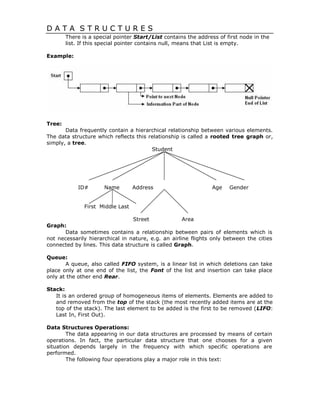
There is a special pointer Start/List contains the address of first node in the
list. If this special pointer contains null, means that List is empty.
Example:
Tree:
Data frequently contain a hierarchical relationship between various elements.
The data structure which reflects this relationship is called a rooted tree graph or,
simply, a tree.
Student
ID# Name Address Age Gender
First Middle Last
Street Area
Graph:
Data sometimes contains a relationship between pairs of elements which is
not necessarily hierarchical in nature, e.g. an airline flights only between the cities
connected by lines. This data structure is called Graph.
Queue:
A queue, also called FIFO system, is a linear list in which deletions can take
place only at one end of the list, the Font of the list and insertion can take place
only at the other end Rear.
Stack:
It is an ordered group of homogeneous items of elements. Elements are added to
and removed from the top of the stack (the most recently added items are at the
top of the stack). The last element to be added is the first to be removed (LIFO:
Last In, First Out).
Data Structures Operations:
The data appearing in our data structures are processed by means of certain
operations. In fact, the particular data structure that one chooses for a given
situation depends largely in the frequency with which specific operations are
performed.
The following four operations play a major role in this text:
D A T A S T R U C T U R E S
 Traversing: accessing each record/node exactly once so
that certain items in the record may be processed. (This
accessing and processing is sometimes called “visiting”
the record.) 
 Searching: Finding the location of the desired node with a
given key value, or finding the locations of all such nodes
which satisfy one or more conditions. 
 Inserting: Adding a new node/record to the structure. 
 Deleting: Removing a node/record from the structure.

Data structures introduction

  • 1.
    D A TA S T R U C T U R E S Data: Data are simply collection of facts and figures. Data are values or set of values. A data item refers to a single unit of values. Data items that are divided into sub items are group items; those that are not are called elementary items. For example, a student’s name may be divided into three sub items – [first name, middle name and last name] but the ID of a student would normally be treated as a single item. Student ID Name Address Age Gender First LastMiddle Street Area In the above example ( ID, Age, Gender, First, Middle, Last, Street, Area ) are elementary data items, whereas (Name, Address ) are group data items. An entity is something that has certain attributes or properties which may be assigned values. The values themselves may be either numeric or non-numeric. Example: Attributes: Name Age Gender Social Society number Values: Hamza 20 M 134-24-5533 Ali Rizwan 23 M 234-9988775 Fatima 20 F 345-7766443 Entities with similar attributes (e.g. all the employees in an organization) form an entity set. Each attribute of an entity set has a range of values, the set of all possible values that could be assigned to the particular attribute. The term “information” is sometimes used for data with given attributes, of, in other words meaningful or processed data. A field is a single elementary unit of information representing an attribute of an entity, a record is the collection of field values of a given entity and a file is the collection of records of the entities in a given entity set. Data Structure: In computer science, a data structure is a particular way of storing and organizing data in a computer’s memory so that it can be used efficiently. Data may be organized in many different ways; the logical or mathematical model of a particular organization of data is called a data structure. The choice of a particular data model depends on the two considerations first; it must be rich enough in structure to mirror the actual relationships of the data in the real world. On the other hand, the structure should be simple enough that one can effectively process the data whenever necessary.
  • 2.
    D A TA S T R U C T U R E S Categories of Data Structure: The data structure can be classified in to major types:  Linear Data Structure   Non-linear Data Structure  1. Linear Data Structure: A data structure is said to be linear if its elements form any sequence. There are basically two ways of representing such linear structure in memory. a) One way is to have the linear relationships between the elements represented by means of sequential memory location. These linear structures are called arrays. b) The other way is to have the linear relationship between the elements represented by means of pointers or links. These linear structures are called linked lists. The common examples of linear data structure are  Arrays   Queues   Stacks   Linked lists   2. Non-linear Data Structure: This structure is mainly used to represent data containing a hierarchical relationship between elements. e.g. graphs, family trees and table of contents. Arrays: The simplest type of data structure is a linear (or one dimensional) array. A list of a finite number n of similar data referenced respectively by a set of n consecutive numbers, usually 1, 2, 3 . . . . . . . n. if we choose the name A for the array, then the elements of A are denoted by subscript notation A1, A2, A 3 . . . . An or by the parenthesis notation A (1), A (2), A (3) . . . . . . A (n) or by the bracket notation A [1], A [2], A [3] . . . . . . A [n] Example: A linear array A[8] consisting of numbers is pictured in following figure. Linked List: A linked list, or one way list is a linear collection of data elements, called nodes, where the linear order is given by means of pointers. Each node is divided into two parts:  The first part contains the information of the element/node   The second part contains the address of the next node (link /next pointer field) in the list. 
  • 3.
    D A TA S T R U C T U R E S There is a special pointer Start/List contains the address of first node in the list. If this special pointer contains null, means that List is empty. Example: Tree: Data frequently contain a hierarchical relationship between various elements. The data structure which reflects this relationship is called a rooted tree graph or, simply, a tree. Student ID# Name Address Age Gender First Middle Last Street Area Graph: Data sometimes contains a relationship between pairs of elements which is not necessarily hierarchical in nature, e.g. an airline flights only between the cities connected by lines. This data structure is called Graph. Queue: A queue, also called FIFO system, is a linear list in which deletions can take place only at one end of the list, the Font of the list and insertion can take place only at the other end Rear. Stack: It is an ordered group of homogeneous items of elements. Elements are added to and removed from the top of the stack (the most recently added items are at the top of the stack). The last element to be added is the first to be removed (LIFO: Last In, First Out). Data Structures Operations: The data appearing in our data structures are processed by means of certain operations. In fact, the particular data structure that one chooses for a given situation depends largely in the frequency with which specific operations are performed. The following four operations play a major role in this text:
  • 4.
    D A TA S T R U C T U R E S  Traversing: accessing each record/node exactly once so that certain items in the record may be processed. (This accessing and processing is sometimes called “visiting” the record.)   Searching: Finding the location of the desired node with a given key value, or finding the locations of all such nodes which satisfy one or more conditions.   Inserting: Adding a new node/record to the structure.   Deleting: Removing a node/record from the structure.