Security threats and
controls
There is need to protect data from theft because it used to
make decisions in everyday life. Wrongful storage of data can
lead to a number of evil activities if it reaches malicious people
Data security core principles
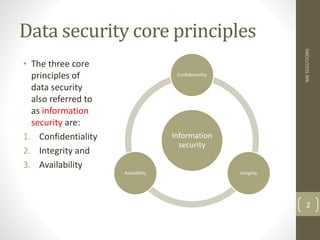
• The three core
principles of
data security
also referred to
as information
security are:
1. Confidentiality
2. Integrity and
3. Availability
MK
SOLUTIONS
2
Information
security
Confidentiality
integrity
Availability
Confidentiality
• This implies that sensitive data or information belonging to an
organization or government should not be accessed by or
disclosed to unauthorized people.
• Such data includes: office documents, chemical formula,
employee’s details, examinations etc.
MK
SOLUTIONS
3
Datasecuritycoreprinciples
Integrity
• Integrity refers to a situation where data should not be
modified without owner’s authority
4
Datasecuritycoreprinciples
MK
SOLUTIONS
Availability
• Information must be available on demand
• This translates to any information system and communication
link used to access it, must be efficient and functional. An
information system may be unavailable due to power outages,
hardware failures, unplanned upgrades or repairs
MK
SOLUTIONS
5
Datasecuritycoreprinciples
Security Threats and
Control Measures
Security threats of private or confidential data includes
unauthorized access, alteration, malicious destruction of hardware,
software, data or network resources as well as sabotage.
The main objective of data security control measures is to provide
security, ensure integrity and safety of an information system
hardware, software and data
Information System Failure
Causes of computerized system failure include
1. Hardware failure due to improper use
2. Unstable power supply as a result of brownout or blackout
and vandalism
3. Network breakdown
4. Natural disaster
5. Program failure
6. Computer virus attacks
MK
SOLUTIONS
7
Control measuresagainst hardwarefailure
• Computer systems should be protected from brownout or
blackout which may cause physical damage or data loss by
using surge protectors and UPS
• Most organizations use Fault Tolerant Systems
• A fault tolerant system has redundant or duplicate storage,
peripheral devices and software that provide a fail-over
capability to back up components in the event of system
failure
• Disaster recovery plans – involves establishing offsite
storage of an organization ‘s databases so that in case of
disaster or fire accidents, the company would have backup
copies to reconstruct lost data from.
MK
SOLUTIONS
8
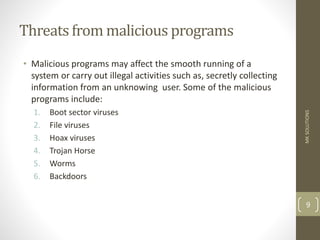
Threats from malicious programs
• Malicious programs may affect the smooth running of a
system or carry out illegal activities such as, secretly collecting
information from an unknowing user. Some of the malicious
programs include:
1. Boot sector viruses
2. File viruses
3. Hoax viruses
4. Trojan Horse
5. Worms
6. Backdoors
MK
SOLUTIONS
9
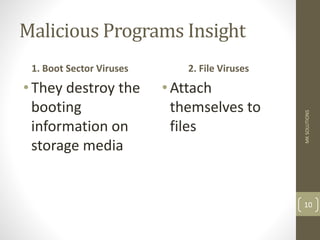
Malicious Programs Insight
1. Boot Sector Viruses
•They destroy the
booting
information on
storage media
2. File Viruses
•Attach
themselves to
files
MK
SOLUTIONS
10
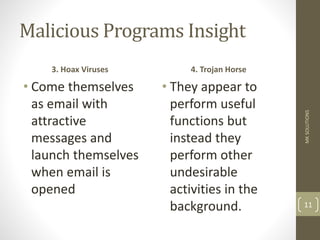
Malicious Programs Insight
3. Hoax Viruses
• Come themselves
as email with
attractive
messages and
launch themselves
when email is
opened
4. Trojan Horse
• They appear to
perform useful
functions but
instead they
perform other
undesirable
activities in the
background.
MK
SOLUTIONS
11
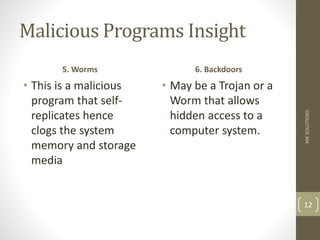
Malicious Programs Insight
5. Worms
• This is a malicious
program that self-
replicates hence
clogs the system
memory and storage
media
6. Backdoors
• May be a Trojan or a
Worm that allows
hidden access to a
computer system.
MK
SOLUTIONS
12
Control measures against theft
1. Employ security agents to keep watch over information
centers and restricted backup sites
2. Reinforce weak access points like the windows, door and
roofing with metallic grills and strong padlocks.
3. Motivate workers so that they feel a sense of belonging in
order to make them proud and trusted custodians of the
company resources.
4. Insure the hardware resources with a reputable insurance
firm.
5. Encrypt and create strong passwords for your data and
access to computers
MK
SOLUTIONS
13
Piracy
•Piracy is a form of intellectual
property theft which means illegal
copying of software, information or
data. Software, information and data
are protected by copyright and patent
laws
MK
SOLUTIONS
14
Control measures against piracy
• To reduce piracy:
1. Enforce laws that protect the owners of data
and information against piracy
2. Make software cheap enough to increase
affordability
3. User licenses and certificates to identify
original software
4. Set installation passwords that deter illegal
installations of software
MK
SOLUTIONS
15
Fraud
• Fraud is a deception deliberately practiced in order to
secure unfair or unlawful gain
• Computer fraud is defined as any act using computers,
the Internet, Internet devices, and Internet services to
defraud people, companies, or government agencies of
money, revenue, or Internet access. There are many
methods used to perform these illegal activities.
Phishing, social engineering, viruses, and DDoS attacks
are fairly well known tactics used to disrupt service or
gain access to another's funds.
MK
SOLUTIONS
16
Sabotage
•Refers to illegal destruction of
data and information with the
aim of crippling service
delivery or causing great loss
to an organization.
MK
SOLUTIONS
17
Threats to piracy and confidentiality
• Privacy means that data or information
belonging to an individual should not be
accessed by or disclosed to other people. Its an
individual’s right to determine for themselves
what should be communicated to others
• Confidentiality – is the sensitive data or
information belonging to an organization or
government. Should therefore not to be
accessed by or disclosed by unauthorized people
MK
SOLUTIONS
18
Computercrimesrelatedtodataprivacyandsecurity
MK
SOLUTIONS
19
1. Eavesdropping
This refers to tapping into
communication channels to get
information.
Hackers use eavesdropping to access
private or confidential information
from internet users or from poorly
secured information systems
Computercrimesrelatedtodataprivacyandsecurity
MK
SOLUTIONS
20
2. Surveillance (monitoring)
This is the monitoring of computer
systems and networks using
background programs such as
spyware, malware and cookies
Computercrimesrelatedtodataprivacyandsecurity
MK
SOLUTIONS
21
3) Industrial Espionage
This involves spying on a
competitor to get information that
can be used to cripple the
competitor
Computercrimesrelatedtodataprivacyandsecurity
MK
SOLUTIONS
22
4) Hacking and Cracking
•Hacking is the process of gaining
unauthorized access into a system just
for fun and the person who hacks is
called a hacker.
•Cracking is the process of gaining
unauthorized access into a system for
malicious reasons
Computercrimesrelatedtodataprivacyandsecurity
MK
SOLUTIONS
23
5) Alteration
•Alteration is the illegal
modification of private or
confidential data and information
with the aim of misinforming
users.
ControlMeasuresAgainstUnauthorizedAccess
MK
SOLUTIONS
24
Introduction
•To safeguard information, a
number of security measures
should be put in place. This
include:
ControlMeasuresAgainstUnauthorizedAccess
MK
SOLUTIONS
25
A. Firewall
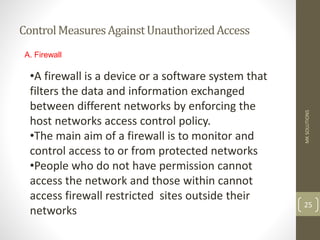
•A firewall is a device or a software system that
filters the data and information exchanged
between different networks by enforcing the
host networks access control policy.
•The main aim of a firewall is to monitor and
control access to or from protected networks
•People who do not have permission cannot
access the network and those within cannot
access firewall restricted sites outside their
networks
ControlMeasuresAgainstUnauthorizedAccess
MK
SOLUTIONS
26
B. Data Encryption
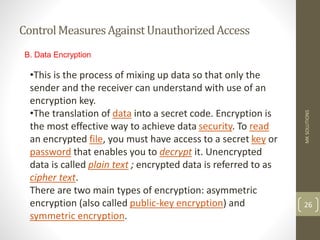
•This is the process of mixing up data so that only the
sender and the receiver can understand with use of an
encryption key.
•The translation of data into a secret code. Encryption is
the most effective way to achieve data security. To read
an encrypted file, you must have access to a secret key or
password that enables you to decrypt it. Unencrypted
data is called plain text ; encrypted data is referred to as
cipher text.
There are two main types of encryption: asymmetric
encryption (also called public-key encryption) and
symmetric encryption.
ControlMeasuresAgainstUnauthorizedAccess
MK
SOLUTIONS
27
C. Security Monitors
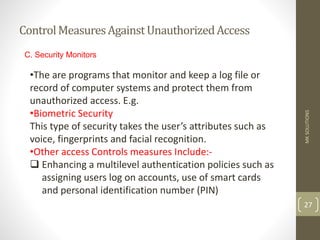
•The are programs that monitor and keep a log file or
record of computer systems and protect them from
unauthorized access. E.g.
•Biometric Security
This type of security takes the user’s attributes such as
voice, fingerprints and facial recognition.
•Other access Controls measures Include:-
 Enhancing a multilevel authentication policies such as
assigning users log on accounts, use of smart cards
and personal identification number (PIN)
Policiesandlawsgoverninginformationsecurity
Introduction
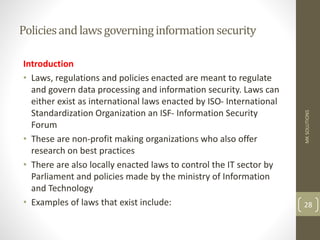
• Laws, regulations and policies enacted are meant to regulate
and govern data processing and information security. Laws can
either exist as international laws enacted by ISO- International
Standardization Organization an ISF- Information Security
Forum
• These are non-profit making organizations who also offer
research on best practices
• There are also locally enacted laws to control the IT sector by
Parliament and policies made by the ministry of Information
and Technology
• Examples of laws that exist include:
MK
SOLUTIONS
28
Policiesandlawsgoverninginformationsecurity
ICT related acts in Kenya
• The science and Technology Act
• Cap. 250 of 1977
• The Kenya Broadcasting Corporation Act of
1988
• The Kenya Communications Act of 1998
However these laws are not adequate to
address the current issues of IT and ICT
MK
SOLUTIONS
29
Policiesandlawsgoverninginformationsecurity
Kenya ICT Policy
•The government has put in place the
ICT policy that seeks to address issues
of privacy, e-security, ICT registration,
cyber crimes, ethical and moral
conduct, copyrights, intellectual
property rights and privacy
MK
SOLUTIONS
30
Policiesandlawsgoverninginformationsecurity
United Kingdom Data Protection Act
1998
•This act protects an individual privacy.
The act states that no processing of
information relating to individuals,
including the obtaining, holding, use
or disclosure of such information can
be done without owner’s consent.
MK
SOLUTIONS
31
Policiesandlawsgoverninginformationsecurity
United Kingdom Computer Misuse Act
1990
• This act makes computer crimes such as
hacking a criminal offence. The act has
become a model of many other countries
including Kenya, which they have used to
draft their own information security
regulations.
MK
SOLUTIONS
32
Policiesandlawsgoverninginformationsecurity
Family Educational Rights and Privacy Act (USA)
• This law protects the privacy of srudent’s
education records. To release any information
from a student’s education record.
Security Breach Notification Laws
• Most countries require businesses, nonprofit,
and state institutions, to notify consumers when
encrypted ‘personal information’ is
compromised, lost, or stolen.
MK
SOLUTIONS
33
Policiesandlawsgoverninginformationsecurity
Copyright and Software Protection Laws
• Hardware and Software are protected by either national or
international Copyright, designs and patents laws or Acts.
• These laws seek to address:
i. Data should not be disclosed to other people without the
owner’s permission
ii. Data and information should be kept secured against loss or
exposure
iii. Data and information should not be kept longer than
necessary
iv. Data and information should be accurate and up to date
v. Data and information should be collected, used and kept for
specified lawful purposes.
MK
SOLUTIONS
34
ReviewQuestions
1. Differentiate between private and confidential data
2. Why is information a useful resource?
3. Explain any three threats to data and information
4. Give two control measures you would take to avoid
unauthorized access to data and information
5. Explain the meaning of industrial espinionage
6. Differentiate between hacking and cracking with reference
to computer crimes
7. What reasons may lead to computer fraud?
8. Explain the term ‘information security’
9. Why would data and information on an externally linked
network not be said to be secure even after burglar proofing
a room?
MK
SOLUTIONS
35
ReviewQuestions
10) How can piracy be prevented in regard to data and
information?
11) Define a computer virus
12) Give four general rules that must be observed to keep
within the law when working with data and information
13) Explain two types of computer viruses
14) What is a program patch? Why are patches important?
15) Explain measures you would take to protect computers from
virus attacks
16) What is data alteration? Explain its effect an data
17) How can you control errors related to data and information?
MK
SOLUTIONS
36
ReviewQuestions
18) Data and information security has recently become very
important. Explain why?
19) Explain eavesdropping with reference to computer crimes
20) Why use copyright laws for software data and information
necessary?
MK
SOLUTIONS
37

DATA SECURITY AND CONTROL.ppt

  • 1.
    Security threats and controls Thereis need to protect data from theft because it used to make decisions in everyday life. Wrongful storage of data can lead to a number of evil activities if it reaches malicious people
  • 2.
    Data security coreprinciples • The three core principles of data security also referred to as information security are: 1. Confidentiality 2. Integrity and 3. Availability MK SOLUTIONS 2 Information security Confidentiality integrity Availability
  • 3.
    Confidentiality • This impliesthat sensitive data or information belonging to an organization or government should not be accessed by or disclosed to unauthorized people. • Such data includes: office documents, chemical formula, employee’s details, examinations etc. MK SOLUTIONS 3 Datasecuritycoreprinciples
  • 4.
    Integrity • Integrity refersto a situation where data should not be modified without owner’s authority 4 Datasecuritycoreprinciples MK SOLUTIONS
  • 5.
    Availability • Information mustbe available on demand • This translates to any information system and communication link used to access it, must be efficient and functional. An information system may be unavailable due to power outages, hardware failures, unplanned upgrades or repairs MK SOLUTIONS 5 Datasecuritycoreprinciples
  • 6.
    Security Threats and ControlMeasures Security threats of private or confidential data includes unauthorized access, alteration, malicious destruction of hardware, software, data or network resources as well as sabotage. The main objective of data security control measures is to provide security, ensure integrity and safety of an information system hardware, software and data
  • 7.
    Information System Failure Causesof computerized system failure include 1. Hardware failure due to improper use 2. Unstable power supply as a result of brownout or blackout and vandalism 3. Network breakdown 4. Natural disaster 5. Program failure 6. Computer virus attacks MK SOLUTIONS 7
  • 8.
    Control measuresagainst hardwarefailure •Computer systems should be protected from brownout or blackout which may cause physical damage or data loss by using surge protectors and UPS • Most organizations use Fault Tolerant Systems • A fault tolerant system has redundant or duplicate storage, peripheral devices and software that provide a fail-over capability to back up components in the event of system failure • Disaster recovery plans – involves establishing offsite storage of an organization ‘s databases so that in case of disaster or fire accidents, the company would have backup copies to reconstruct lost data from. MK SOLUTIONS 8
  • 9.
    Threats from maliciousprograms • Malicious programs may affect the smooth running of a system or carry out illegal activities such as, secretly collecting information from an unknowing user. Some of the malicious programs include: 1. Boot sector viruses 2. File viruses 3. Hoax viruses 4. Trojan Horse 5. Worms 6. Backdoors MK SOLUTIONS 9
  • 10.
    Malicious Programs Insight 1.Boot Sector Viruses •They destroy the booting information on storage media 2. File Viruses •Attach themselves to files MK SOLUTIONS 10
  • 11.
    Malicious Programs Insight 3.Hoax Viruses • Come themselves as email with attractive messages and launch themselves when email is opened 4. Trojan Horse • They appear to perform useful functions but instead they perform other undesirable activities in the background. MK SOLUTIONS 11
  • 12.
    Malicious Programs Insight 5.Worms • This is a malicious program that self- replicates hence clogs the system memory and storage media 6. Backdoors • May be a Trojan or a Worm that allows hidden access to a computer system. MK SOLUTIONS 12
  • 13.
    Control measures againsttheft 1. Employ security agents to keep watch over information centers and restricted backup sites 2. Reinforce weak access points like the windows, door and roofing with metallic grills and strong padlocks. 3. Motivate workers so that they feel a sense of belonging in order to make them proud and trusted custodians of the company resources. 4. Insure the hardware resources with a reputable insurance firm. 5. Encrypt and create strong passwords for your data and access to computers MK SOLUTIONS 13
  • 14.
    Piracy •Piracy is aform of intellectual property theft which means illegal copying of software, information or data. Software, information and data are protected by copyright and patent laws MK SOLUTIONS 14
  • 15.
    Control measures againstpiracy • To reduce piracy: 1. Enforce laws that protect the owners of data and information against piracy 2. Make software cheap enough to increase affordability 3. User licenses and certificates to identify original software 4. Set installation passwords that deter illegal installations of software MK SOLUTIONS 15
  • 16.
    Fraud • Fraud isa deception deliberately practiced in order to secure unfair or unlawful gain • Computer fraud is defined as any act using computers, the Internet, Internet devices, and Internet services to defraud people, companies, or government agencies of money, revenue, or Internet access. There are many methods used to perform these illegal activities. Phishing, social engineering, viruses, and DDoS attacks are fairly well known tactics used to disrupt service or gain access to another's funds. MK SOLUTIONS 16
  • 17.
    Sabotage •Refers to illegaldestruction of data and information with the aim of crippling service delivery or causing great loss to an organization. MK SOLUTIONS 17
  • 18.
    Threats to piracyand confidentiality • Privacy means that data or information belonging to an individual should not be accessed by or disclosed to other people. Its an individual’s right to determine for themselves what should be communicated to others • Confidentiality – is the sensitive data or information belonging to an organization or government. Should therefore not to be accessed by or disclosed by unauthorized people MK SOLUTIONS 18
  • 19.
    Computercrimesrelatedtodataprivacyandsecurity MK SOLUTIONS 19 1. Eavesdropping This refersto tapping into communication channels to get information. Hackers use eavesdropping to access private or confidential information from internet users or from poorly secured information systems
  • 20.
    Computercrimesrelatedtodataprivacyandsecurity MK SOLUTIONS 20 2. Surveillance (monitoring) Thisis the monitoring of computer systems and networks using background programs such as spyware, malware and cookies
  • 21.
    Computercrimesrelatedtodataprivacyandsecurity MK SOLUTIONS 21 3) Industrial Espionage Thisinvolves spying on a competitor to get information that can be used to cripple the competitor
  • 22.
    Computercrimesrelatedtodataprivacyandsecurity MK SOLUTIONS 22 4) Hacking andCracking •Hacking is the process of gaining unauthorized access into a system just for fun and the person who hacks is called a hacker. •Cracking is the process of gaining unauthorized access into a system for malicious reasons
  • 23.
    Computercrimesrelatedtodataprivacyandsecurity MK SOLUTIONS 23 5) Alteration •Alteration isthe illegal modification of private or confidential data and information with the aim of misinforming users.
  • 24.
    ControlMeasuresAgainstUnauthorizedAccess MK SOLUTIONS 24 Introduction •To safeguard information,a number of security measures should be put in place. This include:
  • 25.
    ControlMeasuresAgainstUnauthorizedAccess MK SOLUTIONS 25 A. Firewall •A firewallis a device or a software system that filters the data and information exchanged between different networks by enforcing the host networks access control policy. •The main aim of a firewall is to monitor and control access to or from protected networks •People who do not have permission cannot access the network and those within cannot access firewall restricted sites outside their networks
  • 26.
    ControlMeasuresAgainstUnauthorizedAccess MK SOLUTIONS 26 B. Data Encryption •Thisis the process of mixing up data so that only the sender and the receiver can understand with use of an encryption key. •The translation of data into a secret code. Encryption is the most effective way to achieve data security. To read an encrypted file, you must have access to a secret key or password that enables you to decrypt it. Unencrypted data is called plain text ; encrypted data is referred to as cipher text. There are two main types of encryption: asymmetric encryption (also called public-key encryption) and symmetric encryption.
  • 27.
    ControlMeasuresAgainstUnauthorizedAccess MK SOLUTIONS 27 C. Security Monitors •Theare programs that monitor and keep a log file or record of computer systems and protect them from unauthorized access. E.g. •Biometric Security This type of security takes the user’s attributes such as voice, fingerprints and facial recognition. •Other access Controls measures Include:-  Enhancing a multilevel authentication policies such as assigning users log on accounts, use of smart cards and personal identification number (PIN)
  • 28.
    Policiesandlawsgoverninginformationsecurity Introduction • Laws, regulationsand policies enacted are meant to regulate and govern data processing and information security. Laws can either exist as international laws enacted by ISO- International Standardization Organization an ISF- Information Security Forum • These are non-profit making organizations who also offer research on best practices • There are also locally enacted laws to control the IT sector by Parliament and policies made by the ministry of Information and Technology • Examples of laws that exist include: MK SOLUTIONS 28
  • 29.
    Policiesandlawsgoverninginformationsecurity ICT related actsin Kenya • The science and Technology Act • Cap. 250 of 1977 • The Kenya Broadcasting Corporation Act of 1988 • The Kenya Communications Act of 1998 However these laws are not adequate to address the current issues of IT and ICT MK SOLUTIONS 29
  • 30.
    Policiesandlawsgoverninginformationsecurity Kenya ICT Policy •Thegovernment has put in place the ICT policy that seeks to address issues of privacy, e-security, ICT registration, cyber crimes, ethical and moral conduct, copyrights, intellectual property rights and privacy MK SOLUTIONS 30
  • 31.
    Policiesandlawsgoverninginformationsecurity United Kingdom DataProtection Act 1998 •This act protects an individual privacy. The act states that no processing of information relating to individuals, including the obtaining, holding, use or disclosure of such information can be done without owner’s consent. MK SOLUTIONS 31
  • 32.
    Policiesandlawsgoverninginformationsecurity United Kingdom ComputerMisuse Act 1990 • This act makes computer crimes such as hacking a criminal offence. The act has become a model of many other countries including Kenya, which they have used to draft their own information security regulations. MK SOLUTIONS 32
  • 33.
    Policiesandlawsgoverninginformationsecurity Family Educational Rightsand Privacy Act (USA) • This law protects the privacy of srudent’s education records. To release any information from a student’s education record. Security Breach Notification Laws • Most countries require businesses, nonprofit, and state institutions, to notify consumers when encrypted ‘personal information’ is compromised, lost, or stolen. MK SOLUTIONS 33
  • 34.
    Policiesandlawsgoverninginformationsecurity Copyright and SoftwareProtection Laws • Hardware and Software are protected by either national or international Copyright, designs and patents laws or Acts. • These laws seek to address: i. Data should not be disclosed to other people without the owner’s permission ii. Data and information should be kept secured against loss or exposure iii. Data and information should not be kept longer than necessary iv. Data and information should be accurate and up to date v. Data and information should be collected, used and kept for specified lawful purposes. MK SOLUTIONS 34
  • 35.
    ReviewQuestions 1. Differentiate betweenprivate and confidential data 2. Why is information a useful resource? 3. Explain any three threats to data and information 4. Give two control measures you would take to avoid unauthorized access to data and information 5. Explain the meaning of industrial espinionage 6. Differentiate between hacking and cracking with reference to computer crimes 7. What reasons may lead to computer fraud? 8. Explain the term ‘information security’ 9. Why would data and information on an externally linked network not be said to be secure even after burglar proofing a room? MK SOLUTIONS 35
  • 36.
    ReviewQuestions 10) How canpiracy be prevented in regard to data and information? 11) Define a computer virus 12) Give four general rules that must be observed to keep within the law when working with data and information 13) Explain two types of computer viruses 14) What is a program patch? Why are patches important? 15) Explain measures you would take to protect computers from virus attacks 16) What is data alteration? Explain its effect an data 17) How can you control errors related to data and information? MK SOLUTIONS 36
  • 37.
    ReviewQuestions 18) Data andinformation security has recently become very important. Explain why? 19) Explain eavesdropping with reference to computer crimes 20) Why use copyright laws for software data and information necessary? MK SOLUTIONS 37

Editor's Notes

  • #37 Powered By: www.manyamfranchise.com