The Evolving
Cybersecurity
Landscape
Businesses today face an ever-changing array of cybersecurity threats,
from ransomware attacks to cloud vulnerabilities. Understanding the latest
trends and best practices is crucial for protecting sensitive data and
maintaining business continuity.
Ransomware Attacks
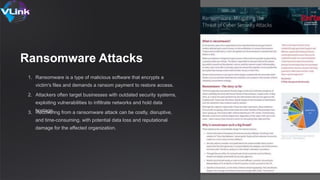
1. Ransomware is a type of malicious software that encrypts a
victim's files and demands a ransom payment to restore access.
2. Attackers often target businesses with outdated security systems,
exploiting vulnerabilities to infiltrate networks and hold data
hostage.
3. Recovering from a ransomware attack can be costly, disruptive,
and time-consuming, with potential data loss and reputational
damage for the affected organization.
Phishing and Social
Engineering
• Phishing attacks use deceptive emails, messages, or websites to
trick victims into revealing sensitive information or installing
malware.
• Social engineering exploits human psychology, manipulating
people into performing actions or divulging confidential data that
compromises security.
• These tactics can lead to data breaches, financial losses, and
reputational damage, making them a serious threat for businesses
of all sizes.
Cloud Vulnerabilities
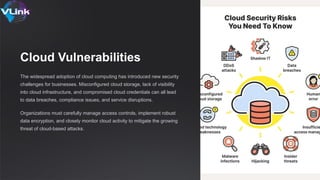
The widespread adoption of cloud computing has introduced new security
challenges for businesses. Misconfigured cloud storage, lack of visibility
into cloud infrastructure, and compromised cloud credentials can all lead
to data breaches, compliance issues, and service disruptions.
Organizations must carefully manage access controls, implement robust
data encryption, and closely monitor cloud activity to mitigate the growing
threat of cloud-based attacks.
Internet of Things (IoT) Threats
Vulnerable IoT Devices
Many IoT devices lack robust
security measures, making
them easy targets for hackers
to infiltrate home and business
networks.
Botnet Attacks
Cybercriminals can hijack
insecure IoT devices to create
vast botnets, which they then
use to launch devastating
DDoS attacks.
Data Privacy Concerns
The vast amounts of personal
and sensitive data collected by
IoT devices pose significant
privacy risks if not properly
secured and protected.
Insider Threats
Disgruntled Employees
Discontented or former employees can abuse
their access privileges to steal sensitive data,
sabotage systems, or leak confidential
information.
Negligent Practices
Careless handling of passwords, unsecured
devices, or lax security protocols can
inadvertently expose an organization to
insider threats.
Accidental Data Breaches
Well-meaning employees may unintentionally
share sensitive information or fall victim to
phishing scams, leading to unintentional data
leaks.
Malicious Insiders
Trusted insiders with malicious intent can
leverage their access to critical systems and
data to carry out espionage, fraud, or
sabotage.
Supply Chain Attacks
1 Vendor Compromise
Cybercriminals target third-party vendors with weaker security to gain
access to a business's network and sensitive data.
2 Software Tampering
Hackers infiltrate the software development process to insert malicious code
into legitimate applications and updates.
3 Logistics Disruption
Attackers disrupt the supply chain by hijacking shipments, intercepting
deliveries, or compromising logistics systems.
Cryptojacking
Legitimate Cryptojacking
Cryptojacking is the unauthorized use of a device's computing power to mine cryptocurrency. Hackers
infiltrate systems and secretly run cryptomining scripts, siphoning processing power and electricity to
generate digital coins without the owner's knowledge or consent.
The rise of cryptojacking poses a dangerous threat to businesses, as it can slow down systems, increase
energy costs, and potentially expose sensitive data. Proactive monitoring, regular software updates, and
user awareness are crucial for defending against this stealthy cybercrime.
Distributed Denial of Service (DDoS)
Attacks
Network
Saturation
DDoS attacks
overwhelm a
website or network
with an
unprecedented
volume of traffic,
causing it to crash
or become
inaccessible to
legitimate users.
Botnets and
Amplification
Attackers leverage
vast networks of
compromised
devices, called
botnets, to amplify
the impact of DDoS
attacks, making
them even more
devastating.
Financial and
Reputational
Damage
DDoS attacks can
result in significant
financial losses,
service disruptions,
and reputational
harm for targeted
organizations,
undermining their
credibility and
operations.
Mitigation
Challenges
Defending against
DDoS attacks can
be complex, as
attackers
continuously evolve
their tactics to
bypass defense
mechanisms and
overwhelm network
resources.
Conclusion and Recommendations
Proactive Cybersecurity
Adopt a proactive approach to cybersecurity
by regularly updating systems,
implementing robust access controls, and
conducting employee security training.
Incident Response Planning
Develop a comprehensive incident
response plan to mitigate the impact of
successful attacks and quickly restore
business operations.
Leverage Security Technologies
Invest in advanced security technologies
like AI-powered threat detection, cloud-
based security solutions, and automated
vulnerability scanning to stay ahead of
evolving threats.
Collaborative Cybersecurity
Foster industry partnerships and information
sharing to gain a deeper understanding of
emerging threats and best practices for
protection.
Reference
https://www.vlinkinfo.com/blog/biggest-cybersecurity-threats/
Get In Touch
info.us@vlinkinfo.com
+1 (860) 247-1400.

The-Evolving-Cybersecurity-Landscape.pptx

  • 1.
    The Evolving Cybersecurity Landscape Businesses todayface an ever-changing array of cybersecurity threats, from ransomware attacks to cloud vulnerabilities. Understanding the latest trends and best practices is crucial for protecting sensitive data and maintaining business continuity.
  • 2.
    Ransomware Attacks 1. Ransomwareis a type of malicious software that encrypts a victim's files and demands a ransom payment to restore access. 2. Attackers often target businesses with outdated security systems, exploiting vulnerabilities to infiltrate networks and hold data hostage. 3. Recovering from a ransomware attack can be costly, disruptive, and time-consuming, with potential data loss and reputational damage for the affected organization.
  • 3.
    Phishing and Social Engineering •Phishing attacks use deceptive emails, messages, or websites to trick victims into revealing sensitive information or installing malware. • Social engineering exploits human psychology, manipulating people into performing actions or divulging confidential data that compromises security. • These tactics can lead to data breaches, financial losses, and reputational damage, making them a serious threat for businesses of all sizes.
  • 4.
    Cloud Vulnerabilities The widespreadadoption of cloud computing has introduced new security challenges for businesses. Misconfigured cloud storage, lack of visibility into cloud infrastructure, and compromised cloud credentials can all lead to data breaches, compliance issues, and service disruptions. Organizations must carefully manage access controls, implement robust data encryption, and closely monitor cloud activity to mitigate the growing threat of cloud-based attacks.
  • 5.
    Internet of Things(IoT) Threats Vulnerable IoT Devices Many IoT devices lack robust security measures, making them easy targets for hackers to infiltrate home and business networks. Botnet Attacks Cybercriminals can hijack insecure IoT devices to create vast botnets, which they then use to launch devastating DDoS attacks. Data Privacy Concerns The vast amounts of personal and sensitive data collected by IoT devices pose significant privacy risks if not properly secured and protected.
  • 6.
    Insider Threats Disgruntled Employees Discontentedor former employees can abuse their access privileges to steal sensitive data, sabotage systems, or leak confidential information. Negligent Practices Careless handling of passwords, unsecured devices, or lax security protocols can inadvertently expose an organization to insider threats. Accidental Data Breaches Well-meaning employees may unintentionally share sensitive information or fall victim to phishing scams, leading to unintentional data leaks. Malicious Insiders Trusted insiders with malicious intent can leverage their access to critical systems and data to carry out espionage, fraud, or sabotage.
  • 7.
    Supply Chain Attacks 1Vendor Compromise Cybercriminals target third-party vendors with weaker security to gain access to a business's network and sensitive data. 2 Software Tampering Hackers infiltrate the software development process to insert malicious code into legitimate applications and updates. 3 Logistics Disruption Attackers disrupt the supply chain by hijacking shipments, intercepting deliveries, or compromising logistics systems.
  • 8.
    Cryptojacking Legitimate Cryptojacking Cryptojacking isthe unauthorized use of a device's computing power to mine cryptocurrency. Hackers infiltrate systems and secretly run cryptomining scripts, siphoning processing power and electricity to generate digital coins without the owner's knowledge or consent. The rise of cryptojacking poses a dangerous threat to businesses, as it can slow down systems, increase energy costs, and potentially expose sensitive data. Proactive monitoring, regular software updates, and user awareness are crucial for defending against this stealthy cybercrime.
  • 9.
    Distributed Denial ofService (DDoS) Attacks Network Saturation DDoS attacks overwhelm a website or network with an unprecedented volume of traffic, causing it to crash or become inaccessible to legitimate users. Botnets and Amplification Attackers leverage vast networks of compromised devices, called botnets, to amplify the impact of DDoS attacks, making them even more devastating. Financial and Reputational Damage DDoS attacks can result in significant financial losses, service disruptions, and reputational harm for targeted organizations, undermining their credibility and operations. Mitigation Challenges Defending against DDoS attacks can be complex, as attackers continuously evolve their tactics to bypass defense mechanisms and overwhelm network resources.
  • 10.
    Conclusion and Recommendations ProactiveCybersecurity Adopt a proactive approach to cybersecurity by regularly updating systems, implementing robust access controls, and conducting employee security training. Incident Response Planning Develop a comprehensive incident response plan to mitigate the impact of successful attacks and quickly restore business operations. Leverage Security Technologies Invest in advanced security technologies like AI-powered threat detection, cloud- based security solutions, and automated vulnerability scanning to stay ahead of evolving threats. Collaborative Cybersecurity Foster industry partnerships and information sharing to gain a deeper understanding of emerging threats and best practices for protection.
  • 11.