
Data Protection and IDEA
Joanne Bone & Neil Bentley
Irwin Mitchell
11 May 2004
Why Is Data Protection
Important?
• Data Protection Act 1998
• Overseen by the UK’s Information
Commissioner
• Potential Civil and Criminal Liability
Why Is Data Protection
Important?
• Criminal Liability
• Fines for breach
– Up to £5000 in Magistrates’ Court
– Unlimited in Crown Court
• Company officers, directors and
managers can be personally liable
Why Is Data Protection
Important?
• Civil Liability
• Any breach of the Act is actionable
• Compensation for damage and/or
distress
• In practice Courts are awarding
damages for breach of the Act
So When Does The Data
Protection Act Apply?
• The Act applies to the PROCESSING
of PERSONAL DATA
What Is Personal Data?
• Personal data can be any information
which relates to a living individual who
is identifiable from that data alone or in
conjunction with other data
• Both paper and electronic records can
be covered
What Is Personal Data?
• Durant v Financial Services Authority
• Definition of personal data interpreted
by the Court in a more restrictive way
• Information now only personal data
where it affects the individual’s privacy
– Is the information biographical?
– Is the information focused on the
individual?
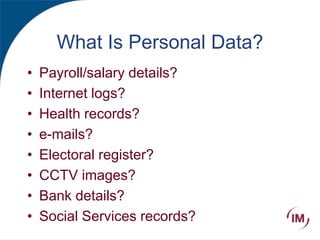
What Is Personal Data?
• Payroll/salary details?
• Internet logs?
• Health records?
• e-mails?
• Electoral register?
• CCTV images?
• Bank details?
• Social Services records?
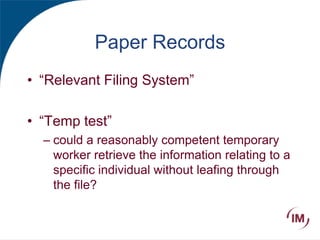
Paper Records
• “Relevant Filing System”
• “Temp test”
– could a reasonably competent temporary
worker retrieve the information relating to a
specific individual without leafing through
the file?
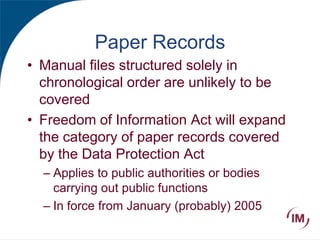
Paper Records
• Manual files structured solely in
chronological order are unlikely to be
covered
• Freedom of Information Act will expand
the category of paper records covered
by the Data Protection Act
– Applies to public authorities or bodies
carrying out public functions
– In force from January (probably) 2005
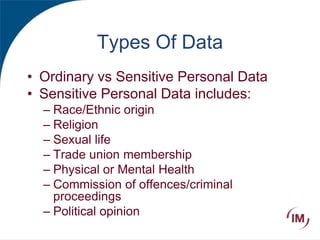
Types Of Data
• Ordinary vs Sensitive Personal Data
• Sensitive Personal Data includes:
– Race/Ethnic origin
– Religion
– Sexual life
– Trade union membership
– Physical or Mental Health
– Commission of offences/criminal
proceedings
– Political opinion
What Is Personal Data?
• Payroll/salary details?
• Internet logs?
• Health records?
• e-mails?
• Electoral register?
• CCTV images?
• Bank details?
• Social Services records?
When Am I Processing
Personal Data?
• Any manipulation of data
• This will include:
– collection
– calling data up on screen
– auditing the information
– storage
– destruction
Who Is Responsible For
Processing?
• Data Controller vs Data Processor
• Data Controller
– Determines the purposes for which the
data are processed and how
– Legally responsible for what happens to
the data
• Data Processor
– Processes data on behalf of/under
instruction of Data Controller
Who Is Responsible For
Processing?
• In a nutshell:
– Do you determine what is done with the
data? (= data controller)
– Do you deal with data under instruction of
third party? (= data processor)
• Internal auditor (=data controller)
• External auditor (=data processor)
• Statutory Auditor (depends)
Who Is Responsible For
Processing?
• Data Controller responsible for
compliance with the Act
• Data Processor is not BUT may be
required to undertake compliance
obligations by contract
– Security/confidentiality
– Only use the data as instructed
• Can be both data controller & processor
Who Is Responsible For
Processing?
• Outsourced functions
– Company to which functions outsourced
likely to be data processor
– Should be a written contract in place
between organisation and company to
which functions outsourced
– Original organisation remains responsible
for compliance
Notification
• Must notify if:
– You are a DATA CONTROLLER and
– process PERSONAL DATA
– on COMPUTER
• Not strictly required if a data processor
for accountancy/audit purposes
• Annual renewal, £35
• 28 days to notify changes
Are We Entitled To
Process The Data?
• Data to be processed fairly & lawfully
• Ordinary Data – unambiguous consent
– actual consent
– necessary to perform a contract
– necessary to decide whether to enter into a
contract
– necessary to comply with a legal obligation
• Sensitive Data – explicit consent
Are We Entitled To
Process The Data?
• Responsibility of the data controller
– If data processor, seek warranty in contract
• Fair processing notice:
– Who will process the data
– What purposes the data will be used for
• is audit included?
– Any further information necessary to be
given for the processing to be fair
• Should notify BEFORE collect data
Are We Entitled To
Process The Data?
• Opt-in, opt-out or neither?
– is it optional?
– is it for marketing purposes?
– does it allow contact by e-mail or SMS?
• “Do not solicit” databases
• Issues of using data collected by third
parties
Are We Entitled To
Process The Data?
• Employee data:
– restrictions on accessing e-mails, call
recordings, CCTV and website logs
• Not only a Data Protection Act issue:
– Human Rights Act; Art 8 ECHR
– Regulation of Investigatory Powers Act
2000
– Telecommunications (Lawful Business
Practice) … Regulations 2000
Are We Entitled To
Process The Data?
• Employee Monitoring and Acceptable
Use Policies:
– for data protection, rely upon “consent” or
“necessary for legitimate interests unless
unwarranted prejudice to data subject”
– for interception, see RIPA & LBP Regs
– see also Data Protection Code, Part 3
• Data processors - seek warranties
What Are The Other Obligations?
• Data to be adequate, relevant and not
excessive
• Data to be accurate and, where
necessary, kept up to date
• Data not to be kept for any longer than
is necessary
• Data controller needs systems for data
management, review and disposal
What Are The Other Obligations?
• Individuals (=data subjects) have rights
of access to personal data
– statutory obligation to reply to requests
– 40 day timetable
– maximum £10 fee
– both electronic and paper records
– beware of identifying other individuals
• Data Controller should have a Subject
Access Procedure
What Are The Other Obligations?
• Appropriate steps to be taken to hold
data securely
– physical and technological measures
– ensure employee reliability
– written contracts with data processors
• Be aware of restrictions on data transfer
to non-EEA countries
– seek consent, “safe harbor” or contract
Are There Any Exemptions?
• Exemption from the eight principles
– e.g. national security; domestic purposes
• Exemption from the non-disclosure
provisions
– e.g. where required by law; to detect crime
• Exemptions from the subject information
provisions
– e.g. regulatory activity; negotiations;
management forecasting and planning
Data Protection And
Freedom Of Information
• For “public authorities” caught by
Freedom of Information Act 2000:
– data protection obligations expanded
– particularly subject access rights
• Publication Schemes
• General “Right to Know”
• January 2005 commencement date
In Summary
Examine the basis for your work:
• are you a data controller or a data
processor?
In Summary
If you are the data controller:
• Appoint a compliance officer
• Have systems in place for data
collection, review and disposal
• Have appropriate contracts with third
party data processors
• Set up standard letters for data requests
In Summary
If you are a data processor:
• Should follow controller’s instructions
• Data controller may propose a written
contract
– their obligation, not yours
– you should seek warranties about data
collection and compliance with the Act
• Do you need a notification?
Any more questions?
Joanne Bone
bonej@irwinmitchell.co.uk
Neil Bentley
bentleyn@irwinmitchell.co.uk
Helen Goldthorpe
goldthorpeh@irwinmitchell.co.uk
0870 1500 100

Data Protection and IDEA

  • 1.
    Data Protection andIDEA Joanne Bone & Neil Bentley Irwin Mitchell 11 May 2004
  • 2.
    Why Is DataProtection Important? • Data Protection Act 1998 • Overseen by the UK’s Information Commissioner • Potential Civil and Criminal Liability
  • 3.
    Why Is DataProtection Important? • Criminal Liability • Fines for breach – Up to £5000 in Magistrates’ Court – Unlimited in Crown Court • Company officers, directors and managers can be personally liable
  • 4.
    Why Is DataProtection Important? • Civil Liability • Any breach of the Act is actionable • Compensation for damage and/or distress • In practice Courts are awarding damages for breach of the Act
  • 5.
    So When DoesThe Data Protection Act Apply? • The Act applies to the PROCESSING of PERSONAL DATA
  • 6.
    What Is PersonalData? • Personal data can be any information which relates to a living individual who is identifiable from that data alone or in conjunction with other data • Both paper and electronic records can be covered
  • 7.
    What Is PersonalData? • Durant v Financial Services Authority • Definition of personal data interpreted by the Court in a more restrictive way • Information now only personal data where it affects the individual’s privacy – Is the information biographical? – Is the information focused on the individual?
  • 8.
    What Is PersonalData? • Payroll/salary details? • Internet logs? • Health records? • e-mails? • Electoral register? • CCTV images? • Bank details? • Social Services records?
  • 9.
    Paper Records • “RelevantFiling System” • “Temp test” – could a reasonably competent temporary worker retrieve the information relating to a specific individual without leafing through the file?
  • 10.
    Paper Records • Manualfiles structured solely in chronological order are unlikely to be covered • Freedom of Information Act will expand the category of paper records covered by the Data Protection Act – Applies to public authorities or bodies carrying out public functions – In force from January (probably) 2005
  • 11.
    Types Of Data •Ordinary vs Sensitive Personal Data • Sensitive Personal Data includes: – Race/Ethnic origin – Religion – Sexual life – Trade union membership – Physical or Mental Health – Commission of offences/criminal proceedings – Political opinion
  • 12.
    What Is PersonalData? • Payroll/salary details? • Internet logs? • Health records? • e-mails? • Electoral register? • CCTV images? • Bank details? • Social Services records?
  • 13.
    When Am IProcessing Personal Data? • Any manipulation of data • This will include: – collection – calling data up on screen – auditing the information – storage – destruction
  • 14.
    Who Is ResponsibleFor Processing? • Data Controller vs Data Processor • Data Controller – Determines the purposes for which the data are processed and how – Legally responsible for what happens to the data • Data Processor – Processes data on behalf of/under instruction of Data Controller
  • 15.
    Who Is ResponsibleFor Processing? • In a nutshell: – Do you determine what is done with the data? (= data controller) – Do you deal with data under instruction of third party? (= data processor) • Internal auditor (=data controller) • External auditor (=data processor) • Statutory Auditor (depends)
  • 16.
    Who Is ResponsibleFor Processing? • Data Controller responsible for compliance with the Act • Data Processor is not BUT may be required to undertake compliance obligations by contract – Security/confidentiality – Only use the data as instructed • Can be both data controller & processor
  • 17.
    Who Is ResponsibleFor Processing? • Outsourced functions – Company to which functions outsourced likely to be data processor – Should be a written contract in place between organisation and company to which functions outsourced – Original organisation remains responsible for compliance
  • 18.
    Notification • Must notifyif: – You are a DATA CONTROLLER and – process PERSONAL DATA – on COMPUTER • Not strictly required if a data processor for accountancy/audit purposes • Annual renewal, £35 • 28 days to notify changes
  • 19.
    Are We EntitledTo Process The Data? • Data to be processed fairly & lawfully • Ordinary Data – unambiguous consent – actual consent – necessary to perform a contract – necessary to decide whether to enter into a contract – necessary to comply with a legal obligation • Sensitive Data – explicit consent
  • 20.
    Are We EntitledTo Process The Data? • Responsibility of the data controller – If data processor, seek warranty in contract • Fair processing notice: – Who will process the data – What purposes the data will be used for • is audit included? – Any further information necessary to be given for the processing to be fair • Should notify BEFORE collect data
  • 21.
    Are We EntitledTo Process The Data? • Opt-in, opt-out or neither? – is it optional? – is it for marketing purposes? – does it allow contact by e-mail or SMS? • “Do not solicit” databases • Issues of using data collected by third parties
  • 22.
    Are We EntitledTo Process The Data? • Employee data: – restrictions on accessing e-mails, call recordings, CCTV and website logs • Not only a Data Protection Act issue: – Human Rights Act; Art 8 ECHR – Regulation of Investigatory Powers Act 2000 – Telecommunications (Lawful Business Practice) … Regulations 2000
  • 23.
    Are We EntitledTo Process The Data? • Employee Monitoring and Acceptable Use Policies: – for data protection, rely upon “consent” or “necessary for legitimate interests unless unwarranted prejudice to data subject” – for interception, see RIPA & LBP Regs – see also Data Protection Code, Part 3 • Data processors - seek warranties
  • 24.
    What Are TheOther Obligations? • Data to be adequate, relevant and not excessive • Data to be accurate and, where necessary, kept up to date • Data not to be kept for any longer than is necessary • Data controller needs systems for data management, review and disposal
  • 25.
    What Are TheOther Obligations? • Individuals (=data subjects) have rights of access to personal data – statutory obligation to reply to requests – 40 day timetable – maximum £10 fee – both electronic and paper records – beware of identifying other individuals • Data Controller should have a Subject Access Procedure
  • 26.
    What Are TheOther Obligations? • Appropriate steps to be taken to hold data securely – physical and technological measures – ensure employee reliability – written contracts with data processors • Be aware of restrictions on data transfer to non-EEA countries – seek consent, “safe harbor” or contract
  • 27.
    Are There AnyExemptions? • Exemption from the eight principles – e.g. national security; domestic purposes • Exemption from the non-disclosure provisions – e.g. where required by law; to detect crime • Exemptions from the subject information provisions – e.g. regulatory activity; negotiations; management forecasting and planning
  • 28.
    Data Protection And FreedomOf Information • For “public authorities” caught by Freedom of Information Act 2000: – data protection obligations expanded – particularly subject access rights • Publication Schemes • General “Right to Know” • January 2005 commencement date
  • 29.
    In Summary Examine thebasis for your work: • are you a data controller or a data processor?
  • 30.
    In Summary If youare the data controller: • Appoint a compliance officer • Have systems in place for data collection, review and disposal • Have appropriate contracts with third party data processors • Set up standard letters for data requests
  • 31.
    In Summary If youare a data processor: • Should follow controller’s instructions • Data controller may propose a written contract – their obligation, not yours – you should seek warranties about data collection and compliance with the Act • Do you need a notification?
  • 32.
    Any more questions? JoanneBone bonej@irwinmitchell.co.uk Neil Bentley bentleyn@irwinmitchell.co.uk Helen Goldthorpe goldthorpeh@irwinmitchell.co.uk 0870 1500 100