Duplicate Invoice Payments 
David Macleod 
Internal Auditor 
Falkirk Council 
4 December 2014 IDEA Scottish User Group 1
Outline of Presentation 
• Background 
• Risk 
• Data 
• Use of IDEA 
• Findings 
4 December 2014 IDEA Scottish User Group 2
• Around 7,000 employees across the Chief Executive’s Office and four 
Services: 
– Corporate & Neighbourhood; 
– Development; 
– Education; and 
– Social Work 
• Supports Falkirk Community Trust 
The 2014/15 budgets for the Council are as follows: 
• Revenue Budget = £329,354,000 
• General Capital Programme = £21,170,000 
• Housing Revenue Budget = £54,434,000 
• Housing Capital Investment = £36,533,000 
• (The council has a housing stock of approximately 16,000 properties.) 
4 December 2014 IDEA Scottish User Group 3
Background 
• Integra Finance System 
– Used by Falkirk Council since 2005 
– 800+ users throughout the Council and Falkirk 
Community Trust 
– Users have different permissions (e.g. read only, data 
entry, approval) 
– Various integrated modules including ledger, 
purchasing and creditors 
– Payment files are generated via the creditors module 
– Payment runs every Monday, Wednesday and Friday 
4 December 2014 IDEA Scottish User Group 4
Extract from Falkirk Council Financial 
Regulations (Section 15.5) 
The Officer certifying an invoice or other payment must be satisfied that: 
• The goods or services have been received and are of the agreed quantity and 
quality; 
• The invoice price matches the agreed price; 
• The arithmetic is correct including discounts, credits, and VAT; 
• Appropriate entries have been made in inventories or stock records; 
• The invoice has not previously been authorised for payment; 
• The invoice is in the name of Falkirk Council (or an integral part of it); and 
• The invoice is a proper liability of the Council. 
4 December 2014 IDEA Scottish User Group 5
Extract from Falkirk Council Financial 
Regulations (Section 15.6) 
• “Care must be taken not to make duplicate 
payments, especially if the invoice is a fax, 
copy invoice, or photocopied invoice. 
Payments must not be made on the basis 
of supplier’s statements.” 
4 December 2014 IDEA Scottish User Group 6
Risk 
• Reasons for duplicate creditor payments 
– Paid to incorrect suppliers 
• e.g. Emergency Planning College instead of Emergency 
Planning Society; or 
• Scottish Power instead of Scottish Gas. 
– Payments made on copy invoices or delivery notes 
– Paid to the same (correct) supplier twice 
4 December 2014 IDEA Scottish User Group 7
Examples of Non-Exact Invoice Numbers 
• VP69181270M12101 and VP69181270M12101NK 
• 3360416025 and 3360416025-12.08.13 
• C4053534 and 4053534 
• S671 and S671A 
• OP/IO69386 and OP/1069386 
• 90005973 and 90005973- 
• 313 and 3113 
• 36100000617 and 3610000617 
• 31025. and 31025 
4 December 2014 IDEA Scottish User Group 8
How it was known that duplicate 
payments were occurring 
• Contact (and reimbursement) from suppliers 
• Checks by Creditors team on exact matches 
This resulted in: 
• Concern that some duplicate payments were not 
being detected 
4 December 2014 IDEA Scottish User Group 9
Payments File Report 
• Creditor Reference 
• Supplier Reference 
• Internal Number 
• Location 
• Invoice Date 
• Due Date 
• Payment Date 
• Gross 
• VAT 
• Payment Method 
• Payment Reference 
• Narrative 
• Supplier code on Integra 
• Invoice number 
• Unique reference 
• Section / establishment 
• Total amount of invoice 
• VAT amount 
• BACS or Cheque 
• Details of invoice 
4 December 2014 IDEA Scottish User Group 10
4 December 2014 IDEA Scottish User Group 11
Data 
• 10,000+ active suppliers on supplier database 
• Annual volume of payments via Integra = 
170,000 
• Annual net value of payments via Integra = £278 
million 
• A rolling 12 month period is reviewed each 
month 
4 December 2014 IDEA Scottish User Group 12
Use of IDEA 
• Run payments file report on Integra 
• Import to IDEA using Report Reader 
• Join payment file with Active Suppliers to identify 
supplier name 
• Join combined file with Locations to determine 
location description 
4 December 2014 IDEA Scottish User Group 13
IDEA – Duplicate Key Detection 
• Apply the duplicate key detection function based 
on: 
– Invoice date and gross amount 
[approximately 60,000 results]; 
– Supplier reference and gross amount 
[approximately 1,500 results]; and 
– Supplier reference (as numeric format) and gross 
amount 
[approximately 58,000 results]. 
4 December 2014 IDEA Scottish User Group 14
4 December 2014 IDEA Scottish User Group 15
IDEA – Duplicate Key Detection 
• Review results and copy any potential duplicates to a spreadsheet. 
• Split the file into various value ranges by applying a criterion of 
Gross amount is greater than x and is less than y. 
• Look for duplicates where at least one payment is in the most recent 
month. 
• To convert supplier reference field to numeric format use field 
manipulation to append a column and apply the formula @Val 
(Supplier Reference). Apply the duplicate key detection using this 
appended column and gross amount. 
4 December 2014 IDEA Scottish User Group 16
Value Ranges 
• £0.00 to £100; 
• £100 to £200; 
• £200 to £300; 
• £300 to £400; 
• £400 to £500; 
• £500 to £1,000; 
• £1,000 to £2,000; 
• £2,000 to £3,000; 
• £3,000 to £4,000; 
• £4,000 to £5,000; 
• £5,000 to £10,000; 
• £10,000 to £20,000; 
• £20,000 to £50,000; and 
• Over £50,000 
4 December 2014 IDEA Scottish User Group 17
4 December 2014 IDEA Scottish User Group 18
Duplicate Invoices 
• Check the identified duplicates to Integra for credit notes or refunds. 
• Obtain copies of the invoices from the Creditors section for the remaining duplicates. 
• Review the invoices to determine if the payments are, in fact, duplicates. 
• Check with the Creditors team whether they are aware of any of the remaining 
duplicates and are in the process of recovering them. 
• Report the remaining duplicates to Finance. 
• Provide copies of the relevant invoices to the Creditors team to enable recovery 
action. 
• Record the details of all reported duplicates on a spreadsheet and check to ensure 
that these duplicates are being recovered. Recovery is normally via credit note or by 
refund. 
4 December 2014 IDEA Scottish User Group 19
Findings 
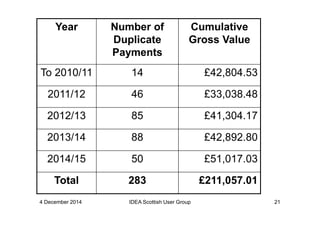
• Since October 2010, a total of 283 
duplicates (to October 2014) have been 
identified. 
• Cumulative gross value = £211,057 
• For 2014/15 (to October 2014), a total of 
50 duplicates have been identified. 
• Cumulative gross value = £51,017 
4 December 2014 IDEA Scottish User Group 20
Year Number of 
Duplicate 
Payments 
Cumulative 
Gross Value 
To 2010/11 14 £42,804.53 
2011/12 46 £33,038.48 
2012/13 85 £41,304.17 
2013/14 88 £42,892.80 
2014/15 50 £51,017.03 
Total 283 £211,057.01 
4 December 2014 IDEA Scottish User Group 21
Duplicate Payments 
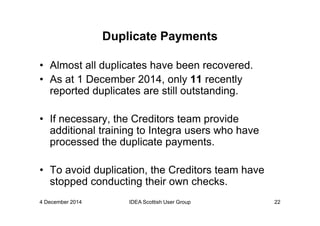
• Almost all duplicates have been recovered. 
• As at 1 December 2014, only 11 recently 
reported duplicates are still outstanding. 
• If necessary, the Creditors team provide 
additional training to Integra users who have 
processed the duplicate payments. 
• To avoid duplication, the Creditors team have 
stopped conducting their own checks. 
4 December 2014 IDEA Scottish User Group 22
Duplicate Payments 
• COSLA and the Scottish Government 
recently provided with details of the 
process followed at Falkirk Council. 
• This is an example of an activity that can 
help to improve the detection of fraud and 
error at relatively low cost. 
4 December 2014 IDEA Scottish User Group 23
Conclusion 
• A value adding activity that has resulted in 
the recovery of more than £200,000 of 
expenditure that would otherwise have 
been lost to Falkirk Council. 
4 December 2014 IDEA Scottish User Group 24
Thank you 
and 
Any Questions? 
4 December 2014 IDEA Scottish User Group 25

IDEA to Detect Duplicate Invoice Payments

  • 1.
    Duplicate Invoice Payments David Macleod Internal Auditor Falkirk Council 4 December 2014 IDEA Scottish User Group 1
  • 2.
    Outline of Presentation • Background • Risk • Data • Use of IDEA • Findings 4 December 2014 IDEA Scottish User Group 2
  • 3.
    • Around 7,000employees across the Chief Executive’s Office and four Services: – Corporate & Neighbourhood; – Development; – Education; and – Social Work • Supports Falkirk Community Trust The 2014/15 budgets for the Council are as follows: • Revenue Budget = £329,354,000 • General Capital Programme = £21,170,000 • Housing Revenue Budget = £54,434,000 • Housing Capital Investment = £36,533,000 • (The council has a housing stock of approximately 16,000 properties.) 4 December 2014 IDEA Scottish User Group 3
  • 4.
    Background • IntegraFinance System – Used by Falkirk Council since 2005 – 800+ users throughout the Council and Falkirk Community Trust – Users have different permissions (e.g. read only, data entry, approval) – Various integrated modules including ledger, purchasing and creditors – Payment files are generated via the creditors module – Payment runs every Monday, Wednesday and Friday 4 December 2014 IDEA Scottish User Group 4
  • 5.
    Extract from FalkirkCouncil Financial Regulations (Section 15.5) The Officer certifying an invoice or other payment must be satisfied that: • The goods or services have been received and are of the agreed quantity and quality; • The invoice price matches the agreed price; • The arithmetic is correct including discounts, credits, and VAT; • Appropriate entries have been made in inventories or stock records; • The invoice has not previously been authorised for payment; • The invoice is in the name of Falkirk Council (or an integral part of it); and • The invoice is a proper liability of the Council. 4 December 2014 IDEA Scottish User Group 5
  • 6.
    Extract from FalkirkCouncil Financial Regulations (Section 15.6) • “Care must be taken not to make duplicate payments, especially if the invoice is a fax, copy invoice, or photocopied invoice. Payments must not be made on the basis of supplier’s statements.” 4 December 2014 IDEA Scottish User Group 6
  • 7.
    Risk • Reasonsfor duplicate creditor payments – Paid to incorrect suppliers • e.g. Emergency Planning College instead of Emergency Planning Society; or • Scottish Power instead of Scottish Gas. – Payments made on copy invoices or delivery notes – Paid to the same (correct) supplier twice 4 December 2014 IDEA Scottish User Group 7
  • 8.
    Examples of Non-ExactInvoice Numbers • VP69181270M12101 and VP69181270M12101NK • 3360416025 and 3360416025-12.08.13 • C4053534 and 4053534 • S671 and S671A • OP/IO69386 and OP/1069386 • 90005973 and 90005973- • 313 and 3113 • 36100000617 and 3610000617 • 31025. and 31025 4 December 2014 IDEA Scottish User Group 8
  • 9.
    How it wasknown that duplicate payments were occurring • Contact (and reimbursement) from suppliers • Checks by Creditors team on exact matches This resulted in: • Concern that some duplicate payments were not being detected 4 December 2014 IDEA Scottish User Group 9
  • 10.
    Payments File Report • Creditor Reference • Supplier Reference • Internal Number • Location • Invoice Date • Due Date • Payment Date • Gross • VAT • Payment Method • Payment Reference • Narrative • Supplier code on Integra • Invoice number • Unique reference • Section / establishment • Total amount of invoice • VAT amount • BACS or Cheque • Details of invoice 4 December 2014 IDEA Scottish User Group 10
  • 11.
    4 December 2014IDEA Scottish User Group 11
  • 12.
    Data • 10,000+active suppliers on supplier database • Annual volume of payments via Integra = 170,000 • Annual net value of payments via Integra = £278 million • A rolling 12 month period is reviewed each month 4 December 2014 IDEA Scottish User Group 12
  • 13.
    Use of IDEA • Run payments file report on Integra • Import to IDEA using Report Reader • Join payment file with Active Suppliers to identify supplier name • Join combined file with Locations to determine location description 4 December 2014 IDEA Scottish User Group 13
  • 14.
    IDEA – DuplicateKey Detection • Apply the duplicate key detection function based on: – Invoice date and gross amount [approximately 60,000 results]; – Supplier reference and gross amount [approximately 1,500 results]; and – Supplier reference (as numeric format) and gross amount [approximately 58,000 results]. 4 December 2014 IDEA Scottish User Group 14
  • 15.
    4 December 2014IDEA Scottish User Group 15
  • 16.
    IDEA – DuplicateKey Detection • Review results and copy any potential duplicates to a spreadsheet. • Split the file into various value ranges by applying a criterion of Gross amount is greater than x and is less than y. • Look for duplicates where at least one payment is in the most recent month. • To convert supplier reference field to numeric format use field manipulation to append a column and apply the formula @Val (Supplier Reference). Apply the duplicate key detection using this appended column and gross amount. 4 December 2014 IDEA Scottish User Group 16
  • 17.
    Value Ranges •£0.00 to £100; • £100 to £200; • £200 to £300; • £300 to £400; • £400 to £500; • £500 to £1,000; • £1,000 to £2,000; • £2,000 to £3,000; • £3,000 to £4,000; • £4,000 to £5,000; • £5,000 to £10,000; • £10,000 to £20,000; • £20,000 to £50,000; and • Over £50,000 4 December 2014 IDEA Scottish User Group 17
  • 18.
    4 December 2014IDEA Scottish User Group 18
  • 19.
    Duplicate Invoices •Check the identified duplicates to Integra for credit notes or refunds. • Obtain copies of the invoices from the Creditors section for the remaining duplicates. • Review the invoices to determine if the payments are, in fact, duplicates. • Check with the Creditors team whether they are aware of any of the remaining duplicates and are in the process of recovering them. • Report the remaining duplicates to Finance. • Provide copies of the relevant invoices to the Creditors team to enable recovery action. • Record the details of all reported duplicates on a spreadsheet and check to ensure that these duplicates are being recovered. Recovery is normally via credit note or by refund. 4 December 2014 IDEA Scottish User Group 19
  • 20.
    Findings • SinceOctober 2010, a total of 283 duplicates (to October 2014) have been identified. • Cumulative gross value = £211,057 • For 2014/15 (to October 2014), a total of 50 duplicates have been identified. • Cumulative gross value = £51,017 4 December 2014 IDEA Scottish User Group 20
  • 21.
    Year Number of Duplicate Payments Cumulative Gross Value To 2010/11 14 £42,804.53 2011/12 46 £33,038.48 2012/13 85 £41,304.17 2013/14 88 £42,892.80 2014/15 50 £51,017.03 Total 283 £211,057.01 4 December 2014 IDEA Scottish User Group 21
  • 22.
    Duplicate Payments •Almost all duplicates have been recovered. • As at 1 December 2014, only 11 recently reported duplicates are still outstanding. • If necessary, the Creditors team provide additional training to Integra users who have processed the duplicate payments. • To avoid duplication, the Creditors team have stopped conducting their own checks. 4 December 2014 IDEA Scottish User Group 22
  • 23.
    Duplicate Payments •COSLA and the Scottish Government recently provided with details of the process followed at Falkirk Council. • This is an example of an activity that can help to improve the detection of fraud and error at relatively low cost. 4 December 2014 IDEA Scottish User Group 23
  • 24.
    Conclusion • Avalue adding activity that has resulted in the recovery of more than £200,000 of expenditure that would otherwise have been lost to Falkirk Council. 4 December 2014 IDEA Scottish User Group 24
  • 25.
    Thank you and Any Questions? 4 December 2014 IDEA Scottish User Group 25