CSE5243 INTRO. TO DATA MINING
Chapter 1. Introduction
Yu Su, CSE@The Ohio State University
Slides adapted from UIUC CS412 by Prof. Jiawei Han and OSU CSE5243 by
Prof. Huan Sun
2
CSE 5243. Course Page & Schedule
¨ Class Homepage:
https://ysu1989.github.io/courses/sp20/cse5243/
¨ Class Schedule:
9:35-10:55 AM, Wed/Fri, Caldwell Lab 171
¨ Office hours:
¤ Instructor: Yu Su @ DL783, Fri 11:00am-12:15pm (right after class)
First week: No office hours
¤ TA: Jiaqi Xu (xu.1629), Wed 03:00pm-04:00pm, Baker 406
3
CSE 5243. Textbook
¨ Recommended but not required
¨ (Primary) Jiawei Han, Micheline Kamber and Jian Pei, Data
Mining: Concepts and Techniques (3rd ed), 2011
¤ More resources:
https://wiki.illinois.edu/wiki/display/cs412/2.+Course+Syllabus+and
+Schedule
¨ (Primary) Pang-Ning Tan, Michael Steinbach, and Vipin Kumar,
Introduction to Data Mining, 2006
¨ (Supplementary) Mohammed J. Zaki and Wagner Meira, Jr.,
Data Mining Analysis and Concepts, 2014
¨ (Supplementary) Jure Leskovec, Anand Rajaraman, Jeff Ullman,
Mining of Massive Datasets
¤ More resources: http://www.mmds.org/
4
CSE 5243. Course Work and Grading
¨ Homework, Course Projects, and Exams
¤ Participation: 10% (Online discussion and/or class participation)
¤ Homework: 50% (No Late Submissions!)
¤ Midterm exam: 20%
¤ Final exam: 20%
¨ Need help and/or discussions?
¤ Carmen: https://osu.instructure.com/courses/76423/discussion_topics
n Receive credits: answer questions on Carmen and engage in class discussion.
¨ Check your homework/exam scores
¤ Carmen: https://osu.instructure.com/courses/76423/gradebook
5
Videos
¨ 10 TED talks on Big Data and Analytics
¤ https://www.promptcloud.com/blog/top-ted-talks-on-big-data/
¤ Shyan Sanker (Director at Palantir Technologies):
n https://www.youtube.com/watch?time_continue=19&v=ltelQ3iKybU
¨ 5 TED talks on Data analytics for business leaders
¤ https://bigdata-madesimple.com/5-best-ted-talks-on-data-analytics-for-business-
leaders/
¨ Data analytics for beginners
¤ https://www.youtube.com/watch?v=66ko_cWSHBU (If you love sports, this
TED Talk on data analytics is going to be an interesting watch)
6
Chapter 1. Introduction
¨ What is Data Mining?
¨ Why Data Mining?
¨ A Multi-Dimensional View of Data Mining
¨ What Kinds of Data Can Be Mined?
¨ What Kinds of Patterns Can Be Mined?
¨ What Kinds of Technologies Are Used?
¨ What Kinds of Applications Are Targeted?
¨ Major Issues in Data Mining
¨ A Brief History of Data Mining and Data Mining Society
¨ Summary
7
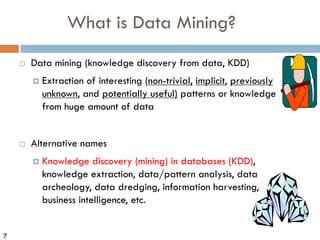
What is Data Mining?
¨ Data mining (knowledge discovery from data, KDD)
¤ Extraction of interesting (non-trivial, implicit, previously
unknown, and potentially useful) patterns or knowledge
from huge amount of data
¨ Alternative names
¤ Knowledge discovery (mining) in databases (KDD),
knowledge extraction, data/pattern analysis, data
archeology, data dredging, information harvesting,
business intelligence, etc.
8
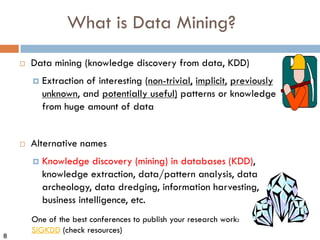
What is Data Mining?
¨ Data mining (knowledge discovery from data, KDD)
¤ Extraction of interesting (non-trivial, implicit, previously
unknown, and potentially useful) patterns or knowledge
from huge amount of data
¨ Alternative names
¤ Knowledge discovery (mining) in databases (KDD),
knowledge extraction, data/pattern analysis, data
archeology, data dredging, information harvesting,
business intelligence, etc.
One of the best conferences to publish your research work:
SIGKDD (check resources)
9
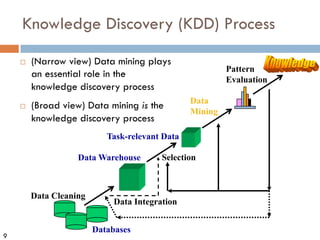
Knowledge Discovery (KDD) Process
¨ (Narrow view) Data mining plays
an essential role in the
knowledge discovery process
¨ (Broad view) Data mining is the
knowledge discovery process
Data Cleaning
Data Integration
Databases
Data Warehouse
Task-relevant Data
Selection
Data
Mining
Pattern
Evaluation
10
Example: A Web Mining Framework
¨ Web mining usually involves
¤ Data crawling and cleaning
¤ Data integration from multiple sources
¤ (Optional) Warehousing the data
¤ (Optional) Data cube construction
¤ Data selection for data mining
¤ Data mining
¤ Presentation of the mining results
¤ Patterns and knowledge to be used or stored into
knowledge base
12
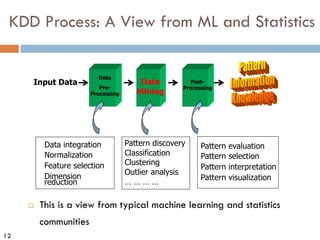
KDD Process: A View from ML and Statistics
¨ This is a view from typical machine learning and statistics
communities
Input Data Data
Mining
Data
Pre-
Processing
Post-
Processing
Data integration
Normalization
Feature selection
Dimension
reduction
Pattern discovery
Classification
Clustering
Outlier analysis
… … … …
Pattern evaluation
Pattern selection
Pattern interpretation
Pattern visualization
13
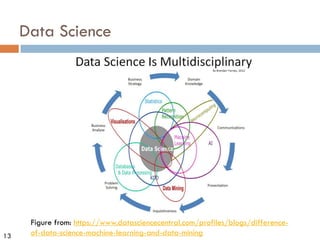
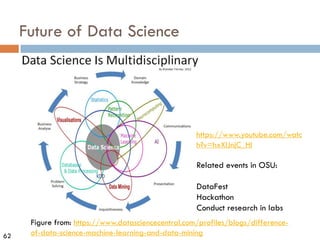
Data Science
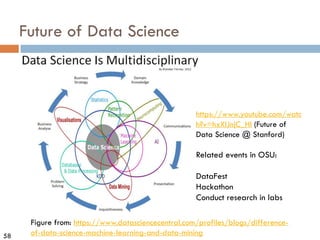
Figure from: https://www.datasciencecentral.com/profiles/blogs/difference-
of-data-science-machine-learning-and-data-mining
14
Chapter 1. Introduction
¨ What Is Data Mining?
¨ Why Data Mining?
¨ A Multi-Dimensional View of Data Mining
¨ What Kinds of Data Can Be Mined?
¨ What Kinds of Patterns Can Be Mined?
¨ What Kinds of Technologies Are Used?
¨ What Kinds of Applications Are Targeted?
¨ Major Issues in Data Mining
¨ A Brief History of Data Mining and Data Mining Society
¨ Summary
15
Why Data Mining?
¨ The Explosive Growth of Data: from terabytes to petabytes
¤ Data collection and data availability
n Automated data collection tools, database systems, Web,
computerized society
16
Why Data Mining?
¨ The Explosive Growth of Data: from terabytes to petabytes
¤ Data collection and data availability
n Automated data collection tools, database systems, Web,
computerized society
¤ Major sources of data
n Business: Web, e-commerce, transactions, stocks, …
n Science: Remote sensing, bioinformatics, scientific simulation, …
n Society and everyone: news, digital cameras, YouTube
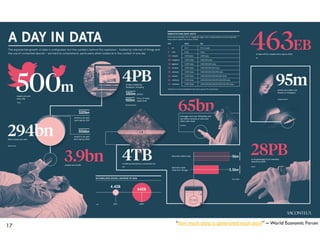
17 “How much data is generated each day?” – World Economic Forum
18
Why Data Mining?
¨ The Explosive Growth of Data: from terabytes to petabytes
¤ Data collection and data availability
n Automated data collection tools, database systems, Web,
computerized society
¤ Major sources of data
n Business: Web, e-commerce, transactions, stocks, …
n Science: Remote sensing, bioinformatics, scientific simulation, …
n Society and everyone: news, digital cameras, YouTube
¨ We are drowning in data, but starving for knowledge!
¨ “Necessity is the mother of invention”—Data mining—Automated
analysis of massive data sets
19
Chapter 1. Introduction
¨ Why Data Mining?
¨ What Is Data Mining?
¨ A Multi-Dimensional View of Data Mining
¨ What Kinds of Data Can Be Mined?
¨ What Kinds of Patterns Can Be Mined?
¨ What Kinds of Technologies Are Used?
¨ What Kinds of Applications Are Targeted?
¨ Major Issues in Data Mining
¨ A Brief History of Data Mining and Data Mining Society
¨ Summary
20
Multi-Dimensional View of Data Mining
¨ Data to be mined
¤ Database data (extended-relational, object-oriented, heterogeneous), data
warehouse, transactional data, stream, spatiotemporal, time-series, sequence, text
and web, multi-media, graphs & social and information networks
21
Multi-Dimensional View of Data Mining
¨ Data to be mined
¤ Database data (extended-relational, object-oriented, heterogeneous), data
warehouse, transactional data, stream, spatiotemporal, time-series, sequence, text
and web, multi-media, graphs & social and information networks
¨ Knowledge to be mined (or: Data mining functions)
¤ Characterization, discrimination, association, classification, clustering,
trend/deviation, outlier analysis, …
¤ Descriptive vs. predictive data mining
¤ Multiple/integrated functions and mining at multiple levels
22
Multi-Dimensional View of Data Mining
¨ Data to be mined
¤ Database data (extended-relational, object-oriented, heterogeneous), data
warehouse, transactional data, stream, spatiotemporal, time-series, sequence, text
and web, multi-media, graphs & social and information networks
¨ Knowledge to be mined (or: Data mining functions)
¤ Characterization, discrimination, association, classification, clustering,
trend/deviation, outlier analysis, …
¤ Descriptive vs. predictive data mining
¤ Multiple/integrated functions and mining at multiple levels
¨ Techniques utilized
¤ Data warehousing (OLAP), machine learning, statistics, pattern recognition,
visualization, high-performance computing, etc.
23
Multi-Dimensional View of Data Mining
¨ Data to be mined
¤ Database data (extended-relational, object-oriented, heterogeneous), data
warehouse, transactional data, stream, spatiotemporal, time-series, sequence, text
and web, multi-media, graphs & social and information networks
¨ Knowledge to be mined (or: Data mining functions)
¤ Characterization, discrimination, association, classification, clustering,
trend/deviation, outlier analysis, …
¤ Descriptive vs. predictive data mining
¤ Multiple/integrated functions and mining at multiple levels
¨ Techniques utilized
¤ Data warehousing (OLAP), machine learning, statistics, pattern recognition,
visualization, high-performance computing, etc.
¨ Applications adapted
¤ Retail, telecommunication, banking, fraud analysis, bio-data mining, stock market
analysis, text mining, Web mining, etc.
24
Chapter 1. Introduction
¨ Why Data Mining?
¨ What Is Data Mining?
¨ A Multi-Dimensional View of Data Mining
¨ What Kinds of Data Can Be Mined?
¨ What Kinds of Patterns Can Be Mined?
¨ What Kinds of Technologies Are Used?
¨ What Kinds of Applications Are Targeted?
¨ Major Issues in Data Mining
¨ A Brief History of Data Mining and Data Mining Society
¨ Summary
25
Data Mining: On What Kinds of Data?
¨ Database-oriented data sets and applications
¤ Relational database, data warehouse, transactional database
¤ Object-relational databases, Heterogeneous databases and legacy
databases
¨ Advanced data sets and advanced applications
¤ Data streams and sensor data
¤ Time-series data, temporal data, sequence data (incl. bio-sequences)
¤ Structure data, graphs, social networks and information networks
¤ Spatial data and spatiotemporal data
¤ Multimedia database
¤ Text databases
¤ The World-Wide Web
26
Survey
Your Name, ID, Major
Question 1: What do you think Data Mining is?
Question 2: What project have you done so far that you think is most relevant to
Data Mining?
• Not necessarily research project; can be your course project or any hackathon
event you participated in.
Question 3: What do you expect to learn from this course?
Briefly answer each question with a few sentences.
27
Chapter 1. Introduction
¨ Why Data Mining?
¨ What Is Data Mining?
¨ A Multi-Dimensional View of Data Mining
¨ What Kinds of Data Can Be Mined?
¨ What Kinds of Patterns Can Be Mined?
¨ What Kinds of Technologies Are Used?
¨ What Kinds of Applications Are Targeted?
¨ Major Issues in Data Mining
¨ A Brief History of Data Mining and Data Mining Society
¨ Summary
28
Data Mining Functions: Pattern Discovery
¨ Frequent patterns
¤ What items do you frequently purchase together on Amazon?
29
Data Mining Functions: Pattern Discovery
¨ Frequent patterns
¤ What items do you frequently purchase together on Amazon?
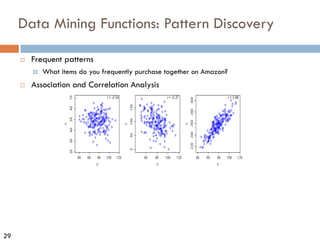
¨ Association and Correlation Analysis
30
Data Mining Functions: Pattern Discovery
¨ Frequent patterns
¤ What items do you frequently purchase together on Amazon?
¨ Association and Correlation Analysis
q A typical association rule
q Diaper à Beer [0.5%, 75%] (support, confidence)
q How to mine such patterns and rules efficiently in large datasets?
q How to use such patterns for classification, clustering, and other applications?
q More: friend recommendation, motif discovery, malware detection, fraud
detection, etc.
31
Data Mining Functions: Classification
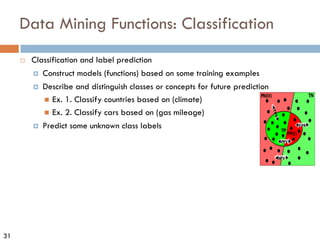
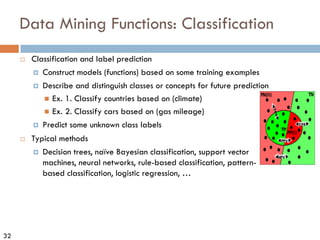
¨ Classification and label prediction
¤ Construct models (functions) based on some training examples
¤ Describe and distinguish classes or concepts for future prediction
n Ex. 1. Classify countries based on (climate)
n Ex. 2. Classify cars based on (gas mileage)
¤ Predict some unknown class labels
32
Data Mining Functions: Classification
¨ Classification and label prediction
¤ Construct models (functions) based on some training examples
¤ Describe and distinguish classes or concepts for future prediction
n Ex. 1. Classify countries based on (climate)
n Ex. 2. Classify cars based on (gas mileage)
¤ Predict some unknown class labels
¨ Typical methods
¤ Decision trees, naïve Bayesian classification, support vector
machines, neural networks, rule-based classification, pattern-
based classification, logistic regression, …
33
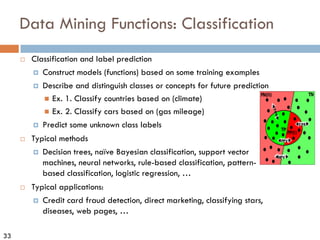
Data Mining Functions: Classification
¨ Classification and label prediction
¤ Construct models (functions) based on some training examples
¤ Describe and distinguish classes or concepts for future prediction
n Ex. 1. Classify countries based on (climate)
n Ex. 2. Classify cars based on (gas mileage)
¤ Predict some unknown class labels
¨ Typical methods
¤ Decision trees, naïve Bayesian classification, support vector
machines, neural networks, rule-based classification, pattern-
based classification, logistic regression, …
¨ Typical applications:
¤ Credit card fraud detection, direct marketing, classifying stars,
diseases, web pages, …
34
Data Mining Functions: Cluster Analysis
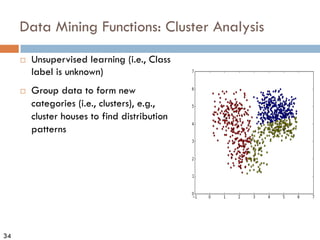
¨ Unsupervised learning (i.e., Class
label is unknown)
¨ Group data to form new
categories (i.e., clusters), e.g.,
cluster houses to find distribution
patterns
35
Data Mining Functions: Cluster Analysis
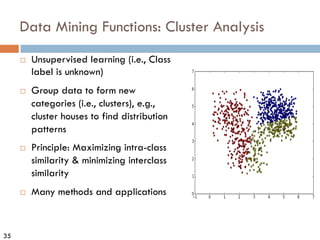
¨ Unsupervised learning (i.e., Class
label is unknown)
¨ Group data to form new
categories (i.e., clusters), e.g.,
cluster houses to find distribution
patterns
¨ Principle: Maximizing intra-class
similarity & minimizing interclass
similarity
¨ Many methods and applications
36
Data Mining Functions: Outlier Analysis
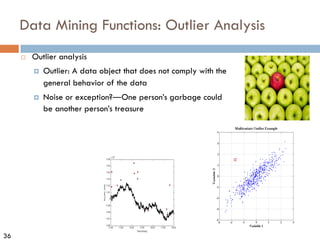
¨ Outlier analysis
¤ Outlier: A data object that does not comply with the
general behavior of the data
¤ Noise or exception?―One person’s garbage could
be another person’s treasure
37
Data Mining Functions: Outlier Analysis
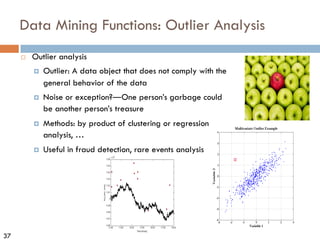
¨ Outlier analysis
¤ Outlier: A data object that does not comply with the
general behavior of the data
¤ Noise or exception?―One person’s garbage could
be another person’s treasure
¤ Methods: by product of clustering or regression
analysis, …
¤ Useful in fraud detection, rare events analysis
38
Data Mining Functions: Time and Ordering:
Sequential Pattern, Trend and Evolution Analysis
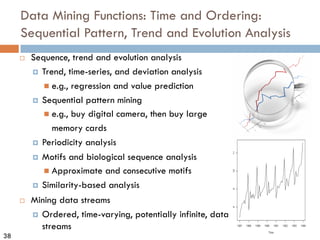
¨ Sequence, trend and evolution analysis
¤ Trend, time-series, and deviation analysis
n e.g., regression and value prediction
¤ Sequential pattern mining
n e.g., buy digital camera, then buy large
memory cards
¤ Periodicity analysis
¤ Motifs and biological sequence analysis
n Approximate and consecutive motifs
¤ Similarity-based analysis
¨ Mining data streams
¤ Ordered, time-varying, potentially infinite, data
streams
39
Data Mining Functions: Structure and
Network Analysis
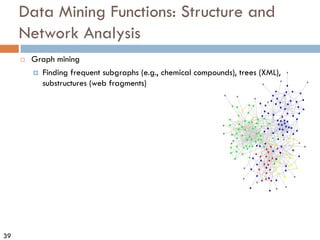
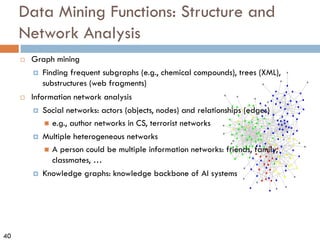
¨ Graph mining
¤ Finding frequent subgraphs (e.g., chemical compounds), trees (XML),
substructures (web fragments)
40
Data Mining Functions: Structure and
Network Analysis
¨ Graph mining
¤ Finding frequent subgraphs (e.g., chemical compounds), trees (XML),
substructures (web fragments)
¨ Information network analysis
¤ Social networks: actors (objects, nodes) and relationships (edges)
n e.g., author networks in CS, terrorist networks
¤ Multiple heterogeneous networks
n A person could be multiple information networks: friends, family,
classmates, …
¤ Knowledge graphs: knowledge backbone of AI systems
41
Data Mining Functions: Structure and
Network Analysis
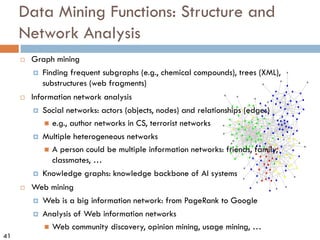
¨ Graph mining
¤ Finding frequent subgraphs (e.g., chemical compounds), trees (XML),
substructures (web fragments)
¨ Information network analysis
¤ Social networks: actors (objects, nodes) and relationships (edges)
n e.g., author networks in CS, terrorist networks
¤ Multiple heterogeneous networks
n A person could be multiple information networks: friends, family,
classmates, …
¤ Knowledge graphs: knowledge backbone of AI systems
¨ Web mining
¤ Web is a big information network: from PageRank to Google
¤ Analysis of Web information networks
n Web community discovery, opinion mining, usage mining, …
42
Evaluation of Knowledge
¨ Are all mined knowledge interesting?
¤ One can mine tremendous amounts of “patterns”
¤ Some may fit only certain dimension space (time, location,
…)
¤ Some may not be representative, may be transient, …
43
Evaluation of Knowledge
¨ Are all mined knowledge interesting?
¤ One can mine tremendous amount of “patterns”
¤ Some may fit only certain dimension space (time, location, …)
¤ Some may not be representative, may be transient, …
¨ Evaluation of mined knowledge → directly mine only interesting
knowledge?
¤ Descriptive vs. predictive
¤ Coverage
¤ Typicality vs. novelty
¤ Accuracy
¤ Timeliness
¤ …
44
Chapter 1. Introduction
¨ Why Data Mining?
¨ What Is Data Mining?
¨ A Multi-Dimensional View of Data Mining
¨ What Kinds of Data Can Be Mined?
¨ What Kinds of Patterns Can Be Mined?
¨ What Kinds of Technologies Are Used?
¨ What Kinds of Applications Are Targeted?
¨ Major Issues in Data Mining
¨ A Brief History of Data Mining and Data Mining Society
¨ Summary
45
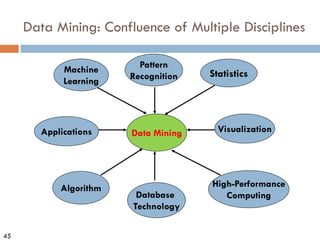
Data Mining: Confluence of Multiple Disciplines
Data Mining
Machine
Learning
Statistics
Applications
Algorithm
Pattern
Recognition
High-Performance
Computing
Visualization
Database
Technology
46
Why Confluence of Multiple Disciplines?
¨ Tremendous amount of data
¤ Algorithms must be scalable to handle big data
¨ High-dimensionality of data
¤ Micro-array may have tens of thousands of dimensions
¨ High complexity of data
¤ Data streams and sensor data
¤ Time-series data, temporal data, sequence data
¤ Structure data, graphs, social and information networks
¤ Spatial, spatiotemporal, multimedia, text and Web data
¤ Software programs, scientific simulations
¨ New and sophisticated applications
47
Chapter 1. Introduction
¨ Why Data Mining?
¨ What Is Data Mining?
¨ A Multi-Dimensional View of Data Mining
¨ What Kinds of Data Can Be Mined?
¨ What Kinds of Patterns Can Be Mined?
¨ What Kinds of Technologies Are Used?
¨ What Kinds of Applications Are Targeted?
¨ Major Issues in Data Mining
¨ A Brief History of Data Mining and Data Mining Society
¨ Summary
48
Applications of Data Mining
¨ Web page analysis: classification, clustering, ranking
¨ Collaborative analysis & recommender systems
¨ Biological and medical data analysis
¨ Data mining and software engineering
¨ Data mining and text analysis
¨ Data mining and social and information network analysis
¨ Built-in (invisible data mining) functions in Google, MS, Yahoo!,
Linked, Facebook, …
49
Chapter 1. Introduction
¨ Why Data Mining?
¨ What Is Data Mining?
¨ A Multi-Dimensional View of Data Mining
¨ What Kinds of Data Can Be Mined?
¨ What Kinds of Patterns Can Be Mined?
¨ What Kinds of Technologies Are Used?
¨ What Kinds of Applications Are Targeted?
¨ Major Issues in Data Mining
¨ A Brief History of Data Mining and Data Mining Society
¨ Summary
50
Major Issues in Data Mining (1)
¨ Mining Methodology
¤ Mining various and new kinds of knowledge
¤ Mining knowledge in multi-dimensional space
¤ Data mining: An interdisciplinary effort
¤ Boosting the power of discovery in a networked environment
¤ Handling noise, uncertainty, and incompleteness of data
¤ Pattern evaluation and pattern- or constraint-guided mining
51
Major Issues in Data Mining (1)
¨ Mining Methodology
¤ Mining various and new kinds of knowledge
¤ Mining knowledge in multi-dimensional space
¤ Data mining: An interdisciplinary effort
¤ Boosting the power of discovery in a networked environment
¤ Handling noise, uncertainty, and incompleteness of data
¤ Pattern evaluation and pattern- or constraint-guided mining
¨ User Interaction & Human-Machine Collaboration
¤ Interactive mining
¤ Incorporation of background knowledge
¤ Presentation and visualization of data mining results
52
¨ Efficiency and Scalability
¤ Efficiency and scalability of data mining algorithms
¤ Parallel, distributed, stream, and incremental mining methods
¨ Diversity of data types
¤ Handling complex types of data
¤ Mining dynamic, networked, and global data repositories
¨ Data mining and society
¤ Social impacts of data mining
¤ Privacy-preserving data mining
Major Issues in Data Mining (2)
53
Chapter 1. Introduction
¨ Why Data Mining?
¨ What Is Data Mining?
¨ A Multi-Dimensional View of Data Mining
¨ What Kinds of Data Can Be Mined?
¨ What Kinds of Patterns Can Be Mined?
¨ What Kinds of Technologies Are Used?
¨ What Kinds of Applications Are Targeted?
¨ Major Issues in Data Mining
¨ A Brief History of Data Mining and Data Mining Society
¨ Summary
54
A Brief History of Data Mining Society
¨ 1989 IJCAI Workshop on Knowledge Discovery in Databases
¤ Knowledge Discovery in Databases (G. Piatetsky-Shapiro and W.
Frawley, 1991)
¨ 1991-1994 Workshops on Knowledge Discovery in Databases
¤ Advances in Knowledge Discovery and Data Mining (U. Fayyad, G.
Piatetsky-Shapiro, P. Smyth, and R. Uthurusamy, 1996)
¨ 1995-1998 International Conferences on Knowledge Discovery in
Databases and Data Mining (KDD’95-98)
¤ Journal of Data Mining and Knowledge Discovery (1997)
¨ ACM SIGKDD conferences since 1998 and SIGKDD Explorations
¨ More conferences on data mining
¤ PAKDD (1997), PKDD (1997), SIAM-Data Mining (2001), (IEEE) ICDM
(2001), WSDM (2008), etc.
¨ ACM Transactions on KDD (2007)
55
Conferences and Journals on Data Mining
¨ KDD Conferences
¤ ACM SIGKDD Int. Conf. on
Knowledge Discovery in
Databases and Data Mining (KDD)
¤ SIAM Data Mining Conf. (SDM)
¤ (IEEE) Int. Conf. on Data Mining
(ICDM)
¤ European Conf. on Machine
Learning and Principles and
practices of Knowledge Discovery
and Data Mining (ECML-PKDD)
¤ Pacific-Asia Conf. on Knowledge
Discovery and Data Mining
(PAKDD)
¤ Int. Conf. on Web Search and
Data Mining (WSDM)
n Other related conferences
n DB conferences: ACM SIGMOD,
VLDB, ICDE, EDBT, ICDT, …
n Web and IR conferences:
WWW, SIGIR, WSDM
n ML conferences: ICML, NIPS
n PR conferences: CVPR,
n Journals
n Data Mining and Knowledge
Discovery (DAMI or DMKD)
n IEEE Trans. On Knowledge and
Data Eng. (TKDE)
n KDD Explorations
n ACM Trans. on KDD
56
Where to Find References? DBLP, CiteSeer, Google
¨ Data mining and KDD (SIGKDD)
¤ Conferences: ACM-SIGKDD, IEEE-ICDM, SIAM-DM, PKDD, PAKDD, etc.
¤ Journal: Data Mining and Knowledge Discovery, KDD Explorations, ACM
TKDD
¨ Database systems (SIGMOD)
¤ Conferences: ACM-SIGMOD, ACM-PODS, VLDB, IEEE-ICDE, EDBT, ICDT,
DASFAA
¤ Journals: IEEE-TKDE, ACM-TODS/TOIS, JIIS, J. ACM, VLDB J., Info. Sys., etc.
¨ AI & Machine Learning
¤ Conferences: Machine learning (ML), AAAI, IJCAI, COLT (Learning Theory),
CVPR, NIPS, etc.
¤ Journals: Machine Learning, Artificial Intelligence, Knowledge and
Information Systems, IEEE-PAMI, etc.
57
Where to Find References? DBLP, CiteSeer, Google
¨ Web and IR
¤ Conferences: SIGIR, WWW, CIKM, etc.
¤ Journals: WWW: Internet and Web Information Systems
¨ Statistics
¤ Conferences: Joint Stat. Meeting, etc.
¤ Journals: Annals of statistics, etc.
¨ Visualization
¤ Conference proceedings: CHI, ACM-SIGGraph, etc.
¤ Journals: IEEE Trans. visualization and computer graphics, etc.
58
Future of Data Science
Figure from: https://www.datasciencecentral.com/profiles/blogs/difference-
of-data-science-machine-learning-and-data-mining
https://www.youtube.com/watc
h?v=hxXIJnjC_HI (Future of
Data Science @ Stanford)
Related events in OSU:
DataFest
Hackathon
Conduct research in labs
59
Chapter 1. Introduction
¨ Why Data Mining?
¨ What Is Data Mining?
¨ A Multi-Dimensional View of Data Mining
¨ What Kinds of Data Can Be Mined?
¨ What Kinds of Patterns Can Be Mined?
¨ What Kinds of Technologies Are Used?
¨ What Kinds of Applications Are Targeted?
¨ Major Issues in Data Mining
¨ A Brief History of Data Mining and Data Mining Society
¨ Summary
60
Summary
¨ Data mining: Discovering interesting patterns and knowledge from
massive amount of data
¨ A natural evolution of science and information technology, in great
demand, with wide applications
¨ A KDD process includes data cleaning, data integration, data
selection, transformation, data mining, pattern evaluation, and
knowledge presentation
¨ Mining can be performed in a variety of data
¨ Data mining functionalities: characterization, discrimination,
association, classification, clustering, trend and outlier analysis, etc.
¨ Data mining technologies and applications
¨ Major issues in data mining
61
Recommended Reference Books
¨ Charu C. Aggarwal, Data Mining: The Textbook, Springer, 2015
¨ E. Alpaydin. Introduction to Machine Learning, 2nd ed., MIT Press, 2011
¨ R. O. Duda, P. E. Hart, and D. G. Stork, Pattern Classification, 2ed., Wiley-
Interscience, 2000
¨ U. Fayyad, G. Grinstein, and A. Wierse, Information Visualization in Data Mining
and Knowledge Discovery, Morgan Kaufmann, 2001
¨ J. Han, M. Kamber, and J. Pei, Data Mining: Concepts and Techniques. Morgan
Kaufmann, 3rd ed. , 2011
¨ T. Hastie, R. Tibshirani, and J. Friedman, The Elements of Statistical Learning:
Data Mining, Inference, and Prediction, 2nd ed., Springer, 2009
¨ T. M. Mitchell, Machine Learning, McGraw Hill, 1997
¨ P.-N. Tan, M. Steinbach and V. Kumar, Introduction to Data Mining, Wiley, 2005
(2nd ed. 2016)
¨ I. H. Witten and E. Frank, Data Mining: Practical Machine Learning Tools and
Techniques with Java Implementations, Morgan Kaufmann, 2nd ed. 2005
¨ Mohammed J. Zaki and Wagner Meira Jr., Data Mining and Analysis:
Fundamental Concepts and Algorithms 2014
62
Future of Data Science
Figure from: https://www.datasciencecentral.com/profiles/blogs/difference-
of-data-science-machine-learning-and-data-mining
https://www.youtube.com/watc
h?v=hxXIJnjC_HI
Related events in OSU:
DataFest
Hackathon
Conduct research in labs

01datamining.pdf

  • 1.
    CSE5243 INTRO. TODATA MINING Chapter 1. Introduction Yu Su, CSE@The Ohio State University Slides adapted from UIUC CS412 by Prof. Jiawei Han and OSU CSE5243 by Prof. Huan Sun
  • 2.
    2 CSE 5243. CoursePage & Schedule ¨ Class Homepage: https://ysu1989.github.io/courses/sp20/cse5243/ ¨ Class Schedule: 9:35-10:55 AM, Wed/Fri, Caldwell Lab 171 ¨ Office hours: ¤ Instructor: Yu Su @ DL783, Fri 11:00am-12:15pm (right after class) First week: No office hours ¤ TA: Jiaqi Xu (xu.1629), Wed 03:00pm-04:00pm, Baker 406
  • 3.
    3 CSE 5243. Textbook ¨Recommended but not required ¨ (Primary) Jiawei Han, Micheline Kamber and Jian Pei, Data Mining: Concepts and Techniques (3rd ed), 2011 ¤ More resources: https://wiki.illinois.edu/wiki/display/cs412/2.+Course+Syllabus+and +Schedule ¨ (Primary) Pang-Ning Tan, Michael Steinbach, and Vipin Kumar, Introduction to Data Mining, 2006 ¨ (Supplementary) Mohammed J. Zaki and Wagner Meira, Jr., Data Mining Analysis and Concepts, 2014 ¨ (Supplementary) Jure Leskovec, Anand Rajaraman, Jeff Ullman, Mining of Massive Datasets ¤ More resources: http://www.mmds.org/
  • 4.
    4 CSE 5243. CourseWork and Grading ¨ Homework, Course Projects, and Exams ¤ Participation: 10% (Online discussion and/or class participation) ¤ Homework: 50% (No Late Submissions!) ¤ Midterm exam: 20% ¤ Final exam: 20% ¨ Need help and/or discussions? ¤ Carmen: https://osu.instructure.com/courses/76423/discussion_topics n Receive credits: answer questions on Carmen and engage in class discussion. ¨ Check your homework/exam scores ¤ Carmen: https://osu.instructure.com/courses/76423/gradebook
  • 5.
    5 Videos ¨ 10 TEDtalks on Big Data and Analytics ¤ https://www.promptcloud.com/blog/top-ted-talks-on-big-data/ ¤ Shyan Sanker (Director at Palantir Technologies): n https://www.youtube.com/watch?time_continue=19&v=ltelQ3iKybU ¨ 5 TED talks on Data analytics for business leaders ¤ https://bigdata-madesimple.com/5-best-ted-talks-on-data-analytics-for-business- leaders/ ¨ Data analytics for beginners ¤ https://www.youtube.com/watch?v=66ko_cWSHBU (If you love sports, this TED Talk on data analytics is going to be an interesting watch)
  • 6.
    6 Chapter 1. Introduction ¨What is Data Mining? ¨ Why Data Mining? ¨ A Multi-Dimensional View of Data Mining ¨ What Kinds of Data Can Be Mined? ¨ What Kinds of Patterns Can Be Mined? ¨ What Kinds of Technologies Are Used? ¨ What Kinds of Applications Are Targeted? ¨ Major Issues in Data Mining ¨ A Brief History of Data Mining and Data Mining Society ¨ Summary
  • 7.
    7 What is DataMining? ¨ Data mining (knowledge discovery from data, KDD) ¤ Extraction of interesting (non-trivial, implicit, previously unknown, and potentially useful) patterns or knowledge from huge amount of data ¨ Alternative names ¤ Knowledge discovery (mining) in databases (KDD), knowledge extraction, data/pattern analysis, data archeology, data dredging, information harvesting, business intelligence, etc.
  • 8.
    8 What is DataMining? ¨ Data mining (knowledge discovery from data, KDD) ¤ Extraction of interesting (non-trivial, implicit, previously unknown, and potentially useful) patterns or knowledge from huge amount of data ¨ Alternative names ¤ Knowledge discovery (mining) in databases (KDD), knowledge extraction, data/pattern analysis, data archeology, data dredging, information harvesting, business intelligence, etc. One of the best conferences to publish your research work: SIGKDD (check resources)
  • 9.
    9 Knowledge Discovery (KDD)Process ¨ (Narrow view) Data mining plays an essential role in the knowledge discovery process ¨ (Broad view) Data mining is the knowledge discovery process Data Cleaning Data Integration Databases Data Warehouse Task-relevant Data Selection Data Mining Pattern Evaluation
  • 10.
    10 Example: A WebMining Framework ¨ Web mining usually involves ¤ Data crawling and cleaning ¤ Data integration from multiple sources ¤ (Optional) Warehousing the data ¤ (Optional) Data cube construction ¤ Data selection for data mining ¤ Data mining ¤ Presentation of the mining results ¤ Patterns and knowledge to be used or stored into knowledge base
  • 11.
    12 KDD Process: AView from ML and Statistics ¨ This is a view from typical machine learning and statistics communities Input Data Data Mining Data Pre- Processing Post- Processing Data integration Normalization Feature selection Dimension reduction Pattern discovery Classification Clustering Outlier analysis … … … … Pattern evaluation Pattern selection Pattern interpretation Pattern visualization
  • 12.
    13 Data Science Figure from:https://www.datasciencecentral.com/profiles/blogs/difference- of-data-science-machine-learning-and-data-mining
  • 13.
    14 Chapter 1. Introduction ¨What Is Data Mining? ¨ Why Data Mining? ¨ A Multi-Dimensional View of Data Mining ¨ What Kinds of Data Can Be Mined? ¨ What Kinds of Patterns Can Be Mined? ¨ What Kinds of Technologies Are Used? ¨ What Kinds of Applications Are Targeted? ¨ Major Issues in Data Mining ¨ A Brief History of Data Mining and Data Mining Society ¨ Summary
  • 14.
    15 Why Data Mining? ¨The Explosive Growth of Data: from terabytes to petabytes ¤ Data collection and data availability n Automated data collection tools, database systems, Web, computerized society
  • 15.
    16 Why Data Mining? ¨The Explosive Growth of Data: from terabytes to petabytes ¤ Data collection and data availability n Automated data collection tools, database systems, Web, computerized society ¤ Major sources of data n Business: Web, e-commerce, transactions, stocks, … n Science: Remote sensing, bioinformatics, scientific simulation, … n Society and everyone: news, digital cameras, YouTube
  • 16.
    17 “How muchdata is generated each day?” – World Economic Forum
  • 17.
    18 Why Data Mining? ¨The Explosive Growth of Data: from terabytes to petabytes ¤ Data collection and data availability n Automated data collection tools, database systems, Web, computerized society ¤ Major sources of data n Business: Web, e-commerce, transactions, stocks, … n Science: Remote sensing, bioinformatics, scientific simulation, … n Society and everyone: news, digital cameras, YouTube ¨ We are drowning in data, but starving for knowledge! ¨ “Necessity is the mother of invention”—Data mining—Automated analysis of massive data sets
  • 18.
    19 Chapter 1. Introduction ¨Why Data Mining? ¨ What Is Data Mining? ¨ A Multi-Dimensional View of Data Mining ¨ What Kinds of Data Can Be Mined? ¨ What Kinds of Patterns Can Be Mined? ¨ What Kinds of Technologies Are Used? ¨ What Kinds of Applications Are Targeted? ¨ Major Issues in Data Mining ¨ A Brief History of Data Mining and Data Mining Society ¨ Summary
  • 19.
    20 Multi-Dimensional View ofData Mining ¨ Data to be mined ¤ Database data (extended-relational, object-oriented, heterogeneous), data warehouse, transactional data, stream, spatiotemporal, time-series, sequence, text and web, multi-media, graphs & social and information networks
  • 20.
    21 Multi-Dimensional View ofData Mining ¨ Data to be mined ¤ Database data (extended-relational, object-oriented, heterogeneous), data warehouse, transactional data, stream, spatiotemporal, time-series, sequence, text and web, multi-media, graphs & social and information networks ¨ Knowledge to be mined (or: Data mining functions) ¤ Characterization, discrimination, association, classification, clustering, trend/deviation, outlier analysis, … ¤ Descriptive vs. predictive data mining ¤ Multiple/integrated functions and mining at multiple levels
  • 21.
    22 Multi-Dimensional View ofData Mining ¨ Data to be mined ¤ Database data (extended-relational, object-oriented, heterogeneous), data warehouse, transactional data, stream, spatiotemporal, time-series, sequence, text and web, multi-media, graphs & social and information networks ¨ Knowledge to be mined (or: Data mining functions) ¤ Characterization, discrimination, association, classification, clustering, trend/deviation, outlier analysis, … ¤ Descriptive vs. predictive data mining ¤ Multiple/integrated functions and mining at multiple levels ¨ Techniques utilized ¤ Data warehousing (OLAP), machine learning, statistics, pattern recognition, visualization, high-performance computing, etc.
  • 22.
    23 Multi-Dimensional View ofData Mining ¨ Data to be mined ¤ Database data (extended-relational, object-oriented, heterogeneous), data warehouse, transactional data, stream, spatiotemporal, time-series, sequence, text and web, multi-media, graphs & social and information networks ¨ Knowledge to be mined (or: Data mining functions) ¤ Characterization, discrimination, association, classification, clustering, trend/deviation, outlier analysis, … ¤ Descriptive vs. predictive data mining ¤ Multiple/integrated functions and mining at multiple levels ¨ Techniques utilized ¤ Data warehousing (OLAP), machine learning, statistics, pattern recognition, visualization, high-performance computing, etc. ¨ Applications adapted ¤ Retail, telecommunication, banking, fraud analysis, bio-data mining, stock market analysis, text mining, Web mining, etc.
  • 23.
    24 Chapter 1. Introduction ¨Why Data Mining? ¨ What Is Data Mining? ¨ A Multi-Dimensional View of Data Mining ¨ What Kinds of Data Can Be Mined? ¨ What Kinds of Patterns Can Be Mined? ¨ What Kinds of Technologies Are Used? ¨ What Kinds of Applications Are Targeted? ¨ Major Issues in Data Mining ¨ A Brief History of Data Mining and Data Mining Society ¨ Summary
  • 24.
    25 Data Mining: OnWhat Kinds of Data? ¨ Database-oriented data sets and applications ¤ Relational database, data warehouse, transactional database ¤ Object-relational databases, Heterogeneous databases and legacy databases ¨ Advanced data sets and advanced applications ¤ Data streams and sensor data ¤ Time-series data, temporal data, sequence data (incl. bio-sequences) ¤ Structure data, graphs, social networks and information networks ¤ Spatial data and spatiotemporal data ¤ Multimedia database ¤ Text databases ¤ The World-Wide Web
  • 25.
    26 Survey Your Name, ID,Major Question 1: What do you think Data Mining is? Question 2: What project have you done so far that you think is most relevant to Data Mining? • Not necessarily research project; can be your course project or any hackathon event you participated in. Question 3: What do you expect to learn from this course? Briefly answer each question with a few sentences.
  • 26.
    27 Chapter 1. Introduction ¨Why Data Mining? ¨ What Is Data Mining? ¨ A Multi-Dimensional View of Data Mining ¨ What Kinds of Data Can Be Mined? ¨ What Kinds of Patterns Can Be Mined? ¨ What Kinds of Technologies Are Used? ¨ What Kinds of Applications Are Targeted? ¨ Major Issues in Data Mining ¨ A Brief History of Data Mining and Data Mining Society ¨ Summary
  • 27.
    28 Data Mining Functions:Pattern Discovery ¨ Frequent patterns ¤ What items do you frequently purchase together on Amazon?
  • 28.
    29 Data Mining Functions:Pattern Discovery ¨ Frequent patterns ¤ What items do you frequently purchase together on Amazon? ¨ Association and Correlation Analysis
  • 29.
    30 Data Mining Functions:Pattern Discovery ¨ Frequent patterns ¤ What items do you frequently purchase together on Amazon? ¨ Association and Correlation Analysis q A typical association rule q Diaper à Beer [0.5%, 75%] (support, confidence) q How to mine such patterns and rules efficiently in large datasets? q How to use such patterns for classification, clustering, and other applications? q More: friend recommendation, motif discovery, malware detection, fraud detection, etc.
  • 30.
    31 Data Mining Functions:Classification ¨ Classification and label prediction ¤ Construct models (functions) based on some training examples ¤ Describe and distinguish classes or concepts for future prediction n Ex. 1. Classify countries based on (climate) n Ex. 2. Classify cars based on (gas mileage) ¤ Predict some unknown class labels
  • 31.
    32 Data Mining Functions:Classification ¨ Classification and label prediction ¤ Construct models (functions) based on some training examples ¤ Describe and distinguish classes or concepts for future prediction n Ex. 1. Classify countries based on (climate) n Ex. 2. Classify cars based on (gas mileage) ¤ Predict some unknown class labels ¨ Typical methods ¤ Decision trees, naïve Bayesian classification, support vector machines, neural networks, rule-based classification, pattern- based classification, logistic regression, …
  • 32.
    33 Data Mining Functions:Classification ¨ Classification and label prediction ¤ Construct models (functions) based on some training examples ¤ Describe and distinguish classes or concepts for future prediction n Ex. 1. Classify countries based on (climate) n Ex. 2. Classify cars based on (gas mileage) ¤ Predict some unknown class labels ¨ Typical methods ¤ Decision trees, naïve Bayesian classification, support vector machines, neural networks, rule-based classification, pattern- based classification, logistic regression, … ¨ Typical applications: ¤ Credit card fraud detection, direct marketing, classifying stars, diseases, web pages, …
  • 33.
    34 Data Mining Functions:Cluster Analysis ¨ Unsupervised learning (i.e., Class label is unknown) ¨ Group data to form new categories (i.e., clusters), e.g., cluster houses to find distribution patterns
  • 34.
    35 Data Mining Functions:Cluster Analysis ¨ Unsupervised learning (i.e., Class label is unknown) ¨ Group data to form new categories (i.e., clusters), e.g., cluster houses to find distribution patterns ¨ Principle: Maximizing intra-class similarity & minimizing interclass similarity ¨ Many methods and applications
  • 35.
    36 Data Mining Functions:Outlier Analysis ¨ Outlier analysis ¤ Outlier: A data object that does not comply with the general behavior of the data ¤ Noise or exception?―One person’s garbage could be another person’s treasure
  • 36.
    37 Data Mining Functions:Outlier Analysis ¨ Outlier analysis ¤ Outlier: A data object that does not comply with the general behavior of the data ¤ Noise or exception?―One person’s garbage could be another person’s treasure ¤ Methods: by product of clustering or regression analysis, … ¤ Useful in fraud detection, rare events analysis
  • 37.
    38 Data Mining Functions:Time and Ordering: Sequential Pattern, Trend and Evolution Analysis ¨ Sequence, trend and evolution analysis ¤ Trend, time-series, and deviation analysis n e.g., regression and value prediction ¤ Sequential pattern mining n e.g., buy digital camera, then buy large memory cards ¤ Periodicity analysis ¤ Motifs and biological sequence analysis n Approximate and consecutive motifs ¤ Similarity-based analysis ¨ Mining data streams ¤ Ordered, time-varying, potentially infinite, data streams
  • 38.
    39 Data Mining Functions:Structure and Network Analysis ¨ Graph mining ¤ Finding frequent subgraphs (e.g., chemical compounds), trees (XML), substructures (web fragments)
  • 39.
    40 Data Mining Functions:Structure and Network Analysis ¨ Graph mining ¤ Finding frequent subgraphs (e.g., chemical compounds), trees (XML), substructures (web fragments) ¨ Information network analysis ¤ Social networks: actors (objects, nodes) and relationships (edges) n e.g., author networks in CS, terrorist networks ¤ Multiple heterogeneous networks n A person could be multiple information networks: friends, family, classmates, … ¤ Knowledge graphs: knowledge backbone of AI systems
  • 40.
    41 Data Mining Functions:Structure and Network Analysis ¨ Graph mining ¤ Finding frequent subgraphs (e.g., chemical compounds), trees (XML), substructures (web fragments) ¨ Information network analysis ¤ Social networks: actors (objects, nodes) and relationships (edges) n e.g., author networks in CS, terrorist networks ¤ Multiple heterogeneous networks n A person could be multiple information networks: friends, family, classmates, … ¤ Knowledge graphs: knowledge backbone of AI systems ¨ Web mining ¤ Web is a big information network: from PageRank to Google ¤ Analysis of Web information networks n Web community discovery, opinion mining, usage mining, …
  • 41.
    42 Evaluation of Knowledge ¨Are all mined knowledge interesting? ¤ One can mine tremendous amounts of “patterns” ¤ Some may fit only certain dimension space (time, location, …) ¤ Some may not be representative, may be transient, …
  • 42.
    43 Evaluation of Knowledge ¨Are all mined knowledge interesting? ¤ One can mine tremendous amount of “patterns” ¤ Some may fit only certain dimension space (time, location, …) ¤ Some may not be representative, may be transient, … ¨ Evaluation of mined knowledge → directly mine only interesting knowledge? ¤ Descriptive vs. predictive ¤ Coverage ¤ Typicality vs. novelty ¤ Accuracy ¤ Timeliness ¤ …
  • 43.
    44 Chapter 1. Introduction ¨Why Data Mining? ¨ What Is Data Mining? ¨ A Multi-Dimensional View of Data Mining ¨ What Kinds of Data Can Be Mined? ¨ What Kinds of Patterns Can Be Mined? ¨ What Kinds of Technologies Are Used? ¨ What Kinds of Applications Are Targeted? ¨ Major Issues in Data Mining ¨ A Brief History of Data Mining and Data Mining Society ¨ Summary
  • 44.
    45 Data Mining: Confluenceof Multiple Disciplines Data Mining Machine Learning Statistics Applications Algorithm Pattern Recognition High-Performance Computing Visualization Database Technology
  • 45.
    46 Why Confluence ofMultiple Disciplines? ¨ Tremendous amount of data ¤ Algorithms must be scalable to handle big data ¨ High-dimensionality of data ¤ Micro-array may have tens of thousands of dimensions ¨ High complexity of data ¤ Data streams and sensor data ¤ Time-series data, temporal data, sequence data ¤ Structure data, graphs, social and information networks ¤ Spatial, spatiotemporal, multimedia, text and Web data ¤ Software programs, scientific simulations ¨ New and sophisticated applications
  • 46.
    47 Chapter 1. Introduction ¨Why Data Mining? ¨ What Is Data Mining? ¨ A Multi-Dimensional View of Data Mining ¨ What Kinds of Data Can Be Mined? ¨ What Kinds of Patterns Can Be Mined? ¨ What Kinds of Technologies Are Used? ¨ What Kinds of Applications Are Targeted? ¨ Major Issues in Data Mining ¨ A Brief History of Data Mining and Data Mining Society ¨ Summary
  • 47.
    48 Applications of DataMining ¨ Web page analysis: classification, clustering, ranking ¨ Collaborative analysis & recommender systems ¨ Biological and medical data analysis ¨ Data mining and software engineering ¨ Data mining and text analysis ¨ Data mining and social and information network analysis ¨ Built-in (invisible data mining) functions in Google, MS, Yahoo!, Linked, Facebook, …
  • 48.
    49 Chapter 1. Introduction ¨Why Data Mining? ¨ What Is Data Mining? ¨ A Multi-Dimensional View of Data Mining ¨ What Kinds of Data Can Be Mined? ¨ What Kinds of Patterns Can Be Mined? ¨ What Kinds of Technologies Are Used? ¨ What Kinds of Applications Are Targeted? ¨ Major Issues in Data Mining ¨ A Brief History of Data Mining and Data Mining Society ¨ Summary
  • 49.
    50 Major Issues inData Mining (1) ¨ Mining Methodology ¤ Mining various and new kinds of knowledge ¤ Mining knowledge in multi-dimensional space ¤ Data mining: An interdisciplinary effort ¤ Boosting the power of discovery in a networked environment ¤ Handling noise, uncertainty, and incompleteness of data ¤ Pattern evaluation and pattern- or constraint-guided mining
  • 50.
    51 Major Issues inData Mining (1) ¨ Mining Methodology ¤ Mining various and new kinds of knowledge ¤ Mining knowledge in multi-dimensional space ¤ Data mining: An interdisciplinary effort ¤ Boosting the power of discovery in a networked environment ¤ Handling noise, uncertainty, and incompleteness of data ¤ Pattern evaluation and pattern- or constraint-guided mining ¨ User Interaction & Human-Machine Collaboration ¤ Interactive mining ¤ Incorporation of background knowledge ¤ Presentation and visualization of data mining results
  • 51.
    52 ¨ Efficiency andScalability ¤ Efficiency and scalability of data mining algorithms ¤ Parallel, distributed, stream, and incremental mining methods ¨ Diversity of data types ¤ Handling complex types of data ¤ Mining dynamic, networked, and global data repositories ¨ Data mining and society ¤ Social impacts of data mining ¤ Privacy-preserving data mining Major Issues in Data Mining (2)
  • 52.
    53 Chapter 1. Introduction ¨Why Data Mining? ¨ What Is Data Mining? ¨ A Multi-Dimensional View of Data Mining ¨ What Kinds of Data Can Be Mined? ¨ What Kinds of Patterns Can Be Mined? ¨ What Kinds of Technologies Are Used? ¨ What Kinds of Applications Are Targeted? ¨ Major Issues in Data Mining ¨ A Brief History of Data Mining and Data Mining Society ¨ Summary
  • 53.
    54 A Brief Historyof Data Mining Society ¨ 1989 IJCAI Workshop on Knowledge Discovery in Databases ¤ Knowledge Discovery in Databases (G. Piatetsky-Shapiro and W. Frawley, 1991) ¨ 1991-1994 Workshops on Knowledge Discovery in Databases ¤ Advances in Knowledge Discovery and Data Mining (U. Fayyad, G. Piatetsky-Shapiro, P. Smyth, and R. Uthurusamy, 1996) ¨ 1995-1998 International Conferences on Knowledge Discovery in Databases and Data Mining (KDD’95-98) ¤ Journal of Data Mining and Knowledge Discovery (1997) ¨ ACM SIGKDD conferences since 1998 and SIGKDD Explorations ¨ More conferences on data mining ¤ PAKDD (1997), PKDD (1997), SIAM-Data Mining (2001), (IEEE) ICDM (2001), WSDM (2008), etc. ¨ ACM Transactions on KDD (2007)
  • 54.
    55 Conferences and Journalson Data Mining ¨ KDD Conferences ¤ ACM SIGKDD Int. Conf. on Knowledge Discovery in Databases and Data Mining (KDD) ¤ SIAM Data Mining Conf. (SDM) ¤ (IEEE) Int. Conf. on Data Mining (ICDM) ¤ European Conf. on Machine Learning and Principles and practices of Knowledge Discovery and Data Mining (ECML-PKDD) ¤ Pacific-Asia Conf. on Knowledge Discovery and Data Mining (PAKDD) ¤ Int. Conf. on Web Search and Data Mining (WSDM) n Other related conferences n DB conferences: ACM SIGMOD, VLDB, ICDE, EDBT, ICDT, … n Web and IR conferences: WWW, SIGIR, WSDM n ML conferences: ICML, NIPS n PR conferences: CVPR, n Journals n Data Mining and Knowledge Discovery (DAMI or DMKD) n IEEE Trans. On Knowledge and Data Eng. (TKDE) n KDD Explorations n ACM Trans. on KDD
  • 55.
    56 Where to FindReferences? DBLP, CiteSeer, Google ¨ Data mining and KDD (SIGKDD) ¤ Conferences: ACM-SIGKDD, IEEE-ICDM, SIAM-DM, PKDD, PAKDD, etc. ¤ Journal: Data Mining and Knowledge Discovery, KDD Explorations, ACM TKDD ¨ Database systems (SIGMOD) ¤ Conferences: ACM-SIGMOD, ACM-PODS, VLDB, IEEE-ICDE, EDBT, ICDT, DASFAA ¤ Journals: IEEE-TKDE, ACM-TODS/TOIS, JIIS, J. ACM, VLDB J., Info. Sys., etc. ¨ AI & Machine Learning ¤ Conferences: Machine learning (ML), AAAI, IJCAI, COLT (Learning Theory), CVPR, NIPS, etc. ¤ Journals: Machine Learning, Artificial Intelligence, Knowledge and Information Systems, IEEE-PAMI, etc.
  • 56.
    57 Where to FindReferences? DBLP, CiteSeer, Google ¨ Web and IR ¤ Conferences: SIGIR, WWW, CIKM, etc. ¤ Journals: WWW: Internet and Web Information Systems ¨ Statistics ¤ Conferences: Joint Stat. Meeting, etc. ¤ Journals: Annals of statistics, etc. ¨ Visualization ¤ Conference proceedings: CHI, ACM-SIGGraph, etc. ¤ Journals: IEEE Trans. visualization and computer graphics, etc.
  • 57.
    58 Future of DataScience Figure from: https://www.datasciencecentral.com/profiles/blogs/difference- of-data-science-machine-learning-and-data-mining https://www.youtube.com/watc h?v=hxXIJnjC_HI (Future of Data Science @ Stanford) Related events in OSU: DataFest Hackathon Conduct research in labs
  • 58.
    59 Chapter 1. Introduction ¨Why Data Mining? ¨ What Is Data Mining? ¨ A Multi-Dimensional View of Data Mining ¨ What Kinds of Data Can Be Mined? ¨ What Kinds of Patterns Can Be Mined? ¨ What Kinds of Technologies Are Used? ¨ What Kinds of Applications Are Targeted? ¨ Major Issues in Data Mining ¨ A Brief History of Data Mining and Data Mining Society ¨ Summary
  • 59.
    60 Summary ¨ Data mining:Discovering interesting patterns and knowledge from massive amount of data ¨ A natural evolution of science and information technology, in great demand, with wide applications ¨ A KDD process includes data cleaning, data integration, data selection, transformation, data mining, pattern evaluation, and knowledge presentation ¨ Mining can be performed in a variety of data ¨ Data mining functionalities: characterization, discrimination, association, classification, clustering, trend and outlier analysis, etc. ¨ Data mining technologies and applications ¨ Major issues in data mining
  • 60.
    61 Recommended Reference Books ¨Charu C. Aggarwal, Data Mining: The Textbook, Springer, 2015 ¨ E. Alpaydin. Introduction to Machine Learning, 2nd ed., MIT Press, 2011 ¨ R. O. Duda, P. E. Hart, and D. G. Stork, Pattern Classification, 2ed., Wiley- Interscience, 2000 ¨ U. Fayyad, G. Grinstein, and A. Wierse, Information Visualization in Data Mining and Knowledge Discovery, Morgan Kaufmann, 2001 ¨ J. Han, M. Kamber, and J. Pei, Data Mining: Concepts and Techniques. Morgan Kaufmann, 3rd ed. , 2011 ¨ T. Hastie, R. Tibshirani, and J. Friedman, The Elements of Statistical Learning: Data Mining, Inference, and Prediction, 2nd ed., Springer, 2009 ¨ T. M. Mitchell, Machine Learning, McGraw Hill, 1997 ¨ P.-N. Tan, M. Steinbach and V. Kumar, Introduction to Data Mining, Wiley, 2005 (2nd ed. 2016) ¨ I. H. Witten and E. Frank, Data Mining: Practical Machine Learning Tools and Techniques with Java Implementations, Morgan Kaufmann, 2nd ed. 2005 ¨ Mohammed J. Zaki and Wagner Meira Jr., Data Mining and Analysis: Fundamental Concepts and Algorithms 2014
  • 61.
    62 Future of DataScience Figure from: https://www.datasciencecentral.com/profiles/blogs/difference- of-data-science-machine-learning-and-data-mining https://www.youtube.com/watc h?v=hxXIJnjC_HI Related events in OSU: DataFest Hackathon Conduct research in labs