Manikandan Balusamy
   What is Data Indexing?

   Why is it important?
   It is a data structure that is added to a file to
    provide faster access to the data.

   It reduces the number of blocks that the DBMS
    has to check.
   The operations read, modify, update, and
    delete are used to access data from database.

   DBMS must first transfer the data temporarily
    to a buffer in main memory.

   Data is then transferred between disk and
    main memory into units called blocks.
   It contains a search key and a pointer.

   Search key - an attribute or set of attributes that is
    used to look up the records in a file.

   Pointer - contains the address of where the data is
    stored in memory.

   It can be compared to the card catalog system used in
    public libraries of the past.
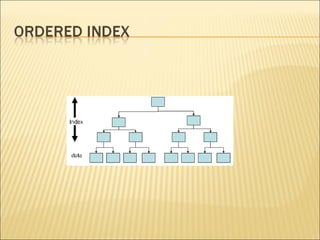
   Ordered index (Primary index or clustering
    index) – which is used to access data sorted by
    order of values.

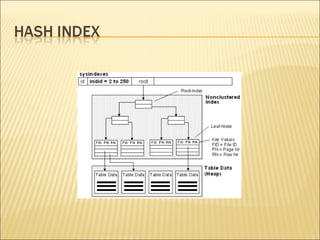
   Hash index (secondary index or non-clustering
    index ) - used to access data that is distributed
    uniformly across a range of buckets.
   Five Factors involved when choosing the
    indexing technique:
   access type
   access time
   insertion time
   deletion time
   space overhead
   Access type is the type of access being used.
   Access time - time required to locate the data.
   Insertion time - time required to insert the new data.
   Deletion time - time required to delete the data.
   Space overhead - the additional space occupied by the
    added data structure.
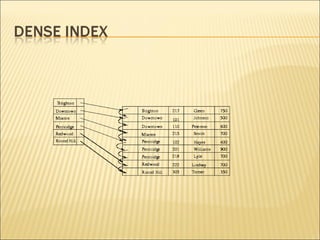
   Dense index - an index record appears for every
    search-key value in the file.

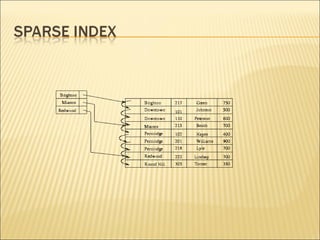
   Sparse index - an index record that appears for
    only some of the values in the file.
   B-tree is the most commonly used data
    structures for indexing.

   It is fully dynamic, that is it can grow and
    shrink.
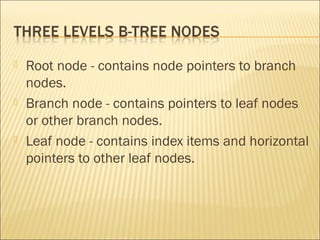
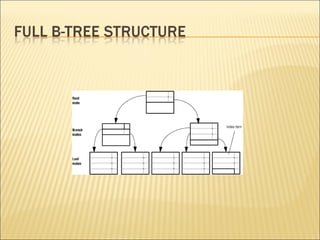
   Root node - contains node pointers to branch
    nodes.
   Branch node - contains pointers to leaf nodes
    or other branch nodes.
   Leaf node - contains index items and horizontal
    pointers to other leaf nodes.
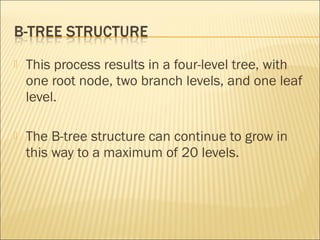
   This process results in a four-level tree, with
    one root node, two branch levels, and one leaf
    level.

   The B-tree structure can continue to grow in
    this way to a maximum of 20 levels.
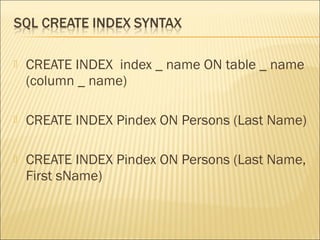
   CREATE INDEX index _ name ON table _ name
    (column _ name)

   CREATE INDEX Pindex ON Persons (Last Name)

   CREATE INDEX Pindex ON Persons (Last Name,
    First sName)
Thank you

Data indexing presentation

  • 1.
  • 2.
    What is Data Indexing?  Why is it important?
  • 3.
    It is a data structure that is added to a file to provide faster access to the data.  It reduces the number of blocks that the DBMS has to check.
  • 4.
    The operations read, modify, update, and delete are used to access data from database.  DBMS must first transfer the data temporarily to a buffer in main memory.  Data is then transferred between disk and main memory into units called blocks.
  • 5.
    It contains a search key and a pointer.  Search key - an attribute or set of attributes that is used to look up the records in a file.  Pointer - contains the address of where the data is stored in memory.  It can be compared to the card catalog system used in public libraries of the past.
  • 6.
    Ordered index (Primary index or clustering index) – which is used to access data sorted by order of values.  Hash index (secondary index or non-clustering index ) - used to access data that is distributed uniformly across a range of buckets.
  • 9.
    Five Factors involved when choosing the indexing technique:  access type  access time  insertion time  deletion time  space overhead
  • 10.
    Access type is the type of access being used.  Access time - time required to locate the data.  Insertion time - time required to insert the new data.  Deletion time - time required to delete the data.  Space overhead - the additional space occupied by the added data structure.
  • 11.
    Dense index - an index record appears for every search-key value in the file.  Sparse index - an index record that appears for only some of the values in the file.
  • 15.
    B-tree is the most commonly used data structures for indexing.  It is fully dynamic, that is it can grow and shrink.
  • 16.
    Root node - contains node pointers to branch nodes.  Branch node - contains pointers to leaf nodes or other branch nodes.  Leaf node - contains index items and horizontal pointers to other leaf nodes.
  • 18.
    This process results in a four-level tree, with one root node, two branch levels, and one leaf level.  The B-tree structure can continue to grow in this way to a maximum of 20 levels.
  • 19.
    CREATE INDEX index _ name ON table _ name (column _ name)  CREATE INDEX Pindex ON Persons (Last Name)  CREATE INDEX Pindex ON Persons (Last Name, First sName)
  • 20.