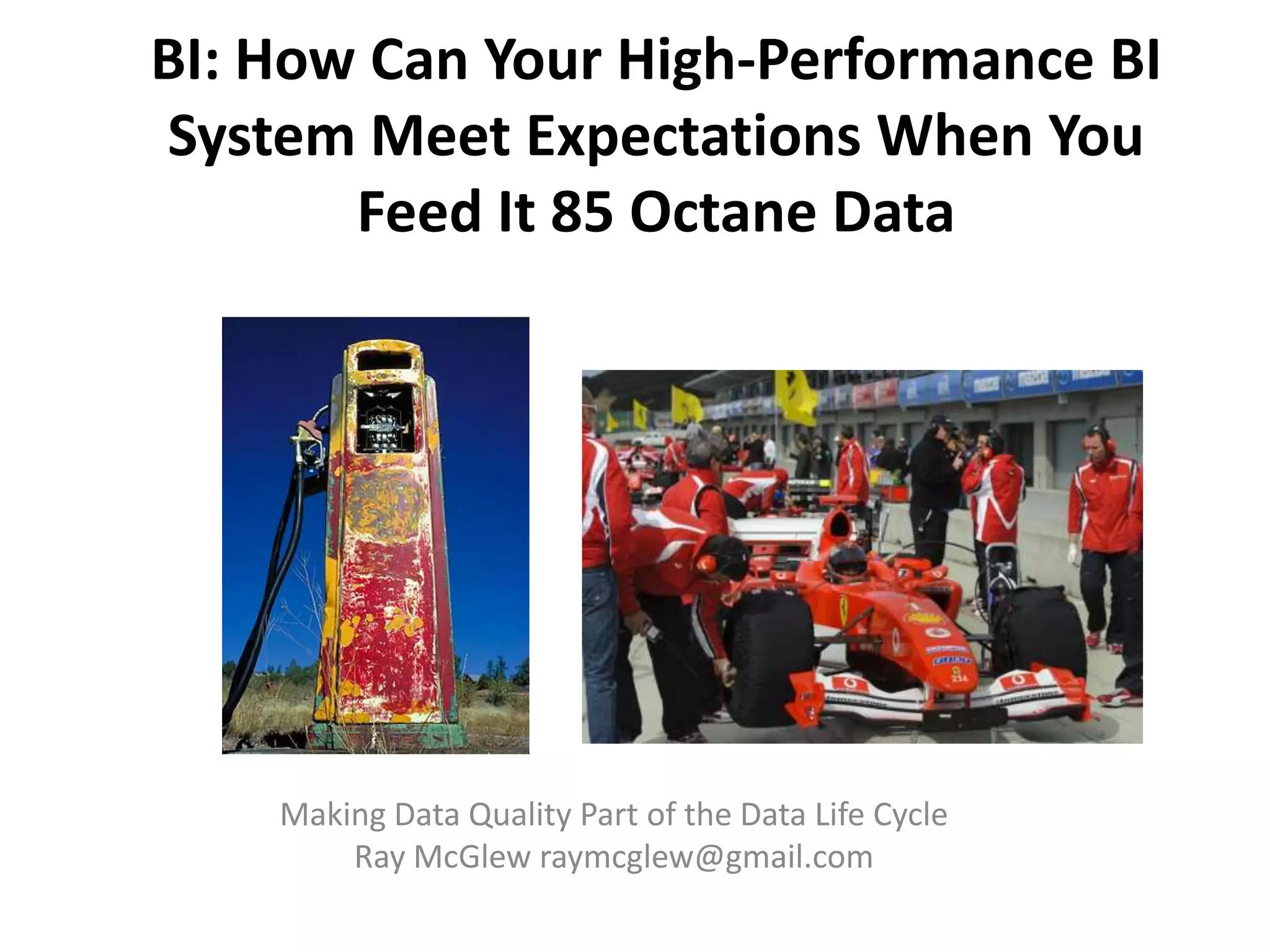
BI: How Can Your High-Performance BI
System Meet Expectations When You
       Feed It 85 Octane Data


    Making Data Quality Part of the Data Life Cycle
        Ray McGlew raymcglew@gmail.com
Brought to You By:
BI Failure Reasons
          Gartner: 70%-80% BI Projects Fail
•   Lack of Business Support and Ownership
•   Poor Quality Data
•   Lack of Requirements
•   Scope Creep
•   Funding
•   Big-Bang Approach
Life Cycle of Data
•   Creation (usually transactions)
•   Operational Use
•   Analytical Use
•   Destruction
Who “Owns” The Data?
• IT responsible for conserving it
  – Restrict use according to rules
  – Providing access
  – Keeping it safe
• Business responsible for managing it
  – Create rules for IT to use
  – Providing IT with requirements for access
• Bottom line… it is a Corporate Resource
Data Concerns
• Privacy
    – Credit Cards
    – Health Records
•   Security
•   Accuracy
•   Usability
•   Availability
Regulatory Compliance
• Privacy regulations
• Legal limits on how long you can keep certain
  data
• Providing lineage on data used for reporting
  – Sarbanes Oxley
  – SEC filings
Quality Data
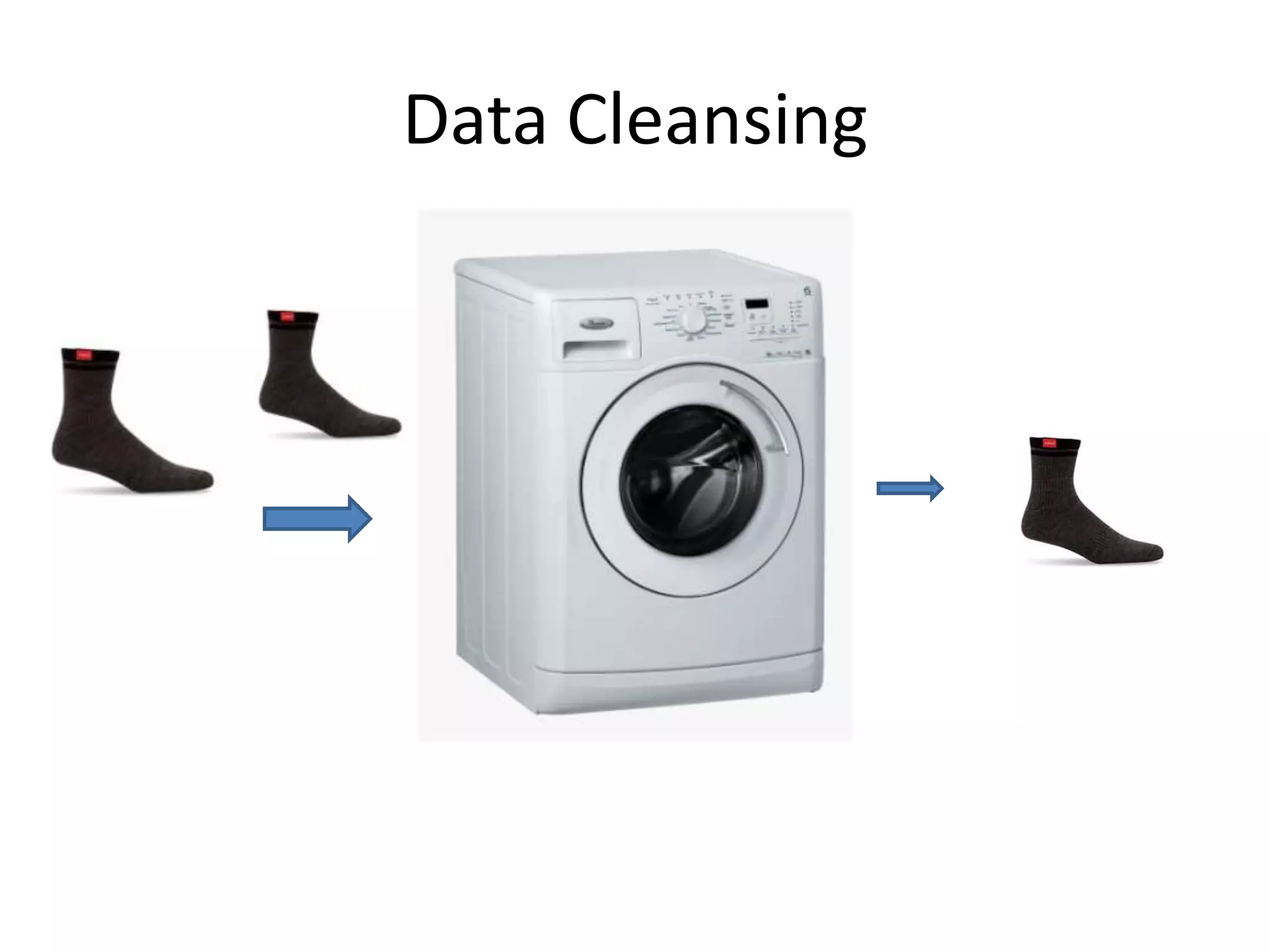
• Easiest to clean at the source
• Some methods to “clean” data
  – Standardize
  – Validate
• Data Cleansing Tools
Data Cleansing
Data Governance
“Data governance (DG) refers to the overall
management of the
availability, usability, integrity, and security of
the data employed in an enterprise. “
Data Governance Facets
•   Data Stewardship
•   Data Dictionary/Glossary
•   Master Data Management
•   Strong Management Promotion
Data Stewardship
• Splits responsibility for ensuring great data
• Business
  – Defines what important data elements are
  – Defines the rules for acquiring data
  – Looks for cross-organizational uses
• IT
  – Responsible for technical methods
  – Acquires and maintains tools
Data Dictionary
• Platform for spreading the knowledge
• Is used in conjunction with reporting tools
• The more data knowledge is used, the better
  it gets
• Can be started using in-house tools
• Starting point for Master Data Management
Master Data Management
• Data Governance should drive MDM
• Technology
  – Facilitates
  – NOT the driver
Strong Management Promotion
• Cross-functional at the highest level of the
  organization
• Will require funding
• Must break through “It will cost my
  department to improve the data quality so
  their department can save time “
Data Governance and Lifecycle
• Data Creation
  – Standard values
  – Validation at the source
• Operational use
  – Required for some customers and vendors
• Analytical use
  – Easier to integrate across systems and groups
• Destruction
Data Governance is NOT a Program!
• Culture Change
• Integrated with other activities
  – Business Intelligence
  – Business Process Re-engineering
  – ERP Implementation
  – Mergers
Data Governance Tips
• Prioritize
   – Based on business value
   – Based on Pain
   – Low Hanging Fruit
• Don’t try to boil the ocean!
Resources
DAMA International (www.dama.org)
     Enterprise Data World
DAMA Philadelphia (www.dama-phila.org)
Data Governance (www.datagovernance.com)
Data Governance Professionals Org (www.dgpo.org)


 Love your data, and stay the course, for it will be
    with you long after flashy apps are gone.

BI: How Can Your High-Performance BI System Meet Expectations When You Feed It 85 Octane Data

  • 1.
    BI: How CanYour High-Performance BI System Meet Expectations When You Feed It 85 Octane Data Making Data Quality Part of the Data Life Cycle Ray McGlew raymcglew@gmail.com
  • 2.
  • 3.
    BI Failure Reasons Gartner: 70%-80% BI Projects Fail • Lack of Business Support and Ownership • Poor Quality Data • Lack of Requirements • Scope Creep • Funding • Big-Bang Approach
  • 4.
    Life Cycle ofData • Creation (usually transactions) • Operational Use • Analytical Use • Destruction
  • 5.
    Who “Owns” TheData? • IT responsible for conserving it – Restrict use according to rules – Providing access – Keeping it safe • Business responsible for managing it – Create rules for IT to use – Providing IT with requirements for access • Bottom line… it is a Corporate Resource
  • 6.
    Data Concerns • Privacy – Credit Cards – Health Records • Security • Accuracy • Usability • Availability
  • 7.
    Regulatory Compliance • Privacyregulations • Legal limits on how long you can keep certain data • Providing lineage on data used for reporting – Sarbanes Oxley – SEC filings
  • 8.
    Quality Data • Easiestto clean at the source • Some methods to “clean” data – Standardize – Validate • Data Cleansing Tools
  • 9.
  • 10.
    Data Governance “Data governance(DG) refers to the overall management of the availability, usability, integrity, and security of the data employed in an enterprise. “
  • 11.
    Data Governance Facets • Data Stewardship • Data Dictionary/Glossary • Master Data Management • Strong Management Promotion
  • 12.
    Data Stewardship • Splitsresponsibility for ensuring great data • Business – Defines what important data elements are – Defines the rules for acquiring data – Looks for cross-organizational uses • IT – Responsible for technical methods – Acquires and maintains tools
  • 13.
    Data Dictionary • Platformfor spreading the knowledge • Is used in conjunction with reporting tools • The more data knowledge is used, the better it gets • Can be started using in-house tools • Starting point for Master Data Management
  • 14.
    Master Data Management •Data Governance should drive MDM • Technology – Facilitates – NOT the driver
  • 15.
    Strong Management Promotion •Cross-functional at the highest level of the organization • Will require funding • Must break through “It will cost my department to improve the data quality so their department can save time “
  • 16.
    Data Governance andLifecycle • Data Creation – Standard values – Validation at the source • Operational use – Required for some customers and vendors • Analytical use – Easier to integrate across systems and groups • Destruction
  • 17.
    Data Governance isNOT a Program! • Culture Change • Integrated with other activities – Business Intelligence – Business Process Re-engineering – ERP Implementation – Mergers
  • 18.
    Data Governance Tips •Prioritize – Based on business value – Based on Pain – Low Hanging Fruit • Don’t try to boil the ocean!
  • 19.
    Resources DAMA International (www.dama.org) Enterprise Data World DAMA Philadelphia (www.dama-phila.org) Data Governance (www.datagovernance.com) Data Governance Professionals Org (www.dgpo.org) Love your data, and stay the course, for it will be with you long after flashy apps are gone.