The First Step in Information Management
www.firstsanfranciscopartners.com
Sustainable	
  Data	
  Governance:	
  
Adding	
  Value	
  for	
  the	
  Long	
  Term	
  
Kelle	
  O’Neal	
  
kelle@firstsanfranciscopartners.com	
  
415-­‐425-­‐9661	
  
@1stsanfrancisco	
  
Why	
  We’re	
  Here	
  
pg 2Copyright (c) 2015 - First San Francisco Partners www.firstsanfranciscopartners.com Proprietary and Confidential
	
  
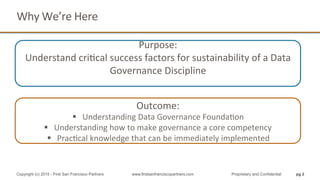
Purpose:	
  	
  
Understand	
  criQcal	
  success	
  factors	
  for	
  sustainability	
  of	
  a	
  Data	
  
Governance	
  Discipline	
  
Outcome:	
  	
  
§  Understanding	
  Data	
  Governance	
  FoundaQon	
  
§  Understanding	
  how	
  to	
  make	
  governance	
  a	
  core	
  competency	
  
§  PracQcal	
  knowledge	
  that	
  can	
  be	
  immediately	
  implemented	
  
Agenda	
  
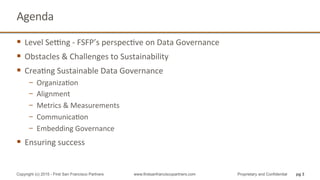
§  Level	
  SeTng	
  -­‐	
  FSFP’s	
  perspecQve	
  on	
  Data	
  Governance	
  
§  Obstacles	
  &	
  Challenges	
  to	
  Sustainability	
  
§  CreaQng	
  Sustainable	
  Data	
  Governance	
  
−  OrganizaQon	
  
−  Alignment	
  
−  Metrics	
  &	
  Measurements	
  
−  CommunicaQon	
  
−  Embedding	
  Governance	
  
§  Ensuring	
  success	
  
pg 3Copyright (c) 2015 - First San Francisco Partners www.firstsanfranciscopartners.com Proprietary and Confidential
www.firstsanfranciscopartners.com
Level	
  SeTng	
  
Data	
  Governance	
  DefiniQon	
  
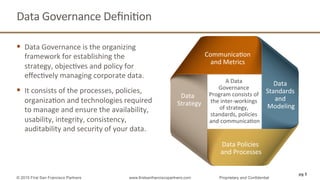
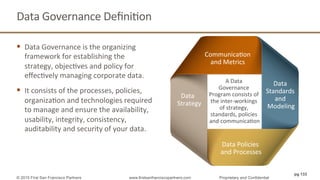
§  Data	
  Governance	
  is	
  the	
  organizing	
  
framework	
  for	
  establishing	
  the	
  
strategy,	
  objecQves	
  and	
  policy	
  for	
  
effecQvely	
  managing	
  corporate	
  data.	
  	
  
§  It	
  consists	
  of	
  the	
  processes,	
  policies,	
  
organizaQon	
  and	
  technologies	
  required	
  
to	
  manage	
  and	
  ensure	
  the	
  availability,	
  
usability,	
  integrity,	
  consistency,	
  
auditability	
  and	
  security	
  of	
  your	
  data.	
  
CommunicaQon	
  
and	
  Metrics	
  
Data	


Strategy	
  
Data	
  Policies	
  
and	
  Processes	
  
Data	
  	
  
Standards	
  	
  
and	
  	
  
Modeling	
  
A	
  Data	
  	
  
Governance	
  	
  
Program	
  consists	
  of	
  
the	
  inter-­‐workings	
  	
  
of	
  strategy,	
  
standards,	
  policies	
  
and	
  communicaQon	
  
pg 5
© 2015 First San Francisco Partners www.firstsanfranciscopartners.com Proprietary and Confidential
pg 6
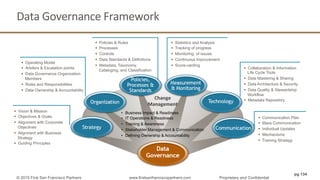
Data	
  Governance	
  Framework	
  
© 2015 First San Francisco Partners www.firstsanfranciscopartners.com Proprietary and Confidential
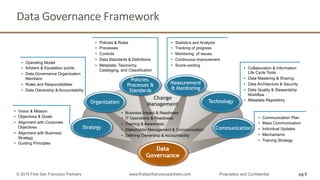
•  Vision & Mission
•  Objectives & Goals
•  Alignment with Corporate
Objectives
•  Alignment with Business
Strategy
•  Guiding Principles
•  Statistics and Analysis
•  Tracking of progress
•  Monitoring of issues
•  Continuous Improvement
•  Score-carding
•  Policies & Rules
•  Processes
•  Controls
•  Data Standards & Definitions
•  Metadata, Taxonomy,
Cataloging, and Classification
•  Operating Model
•  Arbiters & Escalation points
•  Data Governance Organization
Members
•  Roles and Responsibilities
•  Data Ownership & Accountability
•  Collaboration & Information
Life Cycle Tools
•  Data Mastering & Sharing
•  Data Architecture & Security
•  Data Quality & Stewardship
Workflow
•  Metadata Repository
•  Communication Plan
•  Mass Communication
•  Individual Updates
•  Mechanisms
•  Training Strategy
•  Business Impact & Readiness
•  IT Operations & Readiness
•  Training & Awareness
•  Stakeholder Management & Communication
•  Defining Ownership & Accountability
Change
Management
 	
  Develop	
  and	
  execute	
  architectures,	
  policies	
  and	
  procedures	
  to	
  manage	
  the	
  full	
  data	
  lifecycle	
  
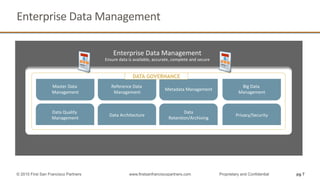
Enterprise	
  Data	
  Management	
  
Enterprise	
  Data	
  Management	
  
Ensure	
  data	
  is	
  available,	
  accurate,	
  complete	
  and	
  secure	
  
Data	
  Quality	
  
Management	
  
Data	
  Architecture	
  
Data	
  
RetenQon/Archiving	
  
Master	
  Data	
  
Management	
  
Big	
  Data	
  	
  
Management	
  
Metadata	
  Management	
  
Reference	
  Data	
  
Management	
  
Privacy/Security	
  
DATA GOVERNANCE
pg 7© 2015 First San Francisco Partners www.firstsanfranciscopartners.com Proprietary and Confidential
pg 8
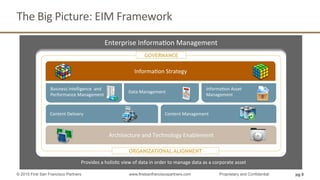
The	
  Big	
  Picture:	
  EIM	
  Framework	
  
© 2015 First San Francisco Partners www.firstsanfranciscopartners.com Proprietary and Confidential
Provides	
  a	
  holisQc	
  view	
  of	
  data	
  in	
  order	
  to	
  manage	
  data	
  as	
  a	
  corporate	
  asset	
  
Enterprise	
  InformaQon	
  Management	
  
InformaQon	
  Strategy	
  
Architecture	
  and	
  Technology	
  Enablement	
  
Content	
  Delivery	
  
Business	
  Intelligence	
  	
  and	
  
Performance	
  Management	
  	
  
Data	
  Management	
  
InformaQon	
  Asset	
  	
  
Management	
  
GOVERNANCE
ORGANIZATIONAL ALIGNMENT
Content	
  Management	
  
www.firstsanfranciscopartners.com
Obstacles	
  &	
  Challenges	
  
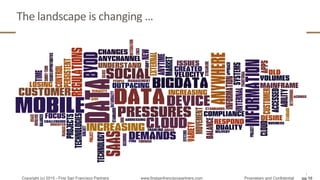
The	
  landscape	
  is	
  changing	
  …	
  
pg 10Copyright (c) 2014 - First San Francisco Partners www.firstsanfranciscopartners.com Proprietary and Confidential
pg 10Copyright (c) 2015 - First San Francisco Partners www.firstsanfranciscopartners.com Proprietary and Confidential
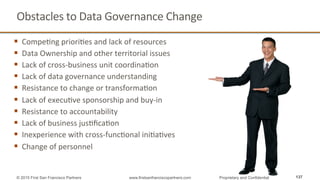
Obstacles	
  
§  CompeQng	
  prioriQes	
  and	
  lack	
  of	
  resources	
  
§  Data	
  Ownership	
  and	
  other	
  territorial	
  issues	
  
§  Lack	
  of	
  cross-­‐business	
  unit	
  coordinaQon	
  
§  Lack	
  of	
  data	
  governance	
  understanding	
  
§  Resistance	
  to	
  change	
  or	
  transformaQon	
  
§  Lack	
  of	
  execuQve	
  sponsorship	
  and	
  buy-­‐in	
  
§  Resistance	
  to	
  accountability	
  
§  Lack	
  of	
  business	
  jusQficaQon	
  
§  Inexperience	
  with	
  cross-­‐funcQonal	
  iniQaQves	
  
§  Change	
  of	
  personnel	
  
pg 11Copyright (c) 2015 - First San Francisco Partners www.firstsanfranciscopartners.com Proprietary and Confidential
Obstacles	
  
pg 12Copyright (c) 2015 - First San Francisco Partners www.firstsanfranciscopartners.com Proprietary and Confidential
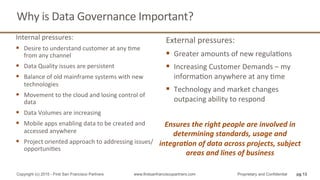
Why	
  is	
  Data	
  Governance	
  Important?	
  
Internal	
  pressures:	
  
§  Desire	
  to	
  understand	
  customer	
  at	
  any	
  Qme	
  
from	
  any	
  channel	
  
§  Data	
  Quality	
  issues	
  are	
  persistent	
  
§  Balance	
  of	
  old	
  mainframe	
  systems	
  with	
  new	
  
technologies	
  
§  Movement	
  to	
  the	
  cloud	
  and	
  losing	
  control	
  of	
  
data	
  
§  Data	
  Volumes	
  are	
  increasing	
  
§  Mobile	
  apps	
  enabling	
  data	
  to	
  be	
  created	
  and	
  
accessed	
  anywhere	
  
§  Project	
  oriented	
  approach	
  to	
  addressing	
  issues/
opportuniQes	
  
External	
  pressures:	
  
§  Greater	
  amounts	
  of	
  new	
  regulaQons	
  
§  Increasing	
  Customer	
  Demands	
  –	
  my	
  
informaQon	
  anywhere	
  at	
  any	
  Qme	
  
§  Technology	
  and	
  market	
  changes	
  
outpacing	
  ability	
  to	
  respond	
  
pg 13Copyright (c) 2015 - First San Francisco Partners www.firstsanfranciscopartners.com Proprietary and Confidential
Ensures	
  the	
  right	
  people	
  are	
  involved	
  in	
  
determining	
  standards,	
  usage	
  and	
  
integra4on	
  of	
  data	
  across	
  projects,	
  subject	
  
areas	
  and	
  lines	
  of	
  business	
  
www.firstsanfranciscopartners.com
Establishing	
  the	
  OrganizaQon	
  
Don’t	
  base	
  your	
  program	
  on	
  specific	
  individuals	
  
pg 15Copyright (c) 2015 - First San Francisco Partners www.firstsanfranciscopartners.com Proprietary and Confidential
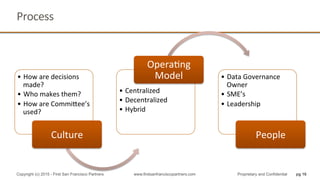
Process	
  
•  How	
  are	
  decisions	
  
made?	
  
•  Who	
  makes	
  them?	
  
•  How	
  are	
  Commihee’s	
  
used?	
  
Culture	
  
•  Centralized	
  
•  Decentralized	
  
•  Hybrid	
  
OperaQng	
  
Model	
   •  Data	
  Governance	
  
Owner	
  
•  SME’s	
  
•  Leadership	
  
People	
  
pg 16Copyright (c) 2015 - First San Francisco Partners www.firstsanfranciscopartners.com Proprietary and Confidential
OperaQng	
  Model	
  	
  
§  Outlines	
  how	
  Data	
  Governance	
  will	
  operate	
  
§  Forms	
  basis	
  for	
  the	
  Data	
  Governance	
  organizaQonal	
  structure	
  –	
  but	
  isn’t	
  an	
  org	
  chart	
  
§  Ensures	
  proper	
  oversight,	
  escalaQon	
  and	
  decision	
  making	
  
§  Ensures	
  the	
  right	
  people	
  are	
  involved	
  in	
  determining	
  standards,	
  usage	
  and	
  integraQon	
  
of	
  data	
  across	
  projects,	
  subject	
  areas	
  and	
  lines	
  of	
  business	
  
§  Creates	
  the	
  infrastructure	
  for	
  accountability	
  and	
  ownership	
  
pg 17Copyright (c) 2014 - First San Francisco Partners www.firstsanfranciscopartners.com Proprietary and Confidential
Wikipedia:	
  An	
  OperaQng	
  Model	
  describes	
  the	
  necessary	
  level	
  of	
  business	
  process	
  
integraQon	
  and	
  data	
  standardizaQon	
  in	
  the	
  business	
  and	
  among	
  trading	
  partners	
  
and	
  guides	
  the	
  underlying	
  Business	
  and	
  Technical	
  Architecture	
  to	
  effecQvely	
  and	
  
efficiently	
  realize	
  its	
  Business	
  Model.	
  The	
  process	
  of	
  OperaQng	
  Model	
  design	
  is	
  also	
  
part	
  of	
  business	
  strategy.	
  
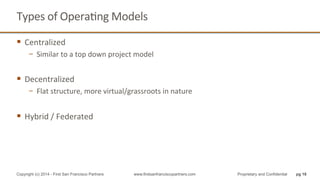
Types	
  of	
  OperaQng	
  Models	
  
§  Centralized	
  
−  Similar	
  to	
  a	
  top	
  down	
  project	
  model	
  	
  
§  Decentralized	
  
−  Flat	
  structure,	
  more	
  virtual/grassroots	
  in	
  nature	
  
§  Hybrid	
  /	
  Federated	
  
pg 18Copyright (c) 2014 - First San Francisco Partners www.firstsanfranciscopartners.com Proprietary and Confidential
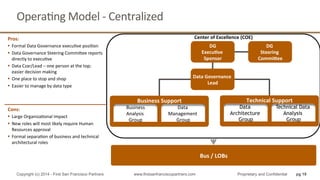
Pros:	
  
•  Formal	
  Data	
  Governance	
  execuQve	
  posiQon	
  
•  Data	
  Governance	
  Steering	
  Commihee	
  reports	
  
directly	
  to	
  execuQve	
  
•  Data	
  Czar/Lead	
  –	
  one	
  person	
  at	
  the	
  top;	
  
easier	
  decision	
  making	
  
•  One	
  place	
  to	
  stop	
  and	
  shop	
  
•  Easier	
  to	
  manage	
  by	
  data	
  type	
  
Cons:	
  
•  Large	
  OrganizaQonal	
  Impact	
  
•  New	
  roles	
  will	
  most	
  likely	
  require	
  Human	
  
Resources	
  approval	
  
•  Formal	
  separaQon	
  of	
  business	
  and	
  technical	
  
architectural	
  roles	
  
Bus	
  /	
  LOBs	
  
pg 19
OperaQng	
  Model	
  -­‐	
  Centralized	
  
Copyright (c) 2014 - First San Francisco Partners www.firstsanfranciscopartners.com Proprietary and Confidential
DG	
  
Execu4ve	
  	
  
Sponsor	
  
DG	
  	
  
Steering	
  
Commi<ee	
  
Center	
  of	
  Excellence	
  (COE)	
  
Data	
  Governance	
  
Lead	
  
Technical	
  Support	
  
Data
Architecture
Group
Technical Data
Analysis
Group
Business	
  Support	
  
Business	
  
Analysis	
  	
  
Group	
  
Data	
  
Management	
  	
  
Group	
  
LOB/BU	
  	
  
Data	
  Governance	
  Steering	
  Commi<ee	
  
LOB/BU	
  Data	
  Governance	
  Working	
  Group	
  
pg 20
OperaQng	
  Model	
  -­‐	
  Decentralized	
  
Copyright (c) 2014 - First San Francisco Partners www.firstsanfranciscopartners.com Proprietary and Confidential
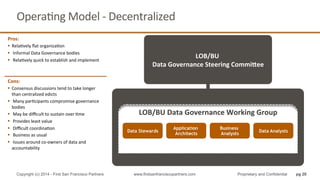
Data Stewards
Application
Architects
Business
Analysts
Data Analysts
Pros:	
  
•  RelaQvely	
  flat	
  organizaQon	
  
•  	
  Informal	
  Data	
  Governance	
  bodies	
  
•  	
  RelaQvely	
  quick	
  to	
  establish	
  and	
  implement	
  
Cons:	
  
•  Consensus	
  discussions	
  tend	
  to	
  take	
  longer	
  
than	
  centralized	
  edicts	
  
•  	
  Many	
  parQcipants	
  compromise	
  governance	
  
bodies	
  
•  	
  May	
  be	
  difficult	
  to	
  sustain	
  over	
  Qme	
  
•  	
  Provides	
  least	
  value	
  	
  
•  	
  Difficult	
  coordinaQon	
  
•  	
  Business	
  as	
  usual	
  
•  	
  Issues	
  around	
  co-­‐owners	
  of	
  data	
  and	
  
accountability	
  
pg 21
OperaQng	
  Model	
  -­‐	
  Hybrid	
  
Copyright (c) 2014 - First San Francisco Partners www.firstsanfranciscopartners.com Proprietary and Confidential
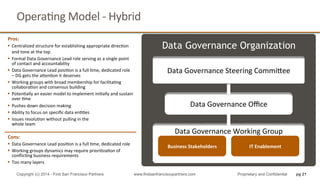
Pros:	
  
•  Centralized	
  structure	
  for	
  establishing	
  appropriate	
  direcQon	
  
and	
  tone	
  at	
  the	
  top	
  
•  Formal	
  Data	
  Governance	
  Lead	
  role	
  serving	
  as	
  a	
  single	
  point	
  
of	
  contact	
  and	
  accountability	
  
•  Data	
  Governance	
  Lead	
  posiQon	
  is	
  a	
  full	
  Qme,	
  dedicated	
  role	
  
–	
  DG	
  gets	
  the	
  ahenQon	
  it	
  deserves	
  
•  Working	
  groups	
  with	
  broad	
  membership	
  for	
  facilitaQng	
  
collaboraQon	
  and	
  consensus	
  building	
  
•  PotenQally	
  an	
  easier	
  model	
  to	
  implement	
  iniQally	
  and	
  sustain	
  
over	
  Qme	
  
•  Pushes	
  down	
  decision	
  making	
  
•  Ability	
  to	
  focus	
  on	
  specific	
  data	
  enQQes	
  
•  Issues	
  resoluQon	
  without	
  pulling	
  in	
  the	
  	
  
whole	
  team
Cons:	
  
•  Data	
  Governance	
  Lead	
  posiQon	
  is	
  a	
  full	
  Qme,	
  dedicated	
  role	
  
•  Working	
  groups	
  dynamics	
  may	
  require	
  prioriQzaQon	
  of	
  
conflicQng	
  business	
  requirements	
  
•  Too	
  many	
  layers
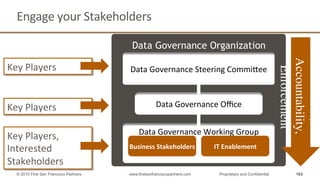
Data	
  Governance	
  Steering	
  Commihee	
  
Data	
  Governance	
  Office	
  
Data	
  Governance	
  Working	
  Group	
  
Business	
  Stakeholders	
   IT	
  Enablement	
  
Data Governance Organization
OperaQng	
  Model	
  -­‐	
  Federated	
  
pg 22Copyright (c) 2015 - First San Francisco Partners www.firstsanfranciscopartners.com Proprietary and Confidential
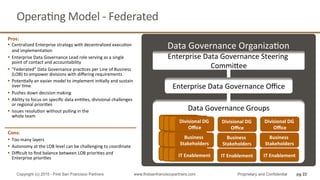
Pros:	
  
•  Centralized	
  Enterprise	
  strategy	
  with	
  decentralized	
  execuQon	
  
and	
  implementaQon	
  
•  Enterprise	
  Data	
  Governance	
  Lead	
  role	
  serving	
  as	
  a	
  single	
  
point	
  of	
  contact	
  and	
  accountability	
  
•  “Federated”	
  Data	
  Governance	
  pracQces	
  per	
  Line	
  of	
  Business	
  
(LOB)	
  to	
  empower	
  divisions	
  with	
  differing	
  requirements	
  
•  PotenQally	
  an	
  easier	
  model	
  to	
  implement	
  iniQally	
  and	
  sustain	
  
over	
  Qme	
  
•  Pushes	
  down	
  decision	
  making	
  
•  Ability	
  to	
  focus	
  on	
  specific	
  data	
  enQQes,	
  divisional	
  challenges	
  
or	
  regional	
  prioriQes	
  
•  Issues	
  resoluQon	
  without	
  pulling	
  in	
  the	
  	
  
whole	
  team
Cons:	
  
•  Too	
  many	
  layers	
  
•  Autonomy	
  at	
  the	
  LOB	
  level	
  can	
  be	
  challenging	
  to	
  coordinate	
  
•  Difficult	
  to	
  find	
  balance	
  between	
  LOB	
  prioriQes	
  and	
  
Enterprise	
  prioriQes
Enterprise	
  Data	
  Governance	
  Steering	
  
Commihee	
  
Enterprise	
  Data	
  Governance	
  Office	
  
Data	
  Governance	
  Groups	
  
Data	
  Governance	
  OrganizaQon	
  
Business	
  
Stakeholders	
  
IT	
  Enablement	
  
Divisional	
  DG	
  
Office	
  
Business	
  
Stakeholders	
  
IT	
  Enablement	
  
Divisional	
  DG	
  
Office	
  
Business	
  
Stakeholders	
  
IT	
  Enablement	
  
Business	
  
Stakeholders	
  
IT	
  Enablement	
  
Divisional	
  DG	
  
Office	
  
OperaQng	
  Model	
  Roles	
  and	
  ResponsibiliQes	
  
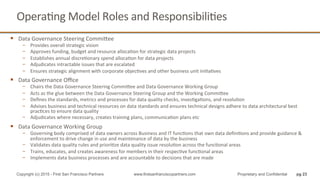
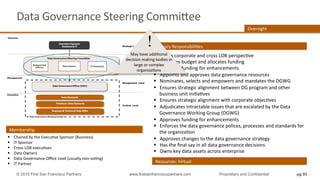
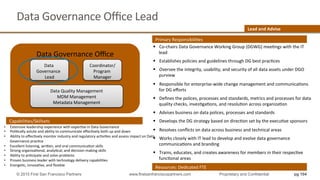
§  Data	
  Governance	
  Steering	
  Commihee	
  
−  Provides	
  overall	
  strategic	
  vision	
  
−  Approves	
  funding,	
  budget	
  and	
  resource	
  allocaQon	
  for	
  strategic	
  data	
  projects	
  
−  Establishes	
  annual	
  discreQonary	
  spend	
  allocaQon	
  for	
  data	
  projects	
  
−  Adjudicates	
  intractable	
  issues	
  that	
  are	
  escalated	
  
−  Ensures	
  strategic	
  alignment	
  with	
  corporate	
  objecQves	
  and	
  other	
  business	
  unit	
  iniQaQves	
  
§  Data	
  Governance	
  Office	
  
−  Chairs	
  the	
  Data	
  Governance	
  Steering	
  Commihee	
  and	
  Data	
  Governance	
  Working	
  Group	
  
−  Acts	
  as	
  the	
  glue	
  between	
  the	
  Data	
  Governance	
  Steering	
  Group	
  and	
  the	
  Working	
  Commihee	
  
−  Defines	
  the	
  standards,	
  metrics	
  and	
  processes	
  for	
  data	
  quality	
  checks,	
  invesQgaQons,	
  and	
  resoluQon	
  	
  
−  Advises	
  business	
  and	
  technical	
  resources	
  on	
  data	
  standards	
  and	
  ensures	
  technical	
  designs	
  adhere	
  to	
  data	
  architectural	
  best	
  
pracQces	
  to	
  ensure	
  data	
  quality	
  
−  Adjudicates	
  where	
  necessary,	
  creates	
  training	
  plans,	
  communicaQon	
  plans	
  etc	
  
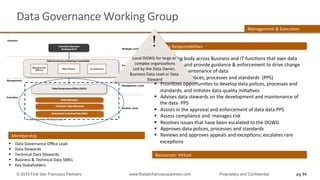
§  Data	
  Governance	
  Working	
  Group	
  
−  Governing	
  body	
  comprised	
  of	
  data	
  owners	
  across	
  Business	
  and	
  IT	
  funcQons	
  that	
  own	
  data	
  definiQons	
  and	
  provide	
  guidance	
  &	
  
enforcement	
  to	
  drive	
  change	
  in	
  use	
  and	
  maintenance	
  of	
  data	
  by	
  the	
  business	
  
−  Validates	
  data	
  quality	
  rules	
  and	
  prioriQze	
  data	
  quality	
  issue	
  resoluQon	
  across	
  the	
  funcQonal	
  areas	
  
−  Trains,	
  educates,	
  and	
  creates	
  awareness	
  for	
  members	
  in	
  their	
  respecQve	
  funcQonal	
  areas	
  
−  Implements	
  data	
  business	
  processes	
  and	
  are	
  accountable	
  to	
  decisions	
  that	
  are	
  made	
  
pg 23Copyright (c) 2015 - First San Francisco Partners www.firstsanfranciscopartners.com Proprietary and Confidential
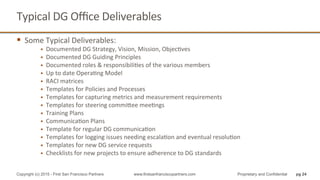
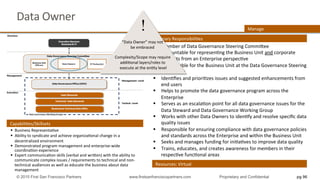
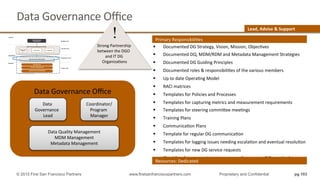
Typical	
  DG	
  Office	
  Deliverables	
  
§  Some	
  Typical	
  Deliverables:	
  
§  Documented	
  DG	
  Strategy,	
  Vision,	
  Mission,	
  ObjecQves	
  
§  Documented	
  DG	
  Guiding	
  Principles	
  
§  Documented	
  roles	
  &	
  responsibiliQes	
  of	
  the	
  various	
  members	
  
§  Up	
  to	
  date	
  OperaQng	
  Model	
  
§  RACI	
  matrices	
  
§  Templates	
  for	
  Policies	
  and	
  Processes	
  
§  Templates	
  for	
  capturing	
  metrics	
  and	
  measurement	
  requirements	
  
§  Templates	
  for	
  steering	
  commihee	
  meeQngs	
  
§  Training	
  Plans	
  
§  CommunicaQon	
  Plans	
  
§  Template	
  for	
  regular	
  DG	
  communicaQon	
  
§  Templates	
  for	
  logging	
  issues	
  needing	
  escalaQon	
  and	
  eventual	
  resoluQon	
  
§  Templates	
  for	
  new	
  DG	
  service	
  requests	
  
§  Checklists	
  for	
  new	
  projects	
  to	
  ensure	
  adherence	
  to	
  DG	
  standards	
  
pg 24Copyright (c) 2015 - First San Francisco Partners www.firstsanfranciscopartners.com Proprietary and Confidential
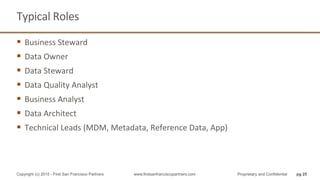
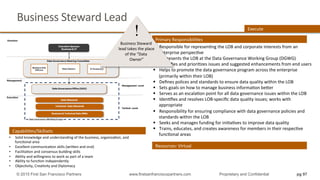
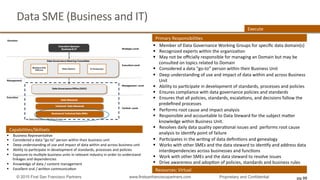
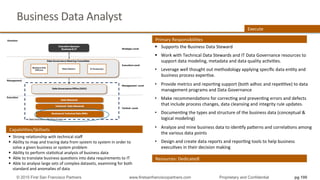
Typical	
  Roles	
  
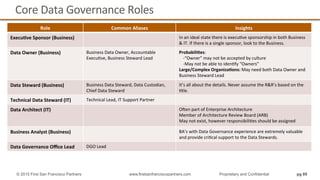
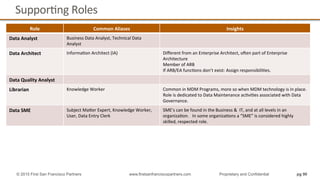
§  Business	
  Steward	
  
§  Data	
  Owner	
  
§  Data	
  Steward	
  
§  Data	
  Quality	
  Analyst	
  
§  Business	
  Analyst	
  
§  Data	
  Architect	
  
§  Technical	
  Leads	
  (MDM,	
  Metadata,	
  Reference	
  Data,	
  App)	
  
pg 25Copyright (c) 2015 - First San Francisco Partners www.firstsanfranciscopartners.com Proprietary and Confidential
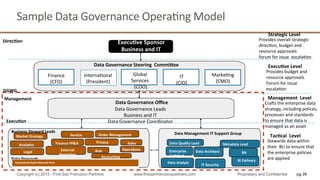
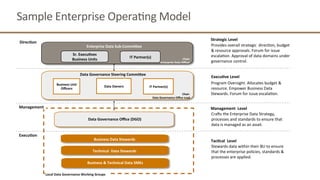
Sample	
  Data	
  Governance	
  OperaQng	
  Model	
  
pg 26Copyright (c) 2015 - First San Francisco Partners www.firstsanfranciscopartners.com Proprietary and Confidential
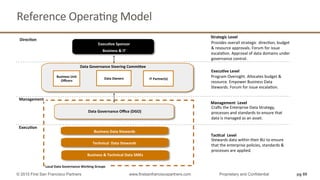
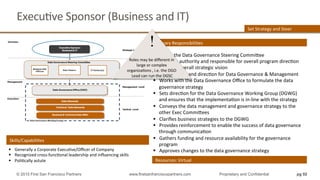
Direc4on	
  
TBD	
  	
  
Execu4ve	
  Sponsor	
  
Business	
  and	
  IT	
  
Business	
  Steward	
  Leads	
  	
  
Service	
   Order	
  Management	
  
Finance	
  FP&A	
   Sales	
  
Market	
  Strategy	
  
Analy4cs	
  
Data	
  Governance	
  Steering	
  	
  Commi<ee	
  	
  
Finance	
  
(CFO)	
  
InternaQonal	
  	
  
(President)	
  
Global	
  
Services	
  
	
  (COO)	
  
IT	
  
(CIO)	
  
MarkeQng	
  	
  
(CMO)	
  
Data	
  Governance	
  Office	
  
Data	
  Governance	
  Leads	
  
Business	
  and	
  IT	
  
Data	
  Governance	
  Coordinator	
  
Management	
  
Provides	
  budget	
  and	
  
resource	
  approvals.	
  	
  
Forum	
  for	
  issue	
  	
  
escalaQon	
  
Craps	
  the	
  enterprise	
  data	
  
strategy,	
  including	
  polices,	
  
processes	
  and	
  standards	
  	
  
to	
  ensure	
  that	
  data	
  is	
  
managed	
  as	
  an	
  asset	
  
Execu4ve	
  Level	
  
Management	
  	
  Level	


Stewards	
  data	
  within	
  
their	
  	
  BU	
  to	
  ensure	
  that	
  
the	
  enterprise	
  policies	
  
are	
  applied	
  
Tac4cal	
  	
  Level	
  
Strategic	
  Level	
  
Provides	
  overall	
  strategic	
  	
  
direcQon,	
  budget	
  and	
  
resource	
  approvals	
  	
  
forum	
  for	
  issue	
  	
  escalaQon	
  
Execu4on	
  
Data	
  Management	
  IT	
  Support	
  Group	
  
Data	
  Quality	
  Lead	
   Metadata	
  Lead	
  
Data	
  Architect	
  	
  
BI	
  Delivery	
  	
  
Opera4ons	
  External	
  	
  
Repor4ng	
  
DGWG	
  
Enterprise	
  
Architect	
  
BA	
  
Data	
  Analyst	
  
IT	
  Security	
  
Privacy	
  
Legal	
  
Data	
  Stewards	
  	
  
Risk	
  	
  
Centralized	
  Data	
  Steward	
  Pool	
  
Accoun4ng	
  
Data	
  Governance	
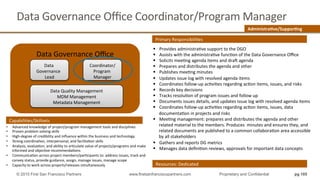
  Leadership	
  Team	
  
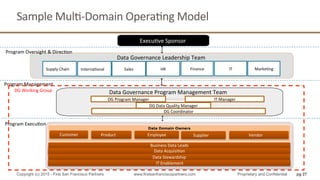
Sample	
  MulQ-­‐Domain	
  OperaQng	
  Model	
  
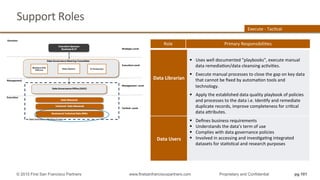
pg 27Copyright (c) 2015 - First San Francisco Partners www.firstsanfranciscopartners.com Proprietary and Confidential
Program	
  Oversight	
  &	
  DirecQon	
  
ExecuQve	
  Sponsor	
  
Program	
  Management	
  
DG	
  Working	
  Group	
   Data	
  Governance	
  Program	
  Management	
  Team	
  
DG	
  Program	
  Manager	
  
DG	
  Coordinator	
  
Program	
  ExecuQon	
  
IT	
  Manager	
  
Data Domain Owners
Business	
  Data	
  Leads	
  
Data	
  AcquisiQon	
  
Data	
  Stewardship	
  
IT	
  Enablement	
  
Supply	
  Chain	
   InternaQonal	
   Sales	
   HR	
   Finance	
   IT	
   MarkeQng	
  
Customer	
   Product	
   Employee	
   Vendor	
  Supplier	
  
DG	
  Data	
  Quality	
  Manager	
  
Direc4on	
  
TBD	
  	
  
Enterprise	
  Data	
  Sub-­‐Commi<ee	
  
Business	
  Data	
  Stewards	
  
Data	
  Governance	
  Steering	
  Commi<ee	
  
Business	
  Unit	
  
Officers	
  
Data	
  Owners	
   IT	
  Partner(s)	
  
Data	
  Governance	
  Office	
  (DGO)	
  
Management	
  
Program	
  Oversight.	
  Allocates	
  budget	
  &	
  
resource.	
  Empower	
  Business	
  Data	
  
Stewards.	
  Forum	
  for	
  issue	
  escalaQon.	
  
Craps	
  the	
  Enterprise	
  Data	
  Strategy,	
  
processes	
  and	
  standards	
  to	
  ensure	
  that	
  
data	
  is	
  managed	
  as	
  an	
  asset.	
  
Execu4ve	
  Level	
  
Management	
  	
  Level	


Stewards	
  data	
  within	
  their	
  BU	
  to	
  ensure	
  
that	
  the	
  enterprise	
  policies,	
  standards	
  &	
  
processes	
  are	
  applied.	
  
Tac4cal	
  	
  Level	
  
Strategic	
  Level	
  
Provides	
  overall	
  strategic	
  	
  direcQon,	
  budget	
  
&	
  resource	
  approvals.	
  Forum	
  for	
  issue	
  	
  
escalaQon.	
  Approval	
  of	
  data	
  domains	
  under	
  
governance	
  control.	
  
Execu4on	
  
Technical	
  	
  Data	
  Stewards	
  
Local	
  Data	
  Governance	
  Working	
  Groups	
  
Chair:	
  	
  
Enterprise	
  Data	
  Officer	
  
Chair:	
  	
  
Data	
  Governance	
  Office	
  Lead	


IT	
  Partner(s)	
  
Sr.	
  Execu4ves	
  
Business	
  Units	
  
Sample	
  Enterprise	
  OperaQng	
  Model	
  
Business	
  &	
  Technical	
  Data	
  SMEs	
  
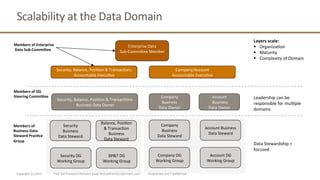
Scalability	
  at	
  the	
  Data	
  Domain	
  
Security,	
  Balance,	
  PosiQon	
  &	
  TransacQons	
  
Accountable	
  ExecuQve	
  
Company/Account	
  
Accountable	
  ExecuQve	
  
Enterprise	
  Data	
  	
  
Sub-­‐Commihee	
  Member	
  
Security,	
  Balance,	
  PosiQon	
  &	
  TransacQons	
  
	
  Business	
  Data	
  Owner	
  
Company	
  
Business	
  	
  
Data	
  Owner	
  
Security	
  	
  
Business	
  	
  
Data	
  Steward	
  
Balance,	
  PosiQon	
  
&	
  TransacQon	
  
Business	
  	
  
Data	
  Steward	
  
Company	
  	
  
Business	
  	
  
Data	
  Steward	
  
Account	
  Business	
  
Data	
  Steward	
  
Security	
  DG	
  
Working	
  Group	
  
BP&T	
  DG	
  
Working	
  Group	
  
Company	
  DG	
  
Working	
  Group	
  
Account	
  DG	
  
Working	
  Group	
  
Layers	
  scale:	
  
§  OrganizaQon	
  
§  Maturity	
  
§  Complexity	
  of	
  Domain	
  
Leadership	
  can	
  be	
  
responsible	
  for	
  mulQple	
  
domains	
  
Data	
  Stewardship	
  =	
  
focused	
  	
  
Account	
  
	
  Business	
  	
  
Data	
  Owner	
  
Members	
  of	
  DG	
  
Steering	
  Commi<ee	
  
Members	
  of	
  
Business	
  Data	
  
Steward	
  Prac4ce	
  
Group	
  
Members	
  of	
  Enterprise	
  
	
  Data	
  Sub-­‐Commi<ee	
  
Copyright	
  (c)	
  2015	
  -­‐	


  First	
  San	
  Francisco	
  Partners	
  www.firstsanfranciscopartners.com	


  Proprietary	
  and	
  ConfidenQal	
  
pg 30
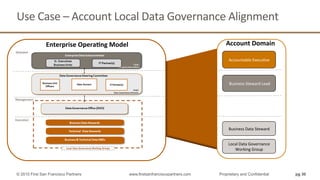
Use	
  Case	
  –	
  Account	
  Local	
  Data	
  Governance	
  Alignment	
  
© 2015 First San Francisco Partners www.firstsanfranciscopartners.com Proprietary and Confidential
Accountable	
  ExecuQve	
  
Business	
  Data	
  Steward	
  
Local	
  Data	
  Governance	
  
Working	
  Group	
  
	
  Business	
  Steward	
  Lead	
  
Account	
  Domain	
  Enterprise	
  Opera4ng	
  Model	
  
Keys	
  to	
  a	
  Successful	
  DG	
  OrganizaQon	
  
pg 31Copyright (c) 2015 - First San Francisco Partners www.firstsanfranciscopartners.com Proprietary and Confidential
§  Governance	
  team	
  must	
  contain	
  members	
  from	
  mulQple	
  lines	
  of	
  business	
  
§  Ensures	
  cross	
  funcQonal	
  buy-­‐in	
  and	
  ownership	
  
§  Key	
  lines	
  of	
  business	
  must	
  be	
  represented	
  
§  Team	
  members	
  must	
  represent	
  both	
  business	
  and	
  IT	
  
§  IT	
  needs	
  to	
  be	
  able	
  to	
  implement	
  per	
  the	
  governance	
  policies	
  and	
  the	
  business	
  needs	
  to	
  be	
  aware	
  of	
  IT	
  
limitaQons…	
  
§  Team	
  needs	
  to	
  meet	
  on	
  a	
  regular	
  basis	
  
§  Business	
  is	
  constantly	
  changing	
  
§  Discuss	
  new	
  and	
  emerging	
  programs	
  
§  Current	
  IT	
  acQviQes	
  and	
  their	
  effect	
  on	
  the	
  data	
  
§  Review	
  policies	
  and	
  study	
  measurement	
  output	
  
§  Agreed	
  upon	
  fundamentals	
  that	
  serve	
  as	
  the	
  Guiding	
  Principles	
  	
  
§  If	
  this	
  doesn’t	
  exist,	
  the	
  first	
  mandate	
  is	
  to	
  create	
  this	
  
§  Standards	
  are	
  mechanisms	
  for	
  Qe-­‐breaking	
  
§  Clear	
  lines	
  of	
  communicaQon	
  	
  
§  Regular	
  interacQon	
  with	
  execuQve	
  management	
  
§  Ensure	
  communicaQon	
  methods	
  to	
  enforce	
  policies	
  at	
  the	
  steward	
  and	
  stakeholder	
  level	
  
§  Invite	
  stewards,	
  project	
  managers,	
  stakeholders	
  etc	
  to	
  provide	
  status	
  updates	
  on	
  criQcal	
  iniQaQves	
  that	
  
affect	
  the	
  data	
  
§  Ensure	
  the	
  Opera4ng	
  Model	
  fits	
  the	
  culture	
  of	
  the	
  company	
  
www.firstsanfranciscopartners.com
Alignment	
  
pg 33Copyright (c) 2015 - First San Francisco Partners www.firstsanfranciscopartners.com Proprietary and Confidential
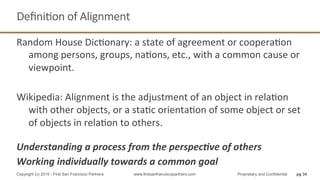
Random	
  House	
  DicQonary:	
  a	
  state	
  of	
  agreement	
  or	
  cooperaQon	
  
among	
  persons,	
  groups,	
  naQons,	
  etc.,	
  with	
  a	
  common	
  cause	
  or	
  
viewpoint.	


Wikipedia:	
  Alignment	
  is	
  the	
  adjustment	
  of	
  an	
  object	
  in	
  relaQon	
  
with	
  other	
  objects,	
  or	
  a	
  staQc	
  orientaQon	
  of	
  some	
  object	
  or	
  set	
  
of	
  objects	
  in	
  relaQon	
  to	
  others.	


Understanding	
  a	
  process	
  from	
  the	
  perspec4ve	
  of	
  others	
  
Working	
  individually	
  towards	
  a	
  common	
  goal	
  
DefiniQon	
  of	
  Alignment	
  
pg 34Copyright (c) 2015 - First San Francisco Partners www.firstsanfranciscopartners.com Proprietary and Confidential
Impact	
  on	
  Governance	
  Programs	
  
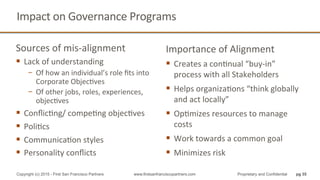
Sources	
  of	
  mis-­‐alignment	
  
§  Lack	
  of	
  understanding	
  
−  Of	
  how	
  an	
  individual’s	
  role	
  fits	
  into	
  
Corporate	
  ObjecQves	
  	
  
−  Of	
  other	
  jobs,	
  roles,	
  experiences,	
  
objecQves	
  
§  ConflicQng/	
  compeQng	
  objecQves	
  
§  PoliQcs	
  
§  CommunicaQon	
  styles	
  
§  Personality	
  conflicts	
  
Importance	
  of	
  Alignment	
  
§  Creates	
  a	
  conQnual	
  “buy-­‐in”	
  
process	
  with	
  all	
  Stakeholders	
  
§  Helps	
  organizaQons	
  “think	
  globally	
  
and	
  act	
  locally”	
  
§  OpQmizes	
  resources	
  to	
  manage	
  
costs	
  
§  Work	
  towards	
  a	
  common	
  goal	
  
§  Minimizes	
  risk	
  
pg 35Copyright (c) 2015 - First San Francisco Partners www.firstsanfranciscopartners.com Proprietary and Confidential
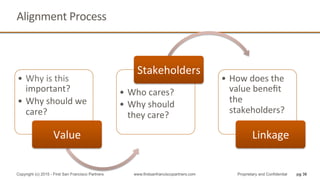
Alignment	
  Process	
  
•  Why	
  is	
  this	
  
important?	
  
•  Why	
  should	
  we	
  
care?	
  
Value	
  
•  Who	
  cares?	
  
•  Why	
  should	
  
they	
  care?	
  
Stakeholders	
  
•  How	
  does	
  the	
  
value	
  benefit	
  
the	
  
stakeholders?	
  
Linkage	
  
pg 36Copyright (c) 2015 - First San Francisco Partners www.firstsanfranciscopartners.com Proprietary and Confidential
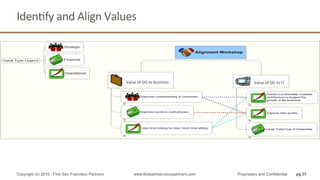
IdenQfy	
  and	
  Align	
  Values	
  
pg 37Copyright (c) 2015 - First San Francisco Partners www.firstsanfranciscopartners.com Proprietary and Confidential
Value	
  of	
  DG	
  to	
  Business	
   Value	
  of	
  DG	
  to	
  IT	
  
IdenQfy	
  Stakeholders	
  
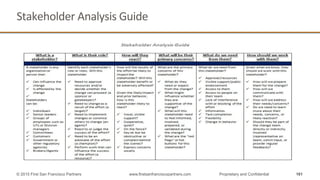
§  Who	
  are	
  the	
  Stakeholders?	
  
§  IT	
  
§  OperaQons	
  
§  Compliance	
  
§  Line	
  of	
  Business	
  
§  What	
  are	
  their	
  drivers?	
  
§  What	
  are	
  their	
  key	
  goals?	
  
§  What	
  are	
  their	
  concerns?	
  
§  What	
  are	
  they	
  trying	
  to	
  avoid?	
  
§  What	
  are	
  their	
  prioriQes?	
  
§  Which	
  goals	
  are	
  criQcal?	
  
§  What	
  happens	
  if	
  those	
  goals	
  aren’t	
  achieved?	
  
pg 38Copyright (c) 2015 - First San Francisco Partners www.firstsanfranciscopartners.com Proprietary and Confidential
pg 39Proprietary & Confidential
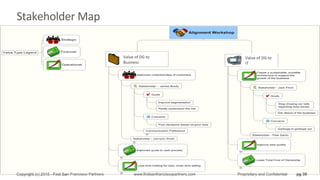
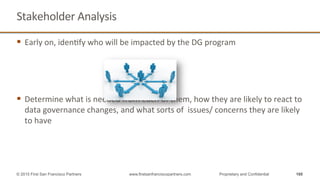
Stakeholder	
  Map	
  
pg 39Copyright (c) 2015 - First San Francisco Partners www.firstsanfranciscopartners.com Proprietary and Confidential
Value	
  of	
  DG	
  to	
  
Business	
  
Value	
  of	
  DG	
  to	
  
IT	
  
Linkage	
  is	
  the	
  tacQcal	
  process	
  of	
  mapping	
  your	
  delivery	
  to	
  the	
  
issues	
  important	
  to	
  the	
  stakeholder.	
  	
  
•  Per	
  Stakeholder,	
  idenQfy	
  what	
  is	
  important	
  to	
  them	
  and	
  why.	
  	
  
§  What	
  happens	
  if	
  they	
  don’t	
  achieve	
  their	
  goal?	
  
•  List	
  elements	
  of	
  DG	
  soluQon	
  
•  Choose	
  Top	
  3	
  
•  Choose	
  up	
  to	
  3	
  elements	
  of	
  the	
  DG	
  soluQon	
  and	
  arQculate	
  how	
  
those	
  deliverables	
  can	
  help	
  that	
  person	
  achieve	
  their	
  goals	
  
§  ConQnually	
  ask	
  yourself,	
  So	
  What?	
  
Linkage	
  delivers	
  Alignment	
  
Create	
  Linkage	
  
pg 40Copyright (c) 2015 - First San Francisco Partners www.firstsanfranciscopartners.com Proprietary and Confidential
PotenQal	
  Deliverables	
  
§  Consistency	
  of	
  customer/product/employee	
  data	
  
§  Improve	
  data	
  quality	
  
§  Improve	
  data	
  consumpQon	
  and	
  appropriate	
  usage	
  
§  Create	
  and	
  understand	
  data	
  lineage	
  
§  Create	
  a	
  data	
  platorm	
  to	
  support	
  a	
  single	
  face	
  to	
  the	
  Customer	
  
§  Facilitate	
  the	
  concept	
  of	
  “Single	
  Sourcing”	
  of	
  data	
  to	
  the	
  Data	
  Warehouse	
  
and	
  Business	
  ApplicaQons	
  
§  Create	
  and	
  implement	
  common	
  enterprise	
  systems/tools	
  and	
  processes	
  for	
  
selected	
  data	
  
pg 41Copyright (c) 2015 - First San Francisco Partners www.firstsanfranciscopartners.com Proprietary and Confidential
DG	
  Program	
  
Sales/MarkeQng	
  
Improve	
  Understanding	
  
of	
  Customers	
  
Improve	
  SegmentaQon	
  
Understand	
  Risk	
  
IT	
  
Improved	
  ProducQvity	
  
ProacQvely	
  support	
  
business	
  
Lower	
  TCO	
  
Improved	
  Data	
  
Quality	
  
Single	
  Repository	
  of	
  
Customer	
  Data	
  
Create	
  Data	
  Lineage	
  
ArQculate	
  Linkage	
  
pg 42Copyright (c) 2015 - First San Francisco Partners www.firstsanfranciscopartners.com Proprietary and Confidential
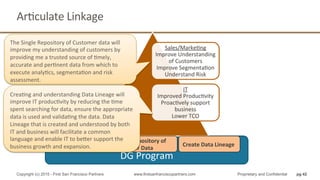
The	
  Single	
  Repository	
  of	
  Customer	
  data	
  will	
  
improve	
  my	
  understanding	
  of	
  customers	
  by	
  
providing	
  me	
  a	
  trusted	
  source	
  of	
  Qmely,	
  
accurate	
  and	
  perQnent	
  data	
  from	
  which	
  to	
  
execute	
  analyQcs,	
  segmentaQon	
  and	
  risk	
  
assessment.	
  
CreaQng	
  and	
  understanding	
  Data	
  Lineage	
  will	
  
improve	
  IT	
  producQvity	
  by	
  reducing	
  the	
  Qme	
  
spent	
  searching	
  for	
  data,	
  ensure	
  the	
  appropriate	
  
data	
  is	
  used	
  and	
  validaQng	
  the	
  data.	
  Data	
  
Lineage	
  that	
  is	
  created	
  and	
  understood	
  by	
  both	
  
IT	
  and	
  business	
  will	
  facilitate	
  a	
  common	
  
language	
  and	
  enable	
  IT	
  to	
  beher	
  support	
  the	
  
business	
  growth	
  and	
  expansion.	
  
Linkage	
  creates	
  Alignment	
  
pg 43Copyright (c) 2015 - First San Francisco Partners www.firstsanfranciscopartners.com Proprietary and Confidential
www.firstsanfranciscopartners.com
Measurement	
  &	
  Metrics	
  
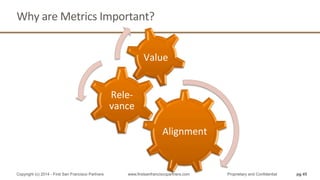
Why	
  are	
  Metrics	
  Important?	
  
Alignment	
  
Rele-­‐
vance	
  
Value	
  
pg 45Copyright (c) 2014 - First San Francisco Partners www.firstsanfranciscopartners.com Proprietary and Confidential
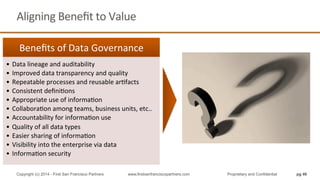
Aligning	
  Benefit	
  to	
  Value	
  
pg 46Copyright (c) 2014 - First San Francisco Partners www.firstsanfranciscopartners.com Proprietary and Confidential
Benefits	
  of	
  Data	
  Governance	
  
•  Data	
  lineage	
  and	
  auditability	
  
•  Improved	
  data	
  transparency	
  and	
  quality	
  
•  Repeatable	
  processes	
  and	
  reusable	
  arQfacts	
  
•  Consistent	
  definiQons	
  
•  Appropriate	
  use	
  of	
  informaQon	
  
•  CollaboraQon	
  among	
  teams,	
  business	
  units,	
  etc..	
  
•  Accountability	
  for	
  informaQon	
  use	
  
•  Quality	
  of	
  all	
  data	
  types	
  
•  Easier	
  sharing	
  of	
  informaQon	
  
•  Visibility	
  into	
  the	
  enterprise	
  via	
  data	
  
•  InformaQon	
  security	
  
Content	
  property	
  of	
  IMCue	
  and	
  FSFP,	
  Copyright	
  2013	
  	
  
ReproducQon	
  prohibited	
  	
  
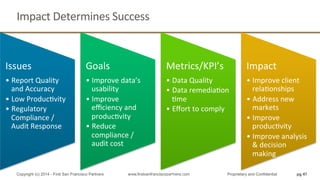
Impact	
  Determines	
  Success	
  
pg 47Copyright (c) 2014 - First San Francisco Partners www.firstsanfranciscopartners.com Proprietary and Confidential
Issues	
  
• Report	
  Quality	
  
and	
  Accuracy	
  
• Low	
  ProducQvity	
  
• Regulatory	
  
Compliance	
  /	
  
Audit	
  Response	
  
Goals	
  
• Improve	
  data’s	
  
usability	
  
• Improve	
  
efficiency	
  and	
  
producQvity	
  
• Reduce	
  
compliance	
  /	
  
audit	
  cost	
  
Metrics/KPI’s	
  
• Data	
  Quality	
  
• Data	
  remediaQon	
  
Qme	
  
• Effort	
  to	
  comply	
  
Impact	
  
• Improve	
  client	
  
relaQonships	
  
• Address	
  new	
  
markets	
  
• Improve	
  
producQvity	
  
• Improve	
  analysis	
  
&	
  decision	
  
making	
  
Content	
  property	
  of	
  IMCue	
  and	
  FSFP,	
  Copyright	
  2013	
  	
  
ReproducQon	
  prohibited	
  	
  
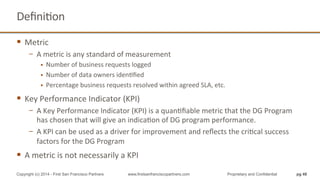
DefiniQon	
  
§  Metric	
  	
  
−  A	
  metric	
  is	
  any	
  standard	
  of	
  measurement	
  
§  Number	
  of	
  business	
  requests	
  logged	
  
§  Number	
  of	
  data	
  owners	
  idenQfied	
  
§  Percentage	
  business	
  requests	
  resolved	
  within	
  agreed	
  SLA,	
  etc.	
  	
  
§  Key	
  Performance	
  Indicator	
  (KPI)	
  
−  A	
  Key	
  Performance	
  Indicator	
  (KPI)	
  is	
  a	
  quanQfiable	
  metric	
  that	
  the	
  DG	
  Program	
  
has	
  chosen	
  that	
  will	
  give	
  an	
  indicaQon	
  of	
  DG	
  program	
  performance.	
  	
  
−  A	
  KPI	
  can	
  be	
  used	
  as	
  a	
  driver	
  for	
  improvement	
  and	
  reflects	
  the	
  criQcal	
  success	
  
factors	
  for	
  the	
  DG	
  Program	
  
§  A	
  metric	
  is	
  not	
  necessarily	
  a	
  KPI	
  
pg 48Copyright (c) 2014 - First San Francisco Partners www.firstsanfranciscopartners.com Proprietary and Confidential
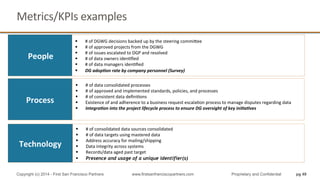
Metrics/KPIs	
  examples	
  
pg 49Copyright (c) 2014 - First San Francisco Partners www.firstsanfranciscopartners.com Proprietary and Confidential
People	
  
§  #	
  of	
  DGWG	
  decisions	
  backed	
  up	
  by	
  the	
  steering	
  commihee	
  
§  #	
  of	
  approved	
  projects	
  from	
  the	
  DGWG	
  
§  #	
  of	
  issues	
  escalated	
  to	
  DGP	
  and	
  resolved	
  
§  #	
  of	
  data	
  owners	
  idenQfied	
  
§  #	
  of	
  data	
  managers	
  idenQfied	
  
§  DG	
  adop4on	
  rate	
  by	
  company	
  personnel	
  (Survey)	
  	
  
Process	
  
§  #	
  of	
  data	
  consolidated	
  processes	
  
§  #	
  of	
  approved	
  and	
  implemented	
  standards,	
  policies,	
  and	
  processes	
  	
  
§  #	
  of	
  consistent	
  data	
  definiQons	
  	
  
§  Existence	
  of	
  and	
  adherence	
  to	
  a	
  business	
  request	
  escalaQon	
  process	
  to	
  manage	
  disputes	
  regarding	
  data	
  
§  Integra4on	
  into	
  the	
  project	
  lifecycle	
  process	
  to	
  ensure	
  DG	
  oversight	
  of	
  key	
  ini4a4ves	
  
Technology	
  
§  #	
  of	
  consolidated	
  data	
  sources	
  consolidated	
  
§  #	
  of	
  data	
  targets	
  using	
  mastered	
  data	
  
§  Address	
  accuracy	
  for	
  mailing/shipping	
  
§  Data	
  integrity	
  across	
  systems	
  
§  Records/data	
  aged	
  past	
  target	
  
§  Presence and usage of a unique identifier(s)	
  
www.firstsanfranciscopartners.com
CreaQng	
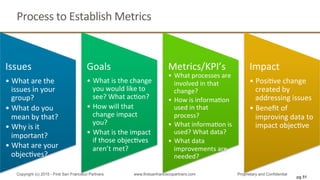
  Metrics	
  
Process	
  to	
  Establish	
  Metrics	
  
pg 51
Copyright (c) 2015 - First San Francisco Partners www.firstsanfranciscopartners.com Proprietary and Confidential
Issues	
  
• What	
  are	
  the	
  
issues	
  in	
  your	
  
group?	
  
• What	
  do	
  you	
  
mean	
  by	
  that?	
  
• Why	
  is	
  it	
  
important?	
  
• What	
  are	
  your	
  
objecQves?	
  
Goals	
  
•  What	
  is	
  the	
  change	
  
you	
  would	
  like	
  to	
  
see?	
  What	
  acQon?	
  
•  How	
  will	
  that	
  
change	
  impact	
  
you?	
  
•  What	
  is	
  the	
  impact	
  
if	
  those	
  objecQves	
  
aren’t	
  met?	
  
Metrics/KPI’s	
  
•  What	
  processes	
  are	
  
involved	
  in	
  that	
  
change?	
  
•  How	
  is	
  informaQon	
  
used	
  in	
  that	
  
process?	
  
•  What	
  informaQon	
  is	
  
used?	
  What	
  data?	
  
•  What	
  data	
  
improvements	
  are	
  
needed?	
  
Impact	
  
• PosiQve	
  change	
  
created	
  by	
  
addressing	
  issues	
  
• Benefit	
  of	
  
improving	
  data	
  to	
  
impact	
  objecQve	
  
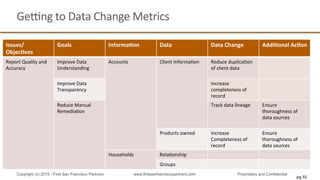
GeTng	
  to	
  Data	
  Change	
  Metrics	
  
Issues/
Objec4ves	
  
Goals	
   Informa4on	
   Data	
   Data	
  Change	
   Addi4onal	
  Ac4on	
  
Report	
  Quality	
  and	
  
Accuracy	


Improve	
  Data	
  
Understanding	


Accounts	
   Client	
  InformaQon	
  	
   Reduce	
  duplicaQon	
  
of	
  client	
  data	
  
Improve	
  Data	
  
Transparency	
  
Increase	
  
completeness	
  of	
  
record	


Reduce	
  Manual	
  
RemediaQon	
  
Track	
  data	
  lineage	
   Ensure	
  
thoroughness	
  of	
  
data	
  sources	


Products	
  owned	


Increase	
  
Completeness	
  of	
  
record	
  
Ensure	
  
thoroughness	
  of	
  
data	
  sources	
  
Households	
   RelaQonship	
  
Groups	
  
pg 52
Copyright (c) 2015 - First San Francisco Partners www.firstsanfranciscopartners.com Proprietary and Confidential
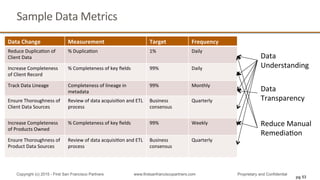
Sample	
  Data	
  Metrics	
  
Data	
  Change	
   Measurement	
   Target	
   Frequency	
  
Reduce	
  DuplicaQon	
  of	
  
Client	
  Data	
  
%	
  DuplicaQon	
   1%	
   Daily	
  
Increase	
  Completeness	
  
of	
  Client	
  Record	
  
%	
  Completeness	
  of	
  key	
  fields	
   99%	
   Daily	
  
Track	
  Data	
  Lineage	
   Completeness	
  of	
  lineage	
  in	
  
metadata	
  
99%	
   Monthly	
  
Ensure	
  Thoroughness	
  of	
  
Client	
  Data	
  Sources	
  
Review	
  of	
  data	
  acquisiQon	
  and	
  ETL	
  
process	
  
Business	
  
consensus	
  
Quarterly	
  
Increase	
  Completeness	
  
of	
  Products	
  Owned	
  	
  
%	
  Completeness	
  of	
  key	
  fields	
   99%	
   Weekly	
  
Ensure	
  Thoroughness	
  of	
  
Product	
  Data	
  Sources	
  
Review	
  of	
  data	
  acquisiQon	
  and	
  ETL	
  
process	


Business	
  
consensus	
  
Quarterly	
  
pg 53
Copyright (c) 2015 - First San Francisco Partners www.firstsanfranciscopartners.com Proprietary and Confidential
Data	
  
Understanding	
  
Data	
  
Transparency	
  
Reduce	
  Manual	
  
RemediaQon	
  
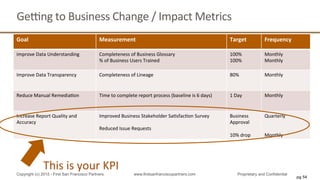
GeTng	
  to	
  Business	
  Change	
  /	
  Impact	
  Metrics	
  
pg 54
Copyright (c) 2015 - First San Francisco Partners www.firstsanfranciscopartners.com Proprietary and Confidential
Goal	
   Measurement	
   Target	
   Frequency	
  
Improve	
  Data	
  Understanding	
   Completeness	
  of	
  Business	
  Glossary	
  
%	
  of	
  Business	
  Users	
  Trained	
  
100%	
  
100%	
  
Monthly	
  
Monthly	
  
Improve	
  Data	
  Transparency	
   Completeness	
  of	
  Lineage	
   80%	
   Monthly	
  
Reduce	
  Manual	
  RemediaQon	
   Time	
  to	
  complete	
  report	
  process	
  (baseline	
  is	
  6	
  days)	
   1	
  Day	
   Monthly	
  
Increase	
  Report	
  Quality	
  and	
  
Accuracy	
  
Improved	
  Business	
  Stakeholder	
  SaQsfacQon	
  Survey	


Reduced	
  Issue	
  Requests	
  
Business	
  
Approval	


10%	
  drop	
  
Quarterly	


Monthly	
  
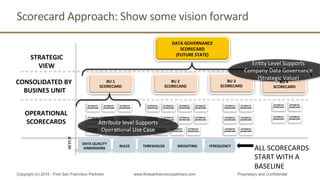
This	
  is	
  your	
  KPI	
  
BU	
  2	
  
SCORECARD	
  
BU	
  4	
  
	
  SCORECARD	
  
BU	
  1	
  
SCORECARD	
  
BU	
  3	
  
SCORECARD	
  
DATA	
  GOVERNANCE	
  
SCORECARD	
  
(FUTURE	
  STATE)	
  
STRATEGIC	
  
VIEW	
  
OPERATIONAL	
  
SCORECARDS	
  
CONSOLIDATED	
  BY	
  
	
  BUSINES	
  UNIT	
  
SETUP
RULES	
   THRESHOLDS	
  
DATA	
  QUALITY	
  
DIMENSIONS	
  
FFREQUENCY	
  WEIGHTING	
  
ALL	
  SCORECARDS	
  
START	
  WITH	
  A	
  
BASELINE	
  
Scorecard	
  Approach:	
  Show	
  some	
  vision	
  forward	
  
Copyright (c) 2015 - First San Francisco Partners www.firstsanfranciscopartners.com Proprietary and Confidential
ATTRIBUTE	
  
SCORECARD	
  
ATTRIBUTE	
  
SCORECARD	
  
ATTRIBUTE	
  
SCORECARD	
  
ATTRIBUTE	
  
SCORECARD	
  
ATTRIBUTE	
  
SCORECARD	
  
ATTRIBUTE	
  
SCORECARD	
  
ATTRIBUTE	
  
SCORECARD	
  
ATTRIBUTE	
  
SCORECARD	
  
ATTRIBUTE	
  
SCORECARD	
  
ATTRIBUTE	
  
SCORECARD	
  
ATTRIBUTE	
  
SCORECARD	
  
ATTRIBUTE	
  
SCORECARD	
  
ATTRIBUTE	
  
SCORECARD	
  
ATTRIBUTE	
  
SCORECARD	
  
ATTRIBUTE	
  
SCORECARD	
  
ATTRIBUTE	
  
SCORECARD	
  
ATTRIBUTE	
  
SCORECARD	
  
ATTRIBUTE	
  
SCORECARD	
  
ATTRIBUTE	
  
SCORECARD	
  
ATTRIBUTE	
  
SCORECARD	
  
ATTRIBUTE	
  
SCORECARD	
  
ATTRIBUTE	
  
SCORECARD	
  
ATTRIBUTE	
  
SCORECARD	
  
ATTRIBUTE	
  
SCORECARD	
  
ATTRIBUTE	
  
SCORECARD	
  
ATTRIBUTE	
  
SCORECARD	
  
ATTRIBUTE	
  
SCORECARD	
  
ATTRIBUTE	
  
SCORECARD	
  
ATTRIBUTE	
  
SCORECARD	
  
ATTRIBUTE	
  
SCORECARD	
  
Ahribute	
  level	
  Supports	
  
OperaQonal	
  Use	
  Case	
  
EnQty	
  Level	
  Supports	


Company	
  Data	
  Governance	
  
(Strategic	
  Value)	
  
www.firstsanfranciscopartners.com
CommunicaQon	
  &	
  Stakeholder	
  Management	
  
Why	
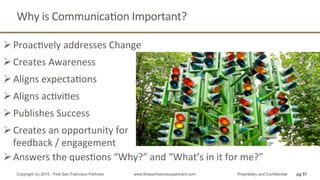
  is	
  CommunicaQon	
  Important?	
  
pg 57Copyright (c) 2015 - First San Francisco Partners www.firstsanfranciscopartners.com Proprietary and Confidential
Ø Creates	
  Awareness	
  
Ø Aligns	
  expectaQons	
  
Ø Creates	
  an	
  opportunity	
  for	
  
feedback	
  /	
  engagement	
  
Ø ProacQvely	
  addresses	
  Change	
  
Ø Publishes	
  Success	
  
Ø Answers	
  the	
  quesQons	
  “Why?”	
  and	
  “What’s	
  in	
  it	
  for	
  me?”	
  
Ø Aligns	
  acQviQes	
  
TranslaQng	
  Data	
  Value	
  into	
  Business	
  Value	
  
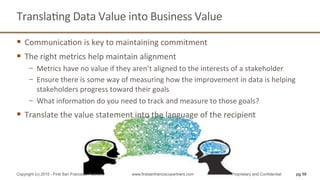
§  CommunicaQon	
  is	
  key	
  to	
  maintaining	
  commitment	
  
§  The	
  right	
  metrics	
  help	
  maintain	
  alignment	
  
−  Metrics	
  have	
  no	
  value	
  if	
  they	
  aren’t	
  aligned	
  to	
  the	
  interests	
  of	
  a	
  stakeholder	
  
−  Ensure	
  there	
  is	
  some	
  way	
  of	
  measuring	
  how	
  the	
  improvement	
  in	
  data	
  is	
  helping	
  
stakeholders	
  progress	
  toward	
  their	
  goals	
  
−  What	
  informaQon	
  do	
  you	
  need	
  to	
  track	
  and	
  measure	
  to	
  those	
  goals?	
  
§  Translate	
  the	
  value	
  statement	
  into	
  the	
  language	
  of	
  the	
  recipient	
  
pg 58Copyright (c) 2015 - First San Francisco Partners www.firstsanfranciscopartners.com Proprietary and Confidential
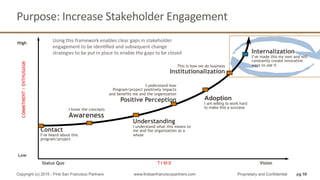
Purpose:	
  Increase	
  Stakeholder	
  Engagement	
  
pg 59Copyright (c) 2015 - First San Francisco Partners www.firstsanfranciscopartners.com Proprietary and Confidential
Using	
  this	
  framework	
  enables	
  clear	
  gaps	
  in	
  stakeholder	
  
engagement	
  to	
  be	
  idenQfied	
  and	
  subsequent	
  change	
  
strategies	
  to	
  be	
  put	
  in	
  place	
  to	
  enable	
  the	
  gaps	
  to	
  be	
  closed	
  
T I M EStatus Quo Vision
COMMITMENT/ENTHUSIASM
High
Contact
I’ve heard about this
program/project
Low
I know the concepts
Awareness
I understand how
Program/project positively impacts
and benefits me and the organization
Positive Perception
This is how we do business
Institutionalization
Understanding
I understand what this means to
me and the organization as a
whole
Adoption
I am willing to work hard
to make this a success
Internalization
I’ve made this my own and will
constantly create innovative
ways to use it
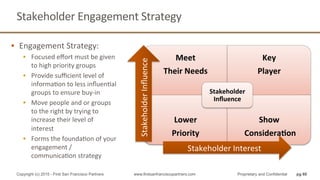
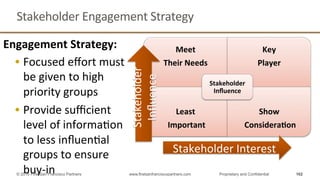
•  Engagement	
  Strategy:	
  
•  Focused	
  effort	
  must	
  be	
  given	
  
to	
  high	
  priority	
  groups	
  
•  Provide	
  sufficient	
  level	
  of	
  
informaQon	
  to	
  less	
  influenQal	
  
groups	
  to	
  ensure	
  buy-­‐in	
  
•  Move	
  people	
  and	
  or	
  groups	
  
to	
  the	
  right	
  by	
  trying	
  to	
  
increase	
  their	
  level	
  of	
  
interest	
  
•  Forms	
  the	
  foundaQon	
  of	
  your	
  
engagement	
  /	
  
communicaQon	
  strategy	
  
Stakeholder	
  Engagement	
  Strategy	
  
pg 60Copyright (c) 2015 - First San Francisco Partners www.firstsanfranciscopartners.com Proprietary and Confidential
Meet	
  
Their	
  Needs	
  
Key	
  
Player	
  
Lower	
  	
  
Priority	
  
Show	
  
	
  Considera4on	
  
Stakeholder	
  
Influence	
  
Stakeholder	
  Influence	
   Stakeholder	
  Interest	
  
What	
  is	
  a	
  CommunicaQon	
  Plan?	
  
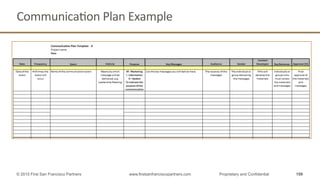
§  CommunicaQon	
  Plan	
  DefiniQon	
  
−  A	
  wrihen	
  document	
  that	
  helps	
  an	
  organizaQon	
  achieve	
  its	
  goals	
  using	
  wrihen	
  and	
  
spoken	
  words.	
  	
  
−  Describes	
  the	
  What,	
  Why,	
  When,	
  Where,	
  and	
  How	
  
§  Importance	
  of	
  a	
  CommunicaQon	
  Plan	
  
−  Gives	
  the	
  working	
  team	
  a	
  day-­‐to-­‐day	
  work	
  focus	
  
−  Helps	
  stakeholders	
  and	
  the	
  working	
  team	
  set	
  prioriQes	
  
−  Provides	
  stakeholders	
  with	
  a	
  sense	
  of	
  order	
  and	
  controls	
  
−  Provides	
  a	
  demonstraQon	
  of	
  value	
  to	
  the	
  stakeholders	
  and	
  the	
  business	
  in	
  general	
  
−  Helps	
  stakeholders	
  to	
  support	
  the	
  DG	
  Program	
  
−  Protects	
  the	
  DG	
  Program	
  against	
  last-­‐minute	
  demands	
  from	
  stakeholders	
  
pg 61Copyright (c) 2015 - First San Francisco Partners www.firstsanfranciscopartners.com Proprietary and Confidential
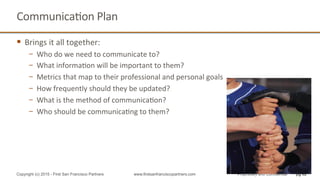
CommunicaQon	
  Plan	
  
§  Brings	
  it	
  all	
  together:	
  
−  Who	
  do	
  we	
  need	
  to	
  communicate	
  to?	
  
−  What	
  informaQon	
  will	
  be	
  important	
  to	
  them?	
  
−  Metrics	
  that	
  map	
  to	
  their	
  professional	
  and	
  personal	
  goals	
  
−  How	
  frequently	
  should	
  they	
  be	
  updated?	
  
−  What	
  is	
  the	
  method	
  of	
  communicaQon?	
  
−  Who	
  should	
  be	
  communicaQng	
  to	
  them?	
  
pg 62Copyright (c) 2015 - First San Francisco Partners www.firstsanfranciscopartners.com Proprietary and Confidential
Components	
  of	
  a	
  CommunicaQon	
  Plan	
  
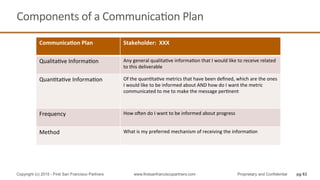
pg 63Copyright (c) 2015 - First San Francisco Partners www.firstsanfranciscopartners.com Proprietary and Confidential
Communica4on	
  Plan	
   Stakeholder:	
  	
  XXX	
  
QualitaQve	
  InformaQon	
   Any	
  general	
  qualitaQve	
  informaQon	
  that	
  I	
  would	
  like	
  to	
  receive	
  related	
  
to	
  this	
  deliverable	
  
QuanQtaQve	
  InformaQon	
   Of	
  the	
  quanQtaQve	
  metrics	
  that	
  have	
  been	
  defined,	
  which	
  are	
  the	
  ones	
  
I	
  would	
  like	
  to	
  be	
  informed	
  about	
  AND	
  how	
  do	
  I	
  want	
  the	
  metric	
  
communicated	
  to	
  me	
  to	
  make	
  the	
  message	
  perQnent	


Frequency	
   How	
  open	
  do	
  I	
  want	
  to	
  be	
  informed	
  about	
  progress	


Method	
   What	
  is	
  my	
  preferred	
  mechanism	
  of	
  receiving	
  the	
  informaQon	
  
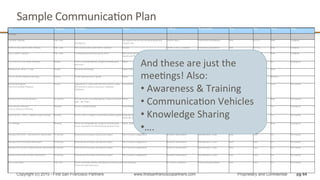
Item Frequency Description Purpose Audience Documentation From Date Owner Status
Meetings
First BSL Meeting One-Time
Introduction
Get explicit buy-in from the participants and
resource ask
DGWG BSLs PowerPoint Presentation John 8/25/11 John Complete
DGWG Core Team Kickoff Meeting One-Time DGO kickoff and vision from IT Sponsor Kickoff DGWG-Core, IT Sponsor PowerPoint presentation John 9/15/11 John Complete
DGO Launch Logistics One-Time Communication announcing the DGO Plan on the best way to communicate the DGO
launch and PR effort
DGO, SVB Corporate
Communication
Email John TBD John Complete
DGO-DGWG-Core Status Meeting Weekly DGWG accomplishments, progress towards goals
and issues
Status DGWG-Core members SharePoint Agenda & Content John Ongoing Flo In progress
Meeting with DGO IT Lead Weekly Planning and strategy Status/Planning DGO Chair, DGO IT Lead and
DGC
John Ongoing John
DGO & MDM alignment meetings Weekly MDM Implementation update Status MDM team, DGO Chair & DGC Agenda Rebecca Ongoing Rebecca
Mentoring program
(Data Stewardship Program)
Weekly Opportunity to learn from Business Steward Leads.
Best practices, polices, processes, standards,
definitions
Enrichment DGWG Data Stewards Data Stewardship Best practices.
DGO Polices, processes,
standards, definitions
TBD TBD TBD Not Started
Meeting with Program Sponsors Bi-Weekly? Provide DGWG accomplishments, progress towards
goals and issues
Status DGO Chair, Biz and IT Sponsor PowerPoint presentation John TBD John Not Started
DGO-DGWG Decision
(Core & Advisory) Meeting
Monthly DGWG voting meeting Vote and approve DGWG materials DGWG members SharePoint Agenda & Content John Ongoing Flo In progress
DGO-DGWG - DM IT Support Group Meeting Monthly DGWG DM IT Support Group team monthly update Bring the advisory team up to speed on status
before the decision meeting
DGWG Advisory members SharePoint Agenda & Content John TBD Flo Not Started
EIC Meeting Monthly DGWG accomplishments, progress towards goals,
issues, documents for informational purposes only
Status, Informational EIC members PowerPoint presentation John Ongoing John In progress
Meeting with SAM - Fund Business stakeholders As needed Relationship building/Expectations/Impact DGO resource engagement Business Stakeholders Informal/deck, Email John TBD Flo Not Started
Meeting with Purchasing stakeholders As needed Relationship building/Expectations/Impact DGO resource engagement Business Stakeholders Informal/deck, Email John TBD Flo Not Started
Meeting with Product Implementation stakeholdersAs needed Relationship building/Expectations/Impact DGO resource engagement Business Stakeholders Informal/deck, Email John TBD Flo Not Started
Meeting with Global Product stakeholders As needed Relationship building/Expectations/Impact DGO resource engagement Business Stakeholders Informal/deck, Email John TBD Flo Not Started
DGO Town Halls One/Year DGWG accomplishments and progress towards goals
Forum for open discussion
Team Building All DGWG members PowerPoint presentation John TBD Flo Not Started
Sample	
  CommunicaQon	
  Plan	
  
pg 64Copyright (c) 2015 - First San Francisco Partners www.firstsanfranciscopartners.com Proprietary and Confidential
And	
  these	
  are	
  just	
  the	
  
meeQngs!	
  Also:	
  
• 	
  Awareness	
  &	
  Training	
  
• 	
  CommunicaQon	
  Vehicles	
  
• 	
  Knowledge	
  Sharing	
  
• ….	
  
www.firstsanfranciscopartners.com
Embedding	
  Data	
  Governance	
  
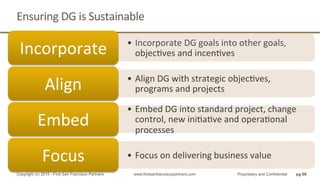
Ensuring	
  DG	
  is	
  Sustainable	
  
•  Incorporate	
  DG	
  goals	
  into	
  other	
  goals,	
  
objecQves	
  and	
  incenQves	
  Incorporate	
  
•  Align	
  DG	
  with	
  strategic	
  objecQves,	
  
programs	
  and	
  projects	
  Align	
  
•  Embed	
  DG	
  into	
  standard	
  project,	
  change	
  
control,	
  new	
  iniQaQve	
  and	
  operaQonal	
  
processes	
  
Embed	
  
•  Focus	
  on	
  delivering	
  business	
  value	
  Focus	
  	
  
pg 66Copyright (c) 2015 - First San Francisco Partners www.firstsanfranciscopartners.com Proprietary and Confidential
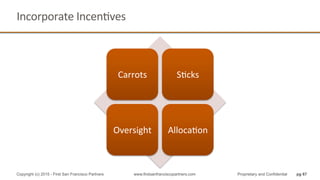
Incorporate	
  IncenQves	
  
Carrots	
   SQcks	
  
Oversight	
   AllocaQon	
  
pg 67Copyright (c) 2015 - First San Francisco Partners www.firstsanfranciscopartners.com Proprietary and Confidential
Align	
  with	
  ObjecQves,	
  Programs	
  and	
  Projects	
  
§  Examples:	
  
§  Alignment	
  with	
  Stakeholder	
  goals	
  (already	
  discussed)	
  
§  Alignment	
  with	
  Corporate	
  ObjecQves	
  
§  Alignment	
  with	
  strategic	
  Programs/Projects	
  
pg 68Copyright (c) 2015 - First San Francisco Partners www.firstsanfranciscopartners.com Proprietary and Confidential
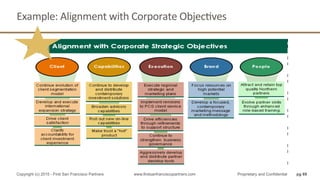
Example:	
  Alignment	
  with	
  Corporate	
  ObjecQves	
  
pg 69Copyright (c) 2015 - First San Francisco Partners www.firstsanfranciscopartners.com Proprietary and Confidential
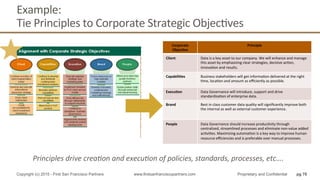
Example:	
  	
  
Tie	
  Principles	
  to	
  Corporate	
  Strategic	
  ObjecQves	
  
Corporate	
  
Objec4ve	
  
Principle	
  
Client	
   Data	
  is	
  a	
  key	
  asset	
  to	
  our	
  company.	
  We	
  will	
  enhance	
  and	
  manage	
  
this	
  asset	
  by	
  emphasizing	
  clear	
  strategies,	
  decisive	
  acQon,	
  
innovaQon	
  and	
  results.	
  
Capabili4es	
   Business	
  stakeholders	
  will	
  get	
  informaQon	
  delivered	
  at	
  the	
  right	
  
Qme,	
  locaQon	
  and	
  amount	
  as	
  efficiently	
  as	
  possible.	
  
Execu4on	
   Data	
  Governance	
  will	
  introduce,	
  support	
  and	
  drive	
  
standardizaQon	
  of	
  enterprise	
  data.	
  
Brand	
   Best	
  in	
  class	
  customer	
  data	
  quality	
  will	
  significantly	
  improve	
  both	
  
the	
  internal	
  as	
  well	
  as	
  external	
  customer	
  experience.	
  
People	
   Data	
  Governance	
  should	
  increase	
  producQvity	
  through	
  
centralized,	
  streamlined	
  processes	
  and	
  eliminate	
  non-­‐value	
  added	
  
acQviQes.	
  Maximizing	
  automaQon	
  is	
  a	
  key	
  way	
  to	
  improve	
  human	
  
resource	
  efficiencies	
  and	
  is	
  preferable	
  over	
  manual	
  processes.	
  
Principles	
  drive	
  crea.on	
  and	
  execu.on	
  of	
  policies,	
  standards,	
  processes,	
  etc….	
  
pg 70Copyright (c) 2015 - First San Francisco Partners www.firstsanfranciscopartners.com Proprietary and Confidential
www.firstsanfranciscopartners.com
Program	
  /	
  Project	
  Alignment	
  
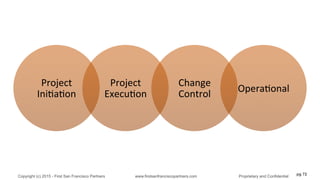
Project	
  
IniQaQon	
  
Project	
  
ExecuQon	
  
Change	
  
Control	
  
OperaQonal	
  
pg 72
Copyright (c) 2015 - First San Francisco Partners www.firstsanfranciscopartners.com Proprietary and Confidential
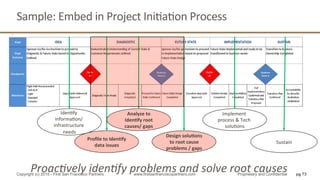
Sample:	
  Embed	
  in	
  Project	
  IniQaQon	
  Process	
  
pg 73Copyright (c) 2015 - First San Francisco Partners www.firstsanfranciscopartners.com Proprietary and Confidential
IdenQfy	
  
informaQon/	
  
infrastructure	
  
needs	
  
Profile	
  to	
  Iden4fy	
  
data	
  issues	
  
Analyze	
  to	
  
Iden4fy	
  root	
  
causes/	
  gaps	
  
Design	
  solu4ons	
  
to	
  root	
  cause	
  
problems	
  /	
  gaps	
  
Implement	
  
process	
  &	
  Tech	
  
soluQons	
  
Sustain	
  
Proac.vely	
  iden.fy	
  problems	
  and	
  solve	
  root	
  causes	
  
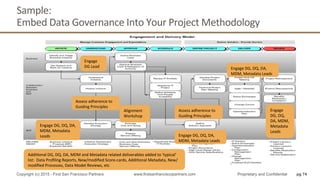
Sample:	
  
Embed	
  Data	
  Governance	
  Into	
  Your	
  Project	
  Methodology	
  
pg 74Copyright (c) 2015 - First San Francisco Partners www.firstsanfranciscopartners.com Proprietary and Confidential
Engage	
  DG,	
  DQ,	
  DA,	
  
MDM,	
  Metadata	
  
Leads	
  
Assess	
  adherence	
  to	
  
Guiding	
  Principles	
  
Alignment	
  
Workshop	
  
Assess	
  adherence	
  to	
  
Guiding	
  Principles	
  
Engage	
  DG,	
  DQ,	
  DA,	
  
MDM,	
  Metadata	
  Leads	
  
Engage	
  DG,	
  DQ,	
  DA,	
  
MDM,	
  Metadata	
  Leads	
  
AddiQonal	
  DG,	
  DQ,	
  DA,	
  MDM	
  and	
  Metadata	
  related	
  deliverables	
  added	
  to	
  ‘typical’	
  
list:	
  	
  Data	
  Profiling	
  Reports,	
  New/modified	
  Score-­‐cards,	
  AddiQonal	
  Metadata,	
  New/
modified	
  Processes,	
  Data	
  Model	
  Reviews,	
  etc	
  
Engage	
  
DG,	
  DQ,	
  
DA,	
  MDM,	
  
Metadata	
  
Leads	
  
Engage	
  
DG	
  Lead	
  
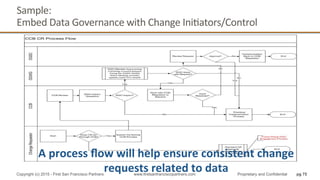
Sample:	
  	
  
Embed	
  Data	
  Governance	
  with	
  Change	
  IniQators/Control	
  
pg 75Copyright (c) 2015 - First San Francisco Partners www.firstsanfranciscopartners.com Proprietary and Confidential
A	
  process	
  flow	
  will	
  help	
  ensure	
  consistent	
  change	
  
requests	
  related	
  to	
  data	


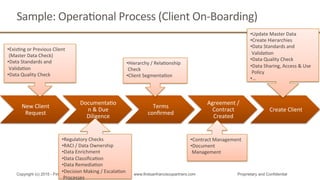
Sample:	
  OperaQonal	
  Process	
  (Client	
  On-­‐Boarding)	
  
New	
  Client	
  
Request	
  
DocumentaQo
n	
  &	
  Due	
  
Diligence	
  
Terms	
  
confirmed	
  
Agreement	
  /	
  
Contract	
  
Created	
  
Create	
  Client	
  
Copyright (c) 2015 - First San Francisco Partners www.firstsanfranciscopartners.com Proprietary and Confidential
• ExisQng	
  or	
  Previous	
  Client	
  
(Master	
  Data	
  Check)	
  
• Data	
  Standards	
  and	
  
ValidaQon	
  
• Data	
  Quality	
  Check	
  
• Regulatory	
  Checks	
  
• RACI	
  /	
  Data	
  Ownership	
  
• Data	
  Enrichment	
  
• Data	
  ClassificaQon	
  
• Data	
  RemediaQon	
  
• Decision	
  Making	
  /	
  EscalaQon	
  
Processes	
  
• Hierarchy	
  /	
  RelaQonship	
  
Check	
  
• Client	
  SegmentaQon	
  
• Contract	
  Management	
  
• Document	
  
Management	
  
• Update	
  Master	
  Data	
  
• Create	
  Hierarchies	
  
• Data	
  Standards	
  and	
  
ValidaQon	
  
• Data	
  Quality	
  Check	
  
• Data	
  Sharing,	
  Access	
  &	
  Use	
  
Policy	
  
• …	
  
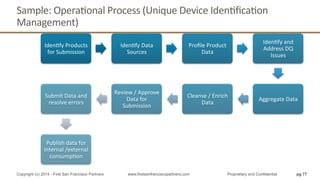
Sample:	
  OperaQonal	
  Process	
  (Unique	
  Device	
  IdenQficaQon	
  
Management)	
  
pg 77Copyright (c) 2014 - First San Francisco Partners www.firstsanfranciscopartners.com Proprietary and Confidential
IdenQfy	
  Products	
  
for	
  Submission	
  
IdenQfy	
  Data	
  
Sources	
  
Profile	
  Product	
  
Data	
  
IdenQfy	
  and	
  
Address	
  DQ	
  
Issues	
  
Aggregate	
  Data	
  
Cleanse	
  /	
  Enrich	
  
Data	
  
Review	
  /	
  Approve	
  
Data	
  for	
  
Submission	
  
Submit	
  Data	
  and	
  
resolve	
  errors	
  
Publish	
  data	
  for	
  
internal	
  /external	
  	
  
consumpQon	
  
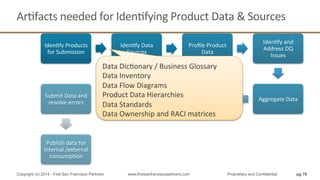
ArQfacts	
  needed	
  for	
  IdenQfying	
  Product	
  Data	
  &	
  Sources	
  
pg 78Copyright (c) 2014 - First San Francisco Partners www.firstsanfranciscopartners.com Proprietary and Confidential
IdenQfy	
  Products	
  
for	
  Submission	
  
IdenQfy	
  Data	
  
Sources	
  
Profile	
  Product	
  
Data	
  
IdenQfy	
  and	
  
Address	
  DQ	
  
Issues	
  
Aggregate	
  Data	
  
Cleanse	
  /	
  Enrich	
  
Data	
  
Review	
  /	
  Approve	
  
Data	
  for	
  
Submission	
  
Submit	
  Data	
  and	
  
resolve	
  errors	
  
Publish	
  data	
  for	
  
internal	
  /external	
  	
  
consumpQon	
  
Data	
  DicQonary	
  /	
  Business	
  Glossary	
  
Data	
  Inventory	
  
Data	
  Flow	
  Diagrams	
  
Product	
  Data	
  Hierarchies	
  
Data	
  Standards	
  
Data	
  Ownership	
  and	
  RACI	
  matrices	
  
ArQfacts	
  needed	
  for	
  Profiling	
  and	
  Addressing	
  DQ	
  
pg 79Copyright (c) 2014 - First San Francisco Partners www.firstsanfranciscopartners.com Proprietary and Confidential
IdenQfy	
  Products	
  
for	
  Submission	
  
IdenQfy	
  Data	
  
Sources	
  
Profile	
  Product	
  
Data	
  
IdenQfy	
  and	
  
Address	
  DQ	
  
Issues	
  
Aggregate	
  Data	
  
Cleanse	
  /	
  Enrich	
  
Data	
  
Review	
  /	
  Approve	
  
Data	
  for	
  
Submission	
  
Submit	
  Data	
  and	
  
resolve	
  errors	
  
Publish	
  data	
  for	
  
internal	
  /external	
  	
  
consumpQon	
  
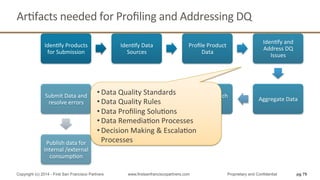
• Data	
  Quality	
  Standards	
  
• Data	
  Quality	
  Rules	
  
• Data	
  Profiling	
  SoluQons	
  
• Data	
  RemediaQon	
  Processes	
  
• Decision	
  Making	
  &	
  EscalaQon	
  
Processes	


ArQfacts	
  needed	
  for	
  AggregaQng,	
  Cleansing,	
  Enriching	
  
pg 80Copyright (c) 2014 - First San Francisco Partners www.firstsanfranciscopartners.com Proprietary and Confidential
IdenQfy	
  Products	
  
for	
  Submission	
  
IdenQfy	
  Data	
  
Sources	
  
Profile	
  Product	
  
Data	
  
IdenQfy	
  and	
  
Address	
  DQ	
  
Issues	
  
Aggregate	
  Data	
  
Cleanse	
  /	
  Enrich	
  
Data	
  
Review	
  /	
  Approve	
  
Data	
  for	
  
Submission	
  
Submit	
  Data	
  and	
  
resolve	
  errors	
  
Publish	
  data	
  for	
  
internal	
  /external	
  	
  
consumpQon	
  
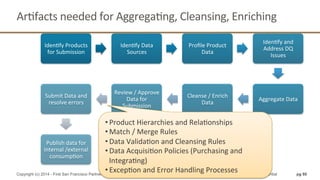
• Product	
  Hierarchies	
  and	
  RelaQonships	
  
• Match	
  /	
  Merge	
  Rules	
  
• Data	
  ValidaQon	
  and	
  Cleansing	
  Rules	
  
• Data	
  AcquisiQon	
  Policies	
  (Purchasing	
  and	
  
IntegraQng)	
  
• ExcepQon	
  and	
  Error	
  Handling	
  Processes	
  
ArQfacts	
  needed	
  for	
  Review,	
  Approve,	
  &	
  Submit	
  
pg 81Copyright (c) 2014 - First San Francisco Partners www.firstsanfranciscopartners.com Proprietary and Confidential
IdenQfy	
  Products	
  
for	
  Submission	
  
IdenQfy	
  Data	
  
Sources	
  
Profile	
  Product	
  
Data	
  
IdenQfy	
  and	
  
Address	
  DQ	
  
Issues	
  
Aggregate	
  Data	
  
Cleanse	
  /	
  Enrich	
  
Data	
  
Review	
  /	
  Approve	
  
Data	
  for	
  
Submission	
  
Submit	
  Data	
  and	
  
resolve	
  errors	
  
Publish	
  data	
  for	
  
internal	
  /external	
  	
  
consumpQon	
  
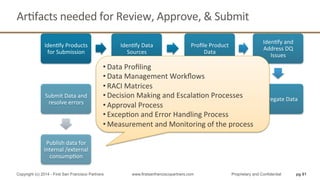
• Data	
  Profiling	
  
• Data	
  Management	
  Workflows	
  
• RACI	
  Matrices	
  
• Decision	
  Making	
  and	
  EscalaQon	
  Processes	
  
• Approval	
  Process	
  
• ExcepQon	
  and	
  Error	
  Handling	
  Process	
  
• Measurement	
  and	
  Monitoring	
  of	
  the	
  process	
  
ArQfacts	
  needed	
  to	
  Publish	
  &	
  Manage	
  
pg 82Copyright (c) 2014 - First San Francisco Partners www.firstsanfranciscopartners.com Proprietary and Confidential
IdenQfy	
  Products	
  
for	
  Submission	
  
IdenQfy	
  Data	
  
Sources	
  
Profile	
  Product	
  
Data	
  
IdenQfy	
  and	
  
Address	
  DQ	
  
Issues	
  
Aggregate	
  Data	
  
Cleanse	
  /	
  Enrich	
  
Data	
  
Review	
  /	
  Approve	
  
Data	
  for	
  
Submission	
  
Submit	
  Data	
  and	
  
resolve	
  errors	
  
Publish	
  data	
  for	
  
internal	
  /external	
  	
  
consumpQon	
  
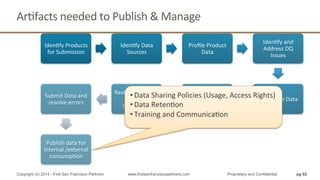
• Data	
  Sharing	
  Policies	
  (Usage,	
  Access	
  Rights)	
  
• Data	
  RetenQon	
  
• Training	
  and	
  CommunicaQon	
  
www.firstsanfranciscopartners.com
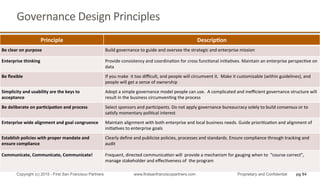
Ensuring	
  Success	
  
Principle	
   Descrip4on	
  
Be	
  clear	
  on	
  purpose	
   Build	
  governance	
  to	
  guide	
  and	
  oversee	
  the	
  strategic	
  and	
  enterprise	
  mission	
  
Enterprise	
  thinking	
   Provide	
  consistency	
  and	
  coordinaQon	
  for	
  cross	
  funcQonal	
  iniQaQves.	
  Maintain	
  an	
  enterprise	
  perspecQve	
  on	
  
data	
  
Be	
  flexible	
   If	
  you	
  make	
  	
  it	
  too	
  difficult,	
  and	
  people	
  will	
  circumvent	
  it.	
  	
  Make	
  it	
  customizable	
  (within	
  guidelines),	
  and	
  
people	
  will	
  get	
  a	
  sense	
  of	
  ownership	
  
Simplicity	
  and	
  usability	
  are	
  the	
  keys	
  to	
  
acceptance	
  
Adopt	
  a	
  simple	
  governance	
  model	
  people	
  can	
  use.	
  	
  A	
  complicated	
  and	
  inefficient	
  governance	
  structure	
  will	
  
result	
  in	
  the	
  business	
  circumvenQng	
  the	
  process	
  
Be	
  deliberate	
  on	
  par4cipa4on	
  and	
  process	
   Select	
  sponsors	
  and	
  parQcipants.	
  Do	
  not	
  apply	
  governance	
  bureaucracy	
  solely	
  to	
  build	
  consensus	
  or	
  to	
  
saQsfy	
  momentary	
  poliQcal	
  interest	
  
Enterprise	
  wide	
  alignment	
  and	
  goal	
  congruence	
   Maintain	
  alignment	
  with	
  both	
  enterprise	
  and	
  local	
  business	
  needs.	
  Guide	
  prioriQzaQon	
  and	
  alignment	
  of	
  
iniQaQves	
  to	
  enterprise	
  goals	
  
Establish	
  policies	
  with	
  proper	
  mandate	
  and	
  
ensure	
  compliance	
  	
  
Clearly	
  define	
  and	
  publicize	
  policies,	
  processes	
  and	
  standards.	
  Ensure	
  compliance	
  through	
  tracking	
  and	
  
audit	
  
Communicate,	
  Communicate,	
  Communicate!	
  	
   Frequent,	
  directed	
  communicaQon	
  will	
  	
  provide	
  a	
  mechanism	
  for	
  gauging	
  when	
  to	
  	
  “course	
  correct”,	
  
manage	
  stakeholder	
  and	
  effecQveness	
  of	
  	
  the	
  program	
  
Governance	
  Design	
  Principles	
  
pg 84Copyright (c) 2015 - First San Francisco Partners www.firstsanfranciscopartners.com Proprietary and Confidential
Ensuring	
  Success	
  
§  The	
  following	
  factors	
  are	
  usually	
  evident	
  in	
  a	
  successful	
  program:	
  
−  First	
  create	
  a	
  strategy	
  and	
  then	
  follow	
  it	
  (agreed	
  on	
  starQng	
  point	
  &	
  steps	
  
necessary)	
  
−  Ensure	
  solid	
  alignment	
  between	
  Business	
  &	
  IT	
  
−  Clearly	
  defined	
  and	
  measureable	
  success	
  criteria	
  
−  Small	
  iteraQons	
  vs.	
  all	
  or	
  nothing	
  
−  ExecuQve	
  sponsorship	
  is	
  criQcal	
  
−  IdenQfy	
  and	
  assess	
  the	
  importance	
  of	
  key	
  people	
  and	
  or	
  groups	
  
−  Really	
  know	
  your	
  data	
  
−  Leverage	
  prior	
  experience/work…don’t	
  re-­‐invent	
  the	
  wheel	
  
−  Embed	
  governance	
  into	
  the	
  operaQons	
  of	
  your	
  company	
  
−  Communicate,	
  Communicate,	
  Communicate!	
  
pg 85Copyright (c) 2015 - First San Francisco Partners www.firstsanfranciscopartners.com Proprietary and Confidential
pg 86Copyright (c) 2015 - First San Francisco Partners www.firstsanfranciscopartners.com Proprietary and Confidential
Thank	
  you!	


Kelle	
  O’Neal	
  
kelle@firstsanfranciscopartners.com	
  
415-­‐425-­‐9661	
  
@1stsanfrancisco	
  
www.firstsanfranciscopartners.com
Appendix	
  1	
  Roles	
  &	
  ResponsibiliQes	
  
pg 87Copyright (c) 2014 - First San Francisco Partners www.firstsanfranciscopartners.com Proprietary and Confidential
Direc4on	
  
TBD	
  	
  
Execu4ve	
  Sponsor	
  
Business	
  &	
  IT	
  
Business	
  Data	
  Stewards	
  
Data	
  Governance	
  Steering	
  Commi<ee	
  
Business	
  Unit	
  
Officers	
  
Data	
  Owners	
   IT	
  Partner(s)	
  
Data	
  Governance	
  Office	
  (DGO)	
  
Management	
  
Program	
  Oversight.	
  Allocates	
  budget	
  &	
  
resource.	
  Empower	
  Business	
  Data	
  
Stewards.	
  Forum	
  for	
  issue	
  escalaQon.	
  
Craps	
  the	
  Enterprise	
  Data	
  Strategy,	
  
processes	
  and	
  standards	
  to	
  ensure	
  that	
  
data	
  is	
  managed	
  as	
  an	
  asset.	
  
Execu4ve	
  Level	
  
Management	
  	
  Level	


Stewards	
  data	
  within	
  their	
  BU	
  to	
  ensure	
  
that	
  the	
  enterprise	
  policies,	
  standards	
  &	
  
processes	
  are	
  applied.	
  
Tac4cal	
  	
  Level	
  
Strategic	
  Level	
  
Provides	
  overall	
  strategic	
  	
  direcQon,	
  budget	
  
&	
  resource	
  approvals.	
  Forum	
  for	
  issue	
  	
  
escalaQon.	
  Approval	
  of	
  data	
  domains	
  under	
  
governance	
  control.	
  
Execu4on	
  
Technical	
  	
  Data	
  Stewards	
  
Local	
  Data	
  Governance	
  Working	
  Groups	
  
Reference	
  OperaQng	
  Model	
  
Business	
  &	
  Technical	
  Data	
  SMEs	
  
pg 88© 2015 First San Francisco Partners www.firstsanfranciscopartners.com Proprietary and Confidential
Core	
  Data	
  Governance	
  Roles	
  
Role	
   Common	
  Aliases	
   Insights	
  
Execu4ve	
  Sponsor	
  (Business)	
   In	
  an	
  ideal	
  state	
  there	
  is	
  execuQve	
  sponsorship	
  in	
  both	
  Business	
  
&	
  IT.	
  If	
  there	
  is	
  a	
  single	
  sponsor,	
  look	
  to	
  the	
  Business.	
  
Data	
  Owner	
  (Business)	
   Business	
  Data	
  Owner,	
  Accountable	
  
ExecuQve,	
  Business	
  Steward	
  Lead	
  
Probabili4es:	
  
-­‐“Owner”	
  may	
  not	
  be	
  accepted	
  by	
  culture	
  
-­‐May	
  not	
  be	
  able	
  to	
  idenQfy	
  “Owners”	
  
Large/Complex	
  Organiza4ons:	
  May	
  need	
  both	
  Data	
  Owner	
  and	
  
Business	
  Steward	
  Lead	
  
Data	
  Steward	
  (Business)	
   Business	
  Data	
  Steward,	
  Data	
  Custodian,	
  
Chief	
  Data	
  Steward	
  
It’s	
  all	
  about	
  the	
  details.	
  Never	
  assume	
  the	
  R&R’s	
  based	
  on	
  the	
  
Qtle.	
  	
  
Technical	
  Data	
  Steward	
  (IT)	
   Technical	
  Lead,	
  IT	
  Support	
  Partner	
  
Data	
  Architect	
  (IT)	
   Open	
  part	
  of	
  Enterprise	
  Architecture	
  
Member	
  of	
  Architecture	
  Review	
  Board	
  (ARB)	
  
May	
  not	
  exist,	
  however	
  responsibiliQes	
  should	
  be	
  assigned	
  
Business	
  Analyst	
  (Business)	
   BA’s	
  with	
  Data	
  Governance	
  experience	
  are	
  extremely	
  valuable	
  
and	
  provide	
  criQcal	
  support	
  to	
  the	
  Data	
  Stewards.	


Data	
  Governance	
  Office	
  Lead	
   DGO	
  Lead	
  
pg 89© 2015 First San Francisco Partners www.firstsanfranciscopartners.com Proprietary and Confidential
SupporQng	
  Roles	
  
Role	
   Common	
  Aliases	
   Insights	
  
Data	
  Analyst	
   Business	
  Data	
  Analyst,	
  Technical	
  Data	
  
Analyst	
  
Data	
  Architect	
   InformaQon	
  Architect	
  (IA)	
   Different	
  from	
  an	
  Enterprise	
  Architect,	
  open	
  part	
  of	
  Enterprise	
  
Architecture	
  
Member	
  of	
  ARB	
  
If	
  ARB/EA	
  funcQons	
  don’t	
  exist:	
  Assign	
  responsibiliQes.	
  
Data	
  Quality	
  Analyst	
  
Librarian	
   Knowledge	
  Worker	
   Common	
  in	
  MDM	
  Programs,	
  more	
  so	
  when	
  MDM	
  technology	
  is	
  in	
  place.	
  
Role	
  is	
  dedicated	
  to	
  Data	
  Maintenance	
  acQviQes	
  associated	
  with	
  Data	
  
Governance.	
  
Data	
  SME	
   Subject	
  Maher	
  Expert,	
  Knowledge	
  Worker,	
  
User,	
  Data	
  Entry	
  Clerk	
  
SME’s	
  can	
  be	
  found	
  in	
  the	
  Business	
  &	
  	
  IT,	
  and	
  at	
  all	
  levels	
  in	
  an	
  
organizaQon.	
  	
  	
  In	
  some	
  organizaQons	
  a	
  “SME”	
  is	
  considered	
  highly	
  
skilled,	
  respected	
  role.	
  
pg 90© 2015 First San Francisco Partners www.firstsanfranciscopartners.com Proprietary and Confidential
www.firstsanfranciscopartners.com
Leadership	
  Roles	
  &	
  Decision	
  Making	
  Bodies	
  
pg	
  91	
  
ExecuQve	
  Sponsor	
  (Business	
  and	
  IT)	
  
§  Chairs	
  the	
  Data	
  Governance	
  Steering	
  Commihee	
  
§  UlQmate	
  authority	
  and	
  responsible	
  for	
  overall	
  program	
  direcQon	
  
§  Provides	
  overall	
  strategic	
  vision	
  
§  Sets	
  strategy	
  and	
  direcQon	
  for	
  Data	
  Governance	
  &	
  Management	
  
§  Works	
  with	
  the	
  Data	
  Governance	
  Office	
  to	
  formulate	
  the	
  data	
  
governance	
  strategy	
  
§  Sets	
  direcQon	
  for	
  the	
  Data	
  Governance	
  Working	
  Group	
  (DGWG)	
  
and	
  ensures	
  that	
  the	
  implementaQon	
  is	
  in-­‐line	
  with	
  the	
  strategy	
  
§  Conveys	
  the	
  data	
  management	
  and	
  governance	
  strategy	
  to	
  the	
  
other	
  Exec	
  Commihees	
  
§  Clarifies	
  business	
  strategies	
  to	
  the	
  DGWG	
  
§  Provides	
  reinforcement	
  to	
  enable	
  the	
  success	
  of	
  data	
  governance	
  
through	
  communicaQon	
  
§  Gathers	
  funding	
  and	
  resource	
  availability	
  for	
  the	
  governance	
  
program	
  
§  Approves	
  changes	
  to	
  the	
  data	
  governance	
  strategy	
  
Resources:	
  Virtual	
  
Primary	
  ResponsibiliQes	
  
Set	
  Strategy	
  and	
  Steer	
  
Skills/CapabiliQes	
  
§  Generally	
  a	
  Corporate	
  ExecuQve/Officer	
  of	
  Company	
  
§  Recognized	
  cross-­‐funcQonal	
  leadership	
  and	
  influencing	
  skills	
  
§  PoliQcally	
  astute	
  
pg 92© 2015 First San Francisco Partners www.firstsanfranciscopartners.com Proprietary and Confidential
!
Roles	
  may	
  be	
  different	
  in	
  
large	
  or	
  complex	
  
organizaQons	
  ,	
  i.e.	
  the	
  DGO	
  
Lead	
  can	
  run	
  the	
  DGSC	
  
Data	
  Governance	
  Steering	
  Commihee	
  
Resources:	
  Virtual	
  
Primary	
  ResponsibiliQes	
  
Membership	
  
§  Chaired	
  by	
  the	
  ExecuQve	
  Sponsor	
  (Business)	
  
§  IT	
  Sponsor	
  
§  Cross	
  LOB	
  execuQves	
  
§  Data	
  Owners	
  
§  Data	
  Governance	
  Office	
  Lead	
  (usually	
  non-­‐voQng)	
  
§  IT	
  Partner	


Oversight	
  
pg 93© 2015 First San Francisco Partners www.firstsanfranciscopartners.com Proprietary and Confidential
§  Brings	
  corporate	
  and	
  cross	
  LOB	
  perspecQve	
  
§  Approves	
  budget	
  and	
  allocates	
  funding	
  	
  
§  Approves	
  funding	
  for	
  enhancements	
  
§  Appoints	
  and	
  approves	
  data	
  governance	
  resources	
  
§  Nominates,	
  selects	
  and	
  empowers	
  and	
  mandates	
  the	
  DGWG	
  
§  Ensures	
  strategic	
  alignment	
  between	
  DG	
  program	
  and	
  other	
  
business	
  unit	
  iniQaQves	
  
§  Ensures	
  strategic	
  alignment	
  with	
  corporate	
  objecQves	
  
§  Adjudicates	
  intractable	
  issues	
  that	
  are	
  escalated	
  by	
  the	
  Data	
  
Governance	
  Working	
  Group	
  (DGWG)	
  
§  Approves	
  funding	
  for	
  enhancements	
  
§  Enforces	
  the	
  data	
  governance	
  polices,	
  processes	
  and	
  standards	
  for	
  
the	
  organizaQon	
  
§  Approves	
  changes	
  to	
  the	
  data	
  governance	
  strategy	
  
§  Has	
  the	
  final	
  say	
  in	
  all	
  data	
  governance	
  decisions	
  
§  Owns	
  key	
  data	
  assets	
  across	
  enterprise	
  
!	
  	
  
May	
  have	
  addiQonal	
  
decision	
  making	
  bodies	
  in	
  
large	
  or	
  complex	
  
organizaQons	
  	
  
Data	
  Governance	
  Working	
  Group	
  
Resources:	
  Virtual	
  
Primary	
  ResponsibiliQes	
  
§  Data	
  Governance	
  Office	
  Lead	
  
§  Data	
  Stewards	
  
§  Technical	
  Data	
  Stewards	
  
§  Business	
  &	
  Technical	
  Data	
  SMEs	
  
§  Key	
  Stakeholders	


Management	
  &	
  ExecuQon	
  
Membership	
  
pg 94© 2015 First San Francisco Partners www.firstsanfranciscopartners.com Proprietary and Confidential
§  Governing	
  body	
  across	
  Business	
  and	
  IT	
  funcQons	
  that	
  own	
  data	
  
definiQons	
  and	
  provide	
  guidance	
  &	
  enforcement	
  to	
  drive	
  change	
  
in	
  use	
  and	
  maintenance	
  of	
  data	
  
§  Defines	
  data	
  polices,	
  processes	
  and	
  standards	
  	
  (PPS)	
  
§  PrioriQzes	
  opportuniQes	
  to	
  develop	
  data	
  polices,	
  processes	
  and	
  
standards,	
  and	
  iniQates	
  data	
  quality	
  iniQaQves	
  
§  Advises	
  data	
  stewards	
  on	
  the	
  development	
  and	
  maintenance	
  of	
  
the	
  data	
  	
  PPS	
  
§  Assists	
  in	
  the	
  approval	
  and	
  enforcement	
  of	
  data	
  data	
  PPS	
  
§  Assess	
  compliance	
  and	
  	
  manages	
  risk	
  
§  Resolves	
  issues	
  that	
  have	
  been	
  escalated	
  to	
  the	
  DGWG	
  
§  Approves	
  data	
  polices,	
  processes	
  and	
  standards	
  	
  
§  Reviews	
  and	
  approves	
  appeals	
  and	
  excepQons;	
  escalates	
  rare	
  
excepQons	
  
!	
  	
  
Local	
  DGWG	
  for	
  large	
  or	
  
complex	
  organizaQons	
  
Led	
  by	
  the	
  Data	
  Owner,	
  
Business	
  Data	
  Lead	
  or	
  Data	
  
Steward	
  
www.firstsanfranciscopartners.com
Data	
  Governance	
  Roles	
  
Data	
  Owner	
  
§  Member	
  of	
  Data	
  Governance	
  Steering	
  Commihee	
  
§  Accountable	
  for	
  represenQng	
  the	
  Business	
  Unit	
  and	
  corporate	
  
interests	
  from	
  an	
  Enterprise	
  perspecQve	
  
§  Accountable	
  for	
  the	
  Business	
  Unit	
  at	
  the	
  Data	
  Governance	
  Steering	
  
Commihee	
  
§  IdenQfies	
  and	
  prioriQzes	
  issues	
  and	
  suggested	
  enhancements	
  from	
  
end	
  users	
  
§  Helps	
  to	
  promote	
  the	
  data	
  governance	
  program	
  across	
  the	
  
Enterprise	
  
§  Serves	
  as	
  an	
  escalaQon	
  point	
  for	
  all	
  data	
  governance	
  issues	
  for	
  the	
  
Data	
  Steward	
  and	
  Data	
  Governance	
  Working	
  Group	
  
§  Works	
  with	
  other	
  Data	
  Owners	
  to	
  idenQfy	
  and	
  resolve	
  specific	
  data	
  
quality	
  issues	
  
§  Responsible	
  for	
  ensuring	
  compliance	
  with	
  data	
  governance	
  policies	
  
and	
  standards	
  across	
  the	
  Enterprise	
  and	
  within	
  the	
  Business	
  Unit	
  
§  Seeks	
  and	
  manages	
  funding	
  for	
  iniQaQves	
  to	
  improve	
  data	
  quality	
  
§  Trains,	
  educates,	
  and	
  creates	
  awareness	
  for	
  members	
  in	
  their	
  
respecQve	
  funcQonal	
  areas	
  
Resources:	
  Virtual	
  
Primary	
  ResponsibiliQes	
  
§  Business	
  RepresentaQve	
  
§  Ability	
  to	
  syndicate	
  and	
  achieve	
  organizaQonal	
  change	
  in	
  a	
  
decentralized	
  environment	
  
§  Demonstrated	
  program	
  management	
  and	
  enterprise-­‐wide	
  
coordinaQon	
  experience	
  
§  Expert	
  communicaQon	
  skills	
  (verbal	
  and	
  wrihen)	
  with	
  the	
  ability	
  to	
  
communicate	
  complex	
  issues	
  /	
  requirements	
  to	
  technical	
  and	
  non-­‐
technical	
  audiences	
  as	
  well	
  as	
  educate	
  the	
  business	
  about	
  data	
  
management	
  
Manage	
  
CapabiliQes/Skillsets	
  
pg 96© 2015 First San Francisco Partners www.firstsanfranciscopartners.com Proprietary and Confidential
!	
  
“Data	
  Owner”	
  may	
  not	
  
be	
  embraced	
  	
  
Complexity/Scope	
  may	
  require	
  
addiQonal	
  layers/roles	
  to	
  
execute	
  at	
  the	
  enQty	
  level	
  
Business	
  Steward	
  Lead	
  
§  Responsible	
  for	
  represenQng	
  the	
  LOB	
  and	
  corporate	
  interests	
  from	
  an	
  
enterprise	
  perspecQve	
  
§  Represents	
  the	
  LOB	
  at	
  the	
  Data	
  Governance	
  Working	
  Group	
  (DGWG)	
  
§  IdenQfies	
  and	
  prioriQzes	
  issues	
  and	
  suggested	
  enhancements	
  from	
  end	
  users	
  
§  Helps	
  to	
  promote	
  the	
  data	
  governance	
  program	
  across	
  the	
  enterprise	
  
(primarily	
  within	
  their	
  LOB)	
  
§  Defines	
  polices	
  and	
  standards	
  to	
  ensure	
  data	
  quality	
  within	
  the	
  LOB	
  
§  Sets	
  goals	
  on	
  how	
  to	
  manage	
  business	
  informaQon	
  beher	
  
§  Serves	
  as	
  an	
  escalaQon	
  point	
  for	
  all	
  data	
  governance	
  issues	
  within	
  the	
  LOB	
  
§  IdenQfies	
  and	
  resolves	
  LOB-­‐specific	
  data	
  quality	
  issues;	
  works	
  with	
  
appropriate	
  
§  Responsibility	
  for	
  ensuring	
  compliance	
  with	
  data	
  governance	
  policies	
  and	
  
standards	
  within	
  the	
  LOB	
  
§  Seeks	
  and	
  manages	
  funding	
  for	
  iniQaQves	
  to	
  improve	
  data	
  quality	
  
§  Trains,	
  educates,	
  and	
  creates	
  awareness	
  for	
  members	
  in	
  their	
  respecQve	
  
funcQonal	
  areas	
  
Resources:	
  Virtual	
  
Primary	
  ResponsibiliQes	
  
•  Solid	
  knowledge	
  and	
  understanding	
  of	
  the	
  business,	
  organizaQon,	
  and	
  
funcQonal	
  area	
  
•  Excellent	
  communicaQon	
  skills	
  (wrihen	
  and	
  oral)	
  
•  FacilitaQon	
  and	
  consensus	
  building	
  skills	
  
•  Ability	
  and	
  willingness	
  to	
  work	
  as	
  part	
  of	
  a	
  team	
  
•  Ability	
  to	
  funcQon	
  independently	
  
•  ObjecQvity,	
  CreaQvity	
  and	
  Diplomacy	
  
Execute	
  
CapabiliQes/Skillsets	
  
pg 97© 2015 First San Francisco Partners www.firstsanfranciscopartners.com Proprietary and Confidential
!	
  
Business	
  Steward	
  
lead	
  takes	
  the	
  place	
  
of	
  the	
  “Data	
  
Owner”	
  
Data	
  Steward	
  (Business)	
  
§  Develop	
  policies	
  and	
  standards	
  to	
  ensure	
  data	
  quality;	
  has	
  overall	
  
accountability	
  for	
  data	
  quality	
  
§  Ensures	
  compliance	
  with	
  data	
  governance	
  policies	
  and	
  standards	
  
§  UlQmately	
  accountable	
  for	
  the	
  execuQon	
  of	
  	
  the	
  data	
  governance	
  
strategy	
  
§  Ensures	
  that	
  all	
  policies,	
  standards,	
  escalaQons,	
  and	
  decisions	
  follow	
  
the	
  predefined	
  processes	
  
§  Performs	
  root	
  cause	
  and	
  impact	
  analysis	
  
§  Responsible	
  and	
  accountable	
  to	
  Business	
  Steward	
  Lead	
  for	
  the	
  subject	
  
maher	
  knowledge	
  within	
  a	
  parQcular	
  LOB	
  
§  Works	
  on	
  Data	
  Governance	
  Working	
  Group	
  (DGWG)	
  when	
  assigned	
  to	
  
specific	
  requests	
  and	
  projects	
  
§  Works	
  with	
  the	
  Business	
  Steward	
  leads	
  to	
  help	
  define	
  metrics	
  to	
  
measure	
  and	
  monitor	
  data	
  quality	
  
§  Ensures	
  consistency	
  of	
  data	
  quality	
  processes	
  within	
  an	
  LOB	
  
§  Resolves	
  daily	
  data	
  quality	
  operaQonal	
  issues	
  and	
  	
  performs	
  root	
  
cause	
  analysis	
  to	
  idenQfy	
  point	
  of	
  failure	
  
§  ParQcipates	
  in	
  the	
  wriQng	
  of	
  data	
  definiQons	
  and	
  genealogy	
  	
  
Resources:	
  Virtual	
  
Primary	
  ResponsibiliQes	
  
CapabiliQes/Skillsets	
  
§  Experience	
  developing	
  standards,	
  processes	
  and	
  policies	
  
§  Exposure	
  to	
  mulQple	
  business	
  units	
  in	
  relevant	
  industry	
  in	
  order	
  to	
  
understand	
  linkages	
  and	
  dependencies	
  
§  Ability	
  to	
  understand	
  upstream	
  and	
  downstream	
  needs	
  
§  Can	
  represent	
  a	
  broader	
  view	
  (beyond	
  LOB)	
  
§  Knowledge	
  of	
  data	
  /	
  content	
  management	
  
§  Experience	
  with	
  technical	
  wriQng	
  
§  Excellent	
  oral	
  /	
  wrihen	
  communicaQon	
  
Execute	
  
pg 98© 2015 First San Francisco Partners www.firstsanfranciscopartners.com Proprietary and Confidential
Data	
  SME	
  (Business	
  and	
  IT)	
  
§  Member	
  of	
  Data	
  Governance	
  Working	
  Groups	
  for	
  specific	
  data	
  domain(s)	
  
§  Recognized	
  experts	
  within	
  the	
  organizaQon	
  
§  May	
  not	
  be	
  officially	
  responsible	
  for	
  managing	
  an	
  Domain	
  but	
  may	
  be	
  
consulted	
  on	
  topics	
  related	
  to	
  Domain	
  
§  Considered	
  a	
  data	
  “go-­‐to”	
  person	
  within	
  their	
  Business	
  Unit	
  
§  Deep	
  understanding	
  of	
  use	
  and	
  impact	
  of	
  data	
  within	
  and	
  across	
  Business	
  
Unit	
  
§  Ability	
  to	
  parQcipate	
  in	
  development	
  of	
  standards,	
  processes	
  and	
  policies	
  
§  Ensures	
  compliance	
  with	
  data	
  governance	
  policies	
  and	
  standards	
  
§  Ensures	
  that	
  all	
  policies,	
  standards,	
  escalaQons,	
  and	
  decisions	
  follow	
  the	
  
predefined	
  processes	
  
§  Performs	
  root	
  cause	
  and	
  impact	
  analysis	
  
§  Responsible	
  and	
  accountable	
  to	
  Data	
  Steward	
  for	
  the	
  subject	
  maher	
  
knowledge	
  within	
  Business	
  Unit.	
  	
  
§  Resolves	
  daily	
  data	
  quality	
  operaQonal	
  issues	
  and	
  	
  performs	
  root	
  cause	
  
analysis	
  to	
  idenQfy	
  point	
  of	
  failure	
  
§  ParQcipates	
  in	
  the	
  wriQng	
  of	
  data	
  definiQons	
  and	
  genealogy	
  	
  
§  Works	
  with	
  other	
  SMEs	
  and	
  the	
  data	
  steward	
  to	
  idenQfy	
  and	
  address	
  data	
  
interdependencies	
  across	
  businesses	
  and	
  funcQons	
  
§  Work	
  with	
  other	
  SMEs	
  and	
  the	
  data	
  steward	
  to	
  resolve	
  issues	
  
§  Drive	
  awareness	
  and	
  adopQon	
  of	
  policies,	
  standards	
  and	
  business	
  rules	
  
Resources:	
  Virtual	
  
Primary	
  ResponsibiliQes	
  
CapabiliQes/Skillsets	
  
§  Business	
  RepresentaQve	
  
§  Considered	
  a	
  data	
  “go-­‐to”	
  person	
  within	
  their	
  business	
  unit	
  
§  Deep	
  understanding	
  of	
  use	
  and	
  impact	
  of	
  data	
  within	
  and	
  across	
  business	
  unit	
  
§  Ability	
  to	
  parQcipate	
  in	
  development	
  of	
  standards,	
  processes	
  and	
  policies	
  
§  Exposure	
  to	
  mulQple	
  business	
  units	
  in	
  relevant	
  industry	
  in	
  order	
  to	
  understand	
  
linkages	
  and	
  dependencies	
  
§  Knowledge	
  of	
  data	
  /	
  content	
  management	
  
§  Excellent	
  oral	
  /	
  wrihen	
  communicaQon	
  
Execute	
  
pg 99© 2015 First San Francisco Partners www.firstsanfranciscopartners.com Proprietary and Confidential
Business	
  Data	
  Analyst	
  
§  Supports	
  the	
  Business	
  Data	
  Steward	
  
§  Work	
  with	
  Technical	
  Data	
  Stewards	
  and	
  IT	
  Data	
  Governance	
  resources	
  to	
  
support	
  data	
  modeling,	
  metadata	
  and	
  data	
  quality	
  acQviQes.	
  
•  Leverage	
  well	
  thought	
  out	
  methodology	
  applying	
  specific	
  data	
  enQty	
  and	
  
business	
  process	
  experQse.	
  
•  Provide	
  metrics	
  and	
  reporQng	
  support	
  (both	
  adhoc	
  and	
  repeQQve)	
  to	
  data	
  
management	
  programs	
  and	
  Data	
  Governance	
  
•  Make	
  recommendaQons	
  for	
  correcQng	
  and	
  prevenQng	
  errors	
  and	
  defects	
  
that	
  include	
  process	
  changes,	
  data	
  cleansing	
  and	
  integrity	
  rule	
  updates.	
  
•  DocumenQng	
  the	
  types	
  and	
  structure	
  of	
  the	
  business	
  data	
  (conceptual	
  &	
  
logical	
  modeling)	
  
•  Analyze	
  and	
  mine	
  business	
  data	
  to	
  idenQfy	
  paherns	
  and	
  correlaQons	
  among	
  
the	
  various	
  data	
  points	
  
•  Design	
  and	
  create	
  data	
  reports	
  and	
  reporQng	
  tools	
  to	
  help	
  business	
  
execuQves	
  in	
  their	
  decision	
  making	
  
Resources:	
  Dedicatedl	
  
Primary	
  ResponsibiliQes	
  
CapabiliQes/Skillsets	
  
§  Strong	
  relaQonship	
  with	
  technical	
  staff	
  
§  Ability	
  to	
  map	
  and	
  tracing	
  data	
  from	
  system	
  to	
  system	
  in	
  order	
  to	
  
solve	
  a	
  given	
  business	
  or	
  system	
  problem	
  
§  Ability	
  to	
  perform	
  staQsQcal	
  analysis	
  of	
  business	
  data	
  
§  Able	
  to	
  translate	
  business	
  quesQons	
  into	
  data	
  requirements	
  to	
  IT	
  
§  Able	
  to	
  analyse	
  large	
  sets	
  of	
  complex	
  datasets,	
  examining	
  for	
  both	
  
standard	
  and	
  anomalies	
  of	
  data	
  
Execute	
  
pg 100© 2015 First San Francisco Partners www.firstsanfranciscopartners.com Proprietary and Confidential
Support	
  Roles	
  
Resources:	
  Dedicated	
  
Execute	
  -­‐	
  TacQcal	
  
Role	
   Primary	
  ResponsibiliQes	
  
Data	
  Librarian	


§  Uses	
  well	
  documented	
  "playbooks",	
  execute	
  manual	
  
data	
  remediaQon/data	
  cleansing	
  acQviQes.	
  	
  
§  Execute	
  manual	
  processes	
  to	
  close	
  the	
  gap	
  on	
  key	
  data	
  
that	
  cannot	
  be	
  fixed	
  by	
  automaQon	
  tools	
  and	
  
technology.	
  	
  
§  Apply	
  the	
  established	
  data	
  quality	
  playbook	
  of	
  policies	
  
and	
  processes	
  to	
  the	
  data	
  i.e.	
  IdenQfy	
  and	
  remediate	
  
duplicate	
  records,	
  improve	
  completeness	
  for	
  criQcal	
  
data	
  ahributes.	
  	
  
Data	
  Users	
  
§  Defines	
  business	
  requirements	
  
§  Understands	
  the	
  data’s	
  term	
  of	
  use	
  
§  Complies	
  with	
  data	
  governance	
  policies	
  
§  Involved	
  in	
  accessing	
  and	
  invesQgaQng	
  integrated	
  
datasets	
  for	
  staQsQcal	
  and	
  research	
  purposes	
  
pg 101© 2015 First San Francisco Partners www.firstsanfranciscopartners.com Proprietary and Confidential
www.firstsanfranciscopartners.com
The	
  Data	
  Governance	
  Office	
  
Data	
  Governance	
  Office	
  
§  Documented	
  DG	
  Strategy,	
  Vision,	
  Mission,	
  ObjecQves	
  
§  Documented	
  DQ,	
  MDM/RDM	
  and	
  Metadata	
  Management	
  Strategies	
  
§  Documented	
  DG	
  Guiding	
  Principles	
  
§  Documented	
  roles	
  &	
  responsibiliQes	
  of	
  the	
  various	
  members	
  
§  Up	
  to	
  date	
  OperaQng	
  Model	
  
§  RACI	
  matrices	
  
§  Templates	
  for	
  Policies	
  and	
  Processes	
  
§  Templates	
  for	
  capturing	
  metrics	
  and	
  measurement	
  requirements	
  
§  Templates	
  for	
  steering	
  commihee	
  meeQngs	
  
§  Training	
  Plans	
  
§  CommunicaQon	
  Plans	
  
§  Template	
  for	
  regular	
  DG	
  communicaQon	
  
§  Templates	
  for	
  logging	
  issues	
  needing	
  escalaQon	
  and	
  eventual	
  resoluQon	
  
§  Templates	
  for	
  new	
  DG	
  service	
  requests	
  
§  Checklists	
  for	
  new	
  projects	
  to	
  ensure	
  adherence	
  to	
  DG	
  standards	
  
Resources:	
  Dedicated	
  
Primary	
  ResponsibiliQes	
  
Lead,	
  Advise	
  &	
  Support	
  
Data	
  Governance	
  Office	
  
Data	
  Quality	
  Management	
  
MDM	
  Management	
  
Metadata	
  Management	
  
Coordinator/	
  
Program	
  
Manager	
  
Data	
  
Governance	
  	
  
Lead	
  
pg 103© 2015 First San Francisco Partners www.firstsanfranciscopartners.com Proprietary and Confidential
!	
  
Strong	
  Partnership	
  
between	
  the	
  DGO	
  	
  
and	
  IT	
  DG	
  
OrganizaQons	
  
Data	
  Governance	
  Office	
  Lead	
  
§  Co-­‐chairs	
  Data	
  Governance	
  Working	
  Group	
  (DGWG)	
  meeQngs	
  with	
  the	
  IT	
  
lead	
  
§  Establishes	
  policies	
  and	
  guidelines	
  through	
  DG	
  best	
  pracQces	
  
§  Oversee	
  the	
  integrity,	
  usability,	
  and	
  security	
  of	
  all	
  data	
  assets	
  under	
  DGO	
  
purview	
  
§  Responsible	
  for	
  enterprise-­‐wide	
  change	
  management	
  and	
  communicaQons	
  
for	
  DG	
  efforts	
  
§  Defines	
  the	
  polices,	
  processes	
  and	
  standards,	
  metrics	
  and	
  processes	
  for	
  data	
  
quality	
  checks,	
  invesQgaQons,	
  and	
  resoluQon	
  across	
  organizaQon	
  
§  Advises	
  business	
  on	
  data	
  polices,	
  processes	
  and	
  standards	
  
§  Develops	
  the	
  DG	
  strategy	
  based	
  on	
  direcQon	
  set	
  by	
  the	
  execuQve	
  sponsors	
  
§  Resolves	
  conflicts	
  on	
  data	
  across	
  business	
  and	
  technical	
  areas	
  
§  Works	
  closely	
  with	
  IT	
  lead	
  to	
  develop	
  and	
  evolve	
  data	
  governance	
  
communicaQons	
  and	
  branding	
  
§  Trains,	
  educates,	
  and	
  creates	
  awareness	
  for	
  members	
  in	
  their	
  respecQve	
  
funcQonal	
  areas	
  
Resources:	
  Dedicated	
  FTE	
  
Primary	
  ResponsibiliQes	
  
CapabiliQes/Skillsets	
  
•  Extensive	
  leadership	
  experience	
  with	
  experQse	
  in	
  Data	
  Governance	
  	
  
•  PoliQcally	
  astute	
  and	
  ability	
  to	
  communicate	
  effecQvely	
  both	
  up	
  and	
  down	
  
•  Ability	
  to	
  effecQvely	
  monitor	
  industry	
  and	
  regulatory	
  acQviQes	
  and	
  assess	
  impact	
  on	
  Data	
  
Governance	
  pracQce	
  
•  Excellent	
  listening,	
  wrihen,	
  and	
  oral	
  communicaQon	
  skills	
  
•  Strong	
  organizaQonal,	
  analyQcal,	
  and	
  decision-­‐making	
  skills	
  
•  Ability	
  to	
  anQcipate	
  and	
  solve	
  problems	
  
•  Proven	
  business	
  leader	
  with	
  technology	
  delivery	
  capabiliQes	
  
•  EnergeQc,	
  innovaQve,	
  and	
  flexible	
  	
  
Lead	
  and	
  Advise	
  
Data	
  Governance	
  Office	
  
Data	
  Quality	
  Management	
  
MDM	
  Management	
  
Metadata	
  Management	
  
Coordinator/	
  
Program	
  
Manager	
  
Data	
  
Governance	
  	
  
Lead	
  
pg 104© 2015 First San Francisco Partners www.firstsanfranciscopartners.com Proprietary and Confidential
Data	
  Governance	
  Office	
  Coordinator/Program	
  Manager	
  
§  Provides	
  administraQve	
  support	
  to	
  the	
  DGO	
  
§  Assists	
  with	
  the	
  administraQve	
  funcQon	
  of	
  the	
  Data	
  Governance	
  Office	
  
§  Solicits	
  meeQng	
  agenda	
  items	
  and	
  drap	
  agenda	
  
§  Prepares	
  and	
  distributes	
  the	
  agenda	
  and	
  other	
  	
  
§  Publishes	
  meeQng	
  minutes	
  	
  
§  Updates	
  issue	
  log	
  with	
  resolved	
  agenda	
  items	
  	
  
§  Coordinates	
  follow-­‐up	
  acQviQes	
  regarding	
  acQon	
  items,	
  issues,	
  and	
  risks	
  
§  Records	
  key	
  decisions	
  
§  Tracks	
  resoluQon	
  of	
  program	
  issues	
  and	
  follow	
  up	
  
§  Documents	
  issues	
  details,	
  and	
  updates	
  issue	
  log	
  with	
  resolved	
  agenda	
  items	
  	
  
§  Coordinates	
  follow-­‐up	
  acQviQes	
  regarding	
  acQon	
  items,	
  issues,	
  data	
  
documentaQon	
  in	
  projects	
  and	
  risks	
  
§  MeeQng	
  management:	
  prepares	
  and	
  distributes	
  the	
  agenda	
  and	
  other	
  
related	
  material	
  to	
  the	
  members.	
  Produces	
  	
  minutes	
  and	
  ensures	
  they,	
  and	
  
related	
  documents	
  are	
  published	
  to	
  a	
  common	
  collaboraQon	
  area	
  accessible	
  
by	
  all	
  stakeholders	
  
§  Gathers	
  and	
  reports	
  DG	
  metrics	
  	
  
§  Manages	
  data	
  definiQon	
  reviews,	
  approvals	
  for	
  important	
  data	
  concepts	
  
Resources:	
  Dedicated	
  
Primary	
  ResponsibiliQes	
  
CapabiliQes/Skillsets	
  
•  Advanced	
  knowledge	
  of	
  project/program	
  management	
  tools	
  and	
  disciplines	
  
•  Proven	
  problem	
  solving	
  skills	
  
•  High-­‐degree	
  of	
  credibility	
  and	
  influence	
  within	
  the	
  business	
  and	
  technology	
  
•  Strong	
  coordinaQon,	
  interpersonal,	
  and	
  facilitaQon	
  skills	
  
•  Analysis,	
  evaluaQon,	
  and	
  ability	
  to	
  arQculate	
  value	
  of	
  projects/programs	
  and	
  make	
  
informed	
  and	
  objecQve	
  recommendaQons	
  
•  CommunicaQon	
  across	
  project	
  members/parQcipants	
  to:	
  address	
  issues,	
  track	
  and	
  
convey	
  status,	
  provide	
  guidance,	
  assign,	
  manage	
  issues,	
  manage	
  scope	
  
•  Capacity	
  to	
  work	
  across	
  projects/releases	
  simultaneously	
  	
  
Administra4ve/Suppor4ng	
  
Data	
  Governance	
  Office	
  
Data	
  Quality	
  Management	
  
MDM	
  Management	
  
Metadata	
  Management	
  
Coordinator/	
  
Program	
  
Manager	
  
Data	
  
Governance	
  	
  
Lead	
  
pg 105© 2015 First San Francisco Partners www.firstsanfranciscopartners.com Proprietary and Confidential
www.firstsanfranciscopartners.com
IT	
  Data	
  Governance	
  Roles	
  
Data	
  Governance	
  Office	
  -­‐	
  IT	
  Lead	
  
§  Co-­‐chairs	
  Data	
  Governance	
  Working	
  Group	
  (DGWG)	
  meeQngs	
  with	
  the	
  
Business	
  lead	
  
§  Responsible	
  for	
  represenQng	
  technology	
  interests	
  from	
  an	
  enterprise	
  
perspecQve	
  
§  Responsible	
  for	
  ensuring	
  the	
  technical	
  implementaQon	
  and	
  execuQon	
  of	
  
DGSC	
  and	
  	
  DGWG	
  decisions	
  unless	
  otherwise	
  specified	
  
§  IdenQfies	
  issues	
  and	
  suggested	
  enhancements	
  for	
  all	
  users	
  
§  Responsible	
  for	
  the	
  Data	
  Management	
  IT	
  support	
  Group	
  	
  
§  Custodian	
  of	
  informaQon	
  across	
  the	
  enterprise	
  
§  Member	
  of	
  Architecture	
  Review	
  Commihee	
  (ARC)	
  
§  Advises	
  technical	
  resources	
  on	
  data	
  standards	
  and	
  ensures	
  technical	
  designs	
  
adhere	
  to	
  data	
  architectural	
  best	
  pracQces	
  to	
  ensure	
  data	
  quality	
  
§  Resolves	
  conflicts	
  on	
  data	
  across	
  business	
  and	
  technical	
  areas	
  
§  Advises	
  on	
  implementaQon	
  of	
  data	
  polices,	
  processes	
  and	
  standards	
  
§  Trains,	
  educates,	
  and	
  creates	
  awareness	
  for	
  members	
  in	
  their	
  respecQve	
  
funcQonal	
  areas	
  
Resources:	
  Virtual	
  or	
  Dedicated	
  
Primary	
  ResponsibiliQes	
  
CapabiliQes/Skillsets	
  
•  Extensive	
  leadership	
  experience	
  with	
  experQse	
  in	
  Data	
  Governance	
  
technologies	
  and	
  implementaQon	
  	
  
•  Understanding	
  of	
  implicaQons	
  of	
  policies	
  and	
  standards	
  on	
  data	
  structures	
  
•  Excellent	
  listening,	
  wrihen,	
  and	
  oral	
  communicaQon	
  skills	
  
•  Ability	
  to	
  anQcipate	
  and	
  solve	
  problems	
  
•  Proven	
  technology	
  delivery	
  capabiliQes	
  
•  EnergeQc,	
  innovaQve,	
  and	
  flexible	
  	
  
Lead	
  and	
  Advise	
  
IT	
  Data	
  Governance	
  
Data	
  Quality	
  Support	
  
MDM	
  Support	
  
Metadata	
  Support	
  
IT	
  Governance	
  Lead	
  
pg 107© 2015 First San Francisco Partners www.firstsanfranciscopartners.com Proprietary and Confidential
Data	
  Management	
  IT	
  Support	
  Group	
  
§  Collaborate	
  with	
  the	
  DGWG	
  to	
  provide	
  the	
  day-­‐to-­‐day	
  custodianship	
  of	
  data	
  
assets	
  	
  
§  Partners	
  with	
  the	
  DGO	
  to	
  support	
  and	
  evolve	
  the	
  Data	
  Governance	
  Program	
  
§  IdenQfy	
  business	
  data	
  requirements	
  by	
  working	
  with	
  all	
  data	
  consQtuents	
  
§  Create	
  metrics	
  and	
  measures	
  to	
  help	
  analyze	
  and	
  report	
  on	
  the	
  quality	
  of	
  the	
  
data	
  
§  Communicates	
  with	
  DGO	
  regarding	
  data	
  issues	
  
§  Validates	
  data	
  quality	
  rules	
  and	
  prioriQze	
  data	
  quality	
  issue	
  resoluQon	
  	
  
§  Stores,	
  retains	
  and	
  disposes	
  of	
  data	
  as	
  per	
  requirements	
  
§  Designs	
  technical	
  infrastructure	
  to	
  meet	
  requirements	
  (i.e.	
  data	
  architecture)	
  
§  Trained	
  and	
  fully	
  knowledgeable	
  about	
  data	
  governance	
  processes	
  and	
  
standards	
  and	
  confirms	
  adherence	
  
§  Performs	
  impact	
  analysis	
  for	
  changes	
  to	
  exisQng	
  data	
  sources,	
  informaQon	
  
architecture,	
  security,	
  etc.	
  
§  Ensures	
  security	
  of	
  informaQon	
  
§  Maintains	
  enterprise	
  data	
  model	
  
§  Support	
  ongoing	
  data	
  cleansing	
  and	
  data	
  migraQon	
  
Resources:	
  Virtual	
  
Primary	
  ResponsibiliQes	
  
Execute	
  
IT	
  Data	
  Governance	
  
Data	
  Quality	
  Support	
  
MDM	
  Support	
  
Metadata	
  Support	
  
IT	
  Governance	
  Lead	
  
pg 108© 2015 First San Francisco Partners www.firstsanfranciscopartners.com Proprietary and Confidential
!	
  
Strong	
  Partnership	
  
between	
  IT	
  DG	
  and	
  	
  
DGO	
  OrganizaQons	
  
Technical	
  Data	
  Steward	
  (IT	
  Support	
  Partner)	
  
§  Supports	
  the	
  Data	
  Steward	
  for	
  specific	
  data	
  domain(s)	
  
§  Member	
  of	
  Data	
  Governance	
  Working	
  Group	
  (DGWG),	
  Collaborates	
  with	
  the	
  
DGWG	
  to	
  provide	
  the	
  day-­‐to-­‐day	
  	
  custodianship	
  of	
  data	
  assets	
  	
  
§  Responsible	
  for	
  designing	
  technical	
  infrastructure	
  to	
  meet	
  requirements	
  (i.e.	
  
data	
  architecture)	
  
§  Responsible	
  for	
  managing	
  technical	
  aspects	
  of	
  Data	
  Governance,	
  e.g.,	
  technical	
  
metadata,	
  data	
  modeling	
  
§  Assists	
  in	
  compliance	
  with	
  data	
  standards,	
  policies	
  
§  IdenQfy	
  business	
  data	
  requirements	
  by	
  working	
  with	
  all	
  data	
  consQtuents	
  
§  Create	
  metrics	
  &	
  measures	
  to	
  help	
  analyze	
  and	
  report	
  on	
  the	
  quality	
  of	
  the	
  
data	
  
§  Communicates	
  with	
  DGO	
  regarding	
  data	
  issues	
  
§  Validates	
  data	
  quality	
  rules	
  and	
  prioriQze	
  data	
  quality	
  issue	
  resoluQon	
  	
  
§  Stores,	
  retains	
  and	
  disposes	
  of	
  data	
  as	
  per	
  requirements	
  
§  Performs	
  impact	
  analysis	
  for	
  changes	
  to	
  exisQng	
  data	
  sources,	
  informaQon	
  
architecture,	
  security,	
  etc.	
  
§  Ensures	
  security	
  of	
  informaQon	
  according	
  to	
  exisQng	
  InformaQon	
  Security	
  
Policy	
  
§  Support	
  ongoing	
  data	
  cleansing	
  and	
  data	
  migraQon	
  Resources:	
  Virtual	
  
Primary	
  ResponsibiliQes	
  
CapabiliQes/Skillsets	
  
§  Able	
  to	
  translate	
  business	
  quesQons	
  into	
  technical	
  requirements	
  
§  Able	
  to	
  analyze	
  large	
  sets	
  of	
  complex	
  datasets,	
  examining	
  for	
  both	
  
standard	
  and	
  anomalies	
  of	
  data	
  
§  Have	
  specific	
  data	
  enQty	
  knowledge,	
  understands	
  the	
  business	
  
process	
  that	
  uses	
  the	
  data	
  and	
  is	
  generally	
  responsible	
  for	
  technical	
  
development/enhancement/support	
  in	
  one	
  or	
  more	
  applicaQons	
  or	
  
data	
  sources	
  that	
  house	
  the	
  data.	
  
§  Has	
  subject	
  maher	
  experQse	
  in	
  specific	
  data	
  enQty	
  
Execute	
  
pg 109© 2015 First San Francisco Partners www.firstsanfranciscopartners.com Proprietary and Confidential
www.firstsanfranciscopartners.com
Best	
  PracQces	
  
Ensuring	
  Success	
  
§  Don’t	
  need	
  to	
  re-­‐invent	
  the	
  wheel:	
  Leverage	
  exisQng	
  execuQve	
  leaderships	
  and	
  decision	
  making	
  
forums	
  with	
  expanded	
  decision	
  making	
  responsibiliQes	
  
§  Prevent	
  “delegated	
  responsibiliQes”	
  in	
  decision	
  making	
  bodies	
  –	
  require	
  “peer	
  proxy”	
  at	
  the	
  
execuQve	
  level	
  
§  Titles	
  need	
  to	
  fit	
  the	
  culture:	
  Focus	
  on	
  the	
  Roles	
  &	
  ResponsibiliQes,	
  not	
  the	
  name	
  of	
  the	
  role	
  
§  One	
  individual	
  may	
  fill	
  mulQple	
  roles:	
  Role-­‐based	
  not	
  job-­‐based	
  
§  Ensure	
  robust	
  support	
  for	
  Data	
  Stewards	
  with	
  key	
  support	
  roles:	
  Business	
  Analyst,	
  Data	
  SMEs.	
  
§  Know	
  the	
  program	
  focus	
  and	
  fill	
  roles	
  accordingly:	
  Example:	
  A	
  focus	
  on	
  Data	
  Quality	
  will	
  require	
  
experienced	
  Data	
  Analysts,	
  BA’s,	
  IT	
  Roles	
  
§  Establish	
  PracQce	
  Groups/Centers	
  of	
  Excellence	
  to	
  support	
  and	
  evolve	
  the	
  program,	
  provide	
  
educaQon	
  and	
  training:	
  
§  Business	
  Data	
  Steward	
  PracQce	
  Group	
  (chaired	
  by	
  DGO	
  Lead)	
  
§  Technical	
  Data	
  Steward	
  PracQce	
  Group	
  (chaired	
  by	
  IT	
  DG	
  Lead)	
  
§  Where	
  possible,	
  make	
  roles	
  “official”:	
  
§  Job	
  DescripQons	
  Updated;	
  Goal	
  Alignment	
  
	
   pg 111© 2015 First San Francisco Partners www.firstsanfranciscopartners.com Proprietary and Confidential
www.firstsanfranciscopartners.com
Appendix	
  2	
  Metrics	
  
Sample	
  StaQsQcs	
  
•  Improve	
  efficiencies	
  by	
  10%	
  in	
  1	
  year,	
  building	
  to	
  40%	
  by	
  year	
  3	
  
•  Reduce	
  New	
  Project	
  iniQaQon	
  cost	
  by	
  50%	
  
•  Project	
  delays	
  due	
  to	
  bad	
  data	
  resulted	
  in	
  cost	
  and	
  Qme	
  increase	
  1.5x	
  iniQal	
  esQmate	
  
•  Reduce	
  number	
  of	
  duplicate	
  records	
  by	
  30%	
  in	
  1	
  year	
  
•  Improve	
  ability	
  to	
  respond	
  to	
  regulatory	
  concerns	
  thereby	
  saving	
  up	
  to	
  $5M	
  in	
  external	
  fees	
  per	
  
incident	
  
§  ConsulQng	
  fees	
  are	
  $9m	
  for	
  audit;	
  40%	
  of	
  audit	
  cost	
  spent	
  on	
  gathering	
  data	
  
§  Employee	
  burn	
  out	
  was	
  consistently	
  cited	
  as	
  major	
  risk	
  of	
  maintaining	
  the	
  status	
  quo	
  
§  Credit	
  Risk	
  RaQng	
  remediaQon	
  project	
  resulted	
  in	
  over	
  2,500	
  hours	
  of	
  effort,	
  largely	
  redundant	
  data	
  
processing	
  
§  Global	
  expansion	
  (addiQonal	
  markets	
  and	
  24x7	
  processing	
  )	
  will	
  conQnue	
  to	
  exert	
  pressure	
  on	
  
manual	
  processes,	
  further	
  increasing	
  the	
  likelihood	
  of	
  an	
  oversight	
  leading	
  to	
  reporQng	
  mistakes	
  or	
  
noncompliance	
  
Copyright (c) 2014 - First San Francisco Partners www.firstsanfranciscopartners.com Proprietary and Confidential
pg 113
www.firstsanfranciscopartners.com
Improved	
  ProducQvity	
  
pg 114Copyright (c) 2014 - First San Francisco Partners www.firstsanfranciscopartners.com Proprietary and Confidential
Efficiency	
  
§  Total	
  cost	
  of	
  IT	
  /	
  Party	
  (Customer,	
  Member,	
  etc.)	
  	
  
§  End	
  User	
  Labor	
  /	
  Number	
  Users	
  	
  
§  Total	
  BI/DW	
  Budget	
  /	
  Total	
  Users,	
  and	
  /	
  or	
  Support	
  	
  
§  Number	
  of	
  interfaces,	
  File	
  feeds	
  	
  
§  Cost	
  per	
  Interface	
  	
  
§  DG	
  /	
  Compliance	
  cost	
  divided	
  by	
  Total	
  Income	
  
§  DG	
  /	
  Compliance	
  cost	
  vs.	
  risk	
  reserves	
  /	
  premiums	
  	
  
§  Budget	
  /	
  TB	
  (GB)	


§  Benchmarks	
  	
  
−  Number	
  IT	
  tools	
  
−  Maintenance	
  budgets	
  
−  License	
  costs	
  
−  Training	
  costs	
  	
  
Copyright (c) 2014 - First San Francisco Partners www.firstsanfranciscopartners.com Proprietary and Confidential
Courtesy	
  of	
  John	
  Ladley,	
  
IMCue	
  SoluQons	
  
pg 115
Data	
  Impact	
  on	
  ProducQvity	
  
pg 116Copyright (c) 2014 - First San Francisco Partners www.firstsanfranciscopartners.com Proprietary and Confidential
Manual	
  Data	
  RemediaQon	
  
Data	
  Access	
  and	
  Retrieval	
  
Project	
  and	
  project	
  iniQaQon	
  costs	


CalculaQng	
  ProducQvity	
  Impact	
  
pg 117Copyright (c) 2014 - First San Francisco Partners www.firstsanfranciscopartners.com Proprietary and Confidential
Produc4vity	
  Loss	
   Inputs	
   Quan4fica4on	
  of	
  Impact	
  
Manual	
  Data	
  
ReconciliaQon	
  
• 	
  Employee	
  Time	
  
• 	
  Opportunity	
  Costs	
  
$	
  Impact	
  =	
  E1(Hours	
  x	
  FTE	
  cost)	
  +	
  E2(Hours	
  x	
  FTE	
  cost)	
  +	
  ...	
  
+En(Hours	
  x	
  FTE)	
  +	
  [opportunity	
  cost	
  of	
  E1,	
  2,	
  3,	
  ...	
  n]	


Data	
  Access	
  and	
  
Retrieval	
  
• 	
  Above	
  
• 	
  Incremental	
  costs	
  of	
  
hardware	
  sopware	
  and	
  
process	
  
$	
  Impact	
  =	
  [E1(Hours	
  x	
  FTE	
  cost)	
  +	
  E2(Hours	
  x	
  FTE	
  cost)	
  +	
  ...	
  
+En(Hours	
  x	
  FTE)]	
  +	
  [opportunity	
  cost	
  of	
  E1,	
  2,	
  3,	
  ...	
  n]	
  +	
  
(incremental	
  cost	
  of	
  data	
  sopware,	
  hardware,	
  and	
  support)	


Project	
  Delays	
   • 	
  Above	
  
• 	
  Increased	
  consulQng	
  
fees	
  
• 	
  Opportunity	
  cost	
  of	
  
delay	
  
$	
  Impact	
  =	
  [E1(Hours	
  x	
  FTE	
  cost)	
  +	
  E2(Hours	
  x	
  FTE	
  cost)	
  +En(Hours	
  x	
  
FTE)]	
  +	
  ΔconsulQng	
  cost	
  +	
  Δsupport	
  cost	
  +	
  opportunity	
  cost	
  of	
  delay	


Actual	
  Value	
  IdenQfied	
  
§  TargeQng	
  a	
  10%	
  producQvity	
  improvement	
  in	
  Year	
  1	
  with	
  the	
  ulQmate	
  goal	
  of	
  
reducing	
  those	
  costs	
  by	
  40%	
  over	
  3	
  years	
  
−  EsQmate	
  10	
  FTEs	
  allocated	
  to	
  reconciling	
  data	
  
−  EsQmated	
  5-­‐7	
  addiQonal	
  FTEs	
  dedicated	
  to	
  manual	
  data	
  collecQon/update	
  
processes	
  
−  The	
  acceleraQng	
  	
  adopQon	
  of	
  regulaQon	
  will	
  conQnue	
  to	
  increase	
  the	
  demands	
  for	
  
more	
  transparent	
  data	
  and	
  flexible	
  reporQng	
  
§  Project	
  delays	
  due	
  to	
  bad	
  data	
  resulted	
  in	
  cost	
  and	
  Qme	
  increase	
  1.5x	
  iniQal	
  
esQmate:	
  	
  
−  2	
  year	
  delay	
  
−  $3.1m	
  of	
  $5	
  million	
  spent	
  	
  
−  50%-­‐60%	
  of	
  the	
  funcQonality	
  delivered	
  
pg 118Copyright (c) 2014 - First San Francisco Partners www.firstsanfranciscopartners.com Proprietary and Confidential
www.firstsanfranciscopartners.com
Decreased	
  Costs	
  
Impacted	
  Costs	
  
Copyright (c) 2014 - First San Francisco Partners www.firstsanfranciscopartners.com Proprietary and Confidential
Technology	
  
IT	
  
Resources	
  
MarkeQng	
   Sales	
   …	
  
pg 120
Actual	
  Value	
  IdenQfied	
  
§  Reduce	
  call	
  center	
  agent	
  Qme	
  searching	
  for	
  client	
  informaQon	
  from	
  5	
  min	
  to	
  
2	
  min	
  
−  Improved	
  producQvity	
  could	
  enable	
  1-­‐2	
  people	
  to	
  be	
  reassigned	
  to	
  other	
  high	
  
value	
  acQviQes	
  
−  Improved	
  Customer	
  SaQsfacQon	
  with	
  improved	
  call	
  handling	
  Qme	
  
§  Improved	
  markeQng	
  effecQveness	
  
−  ProducQvity	
  improvement	
  of	
  5–10%	
  would	
  enable	
  markeQng	
  team	
  to	
  increase	
  
number	
  of	
  executed	
  campaigns	
  
§  Reduce	
  sales	
  rep	
  commission	
  reconciliaQon	
  from	
  3	
  days/month	
  to	
  3	
  hours/
month	
  
pg 121Copyright (c) 2014 - First San Francisco Partners www.firstsanfranciscopartners.com Proprietary and Confidential
Customer	
  Experience	
  
pg 122Copyright (c) 2014 - First San Francisco Partners www.firstsanfranciscopartners.com Proprietary and Confidential
Direct	
  Mail	
  
Cost	
  Savings	
  =	
  Cost	
  per	
  mail	
  piece	
  *	
  Number	
  of	
  returned	
  mail	
  
pieces	
  
Cost	
  Savings	
  =	
  Time	
  to	
  manually	
  remediate	
  mailing	
  list	
  *	
  Cost	
  
for	
  Employee	
  
Email	
  
Cost	
  Savings	
  =	
  Cost	
  per	
  outbound	
  email	
  *	
  Number	
  of	
  bounced	
  
emails	
  
Cost	
  Savings	
  =	
  Time	
  to	
  manually	
  remediate	
  mailing	
  list	
  *	
  Cost	
  
for	
  Employee	


www.firstsanfranciscopartners.com
Reduced	
  Risk	
  
Risk	
  Categories	
  
pg 124Copyright (c) 2014 - First San Francisco Partners www.firstsanfranciscopartners.com Proprietary and Confidential
• Liquidity	
  Risk	
  
• Credit	
  Risk	
  
• Market	
  Risk	
  
• Cash	
  Flow	
  
• Regulatory	
  
PenalQes	
  
• Cost	
  to	
  adhere	
  
• Opportunity	
  Cost	
  
• CompeQQon	
  
• M&A	
  
• Supplier	
  exposure	
  
• Employee	
  turnover	
  
• Loss	
  of	
  Info	
  
OperaQonal	
   Strategic	
  
Financial	
  Regulatory	
  
Risk	
  Measurement	
  	
  
§  Threat	
  metrics	
  
−  Cost	
  per	
  downQme	
  event	
  	
  
−  Loss	
  of	
  customer	
  confidence	
  
§  Financial	
  Risk	
  
−  Liquidity	
  
−  OperaQonal	
  costs	
  
−  Equity	
  /	
  market	
  value	
  reducQon	
  
§  Data	
  Governance	
  Compliance	
  	
  
−  “Hits”	
  on	
  web-­‐based	
  tools	
  	
  
−  Access	
  counts	
  on	
  repositories	
  
§  Legal	
  Compliance	
  
−  PotenQal	
  penalQes	
  per	
  subject	
  area	
  	
  
−  LiQgaQon	
  fees	
  over	
  Qme	
  
pg 125Copyright (c) 2014 - First San Francisco Partners www.firstsanfranciscopartners.com Proprietary and Confidential
Courtesy	
  of	
  John	
  Ladley,	
  
IMCue	
  SoluQons	
  
Actual	
  Value	
  IdenQfied	
  
pg 126Copyright (c) 2014 - First San Francisco Partners www.firstsanfranciscopartners.com Proprietary and Confidential
Value	
  Iden4fied	
   Metric	
   Risk	
  
ConsulQng	
  fees	
  are	
  $9m	
  for	
  audit;	
  40%	
  of	
  audit	
  cost	
  spent	
  on	
  
gathering	
  data	
  
Cost	
  to	
  comply,	
  future	
  costs	
  to	
  respond	
  to	
  an	
  
audit	
  
Regulatory	
  
Insurance	
  premiums	
  for	
  error	
  and	
  omissions	
  increased,	
  unable	
  to	
  
argue	
  against	
  the	
  premium	
  change	
  	
  
Insurance	
  costs	
  	
   Financial	
  	
  
Credit	
  Risk	
  RaQng	
  remediaQon	
  project	
  resulted	
  in	
  over	
  2,500	
  hours	
  of	
  
effort,	
  largely	
  on	
  data	
  issues	
  
Future	
  Project	
  costs	
   Financial,	
  
Regulatory	
  
More	
  accurate	
  counterparty	
  data	
  improved	
  risk	
  assessment	
  and	
  
enabled	
  reducQon	
  in	
  capital	
  allocaQon	
  
Counterparty	
  data	
  accuracy,	
  Change	
  in	
  Capital	
  
allocaQon	
  amount	
  
Financial,	
  
Regulatory	
  
Improved	
  Client	
  data	
  protecQon,	
  auditability,	
  and	
  integrity	
  	
   Decrease	
  in	
  number	
  of	
  privacy	
  incidents	
  or	
  
complaints	
  
Regulatory	
  
Global	
  expansion	
  (addiQonal	
  markets	
  and	
  24x7	
  processing	
  )	
  will	
  
conQnue	
  to	
  exert	
  pressure	
  on	
  manual	
  processes,	
  further	
  increasing	
  
the	
  likelihood	
  of	
  an	
  oversight	
  leading	
  to	
  reporQng	
  mistakes	
  or	
  
noncompliance	
  
ReporQng	
  accuracy,	
  reporQng	
  mistakes	
  	
   Strategic,	
  
OperaQonal	
  
Employee	
  burn	
  out	
  was	
  consistently	
  cited	
  as	
  major	
  risk	
  of	
  maintaining	
  
the	
  status	
  quo.	
  
Frequency	
  of	
  employee	
  ciQng	
  “data	
  
remediaQon”	
  as	
  an	
  issue	
  
OperaQonal	
  
www.firstsanfranciscopartners.com
Increased	
  Revenue	
  
Categories	
  of	
  Value	
  to	
  Revenue	
  
§  Increased	
  “walletshare”	
  	
  
§  Improved	
  "household"	
  penetraQon	
  
§  Increased	
  upsell/cross-­‐sell	
  
§  Improved	
  markeQng	
  -­‐	
  response	
  rate,	
  purchase	
  value	
  per	
  response,	
  campaign	
  
effecQveness	
  and	
  opQmized	
  segmentaQon	
  
§  Increased	
  sales	
  effecQveness	
  and	
  face	
  Qme	
  	
  
§  Reduced	
  churn	
  
§  Improved	
  lifeQme	
  value	
  of	
  Customers	
  
pg 128Copyright (c) 2014 - First San Francisco Partners www.firstsanfranciscopartners.com Proprietary and Confidential
Focus	
  on	
  CreaQng	
  Business	
  Value	
  
pg 129Copyright (c) 2014 - First San Francisco Partners www.firstsanfranciscopartners.com Proprietary and Confidential
Issues	
   Goals	
   Impact	
  
Common	
  3rd	
  Party	
  Customer	
  Data	
  
AcquisiQon	
  &	
  IntegraQon	
  processes	


Improved	
  reporQng	
  and	
  analyQcs	


  More	
  accurate	
  payment	
  reconciliaQon	
  
Common	
  Customer	
  DefiniQon	
  
Report	
  inaccuracy	
  
Difficulty	
  
accessing	
  Data	
  
Difficulty	
  
targeQng	
  /	
  
profiling	
  	
  
Lack	
  of	
  Data	
  
Poor	
  Data	
  Quality	
  
&	
  Lack	
  of	
  
Governance	
  
Improved	
  Access	
  to	
  accurate	
  centralized	
  
Customer	
  Data	
  
360°	
  View	
  of	
  Customer	
  	
  -­‐	
  	
  
“single	
  source	
  of	
  truth”	
  
	
  Improved	
  Customer	
  Data	
  Maintenance	
  
Processes	
  
Enable	
  Sales	
  Force	
  AutomaQon	
  and	
  other	
  
tools	
  
Improved	
  customer	
  experience	
  
Increased	
  business	
  effecQveness	
  and	
  agility	
  
Improved	
  ability	
  to	
  measure	
  success	
  
Improved	
  ProducQvity	
  
Reduced	
  Risk	
  
Support	
  ERP	
  roll	
  out	
  and	
  other	
  system	
  
changes	
  
Automated	
  customer	
  engagement	
  
Faster	
  Qme	
  to	
  market	
  
Facilitate	
  Customer-­‐centricity	
  
Increased	
  up-­‐selling	
  and	
  cross-­‐selling	
  
www.firstsanfranciscopartners.com
Appendix	
  3	
  OrganizaQonal	
  Change	
  Management	
  
pg 130© 2015 First San Francisco Partners www.firstsanfranciscopartners.com Proprietary and Confidential
Agenda	
  
§ Quick	
  terminology	
  review	
  
§ Obstacles	
  to	
  successful	
  data	
  
governance	
  change	
  
§ OrganizaQonal	
  Change	
  Management	
  
(OCM)	
  	
  
§ 5	
  Key	
  factors	
  for	
  successful	
  DG	
  change	
  
131© 2015 First San Francisco Partners www.firstsanfranciscopartners.com Proprietary and Confidential
www.firstsanfranciscopartners.com
Terminology	
  	
  
132
Data	
  Governance	
  DefiniQon	
  
§  Data	
  Governance	
  is	
  the	
  organizing	
  
framework	
  for	
  establishing	
  the	
  
strategy,	
  objecQves	
  and	
  policy	
  for	
  
effecQvely	
  managing	
  corporate	
  data.	
  	
  
§  It	
  consists	
  of	
  the	
  processes,	
  policies,	
  
organizaQon	
  and	
  technologies	
  required	
  
to	
  manage	
  and	
  ensure	
  the	
  availability,	
  
usability,	
  integrity,	
  consistency,	
  
auditability	
  and	
  security	
  of	
  your	
  data.	
  
CommunicaQon	
  
and	
  Metrics	
  
Data	


Strategy	
  
Data	
  Policies	
  
and	
  Processes	
  
Data	
  	
  
Standards	
  	
  
and	
  	
  
Modeling	
  
A	
  Data	
  	
  
Governance	
  	
  
Program	
  consists	
  of	
  
the	
  inter-­‐workings	
  	
  
of	
  strategy,	
  
standards,	
  policies	
  
and	
  communicaQon	
  
pg 133
© 2015 First San Francisco Partners www.firstsanfranciscopartners.com Proprietary and Confidential
Data	
  Governance	
  Framework	
  
§  Vision & Mission
§  Objectives & Goals
§  Alignment with Corporate
Objectives
§  Alignment with Business
Strategy
§  Guiding Principles
§  Statistics and Analysis
§  Tracking of progress
§  Monitoring of issues
§  Continuous Improvement
§  Score-carding
§  Policies & Rules
§  Processes
§  Controls
§  Data Standards & Definitions
§  Metadata, Taxonomy,
Cataloging, and Classification
§  Operating Model
§  Arbiters & Escalation points
§  Data Governance Organization
Members
§  Roles and Responsibilities
§  Data Ownership & Accountability
§  Collaboration & Information
Life Cycle Tools
§  Data Mastering & Sharing
§  Data Architecture & Security
§  Data Quality & Stewardship
Workflow
§  Metadata Repository
§  Communication Plan
§  Mass Communication
§  Individual Updates
§  Mechanisms
§  Training Strategy
•  Business Impact & Readiness
•  IT Operations & Readiness
•  Training & Awareness
•  Stakeholder Management & Communication
•  Defining Ownership & Accountability
Change	
  	
  
Management	
  
pg 134
© 2015 First San Francisco Partners www.firstsanfranciscopartners.com Proprietary and Confidential
OrganizaQonal	
  Change	
  Management	
  
135
§  Successful	
  OCM	
  is	
  
−  A	
  structured,	
  organized	
  means	
  to	
  
address	
  the	
  people	
  side	
  of	
  change	
  
−  Helping	
  people	
  through	
  change	
  
quickly	
  	
  and	
  successfully	
  so	
  that	
  
business	
  value	
  is	
  achieved	


§  ProacQvely	
  idenQfying	
  and	
  dealing	
  
with	
  change	
  issues	
  will	
  allow	
  the	
  
data	
  governance	
  team	
  to	
  
−  Address	
  risk	
  areas	
  
−  Increase	
  the	
  speed	
  of	
  change	
  
adopQon	
  
© 2015 First San Francisco Partners www.firstsanfranciscopartners.com Proprietary and Confidential
www.firstsanfranciscopartners.com
Data	
  Governance	
  Impact	
  
136
Obstacles	
  to	
  Data	
  Governance	
  Change	
  
§  CompeQng	
  prioriQes	
  and	
  lack	
  of	
  resources	
  
§  Data	
  Ownership	
  and	
  other	
  territorial	
  issues	
  
§  Lack	
  of	
  cross-­‐business	
  unit	
  coordinaQon	
  
§  Lack	
  of	
  data	
  governance	
  understanding	
  
§  Resistance	
  to	
  change	
  or	
  transformaQon	
  
§  Lack	
  of	
  execuQve	
  sponsorship	
  and	
  buy-­‐in	
  
§  Resistance	
  to	
  accountability	
  
§  Lack	
  of	
  business	
  jusQficaQon	
  
§  Inexperience	
  with	
  cross-­‐funcQonal	
  iniQaQves	
  
§  Change	
  of	
  personnel	
  
137© 2015 First San Francisco Partners www.firstsanfranciscopartners.com Proprietary and Confidential
Obstacles	
  
138© 2015 First San Francisco Partners www.firstsanfranciscopartners.com Proprietary and Confidential
Why	
  is	
  Data	
  Governance	
  Important?	
  
Internal	
  pressures:	
  
§  Desire	
  to	
  understand	
  customer	
  at	
  any	
  
Qme	
  from	
  any	
  channel	
  
§  Data	
  Quality	
  issues	
  are	
  persistent	
  
§  Balance	
  of	
  old	
  mainframe	
  systems	
  with	
  
new	
  technologies	
  
§  Movement	
  to	
  the	
  cloud	
  and	
  losing	
  control	
  
of	
  data	
  
§  Data	
  Volumes	
  are	
  increasing	
  
§  Mobile	
  apps	
  enabling	
  data	
  to	
  be	
  created	
  
and	
  accessed	
  anywhere	
  
§  Project	
  oriented	
  approach	
  to	
  addressing	
  
issues/opportuniQes	
  
External	
  pressures:	
  
§  Greater	
  amounts	
  of	
  new	
  regulaQons	
  
§  Increasing	
  Customer	
  Demands	
  –	
  my	
  
informaQon	
  anywhere	
  at	
  any	
  Qme	
  
§  Technology	
  and	
  market	
  changes	
  outpacing	
  
ability	
  to	
  respond	
  
Ensures	
  the	
  right	
  people	
  are	
  involved	
  in	
  
determining	
  standards,	
  usage	
  and	
  
integraQon	
  of	
  data	
  across	
  projects,	
  subject	
  
areas	
  and	
  lines	
  of	
  business.	
  
pg 139
© 2015 First San Francisco Partners www.firstsanfranciscopartners.com Proprietary and Confidential
140
Success	
  Factors	
  for	
  Sustainable	
  Governance	
  	
  
§  Clear	
  understanding	
  of	
  the	
  business	
  drivers	
  	
  
−  MoQvaQon	
  
−  Metrics	
  	
  
§  Clear	
  business	
  case	
  for	
  DG	
  AND	
  DG	
  change	
  management	
  
§  ProacQve,	
  realisQc	
  change	
  management	
  	
  
§  EffecQve	
  organizaQon	


−  Clear	
  definiQon	
  of	
  ownership	
  and	
  accountability	


−  Strong	
  leadership	
  
−  Sponsorship	
  from	
  key	
  execuQves	
  
§  Project	
  management	
  
−  Development	
  and	
  implementaQon	
  of	
  InformaQon	
  
Management	
  and	
  Data	
  Governance	
  
© 2015 First San Francisco Partners www.firstsanfranciscopartners.com Proprietary and Confidential
141
Data	
  Governance	
  Means	
  Change	
  
§  Successful	
  DG	
  means	
  a	
  change	
  to	
  the	
  informaQon	
  management	
  
culture,	
  processes	
  and	
  policies	
  
§  Changing	
  that	
  culture	
  means	
  that	
  you	
  are	
  asking	
  people	
  to	
  think	
  and	
  
behave	
  differently	
  about	
  how	
  data	
  is	
  accessed	
  and	
  used	
  
§  You	
  need	
  an	
  organized	
  and	
  systemaQc	
  way	
  to	
  manage	
  and	
  sustain	
  
those	
  changes	
  –	
  or	
  there	
  is	
  marginal	
  likelihood	
  of	
  success	
  
© 2015 First San Francisco Partners www.firstsanfranciscopartners.com Proprietary and Confidential
www.firstsanfranciscopartners.com
OCM	
  Basics	
  
142
143
Two	
  Sides	
  to	
  Change	
  Management	
  
WHO?	
  WHAT?	
  WHEN?	
  
WHERE?	
  WHY?	
  	
  
ü  Something	
  old	
  stops,	
  and	
  
something	
  new	
  starts	
  
ü  RelaQvely	
  easy	
  to	
  plan	
  for	
  
and	
  anQcipate	
  
SITUATIONAL REORIENTATION	
  PEOPLE	
  GO	
  THROUGH	
  AS	
  
THEY	
  COME	
  TO	
  TERMS	
  WITH	
  THEIR	
  NEW	
  
SITUATION	
  
ü  It’s	
  important	
  to	
  help	
  affected	
  individuals	
  let	
  go	
  
of	
  the	
  old	
  situaQon	
  and	
  get	
  comfortable	
  with	
  
the	
  new	
  way	
  
ü  Everyone	
  processes	
  at	
  a	
  different	
  rate	
  and	
  are	
  
rarely	
  aligned	
  with	
  the	
  milestones	
  of	
  the	
  
implementaQon	
  plan	
  
PSYCHOLOGICAL
© 2015 First San Francisco Partners www.firstsanfranciscopartners.com Proprietary and Confidential
144
Two	
  Sides	
  to	
  Change	
  Management	
  
For	
  change	
  to	
  be	
  
successful,	
  BOTH	
  sides	
  
need	
  to	
  be	
  addressed	
  
© 2015 First San Francisco Partners www.firstsanfranciscopartners.com Proprietary and Confidential
Why	
  Do	
  People	
  Resist	
  Change?	
  
§  Loss	
  of	
  idenQty	
  and	
  their	
  familiar	
  world	
  
−  Loss	
  Analysis	
  
§  DisorienQng	
  experience	
  of	
  the	
  transiQon	
  between	
  the	
  old	
  and	
  the	
  new	
  
§  Weak/no	
  sponsorship	
  by	
  execuQve	
  leaders	
  and	
  managers	
  
−  Lack	
  of	
  alignment	
  
−  No	
  involvement	
  
§  Overloaded	
  with	
  current	
  responsibiliQes	
  
§  No	
  answer	
  to	
  WIIFM	
  
§  No	
  involvement	
  in	
  the	
  craping	
  the	
  soluQon	
  
§  Each	
  individual’s	
  capacity	
  to	
  handle	
  change	
  
§  Other	
  work	
  and	
  personal	
  issues	
  
§  How	
  well	
  an	
  organizaQon	
  has	
  handled	
  changes	
  in	
  the	
  past	
  
145
145	
  © 2015 First San Francisco Partners www.firstsanfranciscopartners.com Proprietary and Confidential
146
What	
  Might	
  Resistance	
  Look	
  Like?	
  
§  Trying	
  to	
  outlast	
  the	
  changes:	
  bargaining	
  for	
  exempQon	
  from	
  new	
  policies	
  or	
  processes	
  
§  ReducQon	
  in	
  producQvity	
  and	
  missed	
  deadlines	
  
§  Going	
  back	
  to	
  the	
  old	
  way	
  of	
  doing	
  things	
  
§  Lack	
  of	
  ahendance	
  in	
  project	
  status	
  meeQngs	
  and	
  events,	
  or	
  training	
  
§  Higher	
  absenteeism	
  
§  Open	
  expression	
  of	
  negaQve	
  emoQon	
  
§  From	
  execuQves,	
  resistance	
  could	
  be:	
  
−  No	
  visible	
  sponsorship	
  of	
  data	
  governance;	
  no	
  open	
  endorsements	
  
−  Refusal	
  or	
  reluctance	
  to	
  provide	
  needed	
  resources	
  and/or	
  informaQon	
  
−  Repeatedly	
  canceling	
  or	
  refusing	
  to	
  ahend	
  criQcal	
  meeQngs	
  
146	
  © 2015 First San Francisco Partners www.firstsanfranciscopartners.com Proprietary and Confidential
147
GeTng	
  People	
  through	
  Change	
  Successfully	
  Requires….	
  
§  Clear	
  definiQon	
  of	
  what	
  is	
  changing	
  
−  Make	
  sure	
  the	
  new	
  behaviors,	
  skills	
  and	
  aTtudes	
  are	
  clearly	
  defined	
  and	
  
communicated	
  
−  Provide	
  examples,	
  training	
  and	
  allow	
  Qme	
  for	
  pracQce	
  
§  AhenQon	
  to	
  feedback:	


−  What	
  are	
  people	
  saying	
  and	
  how	
  are	
  you	
  addressing	
  it?	
  
−  You	
  must	
  respond	
  to	
  feedback;	
  be	
  sure	
  and	
  ahach	
  the	
  acQons	
  you	
  take	
  to	
  
the	
  feedback	
  you	
  received	
  so	
  that	
  associates	
  know	
  you	
  are	
  listening	
  
§  Some	
  reward	
  or	
  recogniQon	
  structure	
  to	
  encourage	
  new	
  behaviors	
  
§  Measurement	
  and	
  performance	
  management	
  
147	
  © 2015 First San Francisco Partners www.firstsanfranciscopartners.com Proprietary and Confidential
CommunicaQon	
  Framework	
  for	
  DG	
  Leaders	
  
148
§ Explain	
  why	
  we’re	
  
doing	
  what	
  we’re	
  
doing	
  -­‐	
  the	
  purpose	
  
behind	
  the	
  
outcome	
  
§ What	
  is/was	
  the	
  
problem?	
  
§ Who	
  said	
  so	
  and	
  on	
  
what	
  evidence?	
  
§ What	
  could	
  occur	
  if	
  
no	
  one	
  acts	
  to	
  
solve	
  it?	
  
§ What	
  could	
  happen	
  
if	
  that	
  occurs?	
  
Purpose	
   Picture	
   Plan	
   Par4cipa4on	
  
§  Paint	
  the	
  picture	
  
of	
  how	
  the	
  
future	
  will	
  look	
  
and	
  feel	
  once	
  DG	
  
is	
  implemented.	
  
§  How	
  are	
  people	
  
going	
  to	
  get	
  their	
  
work	
  done	
  and	
  
interact	
  with	
  
each	
  other?	
  
§  How	
  will	
  a	
  day	
  
be	
  organized?	
  
§  Lay	
  out	
  the	
  plan	
  
for	
  achieving	
  the	
  
future	
  state	
  	
  -­‐	
  the	
  
steps	
  and	
  Qmeline	
  
in	
  which	
  people	
  
will	
  receive	
  
informaQon,	
  
training,	
  and	
  the	
  	
  
support	
  they	
  need	
  
to	
  transiQon	
  to	
  the	
  
future	
  
§  Get	
  managers	
  
oriented	
  to	
  tell	
  
employees	
  how	
  
and	
  when	
  their	
  
worlds	
  are	
  going	
  to	
  
change	
  
§  Start	
  with	
  where	
  
people	
  are	
  and	
  
work	
  forward	
  
§  Establish	
  each	
  
person’s	
  part	
  in	
  both	
  
the	
  future	
  state	
  and	
  
the	
  plan	
  to	
  get	
  there	
  
§  Show	
  associates	
  
their	
  roles	
  and	
  
relaQonships	
  to	
  each	
  
other	
  in	
  the	
  future	
  
§  Show	
  associates	
  
what	
  part	
  they	
  play	
  
in	
  achieving	
  the	
  
future	
  and	
  the	
  
transiQon	
  process	
  to	
  
get	
  there	
  
§  All	
  this	
  helps	
  them	
  
let	
  go	
  of	
  the	
  past	
  
and	
  focus	
  on	
  the	
  
future	
  
Courtesy	
  of	
  William	
  Bridges,	
  Managing	
  Transi.ons	
  
© 2015 First San Francisco Partners www.firstsanfranciscopartners.com Proprietary and Confidential
149
Change	
  Management	
  Phases	
  
Implemen4ng/	
  
Sustaining	
  
Change	
  
Managing	
  
Change	
  
Planning	
  
for	
  
Change	
  
ü  OrganizaQonal	
  alignment	
  implemented	
  
§  Structure	
  
§  Jobs/people	
  
§  Policies/procedures	
  
§  IncenQves	
  
§  Performance	
  management	
  
ü  Change	
  integraQon/adopQon	
  assessment	
  
ü  CommunicaQon	
  plan	
  execuQon	
  
ü  Training	
  development	
  and	
  delivery	
  
ü  Feedback	
  and	
  analysis	
  of	
  results	
  
ü  Leadership	
  alignment	
  checkpoint	
  
ü  Measurement	
  approach	
  &	
  metrics	
  
ü  OrganizaQonal	
  impact	
  analysis	
  
ü  Resistance	
  management	
  
ü  ImplementaQon	
  checklist	
  development	
  
ü  InformaQon	
  gathering	
  and	
  analysis	
  
ü  Stakeholder	
  Analysis	
  
ü  Sponsorship	
  development	
  
ü  Change	
  plan	
  development	
  
ü  Leadership	
  alignment	
  checkpoint	
  
ü  CommunicaQons	
  planning	
  
ü  Training	
  needs	
  assessment	
  and	
  planning	
  
© 2015 First San Francisco Partners www.firstsanfranciscopartners.com Proprietary and Confidential
Meet	
  with	
  Program/
Project	
  Manager,	
  and	
  lay	
  
out	
  CM	
  Approach	
  for	
  the	
  
Program/Project	
  
Monitor & RefineExtend
Change	
  Management	
  Alignment	
  to	
  DG	
  Phases	
  
150© 2015 First San Francisco Partners www.firstsanfranciscopartners.com Proprietary and Confidential
****Communica4on	
  Launch	
  
Informa4on	
  Gathering	
  and	
  Analysis	
  
Stakeholder	
  Analysis/Loss	
  Analysis	
  
Change	
  Readiness	
  Assessment	
  
Leadership	
  Alignment	
  
Sponsorship	
  Development:	
  Assessment	
  	
  
and	
  Road	
  Map	
  
Detailed	
  Change	
  Planning	
  
Communica4on	
  Plan	
  
Operationalize
ImplementStrategize & PlanAssess & Align
Project
Initiation
Planning	
  for	
  Change	
  
****Collect,	
  Analyze	
  and	
  Report	
  on	
  Feedback	
  
Implementa4on	
  Checklist	
  
More	
  Leadership	
  Alignment	
  
Metrics	
  and	
  measurement	
  
Org	
  Impact	
  Analysis:	
  structure,	
  jobs,	
  training,	
  policies	
  
Managing	
  Change	
  
****Lesson	
  Learned	
  Assessment	
  
Organiza4onal	
  Alignment	
  Ac4on	
  Plan	
  
Change	
  Integra4on	
  Checklist	
  
Transi4oning	
  to	
  the	
  Business	
  
Implemen4ng/	
  Sustaining	
  Change	
  
www.firstsanfranciscopartners.com
Key	
  Success	
  Factors	
  
151
Five	
  Key	
  Factors	
  for	
  DG	
  Success	
  
§  ExecuQve	
  Sponsorship	
  
§  Aligned	
  leadership	
  
§  Clear	
  communicaQon	
  (early	
  and	
  open)	
  
§  Stakeholder	
  Engagement	
  
§  Measurement	
  
152© 2015 First San Francisco Partners www.firstsanfranciscopartners.com Proprietary and Confidential
ExecuQve	
  Sponsorship	
  
§  Has	
  been	
  the	
  #1	
  success	
  factor	
  for	
  successful	
  change	
  in	
  the	
  Prosci	
  studies	
  
since	
  the	
  late	
  1990s	
  
§  Determine	
  the	
  sponsor’s	
  level	
  of	
  comfort	
  with	
  leading	
  change	
  
−  Provide	
  coaching	
  as	
  needed	
  
§  Develop	
  a	
  “roadmap”	
  of	
  events	
  and	
  communicaQons	
  to	
  keep	
  the	
  sponsor	
  
engaged	
  in	
  the	
  data	
  governance	
  effort	
  
153© 2015 First San Francisco Partners www.firstsanfranciscopartners.com Proprietary and Confidential
Sponsorship	
  “Roadmap”	
  
§  The	
  roadmap	
  shows	
  the	
  key	
  acQviQes	
  and	
  responsibiliQes	
  of	
  the	
  project	
  
sponsor	
  in	
  support	
  of	
  DG	
  changes.	
  	
  
§  One	
  of	
  the	
  key	
  roles	
  is	
  to	
  engage	
  other	
  leaders	
  in	
  support	
  of	
  the	
  changes	
  
§  Why:	
  Clarifies	
  the	
  roles	
  of	
  the	
  project	
  sponsor	
  throughout	
  the	
  project	
  life	
  
cycle	
  
−  Helps	
  idenQfy	
  the	
  acQons	
  needed	
  to	
  build	
  successful	
  sponsorship	
  of	
  the	
  project	
  
changes	
  across	
  all	
  leadership	
  levels	
  
−  IdenQfies	
  the	
  acQons	
  needed	
  to	
  demonstrate	
  acQve	
  and	
  visible	
  parQcipaQon	
  
throughout	
  the	
  enQre	
  project	
  
§  Review	
  the	
  roadmap	
  open:	
  in	
  light	
  of	
  DG	
  progress,	
  what	
  needs	
  to	
  be	
  added	
  
or	
  changed?	
  
154© 2015 First San Francisco Partners www.firstsanfranciscopartners.com Proprietary and Confidential
Sponsorship	
  Roadmap	
  Template	
  
155© 2015 First San Francisco Partners www.firstsanfranciscopartners.com Proprietary and Confidential
Leadership	
  Alignment	
  
§  Why	
  do	
  it?	
  
−  Alignment	
  a	
  criQcal	
  success	
  factor	
  validated	
  by	
  
the	
  Prosci	
  best	
  pracQces	
  studies	
  
−  EssenQal	
  to	
  take	
  the	
  Qme	
  to	
  assess	
  alignment	
  and	
  
address	
  any	
  disconnects	
  	
  
−  When	
  leaders	
  are	
  not	
  aligned,	
  change	
  is	
  derailed	
  
−  Provides	
  the	
  opportunity	
  for	
  sponsoring	
  senior	
  
execuQve	
  to	
  reinforce	
  the	
  expectaQon	
  for	
  support	
  
and	
  commitment	
  
§  Repeat	
  at	
  reasonable	
  intervals	
  throughout	
  the	
  
iniQaQve	
  
156© 2015 First San Francisco Partners www.firstsanfranciscopartners.com Proprietary and Confidential
Leadership	
  Alignment	
  Example	
  
157© 2015 First San Francisco Partners www.firstsanfranciscopartners.com Proprietary and Confidential
CommunicaQon	
  
§  Start	
  your	
  communicaQon	
  process	
  early	
  
§  Create	
  an	
  idenQty	
  for	
  your	
  iniQaQve	
  that	
  the	
  
organizaQon	
  can	
  grab	
  onto	
  
§  Build	
  repeatable	
  key	
  messages	
  around	
  it	
  
−  Be	
  prepared	
  to	
  repeat	
  those	
  messages	
  open	
  
§  Remember	
  to	
  customize	
  your	
  messages	
  by	
  
the	
  stakeholder	
  groups	
  impacted;	
  different	
  
groups	
  may	
  require	
  different	
  messages	
  
§  Test	
  to	
  make	
  sure	
  that	
  your	
  messages	
  are	
  
geTng	
  out	
  there	
  and	
  that	
  awareness	
  and	
  
understanding	
  are	
  building	
  
158© 2015 First San Francisco Partners www.firstsanfranciscopartners.com Proprietary and Confidential
CommunicaQon	
  Plan	
  Example	
  
159© 2015 First San Francisco Partners www.firstsanfranciscopartners.com Proprietary and Confidential
Stakeholder	
  Analysis	
  
§  Early	
  on,	
  idenQfy	
  who	
  will	
  be	
  impacted	
  by	
  the	
  DG	
  program	


§  Determine	
  what	
  is	
  needed	
  from	
  each	
  of	
  them,	
  how	
  they	
  are	
  likely	
  to	
  react	
  to	
  
data	
  governance	
  changes,	
  and	
  what	
  sorts	
  of	
  	
  issues/	
  concerns	
  they	
  are	
  likely	
  
to	
  have	
  
160© 2015 First San Francisco Partners www.firstsanfranciscopartners.com Proprietary and Confidential
Stakeholder	
  Analysis	
  Guide	
  
161© 2015 First San Francisco Partners www.firstsanfranciscopartners.com Proprietary and Confidential
Engagement	
  Strategy:	
  
•  Focused	
  effort	
  must	
  
be	
  given	
  to	
  high	
  
priority	
  groups	
  
•  Provide	
  sufficient	
  
level	
  of	
  informaQon	
  
to	
  less	
  influenQal	
  
groups	
  to	
  ensure	
  
buy-­‐in	
  
Stakeholder	
  Engagement	
  Strategy	
  
162© 2015 First San Francisco Partners www.firstsanfranciscopartners.com Proprietary and Confidential
Meet	
  
Their	
  Needs	
  
Key	
  
Player	
  
Least	
  
	
  Important	
  
Show	
  
	
  Considera4on	
  
Stakeholder	
  
Influence	
  
Stakeholder	
  
Influence	
   Stakeholder	
  Interest	
  
Engage	
  your	
  Stakeholders	
  
163© 2015 First San Francisco Partners www.firstsanfranciscopartners.com Proprietary and Confidential
Data	
  Governance	
  Steering	
  Commihee	
  
Data	
  Governance	
  Office	
  
Data	
  Governance	
  Working	
  Group	
  
Business	
  Stakeholders	
   IT	
  Enablement	
  
Data Governance Organization
Key	
  Players	
  
Key	
  Players,	
  
Interested	
  
Stakeholders	
  
Key	
  Players	
  
Influence,
Accountability,
Enforcement
Measuring	
  Progress/AdopQon	
  
§  Governance	
  is	
  not	
  sustainable	
  
without	
  monitoring	
  	
  
−  The	
  “nuisance”	
  of	
  change	
  will	
  
overwhelm	
  perceived	
  subjecQve	
  
benefits	
  
164
– There will be no defense if there are complaints of
longer cycle times or interference
© 2015 First San Francisco Partners www.firstsanfranciscopartners.com Proprietary and Confidential
What	
  Do	
  You	
  Measure?	
  
§  AdopQon	
  
−  How	
  well	
  is	
  the	
  data	
  governance	
  rollout	
  going?	
  
−  How	
  are	
  people	
  adapQng	
  to	
  the	
  necessary	
  changes	
  that	
  DG	
  has	
  brought?	


§  Amount	
  of	
  improvement	
  /	
  delta	
  from	
  a	
  “state”	
  
−  Measure	
  “enabling”	
  aspect	
  of	
  DG	
  –	
  how	
  well	
  does	
  DG	
  influence	
  soluQons	
  with	
  
measurable	
  results?	
  
§  Improved	
  processes,	
  projects	
  
§  Improved	
  idenQficaQon	
  and	
  reacQon	
  to	
  risk	
  
−  Measure	
  “innovaQon”	
  aspect	
  of	
  DG	
  –	
  how	
  well	
  does	
  DG	
  fundamentally	
  change	
  how	
  
business	
  is	
  conducted?	
  
§  Trusted	
  AnalyQcs	
  
165© 2015 First San Francisco Partners www.firstsanfranciscopartners.com Proprietary and Confidential
Pre	
  and	
  Post	
  Change	
  Feedback	
  
§  Series	
  of	
  quesQonnaires	
  or	
  surveys	
  	
  
−  Collect	
  data	
  on	
  how	
  well	
  prepared	
  your	
  target	
  audiences	
  are	
  for	
  data	
  governance	
  
implementaQon	
  
§  Why	
  ?	
  EssenQal	
  to	
  know	
  how	
  well	
  changes	
  are	
  progressing.	
  	
  
−  Without	
  this	
  insight,	
  problems	
  (and	
  resentment)	
  can	
  fester	
  and	
  issues	
  are	
  
compounded	
  
§  Can	
  be	
  conducted	
  as	
  interviews,	
  surveys	
  or	
  focus	
  groups	
  
§  When	
  
−  The	
  pre-­‐change	
  survey	
  should	
  be	
  administered	
  within	
  3-­‐4	
  weeks	
  of	
  a	
  change	
  
−  The	
  post-­‐change	
  survey	
  should	
  be	
  administered	
  at	
  regular	
  intervals	
  (30-­‐60-­‐90	
  
days)	
  
166© 2015 First San Francisco Partners www.firstsanfranciscopartners.com Proprietary and Confidential
Pre-­‐change	
  Survey	
  
167
© 2015 First San Francisco Partners www.firstsanfranciscopartners.com Proprietary and Confidential
Post-­‐change	
  Survey	
  
168© 2015 First San Francisco Partners www.firstsanfranciscopartners.com Proprietary and Confidential
Final	
  Thoughts	
  
§ Be	
  absolutely	
  clear	
  and	
  specific	
  about	
  what	
  is	
  
changing	
  and	
  what	
  that	
  will	
  mean	
  in	
  terms	
  of	
  required	
  
behavior	
  changes:	
  people	
  can’t	
  change	
  behavior	
  if	
  
they	
  don’t	
  know	
  what	
  they’re	
  supposed	
  do	
  
differently.	
  
§ Appreciate	
  that	
  there	
  is	
  a	
  psychology	
  to	
  change:	
  
understanding	
  how	
  people	
  react	
  is	
  essenQal	
  to	
  
structuring	
  your	
  iniQaQve	
  to	
  deal	
  with	
  it.	
  
	
   169© 2015 First San Francisco Partners www.firstsanfranciscopartners.com Proprietary and Confidential

Sustaining Data Governance and Adding Value for the Long Term

  • 1.
    The First Stepin Information Management www.firstsanfranciscopartners.com Sustainable  Data  Governance:   Adding  Value  for  the  Long  Term   Kelle  O’Neal   kelle@firstsanfranciscopartners.com   415-­‐425-­‐9661   @1stsanfrancisco  
  • 2.
    Why  We’re  Here   pg 2Copyright (c) 2015 - First San Francisco Partners www.firstsanfranciscopartners.com Proprietary and Confidential   Purpose:     Understand  criQcal  success  factors  for  sustainability  of  a  Data   Governance  Discipline   Outcome:     §  Understanding  Data  Governance  FoundaQon   §  Understanding  how  to  make  governance  a  core  competency   §  PracQcal  knowledge  that  can  be  immediately  implemented  
  • 3.
    Agenda   §  Level  SeTng  -­‐  FSFP’s  perspecQve  on  Data  Governance   §  Obstacles  &  Challenges  to  Sustainability   §  CreaQng  Sustainable  Data  Governance   −  OrganizaQon   −  Alignment   −  Metrics  &  Measurements   −  CommunicaQon   −  Embedding  Governance   §  Ensuring  success   pg 3Copyright (c) 2015 - First San Francisco Partners www.firstsanfranciscopartners.com Proprietary and Confidential
  • 4.
  • 5.
    Data  Governance  DefiniQon   §  Data  Governance  is  the  organizing   framework  for  establishing  the   strategy,  objecQves  and  policy  for   effecQvely  managing  corporate  data.     §  It  consists  of  the  processes,  policies,   organizaQon  and  technologies  required   to  manage  and  ensure  the  availability,   usability,  integrity,  consistency,   auditability  and  security  of  your  data.   CommunicaQon   and  Metrics   Data       Strategy   Data  Policies   and  Processes   Data     Standards     and     Modeling   A  Data     Governance     Program  consists  of   the  inter-­‐workings     of  strategy,   standards,  policies   and  communicaQon   pg 5 © 2015 First San Francisco Partners www.firstsanfranciscopartners.com Proprietary and Confidential
  • 6.
    pg 6 Data  Governance  Framework   © 2015 First San Francisco Partners www.firstsanfranciscopartners.com Proprietary and Confidential •  Vision & Mission •  Objectives & Goals •  Alignment with Corporate Objectives •  Alignment with Business Strategy •  Guiding Principles •  Statistics and Analysis •  Tracking of progress •  Monitoring of issues •  Continuous Improvement •  Score-carding •  Policies & Rules •  Processes •  Controls •  Data Standards & Definitions •  Metadata, Taxonomy, Cataloging, and Classification •  Operating Model •  Arbiters & Escalation points •  Data Governance Organization Members •  Roles and Responsibilities •  Data Ownership & Accountability •  Collaboration & Information Life Cycle Tools •  Data Mastering & Sharing •  Data Architecture & Security •  Data Quality & Stewardship Workflow •  Metadata Repository •  Communication Plan •  Mass Communication •  Individual Updates •  Mechanisms •  Training Strategy •  Business Impact & Readiness •  IT Operations & Readiness •  Training & Awareness •  Stakeholder Management & Communication •  Defining Ownership & Accountability Change Management
  • 7.
       Develop  and  execute  architectures,  policies  and  procedures  to  manage  the  full  data  lifecycle   Enterprise  Data  Management   Enterprise  Data  Management   Ensure  data  is  available,  accurate,  complete  and  secure   Data  Quality   Management   Data  Architecture   Data   RetenQon/Archiving   Master  Data   Management   Big  Data     Management   Metadata  Management   Reference  Data   Management   Privacy/Security   DATA GOVERNANCE pg 7© 2015 First San Francisco Partners www.firstsanfranciscopartners.com Proprietary and Confidential
  • 8.
    pg 8 The  Big  Picture:  EIM  Framework   © 2015 First San Francisco Partners www.firstsanfranciscopartners.com Proprietary and Confidential Provides  a  holisQc  view  of  data  in  order  to  manage  data  as  a  corporate  asset   Enterprise  InformaQon  Management   InformaQon  Strategy   Architecture  and  Technology  Enablement   Content  Delivery   Business  Intelligence    and   Performance  Management     Data  Management   InformaQon  Asset     Management   GOVERNANCE ORGANIZATIONAL ALIGNMENT Content  Management  
  • 9.
  • 10.
    The  landscape  is  changing  …   pg 10Copyright (c) 2014 - First San Francisco Partners www.firstsanfranciscopartners.com Proprietary and Confidential pg 10Copyright (c) 2015 - First San Francisco Partners www.firstsanfranciscopartners.com Proprietary and Confidential
  • 11.
    Obstacles   §  CompeQng  prioriQes  and  lack  of  resources   §  Data  Ownership  and  other  territorial  issues   §  Lack  of  cross-­‐business  unit  coordinaQon   §  Lack  of  data  governance  understanding   §  Resistance  to  change  or  transformaQon   §  Lack  of  execuQve  sponsorship  and  buy-­‐in   §  Resistance  to  accountability   §  Lack  of  business  jusQficaQon   §  Inexperience  with  cross-­‐funcQonal  iniQaQves   §  Change  of  personnel   pg 11Copyright (c) 2015 - First San Francisco Partners www.firstsanfranciscopartners.com Proprietary and Confidential
  • 12.
    Obstacles   pg 12Copyright(c) 2015 - First San Francisco Partners www.firstsanfranciscopartners.com Proprietary and Confidential
  • 13.
    Why  is  Data  Governance  Important?   Internal  pressures:   §  Desire  to  understand  customer  at  any  Qme   from  any  channel   §  Data  Quality  issues  are  persistent   §  Balance  of  old  mainframe  systems  with  new   technologies   §  Movement  to  the  cloud  and  losing  control  of   data   §  Data  Volumes  are  increasing   §  Mobile  apps  enabling  data  to  be  created  and   accessed  anywhere   §  Project  oriented  approach  to  addressing  issues/ opportuniQes   External  pressures:   §  Greater  amounts  of  new  regulaQons   §  Increasing  Customer  Demands  –  my   informaQon  anywhere  at  any  Qme   §  Technology  and  market  changes   outpacing  ability  to  respond   pg 13Copyright (c) 2015 - First San Francisco Partners www.firstsanfranciscopartners.com Proprietary and Confidential Ensures  the  right  people  are  involved  in   determining  standards,  usage  and   integra4on  of  data  across  projects,  subject   areas  and  lines  of  business  
  • 14.
  • 15.
    Don’t  base  your  program  on  specific  individuals   pg 15Copyright (c) 2015 - First San Francisco Partners www.firstsanfranciscopartners.com Proprietary and Confidential
  • 16.
    Process   •  How  are  decisions   made?   •  Who  makes  them?   •  How  are  Commihee’s   used?   Culture   •  Centralized   •  Decentralized   •  Hybrid   OperaQng   Model   •  Data  Governance   Owner   •  SME’s   •  Leadership   People   pg 16Copyright (c) 2015 - First San Francisco Partners www.firstsanfranciscopartners.com Proprietary and Confidential
  • 17.
    OperaQng  Model     §  Outlines  how  Data  Governance  will  operate   §  Forms  basis  for  the  Data  Governance  organizaQonal  structure  –  but  isn’t  an  org  chart   §  Ensures  proper  oversight,  escalaQon  and  decision  making   §  Ensures  the  right  people  are  involved  in  determining  standards,  usage  and  integraQon   of  data  across  projects,  subject  areas  and  lines  of  business   §  Creates  the  infrastructure  for  accountability  and  ownership   pg 17Copyright (c) 2014 - First San Francisco Partners www.firstsanfranciscopartners.com Proprietary and Confidential Wikipedia:  An  OperaQng  Model  describes  the  necessary  level  of  business  process   integraQon  and  data  standardizaQon  in  the  business  and  among  trading  partners   and  guides  the  underlying  Business  and  Technical  Architecture  to  effecQvely  and   efficiently  realize  its  Business  Model.  The  process  of  OperaQng  Model  design  is  also   part  of  business  strategy.  
  • 18.
    Types  of  OperaQng  Models   §  Centralized   −  Similar  to  a  top  down  project  model     §  Decentralized   −  Flat  structure,  more  virtual/grassroots  in  nature   §  Hybrid  /  Federated   pg 18Copyright (c) 2014 - First San Francisco Partners www.firstsanfranciscopartners.com Proprietary and Confidential
  • 19.
    Pros:   •  Formal  Data  Governance  execuQve  posiQon   •  Data  Governance  Steering  Commihee  reports   directly  to  execuQve   •  Data  Czar/Lead  –  one  person  at  the  top;   easier  decision  making   •  One  place  to  stop  and  shop   •  Easier  to  manage  by  data  type   Cons:   •  Large  OrganizaQonal  Impact   •  New  roles  will  most  likely  require  Human   Resources  approval   •  Formal  separaQon  of  business  and  technical   architectural  roles   Bus  /  LOBs   pg 19 OperaQng  Model  -­‐  Centralized   Copyright (c) 2014 - First San Francisco Partners www.firstsanfranciscopartners.com Proprietary and Confidential DG   Execu4ve     Sponsor   DG     Steering   Commi<ee   Center  of  Excellence  (COE)   Data  Governance   Lead   Technical  Support   Data Architecture Group Technical Data Analysis Group Business  Support   Business   Analysis     Group   Data   Management     Group  
  • 20.
    LOB/BU     Data  Governance  Steering  Commi<ee   LOB/BU  Data  Governance  Working  Group   pg 20 OperaQng  Model  -­‐  Decentralized   Copyright (c) 2014 - First San Francisco Partners www.firstsanfranciscopartners.com Proprietary and Confidential Data Stewards Application Architects Business Analysts Data Analysts Pros:   •  RelaQvely  flat  organizaQon   •   Informal  Data  Governance  bodies   •   RelaQvely  quick  to  establish  and  implement   Cons:   •  Consensus  discussions  tend  to  take  longer   than  centralized  edicts   •   Many  parQcipants  compromise  governance   bodies   •   May  be  difficult  to  sustain  over  Qme   •   Provides  least  value     •   Difficult  coordinaQon   •   Business  as  usual   •   Issues  around  co-­‐owners  of  data  and   accountability  
  • 21.
    pg 21 OperaQng  Model  -­‐  Hybrid   Copyright (c) 2014 - First San Francisco Partners www.firstsanfranciscopartners.com Proprietary and Confidential Pros:   •  Centralized  structure  for  establishing  appropriate  direcQon   and  tone  at  the  top   •  Formal  Data  Governance  Lead  role  serving  as  a  single  point   of  contact  and  accountability   •  Data  Governance  Lead  posiQon  is  a  full  Qme,  dedicated  role   –  DG  gets  the  ahenQon  it  deserves   •  Working  groups  with  broad  membership  for  facilitaQng   collaboraQon  and  consensus  building   •  PotenQally  an  easier  model  to  implement  iniQally  and  sustain   over  Qme   •  Pushes  down  decision  making   •  Ability  to  focus  on  specific  data  enQQes   •  Issues  resoluQon  without  pulling  in  the     whole  team Cons:   •  Data  Governance  Lead  posiQon  is  a  full  Qme,  dedicated  role   •  Working  groups  dynamics  may  require  prioriQzaQon  of   conflicQng  business  requirements   •  Too  many  layers Data  Governance  Steering  Commihee   Data  Governance  Office   Data  Governance  Working  Group   Business  Stakeholders   IT  Enablement   Data Governance Organization
  • 22.
    OperaQng  Model  -­‐  Federated   pg 22Copyright (c) 2015 - First San Francisco Partners www.firstsanfranciscopartners.com Proprietary and Confidential Pros:   •  Centralized  Enterprise  strategy  with  decentralized  execuQon   and  implementaQon   •  Enterprise  Data  Governance  Lead  role  serving  as  a  single   point  of  contact  and  accountability   •  “Federated”  Data  Governance  pracQces  per  Line  of  Business   (LOB)  to  empower  divisions  with  differing  requirements   •  PotenQally  an  easier  model  to  implement  iniQally  and  sustain   over  Qme   •  Pushes  down  decision  making   •  Ability  to  focus  on  specific  data  enQQes,  divisional  challenges   or  regional  prioriQes   •  Issues  resoluQon  without  pulling  in  the     whole  team Cons:   •  Too  many  layers   •  Autonomy  at  the  LOB  level  can  be  challenging  to  coordinate   •  Difficult  to  find  balance  between  LOB  prioriQes  and   Enterprise  prioriQes Enterprise  Data  Governance  Steering   Commihee   Enterprise  Data  Governance  Office   Data  Governance  Groups   Data  Governance  OrganizaQon   Business   Stakeholders   IT  Enablement   Divisional  DG   Office   Business   Stakeholders   IT  Enablement   Divisional  DG   Office   Business   Stakeholders   IT  Enablement   Business   Stakeholders   IT  Enablement   Divisional  DG   Office  
  • 23.
    OperaQng  Model  Roles  and  ResponsibiliQes   §  Data  Governance  Steering  Commihee   −  Provides  overall  strategic  vision   −  Approves  funding,  budget  and  resource  allocaQon  for  strategic  data  projects   −  Establishes  annual  discreQonary  spend  allocaQon  for  data  projects   −  Adjudicates  intractable  issues  that  are  escalated   −  Ensures  strategic  alignment  with  corporate  objecQves  and  other  business  unit  iniQaQves   §  Data  Governance  Office   −  Chairs  the  Data  Governance  Steering  Commihee  and  Data  Governance  Working  Group   −  Acts  as  the  glue  between  the  Data  Governance  Steering  Group  and  the  Working  Commihee   −  Defines  the  standards,  metrics  and  processes  for  data  quality  checks,  invesQgaQons,  and  resoluQon     −  Advises  business  and  technical  resources  on  data  standards  and  ensures  technical  designs  adhere  to  data  architectural  best   pracQces  to  ensure  data  quality   −  Adjudicates  where  necessary,  creates  training  plans,  communicaQon  plans  etc   §  Data  Governance  Working  Group   −  Governing  body  comprised  of  data  owners  across  Business  and  IT  funcQons  that  own  data  definiQons  and  provide  guidance  &   enforcement  to  drive  change  in  use  and  maintenance  of  data  by  the  business   −  Validates  data  quality  rules  and  prioriQze  data  quality  issue  resoluQon  across  the  funcQonal  areas   −  Trains,  educates,  and  creates  awareness  for  members  in  their  respecQve  funcQonal  areas   −  Implements  data  business  processes  and  are  accountable  to  decisions  that  are  made   pg 23Copyright (c) 2015 - First San Francisco Partners www.firstsanfranciscopartners.com Proprietary and Confidential
  • 24.
    Typical  DG  Office  Deliverables   §  Some  Typical  Deliverables:   §  Documented  DG  Strategy,  Vision,  Mission,  ObjecQves   §  Documented  DG  Guiding  Principles   §  Documented  roles  &  responsibiliQes  of  the  various  members   §  Up  to  date  OperaQng  Model   §  RACI  matrices   §  Templates  for  Policies  and  Processes   §  Templates  for  capturing  metrics  and  measurement  requirements   §  Templates  for  steering  commihee  meeQngs   §  Training  Plans   §  CommunicaQon  Plans   §  Template  for  regular  DG  communicaQon   §  Templates  for  logging  issues  needing  escalaQon  and  eventual  resoluQon   §  Templates  for  new  DG  service  requests   §  Checklists  for  new  projects  to  ensure  adherence  to  DG  standards   pg 24Copyright (c) 2015 - First San Francisco Partners www.firstsanfranciscopartners.com Proprietary and Confidential
  • 25.
    Typical  Roles   § Business  Steward   §  Data  Owner   §  Data  Steward   §  Data  Quality  Analyst   §  Business  Analyst   §  Data  Architect   §  Technical  Leads  (MDM,  Metadata,  Reference  Data,  App)   pg 25Copyright (c) 2015 - First San Francisco Partners www.firstsanfranciscopartners.com Proprietary and Confidential
  • 26.
    Sample  Data  Governance  OperaQng  Model   pg 26Copyright (c) 2015 - First San Francisco Partners www.firstsanfranciscopartners.com Proprietary and Confidential Direc4on   TBD     Execu4ve  Sponsor   Business  and  IT   Business  Steward  Leads     Service   Order  Management   Finance  FP&A   Sales   Market  Strategy   Analy4cs   Data  Governance  Steering    Commi<ee     Finance   (CFO)   InternaQonal     (President)   Global   Services    (COO)   IT   (CIO)   MarkeQng     (CMO)   Data  Governance  Office   Data  Governance  Leads   Business  and  IT   Data  Governance  Coordinator   Management   Provides  budget  and   resource  approvals.     Forum  for  issue     escalaQon   Craps  the  enterprise  data   strategy,  including  polices,   processes  and  standards     to  ensure  that  data  is   managed  as  an  asset   Execu4ve  Level   Management    Level       Stewards  data  within   their    BU  to  ensure  that   the  enterprise  policies   are  applied   Tac4cal    Level   Strategic  Level   Provides  overall  strategic     direcQon,  budget  and   resource  approvals     forum  for  issue    escalaQon   Execu4on   Data  Management  IT  Support  Group   Data  Quality  Lead   Metadata  Lead   Data  Architect     BI  Delivery     Opera4ons  External     Repor4ng   DGWG   Enterprise   Architect   BA   Data  Analyst   IT  Security   Privacy   Legal   Data  Stewards     Risk     Centralized  Data  Steward  Pool   Accoun4ng  
  • 27.
    Data  Governance  Leadership  Team   Sample  MulQ-­‐Domain  OperaQng  Model   pg 27Copyright (c) 2015 - First San Francisco Partners www.firstsanfranciscopartners.com Proprietary and Confidential Program  Oversight  &  DirecQon   ExecuQve  Sponsor   Program  Management   DG  Working  Group   Data  Governance  Program  Management  Team   DG  Program  Manager   DG  Coordinator   Program  ExecuQon   IT  Manager   Data Domain Owners Business  Data  Leads   Data  AcquisiQon   Data  Stewardship   IT  Enablement   Supply  Chain   InternaQonal   Sales   HR   Finance   IT   MarkeQng   Customer   Product   Employee   Vendor  Supplier   DG  Data  Quality  Manager  
  • 28.
    Direc4on   TBD     Enterprise  Data  Sub-­‐Commi<ee   Business  Data  Stewards   Data  Governance  Steering  Commi<ee   Business  Unit   Officers   Data  Owners   IT  Partner(s)   Data  Governance  Office  (DGO)   Management   Program  Oversight.  Allocates  budget  &   resource.  Empower  Business  Data   Stewards.  Forum  for  issue  escalaQon.   Craps  the  Enterprise  Data  Strategy,   processes  and  standards  to  ensure  that   data  is  managed  as  an  asset.   Execu4ve  Level   Management    Level       Stewards  data  within  their  BU  to  ensure   that  the  enterprise  policies,  standards  &   processes  are  applied.   Tac4cal    Level   Strategic  Level   Provides  overall  strategic    direcQon,  budget   &  resource  approvals.  Forum  for  issue     escalaQon.  Approval  of  data  domains  under   governance  control.   Execu4on   Technical    Data  Stewards   Local  Data  Governance  Working  Groups   Chair:     Enterprise  Data  Officer   Chair:     Data  Governance  Office  Lead       IT  Partner(s)   Sr.  Execu4ves   Business  Units   Sample  Enterprise  OperaQng  Model   Business  &  Technical  Data  SMEs  
  • 29.
    Scalability  at  the  Data  Domain   Security,  Balance,  PosiQon  &  TransacQons   Accountable  ExecuQve   Company/Account   Accountable  ExecuQve   Enterprise  Data     Sub-­‐Commihee  Member   Security,  Balance,  PosiQon  &  TransacQons    Business  Data  Owner   Company   Business     Data  Owner   Security     Business     Data  Steward   Balance,  PosiQon   &  TransacQon   Business     Data  Steward   Company     Business     Data  Steward   Account  Business   Data  Steward   Security  DG   Working  Group   BP&T  DG   Working  Group   Company  DG   Working  Group   Account  DG   Working  Group   Layers  scale:   §  OrganizaQon   §  Maturity   §  Complexity  of  Domain   Leadership  can  be   responsible  for  mulQple   domains   Data  Stewardship  =   focused     Account    Business     Data  Owner   Members  of  DG   Steering  Commi<ee   Members  of   Business  Data   Steward  Prac4ce   Group   Members  of  Enterprise    Data  Sub-­‐Commi<ee   Copyright  (c)  2015  -­‐                            First  San  Francisco  Partners  www.firstsanfranciscopartners.com                      Proprietary  and  ConfidenQal  
  • 30.
    pg 30 Use  Case  –  Account  Local  Data  Governance  Alignment   © 2015 First San Francisco Partners www.firstsanfranciscopartners.com Proprietary and Confidential Accountable  ExecuQve   Business  Data  Steward   Local  Data  Governance   Working  Group    Business  Steward  Lead   Account  Domain  Enterprise  Opera4ng  Model  
  • 31.
    Keys  to  a  Successful  DG  OrganizaQon   pg 31Copyright (c) 2015 - First San Francisco Partners www.firstsanfranciscopartners.com Proprietary and Confidential §  Governance  team  must  contain  members  from  mulQple  lines  of  business   §  Ensures  cross  funcQonal  buy-­‐in  and  ownership   §  Key  lines  of  business  must  be  represented   §  Team  members  must  represent  both  business  and  IT   §  IT  needs  to  be  able  to  implement  per  the  governance  policies  and  the  business  needs  to  be  aware  of  IT   limitaQons…   §  Team  needs  to  meet  on  a  regular  basis   §  Business  is  constantly  changing   §  Discuss  new  and  emerging  programs   §  Current  IT  acQviQes  and  their  effect  on  the  data   §  Review  policies  and  study  measurement  output   §  Agreed  upon  fundamentals  that  serve  as  the  Guiding  Principles     §  If  this  doesn’t  exist,  the  first  mandate  is  to  create  this   §  Standards  are  mechanisms  for  Qe-­‐breaking   §  Clear  lines  of  communicaQon     §  Regular  interacQon  with  execuQve  management   §  Ensure  communicaQon  methods  to  enforce  policies  at  the  steward  and  stakeholder  level   §  Invite  stewards,  project  managers,  stakeholders  etc  to  provide  status  updates  on  criQcal  iniQaQves  that   affect  the  data   §  Ensure  the  Opera4ng  Model  fits  the  culture  of  the  company  
  • 32.
  • 33.
    pg 33Copyright (c)2015 - First San Francisco Partners www.firstsanfranciscopartners.com Proprietary and Confidential
  • 34.
    Random  House  DicQonary:  a  state  of  agreement  or  cooperaQon   among  persons,  groups,  naQons,  etc.,  with  a  common  cause  or   viewpoint.     Wikipedia:  Alignment  is  the  adjustment  of  an  object  in  relaQon   with  other  objects,  or  a  staQc  orientaQon  of  some  object  or  set   of  objects  in  relaQon  to  others.     Understanding  a  process  from  the  perspec4ve  of  others   Working  individually  towards  a  common  goal   DefiniQon  of  Alignment   pg 34Copyright (c) 2015 - First San Francisco Partners www.firstsanfranciscopartners.com Proprietary and Confidential
  • 35.
    Impact  on  Governance  Programs   Sources  of  mis-­‐alignment   §  Lack  of  understanding   −  Of  how  an  individual’s  role  fits  into   Corporate  ObjecQves     −  Of  other  jobs,  roles,  experiences,   objecQves   §  ConflicQng/  compeQng  objecQves   §  PoliQcs   §  CommunicaQon  styles   §  Personality  conflicts   Importance  of  Alignment   §  Creates  a  conQnual  “buy-­‐in”   process  with  all  Stakeholders   §  Helps  organizaQons  “think  globally   and  act  locally”   §  OpQmizes  resources  to  manage   costs   §  Work  towards  a  common  goal   §  Minimizes  risk   pg 35Copyright (c) 2015 - First San Francisco Partners www.firstsanfranciscopartners.com Proprietary and Confidential
  • 36.
    Alignment  Process   • Why  is  this   important?   •  Why  should  we   care?   Value   •  Who  cares?   •  Why  should   they  care?   Stakeholders   •  How  does  the   value  benefit   the   stakeholders?   Linkage   pg 36Copyright (c) 2015 - First San Francisco Partners www.firstsanfranciscopartners.com Proprietary and Confidential
  • 37.
    IdenQfy  and  Align  Values   pg 37Copyright (c) 2015 - First San Francisco Partners www.firstsanfranciscopartners.com Proprietary and Confidential Value  of  DG  to  Business   Value  of  DG  to  IT  
  • 38.
    IdenQfy  Stakeholders   § Who  are  the  Stakeholders?   §  IT   §  OperaQons   §  Compliance   §  Line  of  Business   §  What  are  their  drivers?   §  What  are  their  key  goals?   §  What  are  their  concerns?   §  What  are  they  trying  to  avoid?   §  What  are  their  prioriQes?   §  Which  goals  are  criQcal?   §  What  happens  if  those  goals  aren’t  achieved?   pg 38Copyright (c) 2015 - First San Francisco Partners www.firstsanfranciscopartners.com Proprietary and Confidential
  • 39.
    pg 39Proprietary &Confidential Stakeholder  Map   pg 39Copyright (c) 2015 - First San Francisco Partners www.firstsanfranciscopartners.com Proprietary and Confidential Value  of  DG  to   Business   Value  of  DG  to   IT  
  • 40.
    Linkage  is  the  tacQcal  process  of  mapping  your  delivery  to  the   issues  important  to  the  stakeholder.     •  Per  Stakeholder,  idenQfy  what  is  important  to  them  and  why.     §  What  happens  if  they  don’t  achieve  their  goal?   •  List  elements  of  DG  soluQon   •  Choose  Top  3   •  Choose  up  to  3  elements  of  the  DG  soluQon  and  arQculate  how   those  deliverables  can  help  that  person  achieve  their  goals   §  ConQnually  ask  yourself,  So  What?   Linkage  delivers  Alignment   Create  Linkage   pg 40Copyright (c) 2015 - First San Francisco Partners www.firstsanfranciscopartners.com Proprietary and Confidential
  • 41.
    PotenQal  Deliverables   § Consistency  of  customer/product/employee  data   §  Improve  data  quality   §  Improve  data  consumpQon  and  appropriate  usage   §  Create  and  understand  data  lineage   §  Create  a  data  platorm  to  support  a  single  face  to  the  Customer   §  Facilitate  the  concept  of  “Single  Sourcing”  of  data  to  the  Data  Warehouse   and  Business  ApplicaQons   §  Create  and  implement  common  enterprise  systems/tools  and  processes  for   selected  data   pg 41Copyright (c) 2015 - First San Francisco Partners www.firstsanfranciscopartners.com Proprietary and Confidential
  • 42.
    DG  Program   Sales/MarkeQng   Improve  Understanding   of  Customers   Improve  SegmentaQon   Understand  Risk   IT   Improved  ProducQvity   ProacQvely  support   business   Lower  TCO   Improved  Data   Quality   Single  Repository  of   Customer  Data   Create  Data  Lineage   ArQculate  Linkage   pg 42Copyright (c) 2015 - First San Francisco Partners www.firstsanfranciscopartners.com Proprietary and Confidential The  Single  Repository  of  Customer  data  will   improve  my  understanding  of  customers  by   providing  me  a  trusted  source  of  Qmely,   accurate  and  perQnent  data  from  which  to   execute  analyQcs,  segmentaQon  and  risk   assessment.   CreaQng  and  understanding  Data  Lineage  will   improve  IT  producQvity  by  reducing  the  Qme   spent  searching  for  data,  ensure  the  appropriate   data  is  used  and  validaQng  the  data.  Data   Lineage  that  is  created  and  understood  by  both   IT  and  business  will  facilitate  a  common   language  and  enable  IT  to  beher  support  the   business  growth  and  expansion.  
  • 43.
    Linkage  creates  Alignment   pg 43Copyright (c) 2015 - First San Francisco Partners www.firstsanfranciscopartners.com Proprietary and Confidential
  • 44.
  • 45.
    Why  are  Metrics  Important?   Alignment   Rele-­‐ vance   Value   pg 45Copyright (c) 2014 - First San Francisco Partners www.firstsanfranciscopartners.com Proprietary and Confidential
  • 46.
    Aligning  Benefit  to  Value   pg 46Copyright (c) 2014 - First San Francisco Partners www.firstsanfranciscopartners.com Proprietary and Confidential Benefits  of  Data  Governance   •  Data  lineage  and  auditability   •  Improved  data  transparency  and  quality   •  Repeatable  processes  and  reusable  arQfacts   •  Consistent  definiQons   •  Appropriate  use  of  informaQon   •  CollaboraQon  among  teams,  business  units,  etc..   •  Accountability  for  informaQon  use   •  Quality  of  all  data  types   •  Easier  sharing  of  informaQon   •  Visibility  into  the  enterprise  via  data   •  InformaQon  security   Content  property  of  IMCue  and  FSFP,  Copyright  2013     ReproducQon  prohibited    
  • 47.
    Impact  Determines  Success   pg 47Copyright (c) 2014 - First San Francisco Partners www.firstsanfranciscopartners.com Proprietary and Confidential Issues   • Report  Quality   and  Accuracy   • Low  ProducQvity   • Regulatory   Compliance  /   Audit  Response   Goals   • Improve  data’s   usability   • Improve   efficiency  and   producQvity   • Reduce   compliance  /   audit  cost   Metrics/KPI’s   • Data  Quality   • Data  remediaQon   Qme   • Effort  to  comply   Impact   • Improve  client   relaQonships   • Address  new   markets   • Improve   producQvity   • Improve  analysis   &  decision   making   Content  property  of  IMCue  and  FSFP,  Copyright  2013     ReproducQon  prohibited    
  • 48.
    DefiniQon   §  Metric     −  A  metric  is  any  standard  of  measurement   §  Number  of  business  requests  logged   §  Number  of  data  owners  idenQfied   §  Percentage  business  requests  resolved  within  agreed  SLA,  etc.     §  Key  Performance  Indicator  (KPI)   −  A  Key  Performance  Indicator  (KPI)  is  a  quanQfiable  metric  that  the  DG  Program   has  chosen  that  will  give  an  indicaQon  of  DG  program  performance.     −  A  KPI  can  be  used  as  a  driver  for  improvement  and  reflects  the  criQcal  success   factors  for  the  DG  Program   §  A  metric  is  not  necessarily  a  KPI   pg 48Copyright (c) 2014 - First San Francisco Partners www.firstsanfranciscopartners.com Proprietary and Confidential
  • 49.
    Metrics/KPIs  examples   pg49Copyright (c) 2014 - First San Francisco Partners www.firstsanfranciscopartners.com Proprietary and Confidential People   §  #  of  DGWG  decisions  backed  up  by  the  steering  commihee   §  #  of  approved  projects  from  the  DGWG   §  #  of  issues  escalated  to  DGP  and  resolved   §  #  of  data  owners  idenQfied   §  #  of  data  managers  idenQfied   §  DG  adop4on  rate  by  company  personnel  (Survey)     Process   §  #  of  data  consolidated  processes   §  #  of  approved  and  implemented  standards,  policies,  and  processes     §  #  of  consistent  data  definiQons     §  Existence  of  and  adherence  to  a  business  request  escalaQon  process  to  manage  disputes  regarding  data   §  Integra4on  into  the  project  lifecycle  process  to  ensure  DG  oversight  of  key  ini4a4ves   Technology   §  #  of  consolidated  data  sources  consolidated   §  #  of  data  targets  using  mastered  data   §  Address  accuracy  for  mailing/shipping   §  Data  integrity  across  systems   §  Records/data  aged  past  target   §  Presence and usage of a unique identifier(s)  
  • 50.
  • 51.
    Process  to  Establish  Metrics   pg 51 Copyright (c) 2015 - First San Francisco Partners www.firstsanfranciscopartners.com Proprietary and Confidential Issues   • What  are  the   issues  in  your   group?   • What  do  you   mean  by  that?   • Why  is  it   important?   • What  are  your   objecQves?   Goals   •  What  is  the  change   you  would  like  to   see?  What  acQon?   •  How  will  that   change  impact   you?   •  What  is  the  impact   if  those  objecQves   aren’t  met?   Metrics/KPI’s   •  What  processes  are   involved  in  that   change?   •  How  is  informaQon   used  in  that   process?   •  What  informaQon  is   used?  What  data?   •  What  data   improvements  are   needed?   Impact   • PosiQve  change   created  by   addressing  issues   • Benefit  of   improving  data  to   impact  objecQve  
  • 52.
    GeTng  to  Data  Change  Metrics   Issues/ Objec4ves   Goals   Informa4on   Data   Data  Change   Addi4onal  Ac4on   Report  Quality  and   Accuracy     Improve  Data   Understanding     Accounts   Client  InformaQon     Reduce  duplicaQon   of  client  data   Improve  Data   Transparency   Increase   completeness  of   record       Reduce  Manual   RemediaQon   Track  data  lineage   Ensure   thoroughness  of   data  sources     Products  owned     Increase   Completeness  of   record   Ensure   thoroughness  of   data  sources   Households   RelaQonship   Groups   pg 52 Copyright (c) 2015 - First San Francisco Partners www.firstsanfranciscopartners.com Proprietary and Confidential
  • 53.
    Sample  Data  Metrics   Data  Change   Measurement   Target   Frequency   Reduce  DuplicaQon  of   Client  Data   %  DuplicaQon   1%   Daily   Increase  Completeness   of  Client  Record   %  Completeness  of  key  fields   99%   Daily   Track  Data  Lineage   Completeness  of  lineage  in   metadata   99%   Monthly   Ensure  Thoroughness  of   Client  Data  Sources   Review  of  data  acquisiQon  and  ETL   process   Business   consensus   Quarterly   Increase  Completeness   of  Products  Owned     %  Completeness  of  key  fields   99%   Weekly   Ensure  Thoroughness  of   Product  Data  Sources   Review  of  data  acquisiQon  and  ETL   process     Business   consensus   Quarterly   pg 53 Copyright (c) 2015 - First San Francisco Partners www.firstsanfranciscopartners.com Proprietary and Confidential Data   Understanding   Data   Transparency   Reduce  Manual   RemediaQon  
  • 54.
    GeTng  to  Business  Change  /  Impact  Metrics   pg 54 Copyright (c) 2015 - First San Francisco Partners www.firstsanfranciscopartners.com Proprietary and Confidential Goal   Measurement   Target   Frequency   Improve  Data  Understanding   Completeness  of  Business  Glossary   %  of  Business  Users  Trained   100%   100%   Monthly   Monthly   Improve  Data  Transparency   Completeness  of  Lineage   80%   Monthly   Reduce  Manual  RemediaQon   Time  to  complete  report  process  (baseline  is  6  days)   1  Day   Monthly   Increase  Report  Quality  and   Accuracy   Improved  Business  Stakeholder  SaQsfacQon  Survey     Reduced  Issue  Requests   Business   Approval     10%  drop   Quarterly       Monthly   This  is  your  KPI  
  • 55.
    BU  2   SCORECARD   BU  4    SCORECARD   BU  1   SCORECARD   BU  3   SCORECARD   DATA  GOVERNANCE   SCORECARD   (FUTURE  STATE)   STRATEGIC   VIEW   OPERATIONAL   SCORECARDS   CONSOLIDATED  BY    BUSINES  UNIT   SETUP RULES   THRESHOLDS   DATA  QUALITY   DIMENSIONS   FFREQUENCY  WEIGHTING   ALL  SCORECARDS   START  WITH  A   BASELINE   Scorecard  Approach:  Show  some  vision  forward   Copyright (c) 2015 - First San Francisco Partners www.firstsanfranciscopartners.com Proprietary and Confidential ATTRIBUTE   SCORECARD   ATTRIBUTE   SCORECARD   ATTRIBUTE   SCORECARD   ATTRIBUTE   SCORECARD   ATTRIBUTE   SCORECARD   ATTRIBUTE   SCORECARD   ATTRIBUTE   SCORECARD   ATTRIBUTE   SCORECARD   ATTRIBUTE   SCORECARD   ATTRIBUTE   SCORECARD   ATTRIBUTE   SCORECARD   ATTRIBUTE   SCORECARD   ATTRIBUTE   SCORECARD   ATTRIBUTE   SCORECARD   ATTRIBUTE   SCORECARD   ATTRIBUTE   SCORECARD   ATTRIBUTE   SCORECARD   ATTRIBUTE   SCORECARD   ATTRIBUTE   SCORECARD   ATTRIBUTE   SCORECARD   ATTRIBUTE   SCORECARD   ATTRIBUTE   SCORECARD   ATTRIBUTE   SCORECARD   ATTRIBUTE   SCORECARD   ATTRIBUTE   SCORECARD   ATTRIBUTE   SCORECARD   ATTRIBUTE   SCORECARD   ATTRIBUTE   SCORECARD   ATTRIBUTE   SCORECARD   ATTRIBUTE   SCORECARD   Ahribute  level  Supports   OperaQonal  Use  Case   EnQty  Level  Supports       Company  Data  Governance   (Strategic  Value)  
  • 56.
  • 57.
    Why  is  CommunicaQon  Important?   pg 57Copyright (c) 2015 - First San Francisco Partners www.firstsanfranciscopartners.com Proprietary and Confidential Ø Creates  Awareness   Ø Aligns  expectaQons   Ø Creates  an  opportunity  for   feedback  /  engagement   Ø ProacQvely  addresses  Change   Ø Publishes  Success   Ø Answers  the  quesQons  “Why?”  and  “What’s  in  it  for  me?”   Ø Aligns  acQviQes  
  • 58.
    TranslaQng  Data  Value  into  Business  Value   §  CommunicaQon  is  key  to  maintaining  commitment   §  The  right  metrics  help  maintain  alignment   −  Metrics  have  no  value  if  they  aren’t  aligned  to  the  interests  of  a  stakeholder   −  Ensure  there  is  some  way  of  measuring  how  the  improvement  in  data  is  helping   stakeholders  progress  toward  their  goals   −  What  informaQon  do  you  need  to  track  and  measure  to  those  goals?   §  Translate  the  value  statement  into  the  language  of  the  recipient   pg 58Copyright (c) 2015 - First San Francisco Partners www.firstsanfranciscopartners.com Proprietary and Confidential
  • 59.
    Purpose:  Increase  Stakeholder  Engagement   pg 59Copyright (c) 2015 - First San Francisco Partners www.firstsanfranciscopartners.com Proprietary and Confidential Using  this  framework  enables  clear  gaps  in  stakeholder   engagement  to  be  idenQfied  and  subsequent  change   strategies  to  be  put  in  place  to  enable  the  gaps  to  be  closed   T I M EStatus Quo Vision COMMITMENT/ENTHUSIASM High Contact I’ve heard about this program/project Low I know the concepts Awareness I understand how Program/project positively impacts and benefits me and the organization Positive Perception This is how we do business Institutionalization Understanding I understand what this means to me and the organization as a whole Adoption I am willing to work hard to make this a success Internalization I’ve made this my own and will constantly create innovative ways to use it
  • 60.
    •  Engagement  Strategy:   •  Focused  effort  must  be  given   to  high  priority  groups   •  Provide  sufficient  level  of   informaQon  to  less  influenQal   groups  to  ensure  buy-­‐in   •  Move  people  and  or  groups   to  the  right  by  trying  to   increase  their  level  of   interest   •  Forms  the  foundaQon  of  your   engagement  /   communicaQon  strategy   Stakeholder  Engagement  Strategy   pg 60Copyright (c) 2015 - First San Francisco Partners www.firstsanfranciscopartners.com Proprietary and Confidential Meet   Their  Needs   Key   Player   Lower     Priority   Show    Considera4on   Stakeholder   Influence   Stakeholder  Influence   Stakeholder  Interest  
  • 61.
    What  is  a  CommunicaQon  Plan?   §  CommunicaQon  Plan  DefiniQon   −  A  wrihen  document  that  helps  an  organizaQon  achieve  its  goals  using  wrihen  and   spoken  words.     −  Describes  the  What,  Why,  When,  Where,  and  How   §  Importance  of  a  CommunicaQon  Plan   −  Gives  the  working  team  a  day-­‐to-­‐day  work  focus   −  Helps  stakeholders  and  the  working  team  set  prioriQes   −  Provides  stakeholders  with  a  sense  of  order  and  controls   −  Provides  a  demonstraQon  of  value  to  the  stakeholders  and  the  business  in  general   −  Helps  stakeholders  to  support  the  DG  Program   −  Protects  the  DG  Program  against  last-­‐minute  demands  from  stakeholders   pg 61Copyright (c) 2015 - First San Francisco Partners www.firstsanfranciscopartners.com Proprietary and Confidential
  • 62.
    CommunicaQon  Plan   § Brings  it  all  together:   −  Who  do  we  need  to  communicate  to?   −  What  informaQon  will  be  important  to  them?   −  Metrics  that  map  to  their  professional  and  personal  goals   −  How  frequently  should  they  be  updated?   −  What  is  the  method  of  communicaQon?   −  Who  should  be  communicaQng  to  them?   pg 62Copyright (c) 2015 - First San Francisco Partners www.firstsanfranciscopartners.com Proprietary and Confidential
  • 63.
    Components  of  a  CommunicaQon  Plan   pg 63Copyright (c) 2015 - First San Francisco Partners www.firstsanfranciscopartners.com Proprietary and Confidential Communica4on  Plan   Stakeholder:    XXX   QualitaQve  InformaQon   Any  general  qualitaQve  informaQon  that  I  would  like  to  receive  related   to  this  deliverable   QuanQtaQve  InformaQon   Of  the  quanQtaQve  metrics  that  have  been  defined,  which  are  the  ones   I  would  like  to  be  informed  about  AND  how  do  I  want  the  metric   communicated  to  me  to  make  the  message  perQnent     Frequency   How  open  do  I  want  to  be  informed  about  progress     Method   What  is  my  preferred  mechanism  of  receiving  the  informaQon  
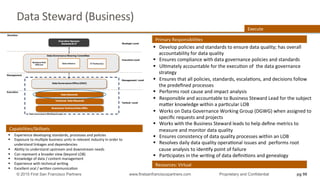
  • 64.
    Item Frequency DescriptionPurpose Audience Documentation From Date Owner Status Meetings First BSL Meeting One-Time Introduction Get explicit buy-in from the participants and resource ask DGWG BSLs PowerPoint Presentation John 8/25/11 John Complete DGWG Core Team Kickoff Meeting One-Time DGO kickoff and vision from IT Sponsor Kickoff DGWG-Core, IT Sponsor PowerPoint presentation John 9/15/11 John Complete DGO Launch Logistics One-Time Communication announcing the DGO Plan on the best way to communicate the DGO launch and PR effort DGO, SVB Corporate Communication Email John TBD John Complete DGO-DGWG-Core Status Meeting Weekly DGWG accomplishments, progress towards goals and issues Status DGWG-Core members SharePoint Agenda & Content John Ongoing Flo In progress Meeting with DGO IT Lead Weekly Planning and strategy Status/Planning DGO Chair, DGO IT Lead and DGC John Ongoing John DGO & MDM alignment meetings Weekly MDM Implementation update Status MDM team, DGO Chair & DGC Agenda Rebecca Ongoing Rebecca Mentoring program (Data Stewardship Program) Weekly Opportunity to learn from Business Steward Leads. Best practices, polices, processes, standards, definitions Enrichment DGWG Data Stewards Data Stewardship Best practices. DGO Polices, processes, standards, definitions TBD TBD TBD Not Started Meeting with Program Sponsors Bi-Weekly? Provide DGWG accomplishments, progress towards goals and issues Status DGO Chair, Biz and IT Sponsor PowerPoint presentation John TBD John Not Started DGO-DGWG Decision (Core & Advisory) Meeting Monthly DGWG voting meeting Vote and approve DGWG materials DGWG members SharePoint Agenda & Content John Ongoing Flo In progress DGO-DGWG - DM IT Support Group Meeting Monthly DGWG DM IT Support Group team monthly update Bring the advisory team up to speed on status before the decision meeting DGWG Advisory members SharePoint Agenda & Content John TBD Flo Not Started EIC Meeting Monthly DGWG accomplishments, progress towards goals, issues, documents for informational purposes only Status, Informational EIC members PowerPoint presentation John Ongoing John In progress Meeting with SAM - Fund Business stakeholders As needed Relationship building/Expectations/Impact DGO resource engagement Business Stakeholders Informal/deck, Email John TBD Flo Not Started Meeting with Purchasing stakeholders As needed Relationship building/Expectations/Impact DGO resource engagement Business Stakeholders Informal/deck, Email John TBD Flo Not Started Meeting with Product Implementation stakeholdersAs needed Relationship building/Expectations/Impact DGO resource engagement Business Stakeholders Informal/deck, Email John TBD Flo Not Started Meeting with Global Product stakeholders As needed Relationship building/Expectations/Impact DGO resource engagement Business Stakeholders Informal/deck, Email John TBD Flo Not Started DGO Town Halls One/Year DGWG accomplishments and progress towards goals Forum for open discussion Team Building All DGWG members PowerPoint presentation John TBD Flo Not Started Sample  CommunicaQon  Plan   pg 64Copyright (c) 2015 - First San Francisco Partners www.firstsanfranciscopartners.com Proprietary and Confidential And  these  are  just  the   meeQngs!  Also:   •   Awareness  &  Training   •   CommunicaQon  Vehicles   •   Knowledge  Sharing   • ….  
  • 65.
  • 66.
    Ensuring  DG  is  Sustainable   •  Incorporate  DG  goals  into  other  goals,   objecQves  and  incenQves  Incorporate   •  Align  DG  with  strategic  objecQves,   programs  and  projects  Align   •  Embed  DG  into  standard  project,  change   control,  new  iniQaQve  and  operaQonal   processes   Embed   •  Focus  on  delivering  business  value  Focus     pg 66Copyright (c) 2015 - First San Francisco Partners www.firstsanfranciscopartners.com Proprietary and Confidential
  • 67.
    Incorporate  IncenQves   Carrots   SQcks   Oversight   AllocaQon   pg 67Copyright (c) 2015 - First San Francisco Partners www.firstsanfranciscopartners.com Proprietary and Confidential
  • 68.
    Align  with  ObjecQves,  Programs  and  Projects   §  Examples:   §  Alignment  with  Stakeholder  goals  (already  discussed)   §  Alignment  with  Corporate  ObjecQves   §  Alignment  with  strategic  Programs/Projects   pg 68Copyright (c) 2015 - First San Francisco Partners www.firstsanfranciscopartners.com Proprietary and Confidential
  • 69.
    Example:  Alignment  with  Corporate  ObjecQves   pg 69Copyright (c) 2015 - First San Francisco Partners www.firstsanfranciscopartners.com Proprietary and Confidential
  • 70.
    Example:     Tie  Principles  to  Corporate  Strategic  ObjecQves   Corporate   Objec4ve   Principle   Client   Data  is  a  key  asset  to  our  company.  We  will  enhance  and  manage   this  asset  by  emphasizing  clear  strategies,  decisive  acQon,   innovaQon  and  results.   Capabili4es   Business  stakeholders  will  get  informaQon  delivered  at  the  right   Qme,  locaQon  and  amount  as  efficiently  as  possible.   Execu4on   Data  Governance  will  introduce,  support  and  drive   standardizaQon  of  enterprise  data.   Brand   Best  in  class  customer  data  quality  will  significantly  improve  both   the  internal  as  well  as  external  customer  experience.   People   Data  Governance  should  increase  producQvity  through   centralized,  streamlined  processes  and  eliminate  non-­‐value  added   acQviQes.  Maximizing  automaQon  is  a  key  way  to  improve  human   resource  efficiencies  and  is  preferable  over  manual  processes.   Principles  drive  crea.on  and  execu.on  of  policies,  standards,  processes,  etc….   pg 70Copyright (c) 2015 - First San Francisco Partners www.firstsanfranciscopartners.com Proprietary and Confidential
  • 71.
  • 72.
    Project   IniQaQon   Project   ExecuQon   Change   Control   OperaQonal   pg 72 Copyright (c) 2015 - First San Francisco Partners www.firstsanfranciscopartners.com Proprietary and Confidential
  • 73.
    Sample:  Embed  in  Project  IniQaQon  Process   pg 73Copyright (c) 2015 - First San Francisco Partners www.firstsanfranciscopartners.com Proprietary and Confidential IdenQfy   informaQon/   infrastructure   needs   Profile  to  Iden4fy   data  issues   Analyze  to   Iden4fy  root   causes/  gaps   Design  solu4ons   to  root  cause   problems  /  gaps   Implement   process  &  Tech   soluQons   Sustain   Proac.vely  iden.fy  problems  and  solve  root  causes  
  • 74.
    Sample:   Embed  Data  Governance  Into  Your  Project  Methodology   pg 74Copyright (c) 2015 - First San Francisco Partners www.firstsanfranciscopartners.com Proprietary and Confidential Engage  DG,  DQ,  DA,   MDM,  Metadata   Leads   Assess  adherence  to   Guiding  Principles   Alignment   Workshop   Assess  adherence  to   Guiding  Principles   Engage  DG,  DQ,  DA,   MDM,  Metadata  Leads   Engage  DG,  DQ,  DA,   MDM,  Metadata  Leads   AddiQonal  DG,  DQ,  DA,  MDM  and  Metadata  related  deliverables  added  to  ‘typical’   list:    Data  Profiling  Reports,  New/modified  Score-­‐cards,  AddiQonal  Metadata,  New/ modified  Processes,  Data  Model  Reviews,  etc   Engage   DG,  DQ,   DA,  MDM,   Metadata   Leads   Engage   DG  Lead  
  • 75.
    Sample:     Embed  Data  Governance  with  Change  IniQators/Control   pg 75Copyright (c) 2015 - First San Francisco Partners www.firstsanfranciscopartners.com Proprietary and Confidential A  process  flow  will  help  ensure  consistent  change   requests  related  to  data      
  • 76.
    Sample:  OperaQonal  Process  (Client  On-­‐Boarding)   New  Client   Request   DocumentaQo n  &  Due   Diligence   Terms   confirmed   Agreement  /   Contract   Created   Create  Client   Copyright (c) 2015 - First San Francisco Partners www.firstsanfranciscopartners.com Proprietary and Confidential • ExisQng  or  Previous  Client   (Master  Data  Check)   • Data  Standards  and   ValidaQon   • Data  Quality  Check   • Regulatory  Checks   • RACI  /  Data  Ownership   • Data  Enrichment   • Data  ClassificaQon   • Data  RemediaQon   • Decision  Making  /  EscalaQon   Processes   • Hierarchy  /  RelaQonship   Check   • Client  SegmentaQon   • Contract  Management   • Document   Management   • Update  Master  Data   • Create  Hierarchies   • Data  Standards  and   ValidaQon   • Data  Quality  Check   • Data  Sharing,  Access  &  Use   Policy   • …  
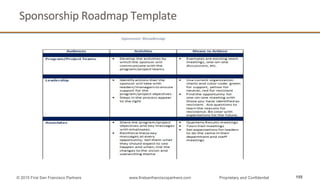
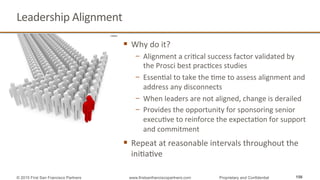
  • 77.
    Sample:  OperaQonal  Process  (Unique  Device  IdenQficaQon   Management)   pg 77Copyright (c) 2014 - First San Francisco Partners www.firstsanfranciscopartners.com Proprietary and Confidential IdenQfy  Products   for  Submission   IdenQfy  Data   Sources   Profile  Product   Data   IdenQfy  and   Address  DQ   Issues   Aggregate  Data   Cleanse  /  Enrich   Data   Review  /  Approve   Data  for   Submission   Submit  Data  and   resolve  errors   Publish  data  for   internal  /external     consumpQon  
  • 78.
    ArQfacts  needed  for  IdenQfying  Product  Data  &  Sources   pg 78Copyright (c) 2014 - First San Francisco Partners www.firstsanfranciscopartners.com Proprietary and Confidential IdenQfy  Products   for  Submission   IdenQfy  Data   Sources   Profile  Product   Data   IdenQfy  and   Address  DQ   Issues   Aggregate  Data   Cleanse  /  Enrich   Data   Review  /  Approve   Data  for   Submission   Submit  Data  and   resolve  errors   Publish  data  for   internal  /external     consumpQon   Data  DicQonary  /  Business  Glossary   Data  Inventory   Data  Flow  Diagrams   Product  Data  Hierarchies   Data  Standards   Data  Ownership  and  RACI  matrices  
  • 79.
    ArQfacts  needed  for  Profiling  and  Addressing  DQ   pg 79Copyright (c) 2014 - First San Francisco Partners www.firstsanfranciscopartners.com Proprietary and Confidential IdenQfy  Products   for  Submission   IdenQfy  Data   Sources   Profile  Product   Data   IdenQfy  and   Address  DQ   Issues   Aggregate  Data   Cleanse  /  Enrich   Data   Review  /  Approve   Data  for   Submission   Submit  Data  and   resolve  errors   Publish  data  for   internal  /external     consumpQon   • Data  Quality  Standards   • Data  Quality  Rules   • Data  Profiling  SoluQons   • Data  RemediaQon  Processes   • Decision  Making  &  EscalaQon   Processes    
  • 80.
    ArQfacts  needed  for  AggregaQng,  Cleansing,  Enriching   pg 80Copyright (c) 2014 - First San Francisco Partners www.firstsanfranciscopartners.com Proprietary and Confidential IdenQfy  Products   for  Submission   IdenQfy  Data   Sources   Profile  Product   Data   IdenQfy  and   Address  DQ   Issues   Aggregate  Data   Cleanse  /  Enrich   Data   Review  /  Approve   Data  for   Submission   Submit  Data  and   resolve  errors   Publish  data  for   internal  /external     consumpQon   • Product  Hierarchies  and  RelaQonships   • Match  /  Merge  Rules   • Data  ValidaQon  and  Cleansing  Rules   • Data  AcquisiQon  Policies  (Purchasing  and   IntegraQng)   • ExcepQon  and  Error  Handling  Processes  
  • 81.
    ArQfacts  needed  for  Review,  Approve,  &  Submit   pg 81Copyright (c) 2014 - First San Francisco Partners www.firstsanfranciscopartners.com Proprietary and Confidential IdenQfy  Products   for  Submission   IdenQfy  Data   Sources   Profile  Product   Data   IdenQfy  and   Address  DQ   Issues   Aggregate  Data   Cleanse  /  Enrich   Data   Review  /  Approve   Data  for   Submission   Submit  Data  and   resolve  errors   Publish  data  for   internal  /external     consumpQon   • Data  Profiling   • Data  Management  Workflows   • RACI  Matrices   • Decision  Making  and  EscalaQon  Processes   • Approval  Process   • ExcepQon  and  Error  Handling  Process   • Measurement  and  Monitoring  of  the  process  
  • 82.
    ArQfacts  needed  to  Publish  &  Manage   pg 82Copyright (c) 2014 - First San Francisco Partners www.firstsanfranciscopartners.com Proprietary and Confidential IdenQfy  Products   for  Submission   IdenQfy  Data   Sources   Profile  Product   Data   IdenQfy  and   Address  DQ   Issues   Aggregate  Data   Cleanse  /  Enrich   Data   Review  /  Approve   Data  for   Submission   Submit  Data  and   resolve  errors   Publish  data  for   internal  /external     consumpQon   • Data  Sharing  Policies  (Usage,  Access  Rights)   • Data  RetenQon   • Training  and  CommunicaQon  
  • 83.
  • 84.
    Principle   Descrip4on   Be  clear  on  purpose   Build  governance  to  guide  and  oversee  the  strategic  and  enterprise  mission   Enterprise  thinking   Provide  consistency  and  coordinaQon  for  cross  funcQonal  iniQaQves.  Maintain  an  enterprise  perspecQve  on   data   Be  flexible   If  you  make    it  too  difficult,  and  people  will  circumvent  it.    Make  it  customizable  (within  guidelines),  and   people  will  get  a  sense  of  ownership   Simplicity  and  usability  are  the  keys  to   acceptance   Adopt  a  simple  governance  model  people  can  use.    A  complicated  and  inefficient  governance  structure  will   result  in  the  business  circumvenQng  the  process   Be  deliberate  on  par4cipa4on  and  process   Select  sponsors  and  parQcipants.  Do  not  apply  governance  bureaucracy  solely  to  build  consensus  or  to   saQsfy  momentary  poliQcal  interest   Enterprise  wide  alignment  and  goal  congruence   Maintain  alignment  with  both  enterprise  and  local  business  needs.  Guide  prioriQzaQon  and  alignment  of   iniQaQves  to  enterprise  goals   Establish  policies  with  proper  mandate  and   ensure  compliance     Clearly  define  and  publicize  policies,  processes  and  standards.  Ensure  compliance  through  tracking  and   audit   Communicate,  Communicate,  Communicate!     Frequent,  directed  communicaQon  will    provide  a  mechanism  for  gauging  when  to    “course  correct”,   manage  stakeholder  and  effecQveness  of    the  program   Governance  Design  Principles   pg 84Copyright (c) 2015 - First San Francisco Partners www.firstsanfranciscopartners.com Proprietary and Confidential
  • 85.
    Ensuring  Success   § The  following  factors  are  usually  evident  in  a  successful  program:   −  First  create  a  strategy  and  then  follow  it  (agreed  on  starQng  point  &  steps   necessary)   −  Ensure  solid  alignment  between  Business  &  IT   −  Clearly  defined  and  measureable  success  criteria   −  Small  iteraQons  vs.  all  or  nothing   −  ExecuQve  sponsorship  is  criQcal   −  IdenQfy  and  assess  the  importance  of  key  people  and  or  groups   −  Really  know  your  data   −  Leverage  prior  experience/work…don’t  re-­‐invent  the  wheel   −  Embed  governance  into  the  operaQons  of  your  company   −  Communicate,  Communicate,  Communicate!   pg 85Copyright (c) 2015 - First San Francisco Partners www.firstsanfranciscopartners.com Proprietary and Confidential
  • 86.
    pg 86Copyright (c)2015 - First San Francisco Partners www.firstsanfranciscopartners.com Proprietary and Confidential Thank  you!     Kelle  O’Neal   kelle@firstsanfranciscopartners.com   415-­‐425-­‐9661   @1stsanfrancisco  
  • 87.
    www.firstsanfranciscopartners.com Appendix  1  Roles  &  ResponsibiliQes   pg 87Copyright (c) 2014 - First San Francisco Partners www.firstsanfranciscopartners.com Proprietary and Confidential
  • 88.
    Direc4on   TBD     Execu4ve  Sponsor   Business  &  IT   Business  Data  Stewards   Data  Governance  Steering  Commi<ee   Business  Unit   Officers   Data  Owners   IT  Partner(s)   Data  Governance  Office  (DGO)   Management   Program  Oversight.  Allocates  budget  &   resource.  Empower  Business  Data   Stewards.  Forum  for  issue  escalaQon.   Craps  the  Enterprise  Data  Strategy,   processes  and  standards  to  ensure  that   data  is  managed  as  an  asset.   Execu4ve  Level   Management    Level       Stewards  data  within  their  BU  to  ensure   that  the  enterprise  policies,  standards  &   processes  are  applied.   Tac4cal    Level   Strategic  Level   Provides  overall  strategic    direcQon,  budget   &  resource  approvals.  Forum  for  issue     escalaQon.  Approval  of  data  domains  under   governance  control.   Execu4on   Technical    Data  Stewards   Local  Data  Governance  Working  Groups   Reference  OperaQng  Model   Business  &  Technical  Data  SMEs   pg 88© 2015 First San Francisco Partners www.firstsanfranciscopartners.com Proprietary and Confidential
  • 89.
    Core  Data  Governance  Roles   Role   Common  Aliases   Insights   Execu4ve  Sponsor  (Business)   In  an  ideal  state  there  is  execuQve  sponsorship  in  both  Business   &  IT.  If  there  is  a  single  sponsor,  look  to  the  Business.   Data  Owner  (Business)   Business  Data  Owner,  Accountable   ExecuQve,  Business  Steward  Lead   Probabili4es:   -­‐“Owner”  may  not  be  accepted  by  culture   -­‐May  not  be  able  to  idenQfy  “Owners”   Large/Complex  Organiza4ons:  May  need  both  Data  Owner  and   Business  Steward  Lead   Data  Steward  (Business)   Business  Data  Steward,  Data  Custodian,   Chief  Data  Steward   It’s  all  about  the  details.  Never  assume  the  R&R’s  based  on  the   Qtle.     Technical  Data  Steward  (IT)   Technical  Lead,  IT  Support  Partner   Data  Architect  (IT)   Open  part  of  Enterprise  Architecture   Member  of  Architecture  Review  Board  (ARB)   May  not  exist,  however  responsibiliQes  should  be  assigned   Business  Analyst  (Business)   BA’s  with  Data  Governance  experience  are  extremely  valuable   and  provide  criQcal  support  to  the  Data  Stewards.       Data  Governance  Office  Lead   DGO  Lead   pg 89© 2015 First San Francisco Partners www.firstsanfranciscopartners.com Proprietary and Confidential
  • 90.
    SupporQng  Roles   Role   Common  Aliases   Insights   Data  Analyst   Business  Data  Analyst,  Technical  Data   Analyst   Data  Architect   InformaQon  Architect  (IA)   Different  from  an  Enterprise  Architect,  open  part  of  Enterprise   Architecture   Member  of  ARB   If  ARB/EA  funcQons  don’t  exist:  Assign  responsibiliQes.   Data  Quality  Analyst   Librarian   Knowledge  Worker   Common  in  MDM  Programs,  more  so  when  MDM  technology  is  in  place.   Role  is  dedicated  to  Data  Maintenance  acQviQes  associated  with  Data   Governance.   Data  SME   Subject  Maher  Expert,  Knowledge  Worker,   User,  Data  Entry  Clerk   SME’s  can  be  found  in  the  Business  &    IT,  and  at  all  levels  in  an   organizaQon.      In  some  organizaQons  a  “SME”  is  considered  highly   skilled,  respected  role.   pg 90© 2015 First San Francisco Partners www.firstsanfranciscopartners.com Proprietary and Confidential
  • 91.
    www.firstsanfranciscopartners.com Leadership  Roles  &  Decision  Making  Bodies   pg  91  
  • 92.
    ExecuQve  Sponsor  (Business  and  IT)   §  Chairs  the  Data  Governance  Steering  Commihee   §  UlQmate  authority  and  responsible  for  overall  program  direcQon   §  Provides  overall  strategic  vision   §  Sets  strategy  and  direcQon  for  Data  Governance  &  Management   §  Works  with  the  Data  Governance  Office  to  formulate  the  data   governance  strategy   §  Sets  direcQon  for  the  Data  Governance  Working  Group  (DGWG)   and  ensures  that  the  implementaQon  is  in-­‐line  with  the  strategy   §  Conveys  the  data  management  and  governance  strategy  to  the   other  Exec  Commihees   §  Clarifies  business  strategies  to  the  DGWG   §  Provides  reinforcement  to  enable  the  success  of  data  governance   through  communicaQon   §  Gathers  funding  and  resource  availability  for  the  governance   program   §  Approves  changes  to  the  data  governance  strategy   Resources:  Virtual   Primary  ResponsibiliQes   Set  Strategy  and  Steer   Skills/CapabiliQes   §  Generally  a  Corporate  ExecuQve/Officer  of  Company   §  Recognized  cross-­‐funcQonal  leadership  and  influencing  skills   §  PoliQcally  astute   pg 92© 2015 First San Francisco Partners www.firstsanfranciscopartners.com Proprietary and Confidential ! Roles  may  be  different  in   large  or  complex   organizaQons  ,  i.e.  the  DGO   Lead  can  run  the  DGSC  
  • 93.
    Data  Governance  Steering  Commihee   Resources:  Virtual   Primary  ResponsibiliQes   Membership   §  Chaired  by  the  ExecuQve  Sponsor  (Business)   §  IT  Sponsor   §  Cross  LOB  execuQves   §  Data  Owners   §  Data  Governance  Office  Lead  (usually  non-­‐voQng)   §  IT  Partner     Oversight   pg 93© 2015 First San Francisco Partners www.firstsanfranciscopartners.com Proprietary and Confidential §  Brings  corporate  and  cross  LOB  perspecQve   §  Approves  budget  and  allocates  funding     §  Approves  funding  for  enhancements   §  Appoints  and  approves  data  governance  resources   §  Nominates,  selects  and  empowers  and  mandates  the  DGWG   §  Ensures  strategic  alignment  between  DG  program  and  other   business  unit  iniQaQves   §  Ensures  strategic  alignment  with  corporate  objecQves   §  Adjudicates  intractable  issues  that  are  escalated  by  the  Data   Governance  Working  Group  (DGWG)   §  Approves  funding  for  enhancements   §  Enforces  the  data  governance  polices,  processes  and  standards  for   the  organizaQon   §  Approves  changes  to  the  data  governance  strategy   §  Has  the  final  say  in  all  data  governance  decisions   §  Owns  key  data  assets  across  enterprise   !     May  have  addiQonal   decision  making  bodies  in   large  or  complex   organizaQons    
  • 94.
    Data  Governance  Working  Group   Resources:  Virtual   Primary  ResponsibiliQes   §  Data  Governance  Office  Lead   §  Data  Stewards   §  Technical  Data  Stewards   §  Business  &  Technical  Data  SMEs   §  Key  Stakeholders     Management  &  ExecuQon   Membership   pg 94© 2015 First San Francisco Partners www.firstsanfranciscopartners.com Proprietary and Confidential §  Governing  body  across  Business  and  IT  funcQons  that  own  data   definiQons  and  provide  guidance  &  enforcement  to  drive  change   in  use  and  maintenance  of  data   §  Defines  data  polices,  processes  and  standards    (PPS)   §  PrioriQzes  opportuniQes  to  develop  data  polices,  processes  and   standards,  and  iniQates  data  quality  iniQaQves   §  Advises  data  stewards  on  the  development  and  maintenance  of   the  data    PPS   §  Assists  in  the  approval  and  enforcement  of  data  data  PPS   §  Assess  compliance  and    manages  risk   §  Resolves  issues  that  have  been  escalated  to  the  DGWG   §  Approves  data  polices,  processes  and  standards     §  Reviews  and  approves  appeals  and  excepQons;  escalates  rare   excepQons   !     Local  DGWG  for  large  or   complex  organizaQons   Led  by  the  Data  Owner,   Business  Data  Lead  or  Data   Steward  
  • 95.
  • 96.
    Data  Owner   § Member  of  Data  Governance  Steering  Commihee   §  Accountable  for  represenQng  the  Business  Unit  and  corporate   interests  from  an  Enterprise  perspecQve   §  Accountable  for  the  Business  Unit  at  the  Data  Governance  Steering   Commihee   §  IdenQfies  and  prioriQzes  issues  and  suggested  enhancements  from   end  users   §  Helps  to  promote  the  data  governance  program  across  the   Enterprise   §  Serves  as  an  escalaQon  point  for  all  data  governance  issues  for  the   Data  Steward  and  Data  Governance  Working  Group   §  Works  with  other  Data  Owners  to  idenQfy  and  resolve  specific  data   quality  issues   §  Responsible  for  ensuring  compliance  with  data  governance  policies   and  standards  across  the  Enterprise  and  within  the  Business  Unit   §  Seeks  and  manages  funding  for  iniQaQves  to  improve  data  quality   §  Trains,  educates,  and  creates  awareness  for  members  in  their   respecQve  funcQonal  areas   Resources:  Virtual   Primary  ResponsibiliQes   §  Business  RepresentaQve   §  Ability  to  syndicate  and  achieve  organizaQonal  change  in  a   decentralized  environment   §  Demonstrated  program  management  and  enterprise-­‐wide   coordinaQon  experience   §  Expert  communicaQon  skills  (verbal  and  wrihen)  with  the  ability  to   communicate  complex  issues  /  requirements  to  technical  and  non-­‐ technical  audiences  as  well  as  educate  the  business  about  data   management   Manage   CapabiliQes/Skillsets   pg 96© 2015 First San Francisco Partners www.firstsanfranciscopartners.com Proprietary and Confidential !   “Data  Owner”  may  not   be  embraced     Complexity/Scope  may  require   addiQonal  layers/roles  to   execute  at  the  enQty  level  
  • 97.
    Business  Steward  Lead   §  Responsible  for  represenQng  the  LOB  and  corporate  interests  from  an   enterprise  perspecQve   §  Represents  the  LOB  at  the  Data  Governance  Working  Group  (DGWG)   §  IdenQfies  and  prioriQzes  issues  and  suggested  enhancements  from  end  users   §  Helps  to  promote  the  data  governance  program  across  the  enterprise   (primarily  within  their  LOB)   §  Defines  polices  and  standards  to  ensure  data  quality  within  the  LOB   §  Sets  goals  on  how  to  manage  business  informaQon  beher   §  Serves  as  an  escalaQon  point  for  all  data  governance  issues  within  the  LOB   §  IdenQfies  and  resolves  LOB-­‐specific  data  quality  issues;  works  with   appropriate   §  Responsibility  for  ensuring  compliance  with  data  governance  policies  and   standards  within  the  LOB   §  Seeks  and  manages  funding  for  iniQaQves  to  improve  data  quality   §  Trains,  educates,  and  creates  awareness  for  members  in  their  respecQve   funcQonal  areas   Resources:  Virtual   Primary  ResponsibiliQes   •  Solid  knowledge  and  understanding  of  the  business,  organizaQon,  and   funcQonal  area   •  Excellent  communicaQon  skills  (wrihen  and  oral)   •  FacilitaQon  and  consensus  building  skills   •  Ability  and  willingness  to  work  as  part  of  a  team   •  Ability  to  funcQon  independently   •  ObjecQvity,  CreaQvity  and  Diplomacy   Execute   CapabiliQes/Skillsets   pg 97© 2015 First San Francisco Partners www.firstsanfranciscopartners.com Proprietary and Confidential !   Business  Steward   lead  takes  the  place   of  the  “Data   Owner”  
  • 98.
    Data  Steward  (Business)   §  Develop  policies  and  standards  to  ensure  data  quality;  has  overall   accountability  for  data  quality   §  Ensures  compliance  with  data  governance  policies  and  standards   §  UlQmately  accountable  for  the  execuQon  of    the  data  governance   strategy   §  Ensures  that  all  policies,  standards,  escalaQons,  and  decisions  follow   the  predefined  processes   §  Performs  root  cause  and  impact  analysis   §  Responsible  and  accountable  to  Business  Steward  Lead  for  the  subject   maher  knowledge  within  a  parQcular  LOB   §  Works  on  Data  Governance  Working  Group  (DGWG)  when  assigned  to   specific  requests  and  projects   §  Works  with  the  Business  Steward  leads  to  help  define  metrics  to   measure  and  monitor  data  quality   §  Ensures  consistency  of  data  quality  processes  within  an  LOB   §  Resolves  daily  data  quality  operaQonal  issues  and    performs  root   cause  analysis  to  idenQfy  point  of  failure   §  ParQcipates  in  the  wriQng  of  data  definiQons  and  genealogy     Resources:  Virtual   Primary  ResponsibiliQes   CapabiliQes/Skillsets   §  Experience  developing  standards,  processes  and  policies   §  Exposure  to  mulQple  business  units  in  relevant  industry  in  order  to   understand  linkages  and  dependencies   §  Ability  to  understand  upstream  and  downstream  needs   §  Can  represent  a  broader  view  (beyond  LOB)   §  Knowledge  of  data  /  content  management   §  Experience  with  technical  wriQng   §  Excellent  oral  /  wrihen  communicaQon   Execute   pg 98© 2015 First San Francisco Partners www.firstsanfranciscopartners.com Proprietary and Confidential
  • 99.
    Data  SME  (Business  and  IT)   §  Member  of  Data  Governance  Working  Groups  for  specific  data  domain(s)   §  Recognized  experts  within  the  organizaQon   §  May  not  be  officially  responsible  for  managing  an  Domain  but  may  be   consulted  on  topics  related  to  Domain   §  Considered  a  data  “go-­‐to”  person  within  their  Business  Unit   §  Deep  understanding  of  use  and  impact  of  data  within  and  across  Business   Unit   §  Ability  to  parQcipate  in  development  of  standards,  processes  and  policies   §  Ensures  compliance  with  data  governance  policies  and  standards   §  Ensures  that  all  policies,  standards,  escalaQons,  and  decisions  follow  the   predefined  processes   §  Performs  root  cause  and  impact  analysis   §  Responsible  and  accountable  to  Data  Steward  for  the  subject  maher   knowledge  within  Business  Unit.     §  Resolves  daily  data  quality  operaQonal  issues  and    performs  root  cause   analysis  to  idenQfy  point  of  failure   §  ParQcipates  in  the  wriQng  of  data  definiQons  and  genealogy     §  Works  with  other  SMEs  and  the  data  steward  to  idenQfy  and  address  data   interdependencies  across  businesses  and  funcQons   §  Work  with  other  SMEs  and  the  data  steward  to  resolve  issues   §  Drive  awareness  and  adopQon  of  policies,  standards  and  business  rules   Resources:  Virtual   Primary  ResponsibiliQes   CapabiliQes/Skillsets   §  Business  RepresentaQve   §  Considered  a  data  “go-­‐to”  person  within  their  business  unit   §  Deep  understanding  of  use  and  impact  of  data  within  and  across  business  unit   §  Ability  to  parQcipate  in  development  of  standards,  processes  and  policies   §  Exposure  to  mulQple  business  units  in  relevant  industry  in  order  to  understand   linkages  and  dependencies   §  Knowledge  of  data  /  content  management   §  Excellent  oral  /  wrihen  communicaQon   Execute   pg 99© 2015 First San Francisco Partners www.firstsanfranciscopartners.com Proprietary and Confidential
  • 100.
    Business  Data  Analyst   §  Supports  the  Business  Data  Steward   §  Work  with  Technical  Data  Stewards  and  IT  Data  Governance  resources  to   support  data  modeling,  metadata  and  data  quality  acQviQes.   •  Leverage  well  thought  out  methodology  applying  specific  data  enQty  and   business  process  experQse.   •  Provide  metrics  and  reporQng  support  (both  adhoc  and  repeQQve)  to  data   management  programs  and  Data  Governance   •  Make  recommendaQons  for  correcQng  and  prevenQng  errors  and  defects   that  include  process  changes,  data  cleansing  and  integrity  rule  updates.   •  DocumenQng  the  types  and  structure  of  the  business  data  (conceptual  &   logical  modeling)   •  Analyze  and  mine  business  data  to  idenQfy  paherns  and  correlaQons  among   the  various  data  points   •  Design  and  create  data  reports  and  reporQng  tools  to  help  business   execuQves  in  their  decision  making   Resources:  Dedicatedl   Primary  ResponsibiliQes   CapabiliQes/Skillsets   §  Strong  relaQonship  with  technical  staff   §  Ability  to  map  and  tracing  data  from  system  to  system  in  order  to   solve  a  given  business  or  system  problem   §  Ability  to  perform  staQsQcal  analysis  of  business  data   §  Able  to  translate  business  quesQons  into  data  requirements  to  IT   §  Able  to  analyse  large  sets  of  complex  datasets,  examining  for  both   standard  and  anomalies  of  data   Execute   pg 100© 2015 First San Francisco Partners www.firstsanfranciscopartners.com Proprietary and Confidential
  • 101.
    Support  Roles   Resources:  Dedicated   Execute  -­‐  TacQcal   Role   Primary  ResponsibiliQes   Data  Librarian     §  Uses  well  documented  "playbooks",  execute  manual   data  remediaQon/data  cleansing  acQviQes.     §  Execute  manual  processes  to  close  the  gap  on  key  data   that  cannot  be  fixed  by  automaQon  tools  and   technology.     §  Apply  the  established  data  quality  playbook  of  policies   and  processes  to  the  data  i.e.  IdenQfy  and  remediate   duplicate  records,  improve  completeness  for  criQcal   data  ahributes.     Data  Users   §  Defines  business  requirements   §  Understands  the  data’s  term  of  use   §  Complies  with  data  governance  policies   §  Involved  in  accessing  and  invesQgaQng  integrated   datasets  for  staQsQcal  and  research  purposes   pg 101© 2015 First San Francisco Partners www.firstsanfranciscopartners.com Proprietary and Confidential
  • 102.
  • 103.
    Data  Governance  Office   §  Documented  DG  Strategy,  Vision,  Mission,  ObjecQves   §  Documented  DQ,  MDM/RDM  and  Metadata  Management  Strategies   §  Documented  DG  Guiding  Principles   §  Documented  roles  &  responsibiliQes  of  the  various  members   §  Up  to  date  OperaQng  Model   §  RACI  matrices   §  Templates  for  Policies  and  Processes   §  Templates  for  capturing  metrics  and  measurement  requirements   §  Templates  for  steering  commihee  meeQngs   §  Training  Plans   §  CommunicaQon  Plans   §  Template  for  regular  DG  communicaQon   §  Templates  for  logging  issues  needing  escalaQon  and  eventual  resoluQon   §  Templates  for  new  DG  service  requests   §  Checklists  for  new  projects  to  ensure  adherence  to  DG  standards   Resources:  Dedicated   Primary  ResponsibiliQes   Lead,  Advise  &  Support   Data  Governance  Office   Data  Quality  Management   MDM  Management   Metadata  Management   Coordinator/   Program   Manager   Data   Governance     Lead   pg 103© 2015 First San Francisco Partners www.firstsanfranciscopartners.com Proprietary and Confidential !   Strong  Partnership   between  the  DGO     and  IT  DG   OrganizaQons  
  • 104.
    Data  Governance  Office  Lead   §  Co-­‐chairs  Data  Governance  Working  Group  (DGWG)  meeQngs  with  the  IT   lead   §  Establishes  policies  and  guidelines  through  DG  best  pracQces   §  Oversee  the  integrity,  usability,  and  security  of  all  data  assets  under  DGO   purview   §  Responsible  for  enterprise-­‐wide  change  management  and  communicaQons   for  DG  efforts   §  Defines  the  polices,  processes  and  standards,  metrics  and  processes  for  data   quality  checks,  invesQgaQons,  and  resoluQon  across  organizaQon   §  Advises  business  on  data  polices,  processes  and  standards   §  Develops  the  DG  strategy  based  on  direcQon  set  by  the  execuQve  sponsors   §  Resolves  conflicts  on  data  across  business  and  technical  areas   §  Works  closely  with  IT  lead  to  develop  and  evolve  data  governance   communicaQons  and  branding   §  Trains,  educates,  and  creates  awareness  for  members  in  their  respecQve   funcQonal  areas   Resources:  Dedicated  FTE   Primary  ResponsibiliQes   CapabiliQes/Skillsets   •  Extensive  leadership  experience  with  experQse  in  Data  Governance     •  PoliQcally  astute  and  ability  to  communicate  effecQvely  both  up  and  down   •  Ability  to  effecQvely  monitor  industry  and  regulatory  acQviQes  and  assess  impact  on  Data   Governance  pracQce   •  Excellent  listening,  wrihen,  and  oral  communicaQon  skills   •  Strong  organizaQonal,  analyQcal,  and  decision-­‐making  skills   •  Ability  to  anQcipate  and  solve  problems   •  Proven  business  leader  with  technology  delivery  capabiliQes   •  EnergeQc,  innovaQve,  and  flexible     Lead  and  Advise   Data  Governance  Office   Data  Quality  Management   MDM  Management   Metadata  Management   Coordinator/   Program   Manager   Data   Governance     Lead   pg 104© 2015 First San Francisco Partners www.firstsanfranciscopartners.com Proprietary and Confidential
  • 105.
    Data  Governance  Office  Coordinator/Program  Manager   §  Provides  administraQve  support  to  the  DGO   §  Assists  with  the  administraQve  funcQon  of  the  Data  Governance  Office   §  Solicits  meeQng  agenda  items  and  drap  agenda   §  Prepares  and  distributes  the  agenda  and  other     §  Publishes  meeQng  minutes     §  Updates  issue  log  with  resolved  agenda  items     §  Coordinates  follow-­‐up  acQviQes  regarding  acQon  items,  issues,  and  risks   §  Records  key  decisions   §  Tracks  resoluQon  of  program  issues  and  follow  up   §  Documents  issues  details,  and  updates  issue  log  with  resolved  agenda  items     §  Coordinates  follow-­‐up  acQviQes  regarding  acQon  items,  issues,  data   documentaQon  in  projects  and  risks   §  MeeQng  management:  prepares  and  distributes  the  agenda  and  other   related  material  to  the  members.  Produces    minutes  and  ensures  they,  and   related  documents  are  published  to  a  common  collaboraQon  area  accessible   by  all  stakeholders   §  Gathers  and  reports  DG  metrics     §  Manages  data  definiQon  reviews,  approvals  for  important  data  concepts   Resources:  Dedicated   Primary  ResponsibiliQes   CapabiliQes/Skillsets   •  Advanced  knowledge  of  project/program  management  tools  and  disciplines   •  Proven  problem  solving  skills   •  High-­‐degree  of  credibility  and  influence  within  the  business  and  technology   •  Strong  coordinaQon,  interpersonal,  and  facilitaQon  skills   •  Analysis,  evaluaQon,  and  ability  to  arQculate  value  of  projects/programs  and  make   informed  and  objecQve  recommendaQons   •  CommunicaQon  across  project  members/parQcipants  to:  address  issues,  track  and   convey  status,  provide  guidance,  assign,  manage  issues,  manage  scope   •  Capacity  to  work  across  projects/releases  simultaneously     Administra4ve/Suppor4ng   Data  Governance  Office   Data  Quality  Management   MDM  Management   Metadata  Management   Coordinator/   Program   Manager   Data   Governance     Lead   pg 105© 2015 First San Francisco Partners www.firstsanfranciscopartners.com Proprietary and Confidential
  • 106.
  • 107.
    Data  Governance  Office  -­‐  IT  Lead   §  Co-­‐chairs  Data  Governance  Working  Group  (DGWG)  meeQngs  with  the   Business  lead   §  Responsible  for  represenQng  technology  interests  from  an  enterprise   perspecQve   §  Responsible  for  ensuring  the  technical  implementaQon  and  execuQon  of   DGSC  and    DGWG  decisions  unless  otherwise  specified   §  IdenQfies  issues  and  suggested  enhancements  for  all  users   §  Responsible  for  the  Data  Management  IT  support  Group     §  Custodian  of  informaQon  across  the  enterprise   §  Member  of  Architecture  Review  Commihee  (ARC)   §  Advises  technical  resources  on  data  standards  and  ensures  technical  designs   adhere  to  data  architectural  best  pracQces  to  ensure  data  quality   §  Resolves  conflicts  on  data  across  business  and  technical  areas   §  Advises  on  implementaQon  of  data  polices,  processes  and  standards   §  Trains,  educates,  and  creates  awareness  for  members  in  their  respecQve   funcQonal  areas   Resources:  Virtual  or  Dedicated   Primary  ResponsibiliQes   CapabiliQes/Skillsets   •  Extensive  leadership  experience  with  experQse  in  Data  Governance   technologies  and  implementaQon     •  Understanding  of  implicaQons  of  policies  and  standards  on  data  structures   •  Excellent  listening,  wrihen,  and  oral  communicaQon  skills   •  Ability  to  anQcipate  and  solve  problems   •  Proven  technology  delivery  capabiliQes   •  EnergeQc,  innovaQve,  and  flexible     Lead  and  Advise   IT  Data  Governance   Data  Quality  Support   MDM  Support   Metadata  Support   IT  Governance  Lead   pg 107© 2015 First San Francisco Partners www.firstsanfranciscopartners.com Proprietary and Confidential
  • 108.
    Data  Management  IT  Support  Group   §  Collaborate  with  the  DGWG  to  provide  the  day-­‐to-­‐day  custodianship  of  data   assets     §  Partners  with  the  DGO  to  support  and  evolve  the  Data  Governance  Program   §  IdenQfy  business  data  requirements  by  working  with  all  data  consQtuents   §  Create  metrics  and  measures  to  help  analyze  and  report  on  the  quality  of  the   data   §  Communicates  with  DGO  regarding  data  issues   §  Validates  data  quality  rules  and  prioriQze  data  quality  issue  resoluQon     §  Stores,  retains  and  disposes  of  data  as  per  requirements   §  Designs  technical  infrastructure  to  meet  requirements  (i.e.  data  architecture)   §  Trained  and  fully  knowledgeable  about  data  governance  processes  and   standards  and  confirms  adherence   §  Performs  impact  analysis  for  changes  to  exisQng  data  sources,  informaQon   architecture,  security,  etc.   §  Ensures  security  of  informaQon   §  Maintains  enterprise  data  model   §  Support  ongoing  data  cleansing  and  data  migraQon   Resources:  Virtual   Primary  ResponsibiliQes   Execute   IT  Data  Governance   Data  Quality  Support   MDM  Support   Metadata  Support   IT  Governance  Lead   pg 108© 2015 First San Francisco Partners www.firstsanfranciscopartners.com Proprietary and Confidential !   Strong  Partnership   between  IT  DG  and     DGO  OrganizaQons  
  • 109.
    Technical  Data  Steward  (IT  Support  Partner)   §  Supports  the  Data  Steward  for  specific  data  domain(s)   §  Member  of  Data  Governance  Working  Group  (DGWG),  Collaborates  with  the   DGWG  to  provide  the  day-­‐to-­‐day    custodianship  of  data  assets     §  Responsible  for  designing  technical  infrastructure  to  meet  requirements  (i.e.   data  architecture)   §  Responsible  for  managing  technical  aspects  of  Data  Governance,  e.g.,  technical   metadata,  data  modeling   §  Assists  in  compliance  with  data  standards,  policies   §  IdenQfy  business  data  requirements  by  working  with  all  data  consQtuents   §  Create  metrics  &  measures  to  help  analyze  and  report  on  the  quality  of  the   data   §  Communicates  with  DGO  regarding  data  issues   §  Validates  data  quality  rules  and  prioriQze  data  quality  issue  resoluQon     §  Stores,  retains  and  disposes  of  data  as  per  requirements   §  Performs  impact  analysis  for  changes  to  exisQng  data  sources,  informaQon   architecture,  security,  etc.   §  Ensures  security  of  informaQon  according  to  exisQng  InformaQon  Security   Policy   §  Support  ongoing  data  cleansing  and  data  migraQon  Resources:  Virtual   Primary  ResponsibiliQes   CapabiliQes/Skillsets   §  Able  to  translate  business  quesQons  into  technical  requirements   §  Able  to  analyze  large  sets  of  complex  datasets,  examining  for  both   standard  and  anomalies  of  data   §  Have  specific  data  enQty  knowledge,  understands  the  business   process  that  uses  the  data  and  is  generally  responsible  for  technical   development/enhancement/support  in  one  or  more  applicaQons  or   data  sources  that  house  the  data.   §  Has  subject  maher  experQse  in  specific  data  enQty   Execute   pg 109© 2015 First San Francisco Partners www.firstsanfranciscopartners.com Proprietary and Confidential
  • 110.
  • 111.
    Ensuring  Success   § Don’t  need  to  re-­‐invent  the  wheel:  Leverage  exisQng  execuQve  leaderships  and  decision  making   forums  with  expanded  decision  making  responsibiliQes   §  Prevent  “delegated  responsibiliQes”  in  decision  making  bodies  –  require  “peer  proxy”  at  the   execuQve  level   §  Titles  need  to  fit  the  culture:  Focus  on  the  Roles  &  ResponsibiliQes,  not  the  name  of  the  role   §  One  individual  may  fill  mulQple  roles:  Role-­‐based  not  job-­‐based   §  Ensure  robust  support  for  Data  Stewards  with  key  support  roles:  Business  Analyst,  Data  SMEs.   §  Know  the  program  focus  and  fill  roles  accordingly:  Example:  A  focus  on  Data  Quality  will  require   experienced  Data  Analysts,  BA’s,  IT  Roles   §  Establish  PracQce  Groups/Centers  of  Excellence  to  support  and  evolve  the  program,  provide   educaQon  and  training:   §  Business  Data  Steward  PracQce  Group  (chaired  by  DGO  Lead)   §  Technical  Data  Steward  PracQce  Group  (chaired  by  IT  DG  Lead)   §  Where  possible,  make  roles  “official”:   §  Job  DescripQons  Updated;  Goal  Alignment     pg 111© 2015 First San Francisco Partners www.firstsanfranciscopartners.com Proprietary and Confidential
  • 112.
  • 113.
    Sample  StaQsQcs   • Improve  efficiencies  by  10%  in  1  year,  building  to  40%  by  year  3   •  Reduce  New  Project  iniQaQon  cost  by  50%   •  Project  delays  due  to  bad  data  resulted  in  cost  and  Qme  increase  1.5x  iniQal  esQmate   •  Reduce  number  of  duplicate  records  by  30%  in  1  year   •  Improve  ability  to  respond  to  regulatory  concerns  thereby  saving  up  to  $5M  in  external  fees  per   incident   §  ConsulQng  fees  are  $9m  for  audit;  40%  of  audit  cost  spent  on  gathering  data   §  Employee  burn  out  was  consistently  cited  as  major  risk  of  maintaining  the  status  quo   §  Credit  Risk  RaQng  remediaQon  project  resulted  in  over  2,500  hours  of  effort,  largely  redundant  data   processing   §  Global  expansion  (addiQonal  markets  and  24x7  processing  )  will  conQnue  to  exert  pressure  on   manual  processes,  further  increasing  the  likelihood  of  an  oversight  leading  to  reporQng  mistakes  or   noncompliance   Copyright (c) 2014 - First San Francisco Partners www.firstsanfranciscopartners.com Proprietary and Confidential pg 113
  • 114.
    www.firstsanfranciscopartners.com Improved  ProducQvity   pg114Copyright (c) 2014 - First San Francisco Partners www.firstsanfranciscopartners.com Proprietary and Confidential
  • 115.
    Efficiency   §  Total  cost  of  IT  /  Party  (Customer,  Member,  etc.)     §  End  User  Labor  /  Number  Users     §  Total  BI/DW  Budget  /  Total  Users,  and  /  or  Support     §  Number  of  interfaces,  File  feeds     §  Cost  per  Interface     §  DG  /  Compliance  cost  divided  by  Total  Income   §  DG  /  Compliance  cost  vs.  risk  reserves  /  premiums     §  Budget  /  TB  (GB)       §  Benchmarks     −  Number  IT  tools   −  Maintenance  budgets   −  License  costs   −  Training  costs     Copyright (c) 2014 - First San Francisco Partners www.firstsanfranciscopartners.com Proprietary and Confidential Courtesy  of  John  Ladley,   IMCue  SoluQons   pg 115
  • 116.
    Data  Impact  on  ProducQvity   pg 116Copyright (c) 2014 - First San Francisco Partners www.firstsanfranciscopartners.com Proprietary and Confidential Manual  Data  RemediaQon   Data  Access  and  Retrieval   Project  and  project  iniQaQon  costs    
  • 117.
    CalculaQng  ProducQvity  Impact   pg 117Copyright (c) 2014 - First San Francisco Partners www.firstsanfranciscopartners.com Proprietary and Confidential Produc4vity  Loss   Inputs   Quan4fica4on  of  Impact   Manual  Data   ReconciliaQon   •   Employee  Time   •   Opportunity  Costs   $  Impact  =  E1(Hours  x  FTE  cost)  +  E2(Hours  x  FTE  cost)  +  ...   +En(Hours  x  FTE)  +  [opportunity  cost  of  E1,  2,  3,  ...  n]       Data  Access  and   Retrieval   •   Above   •   Incremental  costs  of   hardware  sopware  and   process   $  Impact  =  [E1(Hours  x  FTE  cost)  +  E2(Hours  x  FTE  cost)  +  ...   +En(Hours  x  FTE)]  +  [opportunity  cost  of  E1,  2,  3,  ...  n]  +   (incremental  cost  of  data  sopware,  hardware,  and  support)     Project  Delays   •   Above   •   Increased  consulQng   fees   •   Opportunity  cost  of   delay   $  Impact  =  [E1(Hours  x  FTE  cost)  +  E2(Hours  x  FTE  cost)  +En(Hours  x   FTE)]  +  ΔconsulQng  cost  +  Δsupport  cost  +  opportunity  cost  of  delay    
  • 118.
    Actual  Value  IdenQfied   §  TargeQng  a  10%  producQvity  improvement  in  Year  1  with  the  ulQmate  goal  of   reducing  those  costs  by  40%  over  3  years   −  EsQmate  10  FTEs  allocated  to  reconciling  data   −  EsQmated  5-­‐7  addiQonal  FTEs  dedicated  to  manual  data  collecQon/update   processes   −  The  acceleraQng    adopQon  of  regulaQon  will  conQnue  to  increase  the  demands  for   more  transparent  data  and  flexible  reporQng   §  Project  delays  due  to  bad  data  resulted  in  cost  and  Qme  increase  1.5x  iniQal   esQmate:     −  2  year  delay   −  $3.1m  of  $5  million  spent     −  50%-­‐60%  of  the  funcQonality  delivered   pg 118Copyright (c) 2014 - First San Francisco Partners www.firstsanfranciscopartners.com Proprietary and Confidential
  • 119.
  • 120.
    Impacted  Costs   Copyright(c) 2014 - First San Francisco Partners www.firstsanfranciscopartners.com Proprietary and Confidential Technology   IT   Resources   MarkeQng   Sales   …   pg 120
  • 121.
    Actual  Value  IdenQfied   §  Reduce  call  center  agent  Qme  searching  for  client  informaQon  from  5  min  to   2  min   −  Improved  producQvity  could  enable  1-­‐2  people  to  be  reassigned  to  other  high   value  acQviQes   −  Improved  Customer  SaQsfacQon  with  improved  call  handling  Qme   §  Improved  markeQng  effecQveness   −  ProducQvity  improvement  of  5–10%  would  enable  markeQng  team  to  increase   number  of  executed  campaigns   §  Reduce  sales  rep  commission  reconciliaQon  from  3  days/month  to  3  hours/ month   pg 121Copyright (c) 2014 - First San Francisco Partners www.firstsanfranciscopartners.com Proprietary and Confidential
  • 122.
    Customer  Experience   pg122Copyright (c) 2014 - First San Francisco Partners www.firstsanfranciscopartners.com Proprietary and Confidential Direct  Mail   Cost  Savings  =  Cost  per  mail  piece  *  Number  of  returned  mail   pieces   Cost  Savings  =  Time  to  manually  remediate  mailing  list  *  Cost   for  Employee   Email   Cost  Savings  =  Cost  per  outbound  email  *  Number  of  bounced   emails   Cost  Savings  =  Time  to  manually  remediate  mailing  list  *  Cost   for  Employee    
  • 123.
  • 124.
    Risk  Categories   pg124Copyright (c) 2014 - First San Francisco Partners www.firstsanfranciscopartners.com Proprietary and Confidential • Liquidity  Risk   • Credit  Risk   • Market  Risk   • Cash  Flow   • Regulatory   PenalQes   • Cost  to  adhere   • Opportunity  Cost   • CompeQQon   • M&A   • Supplier  exposure   • Employee  turnover   • Loss  of  Info   OperaQonal   Strategic   Financial  Regulatory  
  • 125.
    Risk  Measurement     §  Threat  metrics   −  Cost  per  downQme  event     −  Loss  of  customer  confidence   §  Financial  Risk   −  Liquidity   −  OperaQonal  costs   −  Equity  /  market  value  reducQon   §  Data  Governance  Compliance     −  “Hits”  on  web-­‐based  tools     −  Access  counts  on  repositories   §  Legal  Compliance   −  PotenQal  penalQes  per  subject  area     −  LiQgaQon  fees  over  Qme   pg 125Copyright (c) 2014 - First San Francisco Partners www.firstsanfranciscopartners.com Proprietary and Confidential Courtesy  of  John  Ladley,   IMCue  SoluQons  
  • 126.
    Actual  Value  IdenQfied   pg 126Copyright (c) 2014 - First San Francisco Partners www.firstsanfranciscopartners.com Proprietary and Confidential Value  Iden4fied   Metric   Risk   ConsulQng  fees  are  $9m  for  audit;  40%  of  audit  cost  spent  on   gathering  data   Cost  to  comply,  future  costs  to  respond  to  an   audit   Regulatory   Insurance  premiums  for  error  and  omissions  increased,  unable  to   argue  against  the  premium  change     Insurance  costs     Financial     Credit  Risk  RaQng  remediaQon  project  resulted  in  over  2,500  hours  of   effort,  largely  on  data  issues   Future  Project  costs   Financial,   Regulatory   More  accurate  counterparty  data  improved  risk  assessment  and   enabled  reducQon  in  capital  allocaQon   Counterparty  data  accuracy,  Change  in  Capital   allocaQon  amount   Financial,   Regulatory   Improved  Client  data  protecQon,  auditability,  and  integrity     Decrease  in  number  of  privacy  incidents  or   complaints   Regulatory   Global  expansion  (addiQonal  markets  and  24x7  processing  )  will   conQnue  to  exert  pressure  on  manual  processes,  further  increasing   the  likelihood  of  an  oversight  leading  to  reporQng  mistakes  or   noncompliance   ReporQng  accuracy,  reporQng  mistakes     Strategic,   OperaQonal   Employee  burn  out  was  consistently  cited  as  major  risk  of  maintaining   the  status  quo.   Frequency  of  employee  ciQng  “data   remediaQon”  as  an  issue   OperaQonal  
  • 127.
  • 128.
    Categories  of  Value  to  Revenue   §  Increased  “walletshare”     §  Improved  "household"  penetraQon   §  Increased  upsell/cross-­‐sell   §  Improved  markeQng  -­‐  response  rate,  purchase  value  per  response,  campaign   effecQveness  and  opQmized  segmentaQon   §  Increased  sales  effecQveness  and  face  Qme     §  Reduced  churn   §  Improved  lifeQme  value  of  Customers   pg 128Copyright (c) 2014 - First San Francisco Partners www.firstsanfranciscopartners.com Proprietary and Confidential
  • 129.
    Focus  on  CreaQng  Business  Value   pg 129Copyright (c) 2014 - First San Francisco Partners www.firstsanfranciscopartners.com Proprietary and Confidential Issues   Goals   Impact   Common  3rd  Party  Customer  Data   AcquisiQon  &  IntegraQon  processes     Improved  reporQng  and  analyQcs      More  accurate  payment  reconciliaQon   Common  Customer  DefiniQon   Report  inaccuracy   Difficulty   accessing  Data   Difficulty   targeQng  /   profiling     Lack  of  Data   Poor  Data  Quality   &  Lack  of   Governance   Improved  Access  to  accurate  centralized   Customer  Data   360°  View  of  Customer    -­‐     “single  source  of  truth”    Improved  Customer  Data  Maintenance   Processes   Enable  Sales  Force  AutomaQon  and  other   tools   Improved  customer  experience   Increased  business  effecQveness  and  agility   Improved  ability  to  measure  success   Improved  ProducQvity   Reduced  Risk   Support  ERP  roll  out  and  other  system   changes   Automated  customer  engagement   Faster  Qme  to  market   Facilitate  Customer-­‐centricity   Increased  up-­‐selling  and  cross-­‐selling  
  • 130.
    www.firstsanfranciscopartners.com Appendix  3  OrganizaQonal  Change  Management   pg 130© 2015 First San Francisco Partners www.firstsanfranciscopartners.com Proprietary and Confidential
  • 131.
    Agenda   § Quick  terminology  review   § Obstacles  to  successful  data   governance  change   § OrganizaQonal  Change  Management   (OCM)     § 5  Key  factors  for  successful  DG  change   131© 2015 First San Francisco Partners www.firstsanfranciscopartners.com Proprietary and Confidential
  • 132.
  • 133.
    Data  Governance  DefiniQon   §  Data  Governance  is  the  organizing   framework  for  establishing  the   strategy,  objecQves  and  policy  for   effecQvely  managing  corporate  data.     §  It  consists  of  the  processes,  policies,   organizaQon  and  technologies  required   to  manage  and  ensure  the  availability,   usability,  integrity,  consistency,   auditability  and  security  of  your  data.   CommunicaQon   and  Metrics   Data       Strategy   Data  Policies   and  Processes   Data     Standards     and     Modeling   A  Data     Governance     Program  consists  of   the  inter-­‐workings     of  strategy,   standards,  policies   and  communicaQon   pg 133 © 2015 First San Francisco Partners www.firstsanfranciscopartners.com Proprietary and Confidential
  • 134.
    Data  Governance  Framework   §  Vision & Mission §  Objectives & Goals §  Alignment with Corporate Objectives §  Alignment with Business Strategy §  Guiding Principles §  Statistics and Analysis §  Tracking of progress §  Monitoring of issues §  Continuous Improvement §  Score-carding §  Policies & Rules §  Processes §  Controls §  Data Standards & Definitions §  Metadata, Taxonomy, Cataloging, and Classification §  Operating Model §  Arbiters & Escalation points §  Data Governance Organization Members §  Roles and Responsibilities §  Data Ownership & Accountability §  Collaboration & Information Life Cycle Tools §  Data Mastering & Sharing §  Data Architecture & Security §  Data Quality & Stewardship Workflow §  Metadata Repository §  Communication Plan §  Mass Communication §  Individual Updates §  Mechanisms §  Training Strategy •  Business Impact & Readiness •  IT Operations & Readiness •  Training & Awareness •  Stakeholder Management & Communication •  Defining Ownership & Accountability Change     Management   pg 134 © 2015 First San Francisco Partners www.firstsanfranciscopartners.com Proprietary and Confidential
  • 135.
    OrganizaQonal  Change  Management   135 §  Successful  OCM  is   −  A  structured,  organized  means  to   address  the  people  side  of  change   −  Helping  people  through  change   quickly    and  successfully  so  that   business  value  is  achieved     §  ProacQvely  idenQfying  and  dealing   with  change  issues  will  allow  the   data  governance  team  to   −  Address  risk  areas   −  Increase  the  speed  of  change   adopQon   © 2015 First San Francisco Partners www.firstsanfranciscopartners.com Proprietary and Confidential
  • 136.
  • 137.
    Obstacles  to  Data  Governance  Change   §  CompeQng  prioriQes  and  lack  of  resources   §  Data  Ownership  and  other  territorial  issues   §  Lack  of  cross-­‐business  unit  coordinaQon   §  Lack  of  data  governance  understanding   §  Resistance  to  change  or  transformaQon   §  Lack  of  execuQve  sponsorship  and  buy-­‐in   §  Resistance  to  accountability   §  Lack  of  business  jusQficaQon   §  Inexperience  with  cross-­‐funcQonal  iniQaQves   §  Change  of  personnel   137© 2015 First San Francisco Partners www.firstsanfranciscopartners.com Proprietary and Confidential
  • 138.
    Obstacles   138© 2015First San Francisco Partners www.firstsanfranciscopartners.com Proprietary and Confidential
  • 139.
    Why  is  Data  Governance  Important?   Internal  pressures:   §  Desire  to  understand  customer  at  any   Qme  from  any  channel   §  Data  Quality  issues  are  persistent   §  Balance  of  old  mainframe  systems  with   new  technologies   §  Movement  to  the  cloud  and  losing  control   of  data   §  Data  Volumes  are  increasing   §  Mobile  apps  enabling  data  to  be  created   and  accessed  anywhere   §  Project  oriented  approach  to  addressing   issues/opportuniQes   External  pressures:   §  Greater  amounts  of  new  regulaQons   §  Increasing  Customer  Demands  –  my   informaQon  anywhere  at  any  Qme   §  Technology  and  market  changes  outpacing   ability  to  respond   Ensures  the  right  people  are  involved  in   determining  standards,  usage  and   integraQon  of  data  across  projects,  subject   areas  and  lines  of  business.   pg 139 © 2015 First San Francisco Partners www.firstsanfranciscopartners.com Proprietary and Confidential
  • 140.
    140 Success  Factors  for  Sustainable  Governance     §  Clear  understanding  of  the  business  drivers     −  MoQvaQon   −  Metrics     §  Clear  business  case  for  DG  AND  DG  change  management   §  ProacQve,  realisQc  change  management     §  EffecQve  organizaQon       −  Clear  definiQon  of  ownership  and  accountability       −  Strong  leadership   −  Sponsorship  from  key  execuQves   §  Project  management   −  Development  and  implementaQon  of  InformaQon   Management  and  Data  Governance   © 2015 First San Francisco Partners www.firstsanfranciscopartners.com Proprietary and Confidential
  • 141.
    141 Data  Governance  Means  Change   §  Successful  DG  means  a  change  to  the  informaQon  management   culture,  processes  and  policies   §  Changing  that  culture  means  that  you  are  asking  people  to  think  and   behave  differently  about  how  data  is  accessed  and  used   §  You  need  an  organized  and  systemaQc  way  to  manage  and  sustain   those  changes  –  or  there  is  marginal  likelihood  of  success   © 2015 First San Francisco Partners www.firstsanfranciscopartners.com Proprietary and Confidential
  • 142.
  • 143.
    143 Two  Sides  to  Change  Management   WHO?  WHAT?  WHEN?   WHERE?  WHY?     ü  Something  old  stops,  and   something  new  starts   ü  RelaQvely  easy  to  plan  for   and  anQcipate   SITUATIONAL REORIENTATION  PEOPLE  GO  THROUGH  AS   THEY  COME  TO  TERMS  WITH  THEIR  NEW   SITUATION   ü  It’s  important  to  help  affected  individuals  let  go   of  the  old  situaQon  and  get  comfortable  with   the  new  way   ü  Everyone  processes  at  a  different  rate  and  are   rarely  aligned  with  the  milestones  of  the   implementaQon  plan   PSYCHOLOGICAL © 2015 First San Francisco Partners www.firstsanfranciscopartners.com Proprietary and Confidential
  • 144.
    144 Two  Sides  to  Change  Management   For  change  to  be   successful,  BOTH  sides   need  to  be  addressed   © 2015 First San Francisco Partners www.firstsanfranciscopartners.com Proprietary and Confidential
  • 145.
    Why  Do  People  Resist  Change?   §  Loss  of  idenQty  and  their  familiar  world   −  Loss  Analysis   §  DisorienQng  experience  of  the  transiQon  between  the  old  and  the  new   §  Weak/no  sponsorship  by  execuQve  leaders  and  managers   −  Lack  of  alignment   −  No  involvement   §  Overloaded  with  current  responsibiliQes   §  No  answer  to  WIIFM   §  No  involvement  in  the  craping  the  soluQon   §  Each  individual’s  capacity  to  handle  change   §  Other  work  and  personal  issues   §  How  well  an  organizaQon  has  handled  changes  in  the  past   145 145  © 2015 First San Francisco Partners www.firstsanfranciscopartners.com Proprietary and Confidential
  • 146.
    146 What  Might  Resistance  Look  Like?   §  Trying  to  outlast  the  changes:  bargaining  for  exempQon  from  new  policies  or  processes   §  ReducQon  in  producQvity  and  missed  deadlines   §  Going  back  to  the  old  way  of  doing  things   §  Lack  of  ahendance  in  project  status  meeQngs  and  events,  or  training   §  Higher  absenteeism   §  Open  expression  of  negaQve  emoQon   §  From  execuQves,  resistance  could  be:   −  No  visible  sponsorship  of  data  governance;  no  open  endorsements   −  Refusal  or  reluctance  to  provide  needed  resources  and/or  informaQon   −  Repeatedly  canceling  or  refusing  to  ahend  criQcal  meeQngs   146  © 2015 First San Francisco Partners www.firstsanfranciscopartners.com Proprietary and Confidential
  • 147.
    147 GeTng  People  through  Change  Successfully  Requires….   §  Clear  definiQon  of  what  is  changing   −  Make  sure  the  new  behaviors,  skills  and  aTtudes  are  clearly  defined  and   communicated   −  Provide  examples,  training  and  allow  Qme  for  pracQce   §  AhenQon  to  feedback:       −  What  are  people  saying  and  how  are  you  addressing  it?   −  You  must  respond  to  feedback;  be  sure  and  ahach  the  acQons  you  take  to   the  feedback  you  received  so  that  associates  know  you  are  listening   §  Some  reward  or  recogniQon  structure  to  encourage  new  behaviors   §  Measurement  and  performance  management   147  © 2015 First San Francisco Partners www.firstsanfranciscopartners.com Proprietary and Confidential
  • 148.
    CommunicaQon  Framework  for  DG  Leaders   148 § Explain  why  we’re   doing  what  we’re   doing  -­‐  the  purpose   behind  the   outcome   § What  is/was  the   problem?   § Who  said  so  and  on   what  evidence?   § What  could  occur  if   no  one  acts  to   solve  it?   § What  could  happen   if  that  occurs?   Purpose   Picture   Plan   Par4cipa4on   §  Paint  the  picture   of  how  the   future  will  look   and  feel  once  DG   is  implemented.   §  How  are  people   going  to  get  their   work  done  and   interact  with   each  other?   §  How  will  a  day   be  organized?   §  Lay  out  the  plan   for  achieving  the   future  state    -­‐  the   steps  and  Qmeline   in  which  people   will  receive   informaQon,   training,  and  the     support  they  need   to  transiQon  to  the   future   §  Get  managers   oriented  to  tell   employees  how   and  when  their   worlds  are  going  to   change   §  Start  with  where   people  are  and   work  forward   §  Establish  each   person’s  part  in  both   the  future  state  and   the  plan  to  get  there   §  Show  associates   their  roles  and   relaQonships  to  each   other  in  the  future   §  Show  associates   what  part  they  play   in  achieving  the   future  and  the   transiQon  process  to   get  there   §  All  this  helps  them   let  go  of  the  past   and  focus  on  the   future   Courtesy  of  William  Bridges,  Managing  Transi.ons   © 2015 First San Francisco Partners www.firstsanfranciscopartners.com Proprietary and Confidential
  • 149.
    149 Change  Management  Phases   Implemen4ng/   Sustaining   Change   Managing   Change   Planning   for   Change   ü  OrganizaQonal  alignment  implemented   §  Structure   §  Jobs/people   §  Policies/procedures   §  IncenQves   §  Performance  management   ü  Change  integraQon/adopQon  assessment   ü  CommunicaQon  plan  execuQon   ü  Training  development  and  delivery   ü  Feedback  and  analysis  of  results   ü  Leadership  alignment  checkpoint   ü  Measurement  approach  &  metrics   ü  OrganizaQonal  impact  analysis   ü  Resistance  management   ü  ImplementaQon  checklist  development   ü  InformaQon  gathering  and  analysis   ü  Stakeholder  Analysis   ü  Sponsorship  development   ü  Change  plan  development   ü  Leadership  alignment  checkpoint   ü  CommunicaQons  planning   ü  Training  needs  assessment  and  planning   © 2015 First San Francisco Partners www.firstsanfranciscopartners.com Proprietary and Confidential
  • 150.
    Meet  with  Program/ Project  Manager,  and  lay   out  CM  Approach  for  the   Program/Project   Monitor & RefineExtend Change  Management  Alignment  to  DG  Phases   150© 2015 First San Francisco Partners www.firstsanfranciscopartners.com Proprietary and Confidential ****Communica4on  Launch   Informa4on  Gathering  and  Analysis   Stakeholder  Analysis/Loss  Analysis   Change  Readiness  Assessment   Leadership  Alignment   Sponsorship  Development:  Assessment     and  Road  Map   Detailed  Change  Planning   Communica4on  Plan   Operationalize ImplementStrategize & PlanAssess & Align Project Initiation Planning  for  Change   ****Collect,  Analyze  and  Report  on  Feedback   Implementa4on  Checklist   More  Leadership  Alignment   Metrics  and  measurement   Org  Impact  Analysis:  structure,  jobs,  training,  policies   Managing  Change   ****Lesson  Learned  Assessment   Organiza4onal  Alignment  Ac4on  Plan   Change  Integra4on  Checklist   Transi4oning  to  the  Business   Implemen4ng/  Sustaining  Change  
  • 151.
  • 152.
    Five  Key  Factors  for  DG  Success   §  ExecuQve  Sponsorship   §  Aligned  leadership   §  Clear  communicaQon  (early  and  open)   §  Stakeholder  Engagement   §  Measurement   152© 2015 First San Francisco Partners www.firstsanfranciscopartners.com Proprietary and Confidential
  • 153.
    ExecuQve  Sponsorship   § Has  been  the  #1  success  factor  for  successful  change  in  the  Prosci  studies   since  the  late  1990s   §  Determine  the  sponsor’s  level  of  comfort  with  leading  change   −  Provide  coaching  as  needed   §  Develop  a  “roadmap”  of  events  and  communicaQons  to  keep  the  sponsor   engaged  in  the  data  governance  effort   153© 2015 First San Francisco Partners www.firstsanfranciscopartners.com Proprietary and Confidential
  • 154.
    Sponsorship  “Roadmap”   § The  roadmap  shows  the  key  acQviQes  and  responsibiliQes  of  the  project   sponsor  in  support  of  DG  changes.     §  One  of  the  key  roles  is  to  engage  other  leaders  in  support  of  the  changes   §  Why:  Clarifies  the  roles  of  the  project  sponsor  throughout  the  project  life   cycle   −  Helps  idenQfy  the  acQons  needed  to  build  successful  sponsorship  of  the  project   changes  across  all  leadership  levels   −  IdenQfies  the  acQons  needed  to  demonstrate  acQve  and  visible  parQcipaQon   throughout  the  enQre  project   §  Review  the  roadmap  open:  in  light  of  DG  progress,  what  needs  to  be  added   or  changed?   154© 2015 First San Francisco Partners www.firstsanfranciscopartners.com Proprietary and Confidential
  • 155.
    Sponsorship  Roadmap  Template   155© 2015 First San Francisco Partners www.firstsanfranciscopartners.com Proprietary and Confidential
  • 156.
    Leadership  Alignment   § Why  do  it?   −  Alignment  a  criQcal  success  factor  validated  by   the  Prosci  best  pracQces  studies   −  EssenQal  to  take  the  Qme  to  assess  alignment  and   address  any  disconnects     −  When  leaders  are  not  aligned,  change  is  derailed   −  Provides  the  opportunity  for  sponsoring  senior   execuQve  to  reinforce  the  expectaQon  for  support   and  commitment   §  Repeat  at  reasonable  intervals  throughout  the   iniQaQve   156© 2015 First San Francisco Partners www.firstsanfranciscopartners.com Proprietary and Confidential
  • 157.
    Leadership  Alignment  Example   157© 2015 First San Francisco Partners www.firstsanfranciscopartners.com Proprietary and Confidential
  • 158.
    CommunicaQon   §  Start  your  communicaQon  process  early   §  Create  an  idenQty  for  your  iniQaQve  that  the   organizaQon  can  grab  onto   §  Build  repeatable  key  messages  around  it   −  Be  prepared  to  repeat  those  messages  open   §  Remember  to  customize  your  messages  by   the  stakeholder  groups  impacted;  different   groups  may  require  different  messages   §  Test  to  make  sure  that  your  messages  are   geTng  out  there  and  that  awareness  and   understanding  are  building   158© 2015 First San Francisco Partners www.firstsanfranciscopartners.com Proprietary and Confidential
  • 159.
    CommunicaQon  Plan  Example   159© 2015 First San Francisco Partners www.firstsanfranciscopartners.com Proprietary and Confidential
  • 160.
    Stakeholder  Analysis   § Early  on,  idenQfy  who  will  be  impacted  by  the  DG  program           §  Determine  what  is  needed  from  each  of  them,  how  they  are  likely  to  react  to   data  governance  changes,  and  what  sorts  of    issues/  concerns  they  are  likely   to  have   160© 2015 First San Francisco Partners www.firstsanfranciscopartners.com Proprietary and Confidential
  • 161.
    Stakeholder  Analysis  Guide   161© 2015 First San Francisco Partners www.firstsanfranciscopartners.com Proprietary and Confidential
  • 162.
    Engagement  Strategy:   • Focused  effort  must   be  given  to  high   priority  groups   •  Provide  sufficient   level  of  informaQon   to  less  influenQal   groups  to  ensure   buy-­‐in   Stakeholder  Engagement  Strategy   162© 2015 First San Francisco Partners www.firstsanfranciscopartners.com Proprietary and Confidential Meet   Their  Needs   Key   Player   Least    Important   Show    Considera4on   Stakeholder   Influence   Stakeholder   Influence   Stakeholder  Interest  
  • 163.
    Engage  your  Stakeholders   163© 2015 First San Francisco Partners www.firstsanfranciscopartners.com Proprietary and Confidential Data  Governance  Steering  Commihee   Data  Governance  Office   Data  Governance  Working  Group   Business  Stakeholders   IT  Enablement   Data Governance Organization Key  Players   Key  Players,   Interested   Stakeholders   Key  Players   Influence, Accountability, Enforcement
  • 164.
    Measuring  Progress/AdopQon   § Governance  is  not  sustainable   without  monitoring     −  The  “nuisance”  of  change  will   overwhelm  perceived  subjecQve   benefits   164 – There will be no defense if there are complaints of longer cycle times or interference © 2015 First San Francisco Partners www.firstsanfranciscopartners.com Proprietary and Confidential
  • 165.
    What  Do  You  Measure?   §  AdopQon   −  How  well  is  the  data  governance  rollout  going?   −  How  are  people  adapQng  to  the  necessary  changes  that  DG  has  brought?     §  Amount  of  improvement  /  delta  from  a  “state”   −  Measure  “enabling”  aspect  of  DG  –  how  well  does  DG  influence  soluQons  with   measurable  results?   §  Improved  processes,  projects   §  Improved  idenQficaQon  and  reacQon  to  risk   −  Measure  “innovaQon”  aspect  of  DG  –  how  well  does  DG  fundamentally  change  how   business  is  conducted?   §  Trusted  AnalyQcs   165© 2015 First San Francisco Partners www.firstsanfranciscopartners.com Proprietary and Confidential
  • 166.
    Pre  and  Post  Change  Feedback   §  Series  of  quesQonnaires  or  surveys     −  Collect  data  on  how  well  prepared  your  target  audiences  are  for  data  governance   implementaQon   §  Why  ?  EssenQal  to  know  how  well  changes  are  progressing.     −  Without  this  insight,  problems  (and  resentment)  can  fester  and  issues  are   compounded   §  Can  be  conducted  as  interviews,  surveys  or  focus  groups   §  When   −  The  pre-­‐change  survey  should  be  administered  within  3-­‐4  weeks  of  a  change   −  The  post-­‐change  survey  should  be  administered  at  regular  intervals  (30-­‐60-­‐90   days)   166© 2015 First San Francisco Partners www.firstsanfranciscopartners.com Proprietary and Confidential
  • 167.
    Pre-­‐change  Survey   167 ©2015 First San Francisco Partners www.firstsanfranciscopartners.com Proprietary and Confidential
  • 168.
    Post-­‐change  Survey   168©2015 First San Francisco Partners www.firstsanfranciscopartners.com Proprietary and Confidential
  • 169.
    Final  Thoughts   § Be  absolutely  clear  and  specific  about  what  is   changing  and  what  that  will  mean  in  terms  of  required   behavior  changes:  people  can’t  change  behavior  if   they  don’t  know  what  they’re  supposed  do   differently.   § Appreciate  that  there  is  a  psychology  to  change:   understanding  how  people  react  is  essenQal  to   structuring  your  iniQaQve  to  deal  with  it.     169© 2015 First San Francisco Partners www.firstsanfranciscopartners.com Proprietary and Confidential