Data Governance
(with links to DAMA-DMBOK)
2
​
Introduction to Data Governance and AI, and introduction to the DAMA-DMBOK Framework
Week 1: Agenda
● Overview of data governance and its role.
● Introduction to the DAMA-DMBOK framework.
● Understanding the data lifecycle.
● How DAMA-DMBOK aligns with data project phases.
● Discuss real-world projects using data governance frameworks.
● Understanding data stakeholders and data stewardship.
● Defining data ownership and responsibilities.
● Review data governance software and tools.
3
​
1. Where you work & for how long
​
2. Information Management experience
​
3. Objective(s) from this course
​
4. One interesting nonwork fact about you
Introduction
4
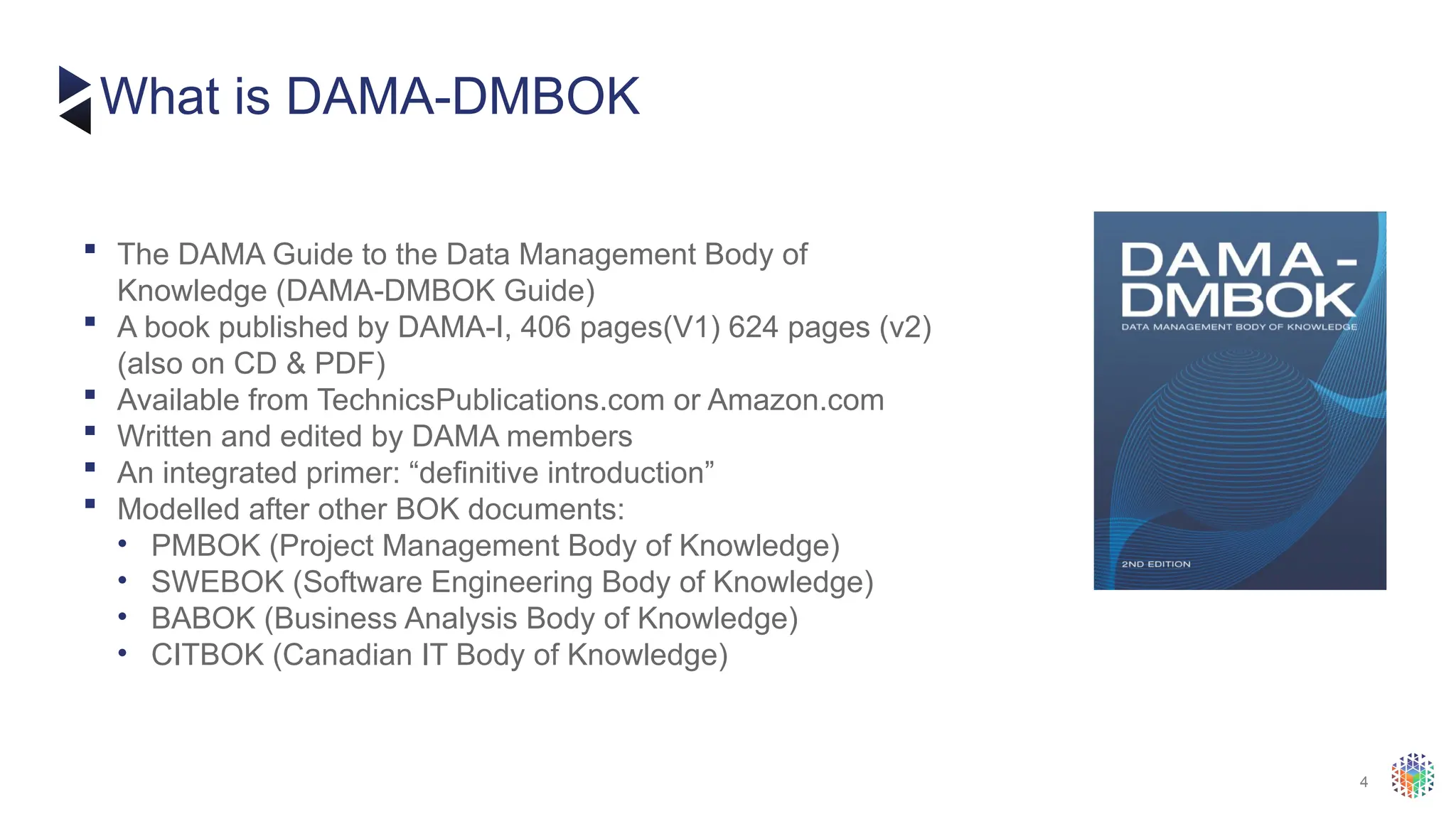
 The DAMA Guide to the Data Management Body of
Knowledge (DAMA-DMBOK Guide)
 A book published by DAMA-I, 406 pages(V1) 624 pages (v2)
(also on CD & PDF)
 Available from TechnicsPublications.com or Amazon.com
 Written and edited by DAMA members
 An integrated primer: “definitive introduction”
 Modelled after other BOK documents:
• PMBOK (Project Management Body of Knowledge)
• SWEBOK (Software Engineering Body of Knowledge)
• BABOK (Business Analysis Body of Knowledge)
• CITBOK (Canadian IT Body of Knowledge)
What is DAMA-DMBOK
5
 Develop, build consensus and foster adoption for a generally
 Accepted view of data management.
 Provide standard definitions for data management functions, roles,
deliverables and other common terminology.
 Identify “guiding principles”.
 Introduce widely adopted practices, methods and techniques, without
references to products and vendors.
 Identify common organisational and cultural issues.
 Guide readers to additional resources.
DAMA DMBOK Goals
6
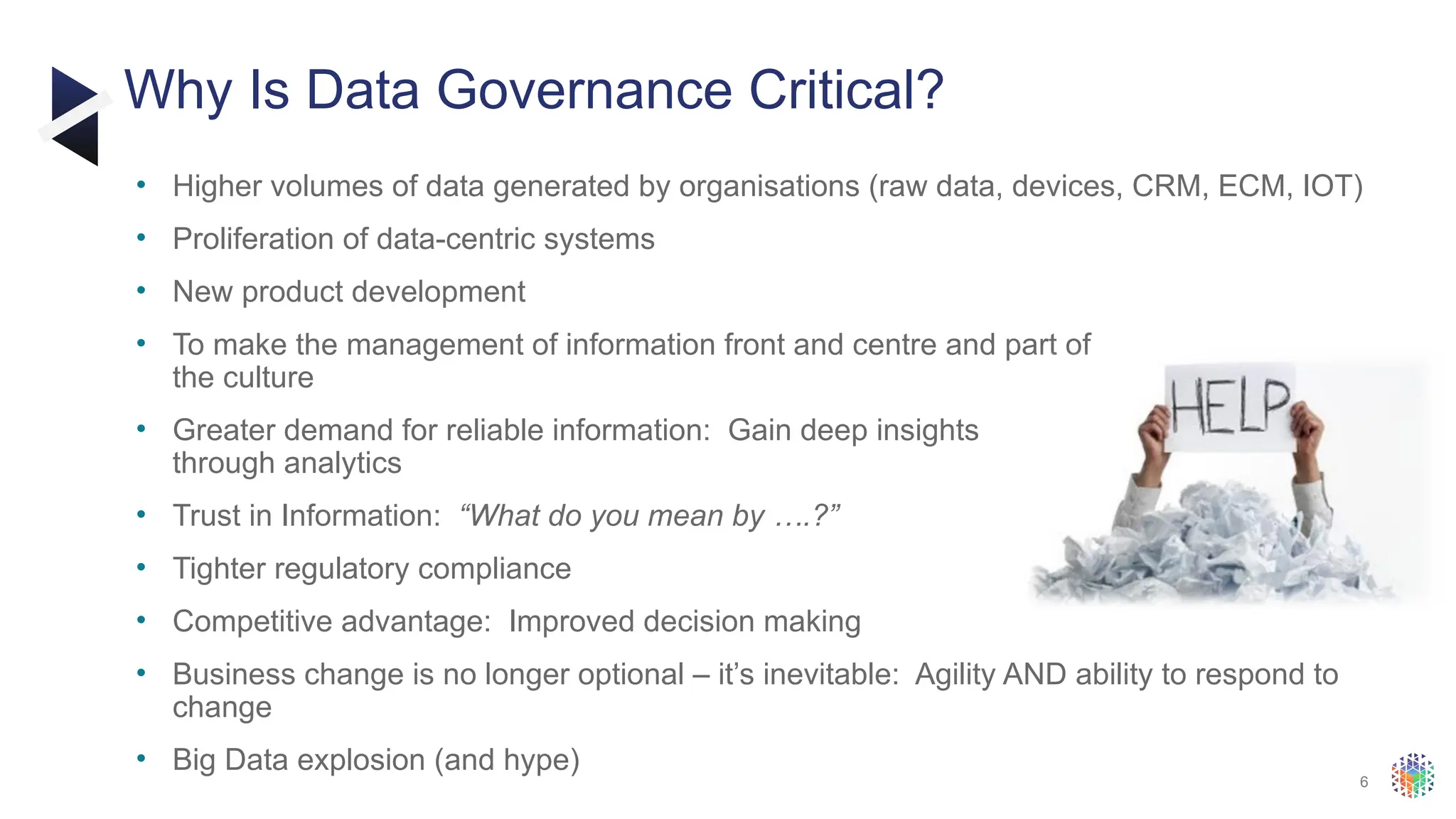
• Higher volumes of data generated by organisations (raw data, devices, CRM, ECM, IOT)
• Proliferation of data-centric systems
• New product development
• To make the management of information front and centre and part of
the culture
• Greater demand for reliable information: Gain deep insights
through analytics
• Trust in Information: “What do you mean by ….?”
• Tighter regulatory compliance
• Competitive advantage: Improved decision making
• Business change is no longer optional – it’s inevitable: Agility AND ability to respond to
change
• Big Data explosion (and hype)
Why Is Data Governance Critical?
7
​
The Design & Execution Of Standards & Policies Covering …
 Design and operation of a management system to assure that data delivers
value and is not a cost
 Who can do what to the organisation’s data and how
 Ensuring standards are set and met
 A strategic & high level view across the whole organisation
What is Data Governance?
The Exercise of Authority and control, Planning, Monitoring, and Enforcement over the
management of data assets. (Dama International)
8
The Design & Execution Of Standards & Policies Covering …
• Design and operation of a management system to assure that data delivers value
and is not a cost
• Who can do what to the organisation’s data and how
• Ensuring standards are set and met
• A strategic & high level view across the whole organisation
To Ensure …
Key principles/processes of effective Information Management are put into practice
Continual improvement through the evolution of an Information Management strategy
Data Governance Is NOT …
• A “one off” Tactical management exercise
• The responsibility of the Technology and IT department alone
What is Data Governance?
The Exercise of Authority and control, Planning, Monitoring, and Enforcement over the
management of data assets. (Dama International)
9
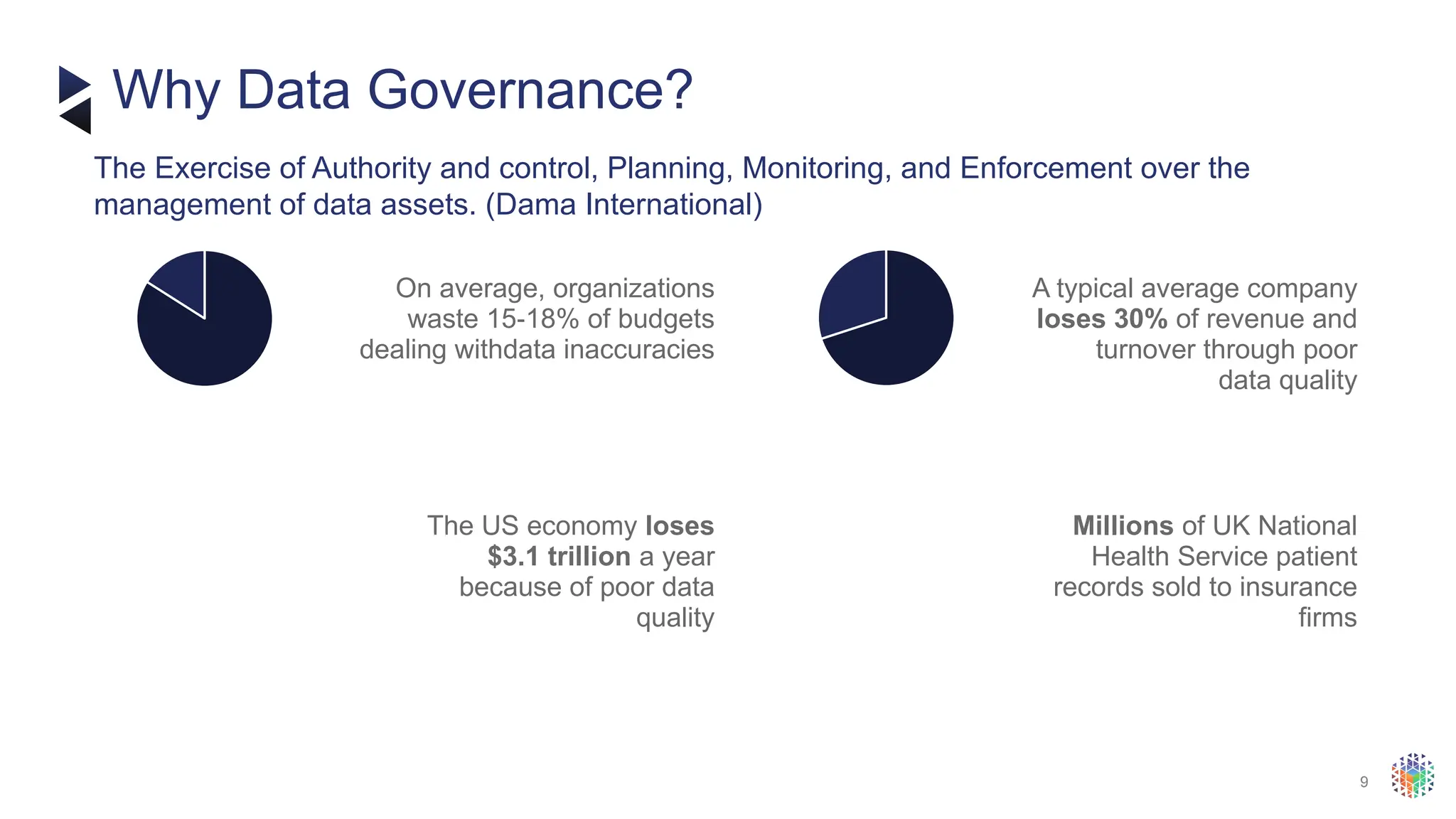
Why Data Governance?
The Exercise of Authority and control, Planning, Monitoring, and Enforcement over the
management of data assets. (Dama International)
On average, organizations
waste 15 18% of budgets
‐
dealing withdata inaccuracies
A typical average company
loses 30% of revenue and
turnover through poor
data quality
The US economy loses
$3.1 trillion a year
because of poor data
quality
Millions of UK National
Health Service patient
records sold to insurance
firms
10
10
Information that is Trusted and Fit to Purpose
• Assurance and evidence that data is
managed effectively reduces regulatory
compliance risk and improves confidence in
operational and management decisions
• Known individuals, their responsibilities and
escalation route reduces the time and
effort to resolve data issues
• Improved opportunity to rapidly and
effectively exploit information for customer
insights and competitive advantage
• Increased agility and capability to respond
to change and events faster through joint
understanding across users and IT
• Reduced system design and integration
effort
• Reduced risk of departmental silos and
duplication leading to reconciliation effort
and argument
Overview of data governance and its role
11
Exercis
e
For each of 5 DG Maturity levels:
1. Assess where you believe Your Company
currently sits
2. What are the most important Data Governance
issues to be addressed
12
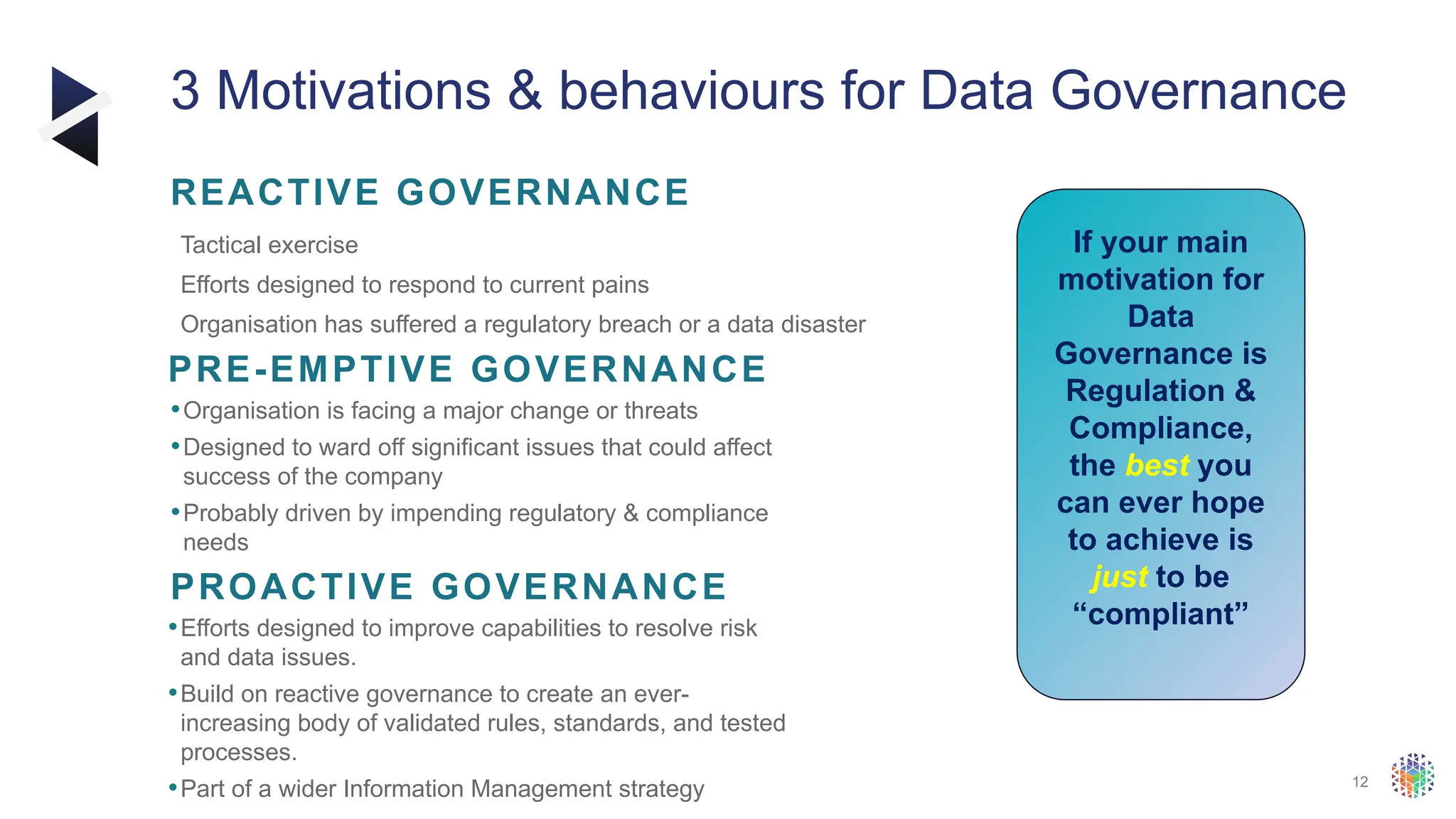
3 Motivations & behaviours for Data Governance
​ Tactical exercise
​ Efforts designed to respond to current pains
​ Organisation has suffered a regulatory breach or a data disaster
REACTIVE GOVERNANCE
•Organisation is facing a major change or threats
•Designed to ward off significant issues that could affect
success of the company
•Probably driven by impending regulatory & compliance
needs
PRE-EMPTIVE GOVERNANCE
•Efforts designed to improve capabilities to resolve risk
and data issues.
•Build on reactive governance to create an ever-
increasing body of validated rules, standards, and tested
processes.
•Part of a wider Information Management strategy
PROACTIVE GOVERNANCE
If your main
motivation for
Data
Governance is
Regulation &
Compliance,
the best you
can ever hope
to achieve is
just to be
“compliant”
13
Drivers for Data Governance
1. Global operations are typically complex, disparate and
often inefficient in their approaches to information
management (IM).
2. Shared and / or critical information is siloed & this siloed
information impairs enterprise level reporting, decision-
making and performance optimization
3. Aggregated information is required by certain business
functions, but is not readily available
4. Business and IT neither talk the same language, nor have a
common understanding about information management,
causing a considerable knowledge gap to exist with
regards to critical data elements for the enterprise.
5. Information management budgets and program focuses are
siloed, often inside individual projects with no enterprise
scope.
6. Enterprise wide information lacks semantic consistency
(meaning & definition).
7. The information management needs of multiple “owners”
across the enterprise must be rationalized.
8. Decentralized IT organizations operate independently
within individual business unit, adding complexity and
challenge.
9. Business perceives IT as being insufficiently agile to meet
ad hoc information needs.
10. If even discussed, Business and IT can’t agree who
actually “owns” the data.
11. Data context is critical to consumers, but often lacking.
12. Operationalization of information management projects at
the enterprise level is a difficult challenge.
13. Regulation & compliance make effective information
management no longer optional.
14. Data quality must be operationalized across the entire
organization to assure the usefulness of the information
that business users consume.
15. Organisations need to become information-centric
enterprises.
16. Successful transformation of an organization into an
information-centric enterprise requires a designated
champion from senior management to educate and guide
the company in operationalizing strategic data plans.
17. Strategic thinking and decision-making is needed on the
issue of whether data should be centralized or distributed.
14
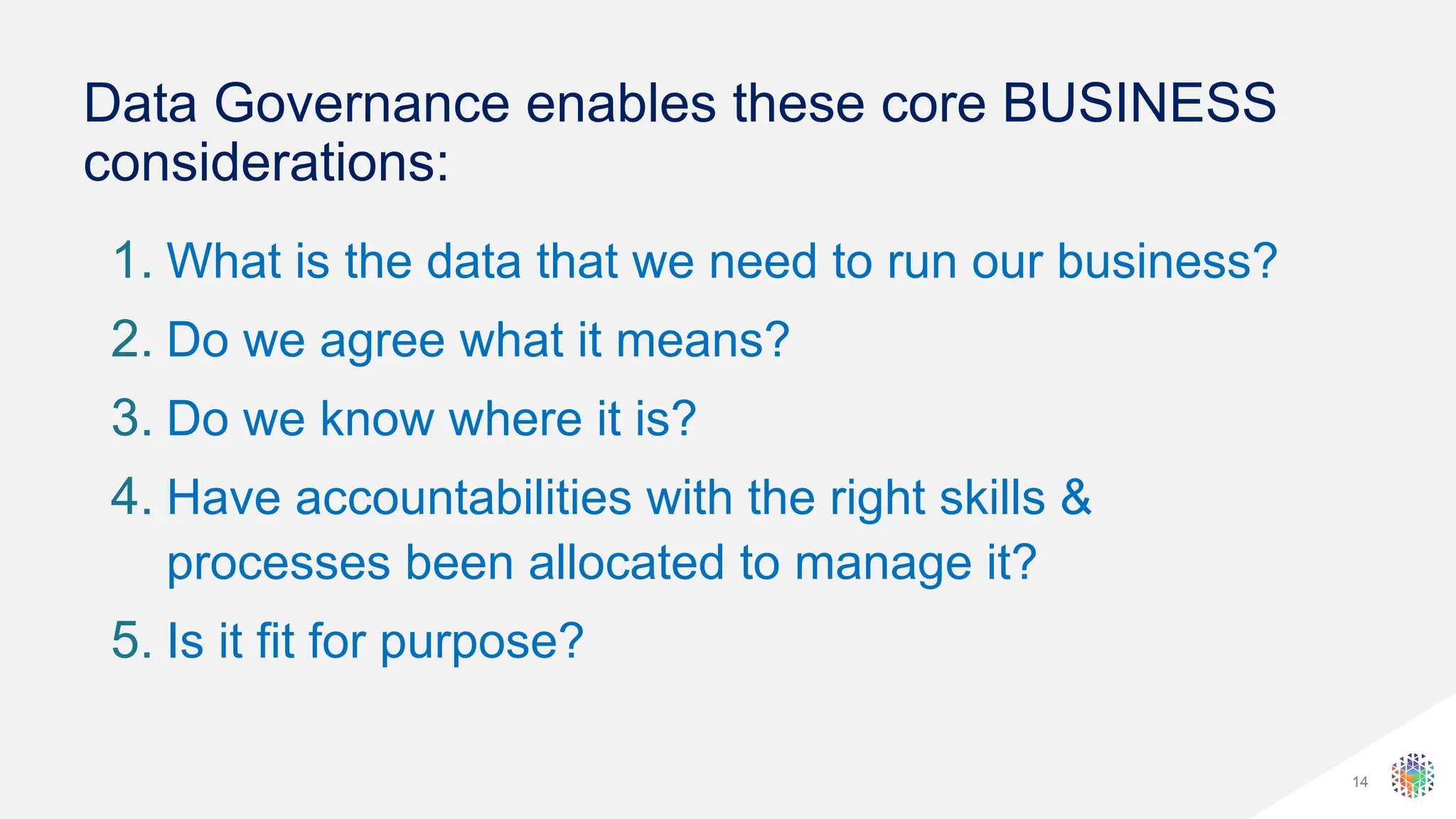
Data Governance enables these core BUSINESS
considerations:
1. What is the data that we need to run our business?
2. Do we agree what it means?
3. Do we know where it is?
4. Have accountabilities with the right skills &
processes been allocated to manage it?
5. Is it fit for purpose?
15
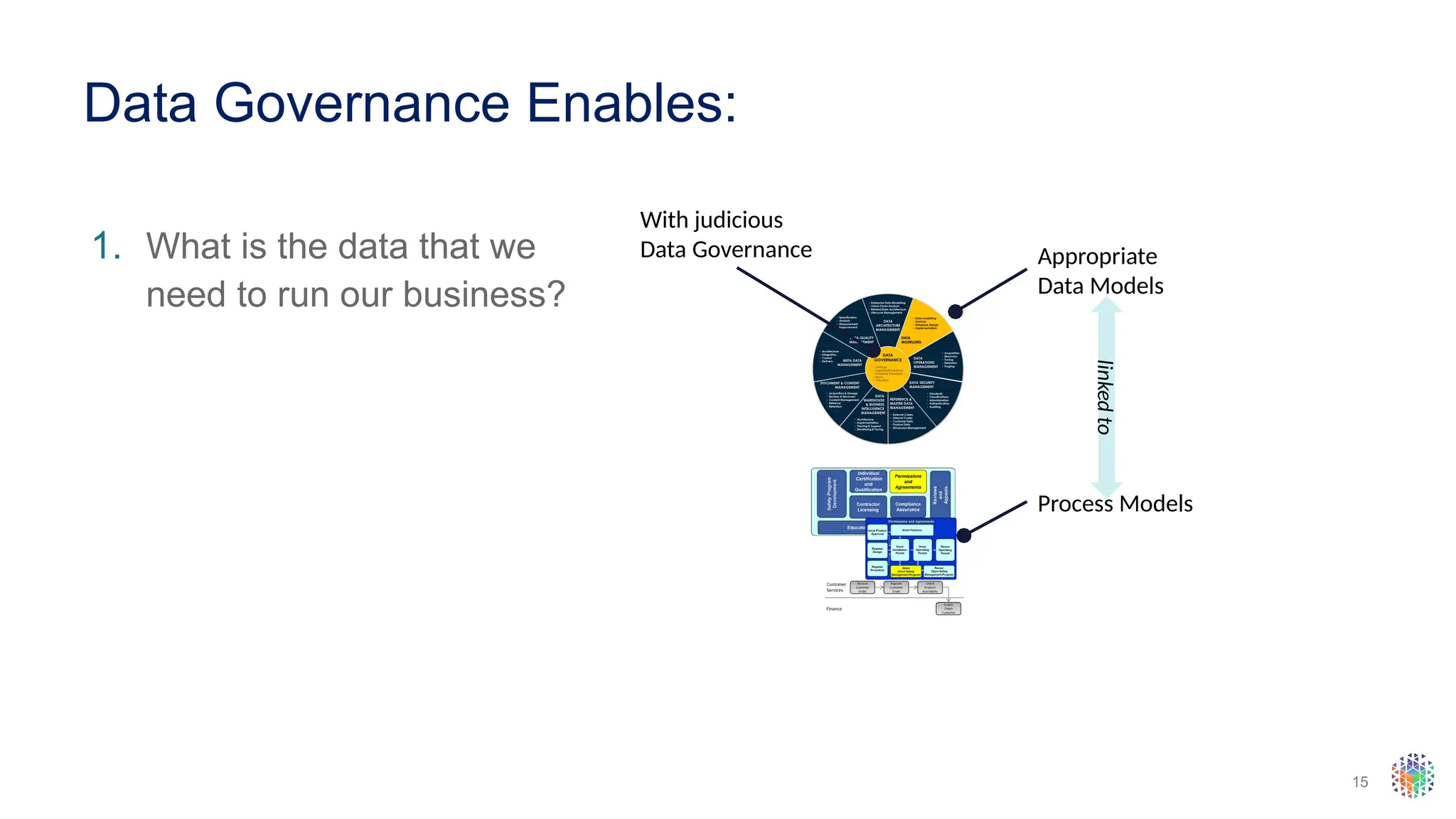
Data Governance Enables:
1. What is the data that we
need to run our business?
Appropriate
Data Models
Process Models
With judicious
Data Governance
linked
to
16
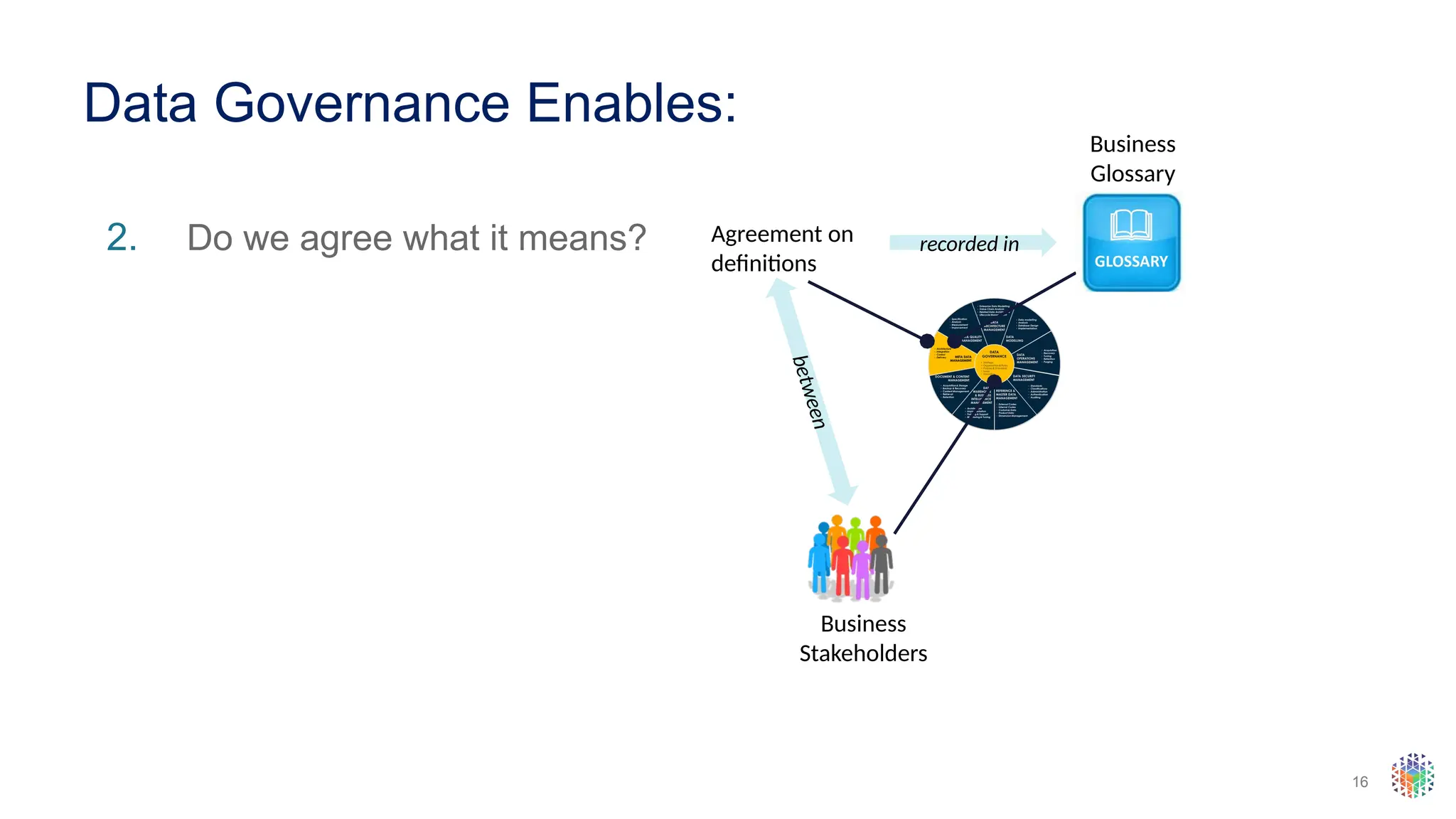
Data Governance Enables:
2. Do we agree what it means? Agreement on
definitions
Business
Stakeholders
b
e
t
w
e
e
n
recorded in
Business
Glossary
17
Data Governance Enables:
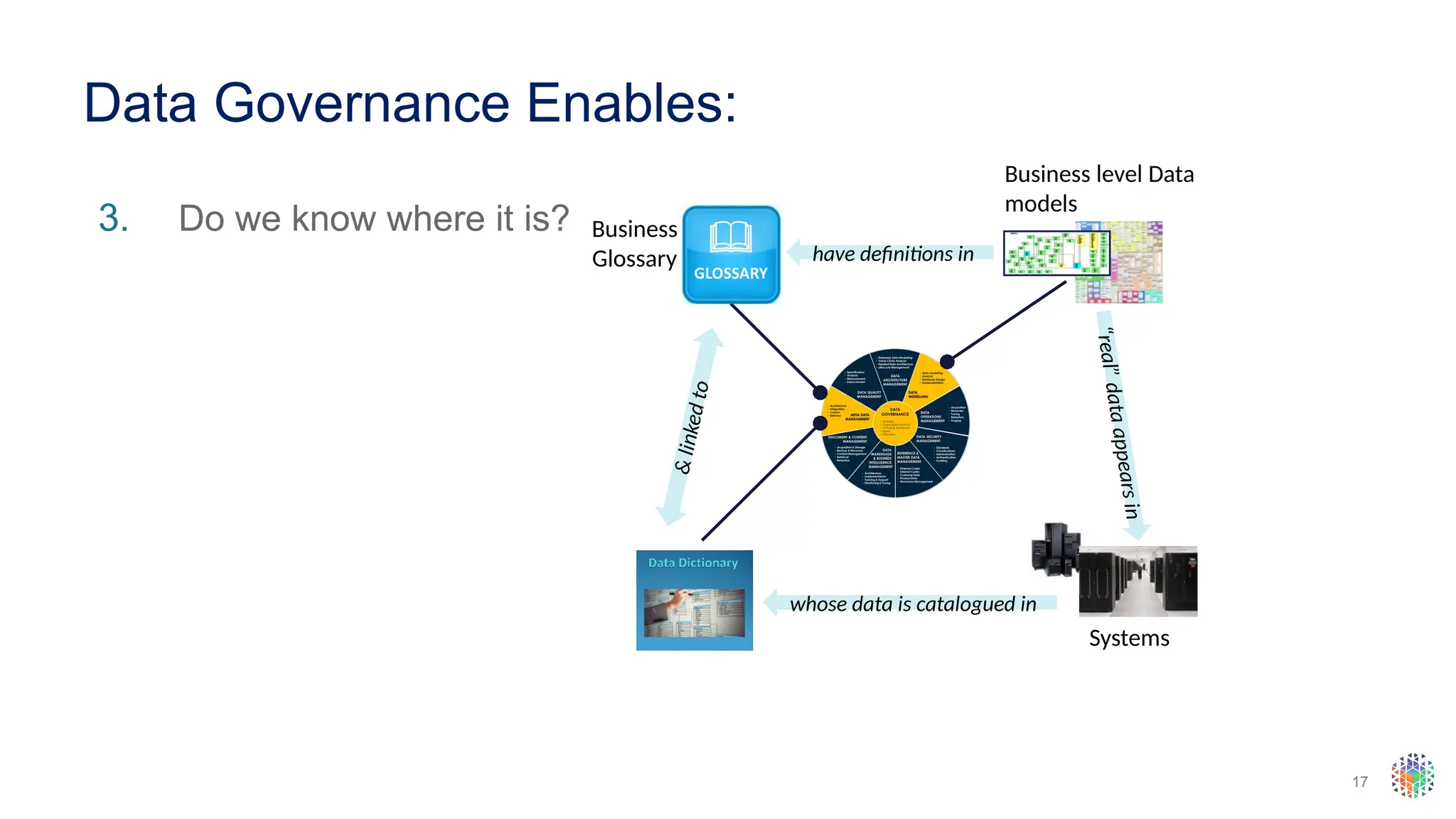
3. Do we know where it is?
Systems
“
r
e
a
l
”
d
a
t
a
a
p
p
e
a
r
s
i
n
Business level Data
models
whose data is catalogued in
have definitions in
&
l
i
n
k
e
d
t
o
Business
Glossary
18
Data Governance Enables:
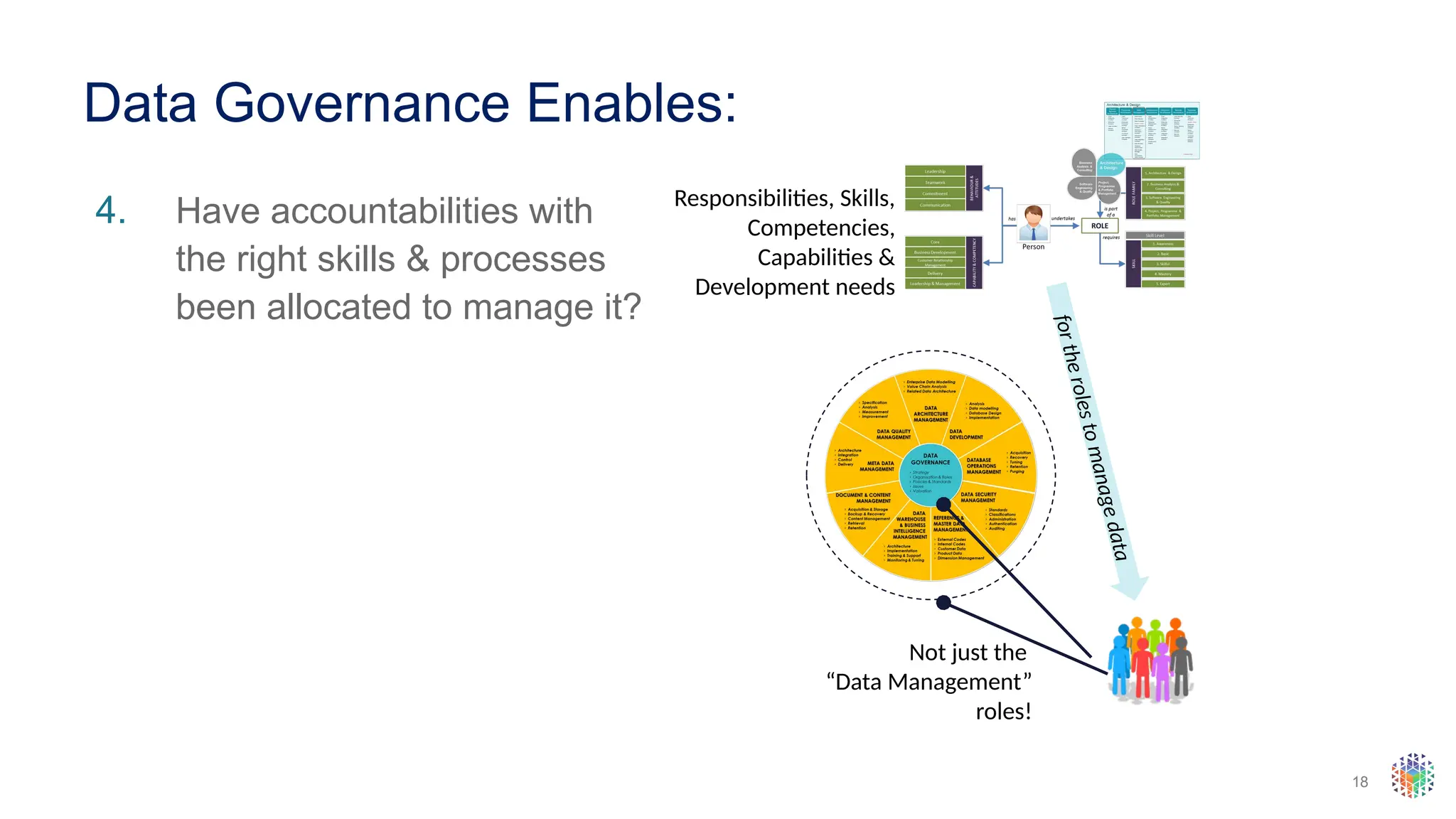
4. Have accountabilities with
the right skills & processes
been allocated to manage it?
Responsibilities, Skills,
Competencies,
Capabilities &
Development needs
f
o
r
t
h
e
r
o
l
e
s
t
o
m
a
n
a
g
e
d
a
t
a
Not just the
“Data Management”
roles!
19
Data Governance Enables:
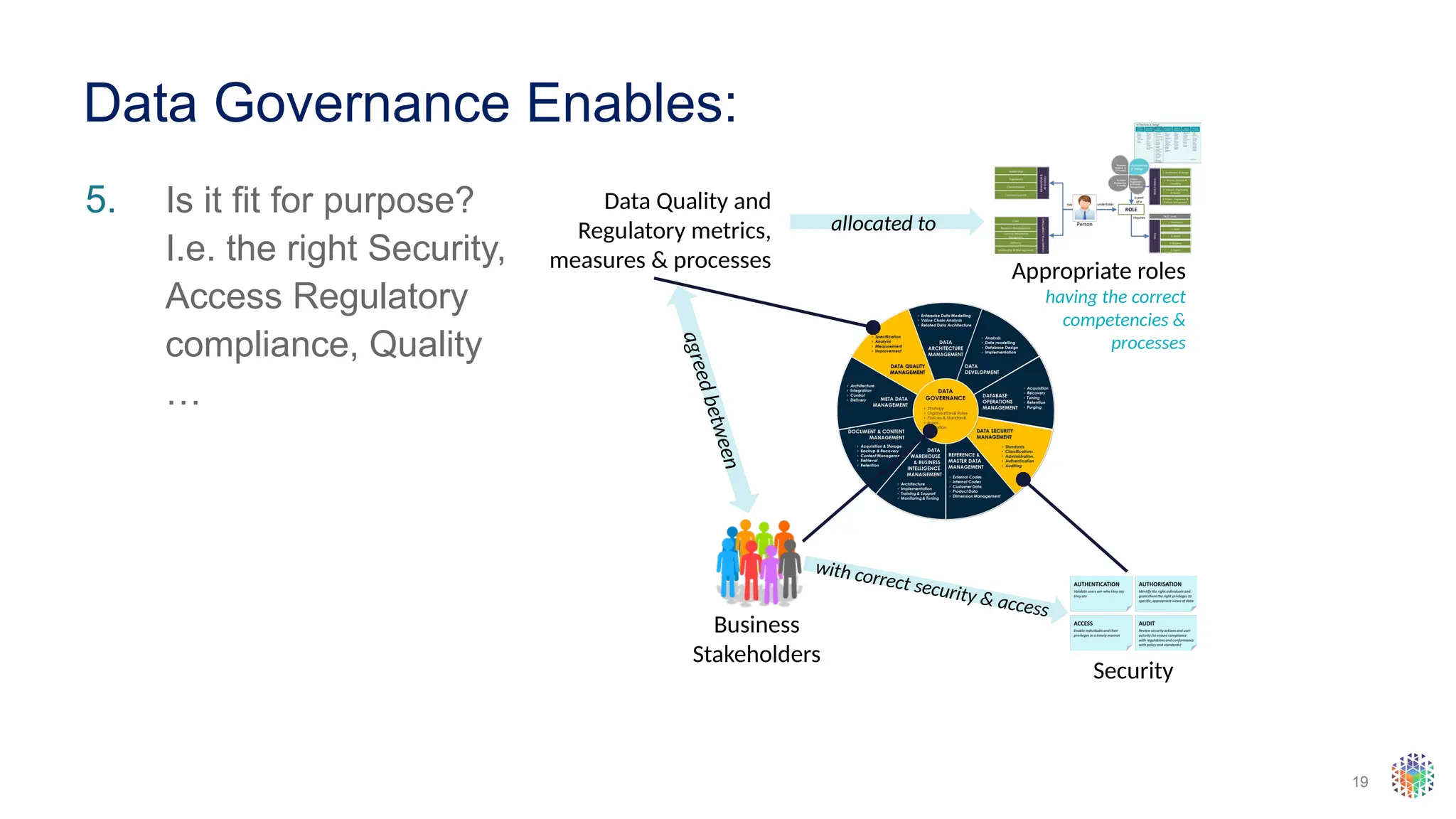
5. Is it fit for purpose?
I.e. the right Security,
Access Regulatory
compliance, Quality
…
Data Quality and
Regulatory metrics,
measures & processes
Business
Stakeholders
a
g
r
e
e
d
b
e
t
w
e
e
n
allocated to
Appropriate roles
having the correct
competencies &
processes
with correct security & access
Security
20
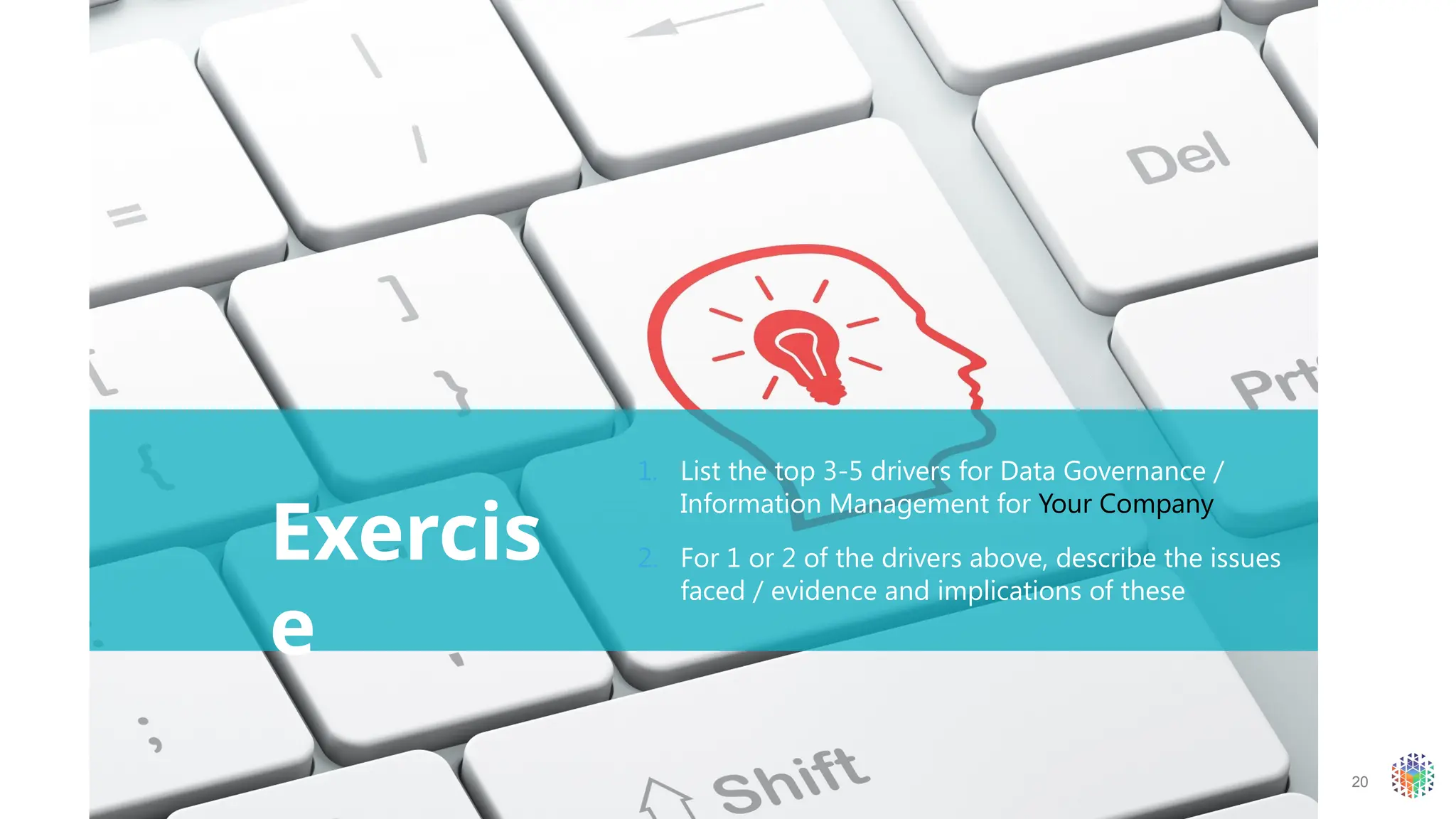
Exercis
e
1. List the top 3-5 drivers for Data Governance /
Information Management for Your Company
2. For 1 or 2 of the drivers above, describe the issues
faced / evidence and implications of these
21
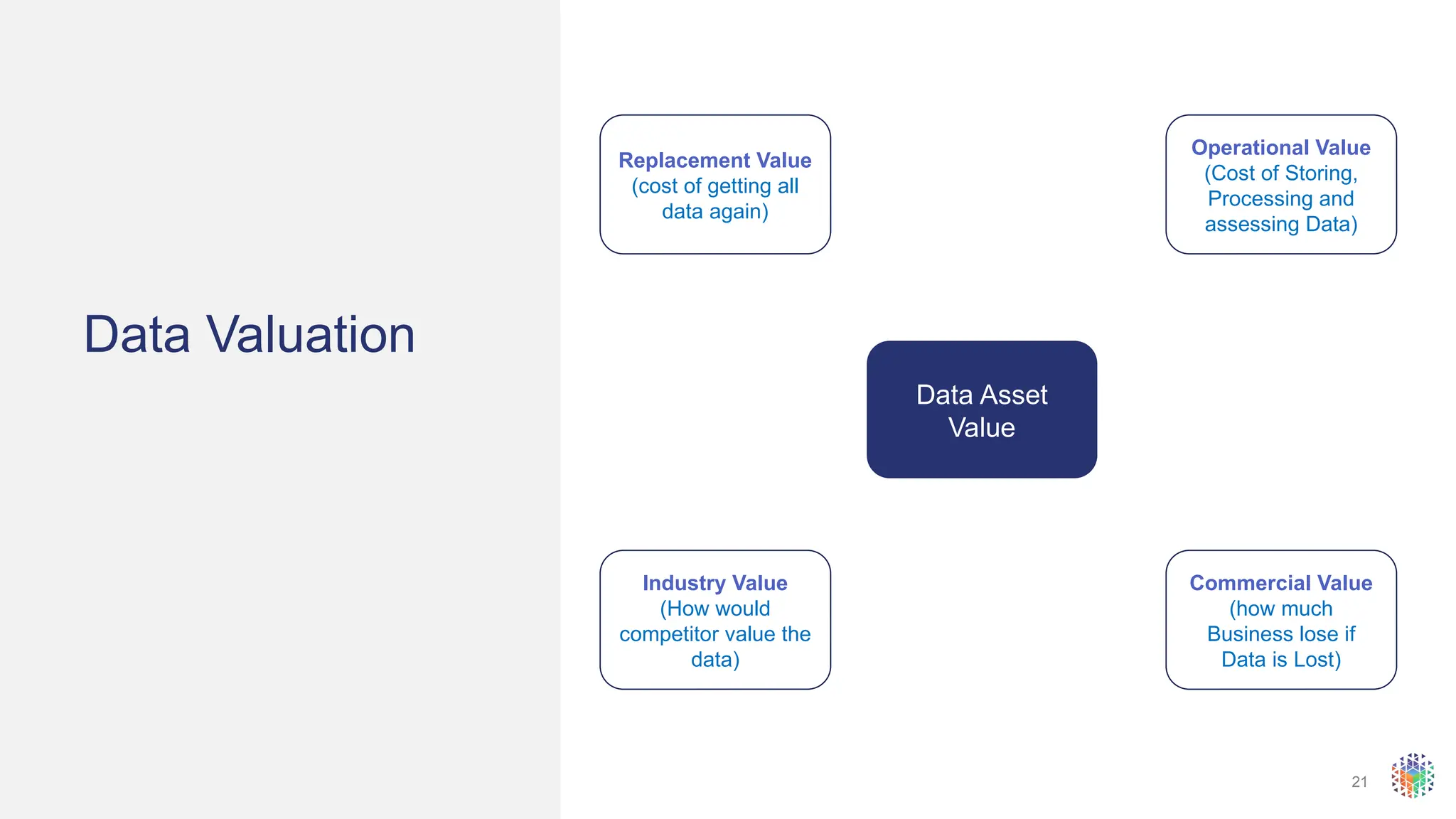
Data Valuation
Data Asset
Value
Operational Value
(Cost of Storing,
Processing and
assessing Data)
Industry Value
(How would
competitor value the
data)
Replacement Value
(cost of getting all
data again)
Commercial Value
(how much
Business lose if
Data is Lost)
22
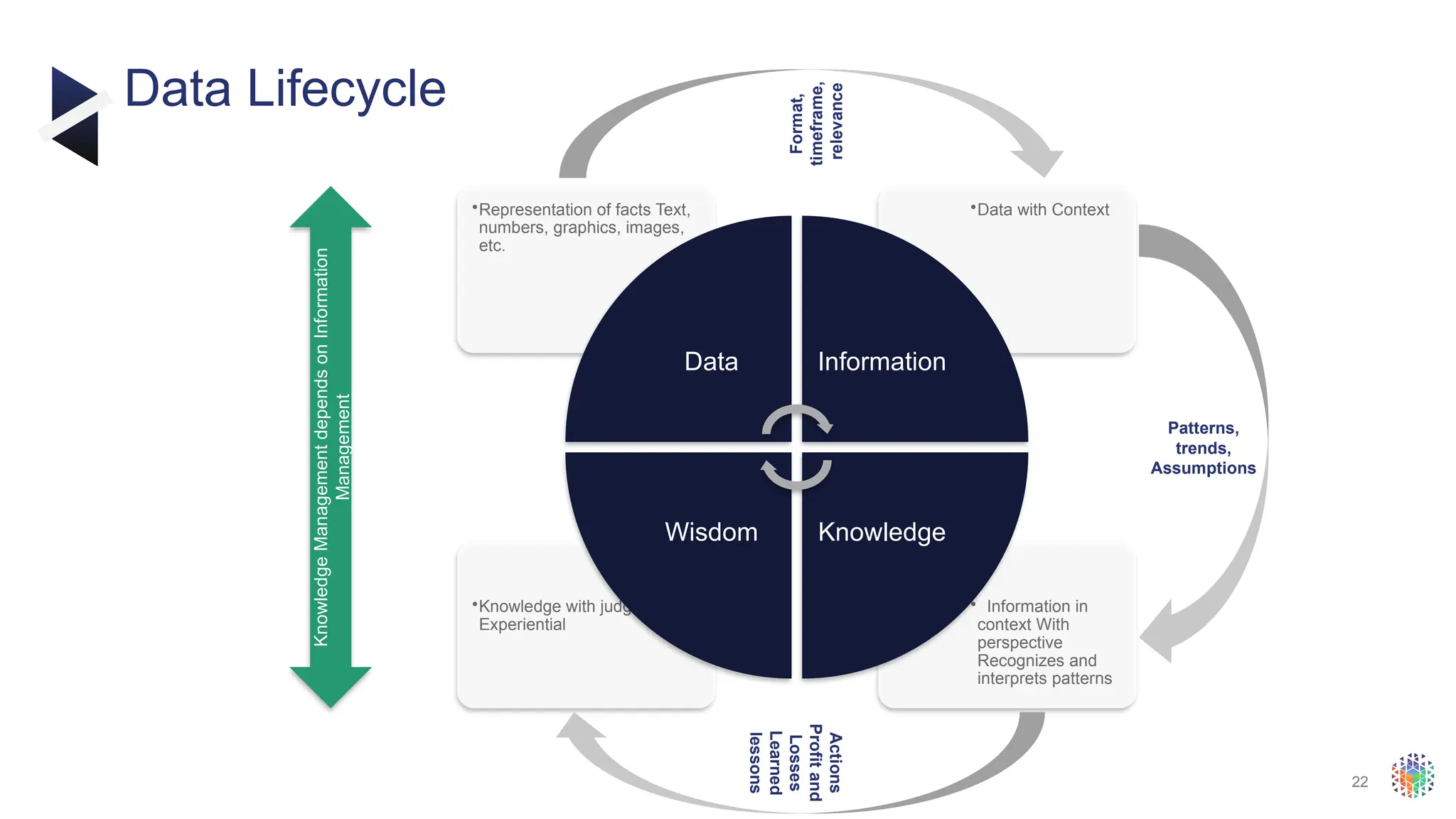
Data Lifecycle
• Information in
context With
perspective
Recognizes and
interprets patterns
•Knowledge with judgement
Experiential
•Data with Context
•Representation of facts Text,
numbers, graphics, images,
etc.
Data Information
Knowledge
Wisdom
Format,
timeframe,
relevance
Patterns,
trends,
Assumptions
Actions
Profit
and
Losses
Learned
lessons
Knowledge
Management
depends
on
Information
Management
23
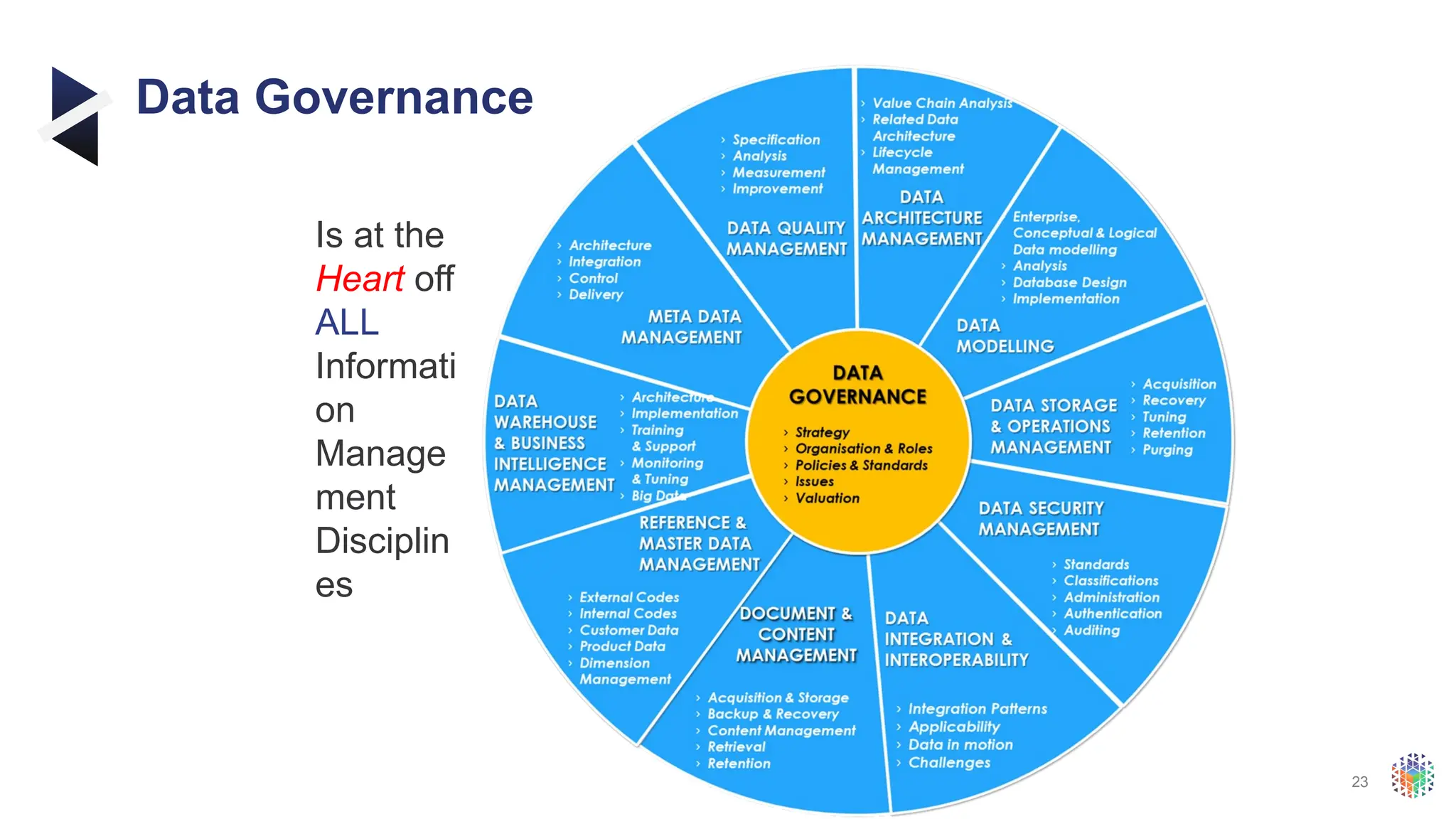
Data Governance
Is at the
Heart off
ALL
Informati
on
Manage
ment
Disciplin
es
24
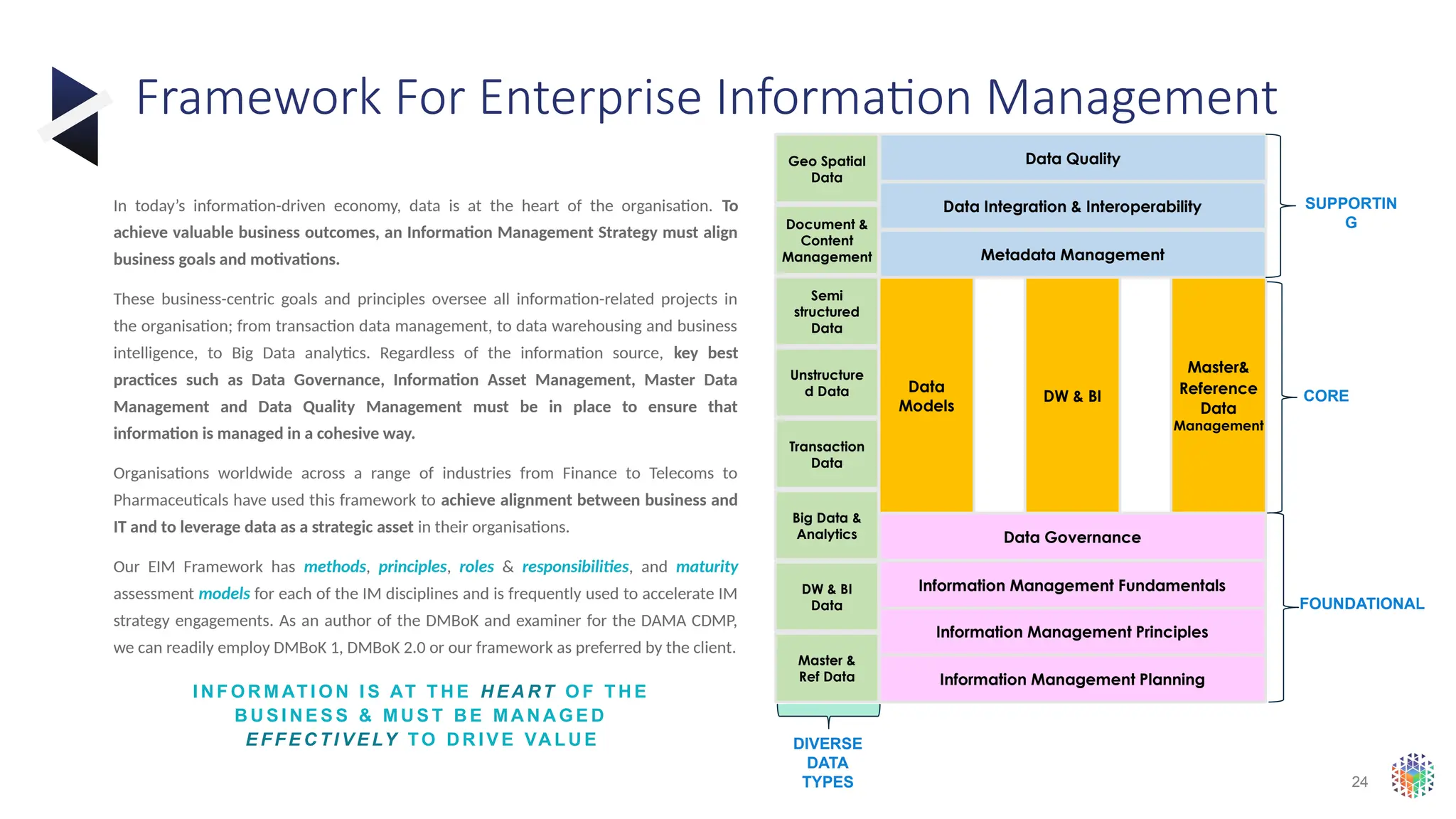
Framework For Enterprise Information Management
​
In today’s information-driven economy, data is at the heart of the organisation. To
achieve valuable business outcomes, an Information Management Strategy must align
business goals and motivations.
​
These business-centric goals and principles oversee all information-related projects in
the organisation; from transaction data management, to data warehousing and business
intelligence, to Big Data analytics. Regardless of the information source, key best
practices such as Data Governance, Information Asset Management, Master Data
Management and Data Quality Management must be in place to ensure that
information is managed in a cohesive way.
​
Organisations worldwide across a range of industries from Finance to Telecoms to
Pharmaceuticals have used this framework to achieve alignment between business and
IT and to leverage data as a strategic asset in their organisations.
​
Our EIM Framework has methods, principles, roles & responsibilities, and maturity
assessment models for each of the IM disciplines and is frequently used to accelerate IM
strategy engagements. As an author of the DMBoK and examiner for the DAMA CDMP,
we can readily employ DMBoK 1, DMBoK 2.0 or our framework as preferred by the client.
I N F O R M AT I O N I S AT T H E H E A RT O F T H E
B U S I N E S S & M U S T B E MA N A G E D
E F F E C T I V E LY TO D R I V E VA L U E
Data
Models
DW & BI
Master&
Reference
Data
Management
Information Management Principles
Information Management Fundamentals
Data Governance
Metadata Management
Data Integration & Interoperability
Data Quality
Information Management Planning
SUPPORTIN
G
CORE
FOUNDATIONAL
DIVERSE
DATA
TYPES
Master &
Ref Data
DW & BI
Data
Big Data &
Analytics
Transaction
Data
Unstructure
d Data
Semi
structured
Data
Document &
Content
Management
Geo Spatial
Data
25
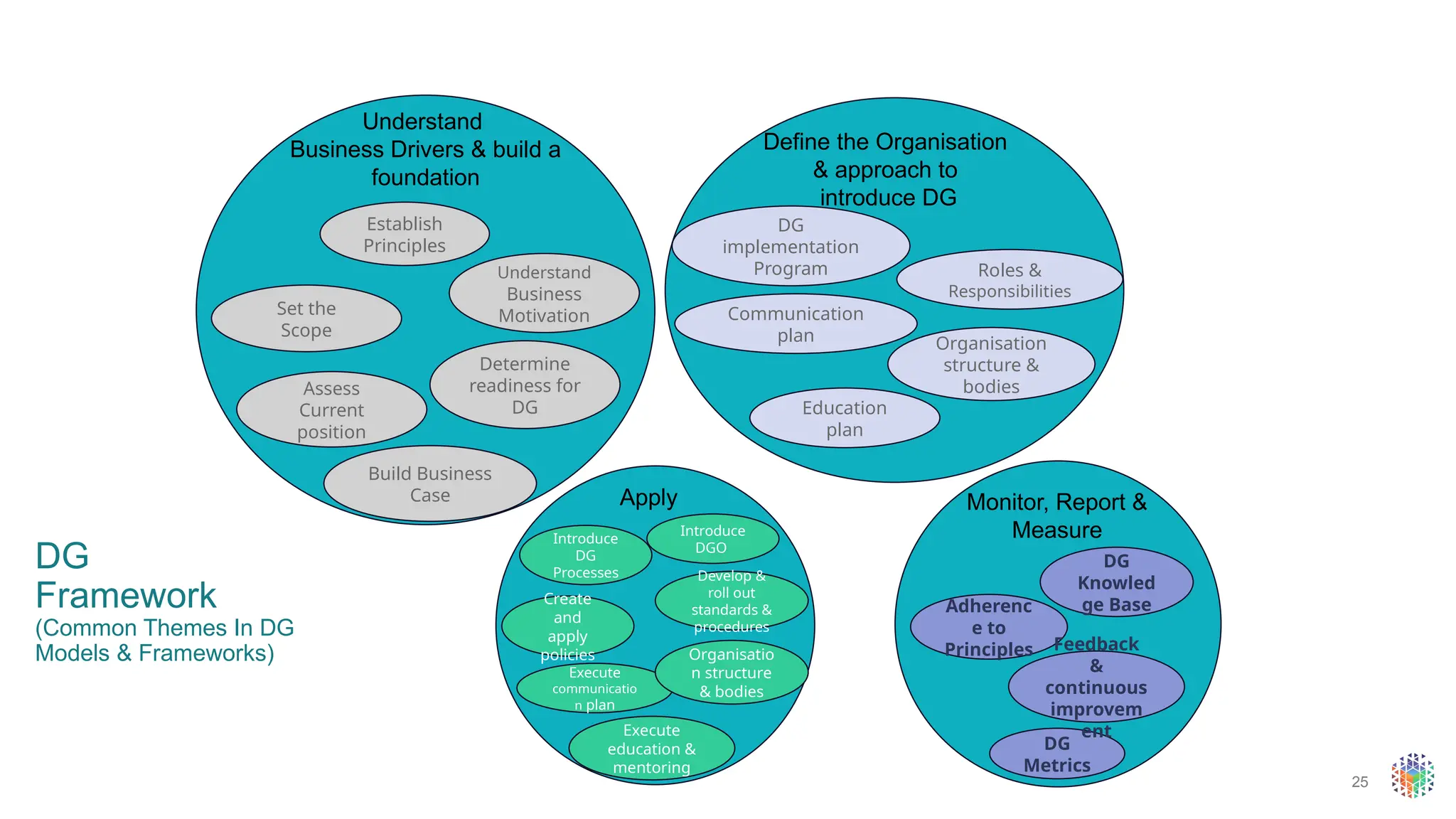
Understand
Business Drivers & build a
foundation
Set the
Scope
Assess
Current
position
Determine
readiness for
DG
Build Business
Case
Understand
Business
Motivation
Define the Organisation
& approach to
introduce DG
DG
implementation
Program
Communication
plan Organisation
structure &
bodies
Education
plan
Roles &
Responsibilities
Apply
Create
and
apply
policies
Execute
communicatio
n plan
Organisatio
n structure
& bodies
Execute
education &
mentoring
Develop &
roll out
standards &
procedures
Introduce
DG
Processes
Introduce
DGO
Establish
Principles
Monitor, Report &
Measure
Adherenc
e to
Principles
DG
Metrics
Feedback
&
continuous
improvem
ent
DG
Knowled
ge Base
DG
Framework
(Common Themes In DG
Models & Frameworks)
26
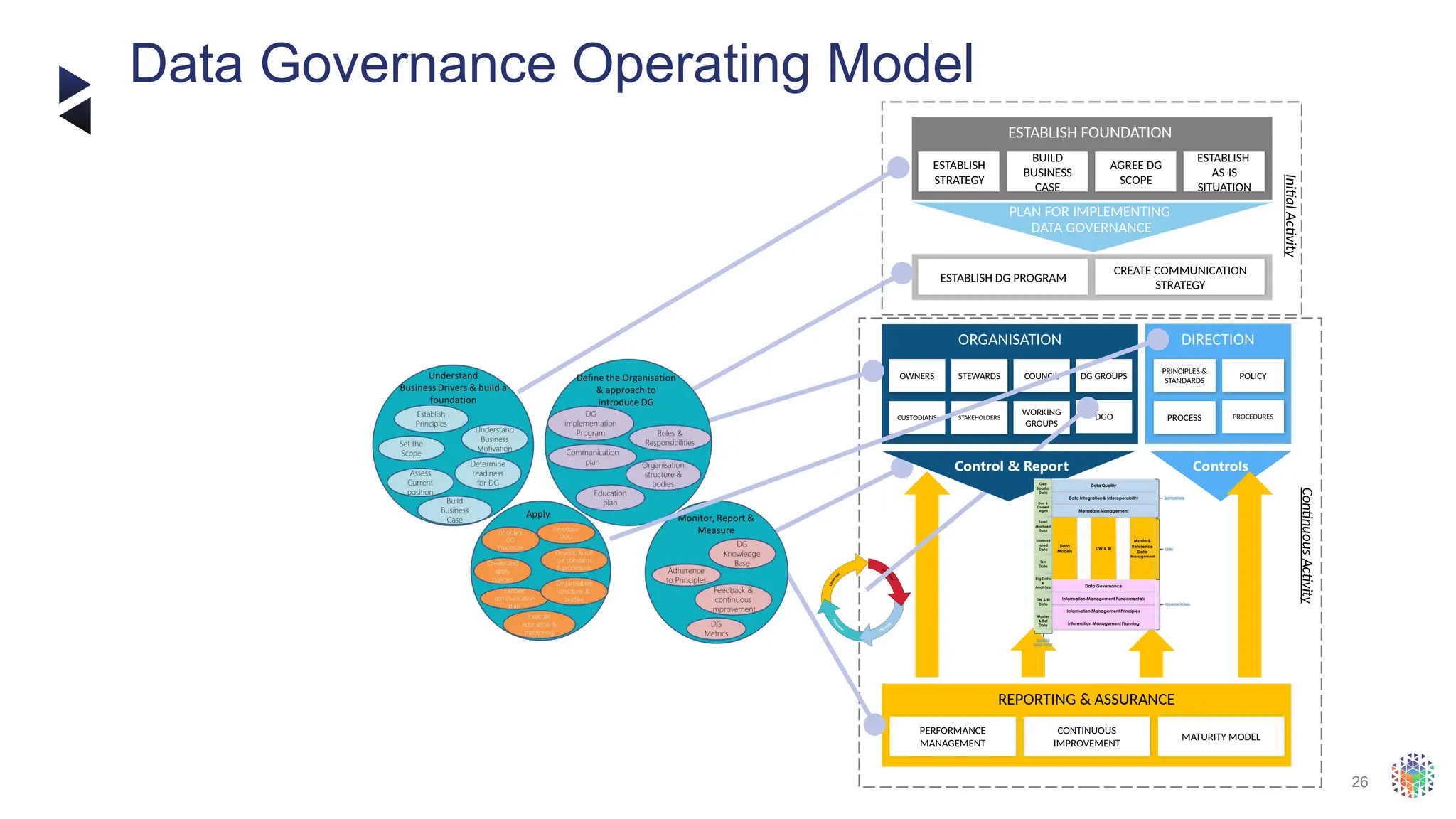
Data Governance Operating Model
ESTABLISH FOUNDATION
ESTABLISH
STRATEGY
BUILD
BUSINESS
CASE
AGREE DG
SCOPE
ESTABLISH
AS-IS
SITUATION
ESTABLISH DG PROGRAM
CREATE COMMUNICATION
STRATEGY
ORGANISATION
OWNERS STEWARDS
CUSTODIANS STAKEHOLDERS
COUNCIL DG GROUPS
WORKING
GROUPS
DGO
DIRECTION
PRINCIPLES &
STANDARDS
POLICY
PROCESS PROCEDURES
Controls
REPORTING & ASSURANCE
PERFORMANCE
MANAGEMENT
CONTINUOUS
IMPROVEMENT
MATURITY MODEL
Continuous
Activity
Initial
Activity
PLAN FOR IMPLEMENTING
DATA GOVERNANCE
Control & Report
27
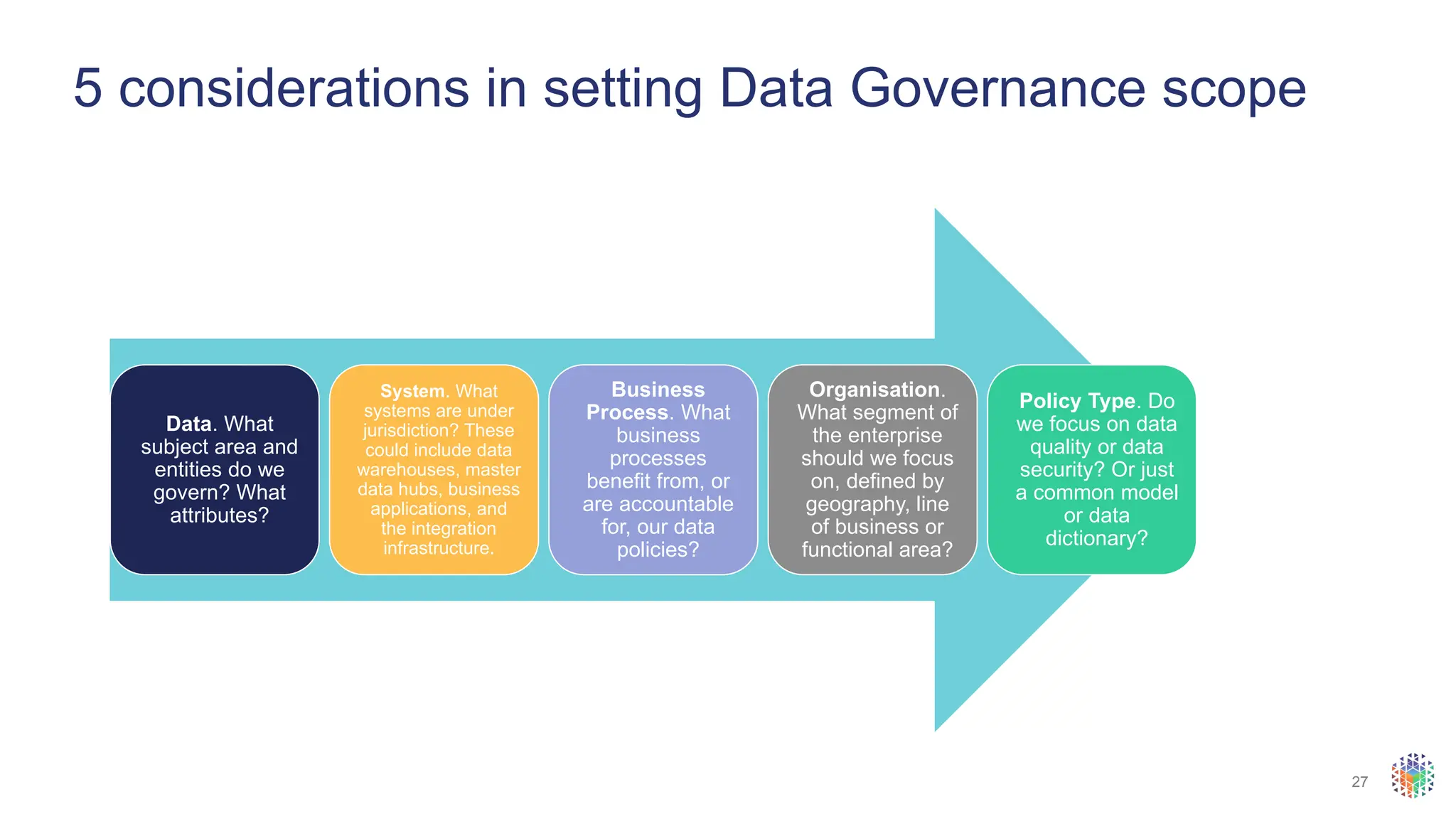
5 considerations in setting Data Governance scope
Data. What
subject area and
entities do we
govern? What
attributes?
System. What
systems are under
jurisdiction? These
could include data
warehouses, master
data hubs, business
applications, and
the integration
infrastructure.
Business
Process. What
business
processes
benefit from, or
are accountable
for, our data
policies?
Organisation.
What segment of
the enterprise
should we focus
on, defined by
geography, line
of business or
functional area?
Policy Type. Do
we focus on data
quality or data
security? Or just
a common model
or data
dictionary?
28
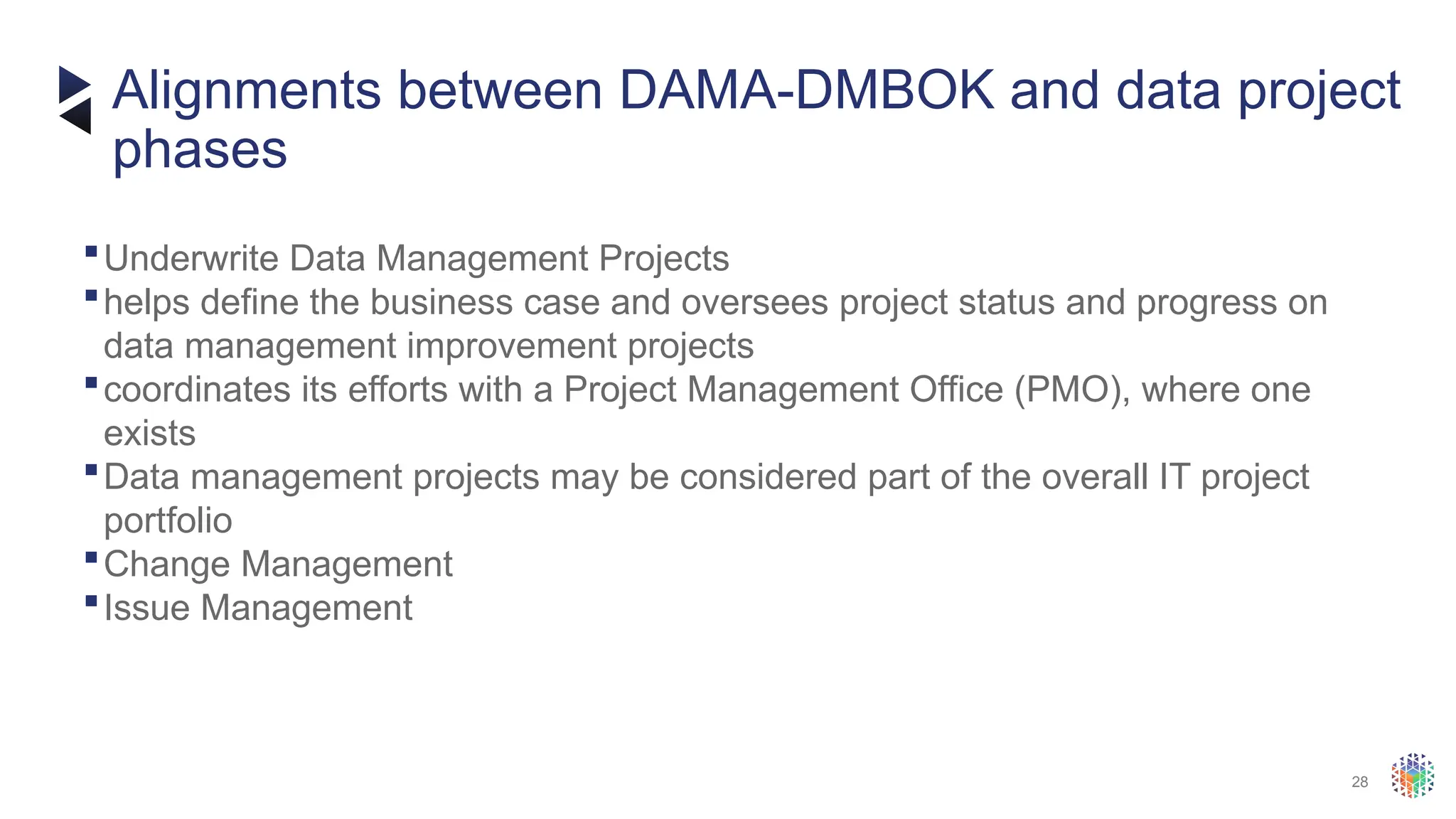
Underwrite Data Management Projects
helps define the business case and oversees project status and progress on
data management improvement projects
coordinates its efforts with a Project Management Office (PMO), where one
exists
Data management projects may be considered part of the overall IT project
portfolio
Change Management
Issue Management
Alignments between DAMA-DMBOK and data project
phases
29
 Collaborative analytics or building new data products
 Data privacy compliance
 Data discovery and data literacy provisions
 Create a centralized repository of all standardized business terms
 Centralized data access management
Real-world projects using data governance frameworks
30
Definition:The exercise of authority, control, and shared decision-making (planning,
monitoring, and enforcement) over the management of data assets.
Goals:
1. Enable an organization to manage its data as an asset.
2. Define, approve, communicate, and implement principles, policies, procedures, metrics, tools, and
responsibilities for data management.
3. Monitor and guide policy compliance, data usage, and management activities.
Activities:
1. Define Data Governance for the
Organization (P)
1.Develop Data Governance Strategy
2. Perform Readiness Assessment
3. Perform Discovery and Business Alignment
4. Develop OrganizationalTouchpoints
2. Define the Data Governance Strategy (P)
1. Define the Data Governance Operating
Framework
2. Develop Goals, Principles, and Policies
3. Underwrite Data Management Projects
4. Engage Change Management
5. Engage in Issue Management
6.Assess Regulatory Compliance
Requirements
3. Implement Data Governance (O)
1. Sponsor Data Standards and Procedures
2. Develop a Business Glossary
3. Co-ordinate with Architecture Groups
4. Sponsor Data AssetValuation
4. Embed Data Governance (C,O)
Inputs:
• Business
Strategies &
Goals
• IT Strategies &
Goals
• Data
Management and
Data Strategies
• Organization
Policies &
Standards
• Business Culture
Assessment
• Data Maturity
Assessment
• IT Practices
• Regulatory
Requirements
Deliverables:
• Data Governance Strategy
• Data Strategy
• Business / Data
Governance Strategy
Roadmap
• Data Principles, Data
Governance Policies,
Processes
• Operating Framework
• Roadmap and
Implementation Strategy
• Operations Plan
• Business Glossary
• Data Governance
Scorecard
• Data GovernanceWebsite
• Communications Plan
• Recognized DataValue
• Maturing Data
Management Practices
Suppliers:
• Business Executives
• Data Stewards
• Data Owners
• Subject Matter Experts
• Maturity Assessors
• Regulators
• Enterprise Architects
Consumers:
• Data Governance Bodies
• Project Managers
• ComplianceTeam
• DM Communities of Interest
• DM Team
• Business Management
• Architecture Groups
• Partner Organizations
Participants:
• Steering Committees
• CIO
• CDO / Chief Data
Stewards
• Executive Data Stewards
• Coordinating Data
Stewards
• Business Data Stewards
• Data Governance Bodies
Techniques:
• Concise Messaging
• Contact List
• Logo
Tools:
• Websites
• Business Glossary Tools
• Workflow Tools
• Document Management Tools
• Data Governance Scorecards
Metrics:
• Compliance to
regulatory and internal
data policies.
• Value
• Effectiveness
• Sustainability
(P) Planning, (C) Control, (D) Development, (O) Operations
• ComplianceTeam
• DM Executives
• Change Managers
• Enterprise Data
Architects
• Project
Management Office
• Governance Bodies
• Audit
• Data Professionals
Technical
Drivers
Business
Drivers
Data Governance
and Stewardship
31
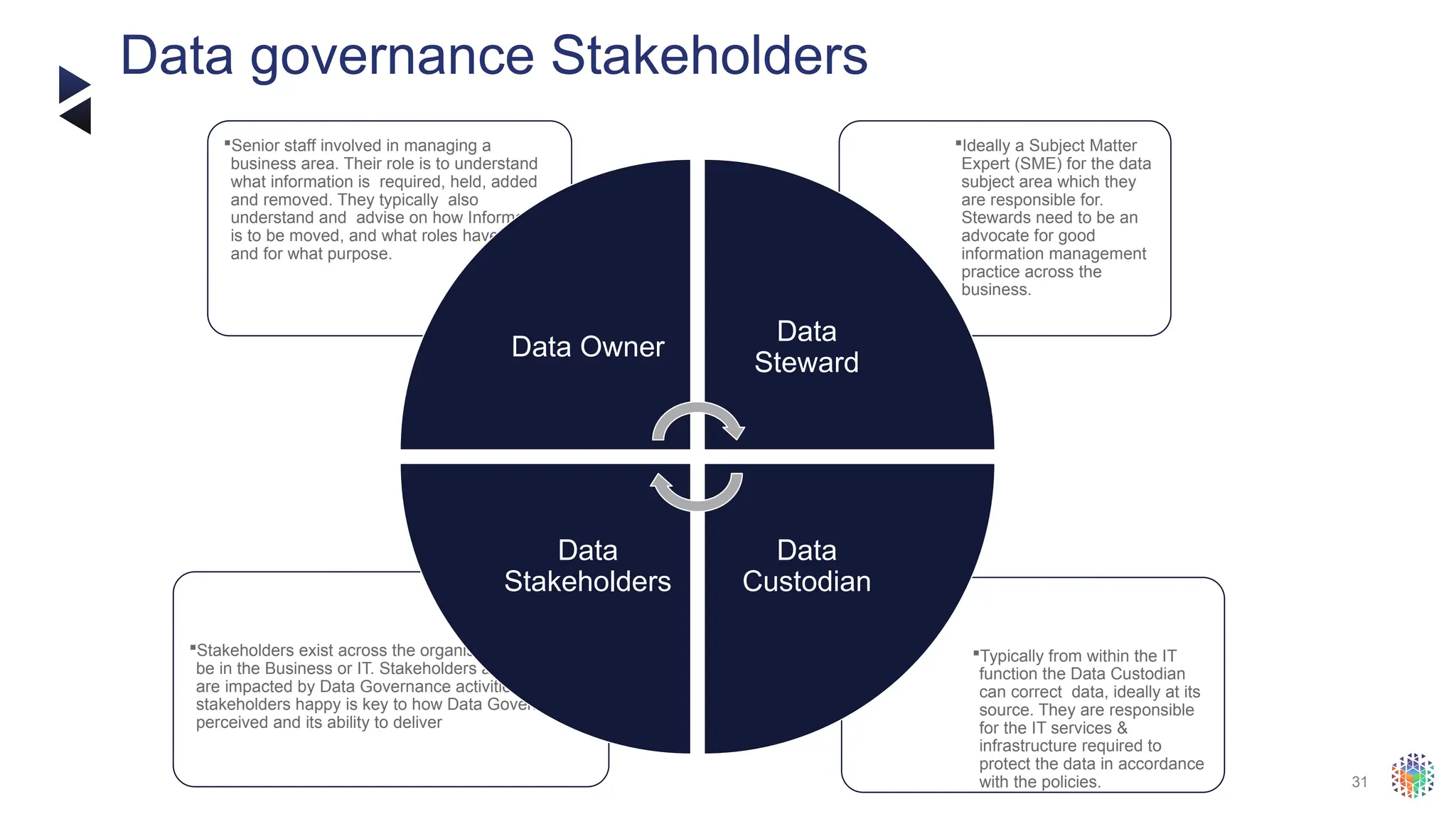
Data governance Stakeholders
Typically from within the IT
function the Data Custodian
can correct data, ideally at its
source. They are responsible
for the IT services &
infrastructure required to
protect the data in accordance
with the policies.
Stakeholders exist across the organisation and could
be in the Business or IT. Stakeholders are those who
are impacted by Data Governance activities. Keeping
stakeholders happy is key to how Data Governance is
perceived and its ability to deliver
Ideally a Subject Matter
Expert (SME) for the data
subject area which they
are responsible for.
Stewards need to be an
advocate for good
information management
practice across the
business.
Senior staff involved in managing a
business area. Their role is to understand
what information is required, held, added
and removed. They typically also
understand and advise on how Information
is to be moved, and what roles have access
and for what purpose.
Data Owner
Data
Steward
Data
Custodian
Data
Stakeholders
32
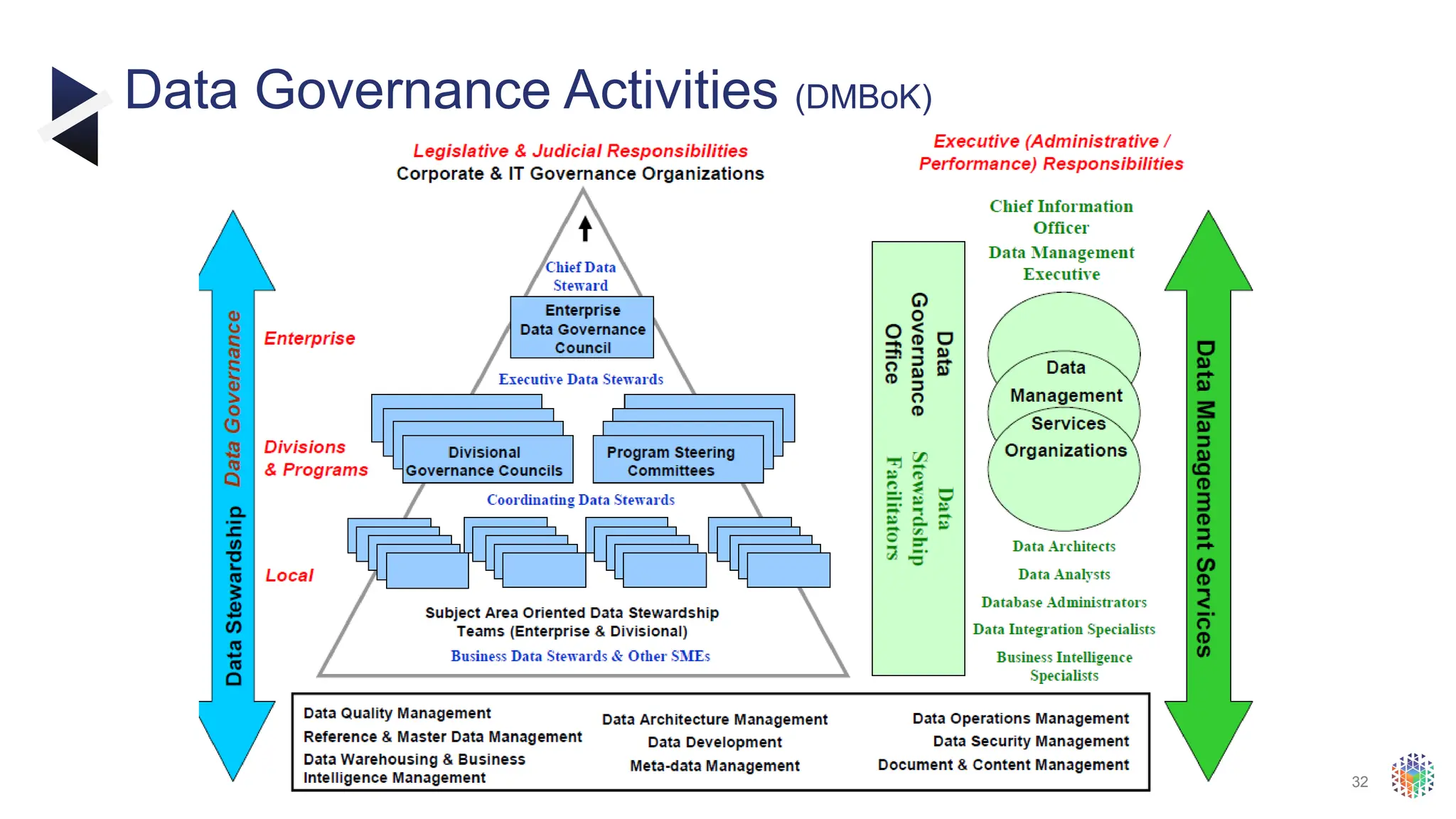
Data Governance Activities (DMBoK)
33
 Alation Data Governance.
 Apache Atlas
 Axon Data Governance
 Collibra Data Governance
 Informatica
 Oracle
 IBM
 …
Sample of known Data Governance Software and tools
Thank you

Data Governance Course without AI_Week 1.pptx

  • 1.
  • 2.
    2 ​ Introduction to DataGovernance and AI, and introduction to the DAMA-DMBOK Framework Week 1: Agenda ● Overview of data governance and its role. ● Introduction to the DAMA-DMBOK framework. ● Understanding the data lifecycle. ● How DAMA-DMBOK aligns with data project phases. ● Discuss real-world projects using data governance frameworks. ● Understanding data stakeholders and data stewardship. ● Defining data ownership and responsibilities. ● Review data governance software and tools.
  • 3.
    3 ​ 1. Where youwork & for how long ​ 2. Information Management experience ​ 3. Objective(s) from this course ​ 4. One interesting nonwork fact about you Introduction
  • 4.
    4  The DAMAGuide to the Data Management Body of Knowledge (DAMA-DMBOK Guide)  A book published by DAMA-I, 406 pages(V1) 624 pages (v2) (also on CD & PDF)  Available from TechnicsPublications.com or Amazon.com  Written and edited by DAMA members  An integrated primer: “definitive introduction”  Modelled after other BOK documents: • PMBOK (Project Management Body of Knowledge) • SWEBOK (Software Engineering Body of Knowledge) • BABOK (Business Analysis Body of Knowledge) • CITBOK (Canadian IT Body of Knowledge) What is DAMA-DMBOK
  • 5.
    5  Develop, buildconsensus and foster adoption for a generally  Accepted view of data management.  Provide standard definitions for data management functions, roles, deliverables and other common terminology.  Identify “guiding principles”.  Introduce widely adopted practices, methods and techniques, without references to products and vendors.  Identify common organisational and cultural issues.  Guide readers to additional resources. DAMA DMBOK Goals
  • 6.
    6 • Higher volumesof data generated by organisations (raw data, devices, CRM, ECM, IOT) • Proliferation of data-centric systems • New product development • To make the management of information front and centre and part of the culture • Greater demand for reliable information: Gain deep insights through analytics • Trust in Information: “What do you mean by ….?” • Tighter regulatory compliance • Competitive advantage: Improved decision making • Business change is no longer optional – it’s inevitable: Agility AND ability to respond to change • Big Data explosion (and hype) Why Is Data Governance Critical?
  • 7.
    7 ​ The Design &Execution Of Standards & Policies Covering …  Design and operation of a management system to assure that data delivers value and is not a cost  Who can do what to the organisation’s data and how  Ensuring standards are set and met  A strategic & high level view across the whole organisation What is Data Governance? The Exercise of Authority and control, Planning, Monitoring, and Enforcement over the management of data assets. (Dama International)
  • 8.
    8 The Design &Execution Of Standards & Policies Covering … • Design and operation of a management system to assure that data delivers value and is not a cost • Who can do what to the organisation’s data and how • Ensuring standards are set and met • A strategic & high level view across the whole organisation To Ensure … Key principles/processes of effective Information Management are put into practice Continual improvement through the evolution of an Information Management strategy Data Governance Is NOT … • A “one off” Tactical management exercise • The responsibility of the Technology and IT department alone What is Data Governance? The Exercise of Authority and control, Planning, Monitoring, and Enforcement over the management of data assets. (Dama International)
  • 9.
    9 Why Data Governance? TheExercise of Authority and control, Planning, Monitoring, and Enforcement over the management of data assets. (Dama International) On average, organizations waste 15 18% of budgets ‐ dealing withdata inaccuracies A typical average company loses 30% of revenue and turnover through poor data quality The US economy loses $3.1 trillion a year because of poor data quality Millions of UK National Health Service patient records sold to insurance firms
  • 10.
    10 10 Information that isTrusted and Fit to Purpose • Assurance and evidence that data is managed effectively reduces regulatory compliance risk and improves confidence in operational and management decisions • Known individuals, their responsibilities and escalation route reduces the time and effort to resolve data issues • Improved opportunity to rapidly and effectively exploit information for customer insights and competitive advantage • Increased agility and capability to respond to change and events faster through joint understanding across users and IT • Reduced system design and integration effort • Reduced risk of departmental silos and duplication leading to reconciliation effort and argument Overview of data governance and its role
  • 11.
    11 Exercis e For each of5 DG Maturity levels: 1. Assess where you believe Your Company currently sits 2. What are the most important Data Governance issues to be addressed
  • 12.
    12 3 Motivations &behaviours for Data Governance ​ Tactical exercise ​ Efforts designed to respond to current pains ​ Organisation has suffered a regulatory breach or a data disaster REACTIVE GOVERNANCE •Organisation is facing a major change or threats •Designed to ward off significant issues that could affect success of the company •Probably driven by impending regulatory & compliance needs PRE-EMPTIVE GOVERNANCE •Efforts designed to improve capabilities to resolve risk and data issues. •Build on reactive governance to create an ever- increasing body of validated rules, standards, and tested processes. •Part of a wider Information Management strategy PROACTIVE GOVERNANCE If your main motivation for Data Governance is Regulation & Compliance, the best you can ever hope to achieve is just to be “compliant”
  • 13.
    13 Drivers for DataGovernance 1. Global operations are typically complex, disparate and often inefficient in their approaches to information management (IM). 2. Shared and / or critical information is siloed & this siloed information impairs enterprise level reporting, decision- making and performance optimization 3. Aggregated information is required by certain business functions, but is not readily available 4. Business and IT neither talk the same language, nor have a common understanding about information management, causing a considerable knowledge gap to exist with regards to critical data elements for the enterprise. 5. Information management budgets and program focuses are siloed, often inside individual projects with no enterprise scope. 6. Enterprise wide information lacks semantic consistency (meaning & definition). 7. The information management needs of multiple “owners” across the enterprise must be rationalized. 8. Decentralized IT organizations operate independently within individual business unit, adding complexity and challenge. 9. Business perceives IT as being insufficiently agile to meet ad hoc information needs. 10. If even discussed, Business and IT can’t agree who actually “owns” the data. 11. Data context is critical to consumers, but often lacking. 12. Operationalization of information management projects at the enterprise level is a difficult challenge. 13. Regulation & compliance make effective information management no longer optional. 14. Data quality must be operationalized across the entire organization to assure the usefulness of the information that business users consume. 15. Organisations need to become information-centric enterprises. 16. Successful transformation of an organization into an information-centric enterprise requires a designated champion from senior management to educate and guide the company in operationalizing strategic data plans. 17. Strategic thinking and decision-making is needed on the issue of whether data should be centralized or distributed.
  • 14.
    14 Data Governance enablesthese core BUSINESS considerations: 1. What is the data that we need to run our business? 2. Do we agree what it means? 3. Do we know where it is? 4. Have accountabilities with the right skills & processes been allocated to manage it? 5. Is it fit for purpose?
  • 15.
    15 Data Governance Enables: 1.What is the data that we need to run our business? Appropriate Data Models Process Models With judicious Data Governance linked to
  • 16.
    16 Data Governance Enables: 2.Do we agree what it means? Agreement on definitions Business Stakeholders b e t w e e n recorded in Business Glossary
  • 17.
    17 Data Governance Enables: 3.Do we know where it is? Systems “ r e a l ” d a t a a p p e a r s i n Business level Data models whose data is catalogued in have definitions in & l i n k e d t o Business Glossary
  • 18.
    18 Data Governance Enables: 4.Have accountabilities with the right skills & processes been allocated to manage it? Responsibilities, Skills, Competencies, Capabilities & Development needs f o r t h e r o l e s t o m a n a g e d a t a Not just the “Data Management” roles!
  • 19.
    19 Data Governance Enables: 5.Is it fit for purpose? I.e. the right Security, Access Regulatory compliance, Quality … Data Quality and Regulatory metrics, measures & processes Business Stakeholders a g r e e d b e t w e e n allocated to Appropriate roles having the correct competencies & processes with correct security & access Security
  • 20.
    20 Exercis e 1. List thetop 3-5 drivers for Data Governance / Information Management for Your Company 2. For 1 or 2 of the drivers above, describe the issues faced / evidence and implications of these
  • 21.
    21 Data Valuation Data Asset Value OperationalValue (Cost of Storing, Processing and assessing Data) Industry Value (How would competitor value the data) Replacement Value (cost of getting all data again) Commercial Value (how much Business lose if Data is Lost)
  • 22.
    22 Data Lifecycle • Informationin context With perspective Recognizes and interprets patterns •Knowledge with judgement Experiential •Data with Context •Representation of facts Text, numbers, graphics, images, etc. Data Information Knowledge Wisdom Format, timeframe, relevance Patterns, trends, Assumptions Actions Profit and Losses Learned lessons Knowledge Management depends on Information Management
  • 23.
    23 Data Governance Is atthe Heart off ALL Informati on Manage ment Disciplin es
  • 24.
    24 Framework For EnterpriseInformation Management ​ In today’s information-driven economy, data is at the heart of the organisation. To achieve valuable business outcomes, an Information Management Strategy must align business goals and motivations. ​ These business-centric goals and principles oversee all information-related projects in the organisation; from transaction data management, to data warehousing and business intelligence, to Big Data analytics. Regardless of the information source, key best practices such as Data Governance, Information Asset Management, Master Data Management and Data Quality Management must be in place to ensure that information is managed in a cohesive way. ​ Organisations worldwide across a range of industries from Finance to Telecoms to Pharmaceuticals have used this framework to achieve alignment between business and IT and to leverage data as a strategic asset in their organisations. ​ Our EIM Framework has methods, principles, roles & responsibilities, and maturity assessment models for each of the IM disciplines and is frequently used to accelerate IM strategy engagements. As an author of the DMBoK and examiner for the DAMA CDMP, we can readily employ DMBoK 1, DMBoK 2.0 or our framework as preferred by the client. I N F O R M AT I O N I S AT T H E H E A RT O F T H E B U S I N E S S & M U S T B E MA N A G E D E F F E C T I V E LY TO D R I V E VA L U E Data Models DW & BI Master& Reference Data Management Information Management Principles Information Management Fundamentals Data Governance Metadata Management Data Integration & Interoperability Data Quality Information Management Planning SUPPORTIN G CORE FOUNDATIONAL DIVERSE DATA TYPES Master & Ref Data DW & BI Data Big Data & Analytics Transaction Data Unstructure d Data Semi structured Data Document & Content Management Geo Spatial Data
  • 25.
    25 Understand Business Drivers &build a foundation Set the Scope Assess Current position Determine readiness for DG Build Business Case Understand Business Motivation Define the Organisation & approach to introduce DG DG implementation Program Communication plan Organisation structure & bodies Education plan Roles & Responsibilities Apply Create and apply policies Execute communicatio n plan Organisatio n structure & bodies Execute education & mentoring Develop & roll out standards & procedures Introduce DG Processes Introduce DGO Establish Principles Monitor, Report & Measure Adherenc e to Principles DG Metrics Feedback & continuous improvem ent DG Knowled ge Base DG Framework (Common Themes In DG Models & Frameworks)
  • 26.
    26 Data Governance OperatingModel ESTABLISH FOUNDATION ESTABLISH STRATEGY BUILD BUSINESS CASE AGREE DG SCOPE ESTABLISH AS-IS SITUATION ESTABLISH DG PROGRAM CREATE COMMUNICATION STRATEGY ORGANISATION OWNERS STEWARDS CUSTODIANS STAKEHOLDERS COUNCIL DG GROUPS WORKING GROUPS DGO DIRECTION PRINCIPLES & STANDARDS POLICY PROCESS PROCEDURES Controls REPORTING & ASSURANCE PERFORMANCE MANAGEMENT CONTINUOUS IMPROVEMENT MATURITY MODEL Continuous Activity Initial Activity PLAN FOR IMPLEMENTING DATA GOVERNANCE Control & Report
  • 27.
    27 5 considerations insetting Data Governance scope Data. What subject area and entities do we govern? What attributes? System. What systems are under jurisdiction? These could include data warehouses, master data hubs, business applications, and the integration infrastructure. Business Process. What business processes benefit from, or are accountable for, our data policies? Organisation. What segment of the enterprise should we focus on, defined by geography, line of business or functional area? Policy Type. Do we focus on data quality or data security? Or just a common model or data dictionary?
  • 28.
    28 Underwrite Data ManagementProjects helps define the business case and oversees project status and progress on data management improvement projects coordinates its efforts with a Project Management Office (PMO), where one exists Data management projects may be considered part of the overall IT project portfolio Change Management Issue Management Alignments between DAMA-DMBOK and data project phases
  • 29.
    29  Collaborative analyticsor building new data products  Data privacy compliance  Data discovery and data literacy provisions  Create a centralized repository of all standardized business terms  Centralized data access management Real-world projects using data governance frameworks
  • 30.
    30 Definition:The exercise ofauthority, control, and shared decision-making (planning, monitoring, and enforcement) over the management of data assets. Goals: 1. Enable an organization to manage its data as an asset. 2. Define, approve, communicate, and implement principles, policies, procedures, metrics, tools, and responsibilities for data management. 3. Monitor and guide policy compliance, data usage, and management activities. Activities: 1. Define Data Governance for the Organization (P) 1.Develop Data Governance Strategy 2. Perform Readiness Assessment 3. Perform Discovery and Business Alignment 4. Develop OrganizationalTouchpoints 2. Define the Data Governance Strategy (P) 1. Define the Data Governance Operating Framework 2. Develop Goals, Principles, and Policies 3. Underwrite Data Management Projects 4. Engage Change Management 5. Engage in Issue Management 6.Assess Regulatory Compliance Requirements 3. Implement Data Governance (O) 1. Sponsor Data Standards and Procedures 2. Develop a Business Glossary 3. Co-ordinate with Architecture Groups 4. Sponsor Data AssetValuation 4. Embed Data Governance (C,O) Inputs: • Business Strategies & Goals • IT Strategies & Goals • Data Management and Data Strategies • Organization Policies & Standards • Business Culture Assessment • Data Maturity Assessment • IT Practices • Regulatory Requirements Deliverables: • Data Governance Strategy • Data Strategy • Business / Data Governance Strategy Roadmap • Data Principles, Data Governance Policies, Processes • Operating Framework • Roadmap and Implementation Strategy • Operations Plan • Business Glossary • Data Governance Scorecard • Data GovernanceWebsite • Communications Plan • Recognized DataValue • Maturing Data Management Practices Suppliers: • Business Executives • Data Stewards • Data Owners • Subject Matter Experts • Maturity Assessors • Regulators • Enterprise Architects Consumers: • Data Governance Bodies • Project Managers • ComplianceTeam • DM Communities of Interest • DM Team • Business Management • Architecture Groups • Partner Organizations Participants: • Steering Committees • CIO • CDO / Chief Data Stewards • Executive Data Stewards • Coordinating Data Stewards • Business Data Stewards • Data Governance Bodies Techniques: • Concise Messaging • Contact List • Logo Tools: • Websites • Business Glossary Tools • Workflow Tools • Document Management Tools • Data Governance Scorecards Metrics: • Compliance to regulatory and internal data policies. • Value • Effectiveness • Sustainability (P) Planning, (C) Control, (D) Development, (O) Operations • ComplianceTeam • DM Executives • Change Managers • Enterprise Data Architects • Project Management Office • Governance Bodies • Audit • Data Professionals Technical Drivers Business Drivers Data Governance and Stewardship
  • 31.
    31 Data governance Stakeholders Typicallyfrom within the IT function the Data Custodian can correct data, ideally at its source. They are responsible for the IT services & infrastructure required to protect the data in accordance with the policies. Stakeholders exist across the organisation and could be in the Business or IT. Stakeholders are those who are impacted by Data Governance activities. Keeping stakeholders happy is key to how Data Governance is perceived and its ability to deliver Ideally a Subject Matter Expert (SME) for the data subject area which they are responsible for. Stewards need to be an advocate for good information management practice across the business. Senior staff involved in managing a business area. Their role is to understand what information is required, held, added and removed. They typically also understand and advise on how Information is to be moved, and what roles have access and for what purpose. Data Owner Data Steward Data Custodian Data Stakeholders
  • 32.
  • 33.
    33  Alation DataGovernance.  Apache Atlas  Axon Data Governance  Collibra Data Governance  Informatica  Oracle  IBM  … Sample of known Data Governance Software and tools
  • 34.