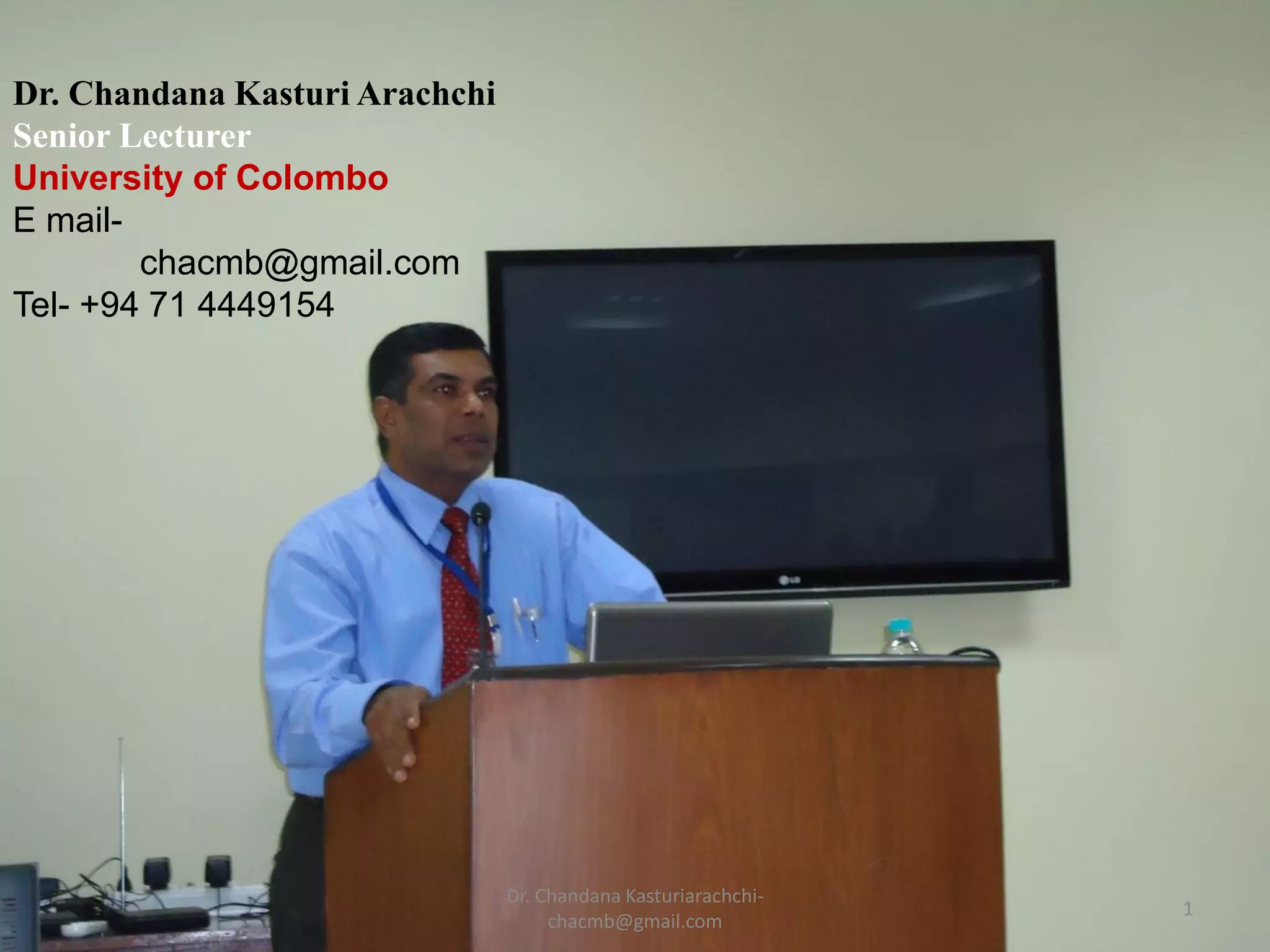
Dr. Chandana Kasturi Arachchi
Senior Lecturer
University of Colombo
E mail-
chacmb@gmail.com
Tel- +94 71 4449154
Dr. Chandana Kasturiarachchi-
chacmb@gmail.com
1
Methods of Data Generation in
Research
Dr. Chandana Kasturiarachchi-
chacmb@gmail.com
2
Instruments for Data
Collection
Dr. Chandana Kasturiarachchi-
chacmb@gmail.com
3
Instruments
• Hatch (2002) and Marshall and Rossman (1995)
contend that in-depth interviewing, participant
observation and reviewing of documents are the
primary data gathering strategies in qualitative
research.
• Bassey (1999) and Merriam (1998) have argued
that data collection in case study research mainly
involves interviewing, observing and analyzing
documents.
Dr. Chandana Kasturiarachchi-
chacmb@gmail.com
4
Instruments
• Patton (1990) argues, "no single source of
information can be trusted to provide a
comprehensive perspective on the
phenomenon…
• Each type of data source has strengths and
weaknesses, researchers combine different
sources to validate and cross-check findings
(p. 244).
Dr. Chandana Kasturiarachchi-
chacmb@gmail.com
5
Interviewing
• "An interview is a conversation, usually between
two people. But it is a conversation where one
person-the interviewer-is seeking responses for a
particular purpose from the other person: the
interviewee" (Gillham, 2000b, p. I).
• It is a tool for gathering information (Denscombe,
1998).
• Understanding the experience of people and what
meanings they derive from those experiences is at
the heart of in- depth interviewing (Seidman, 1998)
Dr. Chandana Kasturiarachchi-
chacmb@gmail.com
6
Interviewing
The purpose of interviewing is to find out what is in
and on someone else's mind ... we interview people
to find out from them those things we cannot
directly observe ... we cannot observe feelings,
thoughts, and intentions. We cannot observe
behaviors that took place at some previous point in
time. We cannot observe situations that preclude
the presence of an observer. We cannot observe
how people have organized the world and the
meanings they attach to what goes on in the world.
We have to ask people questions about those things.
Patton (1 990, p. 278)
Dr. Chandana Kasturiarachchi-
chacmb@gmail.com
7
Interviewing
• Interviews fall into three categories : structured,
semi structured and open-ended interviews (B
erg, 2001 ; Marshal! & Rossman, 1995).
• This categorization is based on the degree to
which it is structured (Bogdan & Biklen, 1998;
Gillham, 2000b; Marshal! & Rossman, 1995) and
the extent to which the interviewee is allowed to
shape the interview's content (Bogdan & Biklen,
1998).
Dr. Chandana Kasturiarachchi-
chacmb@gmail.com
8
Instruments
• In addition to face to face interviews and
telephone interview, group interviewing or
focus group interviewing is among many other
specific types of interviews that are used in
research (Gillham, 2000a, pp. 81-89).
Dr. Chandana Kasturiarachchi-
chacmb@gmail.com
9
structured interview
• The structured interview is used when the
researcher knows the ground that he would
cover during the interviews, and he/she further
assumes that questions included in the interview
schedule would seek all or nearly all the
information related to the topic of study (Berg,
2001).
Dr. Chandana Kasturiarachchi-
chacmb@gmail.com
10
Unstructured or Open-ended
interviews
• unstructured or open-ended interviews, the
researcher does not assume that he knows
what ground to cover and, therefore, he
would not have a set of questions to ask.
Dr. Chandana Kasturiarachchi-
chacmb@gmail.com
11
Semi- structured interviews
• Semi- structured interviews, although there is a
predetermined set of questions, the interviewers
are free, in fact expected, to probe beyond the
answers to these questions.
Dr. Chandana Kasturiarachchi-
chacmb@gmail.com
12
Focus Group Interviews
• In this type of interview, a small group of people
is brought together in order to explore their ideas
about a particular topic (Denscombe, 1998)
• Berg (2007) highlights many advantages of focus
group interviewing. Among these, most notable
are: "it permits the gathering of a large amount
of information from potentially large group of
people in relatively short period of time" (Berg,
2007, p. 148)
Dr. Chandana Kasturiarachchi-
chacmb@gmail.com
13
Participant Observation
• In the participant observation process, "the
researcher carefully observes, systematically
experiences, and consciously records in detail the
many aspects of a situation" (Glesne, 1999, p. 46)
.
Dr. Chandana Kasturiarachchi-
chacmb@gmail.com
14
Participant Observation
• One has to spend a considerable amount of time
in the setting for observation (Marshall &
Rossman, 1995), this method of data collection is
very basic to all qualitative studies (Hatch, 2002;
Marshall & Rossman, 1995; Merriam, 1998;)
• because it allows the researcher to experience
reality from the participants ' perspectives
(Denscombe, 1998; Hatch, 2002; Merriam, 1998;
Patton, 1990) .
Dr. Chandana Kasturiarachchi-
chacmb@gmail.com
15
Documents
• Documents include a wide range of material :
photographs, videos, memos, diaries,
memorabilia of all sorts (Bogdan & Biklen,
1998), logs, announcements, formal policy
statements (Marshall & Rossman, 1995),
annual reports, and so on.
Dr. Chandana Kasturiarachchi-
chacmb@gmail.com
16
Documents
• Bogdan & Biklen (1998) have identified three
main types of documents : personal, official
and popular culture documents.
Dr. Chandana Kasturiarachchi-
chacmb@gmail.com
17
Questionnaire
• A questionnaire is a set of questions given to
participants on paper to be answered by them. In
qualitative research, a questionnaire is used to
learn about characteristics, attitudes or beliefs
among a particular group or a sample population
(Marshall & Rossman, 1995).
• But the usefulness of the questionnaire is limited
to the fact that the researcher would have to rely
completely on the respondents' honesty and
accuracy of their answers (p. 96)
Dr. Chandana Kasturiarachchi-
chacmb@gmail.com
18
Questionnaire
• The type of questions contained in a
questionnaire is mostly factual, straightforward
and, to some extent, open-ended (Gillham,
2000b; Marshall & Rossman, 1995).
• They allow the collecting of small amounts of
data from a large group within a short period of
time; they are relatively easy to analyze; and,
they are impersonal.
Dr. Chandana Kasturiarachchi-
chacmb@gmail.com
19
Interviews
In Detail
Dr. Chandana Kasturiarachchi-
chacmb@gmail.com
20
Introduction
• Interviews are particularly useful for getting the
story behind a participant's experiences. The
interviewer can pursue in-depth information
around a topic. Interviews may be useful as follow-
up to certain respondents to questionnaires, e.g.,
to further investigate their responses. Usually
open-ended questions are asked during interviews.
Dr. Chandana Kasturiarachchi-
chacmb@gmail.com
21
Design your interview
• Before you start to design your interview
questions and process, clearly articulate to
yourself what problem or need is to be
addressed using the information to be gathered
by the interviews. This helps you keep clear
focus on the intent of each question.
Dr. Chandana Kasturiarachchi-
chacmb@gmail.com
22
Types of Interviews
• Informal, conversational interview - no predetermined questions are
asked, in order to remain as open and adaptable as possible to the
interviewee's nature and priorities; during the interview, the
interviewer "goes with the flow".
• General interview guide approach - the guide approach is intended to
ensure that the same general areas of information are collected from
each interviewee; this provides more focus than the conversational
approach, but still allows a degree of freedom and adaptability in
getting information from the interviewee.
• Standardized, open-ended interview - here, the same open-ended
questions are asked to all interviewees (an open-ended question is
where respondents are free to choose how to answer the question, i.e.,
they don't select "yes" or "no" or provide a numeric rating, etc.); this
approach facilitates faster interviews that can be more easily analyzed
and compared.
• Closed, fixed-response interview - where all interviewees are asked the
same questions and asked to choose answers from among the same set
of alternatives. This format is useful for those not practiced in
interviewing.
Dr. Chandana Kasturiarachchi-
chacmb@gmail.com
23
Types of Topics in Questions
Patton notes six kinds of questions. One can ask
questions about:
• Behaviors - about what a person has done or is doing
• Opinions/values - about what a person thinks about a topic
• Feelings - note that respondents sometimes respond with "I
think ..." so be careful to note that you're looking for feelings
• Knowledge - to get facts about a topic
• Sensory - about what people have seen, touched, heard,
tasted or smelled
• Background/demographics - standard background questions,
such as age, education, etc.
Note that the above questions can be asked in terms of past,
present or future.
Dr. Chandana Kasturiarachchi-
chacmb@gmail.com
24
Sequence of Questions
• Before asking about controversial matters (such as
feelings and conclusions), first ask about some
facts. With this approach, respondents can more easily
engage in the interview before warming up to more
personal matters.
• Intersperse fact-based questions throughout the
interview to avoid long lists of fact-based questions, which
tends to leave respondents disengaged.
• Ask questions about the present before questions about
the past or future. It's usually easier for them to talk
about the present and then work into the past or future.
• The last questions might be to allow respondents to
provide any other information they prefer to add and
their impressions of the interview.
Dr. Chandana Kasturiarachchi-
chacmb@gmail.com
25
Wording of Questions
• Wording should be open-ended. Respondents should be
able to choose their own terms when answering questions.
• Questions should be as neutral as possible. Avoid wording
that might influence answers, e.g., evocative, judgmental
wording.
• Questions should be asked one at a time.
• Questions should be worded clearly. This includes
knowing any terms particular to the program or the
respondents' culture.
• Be careful asking "why" questions. This type of question
infers a cause-effect relationship that may not truly exist.
These questions may also cause respondents to feel
defensive, e.g., that they have to justify their response,
which may inhibit their responses to this and future
questions.
Dr. Chandana Kasturiarachchi-
chacmb@gmail.com
26
Conducting Interview
• Occasionally verify the tape recorder (if used) is working.
• Ask one question at a time.
• Attempt to remain as neutral as possible. That is, don't show strong
emotional reactions to their responses. Patton suggests to act as if
"you've heard it all before."
• Encourage responses with occasional nods of the head, "uh huh"s, etc.
• Be careful about the appearance when note taking. That is, if you jump
to take a note, it may appear as if you're surprised or very pleased about
an answer, which may influence answers to future questions.
• Provide transition between major topics, e.g., "we've been talking
about (some topic) and now I'd like to move on to (another topic)."
• Don't lose control of the interview. This can occur when respondents
stray to another topic, take so long to answer a question that times
begins to run out, or even begin asking questions to the interviewer.
Dr. Chandana Kasturiarachchi-
chacmb@gmail.com
27
Immediately After Interview
• Verify if the tape recorder, if used, worked
throughout the interview.
• Make any notes on your written notes, e.g., to
clarify any scratchings, ensure pages are
numbered, fill out any notes that don't make
senses, etc.
• Write down any observations made during the
interview. For example, where did the interview
occur and when, was the respondent particularly
nervous at any time? Were there any surprises
during the interview? Did the tape recorder
break? Dr. Chandana Kasturiarachchi-
chacmb@gmail.com
28
Preparation for Interview
• Choose a setting with little distraction. Avoid loud lights or
noises, ensure the interviewee is comfortable (you might
ask them if they are), etc. Often, they may feel more
comfortable at their own places of work or homes.
• Explain the purpose of the interview.
• Address terms of confidentiality. Note any terms of
confidentiality. (Be careful here. Rarely can you absolutely
promise anything. Courts may get access to information, in
certain circumstances.) Explain who will get access to their
answers and how their answers will be analyzed. If their
comments are to be used as quotes, get their written
permission to do so. See getting informed consent.
Dr. Chandana Kasturiarachchi-
chacmb@gmail.com
29
Preparation for Interview
• Explain the format of the interview. Explain the type of
interview you are conducting and its nature. If you want
them to ask questions, specify if they're to do so as they
have them or wait until the end of the interview.
• Indicate how long the interview usually takes.
• Tell them how to get in touch with you later if they want
to.
• Ask them if they have any questions before you both get
started with the interview.
• Don't count on your memory to recall their answers. Ask
for permission to record the interview or bring along
someone to take notes.
Dr. Chandana Kasturiarachchi-
chacmb@gmail.com
30
• TIPS FOR EFFECTIVE RESEARCH INTERVIEWS
Dr. Chandana Kasturiarachchi-
chacmb@gmail.com
31
TIPS FOR EFFECTIVE RESEARCH
INTERVIEWS
• Make sure the research question is clear.
• Develop a check list of the questions to be
asked during the interview.
• Express clearly the purpose of the interview.
• Start with a neutral question to facilitate free
flow of information.
• Use open-ended questions so that the
respondent can choose his answer.
Dr. Chandana Kasturiarachchi-
chacmb@gmail.com
32
TIPS FOR EFFECTIVE RESEARCH
INTERVIEWS
• Limit the content of each question with a
single idea to avoid confusion.
• Reduce questions that give responses of `yes'
or `no', because they give limited information.
• Do not influence the respondent by asking
leading questions.
• If you have not understood the response ask
the respondent to repeat and clarify.
• Do not assume answers.
Dr. Chandana Kasturiarachchi-
chacmb@gmail.com
33
TIPS FOR EFFECTIVE RESEARCH
INTERVIEWS
• Do not pass judgments.
• Avoid irrelevant discussions.
• When you change the tack, inform the
respondent that you are doing so.
• Keep the interview short.
• At the end of the interview summarize the
points reported and ask the respondent if the
summary is correct.
Dr. Chandana Kasturiarachchi-
chacmb@gmail.com
34
Activity
Prepare an;
• Interview protocol
• Observation Schedule
• Questionnaire
for collecting information of your qualitative
research
Dr. Chandana Kasturiarachchi-
chacmb@gmail.com
35
School Improvement:
The Route Taken by an Urban
Primary School in the Republic of
Maldives
Doctor of Philosophy in Education at Massey
University Palmerston North New Zealand
Dr. Chandana Kasturiarachchi-
chacmb@gmail.com
36
Objectives
1. How does the principal effect and manage change In a
Maldivian urban primary school?
2. What are the internal conditions or major components or
themes at work with regard to improvement efforts in a
Maldivian urban primary school?
3. How does the principal create and/or manipulate the
necessary internal conditions within the school that
would bring about lasting improvements?
4. How do teachers perceive improvement efforts?
5. What is the role of the central office (the MOE in this
case) and, what other parties, besides the MOE, influence
the school 's efforts to change and how do they
influence?
6. How does the school determine the worth of its school
improvement programmes?
Dr. Chandana Kasturiarachchi-
chacmb@gmail.com
37

Data generation in qulitative research

  • 1.
    Dr. Chandana KasturiArachchi Senior Lecturer University of Colombo E mail- chacmb@gmail.com Tel- +94 71 4449154 Dr. Chandana Kasturiarachchi- chacmb@gmail.com 1
  • 2.
    Methods of DataGeneration in Research Dr. Chandana Kasturiarachchi- chacmb@gmail.com 2
  • 3.
    Instruments for Data Collection Dr.Chandana Kasturiarachchi- chacmb@gmail.com 3
  • 4.
    Instruments • Hatch (2002)and Marshall and Rossman (1995) contend that in-depth interviewing, participant observation and reviewing of documents are the primary data gathering strategies in qualitative research. • Bassey (1999) and Merriam (1998) have argued that data collection in case study research mainly involves interviewing, observing and analyzing documents. Dr. Chandana Kasturiarachchi- chacmb@gmail.com 4
  • 5.
    Instruments • Patton (1990)argues, "no single source of information can be trusted to provide a comprehensive perspective on the phenomenon… • Each type of data source has strengths and weaknesses, researchers combine different sources to validate and cross-check findings (p. 244). Dr. Chandana Kasturiarachchi- chacmb@gmail.com 5
  • 6.
    Interviewing • "An interviewis a conversation, usually between two people. But it is a conversation where one person-the interviewer-is seeking responses for a particular purpose from the other person: the interviewee" (Gillham, 2000b, p. I). • It is a tool for gathering information (Denscombe, 1998). • Understanding the experience of people and what meanings they derive from those experiences is at the heart of in- depth interviewing (Seidman, 1998) Dr. Chandana Kasturiarachchi- chacmb@gmail.com 6
  • 7.
    Interviewing The purpose ofinterviewing is to find out what is in and on someone else's mind ... we interview people to find out from them those things we cannot directly observe ... we cannot observe feelings, thoughts, and intentions. We cannot observe behaviors that took place at some previous point in time. We cannot observe situations that preclude the presence of an observer. We cannot observe how people have organized the world and the meanings they attach to what goes on in the world. We have to ask people questions about those things. Patton (1 990, p. 278) Dr. Chandana Kasturiarachchi- chacmb@gmail.com 7
  • 8.
    Interviewing • Interviews fallinto three categories : structured, semi structured and open-ended interviews (B erg, 2001 ; Marshal! & Rossman, 1995). • This categorization is based on the degree to which it is structured (Bogdan & Biklen, 1998; Gillham, 2000b; Marshal! & Rossman, 1995) and the extent to which the interviewee is allowed to shape the interview's content (Bogdan & Biklen, 1998). Dr. Chandana Kasturiarachchi- chacmb@gmail.com 8
  • 9.
    Instruments • In additionto face to face interviews and telephone interview, group interviewing or focus group interviewing is among many other specific types of interviews that are used in research (Gillham, 2000a, pp. 81-89). Dr. Chandana Kasturiarachchi- chacmb@gmail.com 9
  • 10.
    structured interview • Thestructured interview is used when the researcher knows the ground that he would cover during the interviews, and he/she further assumes that questions included in the interview schedule would seek all or nearly all the information related to the topic of study (Berg, 2001). Dr. Chandana Kasturiarachchi- chacmb@gmail.com 10
  • 11.
    Unstructured or Open-ended interviews •unstructured or open-ended interviews, the researcher does not assume that he knows what ground to cover and, therefore, he would not have a set of questions to ask. Dr. Chandana Kasturiarachchi- chacmb@gmail.com 11
  • 12.
    Semi- structured interviews •Semi- structured interviews, although there is a predetermined set of questions, the interviewers are free, in fact expected, to probe beyond the answers to these questions. Dr. Chandana Kasturiarachchi- chacmb@gmail.com 12
  • 13.
    Focus Group Interviews •In this type of interview, a small group of people is brought together in order to explore their ideas about a particular topic (Denscombe, 1998) • Berg (2007) highlights many advantages of focus group interviewing. Among these, most notable are: "it permits the gathering of a large amount of information from potentially large group of people in relatively short period of time" (Berg, 2007, p. 148) Dr. Chandana Kasturiarachchi- chacmb@gmail.com 13
  • 14.
    Participant Observation • Inthe participant observation process, "the researcher carefully observes, systematically experiences, and consciously records in detail the many aspects of a situation" (Glesne, 1999, p. 46) . Dr. Chandana Kasturiarachchi- chacmb@gmail.com 14
  • 15.
    Participant Observation • Onehas to spend a considerable amount of time in the setting for observation (Marshall & Rossman, 1995), this method of data collection is very basic to all qualitative studies (Hatch, 2002; Marshall & Rossman, 1995; Merriam, 1998;) • because it allows the researcher to experience reality from the participants ' perspectives (Denscombe, 1998; Hatch, 2002; Merriam, 1998; Patton, 1990) . Dr. Chandana Kasturiarachchi- chacmb@gmail.com 15
  • 16.
    Documents • Documents includea wide range of material : photographs, videos, memos, diaries, memorabilia of all sorts (Bogdan & Biklen, 1998), logs, announcements, formal policy statements (Marshall & Rossman, 1995), annual reports, and so on. Dr. Chandana Kasturiarachchi- chacmb@gmail.com 16
  • 17.
    Documents • Bogdan &Biklen (1998) have identified three main types of documents : personal, official and popular culture documents. Dr. Chandana Kasturiarachchi- chacmb@gmail.com 17
  • 18.
    Questionnaire • A questionnaireis a set of questions given to participants on paper to be answered by them. In qualitative research, a questionnaire is used to learn about characteristics, attitudes or beliefs among a particular group or a sample population (Marshall & Rossman, 1995). • But the usefulness of the questionnaire is limited to the fact that the researcher would have to rely completely on the respondents' honesty and accuracy of their answers (p. 96) Dr. Chandana Kasturiarachchi- chacmb@gmail.com 18
  • 19.
    Questionnaire • The typeof questions contained in a questionnaire is mostly factual, straightforward and, to some extent, open-ended (Gillham, 2000b; Marshall & Rossman, 1995). • They allow the collecting of small amounts of data from a large group within a short period of time; they are relatively easy to analyze; and, they are impersonal. Dr. Chandana Kasturiarachchi- chacmb@gmail.com 19
  • 20.
    Interviews In Detail Dr. ChandanaKasturiarachchi- chacmb@gmail.com 20
  • 21.
    Introduction • Interviews areparticularly useful for getting the story behind a participant's experiences. The interviewer can pursue in-depth information around a topic. Interviews may be useful as follow- up to certain respondents to questionnaires, e.g., to further investigate their responses. Usually open-ended questions are asked during interviews. Dr. Chandana Kasturiarachchi- chacmb@gmail.com 21
  • 22.
    Design your interview •Before you start to design your interview questions and process, clearly articulate to yourself what problem or need is to be addressed using the information to be gathered by the interviews. This helps you keep clear focus on the intent of each question. Dr. Chandana Kasturiarachchi- chacmb@gmail.com 22
  • 23.
    Types of Interviews •Informal, conversational interview - no predetermined questions are asked, in order to remain as open and adaptable as possible to the interviewee's nature and priorities; during the interview, the interviewer "goes with the flow". • General interview guide approach - the guide approach is intended to ensure that the same general areas of information are collected from each interviewee; this provides more focus than the conversational approach, but still allows a degree of freedom and adaptability in getting information from the interviewee. • Standardized, open-ended interview - here, the same open-ended questions are asked to all interviewees (an open-ended question is where respondents are free to choose how to answer the question, i.e., they don't select "yes" or "no" or provide a numeric rating, etc.); this approach facilitates faster interviews that can be more easily analyzed and compared. • Closed, fixed-response interview - where all interviewees are asked the same questions and asked to choose answers from among the same set of alternatives. This format is useful for those not practiced in interviewing. Dr. Chandana Kasturiarachchi- chacmb@gmail.com 23
  • 24.
    Types of Topicsin Questions Patton notes six kinds of questions. One can ask questions about: • Behaviors - about what a person has done or is doing • Opinions/values - about what a person thinks about a topic • Feelings - note that respondents sometimes respond with "I think ..." so be careful to note that you're looking for feelings • Knowledge - to get facts about a topic • Sensory - about what people have seen, touched, heard, tasted or smelled • Background/demographics - standard background questions, such as age, education, etc. Note that the above questions can be asked in terms of past, present or future. Dr. Chandana Kasturiarachchi- chacmb@gmail.com 24
  • 25.
    Sequence of Questions •Before asking about controversial matters (such as feelings and conclusions), first ask about some facts. With this approach, respondents can more easily engage in the interview before warming up to more personal matters. • Intersperse fact-based questions throughout the interview to avoid long lists of fact-based questions, which tends to leave respondents disengaged. • Ask questions about the present before questions about the past or future. It's usually easier for them to talk about the present and then work into the past or future. • The last questions might be to allow respondents to provide any other information they prefer to add and their impressions of the interview. Dr. Chandana Kasturiarachchi- chacmb@gmail.com 25
  • 26.
    Wording of Questions •Wording should be open-ended. Respondents should be able to choose their own terms when answering questions. • Questions should be as neutral as possible. Avoid wording that might influence answers, e.g., evocative, judgmental wording. • Questions should be asked one at a time. • Questions should be worded clearly. This includes knowing any terms particular to the program or the respondents' culture. • Be careful asking "why" questions. This type of question infers a cause-effect relationship that may not truly exist. These questions may also cause respondents to feel defensive, e.g., that they have to justify their response, which may inhibit their responses to this and future questions. Dr. Chandana Kasturiarachchi- chacmb@gmail.com 26
  • 27.
    Conducting Interview • Occasionallyverify the tape recorder (if used) is working. • Ask one question at a time. • Attempt to remain as neutral as possible. That is, don't show strong emotional reactions to their responses. Patton suggests to act as if "you've heard it all before." • Encourage responses with occasional nods of the head, "uh huh"s, etc. • Be careful about the appearance when note taking. That is, if you jump to take a note, it may appear as if you're surprised or very pleased about an answer, which may influence answers to future questions. • Provide transition between major topics, e.g., "we've been talking about (some topic) and now I'd like to move on to (another topic)." • Don't lose control of the interview. This can occur when respondents stray to another topic, take so long to answer a question that times begins to run out, or even begin asking questions to the interviewer. Dr. Chandana Kasturiarachchi- chacmb@gmail.com 27
  • 28.
    Immediately After Interview •Verify if the tape recorder, if used, worked throughout the interview. • Make any notes on your written notes, e.g., to clarify any scratchings, ensure pages are numbered, fill out any notes that don't make senses, etc. • Write down any observations made during the interview. For example, where did the interview occur and when, was the respondent particularly nervous at any time? Were there any surprises during the interview? Did the tape recorder break? Dr. Chandana Kasturiarachchi- chacmb@gmail.com 28
  • 29.
    Preparation for Interview •Choose a setting with little distraction. Avoid loud lights or noises, ensure the interviewee is comfortable (you might ask them if they are), etc. Often, they may feel more comfortable at their own places of work or homes. • Explain the purpose of the interview. • Address terms of confidentiality. Note any terms of confidentiality. (Be careful here. Rarely can you absolutely promise anything. Courts may get access to information, in certain circumstances.) Explain who will get access to their answers and how their answers will be analyzed. If their comments are to be used as quotes, get their written permission to do so. See getting informed consent. Dr. Chandana Kasturiarachchi- chacmb@gmail.com 29
  • 30.
    Preparation for Interview •Explain the format of the interview. Explain the type of interview you are conducting and its nature. If you want them to ask questions, specify if they're to do so as they have them or wait until the end of the interview. • Indicate how long the interview usually takes. • Tell them how to get in touch with you later if they want to. • Ask them if they have any questions before you both get started with the interview. • Don't count on your memory to recall their answers. Ask for permission to record the interview or bring along someone to take notes. Dr. Chandana Kasturiarachchi- chacmb@gmail.com 30
  • 31.
    • TIPS FOREFFECTIVE RESEARCH INTERVIEWS Dr. Chandana Kasturiarachchi- chacmb@gmail.com 31
  • 32.
    TIPS FOR EFFECTIVERESEARCH INTERVIEWS • Make sure the research question is clear. • Develop a check list of the questions to be asked during the interview. • Express clearly the purpose of the interview. • Start with a neutral question to facilitate free flow of information. • Use open-ended questions so that the respondent can choose his answer. Dr. Chandana Kasturiarachchi- chacmb@gmail.com 32
  • 33.
    TIPS FOR EFFECTIVERESEARCH INTERVIEWS • Limit the content of each question with a single idea to avoid confusion. • Reduce questions that give responses of `yes' or `no', because they give limited information. • Do not influence the respondent by asking leading questions. • If you have not understood the response ask the respondent to repeat and clarify. • Do not assume answers. Dr. Chandana Kasturiarachchi- chacmb@gmail.com 33
  • 34.
    TIPS FOR EFFECTIVERESEARCH INTERVIEWS • Do not pass judgments. • Avoid irrelevant discussions. • When you change the tack, inform the respondent that you are doing so. • Keep the interview short. • At the end of the interview summarize the points reported and ask the respondent if the summary is correct. Dr. Chandana Kasturiarachchi- chacmb@gmail.com 34
  • 35.
    Activity Prepare an; • Interviewprotocol • Observation Schedule • Questionnaire for collecting information of your qualitative research Dr. Chandana Kasturiarachchi- chacmb@gmail.com 35
  • 36.
    School Improvement: The RouteTaken by an Urban Primary School in the Republic of Maldives Doctor of Philosophy in Education at Massey University Palmerston North New Zealand Dr. Chandana Kasturiarachchi- chacmb@gmail.com 36
  • 37.
    Objectives 1. How doesthe principal effect and manage change In a Maldivian urban primary school? 2. What are the internal conditions or major components or themes at work with regard to improvement efforts in a Maldivian urban primary school? 3. How does the principal create and/or manipulate the necessary internal conditions within the school that would bring about lasting improvements? 4. How do teachers perceive improvement efforts? 5. What is the role of the central office (the MOE in this case) and, what other parties, besides the MOE, influence the school 's efforts to change and how do they influence? 6. How does the school determine the worth of its school improvement programmes? Dr. Chandana Kasturiarachchi- chacmb@gmail.com 37