www.datacademy.ai
Knowledge world
Data Engineering
What is Data Engineering?
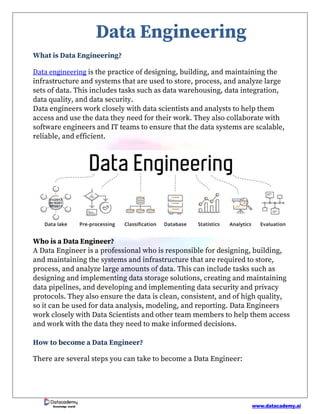
Data engineering is the practice of designing, building, and maintaining the
infrastructure and systems that are used to store, process, and analyze large
sets of data. This includes tasks such as data warehousing, data integration,
data quality, and data security.
Data engineers work closely with data scientists and analysts to help them
access and use the data they need for their work. They also collaborate with
software engineers and IT teams to ensure that the data systems are scalable,
reliable, and efficient.
Who is a Data Engineer?
A Data Engineer is a professional who is responsible for designing, building,
and maintaining the systems and infrastructure that are required to store,
process, and analyze large amounts of data. This can include tasks such as
designing and implementing data storage solutions, creating and maintaining
data pipelines, and developing and implementing data security and privacy
protocols. They also ensure the data is clean, consistent, and of high quality,
so it can be used for data analysis, modeling, and reporting. Data Engineers
work closely with Data Scientists and other team members to help them access
and work with the data they need to make informed decisions.
How to become a Data Engineer?
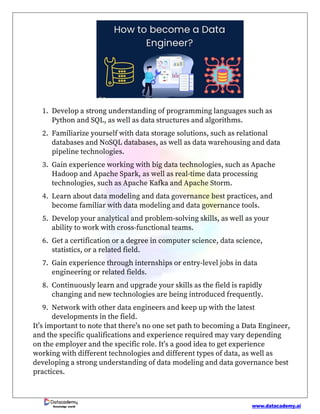
There are several steps you can take to become a Data Engineer:
www.datacademy.ai
Knowledge world
1. Develop a strong understanding of programming languages such as
Python and SQL, as well as data structures and algorithms.
2. Familiarize yourself with data storage solutions, such as relational
databases and NoSQL databases, as well as data warehousing and data
pipeline technologies.
3. Gain experience working with big data technologies, such as Apache
Hadoop and Apache Spark, as well as real-time data processing
technologies, such as Apache Kafka and Apache Storm.
4. Learn about data modeling and data governance best practices, and
become familiar with data modeling and data governance tools.
5. Develop your analytical and problem-solving skills, as well as your
ability to work with cross-functional teams.
6. Get a certification or a degree in computer science, data science,
statistics, or a related field.
7. Gain experience through internships or entry-level jobs in data
engineering or related fields.
8. Continuously learn and upgrade your skills as the field is rapidly
changing and new technologies are being introduced frequently.
9. Network with other data engineers and keep up with the latest
developments in the field.
It’s important to note that there’s no one set path to becoming a Data Engineer,
and the specific qualifications and experience required may vary depending
on the employer and the specific role. It’s a good idea to get experience
working with different technologies and different types of data, as well as
developing a strong understanding of data modeling and data governance best
practices.
www.datacademy.ai
Knowledge world
What are the Roles and Responsibilities of a Data Engineer?
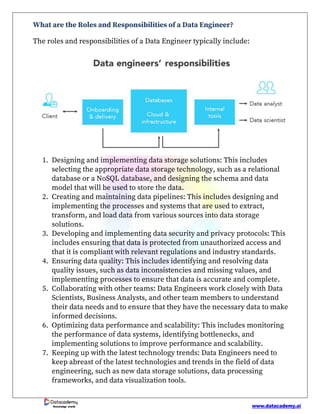
The roles and responsibilities of a Data Engineer typically include:
1. Designing and implementing data storage solutions: This includes
selecting the appropriate data storage technology, such as a relational
database or a NoSQL database, and designing the schema and data
model that will be used to store the data.
2. Creating and maintaining data pipelines: This includes designing and
implementing the processes and systems that are used to extract,
transform, and load data from various sources into data storage
solutions.
3. Developing and implementing data security and privacy protocols: This
includes ensuring that data is protected from unauthorized access and
that it is compliant with relevant regulations and industry standards.
4. Ensuring data quality: This includes identifying and resolving data
quality issues, such as data inconsistencies and missing values, and
implementing processes to ensure that data is accurate and complete.
5. Collaborating with other teams: Data Engineers work closely with Data
Scientists, Business Analysts, and other team members to understand
their data needs and to ensure that they have the necessary data to make
informed decisions.
6. Optimizing data performance and scalability: This includes monitoring
the performance of data systems, identifying bottlenecks, and
implementing solutions to improve performance and scalability.
7. Keeping up with the latest technology trends: Data Engineers need to
keep abreast of the latest technologies and trends in the field of data
engineering, such as new data storage solutions, data processing
frameworks, and data visualization tools.
www.datacademy.ai
Knowledge world
These are some of the common roles and responsibilities of a Data Engineer,
depending on the company, size, and industry the data engineer is working in
there could be slight variations in the role and responsibilities.
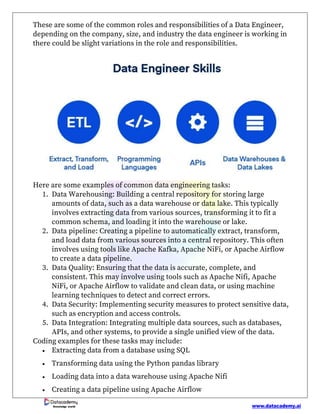
Here are some examples of common data engineering tasks:
1. Data Warehousing: Building a central repository for storing large
amounts of data, such as a data warehouse or data lake. This typically
involves extracting data from various sources, transforming it to fit a
common schema, and loading it into the warehouse or lake.
2. Data pipeline: Creating a pipeline to automatically extract, transform,
and load data from various sources into a central repository. This often
involves using tools like Apache Kafka, Apache NiFi, or Apache Airflow
to create a data pipeline.
3. Data Quality: Ensuring that the data is accurate, complete, and
consistent. This may involve using tools such as Apache Nifi, Apache
NiFi, or Apache Airflow to validate and clean data, or using machine
learning techniques to detect and correct errors.
4. Data Security: Implementing security measures to protect sensitive data,
such as encryption and access controls.
5. Data Integration: Integrating multiple data sources, such as databases,
APIs, and other systems, to provide a single unified view of the data.
Coding examples for these tasks may include:
• Extracting data from a database using SQL
• Transforming data using the Python pandas library
• Loading data into a data warehouse using Apache Nifi
• Creating a data pipeline using Apache Airflow
www.datacademy.ai
Knowledge world
• Data quality checks using Python pandas
• Encrypting data using Python cryptography library
• Data integration using Python pandas.
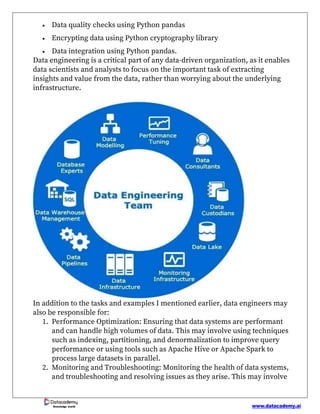
Data engineering is a critical part of any data-driven organization, as it enables
data scientists and analysts to focus on the important task of extracting
insights and value from the data, rather than worrying about the underlying
infrastructure.
In addition to the tasks and examples I mentioned earlier, data engineers may
also be responsible for:
1. Performance Optimization: Ensuring that data systems are performant
and can handle high volumes of data. This may involve using techniques
such as indexing, partitioning, and denormalization to improve query
performance or using tools such as Apache Hive or Apache Spark to
process large datasets in parallel.
2. Monitoring and Troubleshooting: Monitoring the health of data systems,
and troubleshooting and resolving issues as they arise. This may involve
www.datacademy.ai
Knowledge world
using tools such as Grafana or Prometheus to monitor system metrics, or
using logging and tracing tools such as ELK or Zipkin to diagnose issues.
3. Data Governance: Defining and enforcing policies and procedures for
managing data, such as data retention policies, data lineage, and data
cataloging.
4. Cloud Migration: Migrating data systems to the cloud for scalability and
cost-effectiveness. This may involve using cloud services such as
Amazon S3, Google Cloud Storage, or Azure Data Lake Storage for data
storage, or using cloud-native data processing and analytics tools such as
Google BigQuery, Amazon Redshift, or Azure Data Factory.
5. Machine Learning Model Deployment: Helping data scientists to deploy
their machine learning models and make them available for other
systems use. This may involve using tools like TensorFlow serving or
Kubernetes to deploy models and expose them via APIs.
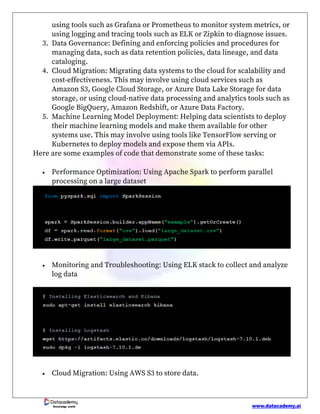
Here are some examples of code that demonstrate some of these tasks:
• Performance Optimization: Using Apache Spark to perform parallel
processing on a large dataset
• Monitoring and Troubleshooting: Using ELK stack to collect and analyze
log data
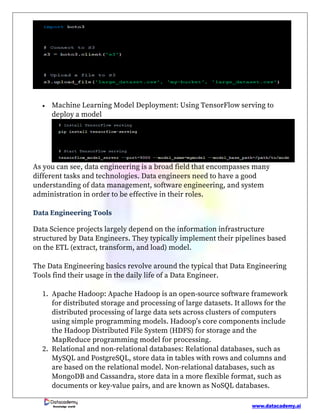
• Cloud Migration: Using AWS S3 to store data.
www.datacademy.ai
Knowledge world
• Machine Learning Model Deployment: Using TensorFlow serving to
deploy a model
As you can see, data engineering is a broad field that encompasses many
different tasks and technologies. Data engineers need to have a good
understanding of data management, software engineering, and system
administration in order to be effective in their roles.
Data Engineering Tools
Data Science projects largely depend on the information infrastructure
structured by Data Engineers. They typically implement their pipelines based
on the ETL (extract, transform, and load) model.
The Data Engineering basics revolve around the typical that Data Engineering
Tools find their usage in the daily life of a Data Engineer.
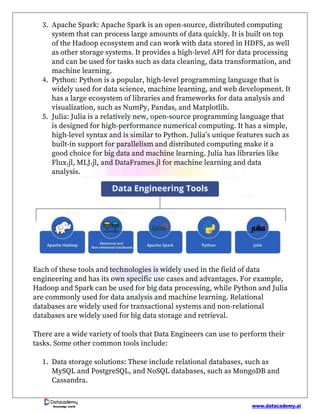
1. Apache Hadoop: Apache Hadoop is an open-source software framework
for distributed storage and processing of large datasets. It allows for the
distributed processing of large data sets across clusters of computers
using simple programming models. Hadoop’s core components include
the Hadoop Distributed File System (HDFS) for storage and the
MapReduce programming model for processing.
2. Relational and non-relational databases: Relational databases, such as
MySQL and PostgreSQL, store data in tables with rows and columns and
are based on the relational model. Non-relational databases, such as
MongoDB and Cassandra, store data in a more flexible format, such as
documents or key-value pairs, and are known as NoSQL databases.
www.datacademy.ai
Knowledge world
3. Apache Spark: Apache Spark is an open-source, distributed computing
system that can process large amounts of data quickly. It is built on top
of the Hadoop ecosystem and can work with data stored in HDFS, as well
as other storage systems. It provides a high-level API for data processing
and can be used for tasks such as data cleaning, data transformation, and
machine learning.
4. Python: Python is a popular, high-level programming language that is
widely used for data science, machine learning, and web development. It
has a large ecosystem of libraries and frameworks for data analysis and
visualization, such as NumPy, Pandas, and Matplotlib.
5. Julia: Julia is a relatively new, open-source programming language that
is designed for high-performance numerical computing. It has a simple,
high-level syntax and is similar to Python. Julia’s unique features such as
built-in support for parallelism and distributed computing make it a
good choice for big data and machine learning. Julia has libraries like
Flux.jl, MLJ.jl, and DataFrames.jl for machine learning and data
analysis.
Each of these tools and technologies is widely used in the field of data
engineering and has its own specific use cases and advantages. For example,
Hadoop and Spark can be used for big data processing, while Python and Julia
are commonly used for data analysis and machine learning. Relational
databases are widely used for transactional systems and non-relational
databases are widely used for big data storage and retrieval.
There are a wide variety of tools that Data Engineers can use to perform their
tasks. Some other common tools include:
1. Data storage solutions: These include relational databases, such as
MySQL and PostgreSQL, and NoSQL databases, such as MongoDB and
Cassandra.
www.datacademy.ai
Knowledge world
2. Data warehousing solutions: These include cloud-based data
warehousing solutions, such as Amazon Redshift and Google BigQuery,
and on-premises data warehousing solutions, such as Teradata and
Oracle Exadata.
3. Data pipeline and ETL tools: These include Apache NiFi, Apache Kafka,
and Apache Storm for real-time data processing and Apache Hadoop and
Apache Spark for batch data processing.
4. Data modeling and data governance tools: These include tools such as
ER/Studio and Dataedo for data modeling and Collibra and Informatica
for data governance.
5. Data visualization and reporting tools: These include Tableau, Power BI,
and Looker for creating visualizations and reports.
6. Cloud-based Data Engineering Platforms: AWS Glue, Google Cloud
Dataflow, Azure Data Factory, and Apache Airflow are cloud-based data
engineering platforms that are used for building, scheduling, and
monitoring data pipelines.
7. Data Quality and Governance: Data Quality, Governance, and Data
Profiling tools like Talend, Informatica, Trifacta, and SAP Data Services
are used for data quality and data governance.
These are some of the commonly used tools by Data Engineers, but there are
many more tools available in the market, and new ones are being introduced
regularly. The choice of tools depends on the specific needs of the
organization and its infrastructure.
Wrapping up
Data Engineering is all about dealing with scale and efficiency. Therefore,
Data Engineers must frequently update their skill set to ease the process of
leveraging the Data Analytics system. Because of their wide knowledge, Data
Engineers can be seen working in collaboration with Database Administrators,
Data Scientists, and Data Architects.
Without a doubt, the demand for skilled Data Engineers is growing rapidly
without having to look back. If you are a person who finds excitement in
building and tweaking large-scale data systems, then Data Engineering is the
best career path for you.

Data Engineering.pdf

  • 1.
    www.datacademy.ai Knowledge world Data Engineering Whatis Data Engineering? Data engineering is the practice of designing, building, and maintaining the infrastructure and systems that are used to store, process, and analyze large sets of data. This includes tasks such as data warehousing, data integration, data quality, and data security. Data engineers work closely with data scientists and analysts to help them access and use the data they need for their work. They also collaborate with software engineers and IT teams to ensure that the data systems are scalable, reliable, and efficient. Who is a Data Engineer? A Data Engineer is a professional who is responsible for designing, building, and maintaining the systems and infrastructure that are required to store, process, and analyze large amounts of data. This can include tasks such as designing and implementing data storage solutions, creating and maintaining data pipelines, and developing and implementing data security and privacy protocols. They also ensure the data is clean, consistent, and of high quality, so it can be used for data analysis, modeling, and reporting. Data Engineers work closely with Data Scientists and other team members to help them access and work with the data they need to make informed decisions. How to become a Data Engineer? There are several steps you can take to become a Data Engineer:
  • 2.
    www.datacademy.ai Knowledge world 1. Developa strong understanding of programming languages such as Python and SQL, as well as data structures and algorithms. 2. Familiarize yourself with data storage solutions, such as relational databases and NoSQL databases, as well as data warehousing and data pipeline technologies. 3. Gain experience working with big data technologies, such as Apache Hadoop and Apache Spark, as well as real-time data processing technologies, such as Apache Kafka and Apache Storm. 4. Learn about data modeling and data governance best practices, and become familiar with data modeling and data governance tools. 5. Develop your analytical and problem-solving skills, as well as your ability to work with cross-functional teams. 6. Get a certification or a degree in computer science, data science, statistics, or a related field. 7. Gain experience through internships or entry-level jobs in data engineering or related fields. 8. Continuously learn and upgrade your skills as the field is rapidly changing and new technologies are being introduced frequently. 9. Network with other data engineers and keep up with the latest developments in the field. It’s important to note that there’s no one set path to becoming a Data Engineer, and the specific qualifications and experience required may vary depending on the employer and the specific role. It’s a good idea to get experience working with different technologies and different types of data, as well as developing a strong understanding of data modeling and data governance best practices.
  • 3.
    www.datacademy.ai Knowledge world What arethe Roles and Responsibilities of a Data Engineer? The roles and responsibilities of a Data Engineer typically include: 1. Designing and implementing data storage solutions: This includes selecting the appropriate data storage technology, such as a relational database or a NoSQL database, and designing the schema and data model that will be used to store the data. 2. Creating and maintaining data pipelines: This includes designing and implementing the processes and systems that are used to extract, transform, and load data from various sources into data storage solutions. 3. Developing and implementing data security and privacy protocols: This includes ensuring that data is protected from unauthorized access and that it is compliant with relevant regulations and industry standards. 4. Ensuring data quality: This includes identifying and resolving data quality issues, such as data inconsistencies and missing values, and implementing processes to ensure that data is accurate and complete. 5. Collaborating with other teams: Data Engineers work closely with Data Scientists, Business Analysts, and other team members to understand their data needs and to ensure that they have the necessary data to make informed decisions. 6. Optimizing data performance and scalability: This includes monitoring the performance of data systems, identifying bottlenecks, and implementing solutions to improve performance and scalability. 7. Keeping up with the latest technology trends: Data Engineers need to keep abreast of the latest technologies and trends in the field of data engineering, such as new data storage solutions, data processing frameworks, and data visualization tools.
  • 4.
    www.datacademy.ai Knowledge world These aresome of the common roles and responsibilities of a Data Engineer, depending on the company, size, and industry the data engineer is working in there could be slight variations in the role and responsibilities. Here are some examples of common data engineering tasks: 1. Data Warehousing: Building a central repository for storing large amounts of data, such as a data warehouse or data lake. This typically involves extracting data from various sources, transforming it to fit a common schema, and loading it into the warehouse or lake. 2. Data pipeline: Creating a pipeline to automatically extract, transform, and load data from various sources into a central repository. This often involves using tools like Apache Kafka, Apache NiFi, or Apache Airflow to create a data pipeline. 3. Data Quality: Ensuring that the data is accurate, complete, and consistent. This may involve using tools such as Apache Nifi, Apache NiFi, or Apache Airflow to validate and clean data, or using machine learning techniques to detect and correct errors. 4. Data Security: Implementing security measures to protect sensitive data, such as encryption and access controls. 5. Data Integration: Integrating multiple data sources, such as databases, APIs, and other systems, to provide a single unified view of the data. Coding examples for these tasks may include: • Extracting data from a database using SQL • Transforming data using the Python pandas library • Loading data into a data warehouse using Apache Nifi • Creating a data pipeline using Apache Airflow
  • 5.
    www.datacademy.ai Knowledge world • Dataquality checks using Python pandas • Encrypting data using Python cryptography library • Data integration using Python pandas. Data engineering is a critical part of any data-driven organization, as it enables data scientists and analysts to focus on the important task of extracting insights and value from the data, rather than worrying about the underlying infrastructure. In addition to the tasks and examples I mentioned earlier, data engineers may also be responsible for: 1. Performance Optimization: Ensuring that data systems are performant and can handle high volumes of data. This may involve using techniques such as indexing, partitioning, and denormalization to improve query performance or using tools such as Apache Hive or Apache Spark to process large datasets in parallel. 2. Monitoring and Troubleshooting: Monitoring the health of data systems, and troubleshooting and resolving issues as they arise. This may involve
  • 6.
    www.datacademy.ai Knowledge world using toolssuch as Grafana or Prometheus to monitor system metrics, or using logging and tracing tools such as ELK or Zipkin to diagnose issues. 3. Data Governance: Defining and enforcing policies and procedures for managing data, such as data retention policies, data lineage, and data cataloging. 4. Cloud Migration: Migrating data systems to the cloud for scalability and cost-effectiveness. This may involve using cloud services such as Amazon S3, Google Cloud Storage, or Azure Data Lake Storage for data storage, or using cloud-native data processing and analytics tools such as Google BigQuery, Amazon Redshift, or Azure Data Factory. 5. Machine Learning Model Deployment: Helping data scientists to deploy their machine learning models and make them available for other systems use. This may involve using tools like TensorFlow serving or Kubernetes to deploy models and expose them via APIs. Here are some examples of code that demonstrate some of these tasks: • Performance Optimization: Using Apache Spark to perform parallel processing on a large dataset • Monitoring and Troubleshooting: Using ELK stack to collect and analyze log data • Cloud Migration: Using AWS S3 to store data.
  • 7.
    www.datacademy.ai Knowledge world • MachineLearning Model Deployment: Using TensorFlow serving to deploy a model As you can see, data engineering is a broad field that encompasses many different tasks and technologies. Data engineers need to have a good understanding of data management, software engineering, and system administration in order to be effective in their roles. Data Engineering Tools Data Science projects largely depend on the information infrastructure structured by Data Engineers. They typically implement their pipelines based on the ETL (extract, transform, and load) model. The Data Engineering basics revolve around the typical that Data Engineering Tools find their usage in the daily life of a Data Engineer. 1. Apache Hadoop: Apache Hadoop is an open-source software framework for distributed storage and processing of large datasets. It allows for the distributed processing of large data sets across clusters of computers using simple programming models. Hadoop’s core components include the Hadoop Distributed File System (HDFS) for storage and the MapReduce programming model for processing. 2. Relational and non-relational databases: Relational databases, such as MySQL and PostgreSQL, store data in tables with rows and columns and are based on the relational model. Non-relational databases, such as MongoDB and Cassandra, store data in a more flexible format, such as documents or key-value pairs, and are known as NoSQL databases.
  • 8.
    www.datacademy.ai Knowledge world 3. ApacheSpark: Apache Spark is an open-source, distributed computing system that can process large amounts of data quickly. It is built on top of the Hadoop ecosystem and can work with data stored in HDFS, as well as other storage systems. It provides a high-level API for data processing and can be used for tasks such as data cleaning, data transformation, and machine learning. 4. Python: Python is a popular, high-level programming language that is widely used for data science, machine learning, and web development. It has a large ecosystem of libraries and frameworks for data analysis and visualization, such as NumPy, Pandas, and Matplotlib. 5. Julia: Julia is a relatively new, open-source programming language that is designed for high-performance numerical computing. It has a simple, high-level syntax and is similar to Python. Julia’s unique features such as built-in support for parallelism and distributed computing make it a good choice for big data and machine learning. Julia has libraries like Flux.jl, MLJ.jl, and DataFrames.jl for machine learning and data analysis. Each of these tools and technologies is widely used in the field of data engineering and has its own specific use cases and advantages. For example, Hadoop and Spark can be used for big data processing, while Python and Julia are commonly used for data analysis and machine learning. Relational databases are widely used for transactional systems and non-relational databases are widely used for big data storage and retrieval. There are a wide variety of tools that Data Engineers can use to perform their tasks. Some other common tools include: 1. Data storage solutions: These include relational databases, such as MySQL and PostgreSQL, and NoSQL databases, such as MongoDB and Cassandra.
  • 9.
    www.datacademy.ai Knowledge world 2. Datawarehousing solutions: These include cloud-based data warehousing solutions, such as Amazon Redshift and Google BigQuery, and on-premises data warehousing solutions, such as Teradata and Oracle Exadata. 3. Data pipeline and ETL tools: These include Apache NiFi, Apache Kafka, and Apache Storm for real-time data processing and Apache Hadoop and Apache Spark for batch data processing. 4. Data modeling and data governance tools: These include tools such as ER/Studio and Dataedo for data modeling and Collibra and Informatica for data governance. 5. Data visualization and reporting tools: These include Tableau, Power BI, and Looker for creating visualizations and reports. 6. Cloud-based Data Engineering Platforms: AWS Glue, Google Cloud Dataflow, Azure Data Factory, and Apache Airflow are cloud-based data engineering platforms that are used for building, scheduling, and monitoring data pipelines. 7. Data Quality and Governance: Data Quality, Governance, and Data Profiling tools like Talend, Informatica, Trifacta, and SAP Data Services are used for data quality and data governance. These are some of the commonly used tools by Data Engineers, but there are many more tools available in the market, and new ones are being introduced regularly. The choice of tools depends on the specific needs of the organization and its infrastructure. Wrapping up Data Engineering is all about dealing with scale and efficiency. Therefore, Data Engineers must frequently update their skill set to ease the process of leveraging the Data Analytics system. Because of their wide knowledge, Data Engineers can be seen working in collaboration with Database Administrators, Data Scientists, and Data Architects. Without a doubt, the demand for skilled Data Engineers is growing rapidly without having to look back. If you are a person who finds excitement in building and tweaking large-scale data systems, then Data Engineering is the best career path for you.