on
PRESENTATION
Computer
Networks
Contents
Of
This presentation
1. UDP Checksum
2. CRC
3. Parity Check
5. Token Ring and FDDI
4. Congestion Control
7. ATM LAN emulation
6. Bridges
8. Bit and Byte stuffing
UDP CHECKSUM
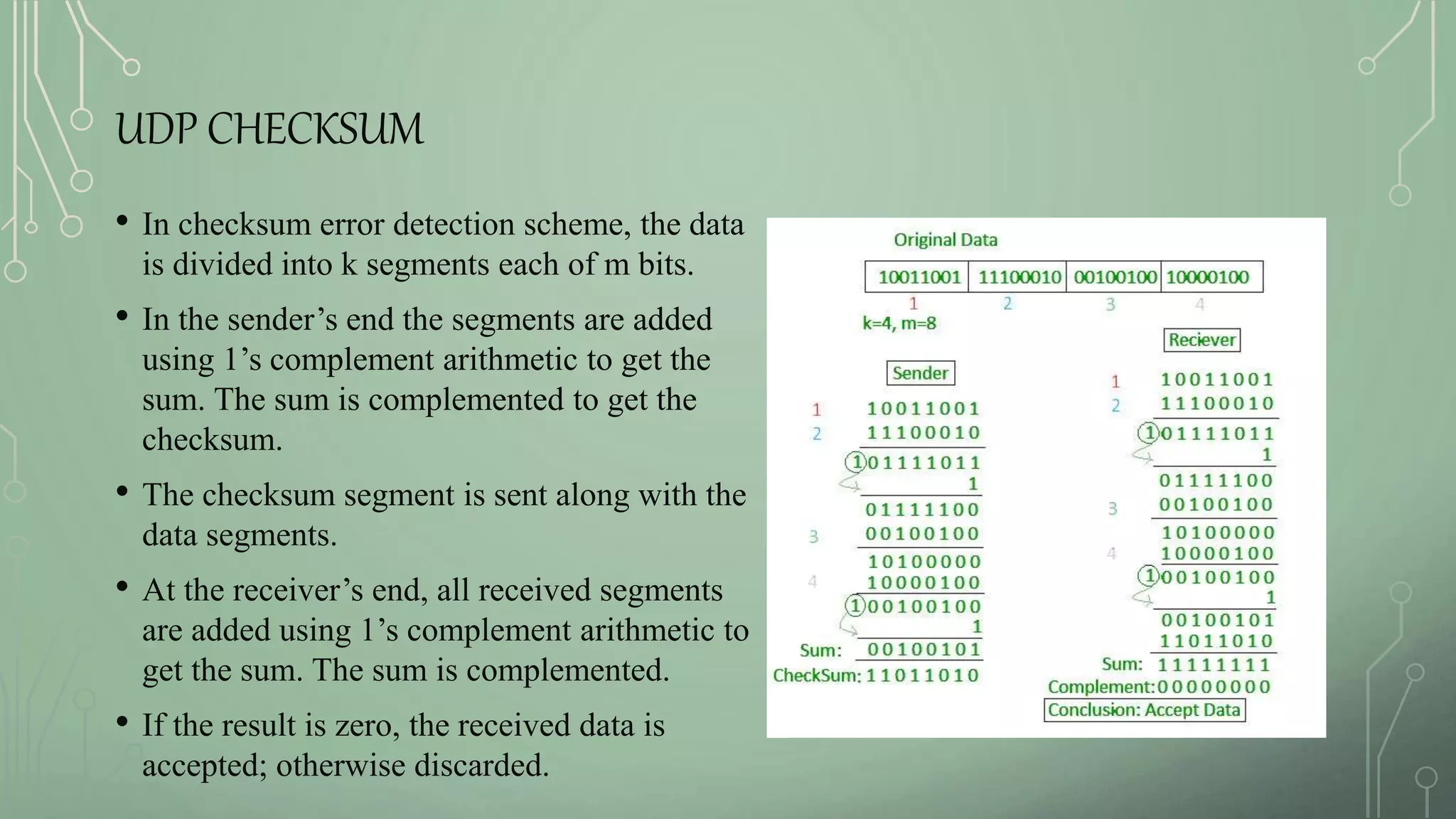
• In checksum error detection scheme, the data
is divided into k segments each of m bits.
• In the sender’s end the segments are added
using 1’s complement arithmetic to get the
sum. The sum is complemented to get the
checksum.
• The checksum segment is sent along with the
data segments.
• At the receiver’s end, all received segments
are added using 1’s complement arithmetic to
get the sum. The sum is complemented.
• If the result is zero, the received data is
accepted; otherwise discarded.
CRC(CYCLIC REDUNDANCY CHECK)
• Unlike checksum scheme, which is based on
addition, CRC is based on binary division.
• In CRC, a sequence of redundant bits, called
cyclic redundancy check bits, are appended to
the end of data unit so that the resulting data
unit becomes exactly divisible by a second,
predetermined binary number.
• At the destination, the incoming data unit is
divided by the same number. If at this step
there is no remainder, the data unit is assumed
to be correct and is therefore accepted.
• A remainder indicates that the data unit has
been damaged in transit and therefore must be
rejected.
PARITY CHECK
• Parity check is the process that ensures accurate data transmission between source and
destination.
• Created to eliminate communication errors
• Simple method of network data verification and has an easy and understandable working
mechanism
There are two methods of checking parity:
I. Simple Parity Check
II. Two Dimensional Parity Check
PARITY CHECK (CONT...)
Simple Parity Check
• Blocks of data from the source are
subjected to a check bit or parity bit
generator form, where a parity of :
• 1 is added to the block if it contains
odd number of 1’s, and
• 0 is added if it contains even number
of 1’s
Parity bit
PARITY CHECK (CONT...)
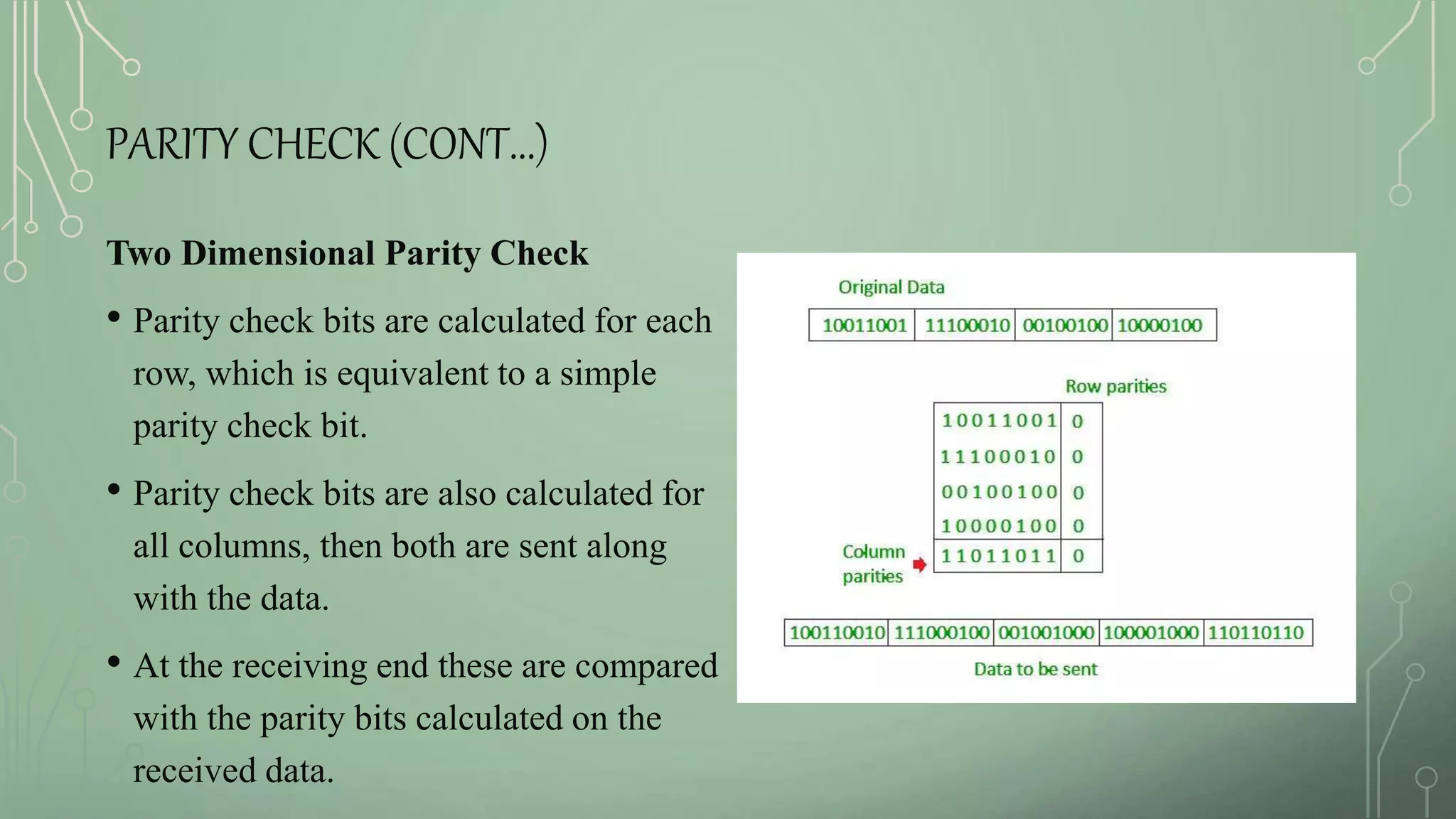
Two Dimensional Parity Check
• Parity check bits are calculated for each
row, which is equivalent to a simple
parity check bit.
• Parity check bits are also calculated for
all columns, then both are sent along
with the data.
• At the receiving end these are compared
with the parity bits calculated on the
received data.
CONGESTION CONTROL
• A situation in communication networks in which too many packets are
present in a part of the subnet performance degrades.
• May occur when the load on the network is greater than the capacity of the
network.
• Network congestion occurs in case of traffic overloading.
• Refers to techniques and mechanisms that can either prevent congestion
before it happens or remove congestion after it has happened.
CONGESTION CONTROL(CONTINUES)
Causes of congestion:
• The input traffic rate exceeds the capacity of the output lines
• The routers are too slow to perform
• The routers' buffer is too limited
• The processors are slow
• Slow links
CONGESTION CONTROL(CONTINUES)
Congestion control mechanisms:
• Open loop congestion control
• Closed loop congestion control.
CONGESTION CONTROL(CONTINUES)
The various methods used for open loop congestion control are:
i. Retransmission policy
ii. Window policy
iii.Acknowledgement policy
iv.Discarding policy
CONGESTION CONTROL(CONTINUES)
The various methods used for closed loop congestion control are:
i. Backpressure
ii. Choke packet
iii.Implicit signaling
iv.Explicit signaling
TOKEN RING NETWORK
• A token ring network is a local area network (LAN).
• All computers are connected in a ring or star topology.
• Pass one or more logical tokens from host to host.
• Only a host that holds a token can send data, and tokens are released
when receipt of the data is confirmed.
TOKEN RING NETWORK (CONT..)
Works Of Token Ring :
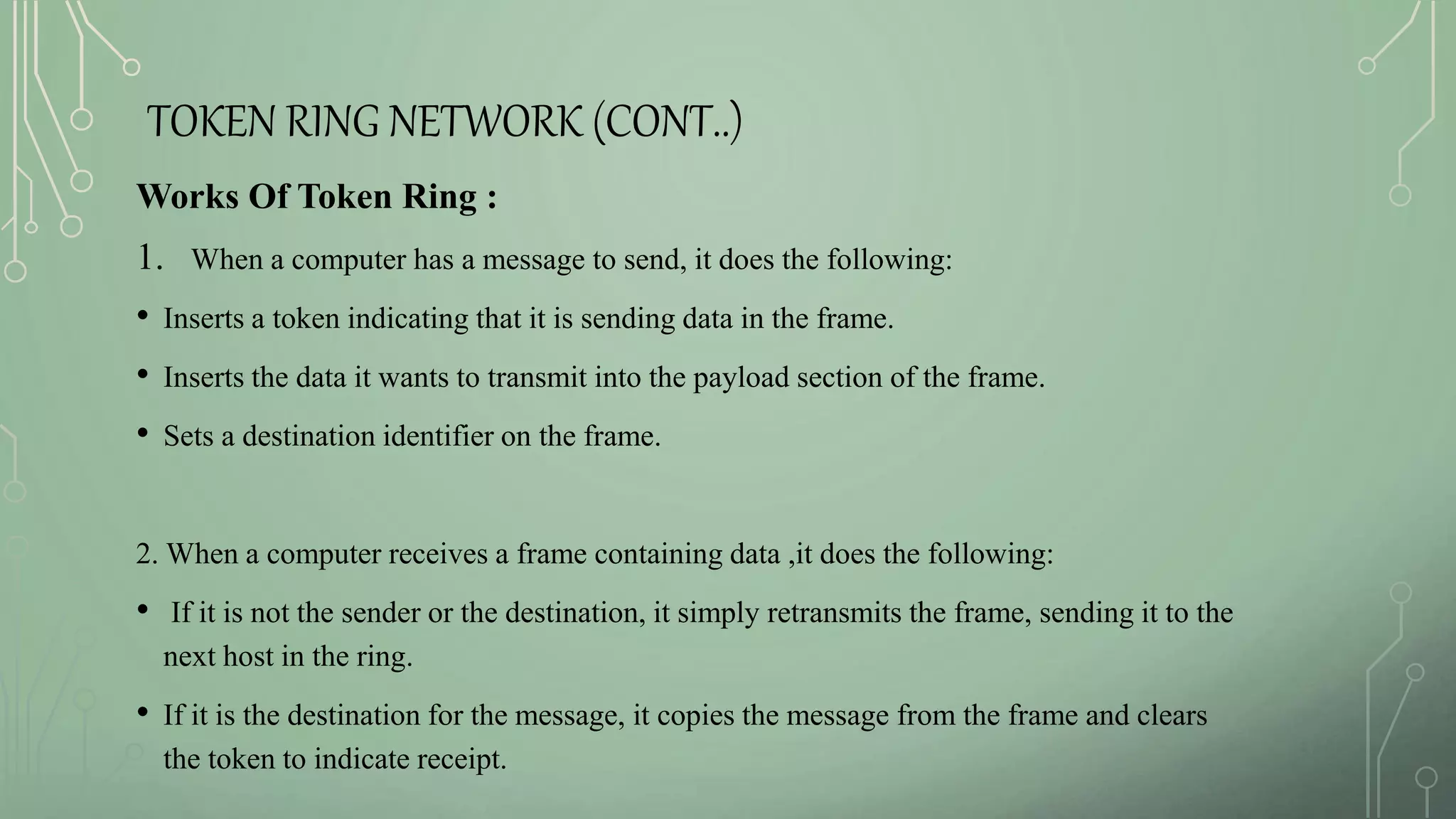
1. When a computer has a message to send, it does the following:
• Inserts a token indicating that it is sending data in the frame.
• Inserts the data it wants to transmit into the payload section of the frame.
• Sets a destination identifier on the frame.
2. When a computer receives a frame containing data ,it does the following:
• If it is not the sender or the destination, it simply retransmits the frame, sending it to the
next host in the ring.
• If it is the destination for the message, it copies the message from the frame and clears
the token to indicate receipt.
TOKEN RING NETWORK (CONT..)
Advantages of Token Ring:
• Reduced chances of data collision .
• Makes ring topology perform better than bus topology under heavy traffic.
• No need of server to control connectivity among the nodes.
Disadvantages Of Token Ring:
• A data packet must pass through all the nodes
• If a node goes down entire network goes down.
FIBER DISTRIBUTED DATA INTERFACE (FDDI)
• A set of ANSI and ISO standards
• It is a standard for data transmission in a local area network over fiber optic cables.
• It is applicable in large LANs that can extend up to 200 kilometers in diameter.
• Using copper cable it may be called CDDI ( Copper Distributed Data Interface).
• It is also referred to as TP-DDI (Twisted-Pair Distributed Data Interface).
• Used in mission critical and high traffic networks, in a large network of high
bandwidth, used in business, hospitals, markets and other medical fields.
FDDI (CONT...)
Features:
• FDDI uses optical fiber as its physical medium.
• It operates in the physical and medium access control (MAC layer) of the Open
Systems Interconnection (OSI) network model.
• It provides high data rate of 100 Mbps and can support thousands of users.
• It is used in LANs up to 200 kilometers for long distance voice and multimedia
communication.
• FDDI technology can also be used as a backbone for a wide area network
(WAN).
Frame Format:
The fields of an FDDI frame are −
• Preamble: 1 byte for synchronization.
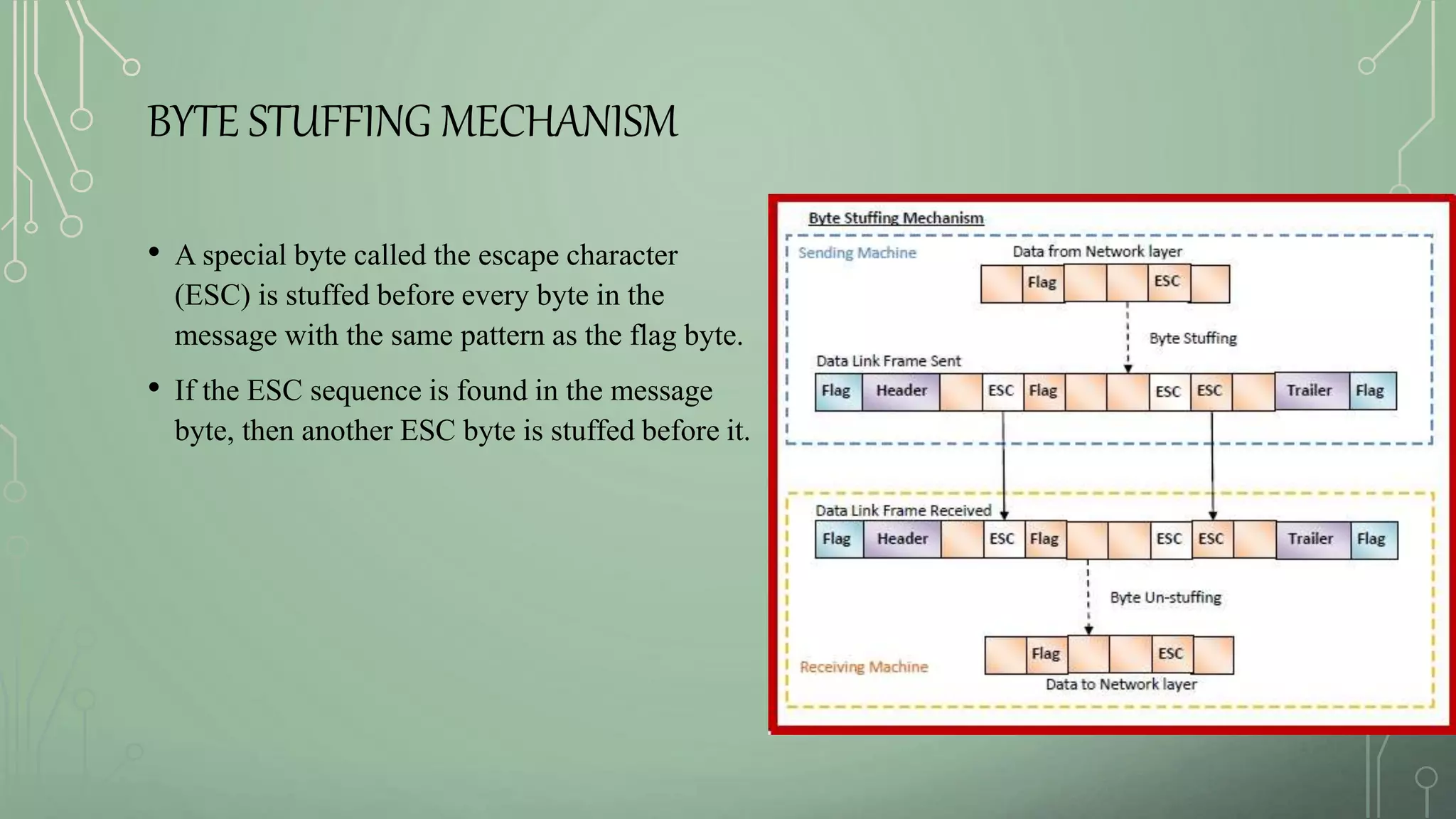
• Start Delimiter: 1 byte that marks the beginning of the frame.
• Frame Control: 1 byte that specifies whether this is a data frame or control frame.
• Destination Address: 2-6 bytes that specifies address of destination station.
• Source Address: 2-6 bytes that specifies address of source station.
• Payload: A variable length field that carries the data from the network layer.
• Checksum: 4 bytes frame check sequence for error detection.
• End Delimiter: 1 byte that marks the end of the frame.
FDDI (CONT...)
FDDI (CONT..)
Advantages of FDDI:
• It offers higher bandwidth (upto 250 Gbps).
• It offers high security .
• Fiber optic cable does not break as easily as other types of cables.
• FDDI uses multiple tokens to improve network speed.
• It is possible to provide priority to the work stations connected in the
chain.
• FDDI can isolate faulty nodes with use of wiring concentrators for
instantaneous re-routing.
FDDI (CONT..)
Disadvantages of FDDI:
• FDDI is complex.
• FDDI is costly. This is because fiber optic cable, adapters and
concentrators are very expensive.
BRIDGE
• In telecommunication networks, a bridge is
a
• product that connects a local area network
(LAN) to another local area network.
• Operates in both the PHYSICAL and the
DATALINK layer.
• Passing messages known to be within the
same LAN.
• Forwarding messages known to be on the
other interconnected LANs.
HOW BRIDGE WORKS
• Bridges work at the Media Access Control
Sub-layer of the OSI model
• Routing table is built to record the segment
no. of address
• If destination address is in the same segment
as the source address, stop transmit
• Otherwise, forward to the other segment
CHARECTERISTIC OF BRIDGE
• Routing Table:
- Contains one entry per station of network to which bridge is connected.
• Filtering:
- Is used by bridge to allow only those packets destined to the remote network.
• Forwarding:
- the process of passing a packet from one network to another.
• Learning algorithm:
- the process by which the bridge learns how to reach stations on the
internetwork.
TYPES OF BRIDGING
1. Simple Bridge
2. Multiport Bridge
3. Transparent Bridge
4. Source Routing Bridge
SIMPLE BRIDGE
• A simple bridge connects two network segments.
• Typically by operating transparently and deciding on a frame-by-frame.
• A store and forward technique is typically used so, during forwarding
• Bridges reduce collisions by partitioning the collision domain.
MULTIPORT BRIDGE
• A multiport bridge connects multiple
networks and operates transparently to
decide on a frame-by-frame.
• It works on the basis whether and where to
forward traffic.
• It also uses store and forward operation.
TRANSPARENT BRIDGE
• Also called learning bridges
• Build a table of MAC addresses as frames
arrive
• Ethernet networks use transparent bridge
• Duties of transparent bridge are : Filtering
frames, forwarding and blocking
SOURCE ROUTING BRIDGE
• Used in Token Ring networks
• Each station should determine the route to the
destination.
• Addresses of these bridges are included in the
frame.
• Frame contains the source and destination
address.
• Frame also contains the bridge addresses.
BRIDGE
Advantages of bridging:
• Extend Physical network
• Reduce network traffic with minor segmentation
• Creates separate collision domains
• Reduce collisions
• Connect different architecture
Disadvantages of bridging:
• Slower that repeaters due to filtering
• Do not filter broadcasts
• More expensive than repeaters
ATM LAN EMULATION
• A protocol that allows existing
networked applications and protocols to run
over an ATM backbone.
• LANs are connectionless while ATM is a
connection-oriented technology.
• To provide a means for ATM hardware and
networks.
• Work at the MAC (layer 2) networking layer of
the OSI model
• The main objective of LAN emulation is to
allow existing applications to access the ATM
network by way of MAC drivers as if they were
running over traditional LAN's.
Connections:
There are two classes of connections utilized within LAN Emulation.
1.Control connections.
2. Data connections.
Protocol Overview:
describes how the various phases of the protocol accomplish the goal of getting
multiple stations to communicate within the ATM network environment.
ATM LAN EMULATION (CONT.)
Advantages of LANE:
• The advantage of LAN Emulation over ATM is that existing
applications and protocols can be adapted to ATM merely by installing
new ATM interfaces and drivers.
Disadvantages of LANE:
• These driver interfaces do not expose any of the benefits of ATM such
as varying qualities of service, full ATM addressing and other non-
LAN protocol type applications. For these uses, the ATM Forum is
developing a Native Service Interface which will define how new
applications can be adapted to ATM networks.
ATM LAN EMULATION (CONT.)
BYTE STUFFING
• A mechanism to convert a message formed of a sequence of bytes that
may contain reserved values.
• A byte is stuffed in the message to differentiate from the delimiter
• Also called character-oriented framing.
BIT STUFFING
• A mechanism of inserting one or more non-information bits into a
message to be transmitted, to break up the message sequence, for
synchronization purpose.
• A pattern of bits of arbitrary length is stuffed in the message to
differentiate from the delimiter.
• Also called bit - oriented framing.
DATA LINK LAYER FRAMES IN
BIT BYTE STUFFING
A data link frame has the following parts:
• Frame Header
• Payload
• Trailer
• Flags
BYTE STUFFING MECHANISM
• A special byte called the escape character
(ESC) is stuffed before every byte in the
message with the same pattern as the flag byte.
• If the ESC sequence is found in the message
byte, then another ESC byte is stuffed before it.
BIT STUFFING MECHANISM
• To differentiate the message from the flag in
case of same sequence, a single bit is stuffed
in the message.
• Whenever a 0 bit is followed by five
consecutive 1bits in the message, an extra 0 bit
is stuffed at the end of the five 1s.
• When the receiver receives the message, it
removes the stuffed 0s after each sequence of
five 1s.
• The un-stuffed message is then sent to the
upper layers.
THANK YOU

Computer Network

  • 1.
  • 2.
    Contents Of This presentation 1. UDPChecksum 2. CRC 3. Parity Check 5. Token Ring and FDDI 4. Congestion Control 7. ATM LAN emulation 6. Bridges 8. Bit and Byte stuffing
  • 3.
    UDP CHECKSUM • Inchecksum error detection scheme, the data is divided into k segments each of m bits. • In the sender’s end the segments are added using 1’s complement arithmetic to get the sum. The sum is complemented to get the checksum. • The checksum segment is sent along with the data segments. • At the receiver’s end, all received segments are added using 1’s complement arithmetic to get the sum. The sum is complemented. • If the result is zero, the received data is accepted; otherwise discarded.
  • 4.
    CRC(CYCLIC REDUNDANCY CHECK) •Unlike checksum scheme, which is based on addition, CRC is based on binary division. • In CRC, a sequence of redundant bits, called cyclic redundancy check bits, are appended to the end of data unit so that the resulting data unit becomes exactly divisible by a second, predetermined binary number. • At the destination, the incoming data unit is divided by the same number. If at this step there is no remainder, the data unit is assumed to be correct and is therefore accepted. • A remainder indicates that the data unit has been damaged in transit and therefore must be rejected.
  • 5.
    PARITY CHECK • Paritycheck is the process that ensures accurate data transmission between source and destination. • Created to eliminate communication errors • Simple method of network data verification and has an easy and understandable working mechanism There are two methods of checking parity: I. Simple Parity Check II. Two Dimensional Parity Check
  • 6.
  • 7.
    PARITY CHECK (CONT...) SimpleParity Check • Blocks of data from the source are subjected to a check bit or parity bit generator form, where a parity of : • 1 is added to the block if it contains odd number of 1’s, and • 0 is added if it contains even number of 1’s Parity bit
  • 8.
    PARITY CHECK (CONT...) TwoDimensional Parity Check • Parity check bits are calculated for each row, which is equivalent to a simple parity check bit. • Parity check bits are also calculated for all columns, then both are sent along with the data. • At the receiving end these are compared with the parity bits calculated on the received data.
  • 9.
    CONGESTION CONTROL • Asituation in communication networks in which too many packets are present in a part of the subnet performance degrades. • May occur when the load on the network is greater than the capacity of the network. • Network congestion occurs in case of traffic overloading. • Refers to techniques and mechanisms that can either prevent congestion before it happens or remove congestion after it has happened.
  • 10.
    CONGESTION CONTROL(CONTINUES) Causes ofcongestion: • The input traffic rate exceeds the capacity of the output lines • The routers are too slow to perform • The routers' buffer is too limited • The processors are slow • Slow links
  • 11.
    CONGESTION CONTROL(CONTINUES) Congestion controlmechanisms: • Open loop congestion control • Closed loop congestion control.
  • 12.
    CONGESTION CONTROL(CONTINUES) The variousmethods used for open loop congestion control are: i. Retransmission policy ii. Window policy iii.Acknowledgement policy iv.Discarding policy
  • 13.
    CONGESTION CONTROL(CONTINUES) The variousmethods used for closed loop congestion control are: i. Backpressure ii. Choke packet iii.Implicit signaling iv.Explicit signaling
  • 14.
    TOKEN RING NETWORK •A token ring network is a local area network (LAN). • All computers are connected in a ring or star topology. • Pass one or more logical tokens from host to host. • Only a host that holds a token can send data, and tokens are released when receipt of the data is confirmed.
  • 15.
  • 16.
    TOKEN RING NETWORK(CONT..) Works Of Token Ring : 1. When a computer has a message to send, it does the following: • Inserts a token indicating that it is sending data in the frame. • Inserts the data it wants to transmit into the payload section of the frame. • Sets a destination identifier on the frame. 2. When a computer receives a frame containing data ,it does the following: • If it is not the sender or the destination, it simply retransmits the frame, sending it to the next host in the ring. • If it is the destination for the message, it copies the message from the frame and clears the token to indicate receipt.
  • 17.
    TOKEN RING NETWORK(CONT..) Advantages of Token Ring: • Reduced chances of data collision . • Makes ring topology perform better than bus topology under heavy traffic. • No need of server to control connectivity among the nodes. Disadvantages Of Token Ring: • A data packet must pass through all the nodes • If a node goes down entire network goes down.
  • 18.
    FIBER DISTRIBUTED DATAINTERFACE (FDDI) • A set of ANSI and ISO standards • It is a standard for data transmission in a local area network over fiber optic cables. • It is applicable in large LANs that can extend up to 200 kilometers in diameter. • Using copper cable it may be called CDDI ( Copper Distributed Data Interface). • It is also referred to as TP-DDI (Twisted-Pair Distributed Data Interface). • Used in mission critical and high traffic networks, in a large network of high bandwidth, used in business, hospitals, markets and other medical fields.
  • 19.
    FDDI (CONT...) Features: • FDDIuses optical fiber as its physical medium. • It operates in the physical and medium access control (MAC layer) of the Open Systems Interconnection (OSI) network model. • It provides high data rate of 100 Mbps and can support thousands of users. • It is used in LANs up to 200 kilometers for long distance voice and multimedia communication. • FDDI technology can also be used as a backbone for a wide area network (WAN).
  • 20.
    Frame Format: The fieldsof an FDDI frame are − • Preamble: 1 byte for synchronization. • Start Delimiter: 1 byte that marks the beginning of the frame. • Frame Control: 1 byte that specifies whether this is a data frame or control frame. • Destination Address: 2-6 bytes that specifies address of destination station. • Source Address: 2-6 bytes that specifies address of source station. • Payload: A variable length field that carries the data from the network layer. • Checksum: 4 bytes frame check sequence for error detection. • End Delimiter: 1 byte that marks the end of the frame. FDDI (CONT...)
  • 21.
    FDDI (CONT..) Advantages ofFDDI: • It offers higher bandwidth (upto 250 Gbps). • It offers high security . • Fiber optic cable does not break as easily as other types of cables. • FDDI uses multiple tokens to improve network speed. • It is possible to provide priority to the work stations connected in the chain. • FDDI can isolate faulty nodes with use of wiring concentrators for instantaneous re-routing.
  • 22.
    FDDI (CONT..) Disadvantages ofFDDI: • FDDI is complex. • FDDI is costly. This is because fiber optic cable, adapters and concentrators are very expensive.
  • 23.
    BRIDGE • In telecommunicationnetworks, a bridge is a • product that connects a local area network (LAN) to another local area network. • Operates in both the PHYSICAL and the DATALINK layer. • Passing messages known to be within the same LAN. • Forwarding messages known to be on the other interconnected LANs.
  • 24.
    HOW BRIDGE WORKS •Bridges work at the Media Access Control Sub-layer of the OSI model • Routing table is built to record the segment no. of address • If destination address is in the same segment as the source address, stop transmit • Otherwise, forward to the other segment
  • 25.
    CHARECTERISTIC OF BRIDGE •Routing Table: - Contains one entry per station of network to which bridge is connected. • Filtering: - Is used by bridge to allow only those packets destined to the remote network. • Forwarding: - the process of passing a packet from one network to another. • Learning algorithm: - the process by which the bridge learns how to reach stations on the internetwork.
  • 26.
    TYPES OF BRIDGING 1.Simple Bridge 2. Multiport Bridge 3. Transparent Bridge 4. Source Routing Bridge
  • 27.
    SIMPLE BRIDGE • Asimple bridge connects two network segments. • Typically by operating transparently and deciding on a frame-by-frame. • A store and forward technique is typically used so, during forwarding • Bridges reduce collisions by partitioning the collision domain.
  • 28.
    MULTIPORT BRIDGE • Amultiport bridge connects multiple networks and operates transparently to decide on a frame-by-frame. • It works on the basis whether and where to forward traffic. • It also uses store and forward operation.
  • 29.
    TRANSPARENT BRIDGE • Alsocalled learning bridges • Build a table of MAC addresses as frames arrive • Ethernet networks use transparent bridge • Duties of transparent bridge are : Filtering frames, forwarding and blocking
  • 30.
    SOURCE ROUTING BRIDGE •Used in Token Ring networks • Each station should determine the route to the destination. • Addresses of these bridges are included in the frame. • Frame contains the source and destination address. • Frame also contains the bridge addresses.
  • 31.
    BRIDGE Advantages of bridging: •Extend Physical network • Reduce network traffic with minor segmentation • Creates separate collision domains • Reduce collisions • Connect different architecture Disadvantages of bridging: • Slower that repeaters due to filtering • Do not filter broadcasts • More expensive than repeaters
  • 32.
    ATM LAN EMULATION •A protocol that allows existing networked applications and protocols to run over an ATM backbone. • LANs are connectionless while ATM is a connection-oriented technology. • To provide a means for ATM hardware and networks. • Work at the MAC (layer 2) networking layer of the OSI model • The main objective of LAN emulation is to allow existing applications to access the ATM network by way of MAC drivers as if they were running over traditional LAN's.
  • 33.
    Connections: There are twoclasses of connections utilized within LAN Emulation. 1.Control connections. 2. Data connections. Protocol Overview: describes how the various phases of the protocol accomplish the goal of getting multiple stations to communicate within the ATM network environment. ATM LAN EMULATION (CONT.)
  • 34.
    Advantages of LANE: •The advantage of LAN Emulation over ATM is that existing applications and protocols can be adapted to ATM merely by installing new ATM interfaces and drivers. Disadvantages of LANE: • These driver interfaces do not expose any of the benefits of ATM such as varying qualities of service, full ATM addressing and other non- LAN protocol type applications. For these uses, the ATM Forum is developing a Native Service Interface which will define how new applications can be adapted to ATM networks. ATM LAN EMULATION (CONT.)
  • 35.
    BYTE STUFFING • Amechanism to convert a message formed of a sequence of bytes that may contain reserved values. • A byte is stuffed in the message to differentiate from the delimiter • Also called character-oriented framing.
  • 36.
    BIT STUFFING • Amechanism of inserting one or more non-information bits into a message to be transmitted, to break up the message sequence, for synchronization purpose. • A pattern of bits of arbitrary length is stuffed in the message to differentiate from the delimiter. • Also called bit - oriented framing.
  • 37.
    DATA LINK LAYERFRAMES IN BIT BYTE STUFFING A data link frame has the following parts: • Frame Header • Payload • Trailer • Flags
  • 38.
    BYTE STUFFING MECHANISM •A special byte called the escape character (ESC) is stuffed before every byte in the message with the same pattern as the flag byte. • If the ESC sequence is found in the message byte, then another ESC byte is stuffed before it.
  • 39.
    BIT STUFFING MECHANISM •To differentiate the message from the flag in case of same sequence, a single bit is stuffed in the message. • Whenever a 0 bit is followed by five consecutive 1bits in the message, an extra 0 bit is stuffed at the end of the five 1s. • When the receiver receives the message, it removes the stuffed 0s after each sequence of five 1s. • The un-stuffed message is then sent to the upper layers.
  • 40.