DATA COMMUNICATION
TERMINOLOGY
NEERAJ PANDEY
CSE 4TH YEAR
CONTENT
 CHANNEL
 BAUD
 BANDWIDTH
 DATA TRANSFER RATE
 TRANSMISSION MEDIA
CHANNEL
 Physical medium like cables over which information is exchanged
 A medium that is used to carry information or data from one point to
another.
BAUD
 The unit of measurement for the information carrying capacity of
communication channel.
 One baud is one electronic state change per second.
 Since a single state change can involve more than a single bit of data, the
bps unit of measurement has replaced it as a better expression of data
transmission speed.
BANDWIDTH
 Data carrying capacity of a channel or medium
 Data transfer rates that can be supported by a network
 It is measured in bits per second (bps).
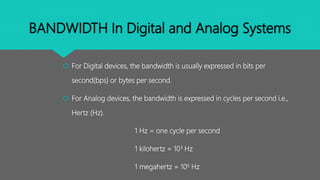
BANDWIDTH In Digital and Analog Systems
 For Digital devices, the bandwidth is usually expressed in bits per
second(bps) or bytes per second.
 For Analog devices, the bandwidth is expressed in cycles per second i.e.,
Hertz (Hz).
1 Hz = one cycle per second
1 kilohertz = 103 Hz
1 megahertz = 106 Hz
BANDWIDTH In Digital and Analog Systems
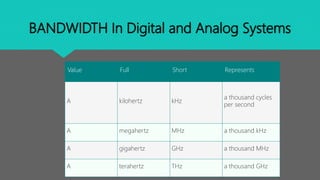
Value Full Short Represents
A kilohertz kHz
a thousand cycles
per second
A megahertz MHz a thousand kHz
A gigahertz GHz a thousand MHz
A terahertz THz a thousand GHz
DATA TRANSFER RATE
 The amount of data transferred per second
 Data rate is measured in units of either bps, Bps
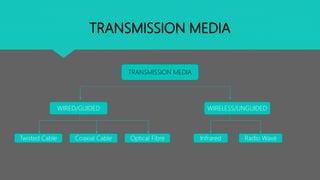
TRANSMISSION MEDIA
TRANSMISSION MEDIA
WIRED/GUIDED WIRELESS/UNGUIDED
Twisted Cable Coaxial Cable Optical Fibre Infrared Radio Wave
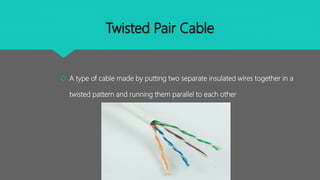
Twisted Pair Cable
 A type of cable made by putting two separate insulated wires together in a
twisted pattern and running them parallel to each other
Coaxial Cable
 Copper cables with better shielding than twisted pair cables, so that
transmitted signals may travel longer distances at higher speeds
 Stiff copper wire as core
 Insulating material surrounding the core
 Closely woven braided mesh of
conducting material surrounding
the insulator
 Protective plastic sheath encasing the wire
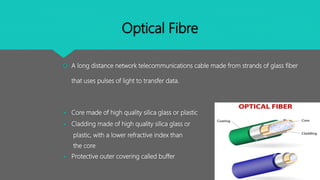
Optical Fibre
 A long distance network telecommunications cable made from strands of glass fiber
that uses pulses of light to transfer data.
 Core made of high quality silica glass or plastic
 Cladding made of high quality silica glass or
plastic, with a lower refractive index than
the core
 Protective outer covering called buffer
Infrared
 Low frequency infrared waves are used for very short distance
communication
 Infrared signals can propagate within a room but cannot penetrate walls.
Radio Wave
 Transmission of data using radio frequencies
 Radio stations transmit radio waves using transmitters, which are received
by the receiver installed in our devices
THANK YOU
HAVE A GOOD DAY

Data communication terminology

  • 1.
  • 2.
    CONTENT  CHANNEL  BAUD BANDWIDTH  DATA TRANSFER RATE  TRANSMISSION MEDIA
  • 3.
    CHANNEL  Physical mediumlike cables over which information is exchanged  A medium that is used to carry information or data from one point to another.
  • 4.
    BAUD  The unitof measurement for the information carrying capacity of communication channel.  One baud is one electronic state change per second.  Since a single state change can involve more than a single bit of data, the bps unit of measurement has replaced it as a better expression of data transmission speed.
  • 5.
    BANDWIDTH  Data carryingcapacity of a channel or medium  Data transfer rates that can be supported by a network  It is measured in bits per second (bps).
  • 6.
    BANDWIDTH In Digitaland Analog Systems  For Digital devices, the bandwidth is usually expressed in bits per second(bps) or bytes per second.  For Analog devices, the bandwidth is expressed in cycles per second i.e., Hertz (Hz). 1 Hz = one cycle per second 1 kilohertz = 103 Hz 1 megahertz = 106 Hz
  • 7.
    BANDWIDTH In Digitaland Analog Systems Value Full Short Represents A kilohertz kHz a thousand cycles per second A megahertz MHz a thousand kHz A gigahertz GHz a thousand MHz A terahertz THz a thousand GHz
  • 8.
    DATA TRANSFER RATE The amount of data transferred per second  Data rate is measured in units of either bps, Bps
  • 9.
    TRANSMISSION MEDIA TRANSMISSION MEDIA WIRED/GUIDEDWIRELESS/UNGUIDED Twisted Cable Coaxial Cable Optical Fibre Infrared Radio Wave
  • 10.
    Twisted Pair Cable A type of cable made by putting two separate insulated wires together in a twisted pattern and running them parallel to each other
  • 11.
    Coaxial Cable  Coppercables with better shielding than twisted pair cables, so that transmitted signals may travel longer distances at higher speeds  Stiff copper wire as core  Insulating material surrounding the core  Closely woven braided mesh of conducting material surrounding the insulator  Protective plastic sheath encasing the wire
  • 12.
    Optical Fibre  Along distance network telecommunications cable made from strands of glass fiber that uses pulses of light to transfer data.  Core made of high quality silica glass or plastic  Cladding made of high quality silica glass or plastic, with a lower refractive index than the core  Protective outer covering called buffer
  • 13.
    Infrared  Low frequencyinfrared waves are used for very short distance communication  Infrared signals can propagate within a room but cannot penetrate walls.
  • 14.
    Radio Wave  Transmissionof data using radio frequencies  Radio stations transmit radio waves using transmitters, which are received by the receiver installed in our devices
  • 15.