Designing Data
Architectures
for Robust Decision
Making
Gwen Shapira / Software Engineer
2©2014 Cloudera, Inc. All rights reserved.
• 15 years of moving data around
• Formerly consultant
• Now Cloudera Engineer:
– Sqoop Committer
– Kafka
– Flume
• @gwenshap
About Me
3©2014 Cloudera, Inc. All rights reserved.
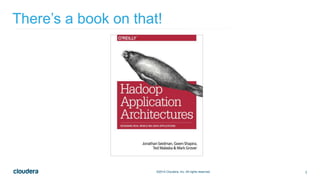
There’s a book on that!
4
About you:
You know Hadoop
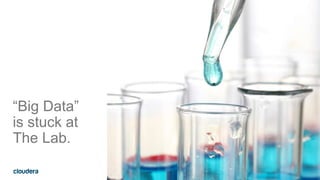
“Big Data”
is stuck at
The Lab.
6
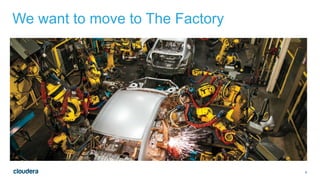
We want to move to The Factory
7Click to enter confidentiality information
8
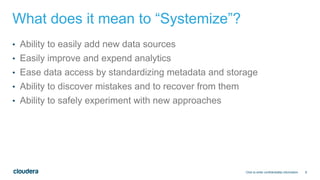
What does it mean to “Systemize”?
• Ability to easily add new data sources
• Easily improve and expend analytics
• Ease data access by standardizing metadata and storage
• Ability to discover mistakes and to recover from them
• Ability to safely experiment with new approaches
Click to enter confidentiality information
9
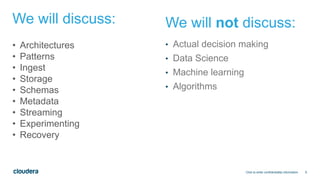
We will discuss:
• Actual decision making
• Data Science
• Machine learning
• Algorithms
Click to enter confidentiality information
We will not discuss:
• Architectures
• Patterns
• Ingest
• Storage
• Schemas
• Metadata
• Streaming
• Experimenting
• Recovery
10
So how do we build
real data
architectures?
Click to enter confidentiality information
11
The Data Bus
1212
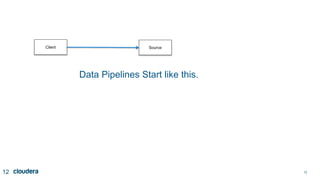
Client Source
Data Pipelines Start like this.
1313
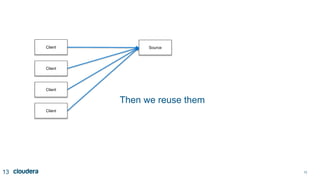
Client Source
Client
Client
Client
Then we reuse them
1414
Client Backend
Client
Client
Client
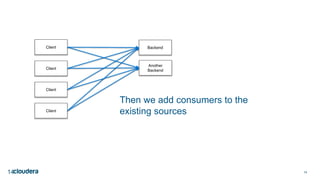
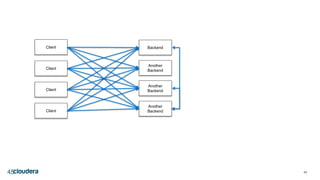
Then we add consumers to the
existing sources
Another
Backend
1515
Client Backend
Client
Client
Client
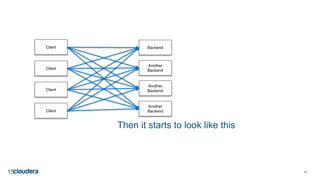
Then it starts to look like this
Another
Backend
Another
Backend
Another
Backend
1616
Client Backend
Client
Client
Client
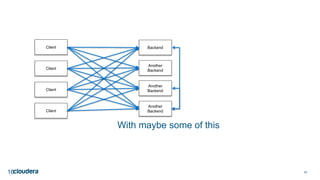
With maybe some of this
Another
Backend
Another
Backend
Another
Backend
17
Adding applications should be easier
We need:
• Shared infrastructure for sending records
• Infrastructure must scale
• Set of agreed-upon record schemas
18
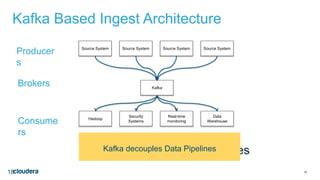
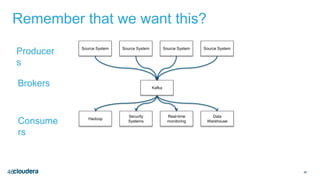
Kafka Based Ingest Architecture
18
Source System Source System Source System Source System
Kafka decouples Data Pipelines
Hadoop
Security
Systems
Real-time
monitoring
Data
Warehouse
Kafka
Producer
s
Brokers
Consume
rs
Kafka decouples Data Pipelines
19
Retain All Data
Click to enter confidentiality information
20
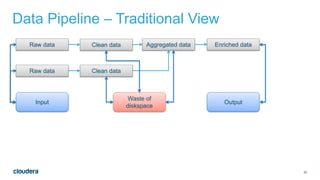
Data Pipeline – Traditional View
Raw data
Raw data Clean data
Aggregated dataClean data Enriched data
Input Output
Waste of
diskspace
21©2014 Cloudera, Inc. All rights reserved.
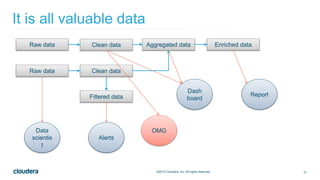
It is all valuable data
Raw data
Raw data Clean data
Aggregated dataClean data Enriched data
Filtered data
Dash
board
Report
Data
scientis
t
Alerts
OMG
22
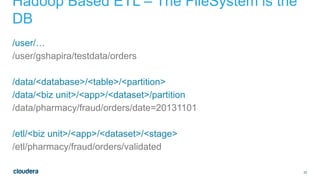
Hadoop Based ETL – The FileSystem is the
DB
/user/…
/user/gshapira/testdata/orders
/data/<database>/<table>/<partition>
/data/<biz unit>/<app>/<dataset>/partition
/data/pharmacy/fraud/orders/date=20131101
/etl/<biz unit>/<app>/<dataset>/<stage>
/etl/pharmacy/fraud/orders/validated
23
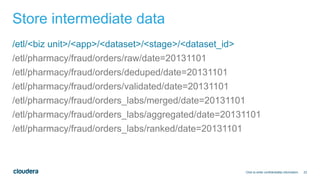
Store intermediate data
/etl/<biz unit>/<app>/<dataset>/<stage>/<dataset_id>
/etl/pharmacy/fraud/orders/raw/date=20131101
/etl/pharmacy/fraud/orders/deduped/date=20131101
/etl/pharmacy/fraud/orders/validated/date=20131101
/etl/pharmacy/fraud/orders_labs/merged/date=20131101
/etl/pharmacy/fraud/orders_labs/aggregated/date=20131101
/etl/pharmacy/fraud/orders_labs/ranked/date=20131101
Click to enter confidentiality information
24
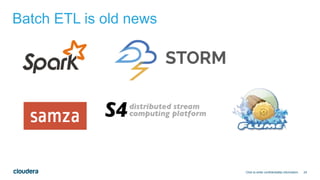
Batch ETL is old news
Click to enter confidentiality information
25
Small Problem!
• HDFS is optimized for large chunks of data
• Don’t write individual events of micro-batches
• Think 100M-2G batches
• What do we do with small events?
Click to enter confidentiality information
26
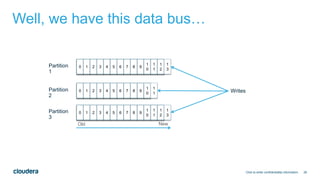
Well, we have this data bus…
Click to enter confidentiality information
0 1 2 3 4 5 6 7 8 9
1
0
1
1
1
2
1
3
0 1 2 3 4 5 6 7 8 9
1
0
1
1
0 1 2 3 4 5 6 7 8 9
1
0
1
1
1
2
1
3
Partition
1
Partition
2
Partition
3
Writes
Old New
27
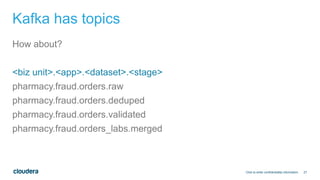
Kafka has topics
How about?
<biz unit>.<app>.<dataset>.<stage>
pharmacy.fraud.orders.raw
pharmacy.fraud.orders.deduped
pharmacy.fraud.orders.validated
pharmacy.fraud.orders_labs.merged
Click to enter confidentiality information
28©2014 Cloudera, Inc. All rights reserved.
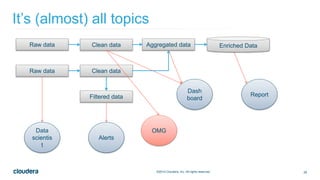
It’s (almost) all topics
Raw data
Raw data Clean data
Aggregated dataClean data
Filtered data
Dash
board
Report
Data
scientis
t
Alerts
OMG
Enriched Data
29
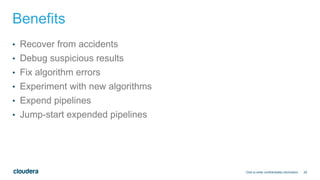
Benefits
• Recover from accidents
• Debug suspicious results
• Fix algorithm errors
• Experiment with new algorithms
• Expend pipelines
• Jump-start expended pipelines
Click to enter confidentiality information
30
Kinda Lambda
31
Lambda Architecture
• Immutable events
• Store intermediate stages
• Combine Batches and Streams
• Reprocessing
Click to enter confidentiality information
32
What we don’t like
Maintaining two applications
Often in two languages
That do the same thing
Click to enter confidentiality information
33
Pain Avoidance #1 – Use Spark +
SparkStreaming
• Spark is awesome for batch, so why not?
– The New Kid that isn’t that New Anymore
– Easily 10x less code
– Extremely Easy and Powerful API
– Very good for machine learning
– Scala, Java, and Python
– RDDs
– DAG Engine
Click to enter confidentiality information
34
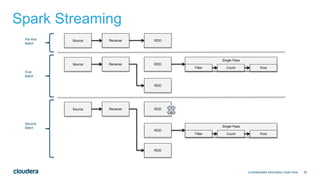
Spark Streaming
• Calling Spark in a Loop
• Extends RDDs with DStream
• Very Little Code Changes from ETL to Streaming
Confidentiality Information Goes Here
35
Spark Streaming
Confidentiality Information Goes Here
Single Pass
Source Receiver RDD
Source Receiver RDD
RDD
Filter Count Print
Source Receiver RDD
RDD
RDD
Single Pass
Filter Count Print
Pre-first
Batch
First
Batch
Second
Batch
36
Small Example
val sparkConf = new SparkConf()
.setMaster(args(0)).setAppName(this.getClass.getCanonicalName)
val ssc = new StreamingContext(sparkConf, Seconds(10))
// Create the DStream from data sent over the network
val dStream = ssc.socketTextStream(args(1), args(2).toInt, StorageLevel.MEMORY_AND_DISK_SER)
// Counting the errors in each RDD in the stream
val errCountStream = dStream.transform(rdd => ErrorCount.countErrors(rdd))
val stateStream = errCountStream.updateStateByKey[Int](updateFunc)
errCountStream.foreachRDD(rdd => {
System.out.println("Errors this minute:%d".format(rdd.first()._2))
})
Click to enter confidentiality information
37
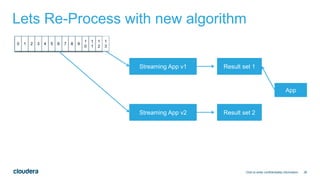
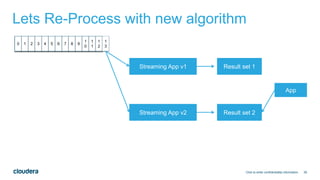
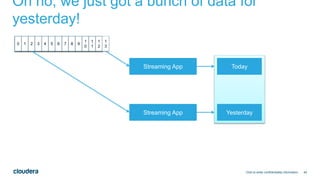
Pain Avoidance #2 – Split the Stream
Why do we even need stream + batch?
• Batch efficiencies
• Re-process to fix errors
• Re-process after delayed arrival
What if we could re-play data?
Click to enter confidentiality information
38
Lets Re-Process with new algorithm
Click to enter confidentiality information
0 1 2 3 4 5 6 7 8 9
1
0
1
1
1
2
1
3
Streaming App v1
Streaming App v2
Result set 1
Result set 2
App
39
Lets Re-Process with new algorithm
Click to enter confidentiality information
0 1 2 3 4 5 6 7 8 9
1
0
1
1
1
2
1
3
Streaming App v1
Streaming App v2
Result set 1
Result set 2
App
40
Oh no, we just got a bunch of data for
yesterday!
Click to enter confidentiality information
0 1 2 3 4 5 6 7 8 9
1
0
1
1
1
2
1
3
Streaming App
Streaming App
Today
Yesterday
41
Note:
No need to choose between the
approaches.
There are good reasons to do both.
Click to enter confidentiality information
42
Prediction:
Batch vs. Streaming distinction is going
away.
Click to enter confidentiality information
43
Yes, you really need
a Schema
Click to enter confidentiality information
44
Schema is a MUST HAVE for
data integration
Click to enter confidentiality information
4545
Client Backend
Client
Client
Client
Another
Backend
Another
Backend
Another
Backend
46
Remember that we want this?
46
Source System Source System Source System Source System
Hadoop
Security
Systems
Real-time
monitoring
Data
Warehouse
Kafka
Producer
s
Brokers
Consume
rs
47
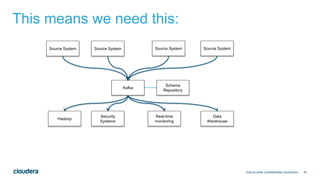
This means we need this:
Click to enter confidentiality information
Source System Source System Source System Source System
Hadoop
Security
Systems
Real-time
monitoring
Data
Warehouse
Kafka
Schema
Repository
48
We can do it in few ways
• People go around asking each other:
“So, what does the 5th field of the messages in topic Blah contain?”
• There’s utility code for reading/writing messages that everyone
reuses
• Schema embedded in the message
• A centralized repository for schemas
– Each message has Schema ID
– Each topic has Schema ID
Click to enter confidentiality information
49
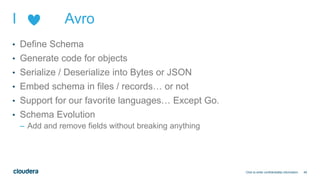
I Avro
• Define Schema
• Generate code for objects
• Serialize / Deserialize into Bytes or JSON
• Embed schema in files / records… or not
• Support for our favorite languages… Except Go.
• Schema Evolution
– Add and remove fields without breaking anything
Click to enter confidentiality information
50
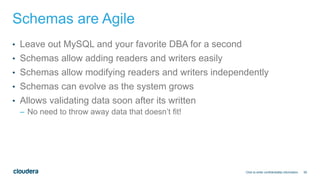
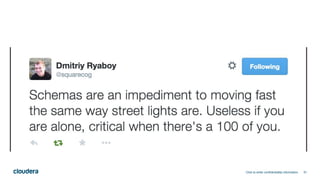
Schemas are Agile
• Leave out MySQL and your favorite DBA for a second
• Schemas allow adding readers and writers easily
• Schemas allow modifying readers and writers independently
• Schemas can evolve as the system grows
• Allows validating data soon after its written
– No need to throw away data that doesn’t fit!
Click to enter confidentiality information
51Click to enter confidentiality information
52
Woah, that was lots of
stuff!
Click to enter confidentiality information
53
Recap – if you remember nothing else…
• After the POC, its time for production
• Goal: Evolve fast without breaking things
For this you need:
• Keep all data
• Design pipeline for error recovery – batch or stream
• Integrate with a data bus
• And Schemas
Thank you

Data Architectures for Robust Decision Making

  • 1.
    Designing Data Architectures for RobustDecision Making Gwen Shapira / Software Engineer
  • 2.
    2©2014 Cloudera, Inc.All rights reserved. • 15 years of moving data around • Formerly consultant • Now Cloudera Engineer: – Sqoop Committer – Kafka – Flume • @gwenshap About Me
  • 3.
    3©2014 Cloudera, Inc.All rights reserved. There’s a book on that!
  • 4.
  • 5.
  • 6.
    6 We want tomove to The Factory
  • 7.
    7Click to enterconfidentiality information
  • 8.
    8 What does itmean to “Systemize”? • Ability to easily add new data sources • Easily improve and expend analytics • Ease data access by standardizing metadata and storage • Ability to discover mistakes and to recover from them • Ability to safely experiment with new approaches Click to enter confidentiality information
  • 9.
    9 We will discuss: •Actual decision making • Data Science • Machine learning • Algorithms Click to enter confidentiality information We will not discuss: • Architectures • Patterns • Ingest • Storage • Schemas • Metadata • Streaming • Experimenting • Recovery
  • 10.
    10 So how dowe build real data architectures? Click to enter confidentiality information
  • 11.
  • 12.
  • 13.
  • 14.
    1414 Client Backend Client Client Client Then weadd consumers to the existing sources Another Backend
  • 15.
    1515 Client Backend Client Client Client Then itstarts to look like this Another Backend Another Backend Another Backend
  • 16.
    1616 Client Backend Client Client Client With maybesome of this Another Backend Another Backend Another Backend
  • 17.
    17 Adding applications shouldbe easier We need: • Shared infrastructure for sending records • Infrastructure must scale • Set of agreed-upon record schemas
  • 18.
    18 Kafka Based IngestArchitecture 18 Source System Source System Source System Source System Kafka decouples Data Pipelines Hadoop Security Systems Real-time monitoring Data Warehouse Kafka Producer s Brokers Consume rs Kafka decouples Data Pipelines
  • 19.
    19 Retain All Data Clickto enter confidentiality information
  • 20.
    20 Data Pipeline –Traditional View Raw data Raw data Clean data Aggregated dataClean data Enriched data Input Output Waste of diskspace
  • 21.
    21©2014 Cloudera, Inc.All rights reserved. It is all valuable data Raw data Raw data Clean data Aggregated dataClean data Enriched data Filtered data Dash board Report Data scientis t Alerts OMG
  • 22.
    22 Hadoop Based ETL– The FileSystem is the DB /user/… /user/gshapira/testdata/orders /data/<database>/<table>/<partition> /data/<biz unit>/<app>/<dataset>/partition /data/pharmacy/fraud/orders/date=20131101 /etl/<biz unit>/<app>/<dataset>/<stage> /etl/pharmacy/fraud/orders/validated
  • 23.
    23 Store intermediate data /etl/<bizunit>/<app>/<dataset>/<stage>/<dataset_id> /etl/pharmacy/fraud/orders/raw/date=20131101 /etl/pharmacy/fraud/orders/deduped/date=20131101 /etl/pharmacy/fraud/orders/validated/date=20131101 /etl/pharmacy/fraud/orders_labs/merged/date=20131101 /etl/pharmacy/fraud/orders_labs/aggregated/date=20131101 /etl/pharmacy/fraud/orders_labs/ranked/date=20131101 Click to enter confidentiality information
  • 24.
    24 Batch ETL isold news Click to enter confidentiality information
  • 25.
    25 Small Problem! • HDFSis optimized for large chunks of data • Don’t write individual events of micro-batches • Think 100M-2G batches • What do we do with small events? Click to enter confidentiality information
  • 26.
    26 Well, we havethis data bus… Click to enter confidentiality information 0 1 2 3 4 5 6 7 8 9 1 0 1 1 1 2 1 3 0 1 2 3 4 5 6 7 8 9 1 0 1 1 0 1 2 3 4 5 6 7 8 9 1 0 1 1 1 2 1 3 Partition 1 Partition 2 Partition 3 Writes Old New
  • 27.
    27 Kafka has topics Howabout? <biz unit>.<app>.<dataset>.<stage> pharmacy.fraud.orders.raw pharmacy.fraud.orders.deduped pharmacy.fraud.orders.validated pharmacy.fraud.orders_labs.merged Click to enter confidentiality information
  • 28.
    28©2014 Cloudera, Inc.All rights reserved. It’s (almost) all topics Raw data Raw data Clean data Aggregated dataClean data Filtered data Dash board Report Data scientis t Alerts OMG Enriched Data
  • 29.
    29 Benefits • Recover fromaccidents • Debug suspicious results • Fix algorithm errors • Experiment with new algorithms • Expend pipelines • Jump-start expended pipelines Click to enter confidentiality information
  • 30.
  • 31.
    31 Lambda Architecture • Immutableevents • Store intermediate stages • Combine Batches and Streams • Reprocessing Click to enter confidentiality information
  • 32.
    32 What we don’tlike Maintaining two applications Often in two languages That do the same thing Click to enter confidentiality information
  • 33.
    33 Pain Avoidance #1– Use Spark + SparkStreaming • Spark is awesome for batch, so why not? – The New Kid that isn’t that New Anymore – Easily 10x less code – Extremely Easy and Powerful API – Very good for machine learning – Scala, Java, and Python – RDDs – DAG Engine Click to enter confidentiality information
  • 34.
    34 Spark Streaming • CallingSpark in a Loop • Extends RDDs with DStream • Very Little Code Changes from ETL to Streaming Confidentiality Information Goes Here
  • 35.
    35 Spark Streaming Confidentiality InformationGoes Here Single Pass Source Receiver RDD Source Receiver RDD RDD Filter Count Print Source Receiver RDD RDD RDD Single Pass Filter Count Print Pre-first Batch First Batch Second Batch
  • 36.
    36 Small Example val sparkConf= new SparkConf() .setMaster(args(0)).setAppName(this.getClass.getCanonicalName) val ssc = new StreamingContext(sparkConf, Seconds(10)) // Create the DStream from data sent over the network val dStream = ssc.socketTextStream(args(1), args(2).toInt, StorageLevel.MEMORY_AND_DISK_SER) // Counting the errors in each RDD in the stream val errCountStream = dStream.transform(rdd => ErrorCount.countErrors(rdd)) val stateStream = errCountStream.updateStateByKey[Int](updateFunc) errCountStream.foreachRDD(rdd => { System.out.println("Errors this minute:%d".format(rdd.first()._2)) }) Click to enter confidentiality information
  • 37.
    37 Pain Avoidance #2– Split the Stream Why do we even need stream + batch? • Batch efficiencies • Re-process to fix errors • Re-process after delayed arrival What if we could re-play data? Click to enter confidentiality information
  • 38.
    38 Lets Re-Process withnew algorithm Click to enter confidentiality information 0 1 2 3 4 5 6 7 8 9 1 0 1 1 1 2 1 3 Streaming App v1 Streaming App v2 Result set 1 Result set 2 App
  • 39.
    39 Lets Re-Process withnew algorithm Click to enter confidentiality information 0 1 2 3 4 5 6 7 8 9 1 0 1 1 1 2 1 3 Streaming App v1 Streaming App v2 Result set 1 Result set 2 App
  • 40.
    40 Oh no, wejust got a bunch of data for yesterday! Click to enter confidentiality information 0 1 2 3 4 5 6 7 8 9 1 0 1 1 1 2 1 3 Streaming App Streaming App Today Yesterday
  • 41.
    41 Note: No need tochoose between the approaches. There are good reasons to do both. Click to enter confidentiality information
  • 42.
    42 Prediction: Batch vs. Streamingdistinction is going away. Click to enter confidentiality information
  • 43.
    43 Yes, you reallyneed a Schema Click to enter confidentiality information
  • 44.
    44 Schema is aMUST HAVE for data integration Click to enter confidentiality information
  • 45.
  • 46.
    46 Remember that wewant this? 46 Source System Source System Source System Source System Hadoop Security Systems Real-time monitoring Data Warehouse Kafka Producer s Brokers Consume rs
  • 47.
    47 This means weneed this: Click to enter confidentiality information Source System Source System Source System Source System Hadoop Security Systems Real-time monitoring Data Warehouse Kafka Schema Repository
  • 48.
    48 We can doit in few ways • People go around asking each other: “So, what does the 5th field of the messages in topic Blah contain?” • There’s utility code for reading/writing messages that everyone reuses • Schema embedded in the message • A centralized repository for schemas – Each message has Schema ID – Each topic has Schema ID Click to enter confidentiality information
  • 49.
    49 I Avro • DefineSchema • Generate code for objects • Serialize / Deserialize into Bytes or JSON • Embed schema in files / records… or not • Support for our favorite languages… Except Go. • Schema Evolution – Add and remove fields without breaking anything Click to enter confidentiality information
  • 50.
    50 Schemas are Agile •Leave out MySQL and your favorite DBA for a second • Schemas allow adding readers and writers easily • Schemas allow modifying readers and writers independently • Schemas can evolve as the system grows • Allows validating data soon after its written – No need to throw away data that doesn’t fit! Click to enter confidentiality information
  • 51.
    51Click to enterconfidentiality information
  • 52.
    52 Woah, that waslots of stuff! Click to enter confidentiality information
  • 53.
    53 Recap – ifyou remember nothing else… • After the POC, its time for production • Goal: Evolve fast without breaking things For this you need: • Keep all data • Design pipeline for error recovery – batch or stream • Integrate with a data bus • And Schemas
  • 54.

Editor's Notes

  • #3 This gives me a lot of perspective regarding the use of Hadoop
  • #6 Not everyone, obviously. But I see a lot of “POC” type use-cases. 1 use case, maybe 3 data sources, 2 interesting insights from analysis. Everything requires lots of manual labor.
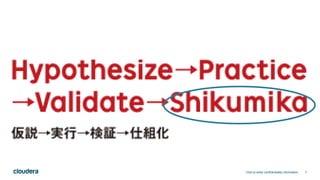
  • #8 Shikumika means “systemize.” This is the step that is crucial to improvement at any large entity. Shikumika means creating a base on which you can continue the improvement process. Because at an individual level, the original three steps are sufficient: build a hypothesis; act on it; and verify the results. If the validation proves the hypothesis to be the right one, you can simply continue acting on it. But for an entire organization, that’s not enough. The steps could end up as a hollow slogan. From the viewpoint of an organization, the cycle of hypothesizing, practicing and validating, conducted by an employee or a department, is a small experiment. If a hypothesis holds true in a small experiment, we can run with that hypothesis on a larger, organization-wide scale.
  • #9 We are looking for AGILE. The ability to expend, grow and evolve. To be flexible without adding tons of risk and overhead.
  • #14 Then we end up adding clients to use that source.
  • #15 But as we start to deploy our applications we realizet hat clients need data from a number of sources. So we add them as needed.
  • #17 But over time, particularly if we are segmenting services by function, we have stuff all over the place, and the dependencies are a nightmare. This makes for a fragile system.
  • #19 Kafka is a pub/sub messaging system that can decouple your data pipelines. Most of you are probably familiar with it’s history at LinkedIn and they use it as a high throughput relatively low latency commit log. It allows sources to push data without worrying about what clients are reading it. Note that producer push, and consumers pull. Kafka itself is a cluster of brokers, which handles both persisting data to disk and serving that data to consumer requests.
  • #42 Approach #1 – easier to develop and deploy in production. Doesn’t require a set of “spare” servers for the second stream Approach #2 – allows for real-time experiments
  • #43 There will be tools and patterns to move seamlessly between the two. Perhaps you won’t even need to care – just say how often you want the data refreshed – every day? Hour? 5 minutes? 5 seconds? 5 milliseconds?
  • #45 Sorry, but “Schema on Read” is kind of B.S. We admit that there is a schema, but we want to “ingest fast”, so we shift the burden to the readers. But the data is written once and read many many times by many different people. They each need to figure this out on their own? This makes no sense. Also, how are you going to validate the data without a schema?
  • #46 But over time, particularly if we are segmenting services by function, we have stuff all over the place, and the dependencies are a nightmare. This makes for a fragile system.
  • #47 Kafka is a pub/sub messaging system that can decouple your data pipelines. Most of you are probably familiar with it’s history at LinkedIn and they use it as a high throughput relatively low latency commit log. It allows sources to push data without worrying about what clients are reading it. Note that producer push, and consumers pull. Kafka itself is a cluster of brokers, which handles both persisting data to disk and serving that data to consumer requests.
  • #49 https://github.com/schema-repo/schema-repo