DATA ANALYTICS
FUNDAMENTALS:
D ATA A N A LY T I C S T Y P E S
A N D U S E C A S E S
Presented by
Dauda Emmanuel
CONTENT
Definition
Introduction
Why is Data Analysis Important
Data Analysis Process
Types of Data Analysis
Data Visualization
DEFINITION
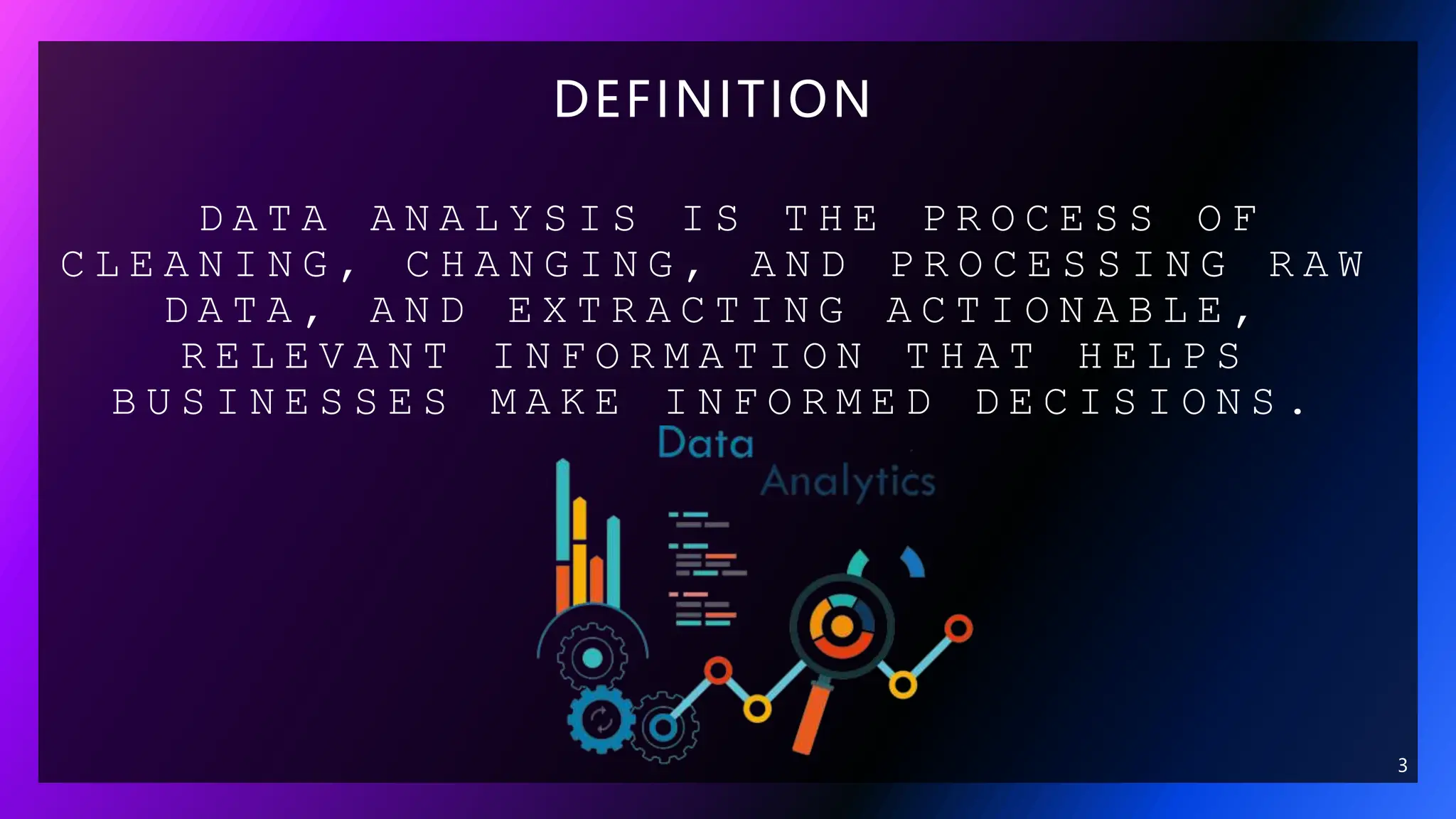
D A T A A N A L Y S I S I S T H E P R O C E S S O F
C L E A N I N G , C H A N G I N G , A N D P R O C E S S I N G R A W
D A T A , A N D E X T R A C T I N G A C T I O N A B L E ,
R E L E V A N T I N F O R M A T I O N T H A T H E L P S
B U S I N E S S E S M A K E I N F O R M E D D E C I S I O N S .
3
INTRODUCTION
4
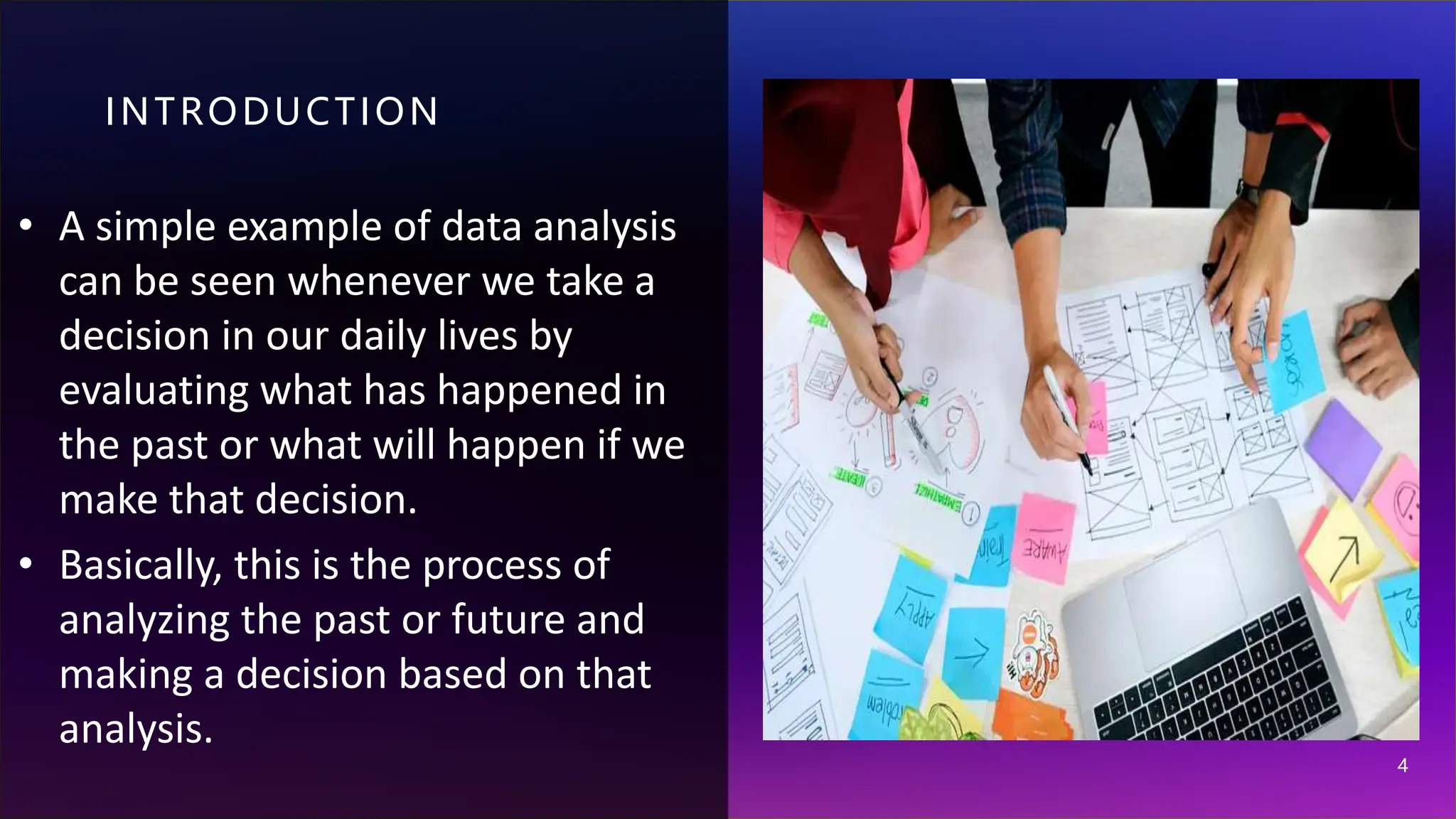
• A simple example of data analysis
can be seen whenever we take a
decision in our daily lives by
evaluating what has happened in
the past or what will happen if we
make that decision.
• Basically, this is the process of
analyzing the past or future and
making a decision based on that
analysis.
W H Y I S D ATA A N A LY S I S I M P O R TA N T ?
BETTER CUSTOMER TARGETING:
• YOU DON’T WANT TO WASTE YOUR
BUSINESS’S PRECIOUS TIME,
RESOURCES, AND MONEY PUTTING
TOGETHER ADVERTISING CAMPAIGNS
TARGETED AT DEMOGRAPHIC GROUPS
THAT HAVE LITTLE TO NO INTEREST IN
THE GOODS AND SERVICES YOU OFFER.
• DATA ANALYSIS HELPS YOU SEE WHERE
YOU SHOULD BE FOCUSING YOUR
ADVERTISING EFFORTS.
W H Y I S D ATA A N A LY S I S I M P O R TA N T ?
YOU WILL KNOW YOUR TARGET CUSTOMERS
BETTER:
• DATA ANALYSIS TRACKS HOW WELL YOUR
PRODUCTS AND CAMPAIGNS ARE
PERFORMING WITHIN YOUR TARGET
DEMOGRAPHIC.
• THROUGH DATA ANALYSIS, YOUR
BUSINESS CAN GET A BETTER IDEA OF
YOUR TARGET AUDIENCE’S SPENDING
HABITS, DISPOSABLE INCOME, AND
MOST LIKELY AREAS OF INTEREST
W H Y I S D ATA A N A LY S I S I M P O R TA N T ?
REDUCE OPERATIONAL COSTS:
DATA ANALYSIS SHOWS YOU WHICH AREAS
IN YOUR BUSINESS NEED MORE
RESOURCES AND MONEY, AND WHICH
AREAS ARE NOT PRODUCING AND THUS
SHOULD BE SCALED BACK OR ELIMINATED
OUTRIGHT.
W H Y I S D ATA A N A LY S I S I M P O R TA N T ?
BETTER PROBLEM-SOLVING METHODS:
INFORMED DECISIONS ARE MORE LIKELY
TO BE SUCCESSFUL DECISIONS. DATA
PROVIDES BUSINESSES WITH
INFORMATION. YOU CAN SEE WHERE THIS
PROGRESSION IS LEADING.
DATA ANALYSIS HELPS BUSINESSES MAKE
THE RIGHT CHOICES AND AVOID COSTLY
PITFALLS.
W H Y I S D ATA A N A LY S I S I M P O R TA N T ?
YOU GET MORE ACCURATE DATA:
DATA ANALYSIS HELPS BUSINESSES
ACQUIRE RELEVANT, ACCURATE
INFORMATION, SUITABLE FOR
DEVELOPING FUTURE MARKETING
STRATEGIES, BUSINESS PLANS, AND
REALIGNING THE COMPANY’S VISION OR
MISSION.
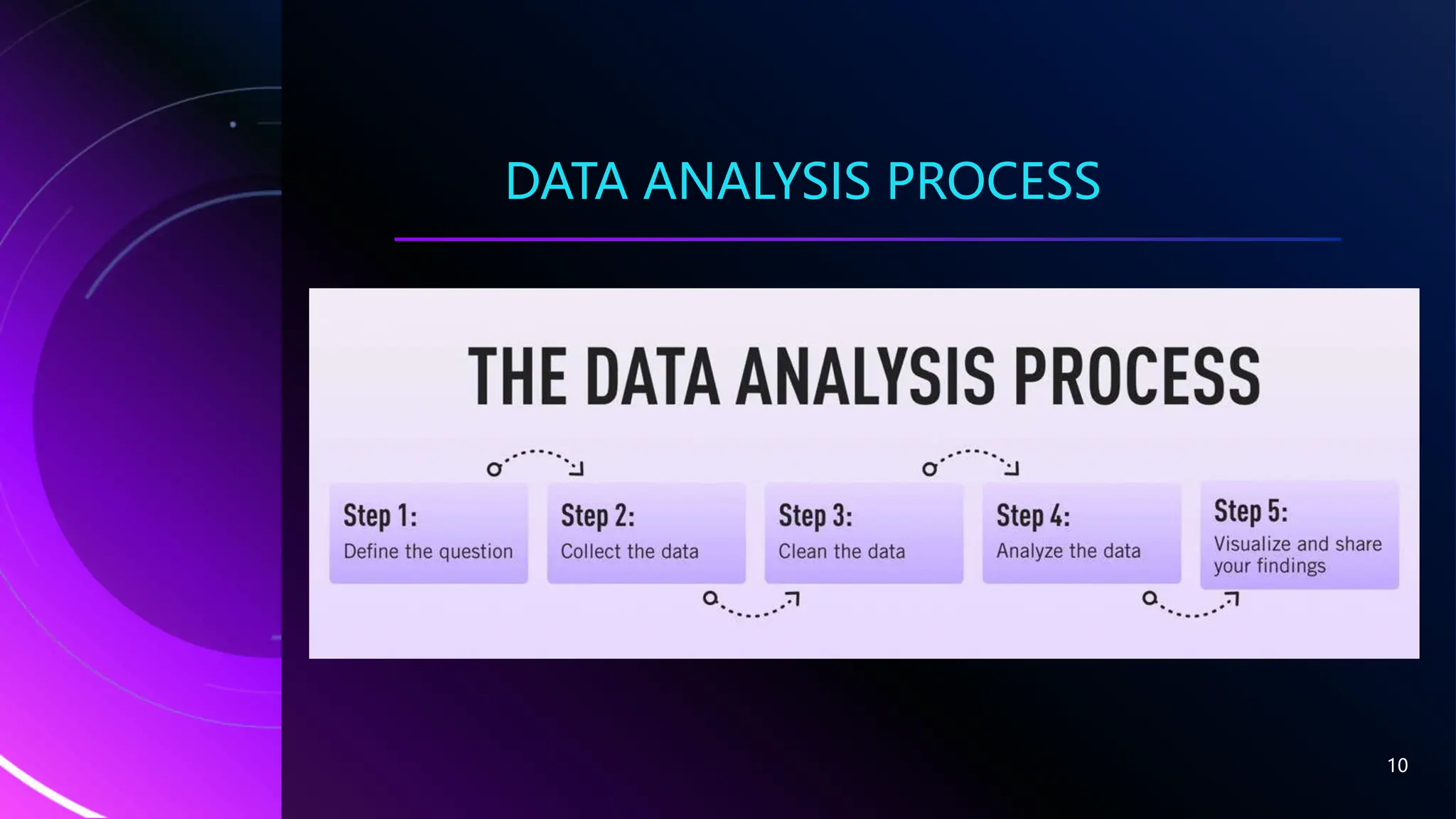
DATA ANALYSIS PROCESS
10
STEP 1: DEFINING THE QUESTION
The first step in any data analysis process is to define your
objective. This is sometimes called the ‘problem statement’.
Defining your objective means coming up with a hypothesis and
figuring how to test it.
Now you’ve defined a problem, you need to determine which
sources of data will best help you solve it.
11
STEP 2: COLLECTING THE DATA
Once you’ve established your objective, you’ll need to create a
strategy for collecting and aggregating the appropriate data. A key
part of this is determining which data you need. This might be
quantitative (numeric) data, e.g. sales figures, or qualitative
(descriptive) data, such as customer reviews. All data fit into one
of three categories: first-party, second-party, and third-party data.
12
STEP 3: CLEANING THE DATA
Once you’ve collected your data, the next step is to get it ready for analysis. This
means cleaning, or ‘scrubbing’ it, and is crucial in making sure that you’re
working with high-quality data. Key data cleaning tasks include:
 Removing major errors, duplicates, and outliers—all of which are inevitable
problems when aggregating data from numerous sources.
 Removing unwanted data points—extracting irrelevant observations that have
no bearing on your intended analysis.
 Bringing structure to your data—general ‘housekeeping’, i.e. fixing typos or
layout issues, which will help you map and manipulate your data more easily.
 Filling in major gaps—as you’re tidying up, you might notice that important
data are missing. Once you’ve identified gaps, you can go about filling them. 13
STEP 4: ANALYZING THE DATA
Finally, you’ve cleaned your data. Now comes the fun bit—analyzing
it! The type of data analysis you carry out largely depends on what
your goal is. But there are many techniques available. Univariate or
bivariate analysis, time-series analysis, and regression analysis are
just a few you might have heard of. More important than the different
types, though, is how you apply them. This depends on what insights
you’re hoping to gain.
14
STEP 5: SHARING YOUR RESULT
You’ve finished carrying out your analyses. You have your insights.
The final step of the data analytics process is to share these insights
with the wider world (or at least with your organization’s
stakeholders!) This is more complex than simply sharing the raw
results of your work—it involves interpreting the outcomes, and
presenting them in a manner that’s digestible for all types of
audiences.
15
TYPES OF DATA ANALYSIS
Diagnostic Analysis:
Diagnostic analysis answers the question, “Why did this
happen?” Using insights gained from statistical analysis,
analysts use diagnostic analysis to identify patterns in
data. Ideally, the analysts find similar patterns that
existed in the past, and consequently, use those
solutions to resolve the present challenges hopefully.
16
TYPES OF DATA ANALYSIS
Predictive Analysis:
Predictive analysis answers the question, “What is most
likely to happen?” By using patterns found in older data
as well as current events, analysts predict future events.
17
TYPES OF DATA ANALYSIS
Prescriptive Analysis:
• Mix all the insights gained from the other data analysis types, and you
have prescriptive analysis.
• Sometimes, an issue can’t be solved solely with one analysis type, and
instead requires multiple insights.
18
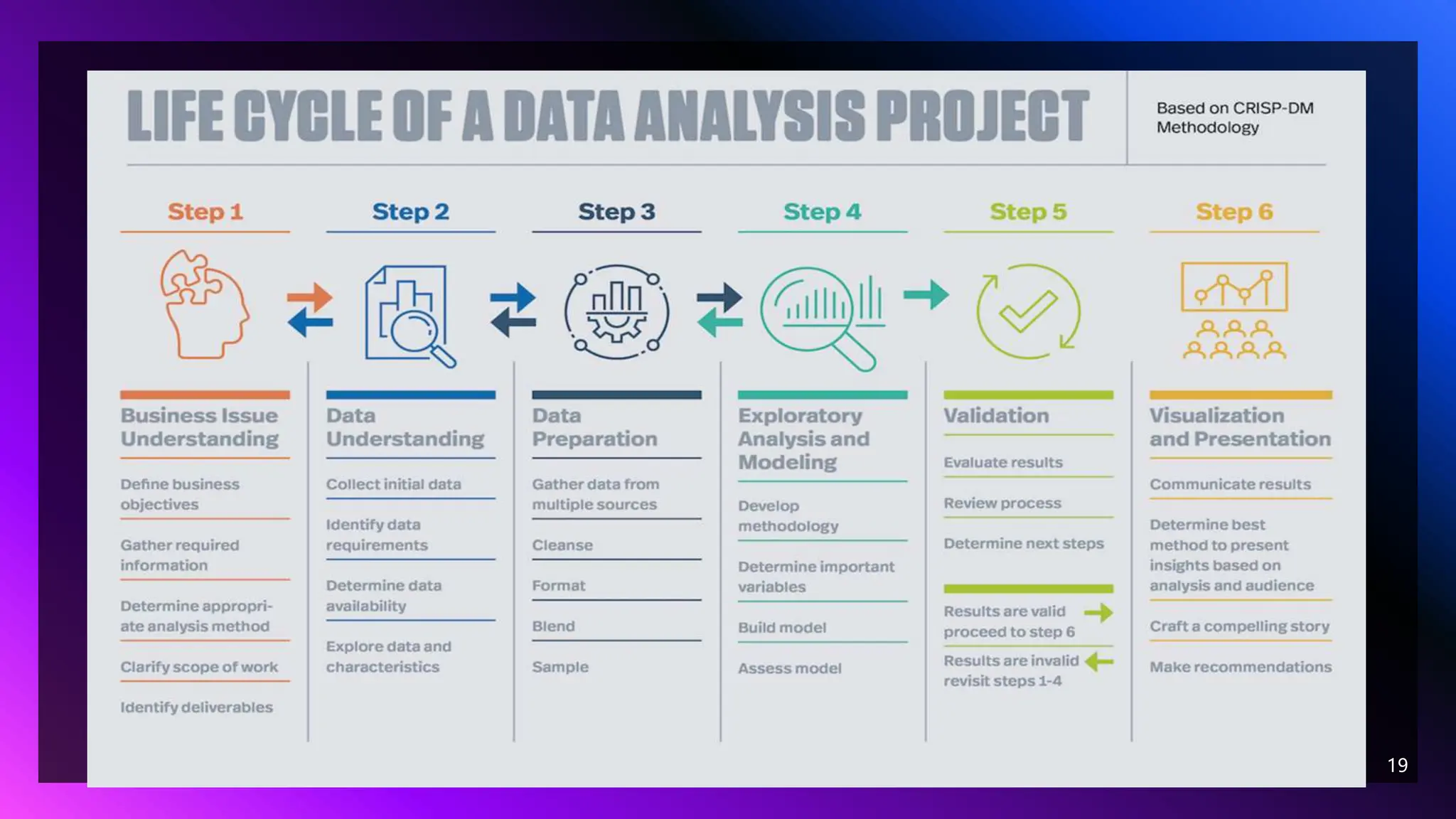
19
THANK YOU
Emmanuel Dauda
emmanuel.dauda@trailblazercgl.com

Data Analytics Fundamentals: data analytics types.potx

  • 1.
    DATA ANALYTICS FUNDAMENTALS: D ATAA N A LY T I C S T Y P E S A N D U S E C A S E S Presented by Dauda Emmanuel
  • 2.
    CONTENT Definition Introduction Why is DataAnalysis Important Data Analysis Process Types of Data Analysis Data Visualization
  • 3.
    DEFINITION D A TA A N A L Y S I S I S T H E P R O C E S S O F C L E A N I N G , C H A N G I N G , A N D P R O C E S S I N G R A W D A T A , A N D E X T R A C T I N G A C T I O N A B L E , R E L E V A N T I N F O R M A T I O N T H A T H E L P S B U S I N E S S E S M A K E I N F O R M E D D E C I S I O N S . 3
  • 4.
    INTRODUCTION 4 • A simpleexample of data analysis can be seen whenever we take a decision in our daily lives by evaluating what has happened in the past or what will happen if we make that decision. • Basically, this is the process of analyzing the past or future and making a decision based on that analysis.
  • 5.
    W H YI S D ATA A N A LY S I S I M P O R TA N T ? BETTER CUSTOMER TARGETING: • YOU DON’T WANT TO WASTE YOUR BUSINESS’S PRECIOUS TIME, RESOURCES, AND MONEY PUTTING TOGETHER ADVERTISING CAMPAIGNS TARGETED AT DEMOGRAPHIC GROUPS THAT HAVE LITTLE TO NO INTEREST IN THE GOODS AND SERVICES YOU OFFER. • DATA ANALYSIS HELPS YOU SEE WHERE YOU SHOULD BE FOCUSING YOUR ADVERTISING EFFORTS.
  • 6.
    W H YI S D ATA A N A LY S I S I M P O R TA N T ? YOU WILL KNOW YOUR TARGET CUSTOMERS BETTER: • DATA ANALYSIS TRACKS HOW WELL YOUR PRODUCTS AND CAMPAIGNS ARE PERFORMING WITHIN YOUR TARGET DEMOGRAPHIC. • THROUGH DATA ANALYSIS, YOUR BUSINESS CAN GET A BETTER IDEA OF YOUR TARGET AUDIENCE’S SPENDING HABITS, DISPOSABLE INCOME, AND MOST LIKELY AREAS OF INTEREST
  • 7.
    W H YI S D ATA A N A LY S I S I M P O R TA N T ? REDUCE OPERATIONAL COSTS: DATA ANALYSIS SHOWS YOU WHICH AREAS IN YOUR BUSINESS NEED MORE RESOURCES AND MONEY, AND WHICH AREAS ARE NOT PRODUCING AND THUS SHOULD BE SCALED BACK OR ELIMINATED OUTRIGHT.
  • 8.
    W H YI S D ATA A N A LY S I S I M P O R TA N T ? BETTER PROBLEM-SOLVING METHODS: INFORMED DECISIONS ARE MORE LIKELY TO BE SUCCESSFUL DECISIONS. DATA PROVIDES BUSINESSES WITH INFORMATION. YOU CAN SEE WHERE THIS PROGRESSION IS LEADING. DATA ANALYSIS HELPS BUSINESSES MAKE THE RIGHT CHOICES AND AVOID COSTLY PITFALLS.
  • 9.
    W H YI S D ATA A N A LY S I S I M P O R TA N T ? YOU GET MORE ACCURATE DATA: DATA ANALYSIS HELPS BUSINESSES ACQUIRE RELEVANT, ACCURATE INFORMATION, SUITABLE FOR DEVELOPING FUTURE MARKETING STRATEGIES, BUSINESS PLANS, AND REALIGNING THE COMPANY’S VISION OR MISSION.
  • 10.
  • 11.
    STEP 1: DEFININGTHE QUESTION The first step in any data analysis process is to define your objective. This is sometimes called the ‘problem statement’. Defining your objective means coming up with a hypothesis and figuring how to test it. Now you’ve defined a problem, you need to determine which sources of data will best help you solve it. 11
  • 12.
    STEP 2: COLLECTINGTHE DATA Once you’ve established your objective, you’ll need to create a strategy for collecting and aggregating the appropriate data. A key part of this is determining which data you need. This might be quantitative (numeric) data, e.g. sales figures, or qualitative (descriptive) data, such as customer reviews. All data fit into one of three categories: first-party, second-party, and third-party data. 12
  • 13.
    STEP 3: CLEANINGTHE DATA Once you’ve collected your data, the next step is to get it ready for analysis. This means cleaning, or ‘scrubbing’ it, and is crucial in making sure that you’re working with high-quality data. Key data cleaning tasks include:  Removing major errors, duplicates, and outliers—all of which are inevitable problems when aggregating data from numerous sources.  Removing unwanted data points—extracting irrelevant observations that have no bearing on your intended analysis.  Bringing structure to your data—general ‘housekeeping’, i.e. fixing typos or layout issues, which will help you map and manipulate your data more easily.  Filling in major gaps—as you’re tidying up, you might notice that important data are missing. Once you’ve identified gaps, you can go about filling them. 13
  • 14.
    STEP 4: ANALYZINGTHE DATA Finally, you’ve cleaned your data. Now comes the fun bit—analyzing it! The type of data analysis you carry out largely depends on what your goal is. But there are many techniques available. Univariate or bivariate analysis, time-series analysis, and regression analysis are just a few you might have heard of. More important than the different types, though, is how you apply them. This depends on what insights you’re hoping to gain. 14
  • 15.
    STEP 5: SHARINGYOUR RESULT You’ve finished carrying out your analyses. You have your insights. The final step of the data analytics process is to share these insights with the wider world (or at least with your organization’s stakeholders!) This is more complex than simply sharing the raw results of your work—it involves interpreting the outcomes, and presenting them in a manner that’s digestible for all types of audiences. 15
  • 16.
    TYPES OF DATAANALYSIS Diagnostic Analysis: Diagnostic analysis answers the question, “Why did this happen?” Using insights gained from statistical analysis, analysts use diagnostic analysis to identify patterns in data. Ideally, the analysts find similar patterns that existed in the past, and consequently, use those solutions to resolve the present challenges hopefully. 16
  • 17.
    TYPES OF DATAANALYSIS Predictive Analysis: Predictive analysis answers the question, “What is most likely to happen?” By using patterns found in older data as well as current events, analysts predict future events. 17
  • 18.
    TYPES OF DATAANALYSIS Prescriptive Analysis: • Mix all the insights gained from the other data analysis types, and you have prescriptive analysis. • Sometimes, an issue can’t be solved solely with one analysis type, and instead requires multiple insights. 18
  • 19.
  • 20.