Data Analytics
vs.
Data Analysis
Understanding the Differences and Applications
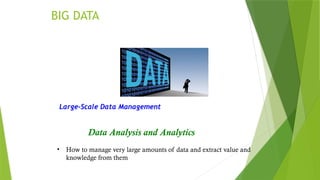
BIG DATA
Large-Scale Data Management
Data Analysis and Analytics
• How to manage very large amounts of data and extract value and
knowledge from them
2
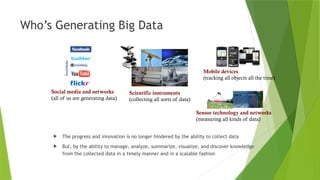
Who’s Generating Big Data
Social media and networks
(all of us are generating data)
Scientific instruments
(collecting all sorts of data)
Mobile devices
(tracking all objects all the time)
Sensor technology and networks
(measuring all kinds of data)
 The progress and innovation is no longer hindered by the ability to collect data
 But, by the ability to manage, analyze, summarize, visualize, and discover knowledge
from the collected data in a timely manner and in a scalable fashion
4
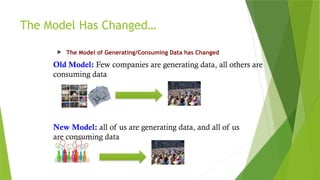
The Model Has Changed…
 The Model of Generating/Consuming Data has Changed
Old Model: Few companies are generating data, all others are
consuming data
New Model: all of us are generating data, and all of us
are consuming data
5
Big Data Definition
 No single standard definition…
“Big Data” is data whose scale, diversity, and complexity require new
architecture, techniques, algorithms, and analytics to manage it and extract
value and hidden knowledge from it…
6
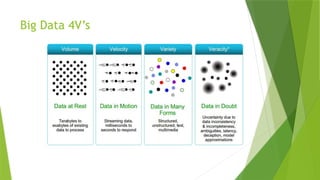
Big Data 4V’s
7
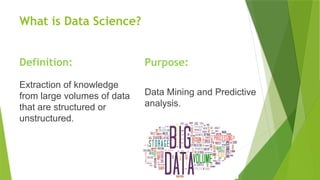
What is Data Science?
Definition:
Extraction of knowledge
from large volumes of data
that are structured or
unstructured.
Purpose:
Data Mining and Predictive
analysis.
What is Data Analysis?
Definition:
 The process of
inspecting, cleansing,
transforming, and
modeling data.
Purpose:
 To discover useful
information, inform
conclusions, and support
decision-making.
Key Techniques in Data Analysis
 Descriptive Statistics
 Inferential Statistics
 Data Visualization
 Example:
 Analyzing sales data to understand trends.
Type of data analysis
 Text analysis. This is also referred to as Data Mining. This method discovers a pattern in
large form data sets using databases or other data mining tools.
 Statistical analysis. This analysis answers “What happened?” by utilizing past data in
dashboard form. Statistic analysis involves the collection, analysis, interpretation,
presentation, and modeling of data.
 Diagnostic analysis. This analysis answers “Why did it happen?” by seeking the cause from
the insights discovered during statistical analysis. This type of analysis is beneficial for
identifying behavior patterns of data.
 Predictive analysis. This analysis suggests what is likely to happen by utilizing previous
data. The predictive analysis makes predictions about future outcomes based on the data.
 Prescriptive analysis. This type of analysis combines the insights from text, statistical,
diagnostic, and predictive analysis to determine the action(s) to take in order to solve a
current problem or influence a decision.
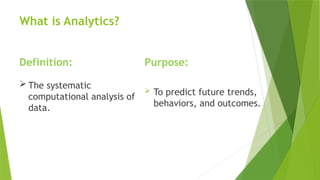
What is Analytics?
Definition:
 The systematic
computational analysis of
data.
Purpose:
 To predict future trends,
behaviors, and outcomes.
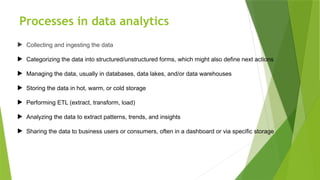
Processes in data analytics
 Collecting and ingesting the data
 Categorizing the data into structured/unstructured forms, which might also define next actions
 Managing the data, usually in databases, data lakes, and/or data warehouses
 Storing the data in hot, warm, or cold storage
 Performing ETL (extract, transform, load)
 Analyzing the data to extract patterns, trends, and insights
 Sharing the data to business users or consumers, often in a dashboard or via specific storage
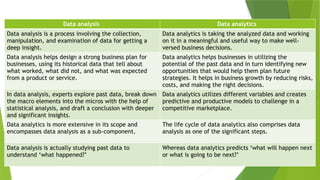
Data analysis Data analytics
Data analysis is a process involving the collection,
manipulation, and examination of data for getting a
deep insight.
Data analytics is taking the analyzed data and working
on it in a meaningful and useful way to make well-
versed business decisions.
Data analysis helps design a strong business plan for
businesses, using its historical data that tell about
what worked, what did not, and what was expected
from a product or service.
Data analytics helps businesses in utilizing the
potential of the past data and in turn identifying new
opportunities that would help them plan future
strategies. It helps in business growth by reducing risks,
costs, and making the right decisions.
In data analysis, experts explore past data, break down
the macro elements into the micros with the help of
statistical analysis, and draft a conclusion with deeper
and significant insights.
Data analytics utilizes different variables and creates
predictive and productive models to challenge in a
competitive marketplace.
Data analytics is more extensive in its scope and
encompasses data analysis as a sub-component.
The life cycle of data analytics also comprises data
analysis as one of the significant steps.
Data analysis is actually studying past data to
understand ‘what happened?’
Whereas data analytics predicts ‘what will happen next
or what is going to be next?’
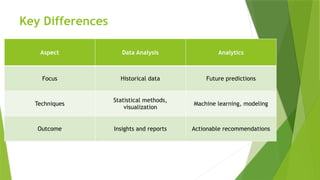
Key Differences
Aspect Data Analysis Analytics
Focus Historical data Future predictions
Techniques
Statistical methods,
visualization
Machine learning, modeling
Outcome Insights and reports Actionable recommendations
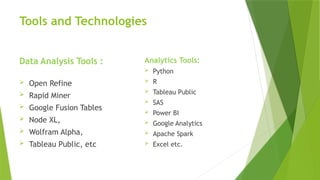
Tools and Technologies
Data Analysis Tools :
 Open Refine
 Rapid Miner
 Google Fusion Tables
 Node XL,
 Wolfram Alpha,
 Tableau Public, etc
Analytics Tools:
 Python
 R
 Tableau Public
 SAS
 Power BI
 Google Analytics
 Apache Spark
 Excel etc.
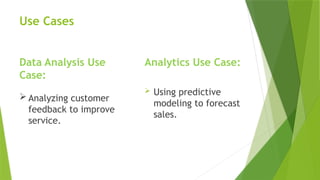
Use Cases
Data Analysis Use
Case:
 Analyzing customer
feedback to improve
service.
Analytics Use Case:
 Using predictive
modeling to forecast
sales.
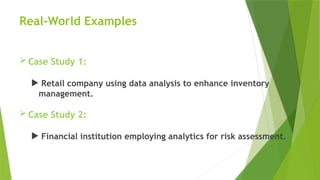
Real-World Examples
 Case Study 1:
 Retail company using data analysis to enhance inventory
management.
 Case Study 2:
 Financial institution employing analytics for risk assessment.
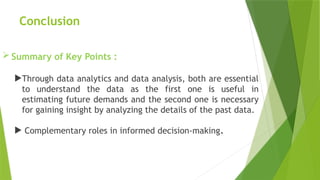
Conclusion
 Summary of Key Points :
Through data analytics and data analysis, both are essential
to understand the data as the first one is useful in
estimating future demands and the second one is necessary
for gaining insight by analyzing the details of the past data.
 Complementary roles in informed decision-making.
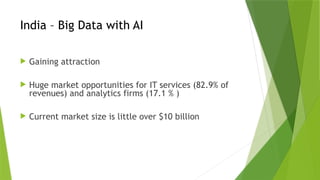
India – Big Data with AI
 Gaining attraction
 Huge market opportunities for IT services (82.9% of
revenues) and analytics firms (17.1 % )
 Current market size is little over $10 billion
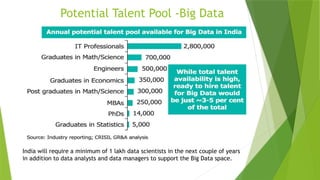
Potential Talent Pool -Big Data
India will require a minimum of 1 lakh data scientists in the next couple of years
in addition to data analysts and data managers to support the Big Data space.
THINK

data analytics vs data analysis understanding the differencespptx

  • 1.
    Data Analytics vs. Data Analysis Understandingthe Differences and Applications
  • 2.
    BIG DATA Large-Scale DataManagement Data Analysis and Analytics • How to manage very large amounts of data and extract value and knowledge from them 2
  • 4.
    Who’s Generating BigData Social media and networks (all of us are generating data) Scientific instruments (collecting all sorts of data) Mobile devices (tracking all objects all the time) Sensor technology and networks (measuring all kinds of data)  The progress and innovation is no longer hindered by the ability to collect data  But, by the ability to manage, analyze, summarize, visualize, and discover knowledge from the collected data in a timely manner and in a scalable fashion 4
  • 5.
    The Model HasChanged…  The Model of Generating/Consuming Data has Changed Old Model: Few companies are generating data, all others are consuming data New Model: all of us are generating data, and all of us are consuming data 5
  • 6.
    Big Data Definition No single standard definition… “Big Data” is data whose scale, diversity, and complexity require new architecture, techniques, algorithms, and analytics to manage it and extract value and hidden knowledge from it… 6
  • 7.
  • 8.
    What is DataScience? Definition: Extraction of knowledge from large volumes of data that are structured or unstructured. Purpose: Data Mining and Predictive analysis.
  • 9.
    What is DataAnalysis? Definition:  The process of inspecting, cleansing, transforming, and modeling data. Purpose:  To discover useful information, inform conclusions, and support decision-making.
  • 10.
    Key Techniques inData Analysis  Descriptive Statistics  Inferential Statistics  Data Visualization  Example:  Analyzing sales data to understand trends.
  • 11.
    Type of dataanalysis  Text analysis. This is also referred to as Data Mining. This method discovers a pattern in large form data sets using databases or other data mining tools.  Statistical analysis. This analysis answers “What happened?” by utilizing past data in dashboard form. Statistic analysis involves the collection, analysis, interpretation, presentation, and modeling of data.  Diagnostic analysis. This analysis answers “Why did it happen?” by seeking the cause from the insights discovered during statistical analysis. This type of analysis is beneficial for identifying behavior patterns of data.  Predictive analysis. This analysis suggests what is likely to happen by utilizing previous data. The predictive analysis makes predictions about future outcomes based on the data.  Prescriptive analysis. This type of analysis combines the insights from text, statistical, diagnostic, and predictive analysis to determine the action(s) to take in order to solve a current problem or influence a decision.
  • 12.
    What is Analytics? Definition: The systematic computational analysis of data. Purpose:  To predict future trends, behaviors, and outcomes.
  • 13.
    Processes in dataanalytics  Collecting and ingesting the data  Categorizing the data into structured/unstructured forms, which might also define next actions  Managing the data, usually in databases, data lakes, and/or data warehouses  Storing the data in hot, warm, or cold storage  Performing ETL (extract, transform, load)  Analyzing the data to extract patterns, trends, and insights  Sharing the data to business users or consumers, often in a dashboard or via specific storage
  • 14.
    Data analysis Dataanalytics Data analysis is a process involving the collection, manipulation, and examination of data for getting a deep insight. Data analytics is taking the analyzed data and working on it in a meaningful and useful way to make well- versed business decisions. Data analysis helps design a strong business plan for businesses, using its historical data that tell about what worked, what did not, and what was expected from a product or service. Data analytics helps businesses in utilizing the potential of the past data and in turn identifying new opportunities that would help them plan future strategies. It helps in business growth by reducing risks, costs, and making the right decisions. In data analysis, experts explore past data, break down the macro elements into the micros with the help of statistical analysis, and draft a conclusion with deeper and significant insights. Data analytics utilizes different variables and creates predictive and productive models to challenge in a competitive marketplace. Data analytics is more extensive in its scope and encompasses data analysis as a sub-component. The life cycle of data analytics also comprises data analysis as one of the significant steps. Data analysis is actually studying past data to understand ‘what happened?’ Whereas data analytics predicts ‘what will happen next or what is going to be next?’
  • 15.
    Key Differences Aspect DataAnalysis Analytics Focus Historical data Future predictions Techniques Statistical methods, visualization Machine learning, modeling Outcome Insights and reports Actionable recommendations
  • 16.
    Tools and Technologies DataAnalysis Tools :  Open Refine  Rapid Miner  Google Fusion Tables  Node XL,  Wolfram Alpha,  Tableau Public, etc Analytics Tools:  Python  R  Tableau Public  SAS  Power BI  Google Analytics  Apache Spark  Excel etc.
  • 17.
    Use Cases Data AnalysisUse Case:  Analyzing customer feedback to improve service. Analytics Use Case:  Using predictive modeling to forecast sales.
  • 18.
    Real-World Examples  CaseStudy 1:  Retail company using data analysis to enhance inventory management.  Case Study 2:  Financial institution employing analytics for risk assessment.
  • 19.
    Conclusion  Summary ofKey Points : Through data analytics and data analysis, both are essential to understand the data as the first one is useful in estimating future demands and the second one is necessary for gaining insight by analyzing the details of the past data.  Complementary roles in informed decision-making.
  • 20.
    India – BigData with AI  Gaining attraction  Huge market opportunities for IT services (82.9% of revenues) and analytics firms (17.1 % )  Current market size is little over $10 billion
  • 21.
    Potential Talent Pool-Big Data India will require a minimum of 1 lakh data scientists in the next couple of years in addition to data analysts and data managers to support the Big Data space.
  • 22.

Editor's Notes

  • #22 If you’re thinking about Big Data, Think IBM. Any questions?