CTICS 2012                                     Jan 24th, 2012


Dark Matter detection (1)


Sergio Colafrancesco
Wits University - DST/NRF SKA Research Chair
INAF - OAR
Email: Sergio.Colafrancesco@wits.ac.za
Email
       Sergio.Colafrancesco@oa-roma.inaf.it

                                                                1
Dark Matter exists !

Dark Matter Proof Found,
Scientists Say


                                                  [F. Zwicky 1933]

A team of researchers has found the first direct proof for the
existence of dark matter, the mysterious and almost invisible
substance thought to make up almost a quarter of the universe.
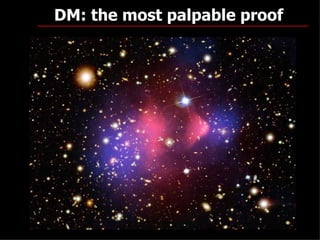
In this composite image, two clusters of galaxies are seen after a
collision. Hot gas, seen in red, was dragged away from the
galaxies during the collision. That gas makes up more than 90
percent of the mass of normal, or visible, matter. But most of the
mass—and thus matter—is located in the galaxy portions of the
clusters, shown in blue, scientists say. In other words, the bulk of
visible matter in the clusters has been separated from the majority
                                                                       2
of mass—which therefore must be dark matter.
Dark Matter exists !                                                … or not !?

Dark Matter Proof Found,                                               Dark matter does not exist !
Scientists Say                                                         Einstein wins again!


                                                                                                 J. Moffat and colleagues
                                                                                                 suggest that there is a
                                                                                                 good reason dark matter
                                                                                                 why has never been
                                                  [F. Zwicky 1933]                               directly detected:
                                                                                                 It doesn't exist .

A team of researchers has found the first direct proof for the         J. Moffat suggests that his Modified Gravity
existence of dark matter, the mysterious and almost invisible          (MOG) theory can explain the Bullet Cluster
substance thought to make up almost a quarter of the universe.         observation. MOG predicts that the force of
In this composite image, two clusters of galaxies are seen after a     gravity changes with distance.
collision. Hot gas, seen in red, was dragged away from the             Moffat thinks that the present day expectation by
galaxies during the collision. That gas makes up more than 90          many that dark matter must exist is similar to the
percent of the mass of normal, or visible, matter. But most of the     expectation by many leading scientists in the
mass—and thus matter—is located in the galaxy portions of the          beginning of the 20th century that a
clusters, shown in blue, scientists say. In other words, the bulk of   "luminiferous ether" should exist. This was a
visible matter in the clusters has been separated from the majority    hypothetical substance, in which the waves of
                                                                                                                     3
of mass—which therefore must be dark matter.                           light were supposed to propagate
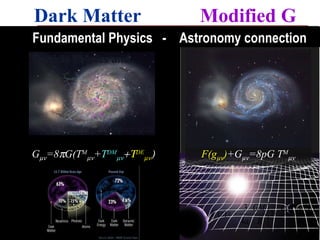
Dark Matter                 Modified G
Fundamental Physics - Astronomy connection


Gµν=8πG(TMµν+TDMµν+ΤDEµν)   F(gµν)+Gµν=8pG TMµν


                                            3 GM    exp(− r / L) 
                              Φ (r ) = −            1 +         
                                           4a1 R          3
                                                              4
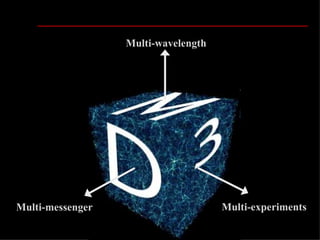
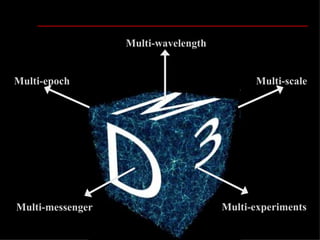
Multi-wavelength


Multi-messenger                      Multi-experiments

                                                     5
Multi-wavelength


Multi-epoch                                Multi-scale


Multi-messenger                      Multi-experiments

                                                     6
Outline
 Multi-epoch
   The Dark Matter Timeline
   The present


 Multi-Scale + M3
   Galactic center
   Galactic structures
   Galaxy Clusters


 The Future
   The DM search challenge

                              7
Outline
 Multi-epoch
   The Dark Matter Timeline
   The present


 Multi-Scale + M3
   DM search at various astronomical scales
    • Galactic center
    • Galactic structures
    • Galaxy Clusters


 The Future
   The DM search challenge
                                              8
Dark Matter timeline


                                                          2T + U = 0                       Coma

                                                  σ   V   ≈ (1019 ± 360)km / s

                                                           M
                                                             ≈ 400 ⋅ h558
                                                           L
                                                  Zwicky used the words “dunkle (kalte) Materie”
                                                                          dark (cold) Matter
                                                  which might be regarded as the first reference to
                   Fritz Zwicky                   Cold Dark Matter
[Varna (Bulgaria), 1898 – Pasadena (USA), 1974]
                                                  … even though not in the modern sense (!?)
                                                                                                      9
Dark Matter timeline


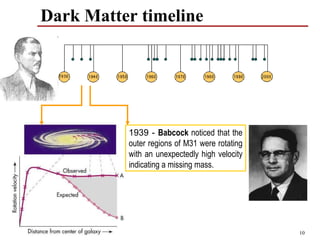
1936 - Smith noticed that          1939 - Babcock noticed that the
also the Virgo cluster exhibited   outer regions of M31 were rotating
a behavior suggestive of an        with an unexpectedly high velocity
extremely high mass.               indicating a missing mass.


                                                                        10
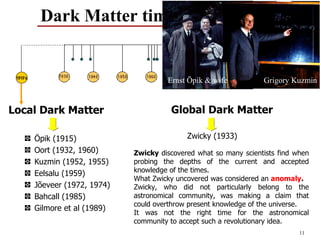
Dark Matter timeline


 1910’s
                                          Ernst Öpik & wife           Grigory Kuzmin


Local Dark Matter                          Global Dark Matter

          Öpik (1915)                           Zwicky (1933)
          Oort (1932, 1960)      Zwicky discovered what so many scientists find when
          Kuzmin (1952, 1955)    probing the depths of the current and accepted
                                 knowledge of the times.
          Eelsalu (1959)
                                 What Zwicky uncovered was considered an anomaly.
          Jõeveer (1972, 1974)   Zwicky, who did not particularly belong to the
          Bahcall (1985)         astronomical community, was making a claim that
                                 could overthrow present knowledge of the universe.
          Gilmore et al (1989)
                                 It was not the right time for the astronomical
                                 community to accept such a revolutionary idea.
                                                                                 11
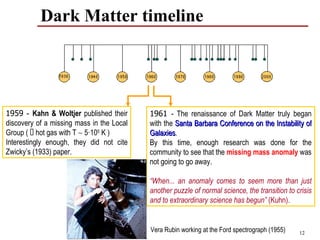
Dark Matter timeline


1959 - Kahn & Woltjer published their      1961 - The renaissance of Dark Matter truly began
discovery of a missing mass in the Local   with the Santa Barbara Conference on the Instability of
Group (  hot gas with T ∼ 5·105 K )       Galaxies.
                                           Galaxies
Interestingly enough, they did not cite    By this time, enough research was done for the
Zwicky’s (1933) paper.                     community to see that the missing mass anomaly was
                                           not going to go away.

                                           “When... an anomaly comes to seem more than just
                                           another puzzle of normal science, the transition to crisis
                                           and to extraordinary science has begun” (Kuhn).


                                           Vera Rubin working at the Ford spectrograph (1955)   12
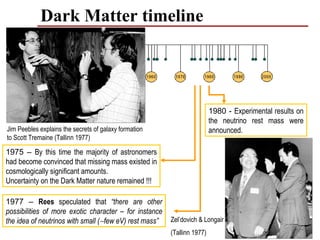
Dark Matter timeline


                                                                         1980 - Experimental results on
                                                                         the neutrino rest mass were
Jim Peebles explains the secrets of galaxy formation                     announced.
to Scott Tremaine (Tallinn 1977)

1975 – By this time the majority of astronomers
had become convinced that missing mass existed in
cosmologically significant amounts.
Uncertainty on the Dark Matter nature remained !!!

1977 – Rees speculated that “there are other
possibilities of more exotic character – for instance
the idea of neutrinos with small (∼few eV) rest mass”   Zel’dovich & Longair
                                                        (Tallinn 1977)                               13
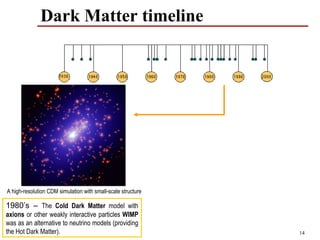
Dark Matter timeline


A high-resolution CDM simulation with small-scale structure

1980’s – The Cold Dark Matter model with
axions or other weakly interactive particles WIMP
was as an alternative to neutrino models (providing
the Hot Dark Matter).                                         14
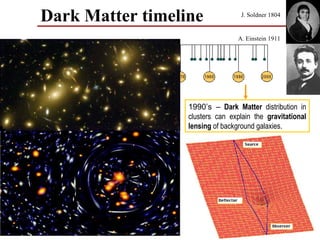
Dark Matter timeline               J. Soldner 1804


                                  A. Einstein 1911


                  1990’s – Dark Matter distribution in
                  clusters can explain the gravitational
                  lensing of background galaxies.


                                                     15
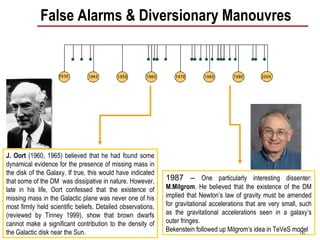
False Alarms & Diversionary Manouvres


J. Oort (1960, 1965) believed that he had found some
dynamical evidence for the presence of missing mass in
the disk of the Galaxy. If true, this would have indicated
that some of the DM was dissipative in nature. However,       1987 – One particularly interesting dissenter:
late in his life, Oort confessed that the existence of        M.Milgrom. He believed that the existence of the DM
missing mass in the Galactic plane was never one of his       implied that Newton’s law of gravity must be amended
most firmly held scientific beliefs. Detailed observations,   for gravitational accelerations that are very small, such
(reviewed by Tinney 1999), show that brown dwarfs             as the gravitational accelerations seen in a galaxy’s
cannot make a significant contribution to the density of      outer fringes. 
the Galactic disk near the Sun.                               Bekenstein followed up Milgrom’s idea in TeVeS model 16
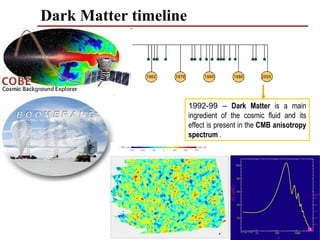
Dark Matter timeline


                       1992-99 – Dark Matter is a main
                       ingredient of the cosmic fluid and its
                       effect is present in the CMB anisotropy
                       spectrum .


                                                           17
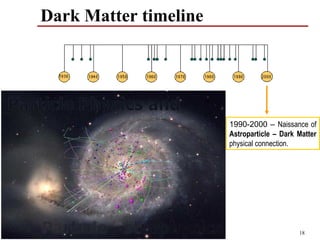
Dark Matter timeline


                       1990-2000 – Naissance of
                       Astroparticle – Dark Matter
                       physical connection.


                                            18
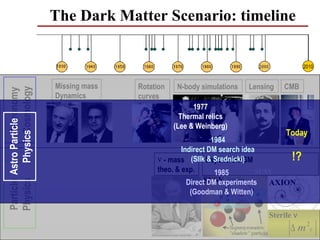
The Dark Matter Scenario: timeline

                                                                                                2010


                               Missing mass   Rotation    N-body simulations   Lensing   CMB
                   Cosmology
                   Astronomy


                               Dynamics       curves
                                                               1977
                                                           Thermal relics
Particle Astro Particle


                                                         (Lee & Weinberg)
                                                                                         Today
Physics Physics


                                                                     1984
                                                           Indirect DM search idea
                                                   ν - mass (SIlk Beyond the SM
                                                                    & Srednicki)          !?
                                                   theo. & exp.       1985         SUSY
                                                             DirectSUSY
                                                                    DM experiments    AXION
                                                              (Goodman & Witten)

                                                                                    Sterile ν
                                                                                          ∆ m 2ν
                                                                                            19
The Present

“The Present and the bubbles of Time" - Oil and acrylic on thin cardboard (B. D’Aleppo)
                                                                                   20
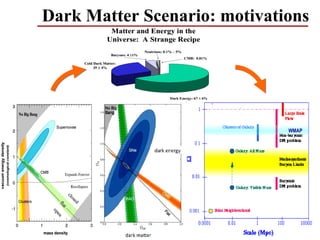
Dark Matter Scenario: motivations


                              WMAP


                                 21
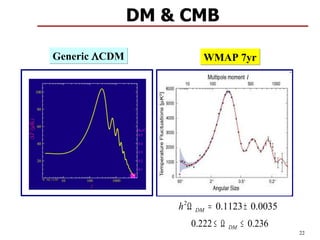
DM & CMB

Generic ΛCDM               WMAP 7yr


                   h 2Ω   DM   = 0.1123 ± 0.0035
                      0.222 ≤ Ω    DM   ≤ 0.236
                                                   22
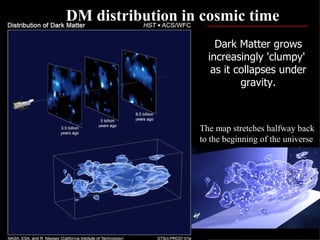
DM distribution in cosmic time
                      Dark Matter grows
                    increasingly 'clumpy'
                     as it collapses under
                            gravity.


                  The map stretches halfway back
                  to the beginning of the universe


                                             23
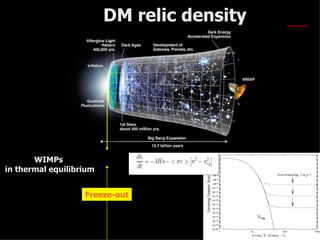
DM relic density


                    n σV ≈ H
                      x
       WIMPs
in thermal equilibrium

                                       3 ⋅ 10 − 27 cm − 3 s − 1
                    Freeze-out Ω χ h ≈
                                          2

                                               σV A


                                                                  24
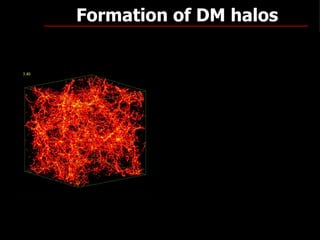
Formation of DM halos


                        25
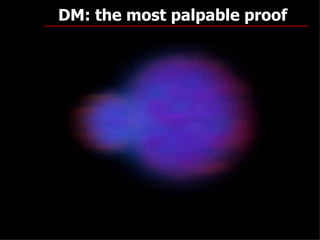
DM: the most palpable proof


                              26
DM: the most palpable proof


                              27
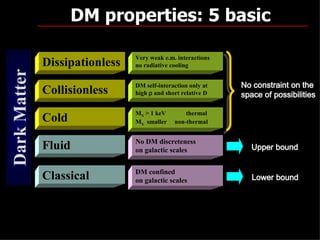
DM properties: 5 basic

                                Very weak e.m. interactions
              Dissipationless   no radiative cooling
Dark Matter


                                DM self-interaction only at   No constraint on the
              Collisionless     high ρ and short relative D   space of possibilities

                                MX > 1 keV        thermal
              Cold              MX smaller    non-thermal


                                No DM discreteness
              Fluid             on galactic scales               Upper bound
                                                                M X ≤ 10 70 − 71 eV
                                DM confined
              Classical         on galactic scales               Lower bound
                                                                 M χ ≥ 10 − 22 eV


                                                                               28
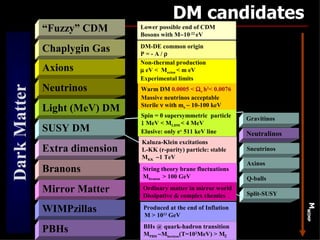
DM candidates
              “Fuzzy” CDM       Lower possible end of CDM
                                Bosons with M∼10-22 eV

              Chaplygin Gas     DM-DE common origin
                                P=-A/ρ
                                Non-thermal production
              Axions            µ eV < Maxion < m eV
                                Experimental limits
              Neutrinos
Dark Matter


                                Warm DM 0.0005 < Ων h2< 0.0076
                                Massive neutrinos acceptable
                                Sterile ν with mν ∼ 10-100 keV
              Light (MeV) DM
                                Spin = 0 supersymmetric particle    Gravitinos
                                1 MeV < MLDM < 4 MeV
              SUSY DM           Elusive: only e± 511 keV line       Neutralinos
                                                                    Neutralinos
                                Kaluza-Klein excitations
              Extra dimension   L-KK (r-parity) particle: stable    Sneutrinos
                                MKK ∼1 TeV
                                                                    Axinos
              Branons           String theory brane fluctuations
                                Mbranon > 100 GeV                   Q-balls
              Mirror Matter     Ordinary matter in mirror world
                                                                    Split-SUSY
                                Dissipative & complex chemics


                                                                                       MWIMP
              WIMPzillas         Produced at the end of Inflation
                                 M > 1013 GeV

              PBHs               BHs @ quark-hadron transition
                                 MPBH ∼Mhorizon(T=102MeV) > M                    29
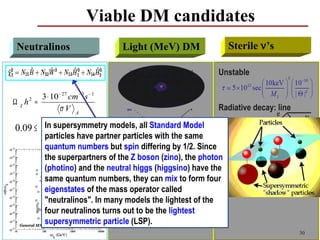
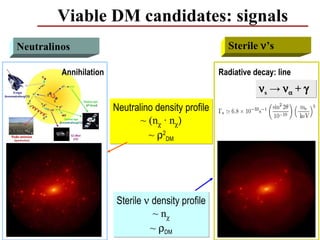
Viable DM candidates
 Neutralinos                      Light (MeV) DM             Sterile ν’s

                                                          Unstable

       3 ⋅ 10 − 27 cm − 3 s − 1
Ω χh ≈2

              σV A                                        Radiative decay: line

0.09 ≤ ΩInDM h 2 ≤ 0.13 models, all Standard Model
           supersymmetry
            particles have partner particles with the same
            quantum numbers but spin differing by 1/2. Since ν → ν + γ
                                                                s α
            the superpartners of the Z boson (zino), the photon
            (photino) and the neutral higgs (higgsino) have the
            same quantum numbers, they can mix to form four
            eigenstates of the mass operator called
            "neutralinos". In many models the lightest of the
            four neutralinos turns out to be the lightest
            supersymmetric particle (LSP).
                                                                                  30
Viable DM candidates
  Neutralinos                     Light (MeV) DM             Sterile ν’s

                                                          Unstable

       3 ⋅ 10 − 27 cm − 3 s − 1
Ω χh ≈2

              σV A                                        Radiative decay: line
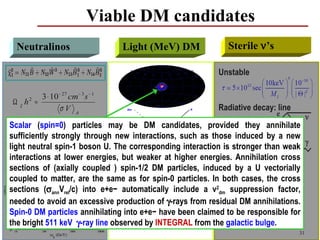
Scalar ≤ (spin=0)2 ≤ 0.13 may be DM candidates, provided they annihilate
  0.09 Ω DM h particles
sufficiently strongly through new interactions, such as those induced by a new
light neutral spin-1 boson U. The corresponding interaction is stronger than weak
                                                           νs → να + γ
interactions at lower energies, but weaker at higher energies. Annihilation cross
sections of (axially coupled ) spin-1/2 DM particles, induced by a U vectorially
coupled to matter, are the same as for spin-0 particles. In both cases, the cross
sections (σannVrel/c) into e+e− automatically include a v2dm suppression factor,
needed to avoid an excessive production of γ-rays from residual DM annihilations.
Spin-0 DM particles annihilating into e+e− have been claimed to be responsible for
the bright 511 keV γ-ray line observed by INTEGRAL from the galactic bulge.
                                                                                  31
Viable DM candidates
 Neutralinos                  Light (MeV) DM              Sterile ν’s

                                                        Unstable

        3 ⋅ 10 − 27 cm − 3 s − 1
 Ω χh ≈
     2
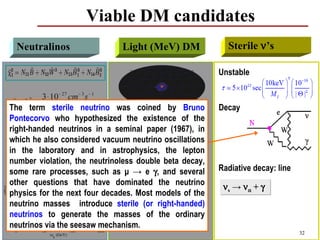
The term sterile A neutrino was coined by Bruno
               σV                                       Decay
Pontecorvo who hypothesized the existence of the
  0.09 ≤ Ω DM h 2 ≤ 0.13
right-handed neutrinos in a seminal paper (1967), in
which he also considered vacuum neutrino oscillations
in the laboratory and in astrophysics, the lepton
number violation, the neutrinoless double beta decay,
some rare processes, such as μ → e γ, and several       Radiative decay: line
other questions that have dominated the neutrino
                                                         ν s → να + γ
physics for the next four decades. Most models of the
neutrino masses introduce sterile (or right-handed)
neutrinos to generate the masses of the ordinary
neutrinos via the seesaw mechanism.
                                                                                32
Viable DM candidates
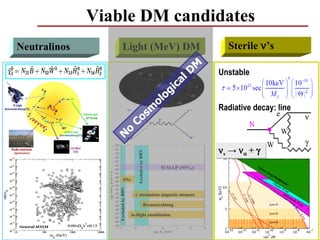
Neutralinos             Light (MeV) DM                                            Sterile ν’s
                                                                            M
                                                                      a   lD    Unstable

                                                                  g ic
                                                            olo
                                                                                Radiative decay: line
                                           sm
                                        Co
                                    o
                             N
                                                                                νs → να + γ
                                         Excluded by BBN


                                                              WMAP (95%)

                          SNe
                  Excluded by BBN


                                        e- anomalous magnetic moment

                                                      Bremsstrahlung

                                    in-flight annihilation


                                                                                                        33
Hunt for the DM particle

DM exists:
     we feel its (gravitational) presence


DM is mostly non-baryonic:
      we must think of a specific search strategy


DM is very elusive:
      we must consider un-ambiguous evidence


             Crucial Probes are required !
                                                    34
Dark Matter probes
          Above-the-ground


    Under-ground
                       35
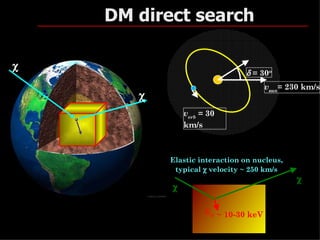
DM direct search

χ
                               δ = 30o
                                      vsun= 230 km/s
       χ
               vorb = 30
               km/s


           Elastic interaction on nucleus,
            typical χ velocity ~ 250 km/s
                                              χ
           χ

                     ER ~ 10-30 keV

                                              36
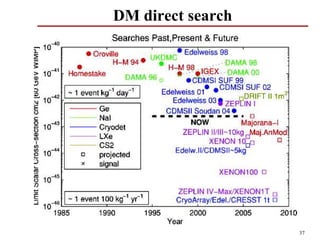
DM direct search


                   37
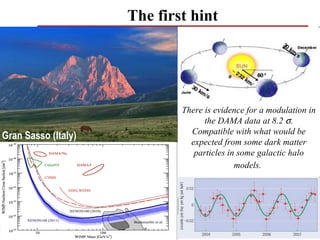
The first hint


                             There is evidence for a modulation in
                                   the DAMA data at 8.2 σ.
                               Compatible with what would be
Gran Sasso (Italy)
                               expected from some dark matter
                                particles in some galactic halo
                                            models.


                                                             38
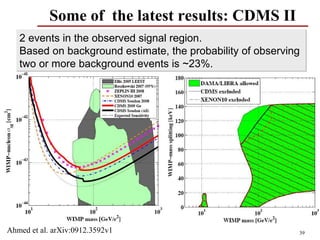
Some of the latest results: CDMS II
   2 events in the observed signal region.
   Based on background estimate, the probability of observing
   two or more background events is ~23%.


Ahmed et al. arXiv:0912.3592v1                              39
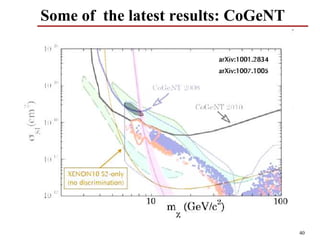
Some of the latest results: CoGeNT


                                     40
Some of the recent results: CRESST-II

                             [arXiv:1109.0702]


                                            41
DM direct search: criticalities
Experimental techniques                 Astrophysics
                              Effect of substructures
  Assume a local DM density   on the local DM density
   and a DM halo structure


                                  [Kamionkowski & Koushiappas 2008]   42
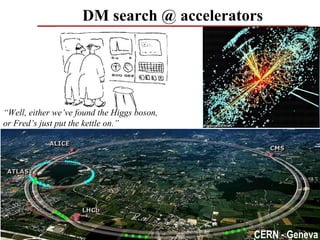
DM search @ accelerators


“Well, either we’ve found the Higgs boson,
or Fred’s just put the kettle on.” 


                                             CERN - Geneva
                                                      43
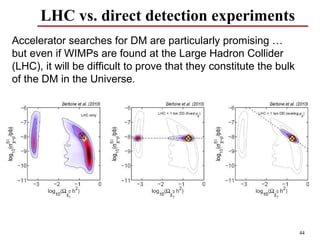
LHC vs. direct detection experiments
Accelerator searches for DM are particularly promising …
but even if WIMPs are found at the Large Hadron Collider
(LHC), it will be difficult to prove that they constitute the bulk
of the DM in the Universe.


                                                                     44
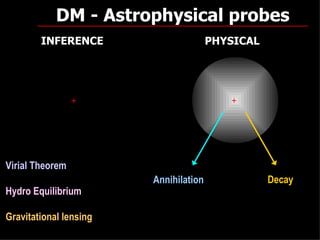
DM - Astrophysical probes
        INFERENCE                      PHYSICAL


                 +                               +


Virial Theorem
                        Annihilation                      Decay
Hydro Equilibrium
                        X+ X→ π      0, ±
                                            , p,...       X → xi + γ
Gravitational lensing   X + X → e ± , µ ± ,τ ± ,ν     i
                                                                  45
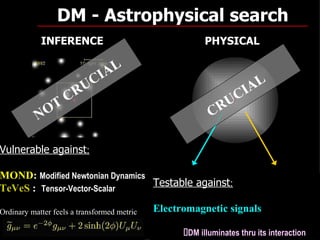
DM - Astrophysical search
          INFERENCE                                 PHYSICAL

                         AL
                      UCI                                         AL
                    R                                           I
              T C
                                                        R UC
                                                          +

         NO                                           C

Vulnerable against:
 Virial Theorem
MOND: Modified Newtonian Dynamics Annihilation                       Decay
                                           Testable against:
TeVeS : Tensor-Vector-Scalar
 Hydro Equilibrium
                                           X + X → π 0, ± , p,...    X → xi + γ
Ordinary matter feels a transformed metric Electromagnetic signals
 Gravitational lensing                     X + X → e ± , µ ± ,τ ± ,ν
                                                                 i
                                              DM illuminates thru its interaction
                                                                                 46
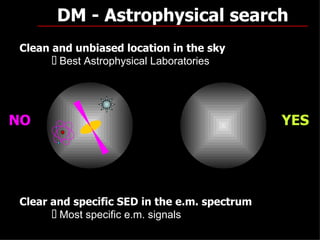
DM - Astrophysical search
Clean and unbiased location in the sky
       Best Astrophysical Laboratories


NO                                            YES


Clear and specific SED in the e.m. spectrum
       Most specific e.m. signals
                                               47
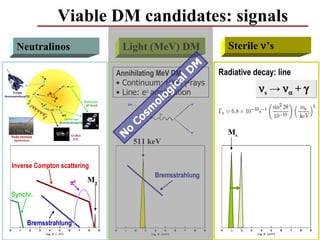
Viable DM candidates: signals
 Neutralinos                    Light (MeV) DM                  Sterile ν’s
                                                        M
                               Annihilating MeV DM
                                                   a  lD      Radiative decay: line
                                                 ic
                               • Continuum: HXR/γ-rays
                                                                         νs → να + γ
                                              og
                               • Line: e± annihilation
                                                 ol
                                            sm
                                         Co
                                     o                          Ms
                                 N
                                     511 keV


Inverse Compton scattering
                                             Bremsstrahlung
                   π  0   Mχ
Synchr.


     Bremsstrahlung
                                                                                      48
Viable DM candidates: signals
Neutralinos                                            Sterile ν’s

         Annihilation                                Radiative decay: line
                                                                νs → να + γ
                        Neutralino density profile
                               ~ (nχ · nχ)
                                 ~ ρ2DM


                        Sterile ν density profile
                                  ~ nχ
                                 ~ ρDM                                       49
Viable DM candidates: signals
  Neutralinos                                           Sterile ν’s

                 Annihilation                      Radiative decay: line
                                                               νs → να + γ


  DM annihilation flux                                    DM decay flux
    1 ρ DM ( r )
        2
                                                          1 ρ DM ( r )
F ∝  2     2
                 〈σ V 〉          Astro physics     F ∝     2
                                                                       〈 Γ rad 〉
    DL  Mχ                                                DL  Mv
                     dE 
× [ f ann ( E ; χ )]          Particle physics    [           ]
                                                                 dE 
                                                   × Eγ ( M v )     
                     dν                                        dν 

                                                                           50
Dark Matter halo structure


                         51
DM halo profile: constraints
             Galaxies                      Galaxy Clusters
• No evidence for a density
  cusp at r < 0.2 kpc
• NGC2976: η =0.27 at r < 1.8 Kpc
 [Simon et al. 2003]                                          η ! l. 2003]
                                                           on alal et a


                                    η
• Inner steeper profile ?                                 s [D
                                                     i nt
                                                 tra
 [Gnedin & Primack 2003]

                       NFW                   ons
     BH ?
                                        n oc
                                                                [Sand et al. 2002]
                                                               MS2137-23

                                           Cluster      η1T          η2T
                                           A2029        0.5           2
      NGC 6822                             A1689        1.3          1.6
      [Weldrake et al. 2002]               A1835        0.9          1.1
                                           MS1358       1.8          1.8
                                              [Bautz & Arabadjis 2002]         52
DM density universal profile
                                                      Galaxies   Clusters
                                             Dwarfs
Numerical simulations (CDM)
Different groups obtained similar results
[Navarro et al. 2003, Reed et al. 2003, …]


Analytical fitting
General DM profile


                                                                            53
DM halo: smooth + clumps + BHs
Cluster of galaxies


                                       [CPU 2006]


                      [Berezinsky et al. 2006]


  dSph Galaxy
                                                    54
Imagine a …
Galaxy         Cluster of galaxies


                                     55
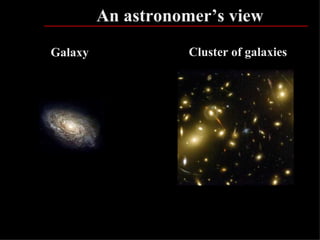
An astronomer’s view
Galaxy              Cluster of galaxies


                                          56
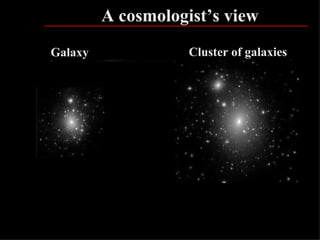
A cosmologist’s view
Galaxy              Cluster of galaxies


                                          57
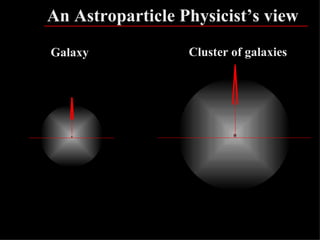
An Astroparticle Physicist’s view
Galaxy            Cluster of galaxies


                                        58
Theoretical description
[Colafrancesco et al. 2006 A&A 455, 21–43]


                                             59
DM halo profile
We consider the limit in which the mean DM distribution
can be regarded as spherically symmetric
and represented by the parametric radial density profile

     Two schemes are adopted to choose the function g(x) , with x=(r/a)

Scheme 1
Assume that g(x) can be directly inferred as the function setting the universal
shape of DM halos found in numerical N-body simulations. We are assuming,
hence, that the DM profile is essentially unaltered from the stage preceding the
baryon collapse, which is – strictly speaking – the picture provided by the
simulations for the present-day cluster morphology.

                                                                  [NFW 2004]


                                                                  [Diemand 2005]

                                                                                   60
DM halo structure
Scheme 2
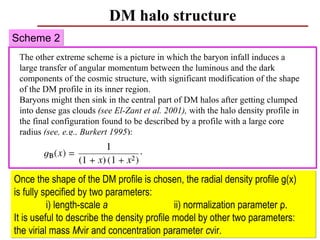
 The other extreme scheme is a picture in which the baryon infall induces a
 large transfer of angular momentum between the luminous and the dark
 components of the cosmic structure, with significant modification of the shape
 of the DM profile in its inner region.
 Baryons might then sink in the central part of DM halos after getting clumped
 into dense gas clouds (see El-Zant et al. 2001), with the halo density profile in
 the final configuration found to be described by a profile with a large core
 radius (see, e.g., Burkert 1995):


Once the shape of the DM profile is chosen, the radial density profile g(x)
is fully specified by two parameters:
          i) length-scale a                  ii) normalization parameter ρ.
It is useful to describe the density profile model by other two parameters:
the virial mass Mvir and concentration parameter cvir.                      61
DM halo structure
Concentration parameter
 We introduce the virial radius Rvir of a DM halo
 of mass Mvir as the radius within which the
 mean density of the halo is equal to the virial
 overdensity Δvir times the mean background
 density


 We assume that the virial overdensity can be
 approximated by an expression appropriate for
 a flat cosmology
 [Colafrancesco et al.’94,’97; Bryan & Norman ’98, …]

 The concentration parameter is then defined as
 with r−2 the radius at which the effective logarithmic slope of the DM profile is −2.
 • x−2 = 1        for the N04 profile
 • x−2 = 2−γ for D05
 • x−2 = 1.52 for the Burkert profile                                             62
DM halo structure
Since the first numerical results with large statistics became available (Navarro et
al. 1996, 1997), it has been realized that, at any given redshift, there is a strong
correlation between cvir and Mvir, with larger concentrations found in lighter
      halos.
This trend may be intuitively explained by the fact that mean overdensities in halos
should be correlated with the mean background densities at the time of collapse,
and in the hierarchical structure formation model small objects form first, when the
Universe was indeed denser.
The correlation between cvir and Mvir
is relevant at two levels:
•     when discussing the mean density profile
•     when including substructures
[Bullock et al]

[ENS]


                                                                                  63
DM Halo structure
For a given shape of the DM halo profile we fit of the parameters Mvir and cvir
against the available dynamical constraints for the Coma cluster.
We consider bounds on the cluster total mass at large radii and on density
profile in its inner region.
• Redshift-space caustics (Geller 1999)
• HE condition (Hughes 1989)
• Velocity moments of a tracer population
  (Binney & Mamon 1982)

 [Colafrancesco et al. 2006 A&A 455, 21–43]


                                                                              64
DM Halo structure
        Sub-structures
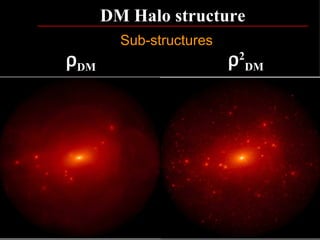
ρDM                      ρ2DM


                                65
DM Halo structure
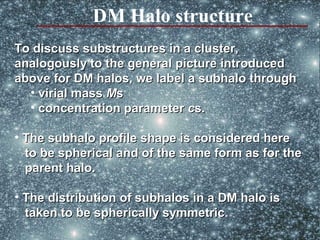
To discuss substructures in a cluster,
analogously to the general picture introduced
above for DM halos, we label a subhalo through
  • virial mass Ms
  • concentration parameter cs.

• The subhalo profile shape is considered here
  to be spherical and of the same form as for the
  parent halo.

• The distribution of subhalos in a DM halo is
  taken to be spherically symmetric.
                          symmetric
                                                 66
DM Halo structure
The subhalo number density probability distribution can then be fully specified
through Ms, cs and the radial coordinate for the subhalo position r.


 The sub-halo mas function is
  [Diemand 2005]

  A(Mvir) is derived imposing

The quantity Ps(cs) is a log-normal distribution in concentration parameters
around a mean value set by the substructure mass.
The 1σ deviation Δ(log10 cs) around the mean in Ps(cs), is assumed to be
independent of Ms and of cosmology, and to be, numerically, Δ(log10 cs) = 0.14
 ps(r) is the spatial distribution of substructures within the cluster.
                     (with a’>a)       and normalized as:
                                                                                  67
DM annihilation distribution
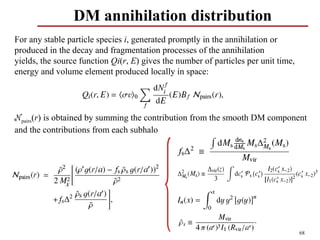
For any stable particle species i, generated promptly in the annihilation or
produced in the decay and fragmentation processes of the annihilation
yields, the source function Qi(r, E) gives the number of particles per unit time,
energy and volume element produced locally in space:


Npairs(r) is obtained by summing the contribution from the smooth DM component
and the contributions from each subhalo


                                                                                    68
DM annihilation distribution
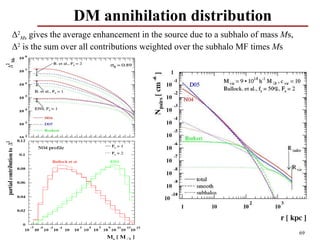
Δ2Ms gives the average enhancement in the source due to a subhalo of mass Ms,
Δ2 is the sum over all contributions weighted over the subhalo MF times Ms


                                                                                69
Viable DM candidates: signals
  Neutralinos                                           Sterile ν’s

                 Annihilation                      Radiative decay: line
                                                               νs → να + γ


  DM annihilation flux                                    DM decay flux
    1 ρ DM ( r )
        2
                                                          1 ρ DM ( r )
F ∝  2     2
                 〈σ V 〉          Astro physics     F ∝     2
                                                                       〈 Γ rad 〉
    DL  Mχ                                                DL  Mv
                     dE 
× [ f ann ( E ; χ )]          Particle physics    [           ]
                                                                 dE 
                                                   × Eγ ( M v )     
                     dν                                        dν 

                                                                           70
Outline
 Multi-epoch
   The Dark Matter Timeline
   The present


 Multi-Scale + M3
   Galactic center
   Galactic structures
   Galaxy Clusters


 The Future
   The DM search challenge

                              71
THANKS

for your attention !


                       72

Colafrancesco - Dark Matter Dectection 1

  • 1.
    CTICS 2012 Jan 24th, 2012 Dark Matter detection (1) Sergio Colafrancesco Wits University - DST/NRF SKA Research Chair INAF - OAR Email: Sergio.Colafrancesco@wits.ac.za Email Sergio.Colafrancesco@oa-roma.inaf.it 1
  • 2.
    Dark Matter exists! Dark Matter Proof Found, Scientists Say [F. Zwicky 1933] A team of researchers has found the first direct proof for the existence of dark matter, the mysterious and almost invisible substance thought to make up almost a quarter of the universe. In this composite image, two clusters of galaxies are seen after a collision. Hot gas, seen in red, was dragged away from the galaxies during the collision. That gas makes up more than 90 percent of the mass of normal, or visible, matter. But most of the mass—and thus matter—is located in the galaxy portions of the clusters, shown in blue, scientists say. In other words, the bulk of visible matter in the clusters has been separated from the majority 2 of mass—which therefore must be dark matter.
  • 3.
    Dark Matter exists! … or not !? Dark Matter Proof Found, Dark matter does not exist ! Scientists Say Einstein wins again! J. Moffat and colleagues suggest that there is a good reason dark matter why has never been [F. Zwicky 1933] directly detected: It doesn't exist . A team of researchers has found the first direct proof for the J. Moffat suggests that his Modified Gravity existence of dark matter, the mysterious and almost invisible (MOG) theory can explain the Bullet Cluster substance thought to make up almost a quarter of the universe. observation. MOG predicts that the force of In this composite image, two clusters of galaxies are seen after a gravity changes with distance. collision. Hot gas, seen in red, was dragged away from the Moffat thinks that the present day expectation by galaxies during the collision. That gas makes up more than 90 many that dark matter must exist is similar to the percent of the mass of normal, or visible, matter. But most of the expectation by many leading scientists in the mass—and thus matter—is located in the galaxy portions of the beginning of the 20th century that a clusters, shown in blue, scientists say. In other words, the bulk of "luminiferous ether" should exist. This was a visible matter in the clusters has been separated from the majority hypothetical substance, in which the waves of 3 of mass—which therefore must be dark matter. light were supposed to propagate
  • 4.
    Dark Matter Modified G Fundamental Physics - Astronomy connection Gµν=8πG(TMµν+TDMµν+ΤDEµν) F(gµν)+Gµν=8pG TMµν 3 GM  exp(− r / L)  Φ (r ) = −  1 +  4a1 R 3 4
  • 5.
  • 6.
    Multi-wavelength Multi-epoch Multi-scale Multi-messenger Multi-experiments 6
  • 7.
    Outline Multi-epoch The Dark Matter Timeline The present Multi-Scale + M3 Galactic center Galactic structures Galaxy Clusters The Future The DM search challenge 7
  • 8.
    Outline Multi-epoch The Dark Matter Timeline The present Multi-Scale + M3 DM search at various astronomical scales • Galactic center • Galactic structures • Galaxy Clusters The Future The DM search challenge 8
  • 9.
    Dark Matter timeline 2T + U = 0 Coma σ V ≈ (1019 ± 360)km / s M ≈ 400 ⋅ h558 L Zwicky used the words “dunkle (kalte) Materie” dark (cold) Matter which might be regarded as the first reference to Fritz Zwicky Cold Dark Matter [Varna (Bulgaria), 1898 – Pasadena (USA), 1974] … even though not in the modern sense (!?) 9
  • 10.
    Dark Matter timeline 1936- Smith noticed that 1939 - Babcock noticed that the also the Virgo cluster exhibited outer regions of M31 were rotating a behavior suggestive of an with an unexpectedly high velocity extremely high mass. indicating a missing mass. 10
  • 11.
    Dark Matter timeline 1910’s Ernst Öpik & wife Grigory Kuzmin Local Dark Matter Global Dark Matter Öpik (1915) Zwicky (1933) Oort (1932, 1960) Zwicky discovered what so many scientists find when Kuzmin (1952, 1955) probing the depths of the current and accepted knowledge of the times. Eelsalu (1959) What Zwicky uncovered was considered an anomaly. Jõeveer (1972, 1974) Zwicky, who did not particularly belong to the Bahcall (1985) astronomical community, was making a claim that could overthrow present knowledge of the universe. Gilmore et al (1989) It was not the right time for the astronomical community to accept such a revolutionary idea. 11
  • 12.
    Dark Matter timeline 1959- Kahn & Woltjer published their 1961 - The renaissance of Dark Matter truly began discovery of a missing mass in the Local with the Santa Barbara Conference on the Instability of Group (  hot gas with T ∼ 5·105 K ) Galaxies. Galaxies Interestingly enough, they did not cite By this time, enough research was done for the Zwicky’s (1933) paper. community to see that the missing mass anomaly was not going to go away. “When... an anomaly comes to seem more than just another puzzle of normal science, the transition to crisis and to extraordinary science has begun” (Kuhn). Vera Rubin working at the Ford spectrograph (1955) 12
  • 13.
    Dark Matter timeline 1980 - Experimental results on the neutrino rest mass were Jim Peebles explains the secrets of galaxy formation announced. to Scott Tremaine (Tallinn 1977) 1975 – By this time the majority of astronomers had become convinced that missing mass existed in cosmologically significant amounts. Uncertainty on the Dark Matter nature remained !!! 1977 – Rees speculated that “there are other possibilities of more exotic character – for instance the idea of neutrinos with small (∼few eV) rest mass” Zel’dovich & Longair (Tallinn 1977) 13
  • 14.
    Dark Matter timeline Ahigh-resolution CDM simulation with small-scale structure 1980’s – The Cold Dark Matter model with axions or other weakly interactive particles WIMP was as an alternative to neutrino models (providing the Hot Dark Matter). 14
  • 15.
    Dark Matter timeline J. Soldner 1804 A. Einstein 1911 1990’s – Dark Matter distribution in clusters can explain the gravitational lensing of background galaxies. 15
  • 16.
    False Alarms &Diversionary Manouvres J. Oort (1960, 1965) believed that he had found some dynamical evidence for the presence of missing mass in the disk of the Galaxy. If true, this would have indicated that some of the DM was dissipative in nature. However, 1987 – One particularly interesting dissenter: late in his life, Oort confessed that the existence of M.Milgrom. He believed that the existence of the DM missing mass in the Galactic plane was never one of his implied that Newton’s law of gravity must be amended most firmly held scientific beliefs. Detailed observations, for gravitational accelerations that are very small, such (reviewed by Tinney 1999), show that brown dwarfs as the gravitational accelerations seen in a galaxy’s cannot make a significant contribution to the density of outer fringes.  the Galactic disk near the Sun. Bekenstein followed up Milgrom’s idea in TeVeS model 16
  • 17.
    Dark Matter timeline 1992-99 – Dark Matter is a main ingredient of the cosmic fluid and its effect is present in the CMB anisotropy spectrum . 17
  • 18.
    Dark Matter timeline 1990-2000 – Naissance of Astroparticle – Dark Matter physical connection. 18
  • 19.
    The Dark MatterScenario: timeline 2010 Missing mass Rotation N-body simulations Lensing CMB Cosmology Astronomy Dynamics curves 1977 Thermal relics Particle Astro Particle (Lee & Weinberg) Today Physics Physics 1984 Indirect DM search idea ν - mass (SIlk Beyond the SM & Srednicki) !? theo. & exp. 1985 SUSY DirectSUSY DM experiments AXION (Goodman & Witten) Sterile ν ∆ m 2ν 19
  • 20.
    The Present “The Presentand the bubbles of Time" - Oil and acrylic on thin cardboard (B. D’Aleppo) 20
  • 21.
    Dark Matter Scenario:motivations WMAP 21
  • 22.
    DM & CMB GenericΛCDM WMAP 7yr h 2Ω DM = 0.1123 ± 0.0035 0.222 ≤ Ω DM ≤ 0.236 22
  • 23.
    DM distribution incosmic time Dark Matter grows increasingly 'clumpy' as it collapses under gravity. The map stretches halfway back to the beginning of the universe 23
  • 24.
    DM relic density n σV ≈ H x WIMPs in thermal equilibrium 3 ⋅ 10 − 27 cm − 3 s − 1 Freeze-out Ω χ h ≈ 2 σV A 24
  • 25.
  • 26.
    DM: the mostpalpable proof 26
  • 27.
    DM: the mostpalpable proof 27
  • 28.
    DM properties: 5basic Very weak e.m. interactions Dissipationless no radiative cooling Dark Matter DM self-interaction only at No constraint on the Collisionless high ρ and short relative D space of possibilities MX > 1 keV thermal Cold MX smaller non-thermal No DM discreteness Fluid on galactic scales Upper bound M X ≤ 10 70 − 71 eV DM confined Classical on galactic scales Lower bound M χ ≥ 10 − 22 eV 28
  • 29.
    DM candidates “Fuzzy” CDM Lower possible end of CDM Bosons with M∼10-22 eV Chaplygin Gas DM-DE common origin P=-A/ρ Non-thermal production Axions µ eV < Maxion < m eV Experimental limits Neutrinos Dark Matter Warm DM 0.0005 < Ων h2< 0.0076 Massive neutrinos acceptable Sterile ν with mν ∼ 10-100 keV Light (MeV) DM Spin = 0 supersymmetric particle Gravitinos 1 MeV < MLDM < 4 MeV SUSY DM Elusive: only e± 511 keV line Neutralinos Neutralinos Kaluza-Klein excitations Extra dimension L-KK (r-parity) particle: stable Sneutrinos MKK ∼1 TeV Axinos Branons String theory brane fluctuations Mbranon > 100 GeV Q-balls Mirror Matter Ordinary matter in mirror world Split-SUSY Dissipative & complex chemics MWIMP WIMPzillas Produced at the end of Inflation M > 1013 GeV PBHs BHs @ quark-hadron transition MPBH ∼Mhorizon(T=102MeV) > M 29
  • 30.
    Viable DM candidates Neutralinos Light (MeV) DM Sterile ν’s Unstable 3 ⋅ 10 − 27 cm − 3 s − 1 Ω χh ≈2 σV A Radiative decay: line 0.09 ≤ ΩInDM h 2 ≤ 0.13 models, all Standard Model supersymmetry particles have partner particles with the same quantum numbers but spin differing by 1/2. Since ν → ν + γ s α the superpartners of the Z boson (zino), the photon (photino) and the neutral higgs (higgsino) have the same quantum numbers, they can mix to form four eigenstates of the mass operator called "neutralinos". In many models the lightest of the four neutralinos turns out to be the lightest supersymmetric particle (LSP). 30
  • 31.
    Viable DM candidates Neutralinos Light (MeV) DM Sterile ν’s Unstable 3 ⋅ 10 − 27 cm − 3 s − 1 Ω χh ≈2 σV A Radiative decay: line Scalar ≤ (spin=0)2 ≤ 0.13 may be DM candidates, provided they annihilate 0.09 Ω DM h particles sufficiently strongly through new interactions, such as those induced by a new light neutral spin-1 boson U. The corresponding interaction is stronger than weak νs → να + γ interactions at lower energies, but weaker at higher energies. Annihilation cross sections of (axially coupled ) spin-1/2 DM particles, induced by a U vectorially coupled to matter, are the same as for spin-0 particles. In both cases, the cross sections (σannVrel/c) into e+e− automatically include a v2dm suppression factor, needed to avoid an excessive production of γ-rays from residual DM annihilations. Spin-0 DM particles annihilating into e+e− have been claimed to be responsible for the bright 511 keV γ-ray line observed by INTEGRAL from the galactic bulge. 31
  • 32.
    Viable DM candidates Neutralinos Light (MeV) DM Sterile ν’s Unstable 3 ⋅ 10 − 27 cm − 3 s − 1 Ω χh ≈ 2 The term sterile A neutrino was coined by Bruno σV Decay Pontecorvo who hypothesized the existence of the 0.09 ≤ Ω DM h 2 ≤ 0.13 right-handed neutrinos in a seminal paper (1967), in which he also considered vacuum neutrino oscillations in the laboratory and in astrophysics, the lepton number violation, the neutrinoless double beta decay, some rare processes, such as μ → e γ, and several Radiative decay: line other questions that have dominated the neutrino ν s → να + γ physics for the next four decades. Most models of the neutrino masses introduce sterile (or right-handed) neutrinos to generate the masses of the ordinary neutrinos via the seesaw mechanism. 32
  • 33.
    Viable DM candidates Neutralinos Light (MeV) DM Sterile ν’s M a lD Unstable g ic olo Radiative decay: line sm Co o N νs → να + γ Excluded by BBN WMAP (95%) SNe Excluded by BBN e- anomalous magnetic moment Bremsstrahlung in-flight annihilation 33
  • 34.
    Hunt for theDM particle DM exists: we feel its (gravitational) presence DM is mostly non-baryonic: we must think of a specific search strategy DM is very elusive: we must consider un-ambiguous evidence Crucial Probes are required ! 34
  • 35.
    Dark Matter probes Above-the-ground Under-ground 35
  • 36.
    DM direct search χ δ = 30o vsun= 230 km/s χ vorb = 30 km/s Elastic interaction on nucleus, typical χ velocity ~ 250 km/s χ χ ER ~ 10-30 keV 36
  • 37.
  • 38.
    The first hint There is evidence for a modulation in the DAMA data at 8.2 σ. Compatible with what would be Gran Sasso (Italy) expected from some dark matter particles in some galactic halo models. 38
  • 39.
    Some of thelatest results: CDMS II 2 events in the observed signal region. Based on background estimate, the probability of observing two or more background events is ~23%. Ahmed et al. arXiv:0912.3592v1 39
  • 40.
    Some of thelatest results: CoGeNT 40
  • 41.
    Some of therecent results: CRESST-II [arXiv:1109.0702] 41
  • 42.
    DM direct search:criticalities Experimental techniques Astrophysics Effect of substructures Assume a local DM density on the local DM density and a DM halo structure [Kamionkowski & Koushiappas 2008] 42
  • 43.
    DM search @accelerators “Well, either we’ve found the Higgs boson, or Fred’s just put the kettle on.”  CERN - Geneva 43
  • 44.
    LHC vs. directdetection experiments Accelerator searches for DM are particularly promising … but even if WIMPs are found at the Large Hadron Collider (LHC), it will be difficult to prove that they constitute the bulk of the DM in the Universe. 44
  • 45.
    DM - Astrophysicalprobes INFERENCE PHYSICAL + + Virial Theorem Annihilation Decay Hydro Equilibrium X+ X→ π 0, ± , p,... X → xi + γ Gravitational lensing X + X → e ± , µ ± ,τ ± ,ν i 45
  • 46.
    DM - Astrophysicalsearch INFERENCE PHYSICAL AL UCI AL R I T C R UC + NO C Vulnerable against: Virial Theorem MOND: Modified Newtonian Dynamics Annihilation Decay Testable against: TeVeS : Tensor-Vector-Scalar Hydro Equilibrium X + X → π 0, ± , p,... X → xi + γ Ordinary matter feels a transformed metric Electromagnetic signals Gravitational lensing X + X → e ± , µ ± ,τ ± ,ν i DM illuminates thru its interaction 46
  • 47.
    DM - Astrophysicalsearch Clean and unbiased location in the sky  Best Astrophysical Laboratories NO YES Clear and specific SED in the e.m. spectrum  Most specific e.m. signals 47
  • 48.
    Viable DM candidates:signals Neutralinos Light (MeV) DM Sterile ν’s M Annihilating MeV DM a lD Radiative decay: line ic • Continuum: HXR/γ-rays νs → να + γ og • Line: e± annihilation ol sm Co o Ms N 511 keV Inverse Compton scattering Bremsstrahlung π 0 Mχ Synchr. Bremsstrahlung 48
  • 49.
    Viable DM candidates:signals Neutralinos Sterile ν’s Annihilation Radiative decay: line νs → να + γ Neutralino density profile ~ (nχ · nχ) ~ ρ2DM Sterile ν density profile ~ nχ ~ ρDM 49
  • 50.
    Viable DM candidates:signals Neutralinos Sterile ν’s Annihilation Radiative decay: line νs → να + γ DM annihilation flux DM decay flux 1 ρ DM ( r ) 2 1 ρ DM ( r ) F ∝ 2 2 〈σ V 〉 Astro physics F ∝ 2 〈 Γ rad 〉 DL Mχ DL Mv  dE  × [ f ann ( E ; χ )]  Particle physics [ ]  dE  × Eγ ( M v )    dν   dν  50
  • 51.
    Dark Matter halostructure 51
  • 52.
    DM halo profile:constraints Galaxies Galaxy Clusters • No evidence for a density cusp at r < 0.2 kpc • NGC2976: η =0.27 at r < 1.8 Kpc [Simon et al. 2003] η ! l. 2003] on alal et a η • Inner steeper profile ? s [D i nt tra [Gnedin & Primack 2003] NFW ons BH ? n oc [Sand et al. 2002] MS2137-23 Cluster η1T η2T A2029 0.5 2 NGC 6822 A1689 1.3 1.6 [Weldrake et al. 2002] A1835 0.9 1.1 MS1358 1.8 1.8 [Bautz & Arabadjis 2002] 52
  • 53.
    DM density universalprofile Galaxies Clusters Dwarfs Numerical simulations (CDM) Different groups obtained similar results [Navarro et al. 2003, Reed et al. 2003, …] Analytical fitting General DM profile 53
  • 54.
    DM halo: smooth+ clumps + BHs Cluster of galaxies [CPU 2006] [Berezinsky et al. 2006] dSph Galaxy 54
  • 55.
    Imagine a … Galaxy Cluster of galaxies 55
  • 56.
    An astronomer’s view Galaxy Cluster of galaxies 56
  • 57.
    A cosmologist’s view Galaxy Cluster of galaxies 57
  • 58.
    An Astroparticle Physicist’sview Galaxy Cluster of galaxies 58
  • 59.
    Theoretical description [Colafrancesco etal. 2006 A&A 455, 21–43] 59
  • 60.
    DM halo profile Weconsider the limit in which the mean DM distribution can be regarded as spherically symmetric and represented by the parametric radial density profile Two schemes are adopted to choose the function g(x) , with x=(r/a) Scheme 1 Assume that g(x) can be directly inferred as the function setting the universal shape of DM halos found in numerical N-body simulations. We are assuming, hence, that the DM profile is essentially unaltered from the stage preceding the baryon collapse, which is – strictly speaking – the picture provided by the simulations for the present-day cluster morphology. [NFW 2004] [Diemand 2005] 60
  • 61.
    DM halo structure Scheme2 The other extreme scheme is a picture in which the baryon infall induces a large transfer of angular momentum between the luminous and the dark components of the cosmic structure, with significant modification of the shape of the DM profile in its inner region. Baryons might then sink in the central part of DM halos after getting clumped into dense gas clouds (see El-Zant et al. 2001), with the halo density profile in the final configuration found to be described by a profile with a large core radius (see, e.g., Burkert 1995): Once the shape of the DM profile is chosen, the radial density profile g(x) is fully specified by two parameters: i) length-scale a ii) normalization parameter ρ. It is useful to describe the density profile model by other two parameters: the virial mass Mvir and concentration parameter cvir. 61
  • 62.
    DM halo structure Concentrationparameter We introduce the virial radius Rvir of a DM halo of mass Mvir as the radius within which the mean density of the halo is equal to the virial overdensity Δvir times the mean background density We assume that the virial overdensity can be approximated by an expression appropriate for a flat cosmology [Colafrancesco et al.’94,’97; Bryan & Norman ’98, …] The concentration parameter is then defined as with r−2 the radius at which the effective logarithmic slope of the DM profile is −2. • x−2 = 1 for the N04 profile • x−2 = 2−γ for D05 • x−2 = 1.52 for the Burkert profile 62
  • 63.
    DM halo structure Sincethe first numerical results with large statistics became available (Navarro et al. 1996, 1997), it has been realized that, at any given redshift, there is a strong correlation between cvir and Mvir, with larger concentrations found in lighter halos. This trend may be intuitively explained by the fact that mean overdensities in halos should be correlated with the mean background densities at the time of collapse, and in the hierarchical structure formation model small objects form first, when the Universe was indeed denser. The correlation between cvir and Mvir is relevant at two levels: • when discussing the mean density profile • when including substructures [Bullock et al] [ENS] 63
  • 64.
    DM Halo structure Fora given shape of the DM halo profile we fit of the parameters Mvir and cvir against the available dynamical constraints for the Coma cluster. We consider bounds on the cluster total mass at large radii and on density profile in its inner region. • Redshift-space caustics (Geller 1999) • HE condition (Hughes 1989) • Velocity moments of a tracer population (Binney & Mamon 1982) [Colafrancesco et al. 2006 A&A 455, 21–43] 64
  • 65.
    DM Halo structure Sub-structures ρDM ρ2DM 65
  • 66.
    DM Halo structure Todiscuss substructures in a cluster, analogously to the general picture introduced above for DM halos, we label a subhalo through • virial mass Ms • concentration parameter cs. • The subhalo profile shape is considered here to be spherical and of the same form as for the parent halo. • The distribution of subhalos in a DM halo is taken to be spherically symmetric. symmetric 66
  • 67.
    DM Halo structure Thesubhalo number density probability distribution can then be fully specified through Ms, cs and the radial coordinate for the subhalo position r. The sub-halo mas function is [Diemand 2005] A(Mvir) is derived imposing The quantity Ps(cs) is a log-normal distribution in concentration parameters around a mean value set by the substructure mass. The 1σ deviation Δ(log10 cs) around the mean in Ps(cs), is assumed to be independent of Ms and of cosmology, and to be, numerically, Δ(log10 cs) = 0.14 ps(r) is the spatial distribution of substructures within the cluster. (with a’>a) and normalized as: 67
  • 68.
    DM annihilation distribution Forany stable particle species i, generated promptly in the annihilation or produced in the decay and fragmentation processes of the annihilation yields, the source function Qi(r, E) gives the number of particles per unit time, energy and volume element produced locally in space: Npairs(r) is obtained by summing the contribution from the smooth DM component and the contributions from each subhalo 68
  • 69.
    DM annihilation distribution Δ2Msgives the average enhancement in the source due to a subhalo of mass Ms, Δ2 is the sum over all contributions weighted over the subhalo MF times Ms 69
  • 70.
    Viable DM candidates:signals Neutralinos Sterile ν’s Annihilation Radiative decay: line νs → να + γ DM annihilation flux DM decay flux 1 ρ DM ( r ) 2 1 ρ DM ( r ) F ∝ 2 2 〈σ V 〉 Astro physics F ∝ 2 〈 Γ rad 〉 DL Mχ DL Mv  dE  × [ f ann ( E ; χ )]  Particle physics [ ]  dE  × Eγ ( M v )    dν   dν  70
  • 71.
    Outline Multi-epoch The Dark Matter Timeline The present Multi-Scale + M3 Galactic center Galactic structures Galaxy Clusters The Future The DM search challenge 71
  • 72.