Detection Of Dark Matter
(via Gravitational Lensing)
Arkajyoti Manna∗
Dept. of Physics
Ramakrishna Mission Vivekananda University
Belur,India
April 29, 2015
Abstract
Since the study of galaxy rotation curve by Vera C. Rubin et.al ,there
was an indication that there is a massive amount of mass exists in our
universe which is not visible to us.Apart from Flat Galaxy Rotation curve
there are several other experiments which confirm the existance of the
so called dark matter.In this article we discuss how can one predict the
existance of dark matter and the mass distribution for it(only for sim-
ple cases) via Gravitational Lensing.We will use the bending of light
phenomenon predicted by General relativity.
1 Galaxy Rotation curve
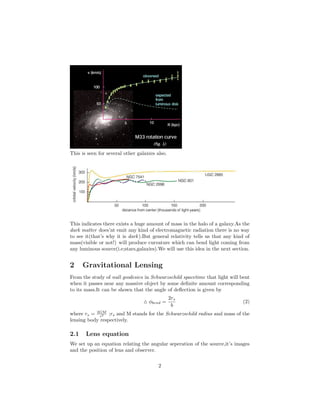
Let us consider a spiral galaxy whose shape is like a disk of total mass Mr .If
the rotational velocity of a body near the edge of the galaxy vr of mass m,at a
distance r from the center of the disk.Then using Newtons Law of Gravitation
it can be shown that
mv2
r
r
=
GMrm
r2
⇒ vr =
GMr
r
(1)
The dotted one is Keplerian orbital velocity distribution and solid one is the
observed one .
∗arkajyoti1@live.com
1
This is seen for several other galaxies also.
This indicates there exists a huge amount of mass in the halo of a galaxy.As the
dark matter does’nt emit any kind of electromagnetic radiation there is no way
to see it(that’s why it is dark).But general relativity tells us that any kind of
mass(visible or not!) will produce curvature which can bend light coming from
any luminous source(i.e;stars,galaxies).We will use this idea in the next section.
2 Gravitational Lensing
From the study of null geodesics in Schwarzschild spacetime that light will bent
when it passes near any massive object by some definite amount corresponding
to its mass.It can be shown that the angle of deflection is given by
φbend =
2rs
b
(2)
where rs = 2GM
c2 ;rs and M stands for the Schwarzschild radius and mass of the
lensing body respectively.
2.1 Lens equation
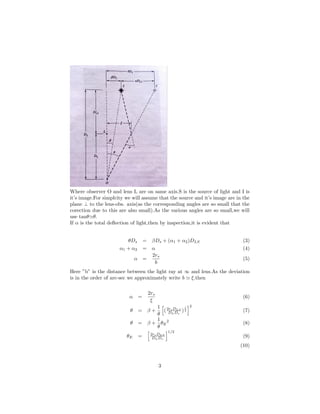
We set up an equation relating the angular seperation of the source,it’s images
and the position of lens and observer.
2
Where observer O and lens L are on same axis.S is the source of light and I is
it’s image.For simplcity we will assume that the source and it’s image are in the
plane ⊥ to the lens-obs. axis(as the corresponding angles are so small that the
corection due to this are also small).As the various angles are so small,we will
use tanθ θ.
If α is the total deflection of light,then by inspection,it is evident that
θDs = βDs + (α1 + α2)DLS (3)
α1 + α2 = α (4)
α =
2rs
b
(5)
Here ”b” is the distance between the light ray at ∞ and lens.As the deviation
is in the order of arc-sec we approximately write b ξ.then
α =
2rs
ξ
(6)
θ = β +
1
θ
(2rsDLS
DLDs
)
1
2
2
(7)
θ = β +
1
θ
θE
2
(8)
θE = 2rsDLS
DLDs
1/2
(9)
(10)
3
where θE is the Einstein angle. As the eqn.8 is quadratic in θ,so we will get
two images at an angular seperation
θ± =
1
2
[β ± (β2
+ 4θ2
E)1/2
] (11)
So clearly θ+ > 0 and θ− < 0.Hence we will get two images on two opposite
sides of L-O axis.Now if have these angles measurd and the angle between S and
O(β) then we have the Einsetin Angle(θE).And the mass of the lensing body
can be found by using eqn.9 as
rS =
2GML
c2
(12)
Typically for the lensing of a source by a galaxy (both at cosmological distance
1Gpc) the θE=1 arc-sec.But for a star (of mass nearly to our sun) within the
galaxy θE = 10−3
arc-sec, which can not be detected in contemporary telescopes.
But to detect and know the mass distribution of Dark matter in the halo of
galaxy we have to measure the Einstein angle θE.And the technique is called
Microlensing.Here we will not discuss the Strong lensing for which constrain
the Dark energy and the mass distribution of Dark matter.
2.2 Microlensing
If Prad⇒ Power radiated by the source isotropically and Ω is the solid angle
subtended by detector,then
dPrad
dΩ
= S. ˆRR2
(13)
(14)
where is Poynting vector.As the intensity I ∝ dPrad
R2 then we can write
I = S. ˆRdΩ.Then
I = k Ω (15)
where k is called surface brightness of the source(directly depenpends only on
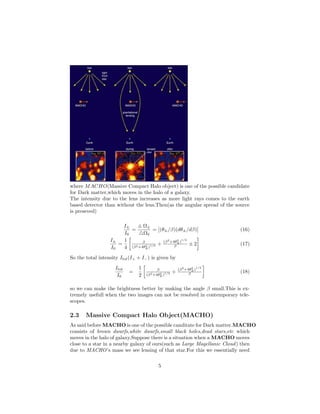
source) and can not be affected by Gravitational lensing.The following diagram
may be helpful.
4
where MACHO(Massive Compact Halo object) is one of the possible candidate
for Dark matter,which moves in the halo of a galaxy.
The intensity due to the lens increases as more light rays comes to the earth
based detector than without the lens.Then(as the angular spread of the source
is preseved)
I±
I0
=
Ω±
Ω0
= (θ±/β)(dθ±/dβ) (16)
I±
I0
=
1
4
β
(β2+4θ2
E )1/2 +
(β2
+4θ2
E )
1/2
β ± 2 (17)
So the total intensity Itot(I+ + I−) is given by
Itot
I0
=
1
2
β
(β2+4θ2
E )1/2 +
(β2
+4θ2
E )
1/2
β
(18)
so we can make the brightness better by making the angle β small.This is ex-
tremely usefull when the two images can not be resolved in contemporary tele-
scopes.
2.3 Massive Compact Halo Object(MACHO)
As said before MACHO is one of the possible canditate for Dark matter.MACHO
consists of brown dwarfs,white dwarfs,small black holes,dead stars,etc which
moves in the halo of galaxy.Suppose there is a situation when a MACHO moves
close to a star in a nearby galaxy of ours(such as Large Magellanic Cloud) then
due to MACHO’s mass we see lensing of that star.For this we essentially need
5
Microlensing.
In a typical Microlensing event we assume that a star (near to the MACHO
is moving behind it and we detect the magnification(Itot
I0
) so that the Ds
DL.And we can see the magnification changes time to time,which is induced by
Microlensing.
We will measure time in the scale of t0 = θE DL
Vtrans.
where t0 is the time taken by the star to cover angular dist. θE. and Vtrans is
the transverse vel. of the star.Then eqn. 18 becomes
Itot
I0
= a2
+2
a(a2+4)1/2 (19)
a =
β
θE
(20)
Now if we assume that the star is moving uniformly then
a = a2
min + ( t
t0
)2 1/2
(21)
a = a2
min + τ2 1/2
(22)
Itot
I0
= (a2
min+τ2
)+2
(a2
min+τ2)1/2(a2
min+τ2)+4)1/2 (23)
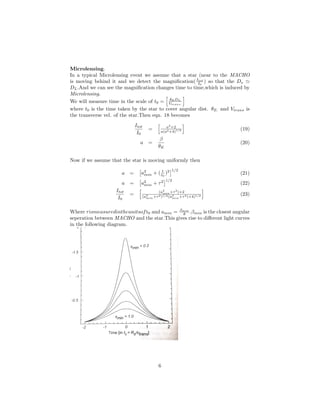
Where τismeasuredintheunitsoft0 and amin = βmin
θ .βmin is the closest angular
seperation between MACHO and the star.This gives rise to different light curves
in the following diagram.
6
3 Conclusion
In this article we only have discussed one of the possible canditate for Dark
matter i,e. MACHO.But recent studies shows that Dark matter is consists of
WIMP(Weakly Interacting Massive Particle) to a large proportion and from
various criterion WIMPs are very eligible canditate for Dark matter(which goes
beyond of our present discussion).
4 Reference
1.Gravity:An Introduction to Einstein’s General Relativity :James Hartle
2.General Relativity :Straumann
7

Dark Matter

  • 1.
    Detection Of DarkMatter (via Gravitational Lensing) Arkajyoti Manna∗ Dept. of Physics Ramakrishna Mission Vivekananda University Belur,India April 29, 2015 Abstract Since the study of galaxy rotation curve by Vera C. Rubin et.al ,there was an indication that there is a massive amount of mass exists in our universe which is not visible to us.Apart from Flat Galaxy Rotation curve there are several other experiments which confirm the existance of the so called dark matter.In this article we discuss how can one predict the existance of dark matter and the mass distribution for it(only for sim- ple cases) via Gravitational Lensing.We will use the bending of light phenomenon predicted by General relativity. 1 Galaxy Rotation curve Let us consider a spiral galaxy whose shape is like a disk of total mass Mr .If the rotational velocity of a body near the edge of the galaxy vr of mass m,at a distance r from the center of the disk.Then using Newtons Law of Gravitation it can be shown that mv2 r r = GMrm r2 ⇒ vr = GMr r (1) The dotted one is Keplerian orbital velocity distribution and solid one is the observed one . ∗arkajyoti1@live.com 1
  • 2.
    This is seenfor several other galaxies also. This indicates there exists a huge amount of mass in the halo of a galaxy.As the dark matter does’nt emit any kind of electromagnetic radiation there is no way to see it(that’s why it is dark).But general relativity tells us that any kind of mass(visible or not!) will produce curvature which can bend light coming from any luminous source(i.e;stars,galaxies).We will use this idea in the next section. 2 Gravitational Lensing From the study of null geodesics in Schwarzschild spacetime that light will bent when it passes near any massive object by some definite amount corresponding to its mass.It can be shown that the angle of deflection is given by φbend = 2rs b (2) where rs = 2GM c2 ;rs and M stands for the Schwarzschild radius and mass of the lensing body respectively. 2.1 Lens equation We set up an equation relating the angular seperation of the source,it’s images and the position of lens and observer. 2
  • 3.
    Where observer Oand lens L are on same axis.S is the source of light and I is it’s image.For simplcity we will assume that the source and it’s image are in the plane ⊥ to the lens-obs. axis(as the corresponding angles are so small that the corection due to this are also small).As the various angles are so small,we will use tanθ θ. If α is the total deflection of light,then by inspection,it is evident that θDs = βDs + (α1 + α2)DLS (3) α1 + α2 = α (4) α = 2rs b (5) Here ”b” is the distance between the light ray at ∞ and lens.As the deviation is in the order of arc-sec we approximately write b ξ.then α = 2rs ξ (6) θ = β + 1 θ (2rsDLS DLDs ) 1 2 2 (7) θ = β + 1 θ θE 2 (8) θE = 2rsDLS DLDs 1/2 (9) (10) 3
  • 4.
    where θE isthe Einstein angle. As the eqn.8 is quadratic in θ,so we will get two images at an angular seperation θ± = 1 2 [β ± (β2 + 4θ2 E)1/2 ] (11) So clearly θ+ > 0 and θ− < 0.Hence we will get two images on two opposite sides of L-O axis.Now if have these angles measurd and the angle between S and O(β) then we have the Einsetin Angle(θE).And the mass of the lensing body can be found by using eqn.9 as rS = 2GML c2 (12) Typically for the lensing of a source by a galaxy (both at cosmological distance 1Gpc) the θE=1 arc-sec.But for a star (of mass nearly to our sun) within the galaxy θE = 10−3 arc-sec, which can not be detected in contemporary telescopes. But to detect and know the mass distribution of Dark matter in the halo of galaxy we have to measure the Einstein angle θE.And the technique is called Microlensing.Here we will not discuss the Strong lensing for which constrain the Dark energy and the mass distribution of Dark matter. 2.2 Microlensing If Prad⇒ Power radiated by the source isotropically and Ω is the solid angle subtended by detector,then dPrad dΩ = S. ˆRR2 (13) (14) where is Poynting vector.As the intensity I ∝ dPrad R2 then we can write I = S. ˆRdΩ.Then I = k Ω (15) where k is called surface brightness of the source(directly depenpends only on source) and can not be affected by Gravitational lensing.The following diagram may be helpful. 4
  • 5.
    where MACHO(Massive CompactHalo object) is one of the possible candidate for Dark matter,which moves in the halo of a galaxy. The intensity due to the lens increases as more light rays comes to the earth based detector than without the lens.Then(as the angular spread of the source is preseved) I± I0 = Ω± Ω0 = (θ±/β)(dθ±/dβ) (16) I± I0 = 1 4 β (β2+4θ2 E )1/2 + (β2 +4θ2 E ) 1/2 β ± 2 (17) So the total intensity Itot(I+ + I−) is given by Itot I0 = 1 2 β (β2+4θ2 E )1/2 + (β2 +4θ2 E ) 1/2 β (18) so we can make the brightness better by making the angle β small.This is ex- tremely usefull when the two images can not be resolved in contemporary tele- scopes. 2.3 Massive Compact Halo Object(MACHO) As said before MACHO is one of the possible canditate for Dark matter.MACHO consists of brown dwarfs,white dwarfs,small black holes,dead stars,etc which moves in the halo of galaxy.Suppose there is a situation when a MACHO moves close to a star in a nearby galaxy of ours(such as Large Magellanic Cloud) then due to MACHO’s mass we see lensing of that star.For this we essentially need 5
  • 6.
    Microlensing. In a typicalMicrolensing event we assume that a star (near to the MACHO is moving behind it and we detect the magnification(Itot I0 ) so that the Ds DL.And we can see the magnification changes time to time,which is induced by Microlensing. We will measure time in the scale of t0 = θE DL Vtrans. where t0 is the time taken by the star to cover angular dist. θE. and Vtrans is the transverse vel. of the star.Then eqn. 18 becomes Itot I0 = a2 +2 a(a2+4)1/2 (19) a = β θE (20) Now if we assume that the star is moving uniformly then a = a2 min + ( t t0 )2 1/2 (21) a = a2 min + τ2 1/2 (22) Itot I0 = (a2 min+τ2 )+2 (a2 min+τ2)1/2(a2 min+τ2)+4)1/2 (23) Where τismeasuredintheunitsoft0 and amin = βmin θ .βmin is the closest angular seperation between MACHO and the star.This gives rise to different light curves in the following diagram. 6
  • 7.
    3 Conclusion In thisarticle we only have discussed one of the possible canditate for Dark matter i,e. MACHO.But recent studies shows that Dark matter is consists of WIMP(Weakly Interacting Massive Particle) to a large proportion and from various criterion WIMPs are very eligible canditate for Dark matter(which goes beyond of our present discussion). 4 Reference 1.Gravity:An Introduction to Einstein’s General Relativity :James Hartle 2.General Relativity :Straumann 7