CREATED BY
1. DhananjayUttamrao Kadam
2. Sumedh Shamrao Kamble
3. Manoj Rajkumar Hipplage
4. Akash Siddharth Khillare
3.
ABSTRACT
Automatic StreetLight Control System is a simple yet powerful
concept, which uses transistor as a switch.
By using this system manual works are 100% removed.
It automatically switches ON lights when the sunlight goes below
the visible region of our eyes. This is done by a sensor called Light
Dependant Resistor (LDR) which senses the light actually like our
eyes.
It automatically switches OFF lights whenever the sunlight comes,
visible to our eyes.
By using this system energy consumption is also reduced because
nowadays the manually operated street lights are not switched off
even the sunlight comes and also switched on earlier before sunset. i
4.
BASIC PRINCIPLE
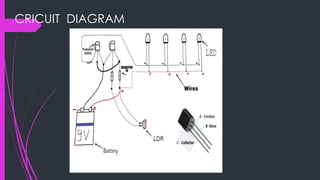
The automaticstreetlight control system operates on 9
V DC supply. The automatic streetlight controller has a
photoconductive device whose resistance changes proportional to
the extent of illumination, which switches ON or OFF the LED with the
use of transistor as a switch. Light dependent resistor. a
photoconductive device has been used as the transducer to
convert light energy into electrical energy. The central dogma of
the circuit is that the change in voltage drop across the light
dependent resistor on illumination or darkness switches the transistor
between cut-off region or saturation region and switches OFF or On
the LEDAs we know property of LDR that during the time of day
resistance is low therefore voltage at the inverting input (IE pin 2) is
higher than the voltage at the non-inverting input (pin3) hence the
output at the pin is low so the transistor goes into the cut off state
• WORKING PRINCIPLE
.Assoon as sunlight falls of LDR sensor cadmium sulfide then sensor
automatically switches OFF the lights which depends on its light-intensity,
otherwise switches ON the lights.
.LDR sensor is used for detecting the presence of surrounding light so
that during the day time when sun is bright, the street light is switched off
automatically. During the night time when there is no light, the LDR
sends signal to microcontroller to turn on the street light.
7.
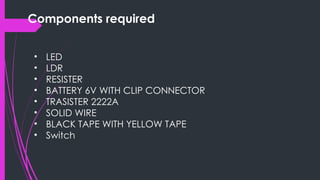
Components required
• LED
•LDR
• RESISTER
• BATTERY 6V WITH CLIP CONNECTOR
• TRASISTER 2222A
• SOLID WIRE
• BLACK TAPE WITH YELLOW TAPE
• Switch
8.
SPECIFICATION OF COMPONENTS
LIGHTDEPENDENT RESISTOR (LDR)
A light-emitting diode (LED) is a
semiconductor device that emits light
when current flows through it. Electrons in
the semiconductor recombine with
electron holes, releasing energy in the form
of photons. The color of the light
(corresponding to the energy of the
photons) is determined by the energy
required for electrons to cross the band
gap of the semiconductor.[5] White light is
obtained by using multiple semiconductors
or a layer of light-emitting phosphor on the
semiconductor device.
9.
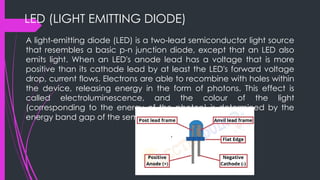
LED (LIGHT EMITTINGDIODE)
A light-emitting diode (LED) is a two-lead semiconductor light source
that resembles a basic p-n junction diode, except that an LED also
emits light. When an LED's anode lead has a voltage that is more
positive than its cathode lead by at least the LED's forward voltage
drop, current flows. Electrons are able to recombine with holes within
the device, releasing energy in the form of photons. This effect is
called electroluminescence, and the colour of the light
(corresponding to the energy of the photon) is determined by the
energy band gap of the semiconductor.
10.
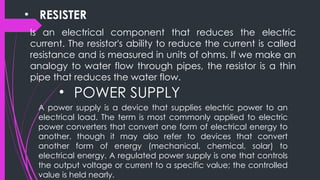
• RESISTER
Is anelectrical component that reduces the electric
current. The resistor's ability to reduce the current is called
resistance and is measured in units of ohms. If we make an
analogy to water flow through pipes, the resistor is a thin
pipe that reduces the water flow.
• POWER SUPPLY
A power supply is a device that supplies electric power to an
electrical load. The term is most commonly applied to electric
power converters that convert one form of electrical energy to
another. though it may also refer to devices that convert
another form of energy (mechanical, chemical, solar) to
electrical energy. A regulated power supply is one that controls
the output voltage or current to a specific value; the controlled
value is held nearly.
11.
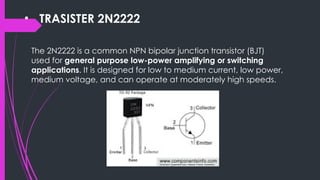
• TRASISTER 2N2222
The2N2222 is a common NPN bipolar junction transistor (BJT)
used for general purpose low-power amplifying or switching
applications. It is designed for low to medium current, low power,
medium voltage, and can operate at moderately high speeds.
12.
• ADVANTAGES
a) Powerconsumption is less
b) Circuit cost is less compared the digital circuit
c) Its operation is easy
13.
• APPLICATIONS
a) Itis not only for street lights but also used for homely applications.
b) These are mostly used in 4-way (or) 3-way to avoid accidents.
• CONCLUSION
In coming days, this will prove a great boon to the country,
since it will save lot of electricity of power plant that gets
wasted in illuminating the street lights. As a conclusion,
around 77%-81% of power consumption can be reduced By
using this system towards providing a solution for energy
saving
14.
FUTURE SCOPE
We cansave the energy for the future use and we can
control the losses of the power . We can implemented this
project for the home lamp or night lamp of the room. This
is also used for the signals


![SPECIFICATION OF COMPONENTS
LIGHT DEPENDENT RESISTOR (LDR)
A light-emitting diode (LED) is a
semiconductor device that emits light
when current flows through it. Electrons in
the semiconductor recombine with
electron holes, releasing energy in the form
of photons. The color of the light
(corresponding to the energy of the
photons) is determined by the energy
required for electrons to cross the band
gap of the semiconductor.[5] White light is
obtained by using multiple semiconductors
or a layer of light-emitting phosphor on the
semiconductor device.](https://image.slidesharecdn.com/ppt-250330135552-b2d36406/85/Ppt-engineering-study-material-available-8-320.jpg)