Darcy’s Law
Vijitha Vikneshwaran
Lecturer (Temporary)
Faculty of Technology
University of Jaffna
Darcy’s Law
• h1: hydraulic heads in well 1
• h2: hydraulic heads in well 2
• Difference between the two hydraulic heads is Δℎ.
• Δℎ is the cause of groundwater flow.
• Distance between the two wells be Δ𝑙.
2
Figure 01: Darcy’s law
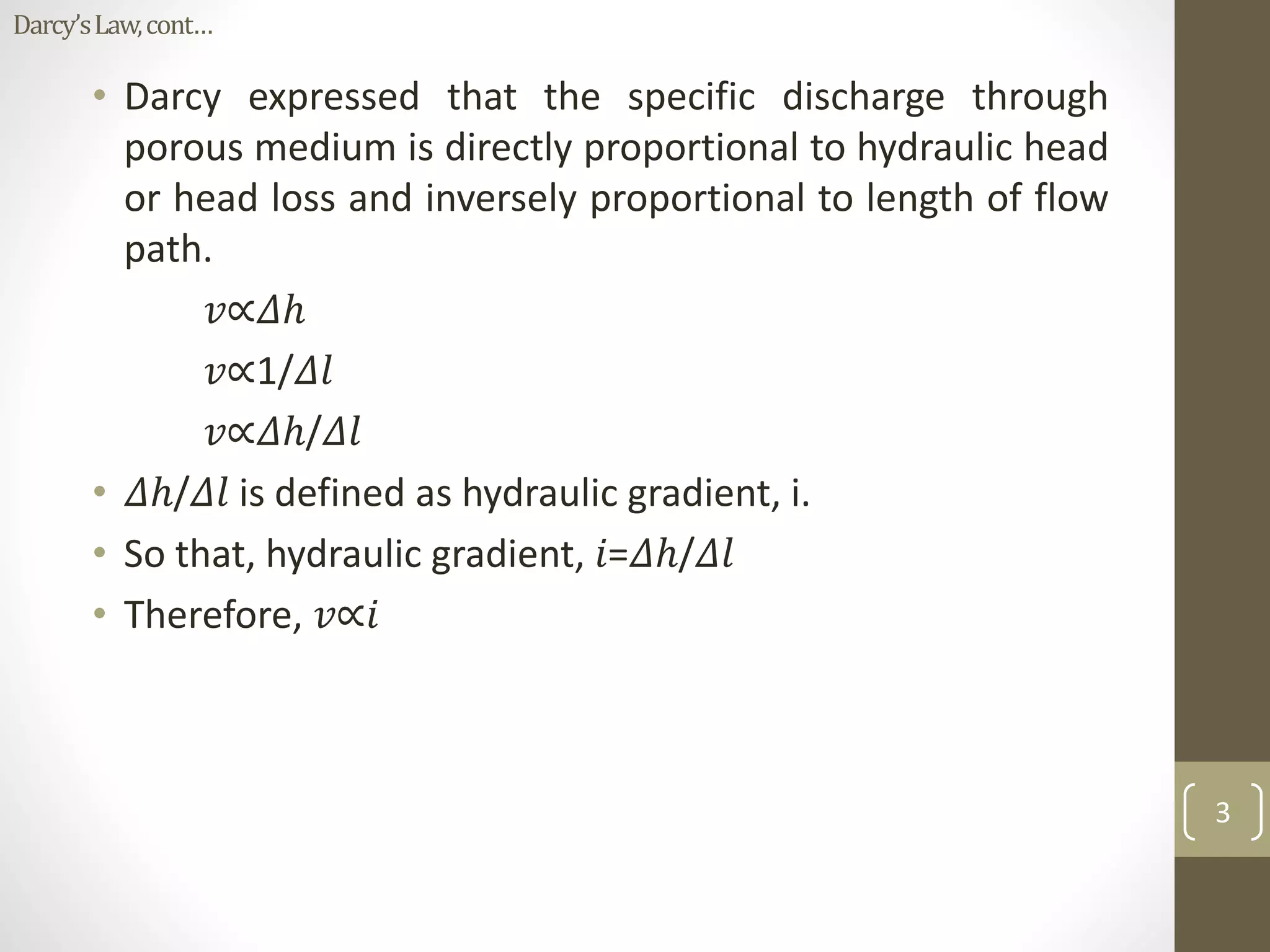
• Darcy expressed that the specific discharge through
porous medium is directly proportional to hydraulic head
or head loss and inversely proportional to length of flow
path.
𝑣∝𝛥ℎ
𝑣∝1/𝛥𝑙
𝑣∝𝛥ℎ/𝛥𝑙
• 𝛥ℎ/𝛥𝑙 is defined as hydraulic gradient, i.
• So that, hydraulic gradient, 𝑖=𝛥ℎ/𝛥𝑙
• Therefore, 𝑣∝𝑖
Darcy’sLaw,cont…
3
• This proportionality is converted to equality by
introducing a constant coefficient, K that has logical
physical meaning.
• This coefficient depends on the characteristics of the
porous medium and the groundwater.
• It refers to a resistance coefficient and is called hydraulic
conductivity.
• This can be written mathematically as,
𝑣=𝑘(𝑑ℎ/𝑑𝑙)
• This is what is known as Darcy’s Law.
Darcy’sLaw,cont…
4
• The differential form of the equation is given as,
𝑣 = −𝑘(𝑑ℎ/𝑑𝑙)
• Negative sign is put in front because the difference
between piezometric head 2 and piezometric head 1 is
negative.
• The value should be multiplied by negative.
• So that the specific discharge will be positive with a
physical meaning.
Darcy’sLaw,cont…
5
𝑣=𝑄/𝐴
• Where,
𝑣: Specific discharge (Darcy velocity or Darcy flux (Length/time))
Q: Volume rate of flow (Length3/time)
A: Cross-sectional area normal to flow direction
• In geotechnical engineering, permeability is used in place of
hydraulic conductivity.
• Hydraulic conductivity is a property of both the fluid and the
porous medium.
• But permeability depends only on the property of the porous
medium.
Darcy’sLaw,cont…
6
• Darcy’s Law is valid for laminar flow, but not for turbulent
flow.
• Turbulent flow can happen in cavernous limestone and
fractured basalt.
• Reynolds number can be used to determine whether a flow is
laminar or turbulent flow.
• Darcy concluded that the law’s range of validity is between
1<Re<10.
• Re=10 is upper limit of the validity of Darcy’s flow.
Darcy’sLaw,cont…
7
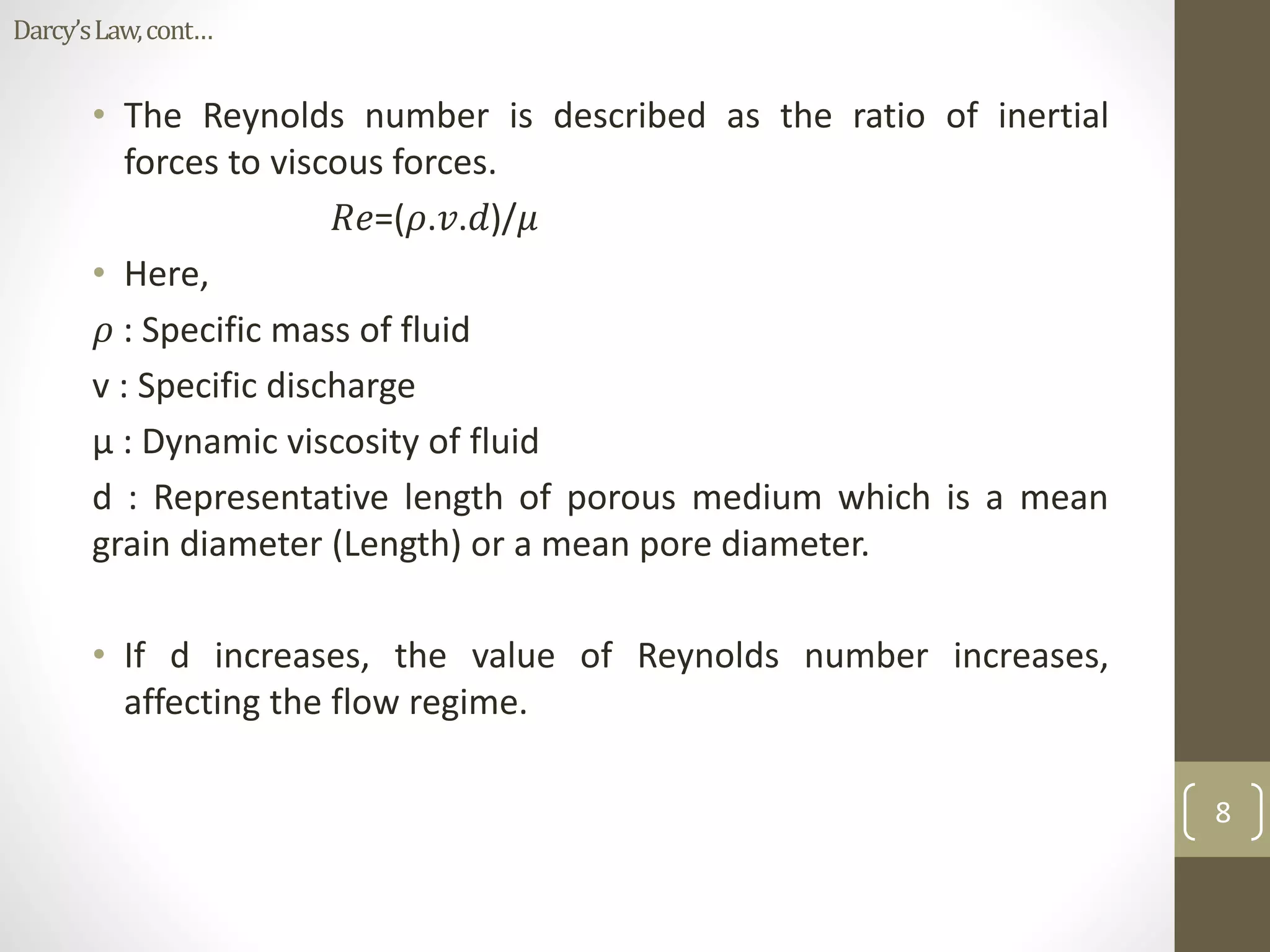
• The Reynolds number is described as the ratio of inertial
forces to viscous forces.
𝑅𝑒=(𝜌.𝑣.𝑑)/𝜇
• Here,
𝜌 : Specific mass of fluid
v : Specific discharge
μ : Dynamic viscosity of fluid
d : Representative length of porous medium which is a mean
grain diameter (Length) or a mean pore diameter.
• If d increases, the value of Reynolds number increases,
affecting the flow regime.
Darcy’sLaw,cont…
8
• Most ground water flow occur when Re number is less than 1.
• Therefore, Darcy’s Law applies in ground water flow
conditions.
• Exceptional situations,
Rock wide opening
Vicinity of pumped well and
Where steep hydraulic head exists.
• Darcy’s Law is invalid,
At low hydraulic gradient.
When Reynolds number stays in range from 1 to 10.
When all flow through granular media is laminar.
Darcy’sLaw,cont…
9
Problems related to ground water
• Increased pressure on groundwater supplies due to,
Increasing population and
Decreasing surface water supplies
• Lowering the water table due to,
Expansion of cone of depression
Diverting water away from recharge areas
• Reversing Groundwater Flow
Cone of depression creates a local slope that
induces pollutants to flow into the well
• Saline Intrusion
Around the coast, salt water will replace freshwater
in an aquifer permanently. 10
• Pore collapse and land subsidence
Excessive groundwater removal creates permanent
depletion problems
By directing the surface runoff to recharge areas or
pumping surface water back into the aquifer this issue
can be overcome
• Groundwater Quality
Hardness due to dissolved Mg2+ and Ca2+
Cause scale on pipes and appliances, soap won’t lather
Pipes can become clogged.
Fe2+ also dissolves from Arseonpyrite (FeAsS) and
creates H2S (rotten egg smell)
Several health issues happen due to poor ground water
quality
Problemsrelatedtogroundwater,cont…
11
• Groundwater Contamination
Rocks are good filters - suspended solids can be removed
Clays can act as exchange surfaces to remove pollutants
• However, groundwater contains dissolved materials that can
be,
toxic - As, Hg, Pb or
non-toxic but unpleasant - lime, sulfur, salt, Fe
• Some organic materials don’t mix with water, but get pushed
through the system.
• Bacteria from septic systems can also go through an aquifer.
Problemsrelatedtogroundwater,cont…
12
Human made contamination
• Sources of contaminants are,
Agriculture: pesticides, herbicides, fertilizer, residues
Industry: dangerous organic and inorganic compounds
Effluent from ”sanitary” landfills and septic tanks
Petroleum products
Radioactive wastes
Acid mine waste
Problemsrelatedtogroundwater,cont…
13
Problemsrelatedtogroundwater,cont…
Figure 02: Human made contamination 14
• If these contaminants get into groundwater, they produce a
contaminant plume as they flow away.
Problemsrelatedtogroundwater,cont…
Figure 03: Contaminant plume
15
Preventing Groundwater Contamination
Sanitary Landfill
• The soil keeps out vermin and confines the trash.
• Usually sited in abandoned gravel pits or surface mines.
• When full, a thick layer of earth is put on top and the
area given over to other uses
• A layer of compacted trash is covered by a layer of earth
at least once a day.
16
Gas Pollutants:
• Initially aerobic decay (trapped air) – CO2 and SO2.
• Changes to anaerobic (CH4 & H2S).
• These gases may percolate through the soil and naturally
vent, but want to keep them in CH4 is a greenhouse gas.
• Both CH4 and H2S, if in high enough concentration, may
cause asphyxiation.
• If kept in, quantity of CH4 produced could be used
commercially other wise it will be burnt off.
PreventingGroundwaterContamination,cont…
17
• Infiltrating water may accumulate in the landfill and
eventually spill over the liner.
• Use low-permeability materials above and below landfill
to minimize this.
• Pump out leachate and treat before disposal.
• Plants growing on a finished landfill may uptake toxic
chemicals – warning against using the site for farming.
PreventingGroundwaterContamination,cont…
18
PreventingGroundwaterContamination,cont…
Figure 04: Bathtub effect
19
Remediating Groundwater Contamination
• Pump and treat.
• Bioremediation.
• Oxygenation.
PreventingGroundwaterContamination,cont…
Figure 05: Waste leakage
20
Groundwater contamination can be cleaned up by
• Utilizing engineering principles and natural processes
• But it is expensive.
• Most remedial strategies include removing the source.
• Bioremediation is a technique that utilizes bacteria to clean
groundwater.
PreventingGroundwaterContamination,cont…
Figure 06: Remediating Groundwater Contamination
21
THANK YOU
22

Darcy’s law

  • 1.
    Darcy’s Law Vijitha Vikneshwaran Lecturer(Temporary) Faculty of Technology University of Jaffna
  • 2.
    Darcy’s Law • h1:hydraulic heads in well 1 • h2: hydraulic heads in well 2 • Difference between the two hydraulic heads is Δℎ. • Δℎ is the cause of groundwater flow. • Distance between the two wells be Δ𝑙. 2 Figure 01: Darcy’s law
  • 3.
    • Darcy expressedthat the specific discharge through porous medium is directly proportional to hydraulic head or head loss and inversely proportional to length of flow path. 𝑣∝𝛥ℎ 𝑣∝1/𝛥𝑙 𝑣∝𝛥ℎ/𝛥𝑙 • 𝛥ℎ/𝛥𝑙 is defined as hydraulic gradient, i. • So that, hydraulic gradient, 𝑖=𝛥ℎ/𝛥𝑙 • Therefore, 𝑣∝𝑖 Darcy’sLaw,cont… 3
  • 4.
    • This proportionalityis converted to equality by introducing a constant coefficient, K that has logical physical meaning. • This coefficient depends on the characteristics of the porous medium and the groundwater. • It refers to a resistance coefficient and is called hydraulic conductivity. • This can be written mathematically as, 𝑣=𝑘(𝑑ℎ/𝑑𝑙) • This is what is known as Darcy’s Law. Darcy’sLaw,cont… 4
  • 5.
    • The differentialform of the equation is given as, 𝑣 = −𝑘(𝑑ℎ/𝑑𝑙) • Negative sign is put in front because the difference between piezometric head 2 and piezometric head 1 is negative. • The value should be multiplied by negative. • So that the specific discharge will be positive with a physical meaning. Darcy’sLaw,cont… 5
  • 6.
    𝑣=𝑄/𝐴 • Where, 𝑣: Specificdischarge (Darcy velocity or Darcy flux (Length/time)) Q: Volume rate of flow (Length3/time) A: Cross-sectional area normal to flow direction • In geotechnical engineering, permeability is used in place of hydraulic conductivity. • Hydraulic conductivity is a property of both the fluid and the porous medium. • But permeability depends only on the property of the porous medium. Darcy’sLaw,cont… 6
  • 7.
    • Darcy’s Lawis valid for laminar flow, but not for turbulent flow. • Turbulent flow can happen in cavernous limestone and fractured basalt. • Reynolds number can be used to determine whether a flow is laminar or turbulent flow. • Darcy concluded that the law’s range of validity is between 1<Re<10. • Re=10 is upper limit of the validity of Darcy’s flow. Darcy’sLaw,cont… 7
  • 8.
    • The Reynoldsnumber is described as the ratio of inertial forces to viscous forces. 𝑅𝑒=(𝜌.𝑣.𝑑)/𝜇 • Here, 𝜌 : Specific mass of fluid v : Specific discharge μ : Dynamic viscosity of fluid d : Representative length of porous medium which is a mean grain diameter (Length) or a mean pore diameter. • If d increases, the value of Reynolds number increases, affecting the flow regime. Darcy’sLaw,cont… 8
  • 9.
    • Most groundwater flow occur when Re number is less than 1. • Therefore, Darcy’s Law applies in ground water flow conditions. • Exceptional situations, Rock wide opening Vicinity of pumped well and Where steep hydraulic head exists. • Darcy’s Law is invalid, At low hydraulic gradient. When Reynolds number stays in range from 1 to 10. When all flow through granular media is laminar. Darcy’sLaw,cont… 9
  • 10.
    Problems related toground water • Increased pressure on groundwater supplies due to, Increasing population and Decreasing surface water supplies • Lowering the water table due to, Expansion of cone of depression Diverting water away from recharge areas • Reversing Groundwater Flow Cone of depression creates a local slope that induces pollutants to flow into the well • Saline Intrusion Around the coast, salt water will replace freshwater in an aquifer permanently. 10
  • 11.
    • Pore collapseand land subsidence Excessive groundwater removal creates permanent depletion problems By directing the surface runoff to recharge areas or pumping surface water back into the aquifer this issue can be overcome • Groundwater Quality Hardness due to dissolved Mg2+ and Ca2+ Cause scale on pipes and appliances, soap won’t lather Pipes can become clogged. Fe2+ also dissolves from Arseonpyrite (FeAsS) and creates H2S (rotten egg smell) Several health issues happen due to poor ground water quality Problemsrelatedtogroundwater,cont… 11
  • 12.
    • Groundwater Contamination Rocksare good filters - suspended solids can be removed Clays can act as exchange surfaces to remove pollutants • However, groundwater contains dissolved materials that can be, toxic - As, Hg, Pb or non-toxic but unpleasant - lime, sulfur, salt, Fe • Some organic materials don’t mix with water, but get pushed through the system. • Bacteria from septic systems can also go through an aquifer. Problemsrelatedtogroundwater,cont… 12
  • 13.
    Human made contamination •Sources of contaminants are, Agriculture: pesticides, herbicides, fertilizer, residues Industry: dangerous organic and inorganic compounds Effluent from ”sanitary” landfills and septic tanks Petroleum products Radioactive wastes Acid mine waste Problemsrelatedtogroundwater,cont… 13
  • 14.
  • 15.
    • If thesecontaminants get into groundwater, they produce a contaminant plume as they flow away. Problemsrelatedtogroundwater,cont… Figure 03: Contaminant plume 15
  • 16.
    Preventing Groundwater Contamination SanitaryLandfill • The soil keeps out vermin and confines the trash. • Usually sited in abandoned gravel pits or surface mines. • When full, a thick layer of earth is put on top and the area given over to other uses • A layer of compacted trash is covered by a layer of earth at least once a day. 16
  • 17.
    Gas Pollutants: • Initiallyaerobic decay (trapped air) – CO2 and SO2. • Changes to anaerobic (CH4 & H2S). • These gases may percolate through the soil and naturally vent, but want to keep them in CH4 is a greenhouse gas. • Both CH4 and H2S, if in high enough concentration, may cause asphyxiation. • If kept in, quantity of CH4 produced could be used commercially other wise it will be burnt off. PreventingGroundwaterContamination,cont… 17
  • 18.
    • Infiltrating watermay accumulate in the landfill and eventually spill over the liner. • Use low-permeability materials above and below landfill to minimize this. • Pump out leachate and treat before disposal. • Plants growing on a finished landfill may uptake toxic chemicals – warning against using the site for farming. PreventingGroundwaterContamination,cont… 18
  • 19.
  • 20.
    Remediating Groundwater Contamination •Pump and treat. • Bioremediation. • Oxygenation. PreventingGroundwaterContamination,cont… Figure 05: Waste leakage 20
  • 21.
    Groundwater contamination canbe cleaned up by • Utilizing engineering principles and natural processes • But it is expensive. • Most remedial strategies include removing the source. • Bioremediation is a technique that utilizes bacteria to clean groundwater. PreventingGroundwaterContamination,cont… Figure 06: Remediating Groundwater Contamination 21
  • 22.