6. GROUNDWATER FLOW
 Groundwater flow: The flow of water through
saturated porous media
 Groundwater flow rate is function of;
 porosity, pore space size and
 connectivity of the pores (hydraulic conductivity) in
geologic formations
FORCES ACTING ON GROUND WATER FLOW
There are three outside forces acting on ground water.
i. Gravity: This pulls water downward
ii. External pressure above the zone of saturation
 The combination of atmospheric pressure and the
weight of overlaying water create pressures in the
zone of saturation.
iii. Molecular attraction:
• This causes water to adhere to solid surfaces.
 It creates surface tension in water and resists the
movement of fluid molecules past each other. This
shearing stress is known as the viscosity of the
fluid.
FACTORS AFFECTING GROUNDWATER FLOW
1. the slope of the water table : the steeper the
water table, the faster ground water moves
2. Hydraulic conductivity: also known as
coefficient of permeability
 Hydraulic conductivity is related to the ability of
the rock to transmit water through its pore
spaces. As mentioned else where the formations
ability to transmit and its capacity to hold water
constitute the most significant hydrologic
properties.
It is a measure of the interconnectivity of the pore
spaces.
Is a quantitative measure of how fast Groundwater
Cont.’
3. Porosity: is the ratio of void spaces in a rock
compared with the total volume of the rock
• Porosity tells us how
much water a rock can
contain when saturated
• Well rounded and sorted
sediments have porosity
of 26% – 48%
T
v
V
V
n 
n: Porosity
Vv: Volume of Voids
VT: Total volume of soils or
rocks
STEADY AND UNSTEADY STATE FLOW
Steady state flow is independent of time at any given
point in the flow field.
As a result, the steady state condition, water level does
not change with time.
This may occur when there is an equilibrium state of
flow between the discharge of pumped well and the
recharge of the aquifer by an outside source.
steady state flow takes place if pumping aquifer is
recharged by outside water resource, rainfall
(unconfined aquifer), and leakage through the aquitard
(Leaky aquifer) from upward or downward and directly
from open water sources.
As a result, we can say that steady state flow is
attained if the changes in the water level in wells and
piezometers are very small with time that they can
be ignored.
UNSTEADY STATE FLOW
Unsteady state occurs from the time of the start of
pumping until steady state flow is reached.
Consequently in an infinite horizontal, completely
confined aquifer of constant thickness which is
pumped at a constant rate, there will always be
considered to be unsteady state as long as in the
piezometers
PRINCIPLE OF GROUNDWATER FLOW
Darcy’s Law
Stated that the groundwater discharge Q through
porous medium is proportional to the difference in
hydraulic head Dh and cross-sectional area A and
inversely proportional to the length of flow path DL,
thus
𝐐 = 𝐀𝐕 = −𝐤𝐀𝐢 , where, 𝒊 =
𝒅𝒉
𝒅𝑳
Where k, the proportionality constant, is called the
hydraulic conductivity, expressed in m/d; i, hydraulic
gradient; and v is the specific discharge (also known
as Darcy velocity or Darcy flux (Length/time)).
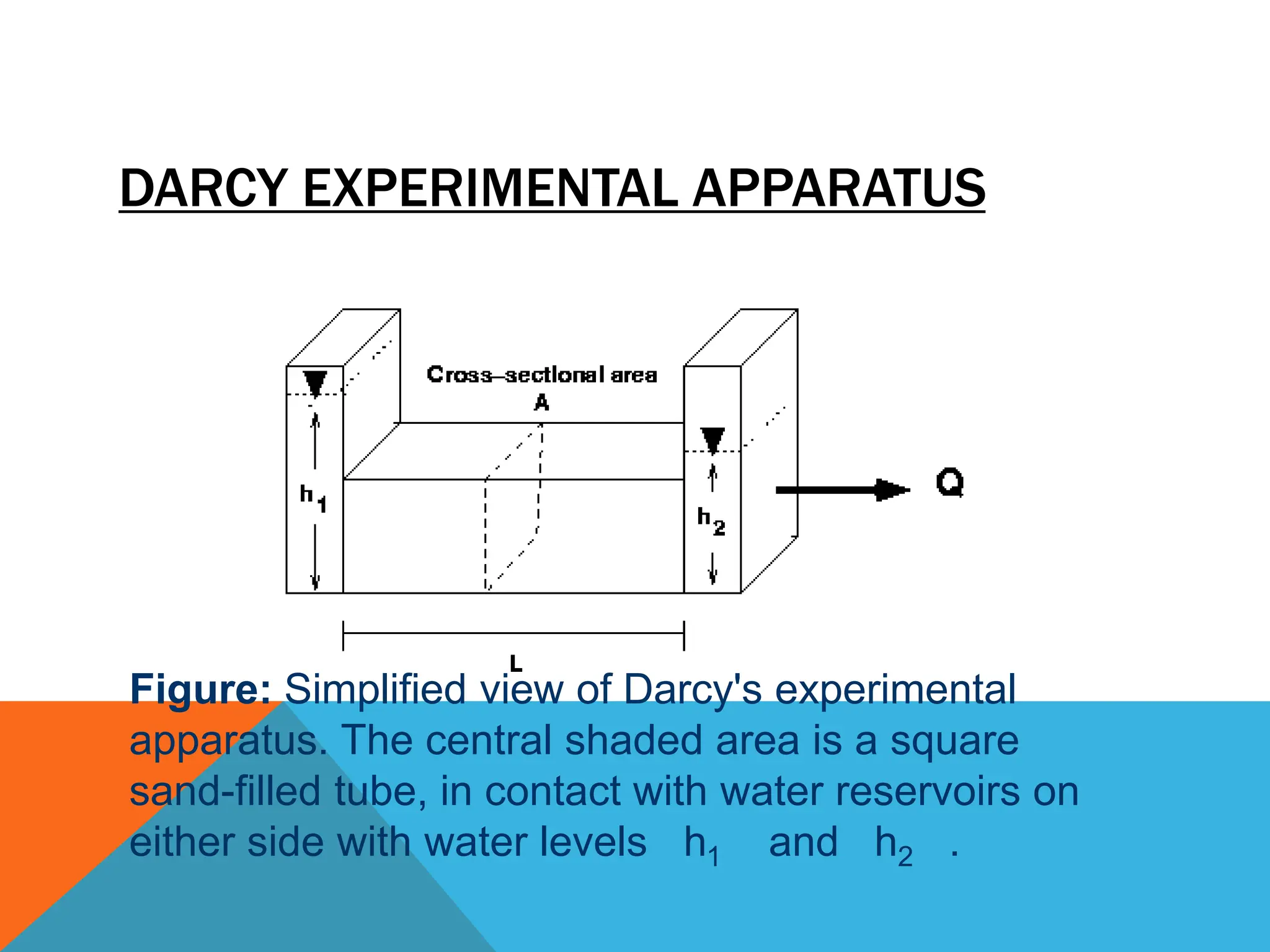
DARCY EXPERIMENTAL APPARATUS
Figure: Simplified view of Darcy's experimental
apparatus. The central shaded area is a square
sand-filled tube, in contact with water reservoirs on
either side with water levels h1 and h2 .
DARCY’S LAW SUMMARIZES THE FOLLOWING GROUNDWATER
FLOW PROPERTIES
if there is no hydraulic gradient over a distance, no
flow occurs (this is hydrostatic conditions),
if there is a hydraulic gradient, flow will occur from
high head towards low head (opposite the direction
of increasing head- hence the negative sign in
Darcy's law),
the greater the hydraulic gradient (through the same
formation material), the greater the discharge rate,
and
the discharge rate of fluid will often be different —
through different formation materials (or even
through the same material, in a different direction) —
• Water is continually recycled through aquifer systems.
• Groundwater recharge is any water added to the aquifer zone.
• Processes that contribute to groundwater recharge include
precipitation, streamflow, leakage (reservoirs, lakes, aqueducts), and
artificial means (injection wells).
• Groundwater discharge is any process that removes water from an
aquifer system. Natural springs and artificial wells are examples of
discharge processes.
Groundwater -- Recharge and Discharge
Chapter 6.pptx ground water flow and its apps

Chapter 6.pptx ground water flow and its apps

  • 1.
    6. GROUNDWATER FLOW Groundwater flow: The flow of water through saturated porous media  Groundwater flow rate is function of;  porosity, pore space size and  connectivity of the pores (hydraulic conductivity) in geologic formations
  • 2.
    FORCES ACTING ONGROUND WATER FLOW There are three outside forces acting on ground water. i. Gravity: This pulls water downward ii. External pressure above the zone of saturation  The combination of atmospheric pressure and the weight of overlaying water create pressures in the zone of saturation. iii. Molecular attraction: • This causes water to adhere to solid surfaces.  It creates surface tension in water and resists the movement of fluid molecules past each other. This shearing stress is known as the viscosity of the fluid.
  • 3.
    FACTORS AFFECTING GROUNDWATERFLOW 1. the slope of the water table : the steeper the water table, the faster ground water moves 2. Hydraulic conductivity: also known as coefficient of permeability  Hydraulic conductivity is related to the ability of the rock to transmit water through its pore spaces. As mentioned else where the formations ability to transmit and its capacity to hold water constitute the most significant hydrologic properties. It is a measure of the interconnectivity of the pore spaces. Is a quantitative measure of how fast Groundwater
  • 4.
    Cont.’ 3. Porosity: isthe ratio of void spaces in a rock compared with the total volume of the rock • Porosity tells us how much water a rock can contain when saturated • Well rounded and sorted sediments have porosity of 26% – 48% T v V V n  n: Porosity Vv: Volume of Voids VT: Total volume of soils or rocks
  • 5.
    STEADY AND UNSTEADYSTATE FLOW Steady state flow is independent of time at any given point in the flow field. As a result, the steady state condition, water level does not change with time. This may occur when there is an equilibrium state of flow between the discharge of pumped well and the recharge of the aquifer by an outside source.
  • 6.
    steady state flowtakes place if pumping aquifer is recharged by outside water resource, rainfall (unconfined aquifer), and leakage through the aquitard (Leaky aquifer) from upward or downward and directly from open water sources. As a result, we can say that steady state flow is attained if the changes in the water level in wells and piezometers are very small with time that they can be ignored.
  • 7.
    UNSTEADY STATE FLOW Unsteadystate occurs from the time of the start of pumping until steady state flow is reached. Consequently in an infinite horizontal, completely confined aquifer of constant thickness which is pumped at a constant rate, there will always be considered to be unsteady state as long as in the piezometers
  • 9.
    PRINCIPLE OF GROUNDWATERFLOW Darcy’s Law Stated that the groundwater discharge Q through porous medium is proportional to the difference in hydraulic head Dh and cross-sectional area A and inversely proportional to the length of flow path DL, thus 𝐐 = 𝐀𝐕 = −𝐤𝐀𝐢 , where, 𝒊 = 𝒅𝒉 𝒅𝑳 Where k, the proportionality constant, is called the hydraulic conductivity, expressed in m/d; i, hydraulic gradient; and v is the specific discharge (also known as Darcy velocity or Darcy flux (Length/time)).
  • 10.
    DARCY EXPERIMENTAL APPARATUS Figure:Simplified view of Darcy's experimental apparatus. The central shaded area is a square sand-filled tube, in contact with water reservoirs on either side with water levels h1 and h2 .
  • 11.
    DARCY’S LAW SUMMARIZESTHE FOLLOWING GROUNDWATER FLOW PROPERTIES if there is no hydraulic gradient over a distance, no flow occurs (this is hydrostatic conditions), if there is a hydraulic gradient, flow will occur from high head towards low head (opposite the direction of increasing head- hence the negative sign in Darcy's law), the greater the hydraulic gradient (through the same formation material), the greater the discharge rate, and the discharge rate of fluid will often be different — through different formation materials (or even through the same material, in a different direction) —
  • 12.
    • Water iscontinually recycled through aquifer systems. • Groundwater recharge is any water added to the aquifer zone. • Processes that contribute to groundwater recharge include precipitation, streamflow, leakage (reservoirs, lakes, aqueducts), and artificial means (injection wells). • Groundwater discharge is any process that removes water from an aquifer system. Natural springs and artificial wells are examples of discharge processes. Groundwater -- Recharge and Discharge