The Latest Developments in
  Computer Crime Law
      SOURCE Seattle
        June 15, 2011
     Marcia Hofmann, EFF
what we’ll talk about today
✪ The federal hacking law and why it’s problematic.

✪ A couple trends that have emerged from recent
cases in which courts have interpreted the scope of
this law.

✪ What these trends suggest about the future.
Background

The Computer Fraud and Abuse Act
       18 U.S.C. § 1030
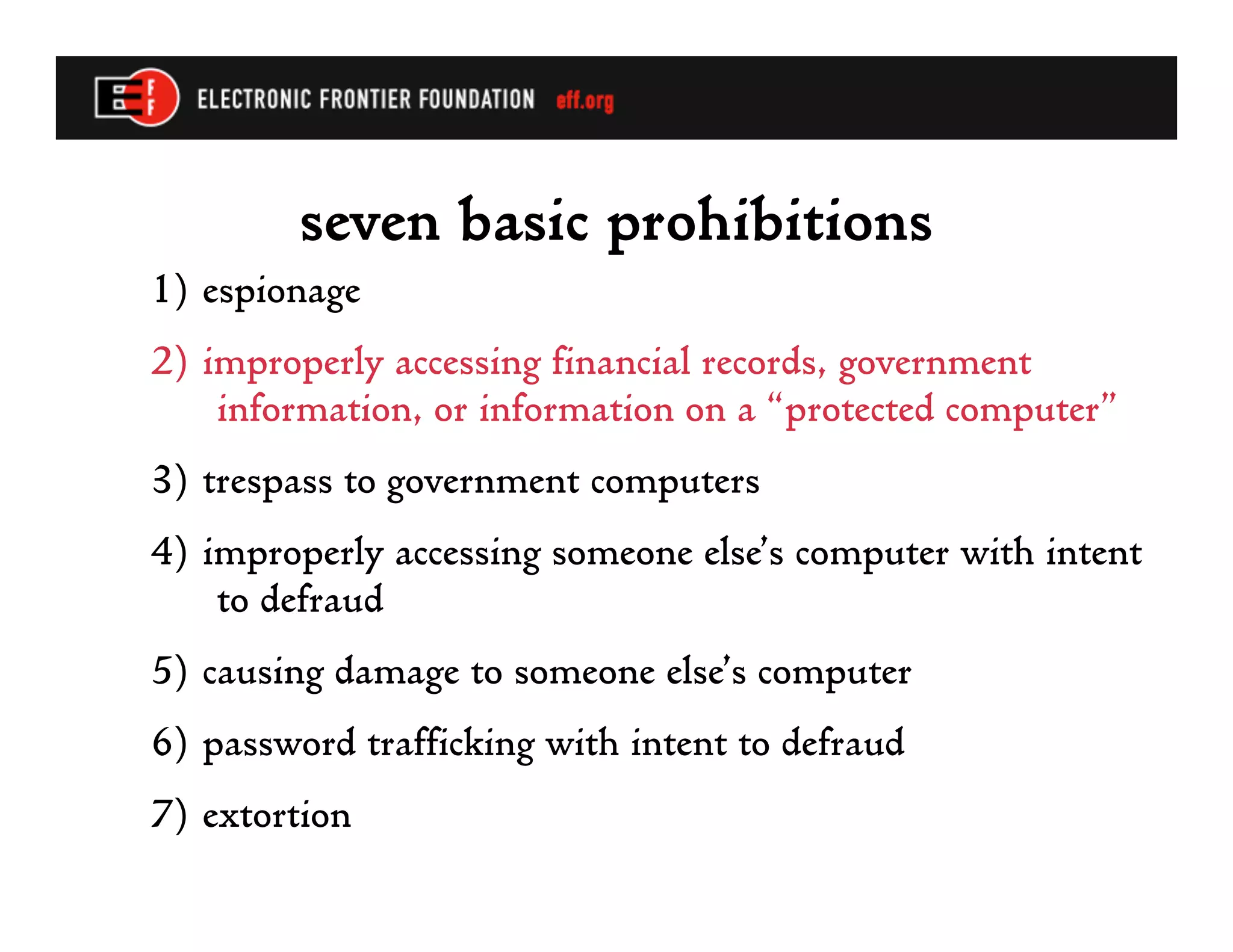
seven basic prohibitions
1) espionage
2) improperly accessing financial records, government
    information, or information on a “protected computer”
3) trespass to government computers
4) improperly accessing someone else’s computer with intent
    to defraud
5) causing damage to someone else’s computer
6) password trafficking with intent to defraud
7) extortion
improper access
The CFAA prohibits, among other things,
“intentionally access[ing] a computer without
  authorization or in excess of authorization, and
  thereby obtain[ing] . . . information from any
  protected computer.”
18 U.S.C. § 1030(a)(2)(C).
improper access
 Courts have interpreted “obtaining information”
                      broadly.

Basically any computer connected to the internet is a
                “protected computer.”

  So the major limiting principle is “authorized.”
development 1

expansive theories of unauthorized
 access/exceeding authorized access
Some people have argued that authorization ends
  when an employee violates a duty of loyalty to
                 an employer...

       International Airport Centers v. Citrin
            LVRC Holdings v. Brekka
Others have gone so far as to argue that
authorization ends when a person violates a
          web site’s terms of use.

          United States v. Drew
        Facebook v. Power Ventures
         United States v. Lowson
The case law in this area recently took a turn for
   the worse when an appeals court found that
  violating an employer’s computer use policies
           “exceeds authorized access.”


              United States v. Nosal
The future?

Lee v. PMSI, Inc.

  Sony v. Hotz
development 2

attempts to double-count penalties for
          unauthorized access
A first-time violation of the “unauthorized
  access” provision is generally a misdemeanor.

However, it can be elevated to a felony in certain
     circumstances, like when the offense is
  committed in furtherance of another crime or
                   tortious act.
United States v. Drew

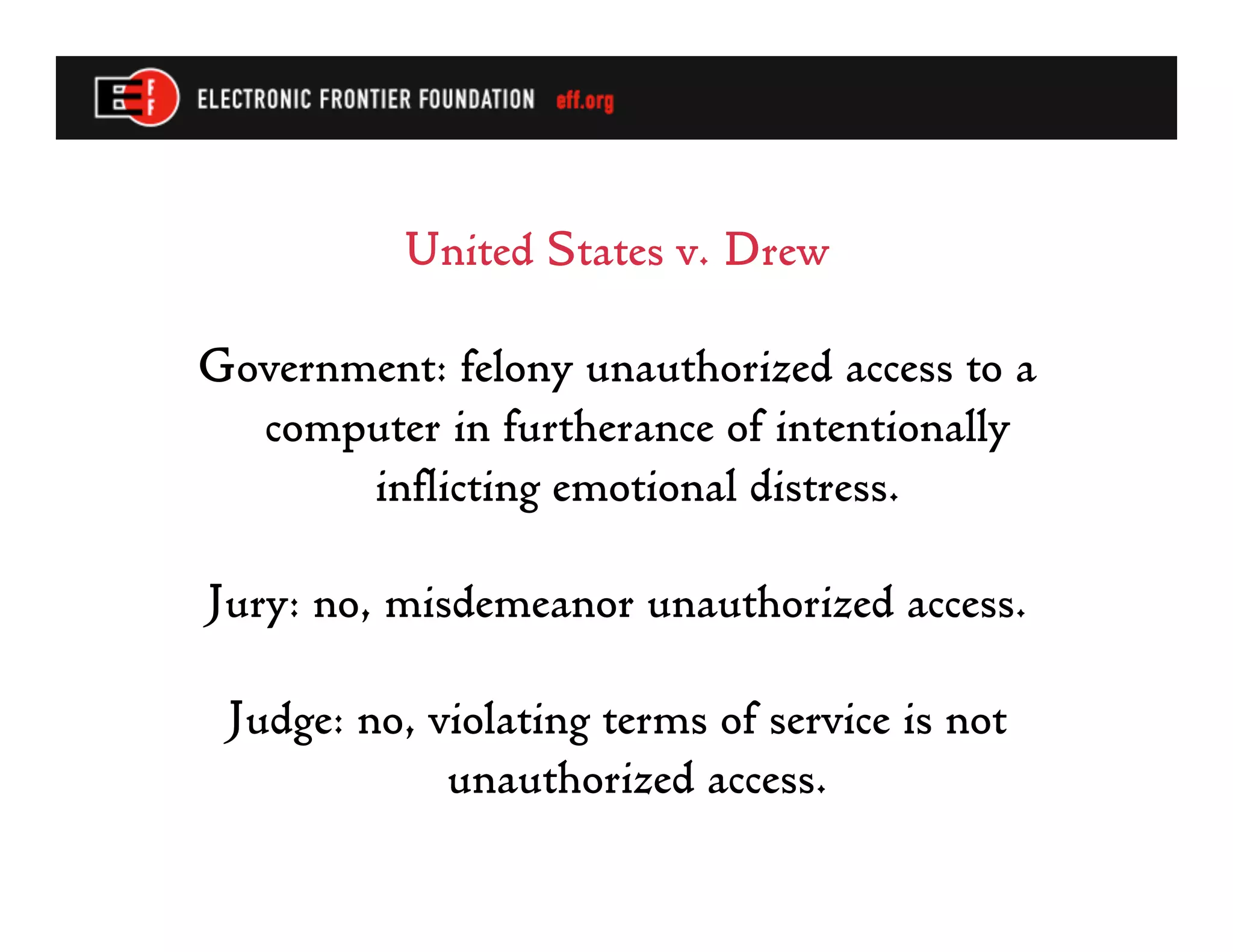
Government: felony unauthorized access to a
  computer in furtherance of intentionally
       inflicting emotional distress.

Jury: no, misdemeanor unauthorized access.

 Judge: no, violating terms of service is not
             unauthorized access.
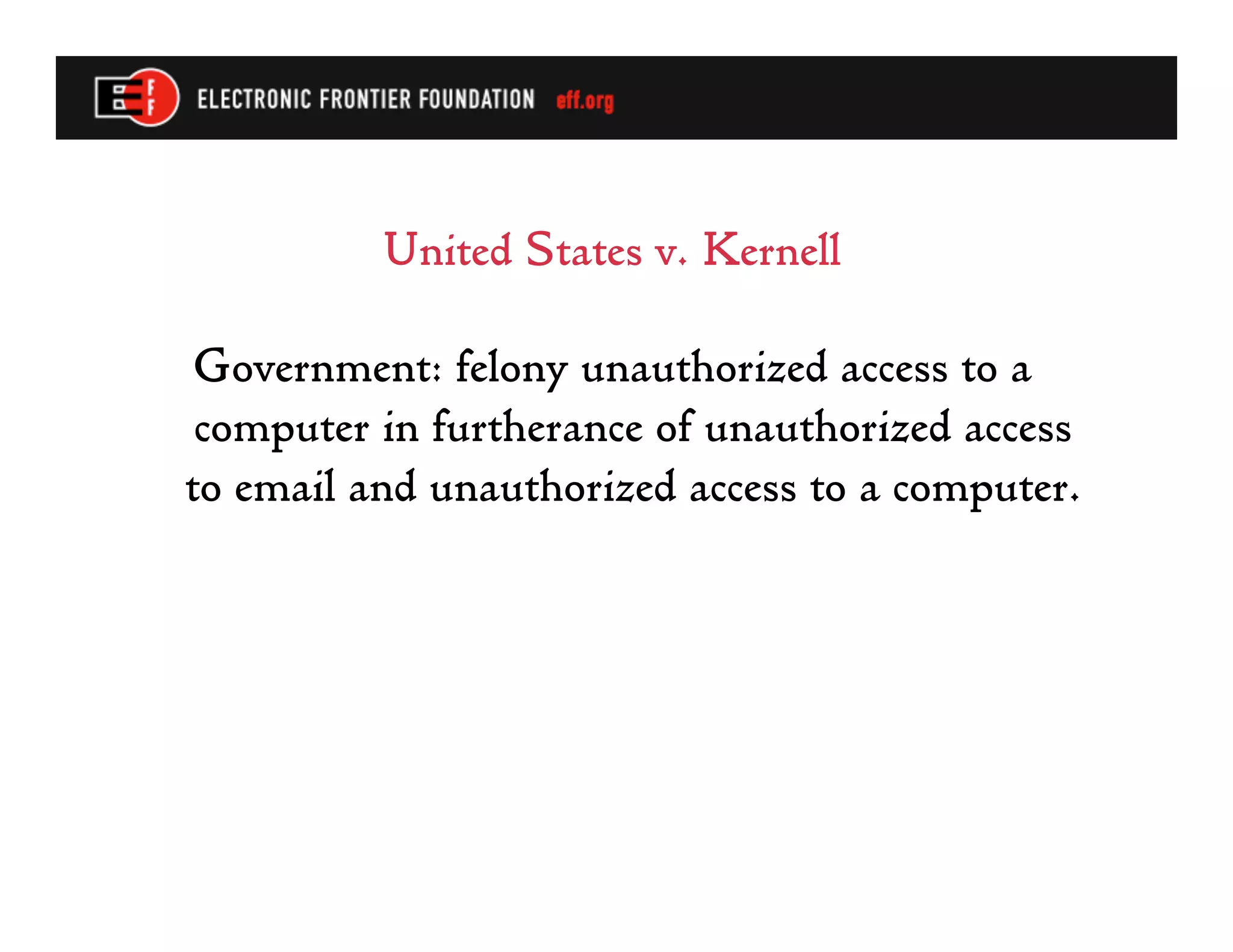
United States v. Kernell

Government: felony unauthorized access to a
 computer in furtherance of unauthorized access
to email and unauthorized access to a computer.
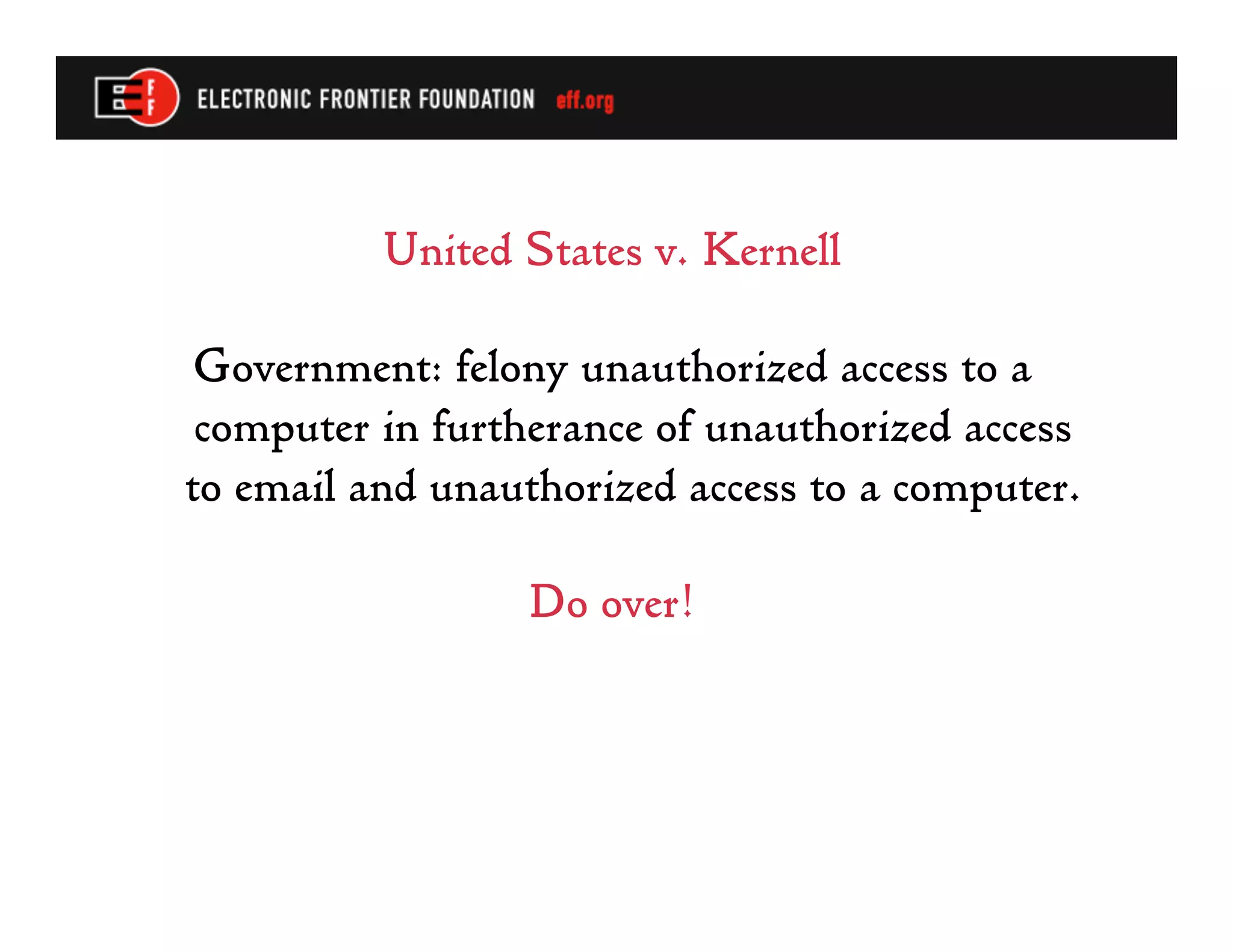
United States v. Kernell

Government: felony unauthorized access to a
 computer in furtherance of unauthorized access
to email and unauthorized access to a computer.

                 Do over!
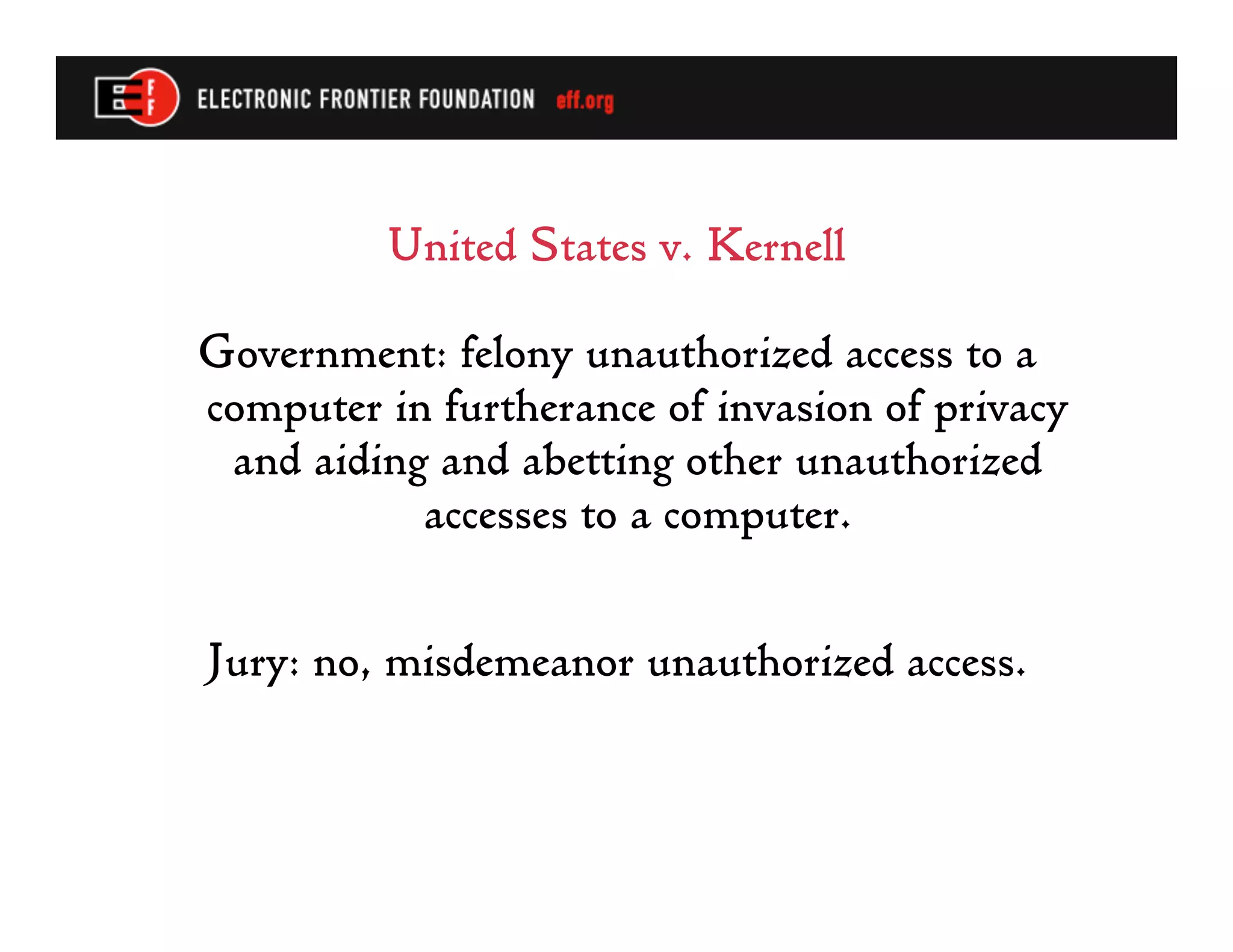
United States v. Kernell

Government: felony unauthorized access to a
computer in furtherance of invasion of privacy
 and aiding and abetting other unauthorized
           accesses to a computer.

Jury: no, misdemeanor unauthorized access.
United States v. Cioni

Government: felony unauthorized access to a
computer in furtherance of unauthorized access
                  to email.

          Jury: yup, two felonies.

           (This is a problem.)
The CFAA prohibits unauthorized access to and
    obtaining information from a computer.
               (Here, email.)

  The Stored Communications Act prohibits
unauthorized access to an electronic communication
  service and obtaining stored communications.
                (Here, email.)

              It’s the same thing.
United States v. Cioni

Government: felony unauthorized access to a
computer in furtherance of unauthorized access
                  to email.

          Jury: yup, two felonies.

Appeals court: no, these are misdemeanors.
The future?

legislative changes
(enhanced penalties?)
questions?

     Marcia Hofmann
Senior Staff Attorney, EFF
      marcia@eff.org

The Latest Developments in Computer Crime Law

  • 1.
    The Latest Developmentsin Computer Crime Law SOURCE Seattle June 15, 2011 Marcia Hofmann, EFF
  • 2.
    what we’ll talkabout today ✪ The federal hacking law and why it’s problematic. ✪ A couple trends that have emerged from recent cases in which courts have interpreted the scope of this law. ✪ What these trends suggest about the future.
  • 3.
    Background The Computer Fraudand Abuse Act 18 U.S.C. § 1030
  • 4.
    seven basic prohibitions 1)espionage 2) improperly accessing financial records, government information, or information on a “protected computer” 3) trespass to government computers 4) improperly accessing someone else’s computer with intent to defraud 5) causing damage to someone else’s computer 6) password trafficking with intent to defraud 7) extortion
  • 5.
    improper access The CFAAprohibits, among other things, “intentionally access[ing] a computer without authorization or in excess of authorization, and thereby obtain[ing] . . . information from any protected computer.” 18 U.S.C. § 1030(a)(2)(C).
  • 6.
    improper access Courtshave interpreted “obtaining information” broadly. Basically any computer connected to the internet is a “protected computer.” So the major limiting principle is “authorized.”
  • 7.
    development 1 expansive theoriesof unauthorized access/exceeding authorized access
  • 8.
    Some people haveargued that authorization ends when an employee violates a duty of loyalty to an employer... International Airport Centers v. Citrin LVRC Holdings v. Brekka
  • 9.
    Others have goneso far as to argue that authorization ends when a person violates a web site’s terms of use. United States v. Drew Facebook v. Power Ventures United States v. Lowson
  • 10.
    The case lawin this area recently took a turn for the worse when an appeals court found that violating an employer’s computer use policies “exceeds authorized access.” United States v. Nosal
  • 11.
    The future? Lee v.PMSI, Inc. Sony v. Hotz
  • 12.
    development 2 attempts todouble-count penalties for unauthorized access
  • 13.
    A first-time violationof the “unauthorized access” provision is generally a misdemeanor. However, it can be elevated to a felony in certain circumstances, like when the offense is committed in furtherance of another crime or tortious act.
  • 14.
    United States v.Drew Government: felony unauthorized access to a computer in furtherance of intentionally inflicting emotional distress. Jury: no, misdemeanor unauthorized access. Judge: no, violating terms of service is not unauthorized access.
  • 15.
    United States v.Kernell Government: felony unauthorized access to a computer in furtherance of unauthorized access to email and unauthorized access to a computer.
  • 16.
    United States v.Kernell Government: felony unauthorized access to a computer in furtherance of unauthorized access to email and unauthorized access to a computer. Do over!
  • 17.
    United States v.Kernell Government: felony unauthorized access to a computer in furtherance of invasion of privacy and aiding and abetting other unauthorized accesses to a computer. Jury: no, misdemeanor unauthorized access.
  • 18.
    United States v.Cioni Government: felony unauthorized access to a computer in furtherance of unauthorized access to email. Jury: yup, two felonies. (This is a problem.)
  • 19.
    The CFAA prohibitsunauthorized access to and obtaining information from a computer. (Here, email.) The Stored Communications Act prohibits unauthorized access to an electronic communication service and obtaining stored communications. (Here, email.) It’s the same thing.
  • 20.
    United States v.Cioni Government: felony unauthorized access to a computer in furtherance of unauthorized access to email. Jury: yup, two felonies. Appeals court: no, these are misdemeanors.
  • 21.
  • 22.
    questions? Marcia Hofmann Senior Staff Attorney, EFF marcia@eff.org