GRADES 7
WEEKLY LESSON LOG
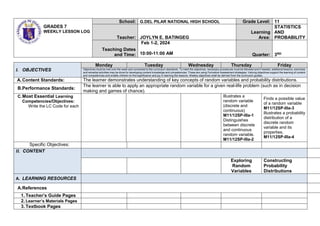
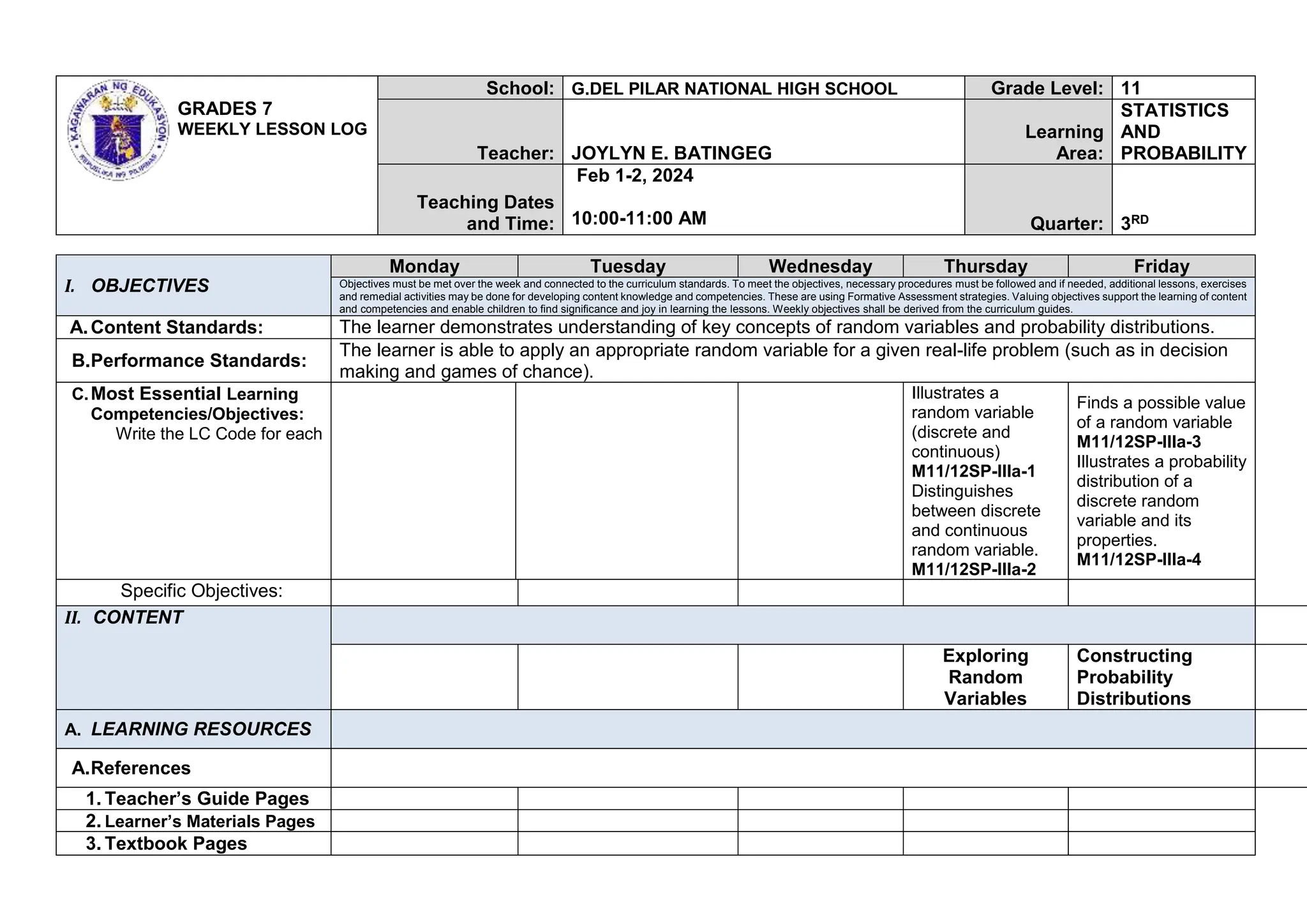
School: G.DEL PILAR NATIONAL HIGH SCHOOL Grade Level: 11
Teacher: JOYLYN E. BATINGEG
Learning
Area:
STATISTICS
AND
PROBABILITY
Teaching Dates
and Time:
Feb 1-2, 2024
10:00-11:00 AM Quarter: 3RD
I. OBJECTIVES
Monday Tuesday Wednesday Thursday Friday
Objectives must be met over the week and connected to the curriculum standards. To meet the objectives, necessary procedures must be followed and if needed, additional lessons, exercises
and remedial activities may be done for developing content knowledge and competencies. These are using Formative Assessment strategies. Valuing objectives support the learning of content
and competencies and enable children to find significance and joy in learning the lessons. Weekly objectives shall be derived from the curriculum guides.
A.Content Standards: The learner demonstrates understanding of key concepts of random variables and probability distributions.
B.Performance Standards:
The learner is able to apply an appropriate random variable for a given real-life problem (such as in decision
making and games of chance).
C.Most Essential Learning
Competencies/Objectives:
Write the LC Code for each
Illustrates a
random variable
(discrete and
continuous)
M11/12SP-IIIa-1
Distinguishes
between discrete
and continuous
random variable.
M11/12SP-IIIa-2
Finds a possible value
of a random variable
M11/12SP-IIIa-3
Illustrates a probability
distribution of a
discrete random
variable and its
properties.
M11/12SP-IIIa-4
Specific Objectives:
II. CONTENT
Exploring
Random
Variables
Constructing
Probability
Distributions
A. LEARNING RESOURCES
A.References
1. Teacher’s Guide Pages
2. Learner’s Materials Pages
3. Textbook Pages
4. Additional Materials
from Learning Resource
(LR) portal
B.Other Learning
Resources
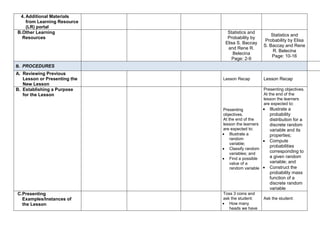
Statistics and
Probability by
Elisa S. Baccay
and Rene R.
Belecina
Page: 2-9
Statistics and
Probability by Elisa
S. Baccay and Rene
R. Belecina
Page: 10-16
B. PROCEDURES
A. Reviewing Previous
Lesson or Presenting the
New Lesson
Lesson Recap Lesson Recap
B. Establishing a Purpose
for the Lesson
Presenting
objectives.
At the end of the
lesson the learners
are expected to:
 Illustrate a
random
variable;
 Classify random
variables; and
 Find a possible
value of a
random variable
Presenting objectives.
At the end of the
lesson the learners
are expected to:
 Illustrate a
probability
distribution for a
discrete random
variable and its
properties;
 Compute
probabilities
corresponding to
a given random
variable; and
 Construct the
probability mass
function of a
discrete random
variable
C.Presenting
Examples/Instances of
the Lesson
Toss 3 coins and
ask the student:
 How many
heads we have
Ask the student:
in the three
tossed coins?
 How many
tails?
Are you free in
making decisions in
your life?
D.Discussing New
Concepts and Practicing
New Skills #1
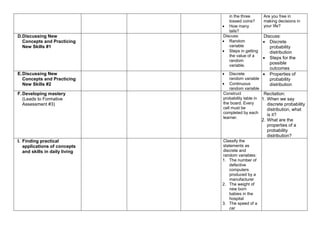
Discuss:
 Random
variable
 Steps in getting
the value of a
random
variable.
Discuss:
 Discrete
probability
distribution
 Steps for the
possible
outcomes
E.Discussing New
Concepts and Practicing
New Skills #2
1.  Discrete
random variable
 Continuous
random variable
 Properties of
probability
distribution
F.Developing mastery
(Leads to Formative
Assessment #3)
Construct
probability table in
the board. Every
cell must be
completed by each
learner.
Recitation:
1. When we say
discrete probability
distribution, what
is it?
2. What are the
properties of a
probability
distribution?
I. Finding practical
applications of concepts
and skills in daily living
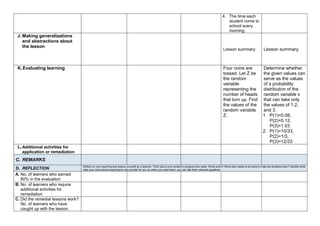
Classify the
statements as
discrete and
random variables:
1. The number of
defective
computers
produced by a
manufacturer
2. The weight of
new born
babies in the
hospital
3. The speed of a
car
4. The time each
student come to
school every
morning
J. Making generalizations
and abstractions about
the lesson
Lesson summary. Lesson summary.
K.Evaluating learning Four coins are
tossed. Let Z be
the random
variable
representing the
number of heads
that turn up. Find
the values of the
random variable
Z.
Determine whether
the given values can
serve as the values
of a probability
distribution of the
random variable x
that can take only
the values of 1,2,
and 3.
1. P(1)=0.08,
P(2)=0.12,
P(3)=1.03
2. P(1)=10/33,
P(2)=1/3,
P(3)=12/33
L.Additional activities for
application or remediation
C. REMARKS
D. REFLECTION Reflect on your teaching and assess yourself as a teacher. Think about your student’s progress this week. What works? What else needs to be done to help the students learn? Identify what
help your instructional supervisors can provide for you so when you meet them, you can ask them relevant questions.
A. No. of learners who earned
80% in the evaluation
B. No. of learners who require
additional activities for
remediation
C. Did the remedial lessons work?
No. of learners who have
caught up with the lesson.
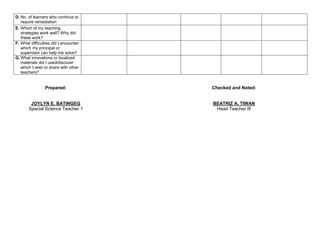
D. No. of learners who continue to
require remediation
E. Which of my teaching
strategies work well? Why did
these work?
F. What difficulties did I encounter
which my principal or
supervisor can help me solve?
G. What innovations or localized
materials did I used/discover
which I wish to share with other
teachers?
Prepared:
JOYLYN E. BATINGEG
Special Science Teacher 1
Checked and Noted:
BEATRIZ A. TIWAN
Head Teacher III

Daily Lesson Plan-W1-STATistic and probability

  • 1.
    GRADES 7 WEEKLY LESSONLOG School: G.DEL PILAR NATIONAL HIGH SCHOOL Grade Level: 11 Teacher: JOYLYN E. BATINGEG Learning Area: STATISTICS AND PROBABILITY Teaching Dates and Time: Feb 1-2, 2024 10:00-11:00 AM Quarter: 3RD I. OBJECTIVES Monday Tuesday Wednesday Thursday Friday Objectives must be met over the week and connected to the curriculum standards. To meet the objectives, necessary procedures must be followed and if needed, additional lessons, exercises and remedial activities may be done for developing content knowledge and competencies. These are using Formative Assessment strategies. Valuing objectives support the learning of content and competencies and enable children to find significance and joy in learning the lessons. Weekly objectives shall be derived from the curriculum guides. A.Content Standards: The learner demonstrates understanding of key concepts of random variables and probability distributions. B.Performance Standards: The learner is able to apply an appropriate random variable for a given real-life problem (such as in decision making and games of chance). C.Most Essential Learning Competencies/Objectives: Write the LC Code for each Illustrates a random variable (discrete and continuous) M11/12SP-IIIa-1 Distinguishes between discrete and continuous random variable. M11/12SP-IIIa-2 Finds a possible value of a random variable M11/12SP-IIIa-3 Illustrates a probability distribution of a discrete random variable and its properties. M11/12SP-IIIa-4 Specific Objectives: II. CONTENT Exploring Random Variables Constructing Probability Distributions A. LEARNING RESOURCES A.References 1. Teacher’s Guide Pages 2. Learner’s Materials Pages 3. Textbook Pages
  • 2.
    4. Additional Materials fromLearning Resource (LR) portal B.Other Learning Resources Statistics and Probability by Elisa S. Baccay and Rene R. Belecina Page: 2-9 Statistics and Probability by Elisa S. Baccay and Rene R. Belecina Page: 10-16 B. PROCEDURES A. Reviewing Previous Lesson or Presenting the New Lesson Lesson Recap Lesson Recap B. Establishing a Purpose for the Lesson Presenting objectives. At the end of the lesson the learners are expected to:  Illustrate a random variable;  Classify random variables; and  Find a possible value of a random variable Presenting objectives. At the end of the lesson the learners are expected to:  Illustrate a probability distribution for a discrete random variable and its properties;  Compute probabilities corresponding to a given random variable; and  Construct the probability mass function of a discrete random variable C.Presenting Examples/Instances of the Lesson Toss 3 coins and ask the student:  How many heads we have Ask the student:
  • 3.
    in the three tossedcoins?  How many tails? Are you free in making decisions in your life? D.Discussing New Concepts and Practicing New Skills #1 Discuss:  Random variable  Steps in getting the value of a random variable. Discuss:  Discrete probability distribution  Steps for the possible outcomes E.Discussing New Concepts and Practicing New Skills #2 1.  Discrete random variable  Continuous random variable  Properties of probability distribution F.Developing mastery (Leads to Formative Assessment #3) Construct probability table in the board. Every cell must be completed by each learner. Recitation: 1. When we say discrete probability distribution, what is it? 2. What are the properties of a probability distribution? I. Finding practical applications of concepts and skills in daily living Classify the statements as discrete and random variables: 1. The number of defective computers produced by a manufacturer 2. The weight of new born babies in the hospital 3. The speed of a car
  • 4.
    4. The timeeach student come to school every morning J. Making generalizations and abstractions about the lesson Lesson summary. Lesson summary. K.Evaluating learning Four coins are tossed. Let Z be the random variable representing the number of heads that turn up. Find the values of the random variable Z. Determine whether the given values can serve as the values of a probability distribution of the random variable x that can take only the values of 1,2, and 3. 1. P(1)=0.08, P(2)=0.12, P(3)=1.03 2. P(1)=10/33, P(2)=1/3, P(3)=12/33 L.Additional activities for application or remediation C. REMARKS D. REFLECTION Reflect on your teaching and assess yourself as a teacher. Think about your student’s progress this week. What works? What else needs to be done to help the students learn? Identify what help your instructional supervisors can provide for you so when you meet them, you can ask them relevant questions. A. No. of learners who earned 80% in the evaluation B. No. of learners who require additional activities for remediation C. Did the remedial lessons work? No. of learners who have caught up with the lesson.
  • 5.
    D. No. oflearners who continue to require remediation E. Which of my teaching strategies work well? Why did these work? F. What difficulties did I encounter which my principal or supervisor can help me solve? G. What innovations or localized materials did I used/discover which I wish to share with other teachers? Prepared: JOYLYN E. BATINGEG Special Science Teacher 1 Checked and Noted: BEATRIZ A. TIWAN Head Teacher III