International Refereed Journal of Engineering and Science (IRJES)
ISSN (Online) 2319-183X, (Print) 2319-1821
Volume 2, Issue 1(January 2013), PP.25-29
www.irjes.com

 Interpretation and Optimization of Resisitivity Studies Data For
  The Shallow Subsurface Geology Along The Cauvery –Vaigai
               Link Canal Project- (A Case Study).
              Prof. S. A. Meshram1, Dr S P Khadse2, Dr. D. C. Meshram3
             1.Prof. S. A. Meshram, Associate Professor Geology, College Of Engg, Pune (COEP)
            2.Dr S P Khadse, Associate Professor Geology, Shri Shivaji Science College-Amravati.
           3.Dr. D. C. Meshram, Professor of Geology; Deptt. of Geology, University of Pune, Pune.

Abstract: Inter-basin transfer of water from surplus basins to deficit basins has been mooted in our country in
order to reduce the imbalances in the availability of water among various regions. A National Perspective Plan
(NPP) for water resources development was formulated in the year 1980 by the then Union Ministry of
Irrigation and the Central Water Commission identifying a number of inter-basin water transfer links in respect
of Peninsular rivers and Himalayan rivers of the country. These Development components put together are
expected to create an additional irrigation potential of 35 million hectares besides hydropower generation and
other benefits.The inter-linking system of Mahanadi – Godavari – Krishna – Pennar – Cauvery – Vaigai –
Gundar is one of the four parts of the Peninsular Rivers Development Component of the NPP.
         Geophysical investigationswas carried out along the proposed Cauvery Vaigai Link Canal Project of
the inter-linking system of Mahanadi – Godavari – Krishna – Pennar, Rivers of India in the present paper.
Detailed Geophysical survey of the proposed canal alignment was carried out by the authors as a part of the
consultancy project. MATLAB was used in preparation of the sub- surface Geological cross sections The data
available from this investigations is interpreted to reveal the local geology and for design of foundations .It has
been observed from these investigations, in conjunction with other literature that the coastal tract, shallow
ground water aquifers occurs in alluvial plains, sand dunes and palaeochannels and the depth of the water table
in the aquifers shows seasonal changes from about 2 to 7 m from the ground level. The aquifers in tertiary
rocks are deep – seated, the depth varying from 80 to 300 m from the ground level. It was observed that the
open wells were tapping unconfined aquifer system in highly weathered rock, moderately weathered / fractured
hard rock and highly fractured hard rock. The bore wells are tapping the confined aquifer system 40 m BGL in
highly fractured hard rock. The aquifers in the bore wells were reported to be in between 40 to 120 m BGL.
Most of the bore wells are dry at present due to depletion of aquifer owing to very little precipitation and over
exploitation.
         From resistivity survey it is inferred that where ever highly fractured hard rock is expected along the
link, abundant quantity of ground water may be present there in those fractured zones. The water table shows
periodical variations. During the excavation of the canal, the study of water table condition will give an idea
about the chances of striking ground water at cut and Cross Drainage portions as ground water poses a serious
hazard during the excavation works.

Key words: Geophysical Investigations; Matlab; Foundation design.

                                       I.         INTRODUCTION:
          This paper deals with the feasibility studies carried out for the Cauvery Vaigai-Gundar link project
envisaging a diversion of water. The scheme of linking the surplus river basins of Mahanadi and Godavari to
the deficit basins of Krishna, Pennar, Cauvery and Vaigai is the most important part of the various proposals for
inter basin transfer of water under the Peninsular River Development Component of the National Perspective
Plan by which the transfer of water from surplus to the deficit basins would be carried out through nine link
canals of which, Cauvery – Vaigai – Gundar link is one of them. The logic behind the interlinking project is
based on the view that there is „Surplus‟ water in some river basins or sub-basins, which provide a permanent
solution to the problem of human sufferings and from droughts and water scarcity. On the face of it, this is
convincing enough logic for undertaking the project for interlinking of Indian Rivers (Bandaopadhyay 2002 and
Gupta, 2008). Long distance inter-basin transfer of water from surplus basins to deficit basins has been mooted
in our country in order to reduce the imbalances in the availability of water among various regions, Prakasa Rao
et al. 2010. The inter-linking system of Mahanadi – Godavari – Krishna – Pennar – Cauvery – Vaigai – Gundar
is one of the four parts of the Peninsular Rivers Development Component of the NPP. The location of the CVG
                                                   www.irjes.com                                        25 | Page
Interpretation And Optimization Of Resisitivity Studies Data For The Shallow Subsurface Geology

link starts from the village Kulluru, which is located on Pennar River. The starting point of the link has latitude
15 o 30‟02 “and longitude 79 o 15‟ 07”near Kulluru village of Nellor taluka of Karur district in Tamil Nadu.
The rivers that would be crossed by the canal are Napalli, Koraiyar, Kondar, Vellar, Pambanar, Virisalar,
Sarugani, Gridhamal, Vaigai and Gundar, Venkatagiri, Swarnamukhi, Nagari, Ponnaiyar, Motottor, Majmukta
Nadi and Marudaiyar. The alignment and command area of the link canal lie between latitudes 150 30‟ 02” and
100 45‟ 05” and longitudes 790 15‟ 07” and 780 45‟ 30”. The entire link is enclosed in the parts of survey of
India toposheets bearing Nos. 57N, 57O, 57P, 58M and 58J of scale 1: 50000 in the districts of Karur,
Thiruchirapalli, Pudukotai, Shivaganga, Ramanathapuram and Viruthnagar in Tamil Nadu.

Geology of the Link:
         Precambrian crystalline rocks cover 80 percent of the terrain and Paleozoic sedimentary rocks cover the
eastern coastal terrain and the river valley account for the rest. In the deeply eroded Precambrian terrain rocks
of the Khondalite and Charnockite Groups and migmatites derived from them are extensively traced within this
west array of crystalline rocks, igneous emplacements of anorthosites, granites, ultramafic bodies and basic sills
and dykes are defined. The geological setup of the Cauvery – Vaigai - Gundar link is as follows:
  o Quaternary sediments
  o Tertiary Sediments
  o Granites
  o Migmatic Rocks
  o Charnockites

Hydrogeology of the Cauvery -Vaigai -Gundar Link:
          The hydrogeological parameters include noting the depth to water table, outcrops at surface, road
cuttings, pits, tunnels and well sections. The observations were carried out in the months of April to May. The
water table ranges from 5 to 25 m BGL along the link. The link canal mostly passes through the draught prone
area where rainfall is very scanty and hence at most places the water table is 15 m Below Ground Level (BGL).
Most of the open wells 10 to 12 m deep where found to be dry.

Geophysical Investigations:
          Geophysical investigations were carried using Schlumberger electrode configuration for vertical
electrical soundings. The method consists of using 4 electrodes made up of stainless steel of about 3 cms in
thickness and 1 meter in length, firmly driven in the ground in one straight line. Out of four electrodes outer two
were used as current electrodes and the inner two were used as potential electrodes. These Electrodes were
connected to the Resistivity meter (aqua meter CRM-500).
          The resistivity values include the effect of change of formation materials as well and the effect of depth
can be separated to obtain the resistivity value for various depths. The technique was applied to obtain a VES
graph consists of determining the apparent resistivity for various spacing of the electrodes. This graph depicts
the apparent resistivity of a certain depth, the average of all resistivity from the surface to the depth of
exploration. Such subsurface investigation was used by Steve Cardimona (1994) to know subsurface lithology in
different formation of hard rock terrain in Colorado while Groundwater exploration studies in Pageru river basin
near Rayalseema areas in hard rock terrain was carried by Sree Devi et al. (2004) by electrical resistivity
method. Sriniwas et al. (2008) used this method to delineate the possible structural features of the subsurface.
Cauvery river basin is composed of granitic hard terrain, most of the catchment area falls under semiarid zone.
Similar region in Kolar district of Karnataka is studied by Chandra et al. 2008. Franz and Dana (2009) used a
computer program to calculate thickness and resistivity of a layered earth from three different variations of
Schlumberger arrangements. Electrical resistivity in support of geological mapping has been well studied by
Dale F Rucker etal (2010) wherein the resisitivity data was correlated to geological maps and to the data thus
obtained.

                                            II.         RESULTS
         During the survey, over exploitation was observed at some places, where the shallow and deep aquifers
are in good health. Some bore wells were also observed near the alignment, whose depths are ranging from 40
to 120 m BGL.
         In the coastal tract, shallow ground water aquifers occurs in alluvial plains, sand dunes and
palaeochannels and the depth of the water table in the aquifers shows seasonal changes from about 2 to 7 m
from the ground level. The aquifers in tertiary rocks are deep – seated, the depth wearying from 80 to 300 m
from the ground level.
         It was observed that the open wells were tapping unconfined aquifer system in highly weathered rock,
moderately weathered / fractured hard rock and highly fractured hard rock. The bore wells are tapping the

                                                   www.irjes.com                                         26 | Page
Interpretation And Optimization Of Resisitivity Studies Data For The Shallow Subsurface Geology

confined aquifer system 40 m BGL in highly fractured hard rock. The aquifers in the bore wells were reported
to be in between 40 to 120 m BGL. Most of the bore wells are dry at present due to depletion of aquifer owing
to very little precipitation and over exploitation.
          From resistivity survey it is inferred that where ever highly fractured hard rock is expected along the
link, abundant quantity of ground water may be present there in those fractured zones. The water table shows
periodical variations. During the excavation of the canal, the study of water table condition will give an idea
about the chances of striking ground water at cut and Cross Drainage portions as ground water poses a serious
hazard during the excavation works. Resistivity survey coupled with geological and hydrogeological
observations help in inferring the sub-surface lithological layers.


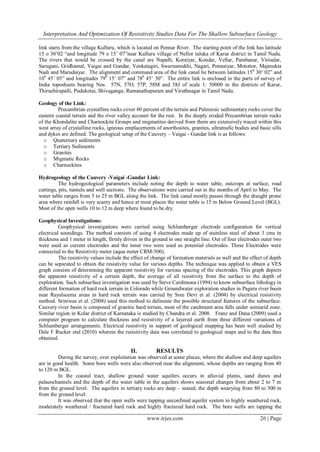
        S. No.      Type of material                                    Method of excavation

                    Soil / alluvium (including all types of gravel,
        1                                                               Manually and / or by machines
                    pebbles, boulders)

        2           Highly weathered rock                               Manually and / or by machines
        3           Moderately weathered hard rock                      Chiseling and / or by blasting

        4           Hard rock                                           Blasting

Preparation of the Vertical Lithological Cross Sections :
          MATLAB is as fast as 3GL programming languages, like C and Fortran. Matlab stands for “Matrix
Laborotary” and was originally developed in the 1970‟s for applications involving matrices, linear algebra and
numerical analysis. MATLAB is both a computer programming language and a software environment. It can
solve various types of problems using arrays and polynomials, using relational operators, creating plots, solving
linear algebraic equations, creating M-file programs, using conditional statements and by using loops. The
interactive environment allows managing variables import and exporting data, performing calculations,
generating plots and developing and managing files for the use in MATLAB. It has a number of add-on-
software modules called toolboxes, that perform more specialized computations and being programmable it has
the same logical ,relational, conditional and loop structures as other programming language such as Fortran, C,
BASIC and PASCAL. The reason for use of MATLAB here is only due to its user interface which provides an
easy to use interactive environment that included extensive numerical computations and visualization
capabilities.
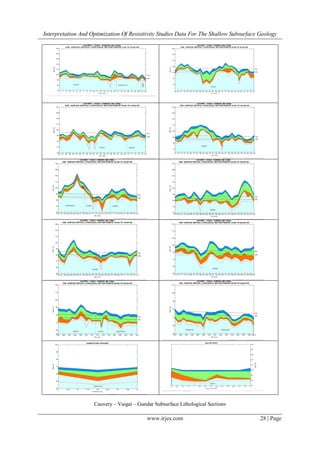
.         We have used basic MATLAB for the preparation of graphs. To plot different layers against the
reduced distances we used „area‟ command. An area plot displays elements in y as one or more curves and fills
the area beneath each curve. When y is a matrix, the curves are stacked showing the relative contribution of each
row element to the total height of the curve at each x interval. „Area (y)‟plots the vector y or the sum of each
column in matrix y. The x-axis automatically scales depending on length (y) when y is a vector and on size(y,1)
when Y is a matrix. „Area (x, y)‟plots y at the corresponding values of x. If x is a vector, length(x) must equal
length (y) and X must be monotonic. If X is a matrix, size (x) must equal size (y) and each column in x must be
monotonic. To make a vector or matrix monotonic, we used sort. „Area‟ creates one curve from all elements in a
vector or one curve per column in a matrix. The colors of the curves were selected from equally spaced intervals
throughout the entire range of the color map. The interpreted resistivity data was correlated with the observed
geological and hydro geological field data and the subsurface layers were classified into four categories as:
   1. Soil
   2. Highly weathered rock
   3. Moderately weathered / Fractured hard rock
   4. Highly fractured hard rock
   5. Hard rock

General sequence of the above layers is shown in the figures attached herewith. The top layer soil is mostly the
deposited layer consisting of sand, gravels, pebbles etc. along with fine particles. The remaining layers are the
highly weathered rock, moderately weathered and / Fractured hard rock and hard rocks are the same type of
rocks with differential weathering. Based on the resistivity, various layer boundaries are demarcated. The layer
boundaries at each sounding are referred to the mean sea level and the other layers are as per the depth of their
occurrences. Sub surface litho logical vertical cross sections are prepared for 255 km length of the alignment.


                                                  www.irjes.com                                          27 | Page
Interpretation And Optimization Of Resisitivity Studies Data For The Shallow Subsurface Geology


                    Cauvery – Vaigai – Gundar Subsurface Lithological Sections

                                           www.irjes.com                                28 | Page
Interpretation And Optimization Of Resisitivity Studies Data For The Shallow Subsurface Geology


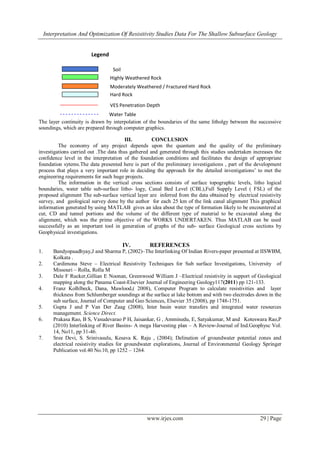
                          Legend

                                    Soil
                                   Highly Weathered Rock
                                   Moderately Weathered / Fractured Hard Rock
                                   Hard Rock
                                   VES Penetration Depth
                                Water Table
The layer continuity is drawn by interpolation of the boundaries of the same litholgy between the successive
soundings, which are prepared through computer graphics.

                                        III.        CONCLUSION
         The economy of any project depends upon the quantum and the quality of the preliminary
investigations carried out .The data thus gathered and generated through this studies undertaken increases the
confidence level in the interpretation of the foundation conditions and facilitates the design of appropriate
foundation sytems.The data presented here is part of the preliminary investigations , part of the development
process that plays a very important role in deciding the approach for the detailed investigations‟ to met the
engineering requirements for such huge projects.
         The information in the vertical cross sections consists of surface topographic levels, litho logical
boundaries, water table sub-surface litho- logy, Canal Bed Level (CBL),Full Supply Level ( FSL) of the
proposed alignment The sub-surface vertical layer are inferred from the data obtained by electrical resistivity
survey, and geological survey done by the author for each 25 km of the link canal alignment This graphical
information generated by using MATLAB gives an idea about the type of formation likely to be encountered at
cut, CD and tunnel portions and the volume of the different type of material to be excavated along the
alignment, which was the prime objective of the WORKS UNDERTAKEN. Thus MATLAB can be used
successfully as an important tool in generation of graphs of the sub- surface Geological cross sections by
Geophysical investigations.

                                           IV.      REFERENCES
1.       Bandyopaadhyay,J and Sharma P, (2002)–The Interlinking Of Indian Rivers-paper presented at IISWBM,
         Kolkata .
2.       Cardimona Steve – Electrical Resistivity Techniques for Sub surface Investigations, University of
         Missouri – Rolla, Rolla M
3.       Dale F Rucker,Gillian E Noonan, Greenwood William J –Electrical resistivity in support of Geological
         mapping along the Panama Coast-Elsevier Journal of Engineering Geology117(2011) pp 121-133.
4.       Franz Kolhlbeck, Dana, Mawlood,( 2008), Computer Program to calculate resistivities and layer
         thickness from Schlumberger soundings at the surface at lake bottom and with two electrodes down in the
         sub surface, Journal of Computer and Geo Sciences, Elsevier 35 (2008), pp 1748-1751.
5.       Gupta J and P Van Der Zaag (2008), Inter basin water transfers and integrated water resources
         management. Science Direct.
6.       Prakasa Rao, B S, Vasudevarao P H, Jaisankar, G , Amminedu, E, Satyakumar, M and Koteswara Rao,P
         (2010) Interlinking of River Basins- A mega Harvesting plan – A Review-Journal of Ind.Geophysc Vol.
         14, No11, pp 31-46.
7.       Sree Devi, S. Srinivasulu, Kesava K. Raju , (2004); Delination of groundwater potential zones and
         electrical resistivity studies for groundwater explorations, Journal of Environmental Geology Springer
         Publication vol.40 No.10, pp 1252 – 1264.


                                                   www.irjes.com                                      29 | Page

D212529

  • 1.
    International Refereed Journalof Engineering and Science (IRJES) ISSN (Online) 2319-183X, (Print) 2319-1821 Volume 2, Issue 1(January 2013), PP.25-29 www.irjes.com Interpretation and Optimization of Resisitivity Studies Data For The Shallow Subsurface Geology Along The Cauvery –Vaigai Link Canal Project- (A Case Study). Prof. S. A. Meshram1, Dr S P Khadse2, Dr. D. C. Meshram3 1.Prof. S. A. Meshram, Associate Professor Geology, College Of Engg, Pune (COEP) 2.Dr S P Khadse, Associate Professor Geology, Shri Shivaji Science College-Amravati. 3.Dr. D. C. Meshram, Professor of Geology; Deptt. of Geology, University of Pune, Pune. Abstract: Inter-basin transfer of water from surplus basins to deficit basins has been mooted in our country in order to reduce the imbalances in the availability of water among various regions. A National Perspective Plan (NPP) for water resources development was formulated in the year 1980 by the then Union Ministry of Irrigation and the Central Water Commission identifying a number of inter-basin water transfer links in respect of Peninsular rivers and Himalayan rivers of the country. These Development components put together are expected to create an additional irrigation potential of 35 million hectares besides hydropower generation and other benefits.The inter-linking system of Mahanadi – Godavari – Krishna – Pennar – Cauvery – Vaigai – Gundar is one of the four parts of the Peninsular Rivers Development Component of the NPP. Geophysical investigationswas carried out along the proposed Cauvery Vaigai Link Canal Project of the inter-linking system of Mahanadi – Godavari – Krishna – Pennar, Rivers of India in the present paper. Detailed Geophysical survey of the proposed canal alignment was carried out by the authors as a part of the consultancy project. MATLAB was used in preparation of the sub- surface Geological cross sections The data available from this investigations is interpreted to reveal the local geology and for design of foundations .It has been observed from these investigations, in conjunction with other literature that the coastal tract, shallow ground water aquifers occurs in alluvial plains, sand dunes and palaeochannels and the depth of the water table in the aquifers shows seasonal changes from about 2 to 7 m from the ground level. The aquifers in tertiary rocks are deep – seated, the depth varying from 80 to 300 m from the ground level. It was observed that the open wells were tapping unconfined aquifer system in highly weathered rock, moderately weathered / fractured hard rock and highly fractured hard rock. The bore wells are tapping the confined aquifer system 40 m BGL in highly fractured hard rock. The aquifers in the bore wells were reported to be in between 40 to 120 m BGL. Most of the bore wells are dry at present due to depletion of aquifer owing to very little precipitation and over exploitation. From resistivity survey it is inferred that where ever highly fractured hard rock is expected along the link, abundant quantity of ground water may be present there in those fractured zones. The water table shows periodical variations. During the excavation of the canal, the study of water table condition will give an idea about the chances of striking ground water at cut and Cross Drainage portions as ground water poses a serious hazard during the excavation works. Key words: Geophysical Investigations; Matlab; Foundation design. I. INTRODUCTION: This paper deals with the feasibility studies carried out for the Cauvery Vaigai-Gundar link project envisaging a diversion of water. The scheme of linking the surplus river basins of Mahanadi and Godavari to the deficit basins of Krishna, Pennar, Cauvery and Vaigai is the most important part of the various proposals for inter basin transfer of water under the Peninsular River Development Component of the National Perspective Plan by which the transfer of water from surplus to the deficit basins would be carried out through nine link canals of which, Cauvery – Vaigai – Gundar link is one of them. The logic behind the interlinking project is based on the view that there is „Surplus‟ water in some river basins or sub-basins, which provide a permanent solution to the problem of human sufferings and from droughts and water scarcity. On the face of it, this is convincing enough logic for undertaking the project for interlinking of Indian Rivers (Bandaopadhyay 2002 and Gupta, 2008). Long distance inter-basin transfer of water from surplus basins to deficit basins has been mooted in our country in order to reduce the imbalances in the availability of water among various regions, Prakasa Rao et al. 2010. The inter-linking system of Mahanadi – Godavari – Krishna – Pennar – Cauvery – Vaigai – Gundar is one of the four parts of the Peninsular Rivers Development Component of the NPP. The location of the CVG www.irjes.com 25 | Page
  • 2.
    Interpretation And OptimizationOf Resisitivity Studies Data For The Shallow Subsurface Geology link starts from the village Kulluru, which is located on Pennar River. The starting point of the link has latitude 15 o 30‟02 “and longitude 79 o 15‟ 07”near Kulluru village of Nellor taluka of Karur district in Tamil Nadu. The rivers that would be crossed by the canal are Napalli, Koraiyar, Kondar, Vellar, Pambanar, Virisalar, Sarugani, Gridhamal, Vaigai and Gundar, Venkatagiri, Swarnamukhi, Nagari, Ponnaiyar, Motottor, Majmukta Nadi and Marudaiyar. The alignment and command area of the link canal lie between latitudes 150 30‟ 02” and 100 45‟ 05” and longitudes 790 15‟ 07” and 780 45‟ 30”. The entire link is enclosed in the parts of survey of India toposheets bearing Nos. 57N, 57O, 57P, 58M and 58J of scale 1: 50000 in the districts of Karur, Thiruchirapalli, Pudukotai, Shivaganga, Ramanathapuram and Viruthnagar in Tamil Nadu. Geology of the Link: Precambrian crystalline rocks cover 80 percent of the terrain and Paleozoic sedimentary rocks cover the eastern coastal terrain and the river valley account for the rest. In the deeply eroded Precambrian terrain rocks of the Khondalite and Charnockite Groups and migmatites derived from them are extensively traced within this west array of crystalline rocks, igneous emplacements of anorthosites, granites, ultramafic bodies and basic sills and dykes are defined. The geological setup of the Cauvery – Vaigai - Gundar link is as follows: o Quaternary sediments o Tertiary Sediments o Granites o Migmatic Rocks o Charnockites Hydrogeology of the Cauvery -Vaigai -Gundar Link: The hydrogeological parameters include noting the depth to water table, outcrops at surface, road cuttings, pits, tunnels and well sections. The observations were carried out in the months of April to May. The water table ranges from 5 to 25 m BGL along the link. The link canal mostly passes through the draught prone area where rainfall is very scanty and hence at most places the water table is 15 m Below Ground Level (BGL). Most of the open wells 10 to 12 m deep where found to be dry. Geophysical Investigations: Geophysical investigations were carried using Schlumberger electrode configuration for vertical electrical soundings. The method consists of using 4 electrodes made up of stainless steel of about 3 cms in thickness and 1 meter in length, firmly driven in the ground in one straight line. Out of four electrodes outer two were used as current electrodes and the inner two were used as potential electrodes. These Electrodes were connected to the Resistivity meter (aqua meter CRM-500). The resistivity values include the effect of change of formation materials as well and the effect of depth can be separated to obtain the resistivity value for various depths. The technique was applied to obtain a VES graph consists of determining the apparent resistivity for various spacing of the electrodes. This graph depicts the apparent resistivity of a certain depth, the average of all resistivity from the surface to the depth of exploration. Such subsurface investigation was used by Steve Cardimona (1994) to know subsurface lithology in different formation of hard rock terrain in Colorado while Groundwater exploration studies in Pageru river basin near Rayalseema areas in hard rock terrain was carried by Sree Devi et al. (2004) by electrical resistivity method. Sriniwas et al. (2008) used this method to delineate the possible structural features of the subsurface. Cauvery river basin is composed of granitic hard terrain, most of the catchment area falls under semiarid zone. Similar region in Kolar district of Karnataka is studied by Chandra et al. 2008. Franz and Dana (2009) used a computer program to calculate thickness and resistivity of a layered earth from three different variations of Schlumberger arrangements. Electrical resistivity in support of geological mapping has been well studied by Dale F Rucker etal (2010) wherein the resisitivity data was correlated to geological maps and to the data thus obtained. II. RESULTS During the survey, over exploitation was observed at some places, where the shallow and deep aquifers are in good health. Some bore wells were also observed near the alignment, whose depths are ranging from 40 to 120 m BGL. In the coastal tract, shallow ground water aquifers occurs in alluvial plains, sand dunes and palaeochannels and the depth of the water table in the aquifers shows seasonal changes from about 2 to 7 m from the ground level. The aquifers in tertiary rocks are deep – seated, the depth wearying from 80 to 300 m from the ground level. It was observed that the open wells were tapping unconfined aquifer system in highly weathered rock, moderately weathered / fractured hard rock and highly fractured hard rock. The bore wells are tapping the www.irjes.com 26 | Page
  • 3.
    Interpretation And OptimizationOf Resisitivity Studies Data For The Shallow Subsurface Geology confined aquifer system 40 m BGL in highly fractured hard rock. The aquifers in the bore wells were reported to be in between 40 to 120 m BGL. Most of the bore wells are dry at present due to depletion of aquifer owing to very little precipitation and over exploitation. From resistivity survey it is inferred that where ever highly fractured hard rock is expected along the link, abundant quantity of ground water may be present there in those fractured zones. The water table shows periodical variations. During the excavation of the canal, the study of water table condition will give an idea about the chances of striking ground water at cut and Cross Drainage portions as ground water poses a serious hazard during the excavation works. Resistivity survey coupled with geological and hydrogeological observations help in inferring the sub-surface lithological layers. S. No. Type of material Method of excavation Soil / alluvium (including all types of gravel, 1 Manually and / or by machines pebbles, boulders) 2 Highly weathered rock Manually and / or by machines 3 Moderately weathered hard rock Chiseling and / or by blasting 4 Hard rock Blasting Preparation of the Vertical Lithological Cross Sections : MATLAB is as fast as 3GL programming languages, like C and Fortran. Matlab stands for “Matrix Laborotary” and was originally developed in the 1970‟s for applications involving matrices, linear algebra and numerical analysis. MATLAB is both a computer programming language and a software environment. It can solve various types of problems using arrays and polynomials, using relational operators, creating plots, solving linear algebraic equations, creating M-file programs, using conditional statements and by using loops. The interactive environment allows managing variables import and exporting data, performing calculations, generating plots and developing and managing files for the use in MATLAB. It has a number of add-on- software modules called toolboxes, that perform more specialized computations and being programmable it has the same logical ,relational, conditional and loop structures as other programming language such as Fortran, C, BASIC and PASCAL. The reason for use of MATLAB here is only due to its user interface which provides an easy to use interactive environment that included extensive numerical computations and visualization capabilities. . We have used basic MATLAB for the preparation of graphs. To plot different layers against the reduced distances we used „area‟ command. An area plot displays elements in y as one or more curves and fills the area beneath each curve. When y is a matrix, the curves are stacked showing the relative contribution of each row element to the total height of the curve at each x interval. „Area (y)‟plots the vector y or the sum of each column in matrix y. The x-axis automatically scales depending on length (y) when y is a vector and on size(y,1) when Y is a matrix. „Area (x, y)‟plots y at the corresponding values of x. If x is a vector, length(x) must equal length (y) and X must be monotonic. If X is a matrix, size (x) must equal size (y) and each column in x must be monotonic. To make a vector or matrix monotonic, we used sort. „Area‟ creates one curve from all elements in a vector or one curve per column in a matrix. The colors of the curves were selected from equally spaced intervals throughout the entire range of the color map. The interpreted resistivity data was correlated with the observed geological and hydro geological field data and the subsurface layers were classified into four categories as: 1. Soil 2. Highly weathered rock 3. Moderately weathered / Fractured hard rock 4. Highly fractured hard rock 5. Hard rock General sequence of the above layers is shown in the figures attached herewith. The top layer soil is mostly the deposited layer consisting of sand, gravels, pebbles etc. along with fine particles. The remaining layers are the highly weathered rock, moderately weathered and / Fractured hard rock and hard rocks are the same type of rocks with differential weathering. Based on the resistivity, various layer boundaries are demarcated. The layer boundaries at each sounding are referred to the mean sea level and the other layers are as per the depth of their occurrences. Sub surface litho logical vertical cross sections are prepared for 255 km length of the alignment. www.irjes.com 27 | Page
  • 4.
    Interpretation And OptimizationOf Resisitivity Studies Data For The Shallow Subsurface Geology Cauvery – Vaigai – Gundar Subsurface Lithological Sections www.irjes.com 28 | Page
  • 5.
    Interpretation And OptimizationOf Resisitivity Studies Data For The Shallow Subsurface Geology Legend Soil Highly Weathered Rock Moderately Weathered / Fractured Hard Rock Hard Rock VES Penetration Depth Water Table The layer continuity is drawn by interpolation of the boundaries of the same litholgy between the successive soundings, which are prepared through computer graphics. III. CONCLUSION The economy of any project depends upon the quantum and the quality of the preliminary investigations carried out .The data thus gathered and generated through this studies undertaken increases the confidence level in the interpretation of the foundation conditions and facilitates the design of appropriate foundation sytems.The data presented here is part of the preliminary investigations , part of the development process that plays a very important role in deciding the approach for the detailed investigations‟ to met the engineering requirements for such huge projects. The information in the vertical cross sections consists of surface topographic levels, litho logical boundaries, water table sub-surface litho- logy, Canal Bed Level (CBL),Full Supply Level ( FSL) of the proposed alignment The sub-surface vertical layer are inferred from the data obtained by electrical resistivity survey, and geological survey done by the author for each 25 km of the link canal alignment This graphical information generated by using MATLAB gives an idea about the type of formation likely to be encountered at cut, CD and tunnel portions and the volume of the different type of material to be excavated along the alignment, which was the prime objective of the WORKS UNDERTAKEN. Thus MATLAB can be used successfully as an important tool in generation of graphs of the sub- surface Geological cross sections by Geophysical investigations. IV. REFERENCES 1. Bandyopaadhyay,J and Sharma P, (2002)–The Interlinking Of Indian Rivers-paper presented at IISWBM, Kolkata . 2. Cardimona Steve – Electrical Resistivity Techniques for Sub surface Investigations, University of Missouri – Rolla, Rolla M 3. Dale F Rucker,Gillian E Noonan, Greenwood William J –Electrical resistivity in support of Geological mapping along the Panama Coast-Elsevier Journal of Engineering Geology117(2011) pp 121-133. 4. Franz Kolhlbeck, Dana, Mawlood,( 2008), Computer Program to calculate resistivities and layer thickness from Schlumberger soundings at the surface at lake bottom and with two electrodes down in the sub surface, Journal of Computer and Geo Sciences, Elsevier 35 (2008), pp 1748-1751. 5. Gupta J and P Van Der Zaag (2008), Inter basin water transfers and integrated water resources management. Science Direct. 6. Prakasa Rao, B S, Vasudevarao P H, Jaisankar, G , Amminedu, E, Satyakumar, M and Koteswara Rao,P (2010) Interlinking of River Basins- A mega Harvesting plan – A Review-Journal of Ind.Geophysc Vol. 14, No11, pp 31-46. 7. Sree Devi, S. Srinivasulu, Kesava K. Raju , (2004); Delination of groundwater potential zones and electrical resistivity studies for groundwater explorations, Journal of Environmental Geology Springer Publication vol.40 No.10, pp 1252 – 1264. www.irjes.com 29 | Page