BVM Engineering college, V.V.Nagar 1
GUJARATTECHNOLOGICALUNIVERSITY
BIRLA VISHVAKARMA MAHAVIDYALAYA
Subject :- Hydrology And Water Resources Engineering
Year : 3rd (5th sem-Civil)
Methods of flood control
Compiled by:- Jora Hitesh .H
En no:- 140073106009
Guided by : Prof. Reshma Shah
Prof. Pitroda Sir
Causes of flooding
• Monsoon rain
• Urbanization increases surface run-off
• Dam collapse
• Tsunami caused by underwater earthquake
• Snow melt
• Global warming
• Deforestation
BVM Engineering college, V.V.Nagar 2
BVM Engineering college, V.V.Nagar 3
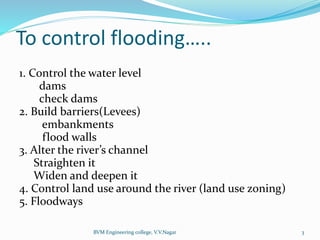
To control flooding…..
1. Control the water level
dams
check dams
2. Build barriers(Levees)
embankments
flood walls
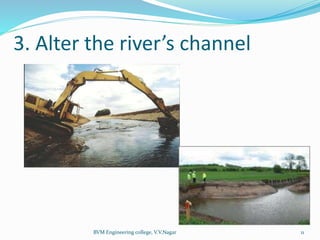
3. Alter the river’s channel
Straighten it
Widen and deepen it
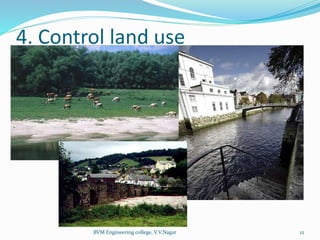
4. Control land use around the river (land use zoning)
5. Floodways
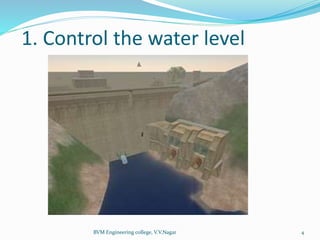
1. Control the water level
BVM Engineering college, V.V.Nagar 4
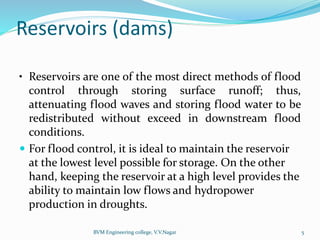
Reservoirs (dams)
• Reservoirs are one of the most direct methods of flood
control through storing surface runoff; thus,
attenuating flood waves and storing flood water to be
redistributed without exceed in downstream flood
conditions.
 For flood control, it is ideal to maintain the reservoir
at the lowest level possible for storage. On the other
hand, keeping the reservoir at a high level provides the
ability to maintain low flows and hydropower
production in droughts.
BVM Engineering college, V.V.Nagar 5
BVM Engineering college, V.V.Nagar 6
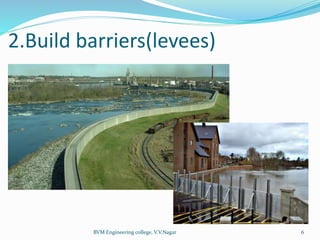
2.Build barriers(levees)
Levees
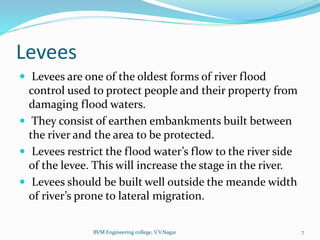
 Levees are one of the oldest forms of river flood
control used to protect people and their property from
damaging flood waters.
 They consist of earthen embankments built between
the river and the area to be protected.
 Levees restrict the flood water’s flow to the river side
of the levee. This will increase the stage in the river.
 Levees should be built well outside the meande width
of river’s prone to lateral migration.
BVM Engineering college, V.V.Nagar 7
Levees
BVM Engineering college, V.V.Nagar 8
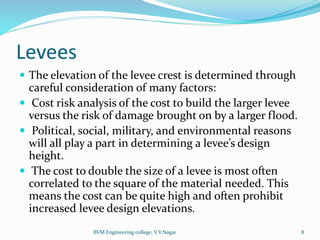
 The elevation of the levee crest is determined through
careful consideration of many factors:
 Cost risk analysis of the cost to build the larger levee
versus the risk of damage brought on by a larger flood.
 Political, social, military, and environmental reasons
will all play a part in determining a levee’s design
height.
 The cost to double the size of a levee is most often
correlated to the square of the material needed. This
means the cost can be quite high and often prohibit
increased levee design elevations.
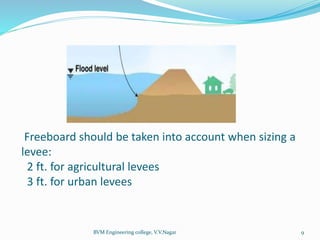
Freeboard should be taken into account when sizing a
levee:
2 ft. for agricultural levees
3 ft. for urban levees
BVM Engineering college, V.V.Nagar 9
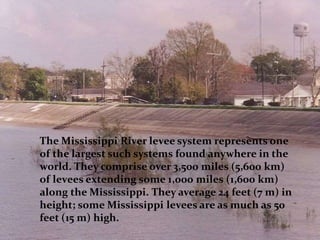
The Mississippi River levee system represents one
of the largest such systems found anywhere in the
world. They comprise over 3,500 miles (5,600 km)
of levees extending some 1,000 miles (1,600 km)
along the Mississippi. They average 24 feet (7 m) in
height; some Mississippi levees are as much as 50
feet (15 m) high.
3. Alter the river’s channel
BVM Engineering college, V.V.Nagar 11
BVM Engineering college, V.V.Nagar 12
4. Control land use
Floodways
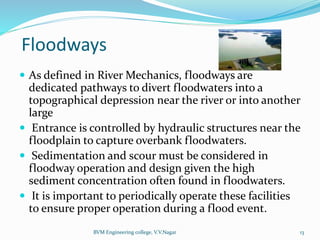
 As defined in River Mechanics, floodways are
dedicated pathways to divert floodwaters into a
topographical depression near the river or into another
large
 Entrance is controlled by hydraulic structures near the
floodplain to capture overbank floodwaters.
 Sedimentation and scour must be considered in
floodway operation and design given the high
sediment concentration often found in floodwaters.
 It is important to periodically operate these facilities
to ensure proper operation during a flood event.
BVM Engineering college, V.V.Nagar 13
BVM Engineering college, V.V.Nagar 14
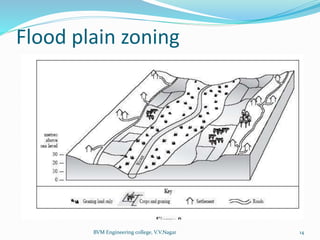
Flood plain zoning
BVM Engineering college, V.V.Nagar 15
References
-Julien, P. Y. (2002). River Mechanics, Cambridge University Press, UK.
-Roberson, J.A., Cassidy, J.J., Chaudhry, M.H. (1998). Hydraulic Engineering,
2nd Edition,
Wiley Press, USA. US Army Corps of Engineers. (2010). After Action Report:
May 2010 Flood Event
Cumberland River Basin.
<http://www.lrn.usace.army.mil/LRN_pdf/AAR_May_2010_Flood_Cumberland
_Draft_V
7_21.pdf>

Methods of flood control

  • 1.
    BVM Engineering college,V.V.Nagar 1 GUJARATTECHNOLOGICALUNIVERSITY BIRLA VISHVAKARMA MAHAVIDYALAYA Subject :- Hydrology And Water Resources Engineering Year : 3rd (5th sem-Civil) Methods of flood control Compiled by:- Jora Hitesh .H En no:- 140073106009 Guided by : Prof. Reshma Shah Prof. Pitroda Sir
  • 2.
    Causes of flooding •Monsoon rain • Urbanization increases surface run-off • Dam collapse • Tsunami caused by underwater earthquake • Snow melt • Global warming • Deforestation BVM Engineering college, V.V.Nagar 2
  • 3.
    BVM Engineering college,V.V.Nagar 3 To control flooding….. 1. Control the water level dams check dams 2. Build barriers(Levees) embankments flood walls 3. Alter the river’s channel Straighten it Widen and deepen it 4. Control land use around the river (land use zoning) 5. Floodways
  • 4.
    1. Control thewater level BVM Engineering college, V.V.Nagar 4
  • 5.
    Reservoirs (dams) • Reservoirsare one of the most direct methods of flood control through storing surface runoff; thus, attenuating flood waves and storing flood water to be redistributed without exceed in downstream flood conditions.  For flood control, it is ideal to maintain the reservoir at the lowest level possible for storage. On the other hand, keeping the reservoir at a high level provides the ability to maintain low flows and hydropower production in droughts. BVM Engineering college, V.V.Nagar 5
  • 6.
    BVM Engineering college,V.V.Nagar 6 2.Build barriers(levees)
  • 7.
    Levees  Levees areone of the oldest forms of river flood control used to protect people and their property from damaging flood waters.  They consist of earthen embankments built between the river and the area to be protected.  Levees restrict the flood water’s flow to the river side of the levee. This will increase the stage in the river.  Levees should be built well outside the meande width of river’s prone to lateral migration. BVM Engineering college, V.V.Nagar 7
  • 8.
    Levees BVM Engineering college,V.V.Nagar 8  The elevation of the levee crest is determined through careful consideration of many factors:  Cost risk analysis of the cost to build the larger levee versus the risk of damage brought on by a larger flood.  Political, social, military, and environmental reasons will all play a part in determining a levee’s design height.  The cost to double the size of a levee is most often correlated to the square of the material needed. This means the cost can be quite high and often prohibit increased levee design elevations.
  • 9.
    Freeboard should betaken into account when sizing a levee: 2 ft. for agricultural levees 3 ft. for urban levees BVM Engineering college, V.V.Nagar 9
  • 10.
    The Mississippi Riverlevee system represents one of the largest such systems found anywhere in the world. They comprise over 3,500 miles (5,600 km) of levees extending some 1,000 miles (1,600 km) along the Mississippi. They average 24 feet (7 m) in height; some Mississippi levees are as much as 50 feet (15 m) high.
  • 11.
    3. Alter theriver’s channel BVM Engineering college, V.V.Nagar 11
  • 12.
    BVM Engineering college,V.V.Nagar 12 4. Control land use
  • 13.
    Floodways  As definedin River Mechanics, floodways are dedicated pathways to divert floodwaters into a topographical depression near the river or into another large  Entrance is controlled by hydraulic structures near the floodplain to capture overbank floodwaters.  Sedimentation and scour must be considered in floodway operation and design given the high sediment concentration often found in floodwaters.  It is important to periodically operate these facilities to ensure proper operation during a flood event. BVM Engineering college, V.V.Nagar 13
  • 14.
    BVM Engineering college,V.V.Nagar 14 Flood plain zoning
  • 15.
    BVM Engineering college,V.V.Nagar 15 References -Julien, P. Y. (2002). River Mechanics, Cambridge University Press, UK. -Roberson, J.A., Cassidy, J.J., Chaudhry, M.H. (1998). Hydraulic Engineering, 2nd Edition, Wiley Press, USA. US Army Corps of Engineers. (2010). After Action Report: May 2010 Flood Event Cumberland River Basin. <http://www.lrn.usace.army.mil/LRN_pdf/AAR_May_2010_Flood_Cumberland _Draft_V 7_21.pdf>