International Journal of Engineering Research and Development
e-ISSN: 2278-067X, p-ISSN: 2278-800X, www.ijerd.com
Volume 3, Issue 1 (August 2012), PP. 27-30


  Simulation of Fuzzy logic Controller for controlling the position
                    and speedof the DC motor
                         Rajnish Mitter1, Krishan Kumar2, Vivek Kumar3
                        1,2
                           Research Scholar,EEE Deptt., BRCMCET, Bahal, Bhiwani, Haryana, India
                            3
                              Astt. Prof., EEE Deptt., BRCMCET, Bahal, Bhiwani, Haryana, India


Abstract––This paper presents the design of a fuzzy control system to control speed of a DC motor. The motor was
modelled and converted to a subsystem in Simulink. This paper describes the design of a Fuzzy logic based controller to
control te speed of DC mtor. The contolling signal is computed in real time using suitable fuzzy membership functions
depending upon the state of the power factor. The use of output membership function permits further fine tuning of the
controller parameters for varied system configurations especially in multi machine environment. The efficacy of the
proposed controlling technique has been demonstrated using multi-machine computer simulation model of power system
under a wide range of system and test conditions.

Keywords––(PSS, Fuzzy Logic Controller (FLC), Fuzzy inference system, Membership function, rule viewer, membership
editor.

                                              I.         INTRODUCTION
          Because of their high reliabilities, flexibilities and low costs, DC motors are widely used in industrial applications,
robot manipulators and home appliances where speed and position control of motor are required. PID controllers are
commonly used for motor control applications because of their simple structures and intuitionally comprehensible control
algorithms. Controller parameters are generally tuned using hand-tuning or Ziegler-Nichols frequency response method.
Both of these methods have successful results but long time and effort are required to obtain a satisfactory system response.
Two main problems encountered in motor control are the time-varying nature of motor parameters under operating
conditions and existence of noise in system loop. Analysis and control of complex, nonlinear and/or time-varying systems is
a challenging task using conventional methods because of uncertainties. Fuzzy set theory (Zadeh, 1965) which led to a new
control method called Fuzzy Control which is able to cope with system uncertainties. One of the most important advantages
of fuzzy control is that it can be successfully applied to control nonlinear complex systems using an operator experiences or
control engineering knowledge without any mathematical model of the plant (Assilian, 1974), (Kickert, 1976).

                                       II.         STRUCTURE MODELLING
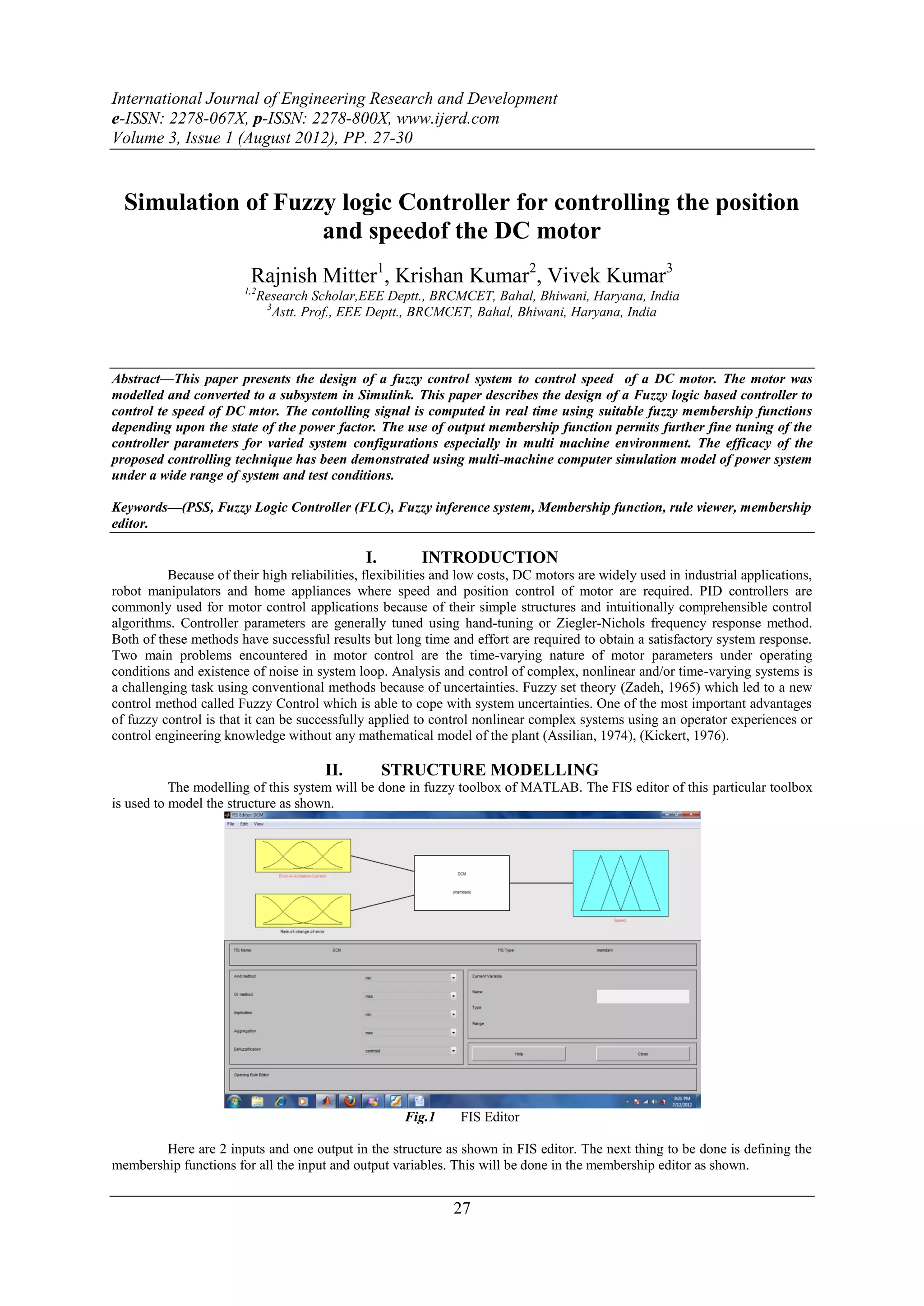
           The modelling of this system will be done in fuzzy toolbox of MATLAB. The FIS editor of this particular toolbox
is used to model the structure as shown.


                                                     Fig.1      FIS Editor

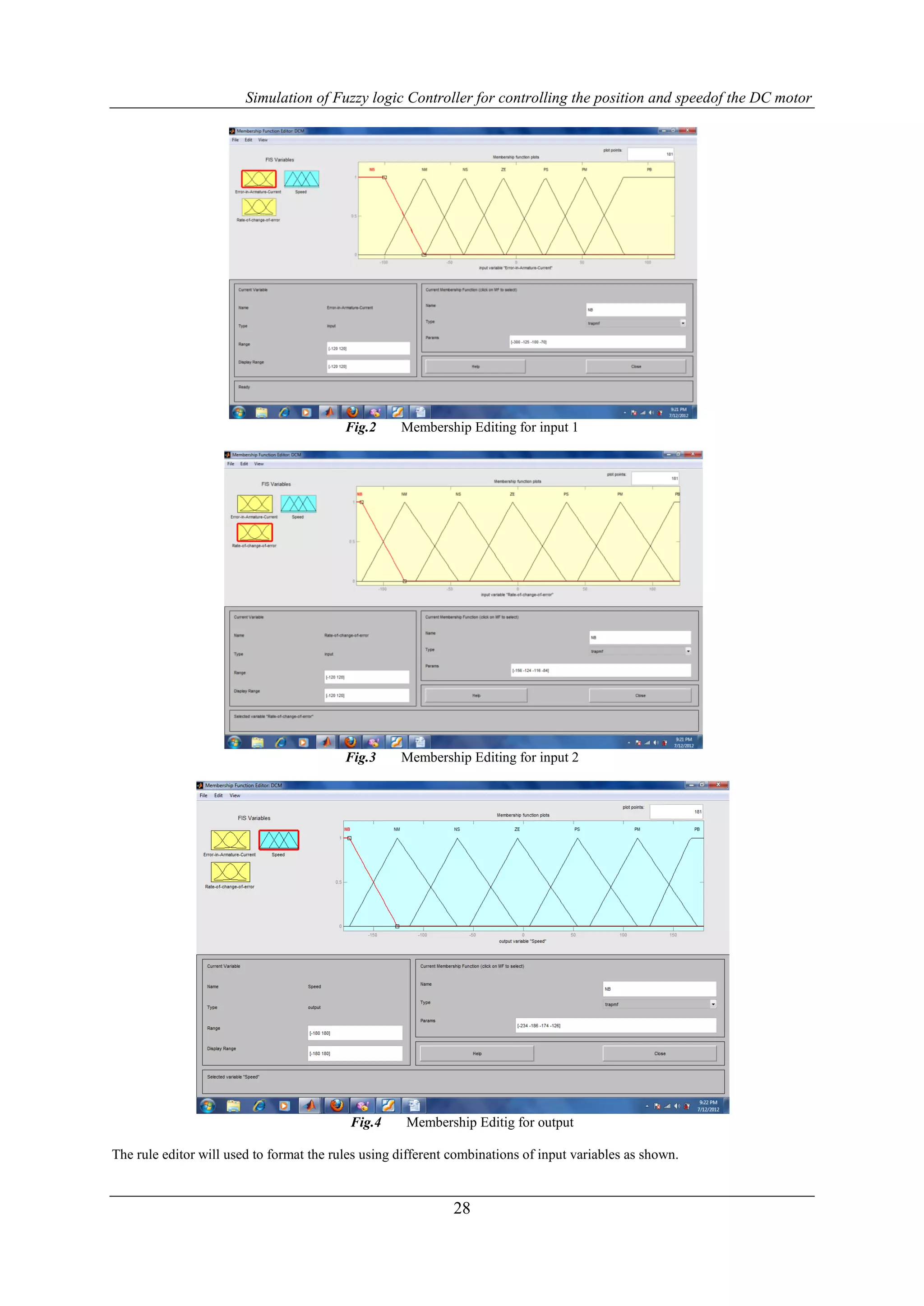
        Here are 2 inputs and one output in the structure as shown in FIS editor. The next thing to be done is defining the
membership functions for all the input and output variables. This will be done in the membership editor as shown.


                                                              27
Simulation of Fuzzy logic Controller for controlling the position and speedof the DC motor


                                          Fig.2     Membership Editing for input 1


                                          Fig.3     Membership Editing for input 2


                                           Fig.4     Membership Editig for output

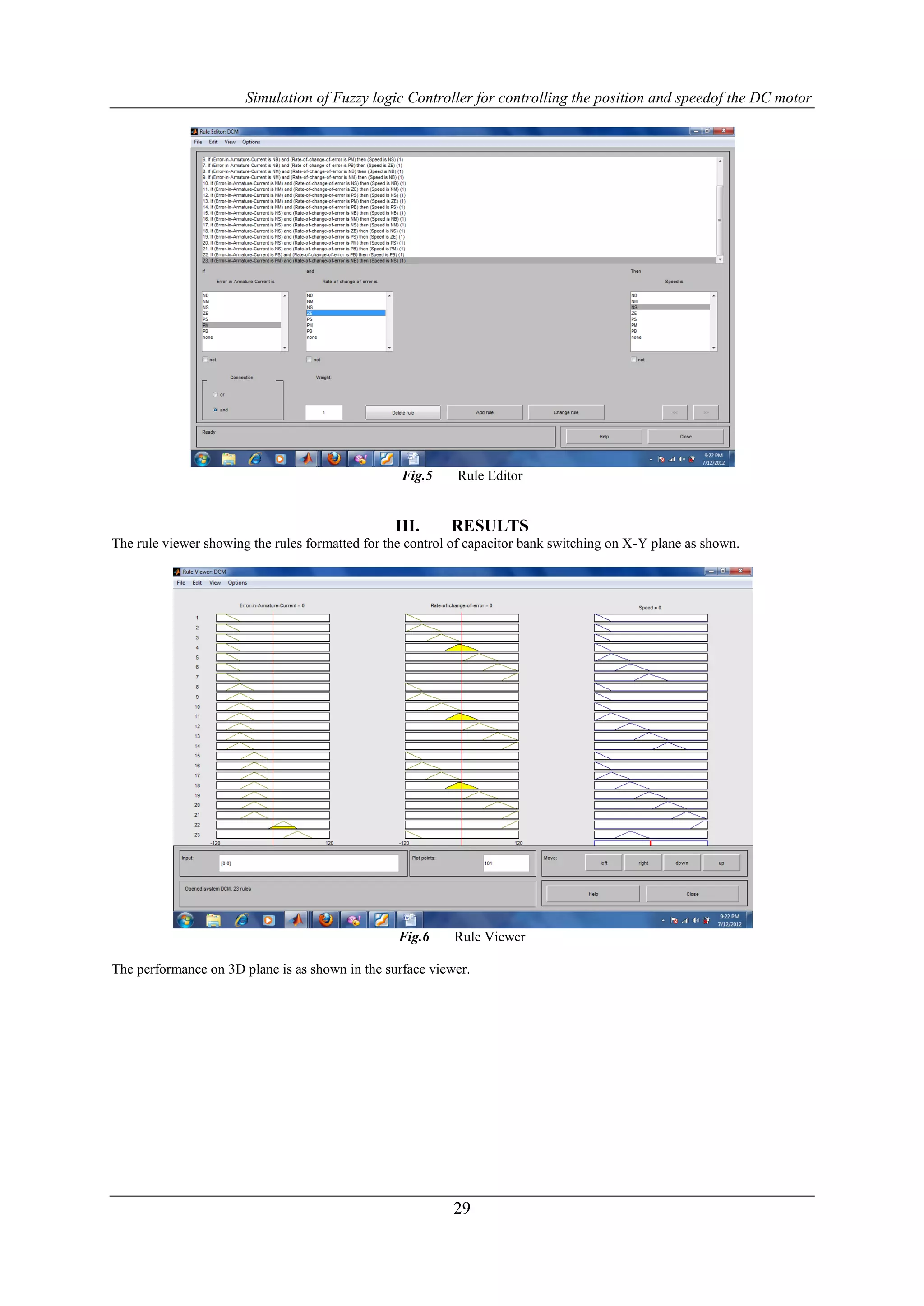
The rule editor will used to format the rules using different combinations of input variables as shown.


                                                              28
Simulation of Fuzzy logic Controller for controlling the position and speedof the DC motor


                                                  Fig.5     Rule Editor


                                                 III.      RESULTS
The rule viewer showing the rules formatted for the control of capacitor bank switching on X-Y plane as shown.


                                                  Fig.6     Rule Viewer

The performance on 3D plane is as shown in the surface viewer.


                                                           29
Simulation of Fuzzy logic Controller for controlling the position and speedof the DC motor


                                              Fig.7    Surface Viewer

                                                REFERENCES
[1].    Bal, G., Bekiroglu, E., Demirbas, S. and Colak, I., Fuzzy logic based DSP controlled servo position control for
        ultrasonic motor. Energy Conversion and Management, 45, 3139–3153, 2004.
[2].    Chapman, S.J., Electric Machinery Fundamentals, 4th edition, New York: McGraw Hill, 2005.
[3].    Jantzen, J., Foundations of Fuzzy Control, WS: John Wiley & Sons, Ltd., 2007.
[4].    Kickert, W. J. M. and van Nauta Lemke, H. R., Application of a Fuzzy Controller in a Warm Water Plant.
        Automatica, 12(4), 301-308, 1976.
[5].    Kwon, C.J., Han, W.Y., Kim, S.J. and Lee C.G., Speed controller with adaptive fuzzy tuning for BLDC motor
        drive under load variations. SICE Annual Conference, 3118-3121, 2003.
[6].    Lin, P.H., Hwang, S. and Chou, J., Comparison on Fuzzy Logic and PID Controls for a DC Motor Position
        Controller. Conference Record of the 1994 IEEE Industry Applications Society Annual Meeting, 1930-1935, 1994.
[7].    Mamdani, E. H., Application of Fuzzy Logic to Approximate Reasoning Using Linguistic Synthesis. IEEE
        Transactions on Computers, 26(12), 1182-1191, 1977.
[8].    Mathworks Inc., Simulink® Response Optimization™ Getting Started Guide, 3rd printing, 2008.
[9].    Mishra, M.K., Kothari, A.G., Kothari, D.P. and Ghosh, A., Development of a Fuzzy Logic Controller for Servo
        Systems. IEEE Region 10 International Conference on Global Connectivity in Energy, Computer, Communication
        and Control (TENCON '98), 204-207, 1998.
[10].   Namazov, M., Samet, R. and Huseynov, R., Modelling and Simulation of the Fuzzy Relay Type Controller for
        Solving the Double Integrator Control Problems. Proceedings of 9th WSEAS International Conference on
        Automatic Control, Modeling&Simulation, 7-11, 2007.
[11].   Ogata, K., Modern Control Engineering, 3rd edition, NJ: Prentice Hall, 1997.
[12].   Veremey, E.I. and Pogojev, S.B., Nonlinear Control Design Blockset [Online] Available:
        http://matlab.exponenta.ru/nonlinecondes/book1/preface.php
[13].   Zadeh, L. A., Fuzzy Sets. Information and Control, 8, 338-353, 1965.
[14].   Zadeh, M. H., Yazdian, A. and Mohamadian, M., Robust Position Control in DC Motor by Fuzzy Sliding Mode
        Control. International Symposium on Power Electronics, Electrical Drives, Automation and Motion (SPEEDAM
        2006), 1413-1418, 2006.


                                                         30

IJERD (www.ijerd.com) International Journal of Engineering Research and Development IJERD : hard copy of journal, Call for Papers 2012, publishing of journal, journal of science and technology, research paper publishing, where to publish research paper,

  • 1.
    International Journal ofEngineering Research and Development e-ISSN: 2278-067X, p-ISSN: 2278-800X, www.ijerd.com Volume 3, Issue 1 (August 2012), PP. 27-30 Simulation of Fuzzy logic Controller for controlling the position and speedof the DC motor Rajnish Mitter1, Krishan Kumar2, Vivek Kumar3 1,2 Research Scholar,EEE Deptt., BRCMCET, Bahal, Bhiwani, Haryana, India 3 Astt. Prof., EEE Deptt., BRCMCET, Bahal, Bhiwani, Haryana, India Abstract––This paper presents the design of a fuzzy control system to control speed of a DC motor. The motor was modelled and converted to a subsystem in Simulink. This paper describes the design of a Fuzzy logic based controller to control te speed of DC mtor. The contolling signal is computed in real time using suitable fuzzy membership functions depending upon the state of the power factor. The use of output membership function permits further fine tuning of the controller parameters for varied system configurations especially in multi machine environment. The efficacy of the proposed controlling technique has been demonstrated using multi-machine computer simulation model of power system under a wide range of system and test conditions. Keywords––(PSS, Fuzzy Logic Controller (FLC), Fuzzy inference system, Membership function, rule viewer, membership editor. I. INTRODUCTION Because of their high reliabilities, flexibilities and low costs, DC motors are widely used in industrial applications, robot manipulators and home appliances where speed and position control of motor are required. PID controllers are commonly used for motor control applications because of their simple structures and intuitionally comprehensible control algorithms. Controller parameters are generally tuned using hand-tuning or Ziegler-Nichols frequency response method. Both of these methods have successful results but long time and effort are required to obtain a satisfactory system response. Two main problems encountered in motor control are the time-varying nature of motor parameters under operating conditions and existence of noise in system loop. Analysis and control of complex, nonlinear and/or time-varying systems is a challenging task using conventional methods because of uncertainties. Fuzzy set theory (Zadeh, 1965) which led to a new control method called Fuzzy Control which is able to cope with system uncertainties. One of the most important advantages of fuzzy control is that it can be successfully applied to control nonlinear complex systems using an operator experiences or control engineering knowledge without any mathematical model of the plant (Assilian, 1974), (Kickert, 1976). II. STRUCTURE MODELLING The modelling of this system will be done in fuzzy toolbox of MATLAB. The FIS editor of this particular toolbox is used to model the structure as shown. Fig.1 FIS Editor Here are 2 inputs and one output in the structure as shown in FIS editor. The next thing to be done is defining the membership functions for all the input and output variables. This will be done in the membership editor as shown. 27
  • 2.
    Simulation of Fuzzylogic Controller for controlling the position and speedof the DC motor Fig.2 Membership Editing for input 1 Fig.3 Membership Editing for input 2 Fig.4 Membership Editig for output The rule editor will used to format the rules using different combinations of input variables as shown. 28
  • 3.
    Simulation of Fuzzylogic Controller for controlling the position and speedof the DC motor Fig.5 Rule Editor III. RESULTS The rule viewer showing the rules formatted for the control of capacitor bank switching on X-Y plane as shown. Fig.6 Rule Viewer The performance on 3D plane is as shown in the surface viewer. 29
  • 4.
    Simulation of Fuzzylogic Controller for controlling the position and speedof the DC motor Fig.7 Surface Viewer REFERENCES [1]. Bal, G., Bekiroglu, E., Demirbas, S. and Colak, I., Fuzzy logic based DSP controlled servo position control for ultrasonic motor. Energy Conversion and Management, 45, 3139–3153, 2004. [2]. Chapman, S.J., Electric Machinery Fundamentals, 4th edition, New York: McGraw Hill, 2005. [3]. Jantzen, J., Foundations of Fuzzy Control, WS: John Wiley & Sons, Ltd., 2007. [4]. Kickert, W. J. M. and van Nauta Lemke, H. R., Application of a Fuzzy Controller in a Warm Water Plant. Automatica, 12(4), 301-308, 1976. [5]. Kwon, C.J., Han, W.Y., Kim, S.J. and Lee C.G., Speed controller with adaptive fuzzy tuning for BLDC motor drive under load variations. SICE Annual Conference, 3118-3121, 2003. [6]. Lin, P.H., Hwang, S. and Chou, J., Comparison on Fuzzy Logic and PID Controls for a DC Motor Position Controller. Conference Record of the 1994 IEEE Industry Applications Society Annual Meeting, 1930-1935, 1994. [7]. Mamdani, E. H., Application of Fuzzy Logic to Approximate Reasoning Using Linguistic Synthesis. IEEE Transactions on Computers, 26(12), 1182-1191, 1977. [8]. Mathworks Inc., Simulink® Response Optimization™ Getting Started Guide, 3rd printing, 2008. [9]. Mishra, M.K., Kothari, A.G., Kothari, D.P. and Ghosh, A., Development of a Fuzzy Logic Controller for Servo Systems. IEEE Region 10 International Conference on Global Connectivity in Energy, Computer, Communication and Control (TENCON '98), 204-207, 1998. [10]. Namazov, M., Samet, R. and Huseynov, R., Modelling and Simulation of the Fuzzy Relay Type Controller for Solving the Double Integrator Control Problems. Proceedings of 9th WSEAS International Conference on Automatic Control, Modeling&Simulation, 7-11, 2007. [11]. Ogata, K., Modern Control Engineering, 3rd edition, NJ: Prentice Hall, 1997. [12]. Veremey, E.I. and Pogojev, S.B., Nonlinear Control Design Blockset [Online] Available: http://matlab.exponenta.ru/nonlinecondes/book1/preface.php [13]. Zadeh, L. A., Fuzzy Sets. Information and Control, 8, 338-353, 1965. [14]. Zadeh, M. H., Yazdian, A. and Mohamadian, M., Robust Position Control in DC Motor by Fuzzy Sliding Mode Control. International Symposium on Power Electronics, Electrical Drives, Automation and Motion (SPEEDAM 2006), 1413-1418, 2006. 30