Khalid Hati, Abdellah El Hajjaji, Mourad Hati / International Journal of Engineering
             Research and Applications (IJERA) ISSN: 2248-9622 www.ijera.com
                     Vol. 3, Issue 1, January -February 2013, pp.1335-1337
      Electromagnetic Modeling of Electronic Package wirebond
                          Khalid HATI*, Abdellah EL HAJJAJI*
 *Communication Systems Laboratory, Department of Physics, Abdelmalek Essaâdi University, M’hannech 2,
                                          Tetouan, Morocco


ABSTRACT
         This paper will describes the modern
packaging issues and the simulated studies using               Ribbon:Is like a strip having a section of
CST MWS as electromagnetic full wave solver.            13x75 µm2. This profile is well used for supplying
         In fact, the aim of this study is to present   high power such as for power transistors, amplifiers
the impact of the contribution of the geometrical       and antennas in package (AiP).
parameters and to know how much it is the
impact on. In the other hand, the position of a
BW is not exact as it was excepted, then an error
evaluation of the difference in return loss
between theoretical and practical bond wire
positions is simulated to know how much it is the
impact on. The simulation is performed using
CST      MICROWAVES             software,      whose
calculations are based on The Finite Integration        (1a)
Technique (FIT).

Keywords - Bond Wire, Cross talk, Geometrical
parameters, processes error.

1. INTRODUCTION
          Cross talk (XT) is an electromagnetic
phenomena caused by undesired capacitive,
inductive, or conductive coupling from one circuit,     (1b)
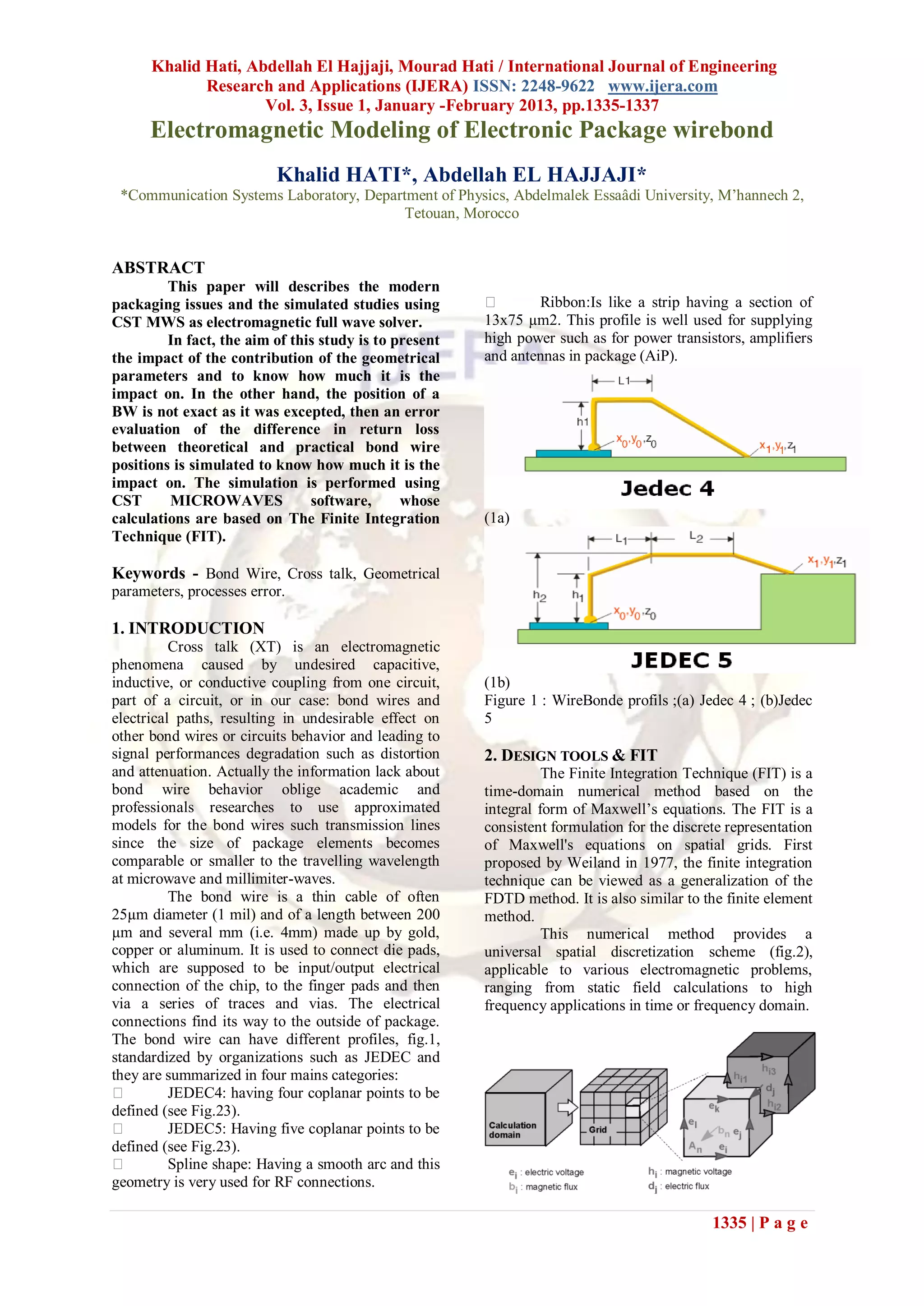
part of a circuit, or in our case: bond wires and       Figure 1 : WireBonde profils ;(a) Jedec 4 ; (b)Jedec
electrical paths, resulting in undesirable effect on    5
other bond wires or circuits behavior and leading to
signal performances degradation such as distortion      2. DESIGN TOOLS & FIT
and attenuation. Actually the information lack about              The Finite Integration Technique (FIT) is a
bond wire behavior oblige academic and                  time-domain numerical method based on the
professionals researches to use approximated            integral form of Maxwell’s equations. The FIT is a
models for the bond wires such transmission lines       consistent formulation for the discrete representation
since the size of package elements becomes              of Maxwell's equations on spatial grids. First
comparable or smaller to the travelling wavelength      proposed by Weiland in 1977, the finite integration
at microwave and millimiter-waves.                      technique can be viewed as a generalization of the
          The bond wire is a thin cable of often        FDTD method. It is also similar to the finite element
25µm diameter (1 mil) and of a length between 200       method.
µm and several mm (i.e. 4mm) made up by gold,                     This numerical method provides a
copper or aluminum. It is used to connect die pads,     universal spatial discretization scheme (fig.2),
which are supposed to be input/output electrical        applicable to various electromagnetic problems,
connection of the chip, to the finger pads and then     ranging from static field calculations to high
via a series of traces and vias. The electrical         frequency applications in time or frequency domain.
connections find its way to the outside of package.
The bond wire can have different profiles, fig.1,
standardized by organizations such as JEDEC and
they are summarized in four mains categories:
         JEDEC4: having four coplanar points to be
defined (see Fig.23).
         JEDEC5: Having five coplanar points to be
defined (see Fig.23).
         Spline shape: Having a smooth arc and this
geometry is very used for RF connections.

                                                                                             1335 | P a g e
Khalid Hati, Abdellah El Hajjaji, Mourad Hati / International Journal of Engineering
              Research and Applications (IJERA) ISSN: 2248-9622 www.ijera.com
                      Vol. 3, Issue 1, January -February 2013, pp.1335-1337
(2a)                                                     the processing moment where the temperature is
                                                         very high causes copper erosion due to the existence
                                                         of several di-oxides and the higher stress on the chip
                                                         required to attaching copper wire on the die pads.
                                                         However, in term electrical performance and costs,
                                                         the copper wire is an excellent choice because of his
                                                         higher electrical conductivity and much better its
                                                         reflection coefficient compared to the gold wire.


(2b)
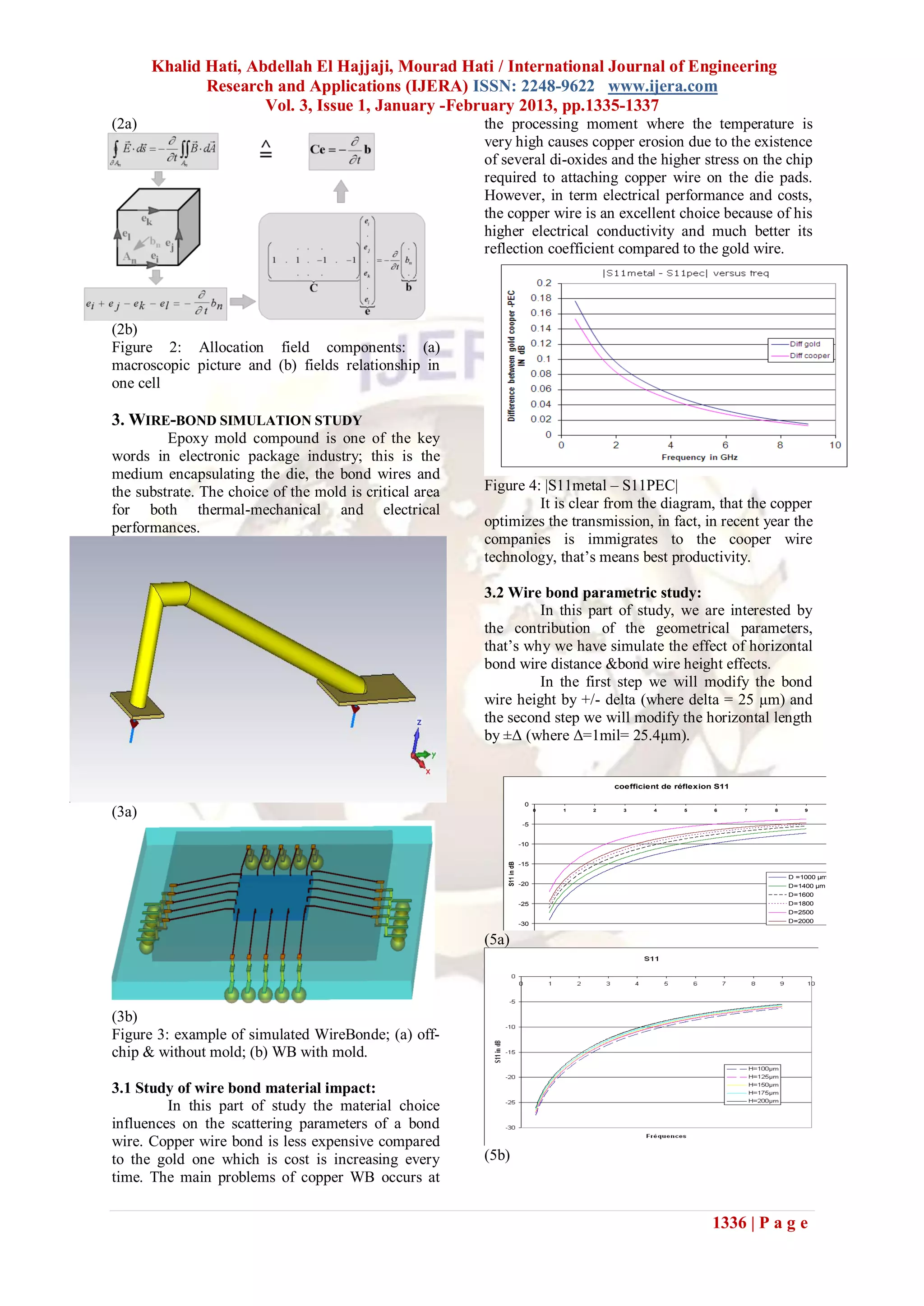
Figure 2: Allocation field components: (a)
macroscopic picture and (b) fields relationship in
one cell

3. WIRE-BOND SIMULATION STUDY
         Epoxy mold compound is one of the key
words in electronic package industry; this is the
medium encapsulating the die, the bond wires and
the substrate. The choice of the mold is critical area   Figure 4: |S11metal – S11PEC|
for both thermal-mechanical and electrical                        It is clear from the diagram, that the copper
performances.                                            optimizes the transmission, in fact, in recent year the
                                                         companies is immigrates to the cooper wire
                                                         technology, that’s means best productivity.

                                                         3.2 Wire bond parametric study:
                                                                  In this part of study, we are interested by
                                                         the contribution of the geometrical parameters,
                                                         that’s why we have simulate the effect of horizontal
                                                         bond wire distance &bond wire height effects.
                                                                  In the first step we will modify the bond
                                                         wire height by +/- delta (where delta = 25 µm) and
                                                         the second step we will modify the horizontal length
                                                         by ±Δ (where Δ=1mil= 25.4µm).


                                                                                           coefficient de réflexion S11

                                                                          0
(3a)                                                                           0   1   2     3      4          5       6   7    8       9        10


                                                                          -5


                                                                         -10
                                                             S11 in dB


                                                                         -15

                                                                                                                                    D =1000 µm
                                                                         -20                                                        D=1400 µm
                                                                                                                                    D=1600
                                                                         -25                                                        D=1800
                                                                                                                                    D=2500
                                                                         -30                                                        D=2000
                                                                                                        Fre q in GHz
                                                         (5a)            -35


(3b)
Figure 3: example of simulated WireBonde; (a) off-
chip & without mold; (b) WB with mold.

3.1 Study of wire bond material impact:
         In this part of study the material choice
influences on the scattering parameters of a bond
wire. Copper wire bond is less expensive compared
to the gold one which is cost is increasing every        (5b)
time. The main problems of copper WB occurs at

                                                                                                                       1336 | P a g e
Khalid Hati, Abdellah El Hajjaji, Mourad Hati / International Journal of Engineering
                                    Research and Applications (IJERA) ISSN: 2248-9622 www.ijera.com
                                            Vol. 3, Issue 1, January -February 2013, pp.1335-1337
                   Figure 5 : S11 versus frequencies: (a) for different          as capacitance and inductance, for arbitrarily shaped
                   distances;(b) for different height.                           objects are presented, which provide a direct link
                   Fig.5 illustrates the results of horizontal distance          between design parameters and electrical
                   and height variations effect on the return loss               performance. An approach using 3D modeling of
                   parameter. It has been shown that return loss                 the geometry for bonding wires for RF applications
                   increases versus frequency when the total length              and packages is demonstrated.
                   increases (the sum of BW height, horizontal length
                   and oblique length), or Manhattan length. As result           ACKNOWLEDGEMENTS
                   and suggestion, It is preferable to use the shorter                   The authors would like to thank Dr.
                   bond wire length in the interconnection, this why             Natasha Healey from TDCmicroelectronics.
                   manufacturer has immigrated to the flip chip                  Appreciation is also extended to technical support
                   technology.                                                   from colleagues: Ms. Andronic. The authors would
                                                                                 also like to add a special thanks to Pr.A. El
                   3.4 Processing error                                          Khamlichi and also Dr. M. Aoutoul.
                            Through this part, we are going to present
                   the result of study of the side effect of processing          REFERENCES
                   error of bond wire. In fact, The fabrication process             [1]   David M. Pozard, Microwave engineering,
                   is not perfect, the position of a BW is not exact as it                3rd Ed, John Wiley & Sons, 2005.
                   was expected, then an error evaluation of the                    [2]   J.O. Hallquist, LS-DYNA User’s Manual-
                   difference in return loss between theoretical and                      Version     940,    Livermore      Software
                   practical bond wire positions is simulated to know                     Technology Corporation, June 1997.
                   how much it is the impact on.                                    [3]    C.Guiffaut. Contribution à la method
                                                                                          FDTD pour l’étude d’antennes et de la
                                        Position effect                                   diffraction d’objets enfouis. Thèse de
                                                                                          doctorat d’université. Rennes : Université
                   0.9
                   0.8
                                                                                          de Rennes, 2005, 1, 200,220p.
                   0.7                                                              [4]   K .S. Yee. Numerical Solution of initial
Difference in dB


                   0.6                                                                    boundary value problems involving
                   0.5                                             -delta                 Maxwell. IEEE, transaction Antennas and
                   0.4                                             +delta
                   0.3                                                                    Propagation, Vol, 14, 1996,p 302-307.
                   0.2                                                              [5]   Lau JH, editor. Ball grid array technology.
                   0.1                                                                    McGraw-Hill; 1995. p. 396.
                    0
                         0       2         4              6    8            10
                                          Frequencies in GHz

                   Figure 6: comparison of S11 difference between
                   Theo. & longer height and between Theo. & shorter
                   height.
                             As shown in fig.6, in the case of « +Δ »
                   that means the length of the wire is longer there are
                   more reflections of power.
                             From these results, we note that there is an
                   effect, in the case of position effect, the error
                   approximately equal to ± 0.8dB, and ± 0.3dB in the
                   case of the height effect.

                   4. CONCLUSION
                             This work starts with geometry modeling
                   for both on-chip and off-chip interconnects followed
                   by extensive electrical performance investigation.
                             During our work we have focused on the
                   return loss parameter because it is characterizes
                   essentially any two ports structure- the bond wire is
                   one of them- a lower return loss parameter values
                   means better values for transmission coefficient if
                   there are no conduction or dielectric losses. In
                   addition, the effect of geometrical and processing
                   error was analyzed
                             Design insight and suitable guidelines for
                   minimizing interconnect inductance are in phase of
                   investigation, electrical parameter extraction, such

                                                                                                                     1337 | P a g e

Gx3113351337

  • 1.
    Khalid Hati, AbdellahEl Hajjaji, Mourad Hati / International Journal of Engineering Research and Applications (IJERA) ISSN: 2248-9622 www.ijera.com Vol. 3, Issue 1, January -February 2013, pp.1335-1337 Electromagnetic Modeling of Electronic Package wirebond Khalid HATI*, Abdellah EL HAJJAJI* *Communication Systems Laboratory, Department of Physics, Abdelmalek Essaâdi University, M’hannech 2, Tetouan, Morocco ABSTRACT This paper will describes the modern packaging issues and the simulated studies using  Ribbon:Is like a strip having a section of CST MWS as electromagnetic full wave solver. 13x75 µm2. This profile is well used for supplying In fact, the aim of this study is to present high power such as for power transistors, amplifiers the impact of the contribution of the geometrical and antennas in package (AiP). parameters and to know how much it is the impact on. In the other hand, the position of a BW is not exact as it was excepted, then an error evaluation of the difference in return loss between theoretical and practical bond wire positions is simulated to know how much it is the impact on. The simulation is performed using CST MICROWAVES software, whose calculations are based on The Finite Integration (1a) Technique (FIT). Keywords - Bond Wire, Cross talk, Geometrical parameters, processes error. 1. INTRODUCTION Cross talk (XT) is an electromagnetic phenomena caused by undesired capacitive, inductive, or conductive coupling from one circuit, (1b) part of a circuit, or in our case: bond wires and Figure 1 : WireBonde profils ;(a) Jedec 4 ; (b)Jedec electrical paths, resulting in undesirable effect on 5 other bond wires or circuits behavior and leading to signal performances degradation such as distortion 2. DESIGN TOOLS & FIT and attenuation. Actually the information lack about The Finite Integration Technique (FIT) is a bond wire behavior oblige academic and time-domain numerical method based on the professionals researches to use approximated integral form of Maxwell’s equations. The FIT is a models for the bond wires such transmission lines consistent formulation for the discrete representation since the size of package elements becomes of Maxwell's equations on spatial grids. First comparable or smaller to the travelling wavelength proposed by Weiland in 1977, the finite integration at microwave and millimiter-waves. technique can be viewed as a generalization of the The bond wire is a thin cable of often FDTD method. It is also similar to the finite element 25µm diameter (1 mil) and of a length between 200 method. µm and several mm (i.e. 4mm) made up by gold, This numerical method provides a copper or aluminum. It is used to connect die pads, universal spatial discretization scheme (fig.2), which are supposed to be input/output electrical applicable to various electromagnetic problems, connection of the chip, to the finger pads and then ranging from static field calculations to high via a series of traces and vias. The electrical frequency applications in time or frequency domain. connections find its way to the outside of package. The bond wire can have different profiles, fig.1, standardized by organizations such as JEDEC and they are summarized in four mains categories:  JEDEC4: having four coplanar points to be defined (see Fig.23).  JEDEC5: Having five coplanar points to be defined (see Fig.23).  Spline shape: Having a smooth arc and this geometry is very used for RF connections. 1335 | P a g e
  • 2.
    Khalid Hati, AbdellahEl Hajjaji, Mourad Hati / International Journal of Engineering Research and Applications (IJERA) ISSN: 2248-9622 www.ijera.com Vol. 3, Issue 1, January -February 2013, pp.1335-1337 (2a) the processing moment where the temperature is very high causes copper erosion due to the existence of several di-oxides and the higher stress on the chip required to attaching copper wire on the die pads. However, in term electrical performance and costs, the copper wire is an excellent choice because of his higher electrical conductivity and much better its reflection coefficient compared to the gold wire. (2b) Figure 2: Allocation field components: (a) macroscopic picture and (b) fields relationship in one cell 3. WIRE-BOND SIMULATION STUDY Epoxy mold compound is one of the key words in electronic package industry; this is the medium encapsulating the die, the bond wires and the substrate. The choice of the mold is critical area Figure 4: |S11metal – S11PEC| for both thermal-mechanical and electrical It is clear from the diagram, that the copper performances. optimizes the transmission, in fact, in recent year the companies is immigrates to the cooper wire technology, that’s means best productivity. 3.2 Wire bond parametric study: In this part of study, we are interested by the contribution of the geometrical parameters, that’s why we have simulate the effect of horizontal bond wire distance &bond wire height effects. In the first step we will modify the bond wire height by +/- delta (where delta = 25 µm) and the second step we will modify the horizontal length by ±Δ (where Δ=1mil= 25.4µm). coefficient de réflexion S11 0 (3a) 0 1 2 3 4 5 6 7 8 9 10 -5 -10 S11 in dB -15 D =1000 µm -20 D=1400 µm D=1600 -25 D=1800 D=2500 -30 D=2000 Fre q in GHz (5a) -35 (3b) Figure 3: example of simulated WireBonde; (a) off- chip & without mold; (b) WB with mold. 3.1 Study of wire bond material impact: In this part of study the material choice influences on the scattering parameters of a bond wire. Copper wire bond is less expensive compared to the gold one which is cost is increasing every (5b) time. The main problems of copper WB occurs at 1336 | P a g e
  • 3.
    Khalid Hati, AbdellahEl Hajjaji, Mourad Hati / International Journal of Engineering Research and Applications (IJERA) ISSN: 2248-9622 www.ijera.com Vol. 3, Issue 1, January -February 2013, pp.1335-1337 Figure 5 : S11 versus frequencies: (a) for different as capacitance and inductance, for arbitrarily shaped distances;(b) for different height. objects are presented, which provide a direct link Fig.5 illustrates the results of horizontal distance between design parameters and electrical and height variations effect on the return loss performance. An approach using 3D modeling of parameter. It has been shown that return loss the geometry for bonding wires for RF applications increases versus frequency when the total length and packages is demonstrated. increases (the sum of BW height, horizontal length and oblique length), or Manhattan length. As result ACKNOWLEDGEMENTS and suggestion, It is preferable to use the shorter The authors would like to thank Dr. bond wire length in the interconnection, this why Natasha Healey from TDCmicroelectronics. manufacturer has immigrated to the flip chip Appreciation is also extended to technical support technology. from colleagues: Ms. Andronic. The authors would also like to add a special thanks to Pr.A. El 3.4 Processing error Khamlichi and also Dr. M. Aoutoul. Through this part, we are going to present the result of study of the side effect of processing REFERENCES error of bond wire. In fact, The fabrication process [1] David M. Pozard, Microwave engineering, is not perfect, the position of a BW is not exact as it 3rd Ed, John Wiley & Sons, 2005. was expected, then an error evaluation of the [2] J.O. Hallquist, LS-DYNA User’s Manual- difference in return loss between theoretical and Version 940, Livermore Software practical bond wire positions is simulated to know Technology Corporation, June 1997. how much it is the impact on. [3] C.Guiffaut. Contribution à la method FDTD pour l’étude d’antennes et de la Position effect diffraction d’objets enfouis. Thèse de doctorat d’université. Rennes : Université 0.9 0.8 de Rennes, 2005, 1, 200,220p. 0.7 [4] K .S. Yee. Numerical Solution of initial Difference in dB 0.6 boundary value problems involving 0.5 -delta Maxwell. IEEE, transaction Antennas and 0.4 +delta 0.3 Propagation, Vol, 14, 1996,p 302-307. 0.2 [5] Lau JH, editor. Ball grid array technology. 0.1 McGraw-Hill; 1995. p. 396. 0 0 2 4 6 8 10 Frequencies in GHz Figure 6: comparison of S11 difference between Theo. & longer height and between Theo. & shorter height. As shown in fig.6, in the case of « +Δ » that means the length of the wire is longer there are more reflections of power. From these results, we note that there is an effect, in the case of position effect, the error approximately equal to ± 0.8dB, and ± 0.3dB in the case of the height effect. 4. CONCLUSION This work starts with geometry modeling for both on-chip and off-chip interconnects followed by extensive electrical performance investigation. During our work we have focused on the return loss parameter because it is characterizes essentially any two ports structure- the bond wire is one of them- a lower return loss parameter values means better values for transmission coefficient if there are no conduction or dielectric losses. In addition, the effect of geometrical and processing error was analyzed Design insight and suitable guidelines for minimizing interconnect inductance are in phase of investigation, electrical parameter extraction, such 1337 | P a g e