by
Anuj
14/MAP/0012
M.Sc. (Applied Physics)
Under the guidance of
Dr. Manmohan Singh Shishodia
Gautam Buddha University, Greater Noida (U.P.)
Finite Element Method for Analyzing TE
Modes of Rectangular Hollow Waveguide
Outlines
 Review of Different Approaches Based On Finite Element
Method
 Introduction To Waveguide
 EM Field Configuration Within The Waveguide
 FEM Formulation
 Homogeneous Hollow waveguide Example
 MATLAB Code To Calculate Propagation Constant
 Result and comparison b/w FEM and Analytical Results
 Overall Summary
 Future Plan
 References
Review of Different Approaches Based On
Finite Element Method
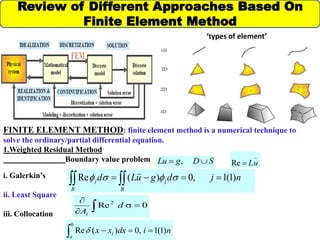
FINITE ELEMENT METHOD: finite element method is a numerical technique to
solve the ordinary/partial differential equation.
1.Weighted Residual Method
Boundary value problem
i. Galerkin’s
ii. Least Square
iii. Collocation
‘types of element’
 
R
j
R
j njdguLd )1(1,0)(Re 
0Re2



 d
Ai
 
b
a
i nidxxx )1(1,0)(Re
SDgLu  ,
_
Re uL
0.0 0.2 0.4 0.6 0.8 1.0
-0.008
-0.004
0.000
0.004
0.008
0.012
(yT/WL
2
)
x/L
Galerkin
Least Square
Collocation
ERROR PLOT FOR DIFFERENT APPROACHES
0.0 0.2 0.4 0.6 0.8 1.0
-0.30
-0.25
-0.20
-0.15
-0.10
-0.05
0.00
0.05
Solutions obtained from different methods
(yT/WL
2
)
x/L
Exact, Collocation
Galerkin, Least Square
Review of Different Approaches Based On
Finite Element Method
0)(2
2
 xw
dx
yd
T
032
2
 W
dx
yd
T
2
0
L
xfor 
02
2
W
dx
yd
T Lx
L
for 
2
* Hence the plot shown that the eroor is least in the Galerkin’s approach.
Introduction To Waveguide
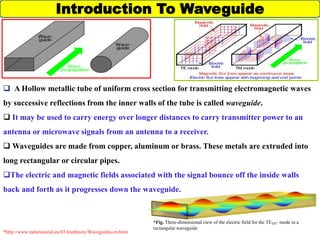
 A Hollow metallic tube of uniform cross section for transmitting electromagnetic waves
by successive reflections from the inner walls of the tube is called waveguide.
 It may be used to carry energy over longer distances to carry transmitter power to an
antenna or microwave signals from an antenna to a receiver.
 Waveguides are made from copper, aluminum or brass. These metals are extruded into
long rectangular or circular pipes.
The electric and magnetic fields associated with the signal bounce off the inside walls
back and forth as it progresses down the waveguide.
*Fig. Three-dimensional view of the electric field for the TE₁₀– mode in a
rectangular waveguide
*http://www.radartutorial.eu/03.linetheory/Waveguides.en.html
EM Field Configuration Within The Waveguide
 In order to determine the EM field configuration within the waveguide, Maxwell’s
equations should be solved subject to appropriate boundary conditions at the walls of the
guide.
 Such solutions give rise to a number of field configurations. Each configuration is known
as a mode.
02
2
2
2
2






z
zz
Ek
y
E
x
E
022
 EkE
ck 22

)()(),( yYxXyxEz 
t
B
EE





,0
t
E
c
BB


 2
1
0
02
2
2
2
2
2





















zEk
cyx

     xkBxkAxX xx cossin 
02
2
2
2
2
2















 XYk
cdy
Yd
X
dx
Xd
Y

   bnaxmEEz /cos/cos0 
 





















22
22
/
b
n
a
m
ck 
mn
b
n
a
m
c  





















22
Scalar Wave Equation
Where
Maxwell’s Equations
*David J. Griffiths, “Introduction to Electrodynamics” Pearson Education, Inc., ISBN-978-81-203-1601-0 (1999),.
Possible Types of modes
Transverse Electromagnetic (TEM):
Here both electric and magnetic fields are directed
components. (i.e.) E z = 0 and Hz = 0
Transverse Electric (TE) wave:
Here only the electric field is purely transverse to the direction of propagation and
the magnetic field is not purely transverse. (i.e.) E z = 0, Hz ≠ 0.
Transverse Magnetic (TM) wave:
Here only magnetic field is transverse to the direction of propagation and the electric
field is not purely transverse. (i.e.) E z ≠ 0, Hz = 0.
Dimensions of the waveguide which determines the
operating frequency range
EM Field Configuration Within The Waveguide
    mnbnamc  
22
//
Where is the cutoff frequency
 The size of the waveguide determines its operating frequency range.
 The frequency of operation is determined by the dimension ‘a’ and b.
 This dimension is usually made equal to one – half the wavelength at the
lowest frequency of operation, this frequency is known as the waveguide cutoff
frequency.
 At the cutoff frequency and below, the waveguide will not transmit energy. At
frequencies above the cutoff frequency, the waveguide will propagate energy.
Angle of incidence(A) Angle of reflection (B)
(A = B)
(a)At high frequency
(b) At medium frequency
( c ) At low frequency
(d) At cutoff frequency
EM Field Configuration Within The Waveguide
022
 k
dsk
yx
F
s
 























 22
22
2
1
)(
,
22
0
2
zr kkk  
0
0
2


k
  dSk
yx
F e
ee
N
e A
e
e
























 
22
22
2
1
 
2
22 ,
e
yx

 
3
33 ,
e
yx

 11
1
, yx
e
 yxP ,
x
y
Element e
1
2 3
cybxae 
FEM Formulation
 The scalar wave equation for a homogeneous isotropic medium is chosen.
 The scalar wave equation has many applications.
 It can be used to analyse problem such as the propagation of plane waves.
 It can be used to analyse the TE and TM modes in waveguides/weakly guiding optical
fibers.
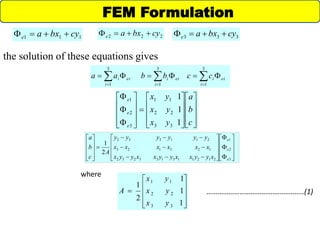
The FEM solution of the above scalar equation by minimisation of a corresponding
functional is given by
The function at a point inside the triangle may be
approximated as , the linear terms:-
e
Fig. A typical first order triangular element.
111 cybxae  222 cybxae  333 cybxae 
the solution of these equations gives
 

3
1
3
1
3
1 i
eii
i
eii
i
eii ccbbaa


































c
b
a
yx
yx
yx
e
e
e
1
1
1
33
22
11
3
2
1





































3
2
1
212113133232
123123
211332
2
1
e
e
e
xyyxxyyxxyyx
xxxxxx
yyyyyy
A
c
b
a











1
1
1
2
1
33
22
11
yx
yx
yx
A
FEM Formulation
where
……………………………………………..(1)
     23132132321
2
1
,
2
1
,
2
1
xx
A
cyy
A
bxyyx
A
a 
     31113213132
2
1
,
2
1
,
2
1
xx
A
cyy
A
bxyyx
A
a 
     12321321213
2
1
,
2
1
,
2
1
xx
A
cyy
A
bxyyx
A
a 
Hence, we can write
ei
i
ie u  
3
1
 321 eeee   321 uuuu   321 bbbb  321 cccc 
Using row vectors
 
   
 
dS
uukc
cbb
F
e
e
N
e A
t
e
tt
e
t
e
tt
e
t
e
tt
e
 










1 22
1
   

eN
e
t
eee
t
eee QkPF
1
2
2
1
FEM Formulation
   

eN
e
t
eee
t
eee QkPF
1
2
2
1  ccbbAP tt
ee 











211
121
112
12
e
e
A
Q
Using eqn (1)
Homogeneous Hollow Waveguide Example
The example of a homogeneous hollow waveguide (WR-90) is taken to calculate the value of
propagation constant.[WR-90 waveguide :- frequency range:- 8.2GHz to 12.4GHz]
The dimensions of the waveguide is 2.286cm*1.016cm.
First we will dicretize the domain (waveguide) using “pde-toolbox” , this process is known as
meshing,.
Then we create three matrices....
1. For triangle node numbers:- A file element which has three node numbers of each triangle,
with rows arranged to correspond to triangle number in ascending order.
2. Coordinates of nodes:- A file coord which has two columns containing x coordinate in the
first column and y coordinate in the second, with rows arranged to correspond to node
numbers in ascending order.
3. Boundary node numbers:- A file bn with one column containing the boundary node numbers
in ascending order.
function [pe,qe] = triangle1(x,y)
ae=x(2)*y(3)-x(3)*y(2)+x(1)*y(2)-x(2)*y(1)-x(1)*y(3)+x(3)*y(1);
ae=abs(ae)/2;
b=[y(2)-y(3),y(3)-y(1),y(1)-y(2)];
c=[x(3)-x(2),x(1)-x(3),x(2)-x(1)];
b=b/(2*ae);
c=c/(2*ae);
pe=(b.'*b+c.'*c)*ae;
qe=[2,1,1;1,2,1;1,1,2];
qe=qe*(ae/12);
end
MATLAB Code To Calculate Propagation Constant
Function
clc
clear all
format long g
% load the data file
element=xlsread('element.xlsx');
coord=xlsread('coord.xlsx');
bn=xlsread('bn.xlsx');
% find the total no. of elements and nodes
ne=length(element(:,1));
nn=length(coord(:,1));
% set up pull global matrices
pg=zeros(nn,nn);
qg=zeros(nn,nn);
% sum over triangles
for e=1:ne;
% Get the three node no. of triangle no. e
node=[element(e,:)];
% Get the coordinates of each node and form row vectors
x=[coord(node(1),1),coord(node(2),1),coord(node(3),1)];
y=[coord(node(1),2),coord(node(2),2),coord(node(3),2)];
% Calculate the local matrix for triangle no. e
[pe,qe]=triangle1(x,y);
% Add each element of the local matrix to the appropriate lement
of the
% global matrix
for k=1:3;
for m=1:3;
pg(node(k),node(m))=pg(node(k),node(m))+pe(k,m);
qg(node(k),node(m))=qg(node(k),node(m))+qe(k,m);
end
end
end
ksquare=eig(pg,qg)
Script
Result and comparison b/w FEM and Analytical
Results
No mode 9.5748
(9.56119)
38.4625
(38.24479)
1.8891
(1.8886)
11.4693
(11.4498)
40.3694
(40.1334)
7.5638
(7.5545)
17.159
(17.1157)
46.11235
(45.7993)
m
n
0
0
1
1
2
2
Overall Summary
 Learned fundamentals of PDEs useful for scientists and engineers
(e.g., elliptic, parabolic & hyperbolic, scalar wave eqn).
 Studied waveguide and learned its different fundamental mode i.e.
TE.
Calculated values of propagation constant for different modes.
Future Plan
 In future, we will calculate the propagation constant for TM mode.
we will solve the problems on waveguide using ANSYS.
We will move towards optical wave guide and plasmonic waveguide
and study the different properties with the help of ANSYS .
1. Erik G. Thompson, “An Introduction To The Finite Element Method”, John Willey &
Sons, ISBN: 978-81-265-2455-6 (2005)
2. Radhey S. Gupta, “Elements of Numerical Analysis”, Macmillan India Ltd.,ISBN: 446-
521 (2009),.
3. David J. Griffiths, “Introduction to Electrodynamics” Pearson Education, Inc., ISBN-
978-81-203-1601-0 (1999),.
References
Thank
You !!!

Anuj 10mar2016

  • 1.
    by Anuj 14/MAP/0012 M.Sc. (Applied Physics) Underthe guidance of Dr. Manmohan Singh Shishodia Gautam Buddha University, Greater Noida (U.P.) Finite Element Method for Analyzing TE Modes of Rectangular Hollow Waveguide
  • 2.
    Outlines  Review ofDifferent Approaches Based On Finite Element Method  Introduction To Waveguide  EM Field Configuration Within The Waveguide  FEM Formulation  Homogeneous Hollow waveguide Example  MATLAB Code To Calculate Propagation Constant  Result and comparison b/w FEM and Analytical Results  Overall Summary  Future Plan  References
  • 4.
    Review of DifferentApproaches Based On Finite Element Method FINITE ELEMENT METHOD: finite element method is a numerical technique to solve the ordinary/partial differential equation. 1.Weighted Residual Method Boundary value problem i. Galerkin’s ii. Least Square iii. Collocation ‘types of element’   R j R j njdguLd )1(1,0)(Re  0Re2     d Ai   b a i nidxxx )1(1,0)(Re SDgLu  , _ Re uL
  • 5.
    0.0 0.2 0.40.6 0.8 1.0 -0.008 -0.004 0.000 0.004 0.008 0.012 (yT/WL 2 ) x/L Galerkin Least Square Collocation ERROR PLOT FOR DIFFERENT APPROACHES 0.0 0.2 0.4 0.6 0.8 1.0 -0.30 -0.25 -0.20 -0.15 -0.10 -0.05 0.00 0.05 Solutions obtained from different methods (yT/WL 2 ) x/L Exact, Collocation Galerkin, Least Square Review of Different Approaches Based On Finite Element Method 0)(2 2  xw dx yd T 032 2  W dx yd T 2 0 L xfor  02 2 W dx yd T Lx L for  2 * Hence the plot shown that the eroor is least in the Galerkin’s approach.
  • 6.
    Introduction To Waveguide A Hollow metallic tube of uniform cross section for transmitting electromagnetic waves by successive reflections from the inner walls of the tube is called waveguide.  It may be used to carry energy over longer distances to carry transmitter power to an antenna or microwave signals from an antenna to a receiver.  Waveguides are made from copper, aluminum or brass. These metals are extruded into long rectangular or circular pipes. The electric and magnetic fields associated with the signal bounce off the inside walls back and forth as it progresses down the waveguide. *Fig. Three-dimensional view of the electric field for the TE₁₀– mode in a rectangular waveguide *http://www.radartutorial.eu/03.linetheory/Waveguides.en.html
  • 7.
    EM Field ConfigurationWithin The Waveguide  In order to determine the EM field configuration within the waveguide, Maxwell’s equations should be solved subject to appropriate boundary conditions at the walls of the guide.  Such solutions give rise to a number of field configurations. Each configuration is known as a mode. 02 2 2 2 2       z zz Ek y E x E 022  EkE ck 22  )()(),( yYxXyxEz  t B EE      ,0 t E c BB    2 1 0 02 2 2 2 2 2                      zEk cyx       xkBxkAxX xx cossin  02 2 2 2 2 2                 XYk cdy Yd X dx Xd Y     bnaxmEEz /cos/cos0                         22 22 / b n a m ck  mn b n a m c                        22 Scalar Wave Equation Where Maxwell’s Equations *David J. Griffiths, “Introduction to Electrodynamics” Pearson Education, Inc., ISBN-978-81-203-1601-0 (1999),.
  • 8.
    Possible Types ofmodes Transverse Electromagnetic (TEM): Here both electric and magnetic fields are directed components. (i.e.) E z = 0 and Hz = 0 Transverse Electric (TE) wave: Here only the electric field is purely transverse to the direction of propagation and the magnetic field is not purely transverse. (i.e.) E z = 0, Hz ≠ 0. Transverse Magnetic (TM) wave: Here only magnetic field is transverse to the direction of propagation and the electric field is not purely transverse. (i.e.) E z ≠ 0, Hz = 0. Dimensions of the waveguide which determines the operating frequency range EM Field Configuration Within The Waveguide     mnbnamc   22 // Where is the cutoff frequency
  • 9.
     The sizeof the waveguide determines its operating frequency range.  The frequency of operation is determined by the dimension ‘a’ and b.  This dimension is usually made equal to one – half the wavelength at the lowest frequency of operation, this frequency is known as the waveguide cutoff frequency.  At the cutoff frequency and below, the waveguide will not transmit energy. At frequencies above the cutoff frequency, the waveguide will propagate energy. Angle of incidence(A) Angle of reflection (B) (A = B) (a)At high frequency (b) At medium frequency ( c ) At low frequency (d) At cutoff frequency EM Field Configuration Within The Waveguide
  • 10.
    022  k dsk yx F s                          22 22 2 1 )( , 22 0 2 zr kkk   0 0 2   k   dSk yx F e ee N e A e e                           22 22 2 1   2 22 , e yx    3 33 , e yx   11 1 , yx e  yxP , x y Element e 1 2 3 cybxae  FEM Formulation  The scalar wave equation for a homogeneous isotropic medium is chosen.  The scalar wave equation has many applications.  It can be used to analyse problem such as the propagation of plane waves.  It can be used to analyse the TE and TM modes in waveguides/weakly guiding optical fibers. The FEM solution of the above scalar equation by minimisation of a corresponding functional is given by The function at a point inside the triangle may be approximated as , the linear terms:- e Fig. A typical first order triangular element.
  • 11.
    111 cybxae 222 cybxae  333 cybxae  the solution of these equations gives    3 1 3 1 3 1 i eii i eii i eii ccbbaa                                   c b a yx yx yx e e e 1 1 1 33 22 11 3 2 1                                      3 2 1 212113133232 123123 211332 2 1 e e e xyyxxyyxxyyx xxxxxx yyyyyy A c b a            1 1 1 2 1 33 22 11 yx yx yx A FEM Formulation where ……………………………………………..(1)
  • 12.
        23132132321 2 1 , 2 1 , 2 1 xx A cyy A bxyyx A a       31113213132 2 1 , 2 1 , 2 1 xx A cyy A bxyyx A a       12321321213 2 1 , 2 1 , 2 1 xx A cyy A bxyyx A a  Hence, we can write ei i ie u   3 1  321 eeee   321 uuuu   321 bbbb  321 cccc  Using row vectors         dS uukc cbb F e e N e A t e tt e t e tt e t e tt e             1 22 1      eN e t eee t eee QkPF 1 2 2 1 FEM Formulation      eN e t eee t eee QkPF 1 2 2 1  ccbbAP tt ee             211 121 112 12 e e A Q Using eqn (1)
  • 13.
    Homogeneous Hollow WaveguideExample The example of a homogeneous hollow waveguide (WR-90) is taken to calculate the value of propagation constant.[WR-90 waveguide :- frequency range:- 8.2GHz to 12.4GHz] The dimensions of the waveguide is 2.286cm*1.016cm. First we will dicretize the domain (waveguide) using “pde-toolbox” , this process is known as meshing,. Then we create three matrices.... 1. For triangle node numbers:- A file element which has three node numbers of each triangle, with rows arranged to correspond to triangle number in ascending order. 2. Coordinates of nodes:- A file coord which has two columns containing x coordinate in the first column and y coordinate in the second, with rows arranged to correspond to node numbers in ascending order. 3. Boundary node numbers:- A file bn with one column containing the boundary node numbers in ascending order.
  • 14.
    function [pe,qe] =triangle1(x,y) ae=x(2)*y(3)-x(3)*y(2)+x(1)*y(2)-x(2)*y(1)-x(1)*y(3)+x(3)*y(1); ae=abs(ae)/2; b=[y(2)-y(3),y(3)-y(1),y(1)-y(2)]; c=[x(3)-x(2),x(1)-x(3),x(2)-x(1)]; b=b/(2*ae); c=c/(2*ae); pe=(b.'*b+c.'*c)*ae; qe=[2,1,1;1,2,1;1,1,2]; qe=qe*(ae/12); end MATLAB Code To Calculate Propagation Constant Function clc clear all format long g % load the data file element=xlsread('element.xlsx'); coord=xlsread('coord.xlsx'); bn=xlsread('bn.xlsx'); % find the total no. of elements and nodes ne=length(element(:,1)); nn=length(coord(:,1)); % set up pull global matrices pg=zeros(nn,nn); qg=zeros(nn,nn); % sum over triangles for e=1:ne; % Get the three node no. of triangle no. e node=[element(e,:)]; % Get the coordinates of each node and form row vectors x=[coord(node(1),1),coord(node(2),1),coord(node(3),1)]; y=[coord(node(1),2),coord(node(2),2),coord(node(3),2)]; % Calculate the local matrix for triangle no. e [pe,qe]=triangle1(x,y); % Add each element of the local matrix to the appropriate lement of the % global matrix for k=1:3; for m=1:3; pg(node(k),node(m))=pg(node(k),node(m))+pe(k,m); qg(node(k),node(m))=qg(node(k),node(m))+qe(k,m); end end end ksquare=eig(pg,qg) Script
  • 15.
    Result and comparisonb/w FEM and Analytical Results No mode 9.5748 (9.56119) 38.4625 (38.24479) 1.8891 (1.8886) 11.4693 (11.4498) 40.3694 (40.1334) 7.5638 (7.5545) 17.159 (17.1157) 46.11235 (45.7993) m n 0 0 1 1 2 2
  • 16.
    Overall Summary  Learnedfundamentals of PDEs useful for scientists and engineers (e.g., elliptic, parabolic & hyperbolic, scalar wave eqn).  Studied waveguide and learned its different fundamental mode i.e. TE. Calculated values of propagation constant for different modes.
  • 17.
    Future Plan  Infuture, we will calculate the propagation constant for TM mode. we will solve the problems on waveguide using ANSYS. We will move towards optical wave guide and plasmonic waveguide and study the different properties with the help of ANSYS .
  • 18.
    1. Erik G.Thompson, “An Introduction To The Finite Element Method”, John Willey & Sons, ISBN: 978-81-265-2455-6 (2005) 2. Radhey S. Gupta, “Elements of Numerical Analysis”, Macmillan India Ltd.,ISBN: 446- 521 (2009),. 3. David J. Griffiths, “Introduction to Electrodynamics” Pearson Education, Inc., ISBN- 978-81-203-1601-0 (1999),. References
  • 19.