International Journal of Electronics and Communication Engineering AND COMMUNICATION0976 –
       INTERNATIONAL JOURNAL OF ELECTRONICS & Technology (IJECET), ISSN
 6464(Print), ISSN 0976 – 6472(Online) Volume& Issue 3, October- December (2012), © IAEME
                           ENGINEERING 3, TECHNOLOGY (IJECET)

ISSN 0976 – 6464(Print)
ISSN 0976 – 6472(Online)
Volume 3, Issue 3, October- December (2012), pp. 01-07                       IJECET
© IAEME: www.iaeme.com/ijecet.html
Journal Impact Factor (2012): 3.5930 (Calculated by GISI)                   ©IAEME
www.jifactor.com


      SIMULATION AND ANALYSIS OF SLOT-COUPLED PATCH ANTENNA
               AT DIFFERENT FREQUENCIES USING HFSS

          Tauheed Qamar1, Naseem Halder2, Mohd. Gulman Siddiqui3, Vishal Varshney4
                1,2,,3,4
                         (Department of Electronics and Communication Engineering
         Amity School of Engineering And Technology, Amity University, Noida, U.p, India
                  1
                    (muhammadtauheed20@gmail.com), 2(naseem.halder@yahoo.in),
                       3
                         (mohdgulman@gmail.com ) ,4(vishal.amity08@yahoo.co.in )


 ABSTRACT
 Microstrip patch antennas are well suited for integration in too many applications owing to their
 conformal nature. There are many wide banding techniques used for the MSAs. But many wide
 banding techniques such as using slots in the patch require an inductive coupled feed. Aperture
 coupled feed which makes use of thick antenna substrates is the most convenient as it has only
 single ground plane. Apart from this aperture coupling provides a greater radiation pattern
 symmetry and greater ease of design for higher impedance band width owing to a large number
 of design parameters. In this type of feed by using multiple patches bandwidths up to 70% are
 reported. This paper presents a slot coupled microstrip antenna with a rectangular patch which is
 located on top of two slots on the ground plane. The patch and slots are separated by an air gap
 and a material with low dielectric constant. The reduction in return loss is achieved as we moved
 to the higher frequencies. The operational frequencies are taken as from 3 GHz to 5 GHz. The
 comparison of s parameter plot and radiation pattern plot is done in order to achieve a better
 design in terms of low return loss, improved radiation pattern etc.

 Keywords – Air gap, Aperture coupled, High bandwidth, MSA, Radiation pattern, Return loss &
 S-parameter.

 I.                         INTRODUCTION

 Microstrip antennas have several advantages like: low cost, easy fabrication and light weight.
 But they suffer from disadvantages like low gain and narrow impedance bandwidth [1-5]. In
 high-performance aircraft, spacecraft, satellite, and missile applications, where size, weight, cost,

                                                  1
International Journal of Electronics and Communication Engineering & Technology (IJECET), ISSN 0976 –
6464(Print), ISSN 0976 – 6472(Online) Volume 3, Issue 3, October- December (2012), © IAEME


performance, ease of installation, and aerodynamic profile are constraints, and low-profile
antennas may be required. Presently there are many other government and commercial
applications, such as mobile radio and wireless communications that have similar specifications.
To meet these requirements, microstrip antennas can be used [7]. These antennas are low profile,
conformable to planar and non planar surfaces, simple and inexpensive to manufacture using
modern printed-circuit technology, mechanically robust when mounted on rigid surfaces,
compatible with MMIC designs, and when the particular patch shape and mode are selected, they
are very versatile in terms of resonant frequency, polarization, pattern, and impedance [6]. In
addition, by adding loads between the patch and the ground plane, such as pins and varactor
diodes, adaptive elements with variable resonant frequency, impedance, polarization, and pattern
can be designed.
          Major operational disadvantages of microstrip antennas are their low efficiency, low
power, high Q (sometimes in excess of 100), poor polarization purity, poor scan performance,
spurious feed radiation and very narrow frequency bandwidth, which is typically only a fraction
of a percent or at most a few percent. In some applications, such as in government security
systems, narrow bandwidths are desirable [7]. However, there are methods, such as increasing
the height of the substrate that can be used to extend the efficiency (to as large as 90 percent if
surface waves are not included) and bandwidth (up to about 35 percent). However, as the height
increases, surface waves are introduced which usually are not desirable because they extract
power from the total available for direct radiation (space waves). The surface waves travel within
the substrate and they are scattered at bends and surface discontinuities, such as the truncation of
the dielectric and ground plane [8 & 13], and degrade the antenna pattern and polarization
characteristics. Surface waves can be eliminated, while maintaining large bandwidths, by using
cavities. Stacking, as well as other methods, of microstrip elements can also be used to increase
the bandwidth.
          In addition, microstrip antennas also exhibit large electromagnetic signatures at certain
frequencies outside the operating band, are rather large physically at VHF and possibly UHF
frequencies, and in large arrays there is a trade-off between bandwidth and scan volume. In order
to achieve the higher bandwidth with improved radiation efficiency and reduced return loss, slot
couple patch antenna is design in such a manner that it can easily overcome these problems [10].

 II.                       RESEARCH METHODOLOGY

        The research methodology inculcates the designing of the slot couple patch antenna. This
designed antenna structure is fed by using single coaxial probe feed. After feeding the antenna
structure these designed antennas are further simulated over HFSS simulation software, a FET
based simulation software. These simulations are continued till an optimum result is obtained.

III.                       INDENTATIONS AND EQUATIONS (ANTENNA DESIGN):

        Because of the fringing effects, electrically the patch of the microstrip antenna looks
greater than its physical dimensions. For the principal E-plane (xy-plane), this is demonstrated in
Figure 1.1 where the dimensions of the patch along its length have been extended on each end by


                                                 2
International Journal of Electronics and Communication Engineering & Technology (IJECET), ISSN 0976 –
6464(Print), ISSN 0976 – 6472(Online) Volume 3, Issue 3, October- December (2012), © IAEME


a distance ∆L, which is a function of the effective dielectric constant εreff and the width-to-height
ratio (W/h).

       ∆L                                                                                    ∆L
                                                L


                                                                                                  W


                     Figure: 1.1 Physical and effective lengths of rectangular microstrip patch.


A very popular and practical approximate relation for the normalized extension of the length is
given by the following expression:
              ∆L/h = 0.412 {(εreff+0.3)[(W/h)+0.264]/ (εreff+0.3)[(W/h)+0.264]}…….(1)
    Since the length of the patch has been extended by ∆L on each side, the effective length of
the patch is now (L = λ/2 for dominant TM010 mode with no fringing)
                    Leffe = L+2∆L……………………………………………..(2)
Based on the simplified formulation that has been described, a design procedure is outlined
which leads to practical designs of rectangular microstrip antennas. The procedure assumes that
the specified information includes the dielectric constant of the substrate (εr), the resonant
frequency (fr), and the height of the substrate h. The procedure is as follows: Specify: εr, fr (in
Hz), and h. Determine: W, L
Design Equations:
1. For an efficient radiator, a practical width that leads to good radiation efficiencies is
W = ( 1/(2frඥߤ଴ ߝ଴ 	 )ඥ2/(ߝ௥ + 1) = (‫ݒ‬଴ /2݂௥ )	ඥ2/(ߝ௥ + 1) ............................(3)
Where vo is the free-space velocity of light.


                                                      3
International Journal of Electronics and Communication Engineering & Technology (IJECET), ISSN 0976 –
6464(Print), ISSN 0976 – 6472(Online) Volume 3, Issue 3, October- December (2012), © IAEME


2. Determine the effective dielectric constant of the microstrip antenna.
3. Once W is found using, determine the extension of the length ∆L.
4. The actual length of the patch can now be determined by solving for L.
                ଵ
      ଶ௙
L=                          – 2 ∆L……………………………………………………(4)
           ೝටഄೝ೐೑೑ ඥഋబ ഄబ


IV.                          STRUCTURE OF ANTENNA


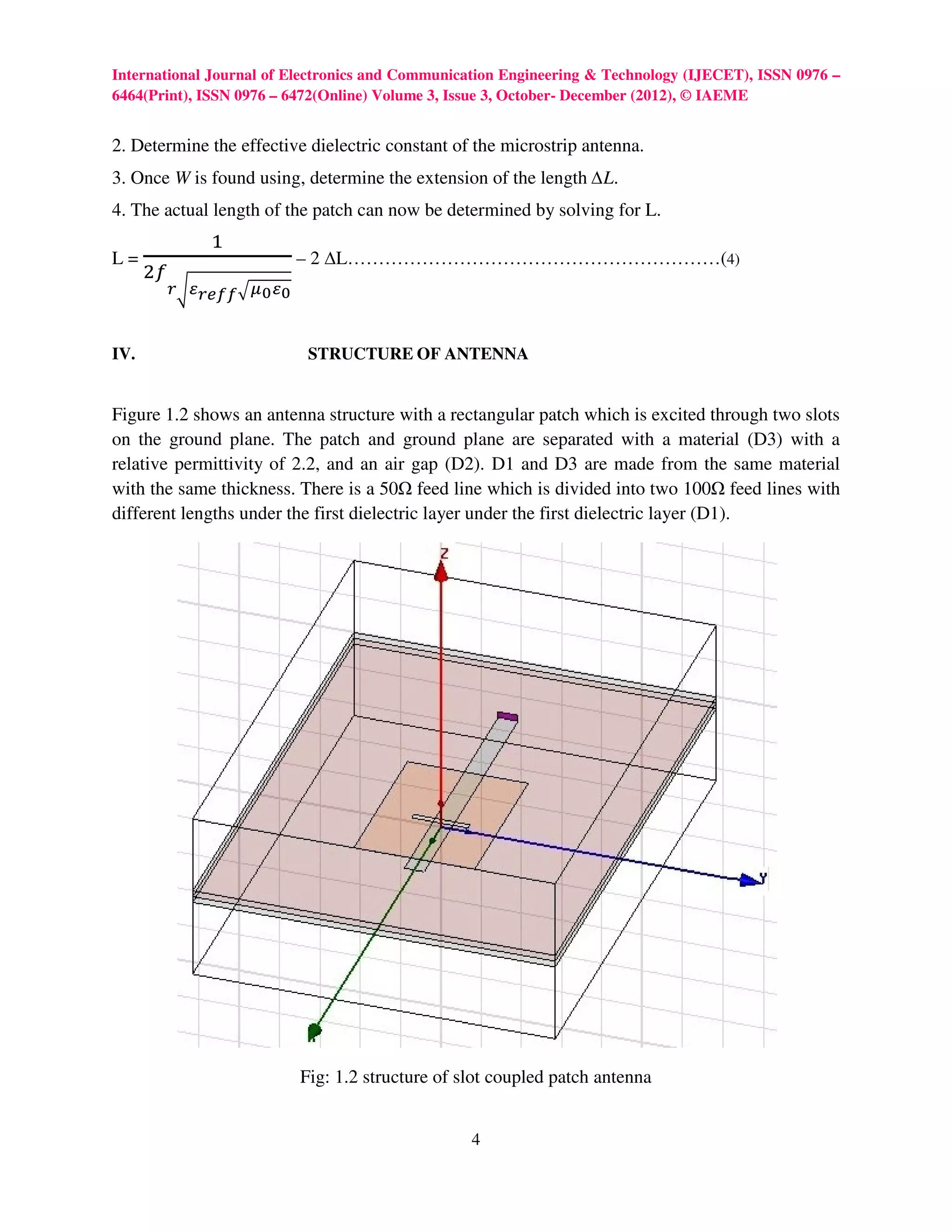
Figure 1.2 shows an antenna structure with a rectangular patch which is excited through two slots
on the ground plane. The patch and ground plane are separated with a material (D3) with a
relative permittivity of 2.2, and an air gap (D2). D1 and D3 are made from the same material
with the same thickness. There is a 50 feed line which is divided into two 100 feed lines with
different lengths under the first dielectric layer under the first dielectric layer (D1).


                            Fig: 1.2 structure of slot coupled patch antenna


                                                   4
International Journal of Electronics and Communication Engineering & Technology (IJECET), ISSN 0976 –
6464(Print), ISSN 0976 – 6472(Online) Volume 3, Issue 3, October- December (2012), © IAEME


V.                             Figures and Tables (RESULT)


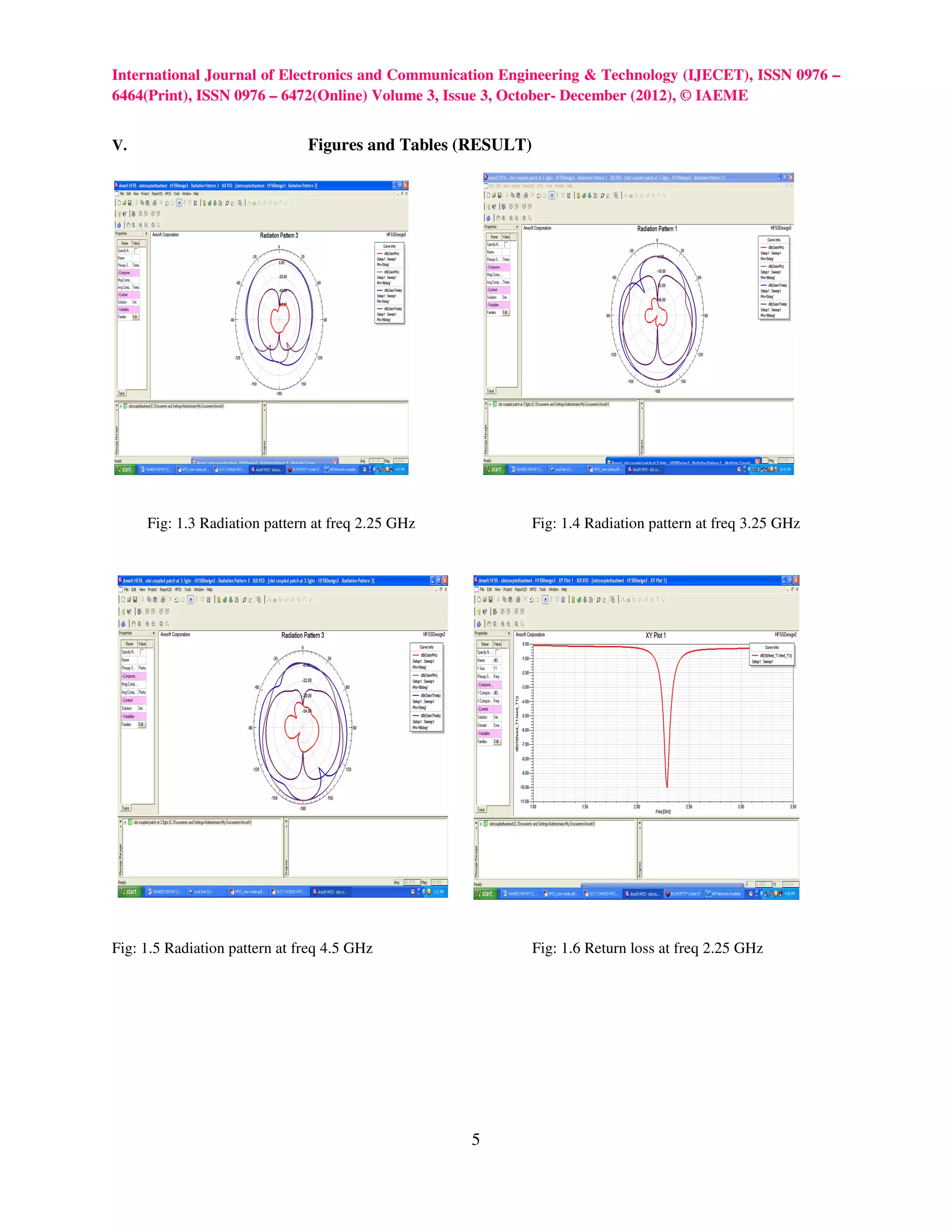
     Fig: 1.3 Radiation pattern at freq 2.25 GHz             Fig: 1.4 Radiation pattern at freq 3.25 GHz


Fig: 1.5 Radiation pattern at freq 4.5 GHz                   Fig: 1.6 Return loss at freq 2.25 GHz


                                                   5
International Journal of Electronics and Communication Engineering & Technology (IJECET), ISSN 0976 –
6464(Print), ISSN 0976 – 6472(Online) Volume 3, Issue 3, October- December (2012), © IAEME


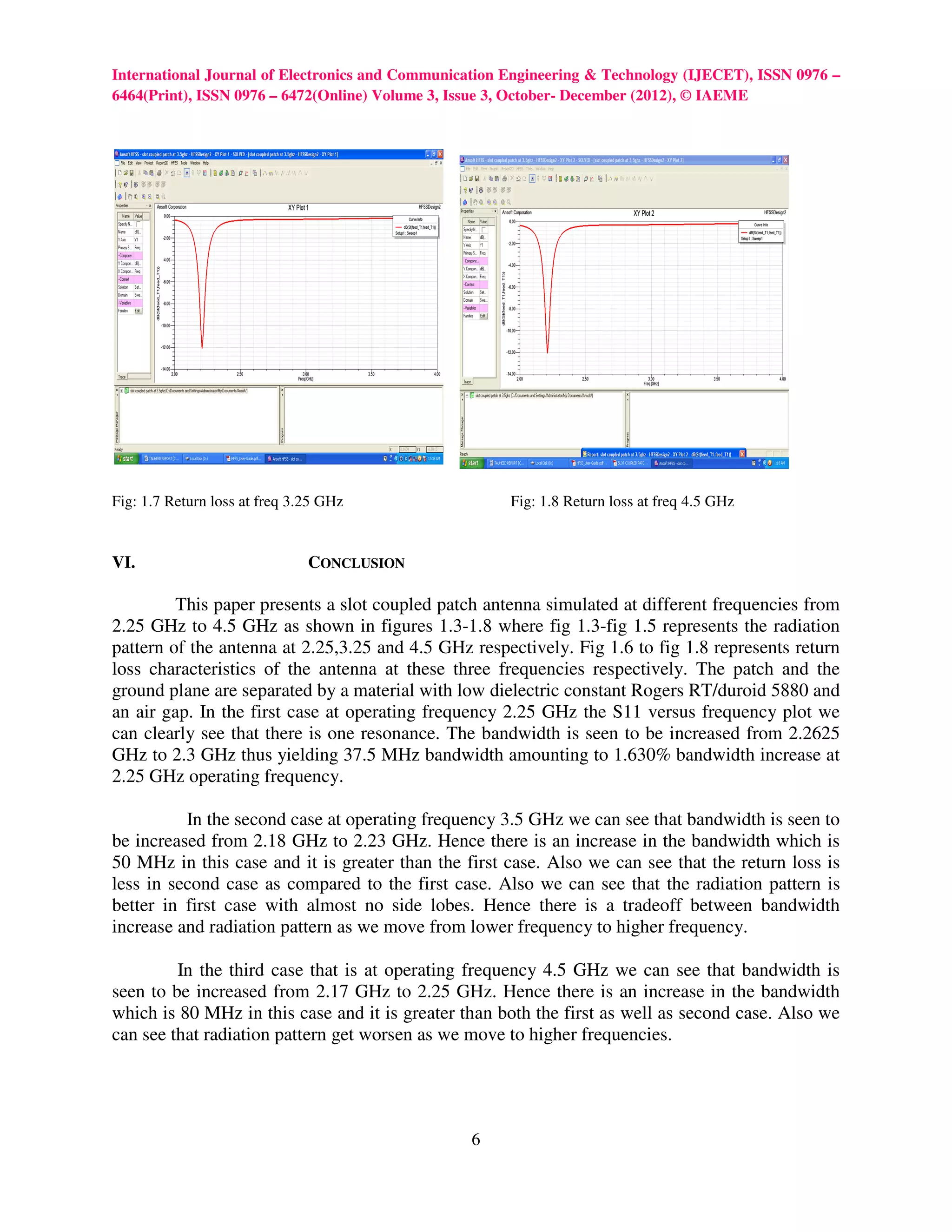
Fig: 1.7 Return loss at freq 3.25 GHz                  Fig: 1.8 Return loss at freq 4.5 GHz


VI.                            CONCLUSION

         This paper presents a slot coupled patch antenna simulated at different frequencies from
2.25 GHz to 4.5 GHz as shown in figures 1.3-1.8 where fig 1.3-fig 1.5 represents the radiation
pattern of the antenna at 2.25,3.25 and 4.5 GHz respectively. Fig 1.6 to fig 1.8 represents return
loss characteristics of the antenna at these three frequencies respectively. The patch and the
ground plane are separated by a material with low dielectric constant Rogers RT/duroid 5880 and
an air gap. In the first case at operating frequency 2.25 GHz the S11 versus frequency plot we
can clearly see that there is one resonance. The bandwidth is seen to be increased from 2.2625
GHz to 2.3 GHz thus yielding 37.5 MHz bandwidth amounting to 1.630% bandwidth increase at
2.25 GHz operating frequency.

          In the second case at operating frequency 3.5 GHz we can see that bandwidth is seen to
be increased from 2.18 GHz to 2.23 GHz. Hence there is an increase in the bandwidth which is
50 MHz in this case and it is greater than the first case. Also we can see that the return loss is
less in second case as compared to the first case. Also we can see that the radiation pattern is
better in first case with almost no side lobes. Hence there is a tradeoff between bandwidth
increase and radiation pattern as we move from lower frequency to higher frequency.

         In the third case that is at operating frequency 4.5 GHz we can see that bandwidth is
seen to be increased from 2.17 GHz to 2.25 GHz. Hence there is an increase in the bandwidth
which is 80 MHz in this case and it is greater than both the first as well as second case. Also we
can see that radiation pattern get worsen as we move to higher frequencies.


                                                 6
International Journal of Electronics and Communication Engineering & Technology (IJECET), ISSN 0976 –
6464(Print), ISSN 0976 – 6472(Online) Volume 3, Issue 3, October- December (2012), © IAEME


        Hence I would like to conclude that there is a tradeoff between frequency of operation
and increase in bandwidth and radiation loss. Bandwidth achieved at higher frequencies is high
but the problem is that the radiation loss is also high at higher frequencies.

        The structure designed was only a single cavity structure but to increase the bandwidth
further increase the number of resonant cavities in the structure which leads to other wide
banding techniques such as design with stacked patches, slots on ground plane.

REFERENCES


1. Ghassemi, N., M. H. Neshati, and J. Rashed-Mohassel, “Investigation of multilayer probe-fed
microstrip antenna for ultra wideband operation,” Proceeding of Asia Pacific Microwave
Conference (APMC 2007), 2135–2138, Bangkok, Thailand, Dec. 11–14, 2007.
2.Milligan, T. A., Modern Antenna Design, John Wiley & Sons, Hoboken, New Jersey, 2005.
3. Kumar, G. and K. P. Ray, Broadband Microstrip Antennas, Artech House, USA, 2003.
4.Wong, K. L., Compact and Broadband Microstrip Antenna, John Wiley & Sones, New York,
2002.
5. Garg, R., P. Bhartia, I. Bahl, and A. Ittipiboon, Microstrip Antenna Design Handbook, Artech
House, Boston, London, 2001.
6. M. P. Purchine and J. T. Aberle, “A Tunable L-Band Circular Microstrip Patch Antenna,”
Microwave Journal, pp. 80, 84, 87, and 88, October 1994.
7.D. M. Pozar, “Microstrip Antennas,” Proc. IEEE, Vol. 80, No. 1, pp. 79–81, January 1992.
8. S. B. De Assis Fonseca and A. J. Giarola, “Microstrip Disk Antennas, Part I: Efficiency of
Space Wave Launching,” IEEE Trans. Antennas Propagat., Vol. AP-32, No. 6, pp. 561–567,
June 1984.
9. S. B. De Assis Fonseca and A. J. Giarola, “Microstrip Disk Antennas, Part II: the Problem of
Surface Wave Radiation by Dielectric Truncation,” IEEE Trans. Antennas Propagat., Vol. AP-
32, No. 6, pp. 568–573, June 1984.
10. D. M. Pozar and D. H. Schaubert, “Scan Blindness in Infinite Phased Arrays of Printed
Dipoles,” IEEE Trans. Antennas Propagat., Vol. AP-32, No. 6, pp. 602–610, June 1984.
11. C. M. Krowne, “Cylindrical-Rectangular Microstrip Antenna,” IEEE Trans. Antennas
Propagat., Vol. AP-31, No. 1, pp. 194–199, January 1983
12. J. Huang, “The Finite Ground Plane Effect on the Microstrip Antenna Radiation Patterns,”
IEEE Trans. Antennas Propagat., Vol. AP-31, No. 7, pp. 649–653, July 1983.
13. I. Lier and K. R. Jakobsen, “Rectangular Microstrip Patch Antennas with Infinite and Finite
Ground-Plane Dimensions,” IEEE Trans. Antennas Propagat., Vol. AP-31, No. 6, pp. 978–984,
November 1983.


                                                 7

Simulation and analysis of slot coupled patch antenna

  • 1.
    International Journal ofElectronics and Communication Engineering AND COMMUNICATION0976 – INTERNATIONAL JOURNAL OF ELECTRONICS & Technology (IJECET), ISSN 6464(Print), ISSN 0976 – 6472(Online) Volume& Issue 3, October- December (2012), © IAEME ENGINEERING 3, TECHNOLOGY (IJECET) ISSN 0976 – 6464(Print) ISSN 0976 – 6472(Online) Volume 3, Issue 3, October- December (2012), pp. 01-07 IJECET © IAEME: www.iaeme.com/ijecet.html Journal Impact Factor (2012): 3.5930 (Calculated by GISI) ©IAEME www.jifactor.com SIMULATION AND ANALYSIS OF SLOT-COUPLED PATCH ANTENNA AT DIFFERENT FREQUENCIES USING HFSS Tauheed Qamar1, Naseem Halder2, Mohd. Gulman Siddiqui3, Vishal Varshney4 1,2,,3,4 (Department of Electronics and Communication Engineering Amity School of Engineering And Technology, Amity University, Noida, U.p, India 1 (muhammadtauheed20@gmail.com), 2(naseem.halder@yahoo.in), 3 (mohdgulman@gmail.com ) ,4(vishal.amity08@yahoo.co.in ) ABSTRACT Microstrip patch antennas are well suited for integration in too many applications owing to their conformal nature. There are many wide banding techniques used for the MSAs. But many wide banding techniques such as using slots in the patch require an inductive coupled feed. Aperture coupled feed which makes use of thick antenna substrates is the most convenient as it has only single ground plane. Apart from this aperture coupling provides a greater radiation pattern symmetry and greater ease of design for higher impedance band width owing to a large number of design parameters. In this type of feed by using multiple patches bandwidths up to 70% are reported. This paper presents a slot coupled microstrip antenna with a rectangular patch which is located on top of two slots on the ground plane. The patch and slots are separated by an air gap and a material with low dielectric constant. The reduction in return loss is achieved as we moved to the higher frequencies. The operational frequencies are taken as from 3 GHz to 5 GHz. The comparison of s parameter plot and radiation pattern plot is done in order to achieve a better design in terms of low return loss, improved radiation pattern etc. Keywords – Air gap, Aperture coupled, High bandwidth, MSA, Radiation pattern, Return loss & S-parameter. I. INTRODUCTION Microstrip antennas have several advantages like: low cost, easy fabrication and light weight. But they suffer from disadvantages like low gain and narrow impedance bandwidth [1-5]. In high-performance aircraft, spacecraft, satellite, and missile applications, where size, weight, cost, 1
  • 2.
    International Journal ofElectronics and Communication Engineering & Technology (IJECET), ISSN 0976 – 6464(Print), ISSN 0976 – 6472(Online) Volume 3, Issue 3, October- December (2012), © IAEME performance, ease of installation, and aerodynamic profile are constraints, and low-profile antennas may be required. Presently there are many other government and commercial applications, such as mobile radio and wireless communications that have similar specifications. To meet these requirements, microstrip antennas can be used [7]. These antennas are low profile, conformable to planar and non planar surfaces, simple and inexpensive to manufacture using modern printed-circuit technology, mechanically robust when mounted on rigid surfaces, compatible with MMIC designs, and when the particular patch shape and mode are selected, they are very versatile in terms of resonant frequency, polarization, pattern, and impedance [6]. In addition, by adding loads between the patch and the ground plane, such as pins and varactor diodes, adaptive elements with variable resonant frequency, impedance, polarization, and pattern can be designed. Major operational disadvantages of microstrip antennas are their low efficiency, low power, high Q (sometimes in excess of 100), poor polarization purity, poor scan performance, spurious feed radiation and very narrow frequency bandwidth, which is typically only a fraction of a percent or at most a few percent. In some applications, such as in government security systems, narrow bandwidths are desirable [7]. However, there are methods, such as increasing the height of the substrate that can be used to extend the efficiency (to as large as 90 percent if surface waves are not included) and bandwidth (up to about 35 percent). However, as the height increases, surface waves are introduced which usually are not desirable because they extract power from the total available for direct radiation (space waves). The surface waves travel within the substrate and they are scattered at bends and surface discontinuities, such as the truncation of the dielectric and ground plane [8 & 13], and degrade the antenna pattern and polarization characteristics. Surface waves can be eliminated, while maintaining large bandwidths, by using cavities. Stacking, as well as other methods, of microstrip elements can also be used to increase the bandwidth. In addition, microstrip antennas also exhibit large electromagnetic signatures at certain frequencies outside the operating band, are rather large physically at VHF and possibly UHF frequencies, and in large arrays there is a trade-off between bandwidth and scan volume. In order to achieve the higher bandwidth with improved radiation efficiency and reduced return loss, slot couple patch antenna is design in such a manner that it can easily overcome these problems [10]. II. RESEARCH METHODOLOGY The research methodology inculcates the designing of the slot couple patch antenna. This designed antenna structure is fed by using single coaxial probe feed. After feeding the antenna structure these designed antennas are further simulated over HFSS simulation software, a FET based simulation software. These simulations are continued till an optimum result is obtained. III. INDENTATIONS AND EQUATIONS (ANTENNA DESIGN): Because of the fringing effects, electrically the patch of the microstrip antenna looks greater than its physical dimensions. For the principal E-plane (xy-plane), this is demonstrated in Figure 1.1 where the dimensions of the patch along its length have been extended on each end by 2
  • 3.
    International Journal ofElectronics and Communication Engineering & Technology (IJECET), ISSN 0976 – 6464(Print), ISSN 0976 – 6472(Online) Volume 3, Issue 3, October- December (2012), © IAEME a distance ∆L, which is a function of the effective dielectric constant εreff and the width-to-height ratio (W/h). ∆L ∆L L W Figure: 1.1 Physical and effective lengths of rectangular microstrip patch. A very popular and practical approximate relation for the normalized extension of the length is given by the following expression: ∆L/h = 0.412 {(εreff+0.3)[(W/h)+0.264]/ (εreff+0.3)[(W/h)+0.264]}…….(1) Since the length of the patch has been extended by ∆L on each side, the effective length of the patch is now (L = λ/2 for dominant TM010 mode with no fringing) Leffe = L+2∆L……………………………………………..(2) Based on the simplified formulation that has been described, a design procedure is outlined which leads to practical designs of rectangular microstrip antennas. The procedure assumes that the specified information includes the dielectric constant of the substrate (εr), the resonant frequency (fr), and the height of the substrate h. The procedure is as follows: Specify: εr, fr (in Hz), and h. Determine: W, L Design Equations: 1. For an efficient radiator, a practical width that leads to good radiation efficiencies is W = ( 1/(2frඥߤ଴ ߝ଴ )ඥ2/(ߝ௥ + 1) = (‫ݒ‬଴ /2݂௥ ) ඥ2/(ߝ௥ + 1) ............................(3) Where vo is the free-space velocity of light. 3
  • 4.
    International Journal ofElectronics and Communication Engineering & Technology (IJECET), ISSN 0976 – 6464(Print), ISSN 0976 – 6472(Online) Volume 3, Issue 3, October- December (2012), © IAEME 2. Determine the effective dielectric constant of the microstrip antenna. 3. Once W is found using, determine the extension of the length ∆L. 4. The actual length of the patch can now be determined by solving for L. ଵ ଶ௙ L= – 2 ∆L……………………………………………………(4) ೝටഄೝ೐೑೑ ඥഋబ ഄబ IV. STRUCTURE OF ANTENNA Figure 1.2 shows an antenna structure with a rectangular patch which is excited through two slots on the ground plane. The patch and ground plane are separated with a material (D3) with a relative permittivity of 2.2, and an air gap (D2). D1 and D3 are made from the same material with the same thickness. There is a 50 feed line which is divided into two 100 feed lines with different lengths under the first dielectric layer under the first dielectric layer (D1). Fig: 1.2 structure of slot coupled patch antenna 4
  • 5.
    International Journal ofElectronics and Communication Engineering & Technology (IJECET), ISSN 0976 – 6464(Print), ISSN 0976 – 6472(Online) Volume 3, Issue 3, October- December (2012), © IAEME V. Figures and Tables (RESULT) Fig: 1.3 Radiation pattern at freq 2.25 GHz Fig: 1.4 Radiation pattern at freq 3.25 GHz Fig: 1.5 Radiation pattern at freq 4.5 GHz Fig: 1.6 Return loss at freq 2.25 GHz 5
  • 6.
    International Journal ofElectronics and Communication Engineering & Technology (IJECET), ISSN 0976 – 6464(Print), ISSN 0976 – 6472(Online) Volume 3, Issue 3, October- December (2012), © IAEME Fig: 1.7 Return loss at freq 3.25 GHz Fig: 1.8 Return loss at freq 4.5 GHz VI. CONCLUSION This paper presents a slot coupled patch antenna simulated at different frequencies from 2.25 GHz to 4.5 GHz as shown in figures 1.3-1.8 where fig 1.3-fig 1.5 represents the radiation pattern of the antenna at 2.25,3.25 and 4.5 GHz respectively. Fig 1.6 to fig 1.8 represents return loss characteristics of the antenna at these three frequencies respectively. The patch and the ground plane are separated by a material with low dielectric constant Rogers RT/duroid 5880 and an air gap. In the first case at operating frequency 2.25 GHz the S11 versus frequency plot we can clearly see that there is one resonance. The bandwidth is seen to be increased from 2.2625 GHz to 2.3 GHz thus yielding 37.5 MHz bandwidth amounting to 1.630% bandwidth increase at 2.25 GHz operating frequency. In the second case at operating frequency 3.5 GHz we can see that bandwidth is seen to be increased from 2.18 GHz to 2.23 GHz. Hence there is an increase in the bandwidth which is 50 MHz in this case and it is greater than the first case. Also we can see that the return loss is less in second case as compared to the first case. Also we can see that the radiation pattern is better in first case with almost no side lobes. Hence there is a tradeoff between bandwidth increase and radiation pattern as we move from lower frequency to higher frequency. In the third case that is at operating frequency 4.5 GHz we can see that bandwidth is seen to be increased from 2.17 GHz to 2.25 GHz. Hence there is an increase in the bandwidth which is 80 MHz in this case and it is greater than both the first as well as second case. Also we can see that radiation pattern get worsen as we move to higher frequencies. 6
  • 7.
    International Journal ofElectronics and Communication Engineering & Technology (IJECET), ISSN 0976 – 6464(Print), ISSN 0976 – 6472(Online) Volume 3, Issue 3, October- December (2012), © IAEME Hence I would like to conclude that there is a tradeoff between frequency of operation and increase in bandwidth and radiation loss. Bandwidth achieved at higher frequencies is high but the problem is that the radiation loss is also high at higher frequencies. The structure designed was only a single cavity structure but to increase the bandwidth further increase the number of resonant cavities in the structure which leads to other wide banding techniques such as design with stacked patches, slots on ground plane. REFERENCES 1. Ghassemi, N., M. H. Neshati, and J. Rashed-Mohassel, “Investigation of multilayer probe-fed microstrip antenna for ultra wideband operation,” Proceeding of Asia Pacific Microwave Conference (APMC 2007), 2135–2138, Bangkok, Thailand, Dec. 11–14, 2007. 2.Milligan, T. A., Modern Antenna Design, John Wiley & Sons, Hoboken, New Jersey, 2005. 3. Kumar, G. and K. P. Ray, Broadband Microstrip Antennas, Artech House, USA, 2003. 4.Wong, K. L., Compact and Broadband Microstrip Antenna, John Wiley & Sones, New York, 2002. 5. Garg, R., P. Bhartia, I. Bahl, and A. Ittipiboon, Microstrip Antenna Design Handbook, Artech House, Boston, London, 2001. 6. M. P. Purchine and J. T. Aberle, “A Tunable L-Band Circular Microstrip Patch Antenna,” Microwave Journal, pp. 80, 84, 87, and 88, October 1994. 7.D. M. Pozar, “Microstrip Antennas,” Proc. IEEE, Vol. 80, No. 1, pp. 79–81, January 1992. 8. S. B. De Assis Fonseca and A. J. Giarola, “Microstrip Disk Antennas, Part I: Efficiency of Space Wave Launching,” IEEE Trans. Antennas Propagat., Vol. AP-32, No. 6, pp. 561–567, June 1984. 9. S. B. De Assis Fonseca and A. J. Giarola, “Microstrip Disk Antennas, Part II: the Problem of Surface Wave Radiation by Dielectric Truncation,” IEEE Trans. Antennas Propagat., Vol. AP- 32, No. 6, pp. 568–573, June 1984. 10. D. M. Pozar and D. H. Schaubert, “Scan Blindness in Infinite Phased Arrays of Printed Dipoles,” IEEE Trans. Antennas Propagat., Vol. AP-32, No. 6, pp. 602–610, June 1984. 11. C. M. Krowne, “Cylindrical-Rectangular Microstrip Antenna,” IEEE Trans. Antennas Propagat., Vol. AP-31, No. 1, pp. 194–199, January 1983 12. J. Huang, “The Finite Ground Plane Effect on the Microstrip Antenna Radiation Patterns,” IEEE Trans. Antennas Propagat., Vol. AP-31, No. 7, pp. 649–653, July 1983. 13. I. Lier and K. R. Jakobsen, “Rectangular Microstrip Patch Antennas with Infinite and Finite Ground-Plane Dimensions,” IEEE Trans. Antennas Propagat., Vol. AP-31, No. 6, pp. 978–984, November 1983. 7