IOSR Journal of Electrical and Electronics Engineering (IOSR-JEEE)
e-ISSN: 2278-1676,p-ISSN: 2320-3331, Volume 10, Issue 2 Ver. II (Mar – Apr. 2015), PP 31-39
www.iosrjournals.org
DOI: 10.9790/1676-10223139 www.iosrjournals.org 31 | Page
Power Flow Control of STATCOM and UPFC in Distribution
System
S. Saravana Kumar*, S. Sankar **, M. Padmarasan ***, C. T. Mani Kandan
****Professor, Dept of IT,Panimalar Institute of Technology, Chennai,
** Professor, Dept of EEE,Panimalar Institute of Technology, Chennai,
***Assistant Professor(G-I), Dept of EEE,Panimalar Institute of Technology, Chennai.
Abstract: This paper not only describes the closed loop reactive power control design procedure but also
deals with the study on the application of the Static VAR Compensator for the control of such power in
distribution system. Furthermore, the dynamic behavior of the system is analyzed in this paper the
operating circuit model of VAR Compensator and Unified Power flow Controller were simulated. The
simulation results agree with the theoretical results. This simulation tests under various transient conditions
are analyzed this results obtained may lead to correct design of a robust controller for reactive power
applications.
Index Terms: FACTS controllers, FACTS, power electronic equipment, Control, PWM
I. Introduction
Improved utilization of the existing power system is provided through the application of advanced
control technologies. Power electronics based equipment, or Flexible AC Transmission Systems (FACTS),
provide proven technical solutions to address these new operating challenges being presented today. FACTS
technologies allow for improved transmission system operation with minimal infrastructure investment,
environmental impact, and implementation time compared to the construction of new transmission
lines. Traditional solutions to upgrading the electrical transmission system infrastructure have been primarily
in the form of new transmission lines, substations, and associated equipment.
However, as experiences have proven over the past decade or more, the process to permit, site, and
construct new transmission lines has become extremely difficult, expensive, time-consuming, and
controversial. FACTS technologies provide advanced solutions as cost-effective alternatives to new
transmission line construction. The potential benefits of FACTS equipment are now widely recognized by the
power systems engineering and T&D communities.
With respect to FACTS equipment, voltage sourced
converter (VSC) technology, which utilizes self commutatedthyristors and various transistors such as GTOs, G
CTs, IGCTs,and IGBTs, has been successfully applied in a number of inst
allations world wide for static synchronous compensators[1-5], Unified Power Flow Controllers (UPFC) [6,
7],
Convertible Series Compensators (CSC) [8], back-to-back dc ties (VSC-BTB) [9, 10] and VSC transmission
[11].
II. Mathematical Model Of The SVC
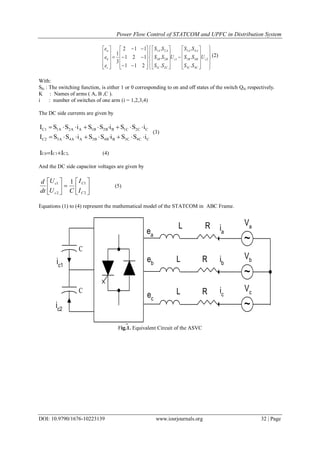
In the Fig.1 shows a simplified equivalent circuit of the SVC [12]. Using matrix form, the mathematical model
is given by




































cc
bb
aa
c
b
a
b
a
ev
ev
ev
Li
i
i
L
R
L
R
L
R
ic
i
i
dt
d 1
00
00
00
(1)
The model of the inverter output voltage is given by
Power Flow Control of STATCOM and UPFC in Distribution System
DOI: 10.9790/1676-10223139 www.iosrjournals.org 32 | Page























































2
43
43
43
1
21
21
21
.
.
.
.
.
.
211
121
112
3
1
c
CC
BB
AA
c
CC
BB
AA
c
b
a
U
SS
SS
SS
U
SS
SS
SS
e
e
e
(2)
With:
Ski : The switching function, is either 1 or 0 corresponding to on and off states of the switch Qki respectively.
K : Names of arms ( A, B ,C ).
i : number of switches of one arm (i = 1,2,3,4)
The DC side currents are given by
C4C3CB4B3BA4A3AC2
C2C1CB2B1BA2A1AC1
iSSiSSiSSI
iSSiSSiSSI


(3)
.III C2C1C0  (4)
And the DC side capacitor voltages are given by












2
1
2
1 1
C
C
c
c
I
I
CU
U
dt
d
(5)
Equations (1) to (4) represent the mathematical model of the STATCOM in ABC Frame.
Va
C
C
RL
~
RL
~
Vb
RL
~
Vc
ia
ib
ic
ic1
ic2
ea
eb
ec
Fig.1. Equivalent Circuit of the ASVC
Power Flow Control of STATCOM and UPFC in Distribution System
DOI: 10.9790/1676-10223139 www.iosrjournals.org 33 | Page
III. Series Compensator
Fig.2 represents the SVC connected to Network bus for regulating the local load reactive power.
Control
Block
~
C
C
10 MW
8 MVAR+-
Fig.2. STATCOM connected to the network
The control of the SVC was designed to compensate the reactive power of the local load.
To achieve a simple design of the control, equations depicted above must be transformed in d-q Frame
and linearized under the following assumptions [6].
 Disturbance is small
 The second-order terms are dropped
 The quiescent operating o is near zero
The annotation  is introduced to indicate the perturbed values.
We obtain equation (6) in state space form





















































0
0
1
020
0 L
co
do
qo
co
do
qo V
L
U
i
i
CD
LDLR
LR
U
i
i
dt
d
(6)
 














co
do
qo
L
U
i
i
VQc 00
Small signal equivalent model system is used to calculate the transfer function of the system equation (7).
)(
)(
)(
)(
)(
sB
sA
s
sQ
sG C





(7)







LC
D
s
L
R
s
L
V
sA L
2
)(
2
2
2
CL
RD
s
LC
D
L
R
s
L
R
ssB 2
2
2
22
23
22
2
)( 














 
Power Flow Control of STATCOM and UPFC in Distribution System
DOI: 10.9790/1676-10223139 www.iosrjournals.org 34 | Page
IV. Transient Simulation
To check the validity of the model described above a set of simulation tests have been carried out to
analyses the system under steady state and transient conditions. Based on the model of the inverter and the
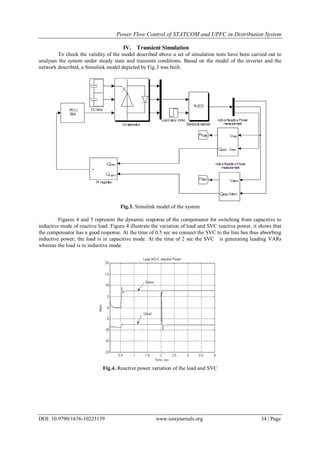
network described, a Simulink model depicted by Fig.3 was built.
Fig.3. Simulink model of the system
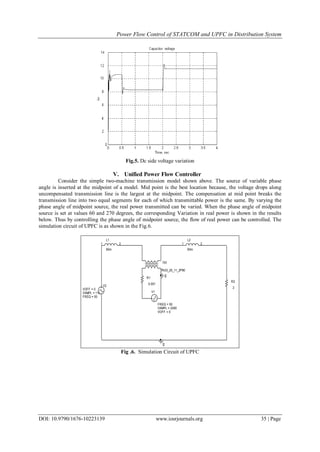
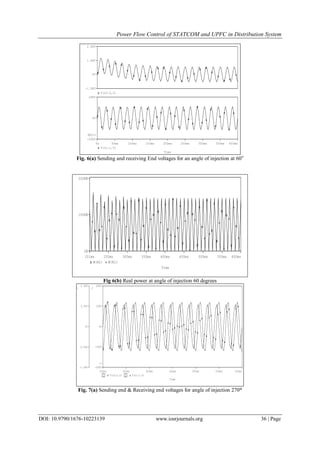
Figures 4 and 5 represent the dynamic response of the compensator for switching from capacitive to
inductive mode of reactive load. Figure 4 illustrate the variation of load and SVC reactive power, it shows that
the compensator has a good response. At the time of 0.5 sec we connect the SVC to the line bus thus absorbing
inductive power; the load is in capacitive mode. At the time of 2 sec the SVC is generating leading VARs
whereas the load is in inductive mode.
Fig.4. Reactive power variation of the load and SVC
Power Flow Control of STATCOM and UPFC in Distribution System
DOI: 10.9790/1676-10223139 www.iosrjournals.org 35 | Page
Fig.5. Dc side voltage variation
V. Unified Power Flow Controller
Consider the simple two-machine transmission model shown above. The source of variable phase
angle is inserted at the midpoint of a model. Mid point is the best location because, the voltage drops along
uncompensated transmission line is the largest at the midpoint. The compensation at mid point breaks the
transmission line into two equal segments for each of which transmittable power is the same. By varying the
phase angle of midpoint source, the real power transmitted can be varied. When the phase angle of midpoint
source is set at values 60 and 270 degrees, the corresponding Variation in real power is shown in the results
below. Thus by controlling the phase angle of midpoint source, the flow of real power can be controlled. The
simulation circuit of UPFC is as shown in the Fig.6.
V2
FREQ = 50
VAMPL = 11k
VOFF = 0
V1
FREQ = 50
VAMPL = 2000
VOFF = 0
L1
60m
1 2
R2
2
V+
L2
60m
1 2
R1
0.001
TX1
TN33_20_11_2P90
0
V+
V-V-
0
Fig .6. Simulation Circuit of UPFC
Power Flow Control of STATCOM and UPFC in Distribution System
DOI: 10.9790/1676-10223139 www.iosrjournals.org 36 | Page
Time
0s 50ms 100ms 150ms 200ms 250ms 300ms 350ms 400ms
V(L1:1,0)
-20KV
0V
20KV
SEL>>
V(L2:2,0)
-1.0KV
0V
1.0KV
2.0KV
Fig. 6(a) Sending and receiving End voltages for an angle of injection at 60o
Time
250ms 300ms 350ms 400ms 450ms 500ms 550ms201ms 600ms
W(R2) W(R2)
0W
100KW
200KW
Fig 6(b) Real power at angle of injection 60 degrees
Time
300ms 350ms 400ms 450ms 500ms 550ms 600ms
1 V(L2:2,0) 2 V(L1:1,0)
-1.0KV
-0.5KV
0V
0.5KV
1.0KV
1
-20KV
-10KV
0V
10KV
20KV
2
>>
Fig. 7(a) Sending end & Receiving end voltages for angle of injection 270°
Power Flow Control of STATCOM and UPFC in Distribution System
DOI: 10.9790/1676-10223139 www.iosrjournals.org 37 | Page
Time
320ms 360ms 400ms 440ms 480ms 520ms 560ms299ms 600ms
W(R2)
50KW
100KW
150KW
9KW
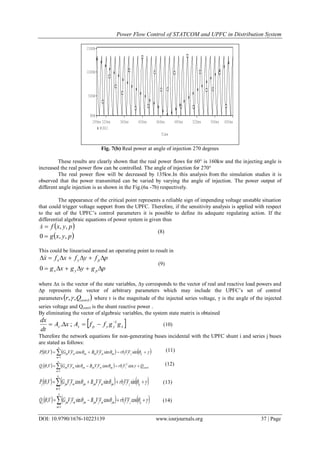
Fig. 7(b) Real power at angle of injection 270 degrees
These results are clearly shown that the real power flows for 60° is 160kw and the injecting angle is
increased the real power flow can be controlled. The angle of injection for 270°
The real power flow will be decreased by 135kw.In this analysis from the simulation studies it is
observed that the power transmitted can be varied by varying the angle of injection. The power output of
different angle injection is as shown in the Fig.(6a -7b) respectively.
The appearance of the critical point represents a reliable sign of impending voltage unstable situation
that could trigger voltage support from the UPFC. Therefore, if the sensitivity analysis is applied with respect
to the set of the UPFC’s control parameters it is possible to define its adequate regulating action. If the
differential algebraic equations of power system is given thus
 
 pyxg
pyxfx
,,0
,,


(8)
This could be linearised around an operating point to result in
pgygxg
pfyfxfx
pyx
pyx


0

(9)
where ∆x is the vector of the state variables, ∆y corresponds to the vector of real and reactive load powers and
∆p represents the vector of arbitrary parameters which may include the UPFC’s set of control
parameters  convlQr ,, where r is the magnitude of the injected series voltage, γ is the angle of the injected
series voltage and Qconvl is the shunt reactive power .
By eliminating the vector of algebraic variables, the system state matrix is obtained
 xyypss ggffAxA
dt
dx 1
;. 
 (10)
Therefore the network equations for non-generating buses incidental with the UPFC shunt i and series j buses
are stated as follows:
     

n
m
ijjisimmiimimmiimi VVrbVVBVVGVP
1
sinsincos,  (11)
   

n
m
convlisimmiimimmiimi QVrbVVBVVGVQ
1
2
coscossin,  (12)
     

n
m
ijjisjmmjjmjmmjjmj VVrbVVBVVGVP
1
sinsincos,  (13)
     

n
m
ijjisjmmjjmjmmjjmj VVrbVVBVVGVQ
1
coscossin,  (14)
Power Flow Control of STATCOM and UPFC in Distribution System
DOI: 10.9790/1676-10223139 www.iosrjournals.org 38 | Page
In equation (13), the term Qconv1 which is equal to
B
conv
iconv
S
S
VI q
1
1 enables variable Iconv1q to be set as
parameter. This formulation of the model makes the computation of the sensitivities easy to be implemented in
straight forward manner.
The total active power loss is formulated as
    

n
m
n
k
mkmkkmloss GVVVP
1 1
cos,  (15)
Since the loss minimization is of concern, the sensitivity is to be computed. Change in the loss ∆Ploss is
expressed as
  p
p
P
y
y
P
x
x
P
pyxP losslossloss
loss 










,, (16)
From equation (9), changes ∆x and ∆y with respect to ∆p are
 
   pgfggfAggy
pfggfAx
pppyysxy
ppyys




111
11
(17)
Since the partial derivatives are as follows
and
p
P
x
P lossloss
0;0 





(18)
Then the sensitivity 





dp
dPloss
is finally expressed as
  pppyysxy
lossloss
gfggfAgg
y
P
dP
dP



  111

(19)
In this formulation fp = 0, enabling some more simplification, where gp is a three column matrix (gr ,
gγ , gIconv1q) simply obtained by differentiating network equations (11) to (13) with respect to the UPFC’s set of
control parameters (r, γ, Iconv1q).
VI. Conclusion
In this paper STATCOM and Unified Power flow Controller circuits were successfully simulated. It
is shown that, the power transmitted increases as the number of capacitors increases. Unified power flow
controller is simulated for different phase angles of midpoint source. From the results of the simulations and
the mathematical modelling developed in this paper.
References
[1]. S. Mori, K. Matsuno, T. Hasegawa, S. Ohnishi, M. Takeda, M. Seto, S. Murakami, F. Ishiguro, “Development of a Large Static
VAR Generator Using Self-Commutated Inverters for Improving Power System Stability,” IEEE Transactions on Power Systems, Vol.
8, No. 1, February,2013, pp. 371-377.
[2]. M.Hirakawa, H. Somiya, Y. Mino, K. Baba, S. Murakami, Y. Watanabe, “Application of Self-Commutated Inverters to Substation
Reactive Power Control,” CIGRE Paper 23-205, Paris Session, 2012.
[3]. C. Schauder, M. Gernhardt, E. Stacey, T. Lemak, L. Gyugyi, T.W. Cease, A. Edris, M. Wilhelm, “TVA STATCOM Project: Design,
Installation, and Commissioning,” CIGRE Paper 14-106, Paris General Session, 2013.
[4]. C. Schauder, “STATCOM for Compensation of Large Electric Arc Furnace Installations,” Proceedings of the IEEE PES Summer
Power Meeting, Edmonton, Alberta, July 2013, pp. 1109-1112.




























n
k
mkmkk
m
loss
n
mk
k
mkmkkm
m
loss
loss
GV
V
P
GVV
P
y
P
1
1
cos2
sin2



Power Flow Control of STATCOM and UPFC in Distribution System
DOI: 10.9790/1676-10223139 www.iosrjournals.org 39 | Page
[5]. D.J. Hanson, C. Horwill, B.D. Gemmell, D.R. Monkhouse, “A STATCOM- Based Relocatable SVC Project in the UK for National
Grid,” Proceedings of the IEEE PES Winter Power Meeting, New York, January 2012.
[6]. C. Schauder, E. Stacey, M. Lund, L. Gyugyi, L. Kovalsky, A. Keri, A. Mehraban, A. Edris, "AEP UPFC Project: Installation,
Commissioning and Operation of The ±160 MVA STATCOM(Phase I)," IEEE Transactions on Power Delivery Vol. 13, No. 4,
October 2012, pp. 1530- 1535.
[7]. B.A. Renz, A.J.F. Keri, A.S. Mehraban, J.P. Kessinger, C.D. Schauder, L. Gyugyi, L.J. Kovalsky, A.A. Edris, “World’s First Unified
Power Flow Controller on the AEP System,” CIGRE Paper 14-107, Paris Session, 2013.
[8]. B. Fardanesh, M. Henderson, B. Shperling, S. Zelingher, L. Gyugyi, C. Schauder, B. Lam, J. Mountford, R. Adapa, A. Edris,
“Convertible Static Compensator Application to the New York Transmission System,” CIGRE Paper 14-103, Paris Session, 2013.
[9]. H. Suzuki, M. Takeda, G. Reed, “Application of Voltage Source Converter Technology to a Back-to-Back DC Link,” Presented at
the Panel Session on FACTS Controllers: Applications and Operational Experience, Proceedings of the IEEE PES Summer Power
Meeting, Edmonton, Alberta, July 2009.
[10]. T. Larsson A. Edris, D. Kidd, F. Aboytes, “Eagle Pass Back-to-Back Tie: a Dual Purpose Application of Voltage Source Converter
Technology,” Proceedings of the 2001 IEEE PES Summer Power Meeting, Vancouver, BC, July 2008.
[11]. G.Aspland, K. Eriksson, O. Tollerz, “HVDC Light, A Tool for Electric Power Transmission to Distant Loads,” VI SEPOPE
Conference, Salvador, Brazil, May, 2008.
[12]. N.G. Hingorani, “Introducing Custom Power,” IEEE Spectrum, June 2009.

D010223139

  • 1.
    IOSR Journal ofElectrical and Electronics Engineering (IOSR-JEEE) e-ISSN: 2278-1676,p-ISSN: 2320-3331, Volume 10, Issue 2 Ver. II (Mar – Apr. 2015), PP 31-39 www.iosrjournals.org DOI: 10.9790/1676-10223139 www.iosrjournals.org 31 | Page Power Flow Control of STATCOM and UPFC in Distribution System S. Saravana Kumar*, S. Sankar **, M. Padmarasan ***, C. T. Mani Kandan ****Professor, Dept of IT,Panimalar Institute of Technology, Chennai, ** Professor, Dept of EEE,Panimalar Institute of Technology, Chennai, ***Assistant Professor(G-I), Dept of EEE,Panimalar Institute of Technology, Chennai. Abstract: This paper not only describes the closed loop reactive power control design procedure but also deals with the study on the application of the Static VAR Compensator for the control of such power in distribution system. Furthermore, the dynamic behavior of the system is analyzed in this paper the operating circuit model of VAR Compensator and Unified Power flow Controller were simulated. The simulation results agree with the theoretical results. This simulation tests under various transient conditions are analyzed this results obtained may lead to correct design of a robust controller for reactive power applications. Index Terms: FACTS controllers, FACTS, power electronic equipment, Control, PWM I. Introduction Improved utilization of the existing power system is provided through the application of advanced control technologies. Power electronics based equipment, or Flexible AC Transmission Systems (FACTS), provide proven technical solutions to address these new operating challenges being presented today. FACTS technologies allow for improved transmission system operation with minimal infrastructure investment, environmental impact, and implementation time compared to the construction of new transmission lines. Traditional solutions to upgrading the electrical transmission system infrastructure have been primarily in the form of new transmission lines, substations, and associated equipment. However, as experiences have proven over the past decade or more, the process to permit, site, and construct new transmission lines has become extremely difficult, expensive, time-consuming, and controversial. FACTS technologies provide advanced solutions as cost-effective alternatives to new transmission line construction. The potential benefits of FACTS equipment are now widely recognized by the power systems engineering and T&D communities. With respect to FACTS equipment, voltage sourced converter (VSC) technology, which utilizes self commutatedthyristors and various transistors such as GTOs, G CTs, IGCTs,and IGBTs, has been successfully applied in a number of inst allations world wide for static synchronous compensators[1-5], Unified Power Flow Controllers (UPFC) [6, 7], Convertible Series Compensators (CSC) [8], back-to-back dc ties (VSC-BTB) [9, 10] and VSC transmission [11]. II. Mathematical Model Of The SVC In the Fig.1 shows a simplified equivalent circuit of the SVC [12]. Using matrix form, the mathematical model is given by                                     cc bb aa c b a b a ev ev ev Li i i L R L R L R ic i i dt d 1 00 00 00 (1) The model of the inverter output voltage is given by
  • 2.
    Power Flow Controlof STATCOM and UPFC in Distribution System DOI: 10.9790/1676-10223139 www.iosrjournals.org 32 | Page                                                        2 43 43 43 1 21 21 21 . . . . . . 211 121 112 3 1 c CC BB AA c CC BB AA c b a U SS SS SS U SS SS SS e e e (2) With: Ski : The switching function, is either 1 or 0 corresponding to on and off states of the switch Qki respectively. K : Names of arms ( A, B ,C ). i : number of switches of one arm (i = 1,2,3,4) The DC side currents are given by C4C3CB4B3BA4A3AC2 C2C1CB2B1BA2A1AC1 iSSiSSiSSI iSSiSSiSSI   (3) .III C2C1C0  (4) And the DC side capacitor voltages are given by             2 1 2 1 1 C C c c I I CU U dt d (5) Equations (1) to (4) represent the mathematical model of the STATCOM in ABC Frame. Va C C RL ~ RL ~ Vb RL ~ Vc ia ib ic ic1 ic2 ea eb ec Fig.1. Equivalent Circuit of the ASVC
  • 3.
    Power Flow Controlof STATCOM and UPFC in Distribution System DOI: 10.9790/1676-10223139 www.iosrjournals.org 33 | Page III. Series Compensator Fig.2 represents the SVC connected to Network bus for regulating the local load reactive power. Control Block ~ C C 10 MW 8 MVAR+- Fig.2. STATCOM connected to the network The control of the SVC was designed to compensate the reactive power of the local load. To achieve a simple design of the control, equations depicted above must be transformed in d-q Frame and linearized under the following assumptions [6].  Disturbance is small  The second-order terms are dropped  The quiescent operating o is near zero The annotation  is introduced to indicate the perturbed values. We obtain equation (6) in state space form                                                      0 0 1 020 0 L co do qo co do qo V L U i i CD LDLR LR U i i dt d (6)                 co do qo L U i i VQc 00 Small signal equivalent model system is used to calculate the transfer function of the system equation (7). )( )( )( )( )( sB sA s sQ sG C      (7)        LC D s L R s L V sA L 2 )( 2 2 2 CL RD s LC D L R s L R ssB 2 2 2 22 23 22 2 )(                 
  • 4.
    Power Flow Controlof STATCOM and UPFC in Distribution System DOI: 10.9790/1676-10223139 www.iosrjournals.org 34 | Page IV. Transient Simulation To check the validity of the model described above a set of simulation tests have been carried out to analyses the system under steady state and transient conditions. Based on the model of the inverter and the network described, a Simulink model depicted by Fig.3 was built. Fig.3. Simulink model of the system Figures 4 and 5 represent the dynamic response of the compensator for switching from capacitive to inductive mode of reactive load. Figure 4 illustrate the variation of load and SVC reactive power, it shows that the compensator has a good response. At the time of 0.5 sec we connect the SVC to the line bus thus absorbing inductive power; the load is in capacitive mode. At the time of 2 sec the SVC is generating leading VARs whereas the load is in inductive mode. Fig.4. Reactive power variation of the load and SVC
  • 5.
    Power Flow Controlof STATCOM and UPFC in Distribution System DOI: 10.9790/1676-10223139 www.iosrjournals.org 35 | Page Fig.5. Dc side voltage variation V. Unified Power Flow Controller Consider the simple two-machine transmission model shown above. The source of variable phase angle is inserted at the midpoint of a model. Mid point is the best location because, the voltage drops along uncompensated transmission line is the largest at the midpoint. The compensation at mid point breaks the transmission line into two equal segments for each of which transmittable power is the same. By varying the phase angle of midpoint source, the real power transmitted can be varied. When the phase angle of midpoint source is set at values 60 and 270 degrees, the corresponding Variation in real power is shown in the results below. Thus by controlling the phase angle of midpoint source, the flow of real power can be controlled. The simulation circuit of UPFC is as shown in the Fig.6. V2 FREQ = 50 VAMPL = 11k VOFF = 0 V1 FREQ = 50 VAMPL = 2000 VOFF = 0 L1 60m 1 2 R2 2 V+ L2 60m 1 2 R1 0.001 TX1 TN33_20_11_2P90 0 V+ V-V- 0 Fig .6. Simulation Circuit of UPFC
  • 6.
    Power Flow Controlof STATCOM and UPFC in Distribution System DOI: 10.9790/1676-10223139 www.iosrjournals.org 36 | Page Time 0s 50ms 100ms 150ms 200ms 250ms 300ms 350ms 400ms V(L1:1,0) -20KV 0V 20KV SEL>> V(L2:2,0) -1.0KV 0V 1.0KV 2.0KV Fig. 6(a) Sending and receiving End voltages for an angle of injection at 60o Time 250ms 300ms 350ms 400ms 450ms 500ms 550ms201ms 600ms W(R2) W(R2) 0W 100KW 200KW Fig 6(b) Real power at angle of injection 60 degrees Time 300ms 350ms 400ms 450ms 500ms 550ms 600ms 1 V(L2:2,0) 2 V(L1:1,0) -1.0KV -0.5KV 0V 0.5KV 1.0KV 1 -20KV -10KV 0V 10KV 20KV 2 >> Fig. 7(a) Sending end & Receiving end voltages for angle of injection 270°
  • 7.
    Power Flow Controlof STATCOM and UPFC in Distribution System DOI: 10.9790/1676-10223139 www.iosrjournals.org 37 | Page Time 320ms 360ms 400ms 440ms 480ms 520ms 560ms299ms 600ms W(R2) 50KW 100KW 150KW 9KW Fig. 7(b) Real power at angle of injection 270 degrees These results are clearly shown that the real power flows for 60° is 160kw and the injecting angle is increased the real power flow can be controlled. The angle of injection for 270° The real power flow will be decreased by 135kw.In this analysis from the simulation studies it is observed that the power transmitted can be varied by varying the angle of injection. The power output of different angle injection is as shown in the Fig.(6a -7b) respectively. The appearance of the critical point represents a reliable sign of impending voltage unstable situation that could trigger voltage support from the UPFC. Therefore, if the sensitivity analysis is applied with respect to the set of the UPFC’s control parameters it is possible to define its adequate regulating action. If the differential algebraic equations of power system is given thus    pyxg pyxfx ,,0 ,,   (8) This could be linearised around an operating point to result in pgygxg pfyfxfx pyx pyx   0  (9) where ∆x is the vector of the state variables, ∆y corresponds to the vector of real and reactive load powers and ∆p represents the vector of arbitrary parameters which may include the UPFC’s set of control parameters  convlQr ,, where r is the magnitude of the injected series voltage, γ is the angle of the injected series voltage and Qconvl is the shunt reactive power . By eliminating the vector of algebraic variables, the system state matrix is obtained  xyypss ggffAxA dt dx 1 ;.   (10) Therefore the network equations for non-generating buses incidental with the UPFC shunt i and series j buses are stated as follows:        n m ijjisimmiimimmiimi VVrbVVBVVGVP 1 sinsincos,  (11)      n m convlisimmiimimmiimi QVrbVVBVVGVQ 1 2 coscossin,  (12)        n m ijjisjmmjjmjmmjjmj VVrbVVBVVGVP 1 sinsincos,  (13)        n m ijjisjmmjjmjmmjjmj VVrbVVBVVGVQ 1 coscossin,  (14)
  • 8.
    Power Flow Controlof STATCOM and UPFC in Distribution System DOI: 10.9790/1676-10223139 www.iosrjournals.org 38 | Page In equation (13), the term Qconv1 which is equal to B conv iconv S S VI q 1 1 enables variable Iconv1q to be set as parameter. This formulation of the model makes the computation of the sensitivities easy to be implemented in straight forward manner. The total active power loss is formulated as       n m n k mkmkkmloss GVVVP 1 1 cos,  (15) Since the loss minimization is of concern, the sensitivity is to be computed. Change in the loss ∆Ploss is expressed as   p p P y y P x x P pyxP losslossloss loss            ,, (16) From equation (9), changes ∆x and ∆y with respect to ∆p are      pgfggfAggy pfggfAx pppyysxy ppyys     111 11 (17) Since the partial derivatives are as follows and p P x P lossloss 0;0       (18) Then the sensitivity       dp dPloss is finally expressed as   pppyysxy lossloss gfggfAgg y P dP dP      111  (19) In this formulation fp = 0, enabling some more simplification, where gp is a three column matrix (gr , gγ , gIconv1q) simply obtained by differentiating network equations (11) to (13) with respect to the UPFC’s set of control parameters (r, γ, Iconv1q). VI. Conclusion In this paper STATCOM and Unified Power flow Controller circuits were successfully simulated. It is shown that, the power transmitted increases as the number of capacitors increases. Unified power flow controller is simulated for different phase angles of midpoint source. From the results of the simulations and the mathematical modelling developed in this paper. References [1]. S. Mori, K. Matsuno, T. Hasegawa, S. Ohnishi, M. Takeda, M. Seto, S. Murakami, F. Ishiguro, “Development of a Large Static VAR Generator Using Self-Commutated Inverters for Improving Power System Stability,” IEEE Transactions on Power Systems, Vol. 8, No. 1, February,2013, pp. 371-377. [2]. M.Hirakawa, H. Somiya, Y. Mino, K. Baba, S. Murakami, Y. Watanabe, “Application of Self-Commutated Inverters to Substation Reactive Power Control,” CIGRE Paper 23-205, Paris Session, 2012. [3]. C. Schauder, M. Gernhardt, E. Stacey, T. Lemak, L. Gyugyi, T.W. Cease, A. Edris, M. Wilhelm, “TVA STATCOM Project: Design, Installation, and Commissioning,” CIGRE Paper 14-106, Paris General Session, 2013. [4]. C. Schauder, “STATCOM for Compensation of Large Electric Arc Furnace Installations,” Proceedings of the IEEE PES Summer Power Meeting, Edmonton, Alberta, July 2013, pp. 1109-1112.                             n k mkmkk m loss n mk k mkmkkm m loss loss GV V P GVV P y P 1 1 cos2 sin2   
  • 9.
    Power Flow Controlof STATCOM and UPFC in Distribution System DOI: 10.9790/1676-10223139 www.iosrjournals.org 39 | Page [5]. D.J. Hanson, C. Horwill, B.D. Gemmell, D.R. Monkhouse, “A STATCOM- Based Relocatable SVC Project in the UK for National Grid,” Proceedings of the IEEE PES Winter Power Meeting, New York, January 2012. [6]. C. Schauder, E. Stacey, M. Lund, L. Gyugyi, L. Kovalsky, A. Keri, A. Mehraban, A. Edris, "AEP UPFC Project: Installation, Commissioning and Operation of The ±160 MVA STATCOM(Phase I)," IEEE Transactions on Power Delivery Vol. 13, No. 4, October 2012, pp. 1530- 1535. [7]. B.A. Renz, A.J.F. Keri, A.S. Mehraban, J.P. Kessinger, C.D. Schauder, L. Gyugyi, L.J. Kovalsky, A.A. Edris, “World’s First Unified Power Flow Controller on the AEP System,” CIGRE Paper 14-107, Paris Session, 2013. [8]. B. Fardanesh, M. Henderson, B. Shperling, S. Zelingher, L. Gyugyi, C. Schauder, B. Lam, J. Mountford, R. Adapa, A. Edris, “Convertible Static Compensator Application to the New York Transmission System,” CIGRE Paper 14-103, Paris Session, 2013. [9]. H. Suzuki, M. Takeda, G. Reed, “Application of Voltage Source Converter Technology to a Back-to-Back DC Link,” Presented at the Panel Session on FACTS Controllers: Applications and Operational Experience, Proceedings of the IEEE PES Summer Power Meeting, Edmonton, Alberta, July 2009. [10]. T. Larsson A. Edris, D. Kidd, F. Aboytes, “Eagle Pass Back-to-Back Tie: a Dual Purpose Application of Voltage Source Converter Technology,” Proceedings of the 2001 IEEE PES Summer Power Meeting, Vancouver, BC, July 2008. [11]. G.Aspland, K. Eriksson, O. Tollerz, “HVDC Light, A Tool for Electric Power Transmission to Distant Loads,” VI SEPOPE Conference, Salvador, Brazil, May, 2008. [12]. N.G. Hingorani, “Introducing Custom Power,” IEEE Spectrum, June 2009.