
Abstract—In the modern era, grid connected sustainable
energy based hybrid power system is considered as an
alternative source for power generation. Especially, need of the
time is to provide the three-phase power to grid with smooth
sinusoidal voltages having fixed frequency in synchronization
manner with the grid. In sustainable energy wind energy
conversions system and solar photovoltaic energy conversion
system the integration of power electronics converters is a
common for grid synchronization with improving current
injected quality in terms of total harmonic distortions (THDs)
This paper presents a new control for grid synchronization, les s
Total harmonic distortion with fixed frequency and voltage
magnitude of grid voltage. A permanent magnet synchronous
generator-based full-scale wind turbine is interfaced to the
utility-grid via back-to-back voltage-source converters (VSCs).
A PV solar generator is connected to the dc-link capacitor of
VSCs through the boost dc to dc converter. The proposed
topology features an independent maximum power point
tracking for both the wind and the PV generators to maximize
the extraction of the sustainable energy. The proposed system
control algorithm is developed and implemented, using soft tools
in MATLAB 2015a software using sim power system toolbox
and perforce validated through the simulations results
Index Terms—Frequency Control, MPPT, Photovoltaic
system, sustainable energy, Voltage Control, Voltage Source
Converter (VSC) Voltage Source Inverter (VSI) and Wind
energy system
I. INTRODUCTION
Nowadays, energy demand is getting increased with the
passage of time and sustainable energy based power systems
especially through wind, solar and fuel cells as well as their
related power conversion systems are conferred immensely.
Many problems like grid instability, low power factor and
power outage etc. for power distribution have also been
increased with increase in energy demand [1]. However, co
generation power systems are found to be a sensible solution
for such problems as they have relatively robust stability and
causes additional flexibility balance. Moreover, their
utilization can also improve the distribution networks
management and carbon release is also reduced. VSIs are
extensively necessitated for the commercial purpose as well
as for the industrial applications as they play a key role in
converting the DC voltage and current, usually produced by
various energy source based system applications, into AC
before being discharged into the grid or consumed by the
load. Several control systems are introduced, various schemes
are proposed and numerous techniques are updated in order to
facilitate the control of three-phase VSI. The objectives of
these control schemes are to constrain the high and
low-frequency electromagnetic pollution and to inject the
active power with zero power factor into grid [2]. The smooth
and steady sinusoidal waveform can be a good input to a load
for getting the most suitable response, therefore, the output of
the inverter, which normally enjoys special standards and
characteristics, should be controlled for providing an
aforementioned waveform to load and grid.
Generally, it is observed that several problems are caused
in linking the co generation power system to a grid or grid to
load in bidirectional inverters, i.e., grid instability, distortion
in the waveform, attenuation as well as major and minor
disturbances. Hence, in order to overcome these problems and
to provide high-quality power, appropriate controllers with
rapid response, compatible algorithm, ability to remove stable
errors, less transit time, high tracking ability, less total
harmonic distortion, THD value and smooth sinusoidal output
should be designed. Various controllers are designed for
achieving these qualities. The cascade technologies are
introduced in the literature comprises of an inner current loop
and outer voltage loop [3–9]. As the inner-loop current
controller plays a fundamental role in closed-loop
performance, various control approaches like PI [3], deadbeat
[4] and hysteresis [5] are extensively applied. Outer voltage
loop in the aforementioned cases refines the tracking ability
and decreases the tracking error. In case of no input
limitations, aforesaid PI controllers are the best choice for
stabilizing the inner loop performance. However, input
constraints restrict their performance and no optimization is
usually observed by using PI controllers. The deadbeat
control method is proposed in [4] to enhance the closed-loop
performance but unfortunately, it was found highly sensitive
to the disturbances, parameters mismatches and measurement
noise. Later on, some observed based deadbeat controllers are
introduced in order to provide compensation for these
discrepancies, however, a trade-off was observed between
phase margin and closed-loop performance [6-8].
Motivated by the promising benefits of the wind-PV
generation systems, this paper present a new control of grid
Analysis of Design, and Control of Sustainable Energy
Based Hybrid Power System
Anrat Kumar Chadar 1
and Samina E. Mubeen 2
anil.ee123@gmail.com and saminaeml@gmail.com
1
PG Scholar, Electrical and Electronics Engineering Department, Radharaman Engineering College,
Bhopal
2
Prof. & Head, Electrical and Electronics Engineering Department, Radharaman Engineering College,
Bhopal
side converter to improve the performance, yet simple and
efficient to interface both the wind and PV generators into the
utility-grid.
II.MODELING OF PROPOSED SYSTEM
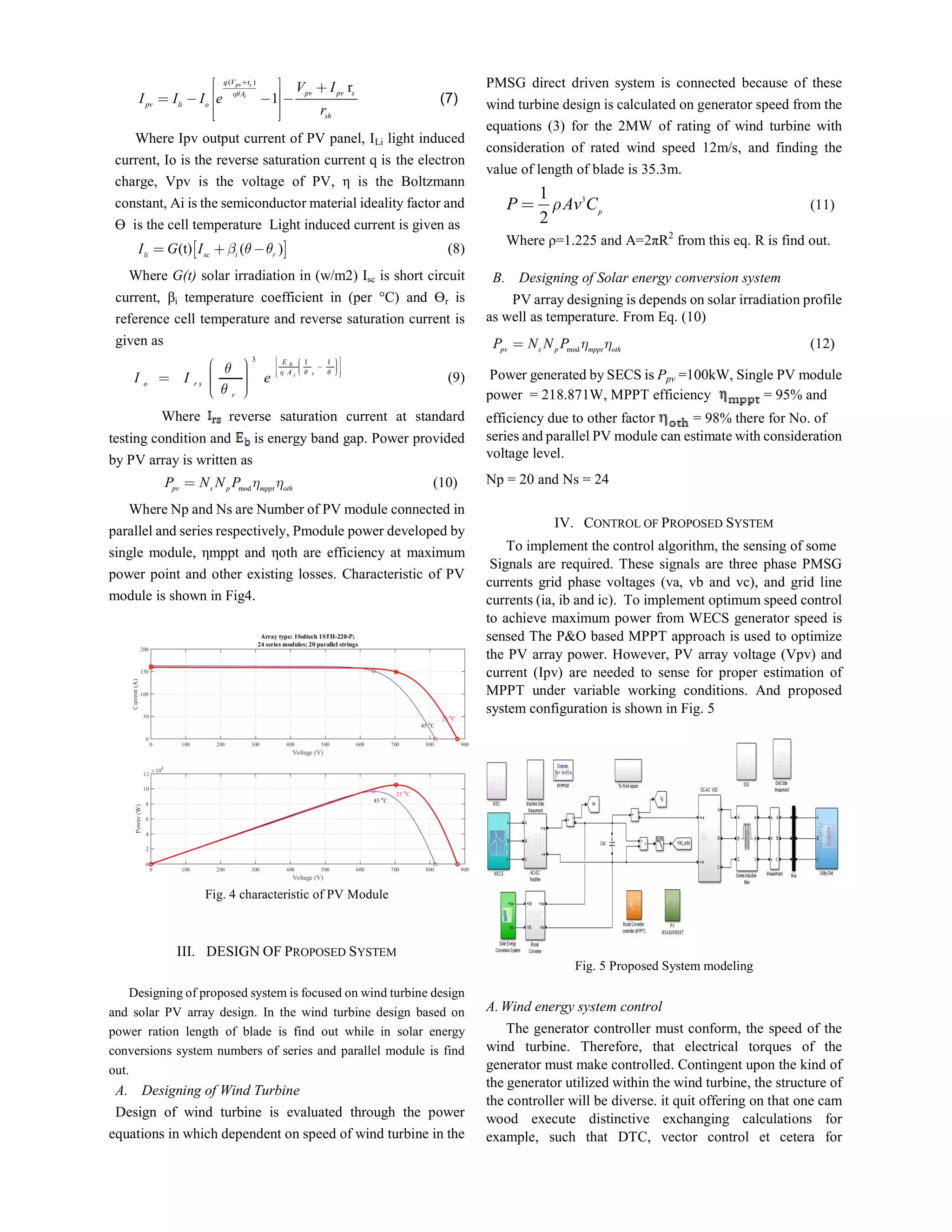
As shown in Fig. 1, the proposed system consists of a
voltage source converter (VSC) to interface the wind
generator, and a voltage source inverter (VSI) to connect the
cogeneration system into the utility-grid. The PV generator is
connected with dc link through the boost dc-dc converter to
extract maximum power. The VSC and VSI are two-level
converters consisting of six cells; each comprises an
insulated-gate-bipolar transistor (IGBT) in parallel with a
diode. In the following subsections, the complete modeling of
the proposed system is provided.
A.Wind turbine modeling
A full-scale wind turbine (FSWT) utilizing a permanent
magnet synchronous generator (PMSG) is selected for its low
maintenance and low operational cost [10]. In wind energy
conversion system (WECS) wind potential energy is
converted into electrical energy with the help of wind turbine
and generator, in proposed paper permanent magnet
synchronous generator is used to convert mechanical energy
to electrical energy. In modeling of WECS following key
equations are used,
Power contains in the undisturbed wind is in form of
kinetic energy then the power is,
21
2
E mv (1)
Where m and v are rate of flow of wind and speed of
undisturbed wind respectively, and the rate of flow of wind is
the function of air density, area through wind is passing and
speed of wind then the power contains in undisturbed wind
can be also written as,
31
2
P Av (2)
Where ρ and A are the density of wind and swept area of
wind turbine respectively
Power output from the wind turbine is given as,
31
2
p
P Av C (3)
3
21
2
p
R
P R C



     
(4)
Where λ is tip speed ratio it is depends on wind speed
length of blade and generator angular speed in the case of
direct driven wind turbine. And Cp is the betz limit its
optimums value is 0.49. Characteristic of wind turbine is
shown in Fig. 1
B.Modeling of Permanent Magnet Synchronous Generator
(PMSG)
To analysis equivalent circuit of PMSG normally modeled
in synchronous reference frame. To model PMSG rotor
circuit there is no field winding so it can be replaced with
constant current source with fixed magnitude
The following mathematical manipulation can be done.
The voltage equation of PMSG in synchronous reference
frame is given by
Fig. 1Wind turbine characteristic




Fig.2 Equivalent circuit of PMSG in synchronous reference frame
(I R )ds
ds ds s r qs
d
V
dt

     (5)
(I R )
qs
qs qs s r ds
d
V
dt

     (6)
C. Modeling of photovoltaic system
Photovoltaic system is manly depends on PV module which
is consist with PV cell equivalent circuit of PV cell is given in
Fig. 3
Fig. 3 The equivalent circuit of PV cell
Current equation of PV module are given as,
( r )
r
1
pv s
i
q V
pv pv sA
pv li o
sh
V I
I I I e
r


       
  
(7)
Where Ipv output current of PV panel, ILi light induced
current, Io is the reverse saturation current q is the electron
charge, Vpv is the voltage of PV, η is the Boltzmann
constant, Ai is the semiconductor material ideality factor and
ϴ is the cell temperature Light induced current is given as
 (t) ( )li sc i r
I G I      (8)
Where G(t) solar irradiation in (w/m2) Isc is short circuit
current, βi temperature coefficient in (per °C) and ϴr is
reference cell temperature and reverse saturation current is
given as
3 1 1b
ri
E
A
o r s
r
I I e
  

         
      
(9)
Where reverse saturation current at standard
testing condition and is energy band gap. Power provided
by PV array is written as
modpv s p mppt oth
P N N P   (10)
Where Np and Ns are Number of PV module connected in
parallel and series respectively, Pmodule power developed by
single module, ηmppt and ηoth are efficiency at maximum
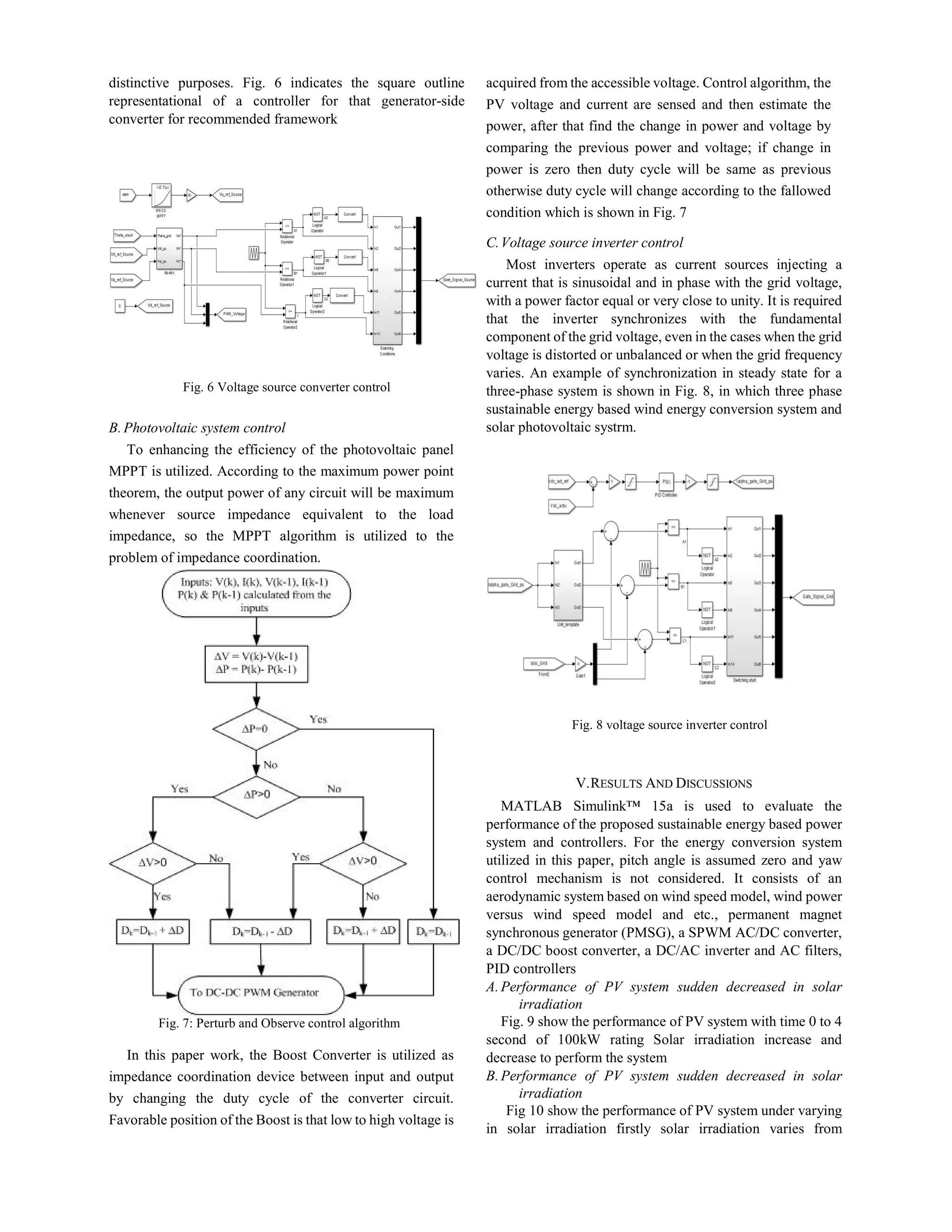
power point and other existing losses. Characteristic of PV
module is shown in Fig4.
Fig. 4 characteristic of PV Module
III. DESIGN OF PROPOSED SYSTEM
Designing of proposed system is focused on wind turbine design
and solar PV array design. In the wind turbine design based on
power ration length of blade is find out while in solar energy
conversions system numbers of series and parallel module is find
out.
A. Designing of Wind Turbine
Design of wind turbine is evaluated through the power
equations in which dependent on speed of wind turbine in the
PMSG direct driven system is connected because of these
wind turbine design is calculated on generator speed from the
equations (3) for the 2MW of rating of wind turbine with
consideration of rated wind speed 12m/s, and finding the
value of length of blade is 35.3m.
31
2
p
P Av C (11)
Where ρ=1.225 and A=2πR2
from this eq. R is find out.
B. Designing of Solar energy conversion system
PV array designing is depends on solar irradiation profile
as well as temperature. From Eq. (10)
modpv s p mppt oth
P N N P   (12)
Power generated by SECS is Ppv =100kW, Single PV module
power = 218.871W, MPPT efficiency = 95% and
efficiency due to other factor = 98% there for No. of
series and parallel PV module can estimate with consideration
voltage level.
Np = 20 and Ns = 24
IV. CONTROL OF PROPOSED SYSTEM
To implement the control algorithm, the sensing of some
Signals are required. These signals are three phase PMSG
currents grid phase voltages (va, vb and vc), and grid line
currents (ia, ib and ic). To implement optimum speed control
to achieve maximum power from WECS generator speed is
sensed The P&O based MPPT approach is used to optimize
the PV array power. However, PV array voltage (Vpv) and
current (Ipv) are needed to sense for proper estimation of
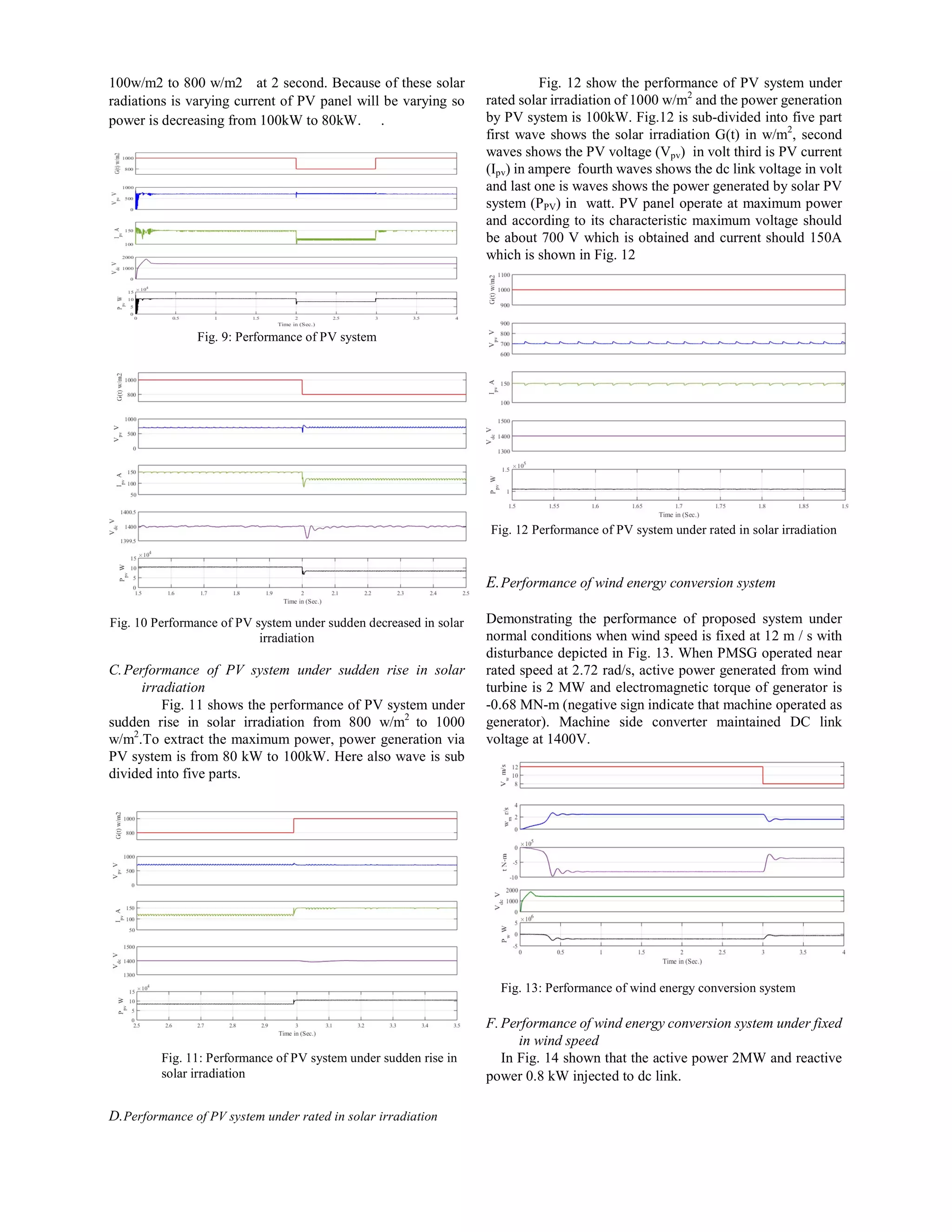
MPPT under variable working conditions. And proposed
system configuration is shown in Fig. 5
Fig. 5 Proposed System modeling
A.Wind energy system control
The generator controller must conform, the speed of the
wind turbine. Therefore, that electrical torques of the
generator must make controlled. Contingent upon the kind of
the generator utilized within the wind turbine, the structure of
the controller will be diverse. it quit offering on that one cam
wood execute distinctive exchanging calculations for
example, such that DTC, vector control et cetera for
distinctive purposes. Fig. 6 indicates the square outline
representational of a controller for that generator-side
converter for recommended framework
Fig. 6 Voltage source converter control
B.Photovoltaic system control
To enhancing the efficiency of the photovoltaic panel
MPPT is utilized. According to the maximum power point
theorem, the output power of any circuit will be maximum
whenever source impedance equivalent to the load
impedance, so the MPPT algorithm is utilized to the
problem of impedance coordination.
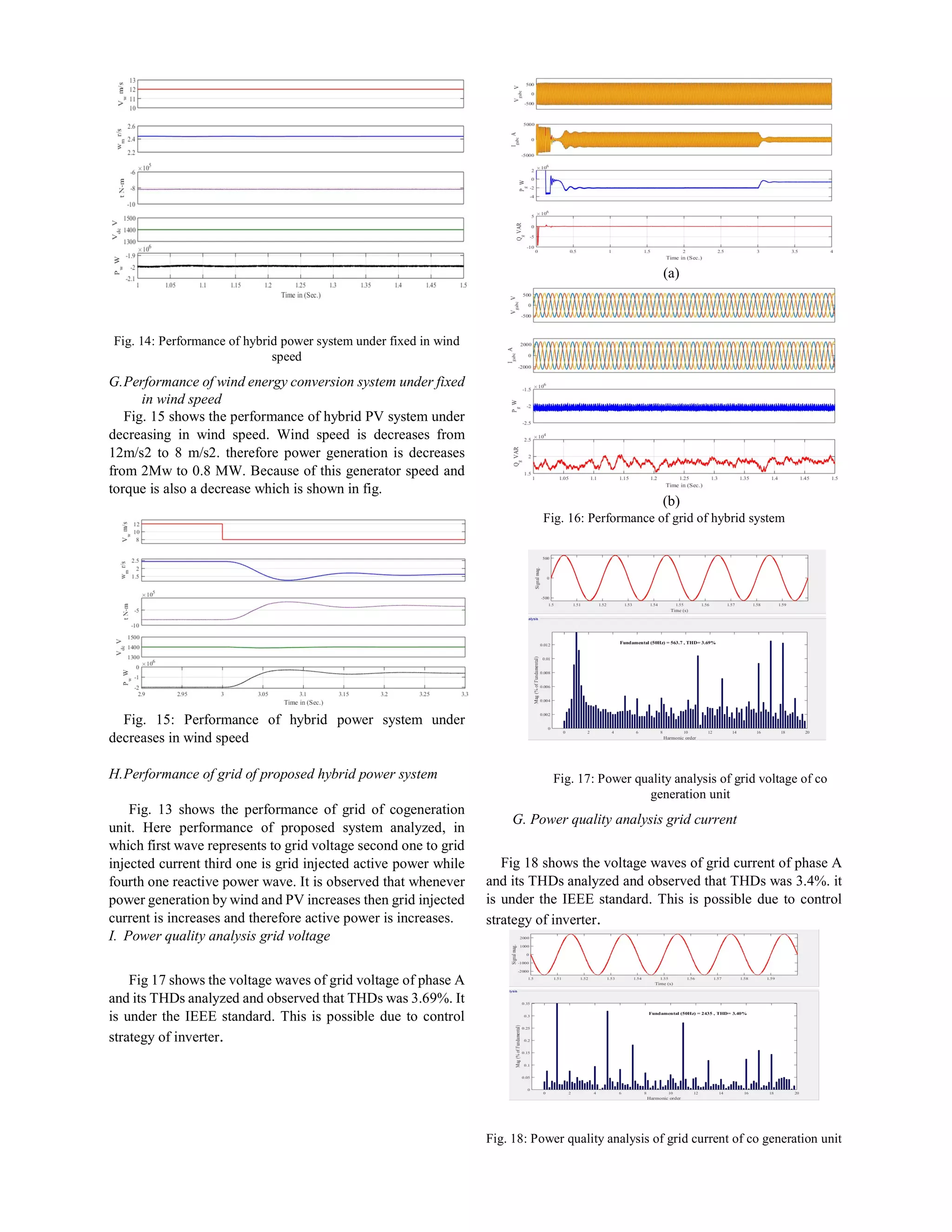
Fig. 7: Perturb and Observe control algorithm
In this paper work, the Boost Converter is utilized as
impedance coordination device between input and output
by changing the duty cycle of the converter circuit.
Favorable position of the Boost is that low to high voltage is
acquired from the accessible voltage. Control algorithm, the
PV voltage and current are sensed and then estimate the
power, after that find the change in power and voltage by
comparing the previous power and voltage; if change in
power is zero then duty cycle will be same as previous
otherwise duty cycle will change according to the fallowed
condition which is shown in Fig. 7
C.Voltage source inverter control
Most inverters operate as current sources injecting a
current that is sinusoidal and in phase with the grid voltage,
with a power factor equal or very close to unity. It is required
that the inverter synchronizes with the fundamental
component of the grid voltage, even in the cases when the grid
voltage is distorted or unbalanced or when the grid frequency
varies. An example of synchronization in steady state for a
three-phase system is shown in Fig. 8, in which three phase
sustainable energy based wind energy conversion system and
solar photovoltaic systrm.
Fig. 8 voltage source inverter control
V.RESULTS AND DISCUSSIONS
MATLAB Simulink™ 15a is used to evaluate the
performance of the proposed sustainable energy based power
system and controllers. For the energy conversion system
utilized in this paper, pitch angle is assumed zero and yaw
control mechanism is not considered. It consists of an
aerodynamic system based on wind speed model, wind power
versus wind speed model and etc., permanent magnet
synchronous generator (PMSG), a SPWM AC/DC converter,
a DC/DC boost converter, a DC/AC inverter and AC filters,
PID controllers
A.Performance of PV system sudden decreased in solar
irradiation
Fig. 9 show the performance of PV system with time 0 to 4
second of 100kW rating Solar irradiation increase and
decrease to perform the system
B.Performance of PV system sudden decreased in solar
irradiation
Fig 10 show the performance of PV system under varying
in solar irradiation firstly solar irradiation varies from
100w/m2 to 800 w/m2 at 2 second. Because of these solar
radiations is varying current of PV panel will be varying so
power is decreasing from 100kW to 80kW. .
Fig. 9: Performance of PV system
Fig. 10 Performance of PV system under sudden decreased in solar
irradiation
C.Performance of PV system under sudden rise in solar
irradiation
Fig. 11 shows the performance of PV system under
sudden rise in solar irradiation from 800 w/m2
to 1000
w/m2
.To extract the maximum power, power generation via
PV system is from 80 kW to 100kW. Here also wave is sub
divided into five parts.
Fig. 11: Performance of PV system under sudden rise in
solar irradiation
D.Performance of PV system under rated in solar irradiation
Fig. 12 show the performance of PV system under
rated solar irradiation of 1000 w/m2
and the power generation
by PV system is 100kW. Fig.12 is sub-divided into five part
first wave shows the solar irradiation G(t) in w/m2
, second
waves shows the PV voltage (Vpv) in volt third is PV current
(Ipv) in ampere fourth waves shows the dc link voltage in volt
and last one is waves shows the power generated by solar PV
system (PPV) in watt. PV panel operate at maximum power
and according to its characteristic maximum voltage should
be about 700 V which is obtained and current should 150A
which is shown in Fig. 12
Fig. 12 Performance of PV system under rated in solar irradiation
E.Performance of wind energy conversion system
Demonstrating the performance of proposed system under
normal conditions when wind speed is fixed at 12 m / s with
disturbance depicted in Fig. 13. When PMSG operated near
rated speed at 2.72 rad/s, active power generated from wind
turbine is 2 MW and electromagnetic torque of generator is
-0.68 MN-m (negative sign indicate that machine operated as
generator). Machine side converter maintained DC link
voltage at 1400V.
Fig. 13: Performance of wind energy conversion system
F.Performance of wind energy conversion system under fixed
in wind speed
In Fig. 14 shown that the active power 2MW and reactive
power 0.8 kW injected to dc link.
Fig. 14: Performance of hybrid power system under fixed in wind
speed
G.Performance of wind energy conversion system under fixed
in wind speed
Fig. 15 shows the performance of hybrid PV system under
decreasing in wind speed. Wind speed is decreases from
12m/s2 to 8 m/s2. therefore power generation is decreases
from 2Mw to 0.8 MW. Because of this generator speed and
torque is also a decrease which is shown in fig.
Fig. 15: Performance of hybrid power system under
decreases in wind speed
H.Performance of grid of proposed hybrid power system
Fig. 13 shows the performance of grid of cogeneration
unit. Here performance of proposed system analyzed, in
which first wave represents to grid voltage second one to grid
injected current third one is grid injected active power while
fourth one reactive power wave. It is observed that whenever
power generation by wind and PV increases then grid injected
current is increases and therefore active power is increases.
I. Power quality analysis grid voltage
Fig 17 shows the voltage waves of grid voltage of phase A
and its THDs analyzed and observed that THDs was 3.69%. It
is under the IEEE standard. This is possible due to control
strategy of inverter.
(a)
(b)
Fig. 16: Performance of grid of hybrid system
Fig. 17: Power quality analysis of grid voltage of co
generation unit
G. Power quality analysis grid current
Fig 18 shows the voltage waves of grid current of phase A
and its THDs analyzed and observed that THDs was 3.4%. it
is under the IEEE standard. This is possible due to control
strategy of inverter.
Fig. 18: Power quality analysis of grid current of co generation unit
VI. CONCLUSION
This paper has presented the sustainable energy based
hybrid power systems using current-controlled
grid-connected VSIs. The VSC at the wind generator-side is
responsible for extracting the maximum wind power
following the wind speed variations. On the utility-grid side,
the role of the VSI is synchronizing with the grid in terms of
phase sequence, grid frequency and voltage magnitude. The
extract of the maximum PV power from the PV generator,
achieve the maximum power by P&O techniques with the
help of dc-dc boost converter and to maintain the dc link
voltage VSI control is responsible a unity PCC voltage under
different modes of operation. Different control techniques for
proposed system such as PV mppt, WECS MPPT control.
And Inverter control and it performance is validated through
the MATLAB Simulink 2015a.
APPENDIX
Proposed system parameters are given in Table.
Table 1 PV specifications
Variable Description Value
PPV Rated power 218W
VOC Open circuit voltage 36.6V
ISC Short circuit current 7.97A
VPVM MPPT voltage 29.3V
IPVM MPPT current 7.47A
Ns Number of series module 20
NP Number of parallel module 24
Table 2 Boost converter Specification
VARIABLE DESCRIPTION VALUE
LC INDUCTOR 8.5MH
CC CAPACITANCE 5000ΜF
FC SWITCHING FREQUENCY 10KHZ
Table 3 Parameters of PMSG
VARIABLE DESCRIPTION VALUE
P RATED POWER 2MW
VLM NOMINAL VOLTAGE 690 V
F NOMINAL FREQUENCY 9.75 HZ
STATOR RESISTANCE 0.821 MΩ
D-AXIS ARMATURE
INDUCTANCE
1.5731 MH
Q-AXIS ARMATURE
INDUCTANCE
5.839MH
J INERTIA 20000 KG.M
2
NR RATED SPEED 22.5 RPM
P POLE PAIR 26
Table 4 Parameters of wind turbine
VARIABLE DESCRIPTION VALUE
P RATED ACTIVE POWER
OUTPUT (MW)
2
S RATED APPARENT POWER
(MVAR)
2.2
Τ RATED WIND TURBINE
TORQUE (KN.M)
848.8
ω RATED TURBINE SPEED
(RPM)
22.5
Blade radius (m) 35.3
REFERENCES
[1] F. Blaabjerg, R. Teodorescu, M. Liserre, and A. V. Timbus,
"Overview of Control and Grid Synchronization for
Distributed Power Generation Systems," Industrial
Electronics, IEEE Transactions on, vol. 53, pp. 1398-1409,
2006.
[2] G. H. Bode, L. Poh Chiang, M. J. Newman, and D. G. Holmes,
"An improved robust predictive current regulation algorithm,"
Industry Applications, IEEE Transactions on, vol. 41, pp.
1720-1733, 2005.
[3] A. Rashid, N. Hasan, K. T. Parvez and M. N. I. Maruf, “Study
and analysis of a small scale micro-grid using renewable
energy resources,” Proceedings of Inter. Conf. on Electrical
Engineering and Information Communication Technology
(ICEEICT), Dhaka, 2015.
[4] M. Pichan, H. Rastegar and M. Monfared, “Deadbeat Control
of the Stand-Alone Four-Leg Inverter Considering the Effect of
the Neutral Line Inductor”, IEEE Trans. Ind. Electron., vol.
64, no. 5, pp. 2592 - 2601, Nov. 2017
[5] P. Rodríguez, A. Luna, R. S. Muñoz-Aguilar, I.
Etxeberria-Otadui, R. Teodorescu and F. Blaabjerg, “A
stationary reference frame grid synchronization system for
three-phase grid-connected power converters under adverse
grid conditions,” IEEE Trans. Power Electron., vol. 27, no. 1,
pp. 99–112, Jan. 2012
[6] Fatih Cingoz, Ali Elrayyah, and Yilmaz Sozer, “Optimized
Settings of Droop Parameters Using Stochastic Load Modeling
for Effective DC Microgrids Operation,” IEEE Trans. Industry
Applications, vol. 53, no. 2, pp. 1358 – 1371, 2017.
[7] M. Rezkallah, A. Chandra, B. Singh and S. Singh, “Microgrid
Configurations, Control and Applications,” IEEE
Transactions on Smart Grid, Early Acess, 2018.
[8] P. Roshanfekr, S. Lundmark, T. Thiringer, and M. Alatalo, “A
synchronous reluctance generator for a wind
application-compared with an interior mounted permanent
magnet synchronous generator,” Proceedings in 7th IET Inter.
Conference on Power Electronics, Machines and Drives
(PEMD 2014 , Manchester, pp. 1-5, 2014.
[9] Z.M. Dalala, Z.U. Zahid, and Lai Jih-Sheng, “New Overall
Control Strategy for Small-Scale WECS in MPPT and Stall
Regions with Mode Transfer Control,” IEEE Trans. Energy
Conversion, vol.28, no.4, pp.1082-1092, Dec. 2013.
[10] G. Pathak, B. Singh, and B. K. Panigrahi, “Back Propagation
Algorithm Based Controller for Autonomous Wind-DG
Microgrid,” IEEE Trans. Industry Applications, vol. 52, no. 5,
pp. 4408-4415, Sept.-Oct. 2016.
[11] F. Blaabjerg, Z. Chen, and S. B. Kjaer, “Power electronics as
efficien interface in dispersed power generation systems,”
IEEE Trans. Power Electron., vol. 19, no. 5, pp. 1184-1194,
2004
[12] A. Radwan and Y. Mohamed, "Grid-Connected Wind-Solar
Cogeneration Using Back-to-Back Voltage Source
Converters," in IEEE Transactions on Sustainable Energy.
2019.
Analysis of Design, and Control of Sustainable Energy Based Hybrid Power System

Analysis of Design, and Control of Sustainable Energy Based Hybrid Power System

  • 1.
     Abstract—In the modernera, grid connected sustainable energy based hybrid power system is considered as an alternative source for power generation. Especially, need of the time is to provide the three-phase power to grid with smooth sinusoidal voltages having fixed frequency in synchronization manner with the grid. In sustainable energy wind energy conversions system and solar photovoltaic energy conversion system the integration of power electronics converters is a common for grid synchronization with improving current injected quality in terms of total harmonic distortions (THDs) This paper presents a new control for grid synchronization, les s Total harmonic distortion with fixed frequency and voltage magnitude of grid voltage. A permanent magnet synchronous generator-based full-scale wind turbine is interfaced to the utility-grid via back-to-back voltage-source converters (VSCs). A PV solar generator is connected to the dc-link capacitor of VSCs through the boost dc to dc converter. The proposed topology features an independent maximum power point tracking for both the wind and the PV generators to maximize the extraction of the sustainable energy. The proposed system control algorithm is developed and implemented, using soft tools in MATLAB 2015a software using sim power system toolbox and perforce validated through the simulations results Index Terms—Frequency Control, MPPT, Photovoltaic system, sustainable energy, Voltage Control, Voltage Source Converter (VSC) Voltage Source Inverter (VSI) and Wind energy system I. INTRODUCTION Nowadays, energy demand is getting increased with the passage of time and sustainable energy based power systems especially through wind, solar and fuel cells as well as their related power conversion systems are conferred immensely. Many problems like grid instability, low power factor and power outage etc. for power distribution have also been increased with increase in energy demand [1]. However, co generation power systems are found to be a sensible solution for such problems as they have relatively robust stability and causes additional flexibility balance. Moreover, their utilization can also improve the distribution networks management and carbon release is also reduced. VSIs are extensively necessitated for the commercial purpose as well as for the industrial applications as they play a key role in converting the DC voltage and current, usually produced by various energy source based system applications, into AC before being discharged into the grid or consumed by the load. Several control systems are introduced, various schemes are proposed and numerous techniques are updated in order to facilitate the control of three-phase VSI. The objectives of these control schemes are to constrain the high and low-frequency electromagnetic pollution and to inject the active power with zero power factor into grid [2]. The smooth and steady sinusoidal waveform can be a good input to a load for getting the most suitable response, therefore, the output of the inverter, which normally enjoys special standards and characteristics, should be controlled for providing an aforementioned waveform to load and grid. Generally, it is observed that several problems are caused in linking the co generation power system to a grid or grid to load in bidirectional inverters, i.e., grid instability, distortion in the waveform, attenuation as well as major and minor disturbances. Hence, in order to overcome these problems and to provide high-quality power, appropriate controllers with rapid response, compatible algorithm, ability to remove stable errors, less transit time, high tracking ability, less total harmonic distortion, THD value and smooth sinusoidal output should be designed. Various controllers are designed for achieving these qualities. The cascade technologies are introduced in the literature comprises of an inner current loop and outer voltage loop [3–9]. As the inner-loop current controller plays a fundamental role in closed-loop performance, various control approaches like PI [3], deadbeat [4] and hysteresis [5] are extensively applied. Outer voltage loop in the aforementioned cases refines the tracking ability and decreases the tracking error. In case of no input limitations, aforesaid PI controllers are the best choice for stabilizing the inner loop performance. However, input constraints restrict their performance and no optimization is usually observed by using PI controllers. The deadbeat control method is proposed in [4] to enhance the closed-loop performance but unfortunately, it was found highly sensitive to the disturbances, parameters mismatches and measurement noise. Later on, some observed based deadbeat controllers are introduced in order to provide compensation for these discrepancies, however, a trade-off was observed between phase margin and closed-loop performance [6-8]. Motivated by the promising benefits of the wind-PV generation systems, this paper present a new control of grid Analysis of Design, and Control of Sustainable Energy Based Hybrid Power System Anrat Kumar Chadar 1 and Samina E. Mubeen 2 anil.ee123@gmail.com and saminaeml@gmail.com 1 PG Scholar, Electrical and Electronics Engineering Department, Radharaman Engineering College, Bhopal 2 Prof. & Head, Electrical and Electronics Engineering Department, Radharaman Engineering College, Bhopal
  • 2.
    side converter toimprove the performance, yet simple and efficient to interface both the wind and PV generators into the utility-grid. II.MODELING OF PROPOSED SYSTEM As shown in Fig. 1, the proposed system consists of a voltage source converter (VSC) to interface the wind generator, and a voltage source inverter (VSI) to connect the cogeneration system into the utility-grid. The PV generator is connected with dc link through the boost dc-dc converter to extract maximum power. The VSC and VSI are two-level converters consisting of six cells; each comprises an insulated-gate-bipolar transistor (IGBT) in parallel with a diode. In the following subsections, the complete modeling of the proposed system is provided. A.Wind turbine modeling A full-scale wind turbine (FSWT) utilizing a permanent magnet synchronous generator (PMSG) is selected for its low maintenance and low operational cost [10]. In wind energy conversion system (WECS) wind potential energy is converted into electrical energy with the help of wind turbine and generator, in proposed paper permanent magnet synchronous generator is used to convert mechanical energy to electrical energy. In modeling of WECS following key equations are used, Power contains in the undisturbed wind is in form of kinetic energy then the power is, 21 2 E mv (1) Where m and v are rate of flow of wind and speed of undisturbed wind respectively, and the rate of flow of wind is the function of air density, area through wind is passing and speed of wind then the power contains in undisturbed wind can be also written as, 31 2 P Av (2) Where ρ and A are the density of wind and swept area of wind turbine respectively Power output from the wind turbine is given as, 31 2 p P Av C (3) 3 21 2 p R P R C          (4) Where λ is tip speed ratio it is depends on wind speed length of blade and generator angular speed in the case of direct driven wind turbine. And Cp is the betz limit its optimums value is 0.49. Characteristic of wind turbine is shown in Fig. 1 B.Modeling of Permanent Magnet Synchronous Generator (PMSG) To analysis equivalent circuit of PMSG normally modeled in synchronous reference frame. To model PMSG rotor circuit there is no field winding so it can be replaced with constant current source with fixed magnitude The following mathematical manipulation can be done. The voltage equation of PMSG in synchronous reference frame is given by Fig. 1Wind turbine characteristic     Fig.2 Equivalent circuit of PMSG in synchronous reference frame (I R )ds ds ds s r qs d V dt       (5) (I R ) qs qs qs s r ds d V dt       (6) C. Modeling of photovoltaic system Photovoltaic system is manly depends on PV module which is consist with PV cell equivalent circuit of PV cell is given in Fig. 3 Fig. 3 The equivalent circuit of PV cell Current equation of PV module are given as,
  • 3.
    ( r ) r 1 pvs i q V pv pv sA pv li o sh V I I I I e r              (7) Where Ipv output current of PV panel, ILi light induced current, Io is the reverse saturation current q is the electron charge, Vpv is the voltage of PV, η is the Boltzmann constant, Ai is the semiconductor material ideality factor and ϴ is the cell temperature Light induced current is given as  (t) ( )li sc i r I G I      (8) Where G(t) solar irradiation in (w/m2) Isc is short circuit current, βi temperature coefficient in (per °C) and ϴr is reference cell temperature and reverse saturation current is given as 3 1 1b ri E A o r s r I I e                      (9) Where reverse saturation current at standard testing condition and is energy band gap. Power provided by PV array is written as modpv s p mppt oth P N N P   (10) Where Np and Ns are Number of PV module connected in parallel and series respectively, Pmodule power developed by single module, ηmppt and ηoth are efficiency at maximum power point and other existing losses. Characteristic of PV module is shown in Fig4. Fig. 4 characteristic of PV Module III. DESIGN OF PROPOSED SYSTEM Designing of proposed system is focused on wind turbine design and solar PV array design. In the wind turbine design based on power ration length of blade is find out while in solar energy conversions system numbers of series and parallel module is find out. A. Designing of Wind Turbine Design of wind turbine is evaluated through the power equations in which dependent on speed of wind turbine in the PMSG direct driven system is connected because of these wind turbine design is calculated on generator speed from the equations (3) for the 2MW of rating of wind turbine with consideration of rated wind speed 12m/s, and finding the value of length of blade is 35.3m. 31 2 p P Av C (11) Where ρ=1.225 and A=2πR2 from this eq. R is find out. B. Designing of Solar energy conversion system PV array designing is depends on solar irradiation profile as well as temperature. From Eq. (10) modpv s p mppt oth P N N P   (12) Power generated by SECS is Ppv =100kW, Single PV module power = 218.871W, MPPT efficiency = 95% and efficiency due to other factor = 98% there for No. of series and parallel PV module can estimate with consideration voltage level. Np = 20 and Ns = 24 IV. CONTROL OF PROPOSED SYSTEM To implement the control algorithm, the sensing of some Signals are required. These signals are three phase PMSG currents grid phase voltages (va, vb and vc), and grid line currents (ia, ib and ic). To implement optimum speed control to achieve maximum power from WECS generator speed is sensed The P&O based MPPT approach is used to optimize the PV array power. However, PV array voltage (Vpv) and current (Ipv) are needed to sense for proper estimation of MPPT under variable working conditions. And proposed system configuration is shown in Fig. 5 Fig. 5 Proposed System modeling A.Wind energy system control The generator controller must conform, the speed of the wind turbine. Therefore, that electrical torques of the generator must make controlled. Contingent upon the kind of the generator utilized within the wind turbine, the structure of the controller will be diverse. it quit offering on that one cam wood execute distinctive exchanging calculations for example, such that DTC, vector control et cetera for
  • 4.
    distinctive purposes. Fig.6 indicates the square outline representational of a controller for that generator-side converter for recommended framework Fig. 6 Voltage source converter control B.Photovoltaic system control To enhancing the efficiency of the photovoltaic panel MPPT is utilized. According to the maximum power point theorem, the output power of any circuit will be maximum whenever source impedance equivalent to the load impedance, so the MPPT algorithm is utilized to the problem of impedance coordination. Fig. 7: Perturb and Observe control algorithm In this paper work, the Boost Converter is utilized as impedance coordination device between input and output by changing the duty cycle of the converter circuit. Favorable position of the Boost is that low to high voltage is acquired from the accessible voltage. Control algorithm, the PV voltage and current are sensed and then estimate the power, after that find the change in power and voltage by comparing the previous power and voltage; if change in power is zero then duty cycle will be same as previous otherwise duty cycle will change according to the fallowed condition which is shown in Fig. 7 C.Voltage source inverter control Most inverters operate as current sources injecting a current that is sinusoidal and in phase with the grid voltage, with a power factor equal or very close to unity. It is required that the inverter synchronizes with the fundamental component of the grid voltage, even in the cases when the grid voltage is distorted or unbalanced or when the grid frequency varies. An example of synchronization in steady state for a three-phase system is shown in Fig. 8, in which three phase sustainable energy based wind energy conversion system and solar photovoltaic systrm. Fig. 8 voltage source inverter control V.RESULTS AND DISCUSSIONS MATLAB Simulink™ 15a is used to evaluate the performance of the proposed sustainable energy based power system and controllers. For the energy conversion system utilized in this paper, pitch angle is assumed zero and yaw control mechanism is not considered. It consists of an aerodynamic system based on wind speed model, wind power versus wind speed model and etc., permanent magnet synchronous generator (PMSG), a SPWM AC/DC converter, a DC/DC boost converter, a DC/AC inverter and AC filters, PID controllers A.Performance of PV system sudden decreased in solar irradiation Fig. 9 show the performance of PV system with time 0 to 4 second of 100kW rating Solar irradiation increase and decrease to perform the system B.Performance of PV system sudden decreased in solar irradiation Fig 10 show the performance of PV system under varying in solar irradiation firstly solar irradiation varies from
  • 5.
    100w/m2 to 800w/m2 at 2 second. Because of these solar radiations is varying current of PV panel will be varying so power is decreasing from 100kW to 80kW. . Fig. 9: Performance of PV system Fig. 10 Performance of PV system under sudden decreased in solar irradiation C.Performance of PV system under sudden rise in solar irradiation Fig. 11 shows the performance of PV system under sudden rise in solar irradiation from 800 w/m2 to 1000 w/m2 .To extract the maximum power, power generation via PV system is from 80 kW to 100kW. Here also wave is sub divided into five parts. Fig. 11: Performance of PV system under sudden rise in solar irradiation D.Performance of PV system under rated in solar irradiation Fig. 12 show the performance of PV system under rated solar irradiation of 1000 w/m2 and the power generation by PV system is 100kW. Fig.12 is sub-divided into five part first wave shows the solar irradiation G(t) in w/m2 , second waves shows the PV voltage (Vpv) in volt third is PV current (Ipv) in ampere fourth waves shows the dc link voltage in volt and last one is waves shows the power generated by solar PV system (PPV) in watt. PV panel operate at maximum power and according to its characteristic maximum voltage should be about 700 V which is obtained and current should 150A which is shown in Fig. 12 Fig. 12 Performance of PV system under rated in solar irradiation E.Performance of wind energy conversion system Demonstrating the performance of proposed system under normal conditions when wind speed is fixed at 12 m / s with disturbance depicted in Fig. 13. When PMSG operated near rated speed at 2.72 rad/s, active power generated from wind turbine is 2 MW and electromagnetic torque of generator is -0.68 MN-m (negative sign indicate that machine operated as generator). Machine side converter maintained DC link voltage at 1400V. Fig. 13: Performance of wind energy conversion system F.Performance of wind energy conversion system under fixed in wind speed In Fig. 14 shown that the active power 2MW and reactive power 0.8 kW injected to dc link.
  • 6.
    Fig. 14: Performanceof hybrid power system under fixed in wind speed G.Performance of wind energy conversion system under fixed in wind speed Fig. 15 shows the performance of hybrid PV system under decreasing in wind speed. Wind speed is decreases from 12m/s2 to 8 m/s2. therefore power generation is decreases from 2Mw to 0.8 MW. Because of this generator speed and torque is also a decrease which is shown in fig. Fig. 15: Performance of hybrid power system under decreases in wind speed H.Performance of grid of proposed hybrid power system Fig. 13 shows the performance of grid of cogeneration unit. Here performance of proposed system analyzed, in which first wave represents to grid voltage second one to grid injected current third one is grid injected active power while fourth one reactive power wave. It is observed that whenever power generation by wind and PV increases then grid injected current is increases and therefore active power is increases. I. Power quality analysis grid voltage Fig 17 shows the voltage waves of grid voltage of phase A and its THDs analyzed and observed that THDs was 3.69%. It is under the IEEE standard. This is possible due to control strategy of inverter. (a) (b) Fig. 16: Performance of grid of hybrid system Fig. 17: Power quality analysis of grid voltage of co generation unit G. Power quality analysis grid current Fig 18 shows the voltage waves of grid current of phase A and its THDs analyzed and observed that THDs was 3.4%. it is under the IEEE standard. This is possible due to control strategy of inverter. Fig. 18: Power quality analysis of grid current of co generation unit
  • 7.
    VI. CONCLUSION This paperhas presented the sustainable energy based hybrid power systems using current-controlled grid-connected VSIs. The VSC at the wind generator-side is responsible for extracting the maximum wind power following the wind speed variations. On the utility-grid side, the role of the VSI is synchronizing with the grid in terms of phase sequence, grid frequency and voltage magnitude. The extract of the maximum PV power from the PV generator, achieve the maximum power by P&O techniques with the help of dc-dc boost converter and to maintain the dc link voltage VSI control is responsible a unity PCC voltage under different modes of operation. Different control techniques for proposed system such as PV mppt, WECS MPPT control. And Inverter control and it performance is validated through the MATLAB Simulink 2015a. APPENDIX Proposed system parameters are given in Table. Table 1 PV specifications Variable Description Value PPV Rated power 218W VOC Open circuit voltage 36.6V ISC Short circuit current 7.97A VPVM MPPT voltage 29.3V IPVM MPPT current 7.47A Ns Number of series module 20 NP Number of parallel module 24 Table 2 Boost converter Specification VARIABLE DESCRIPTION VALUE LC INDUCTOR 8.5MH CC CAPACITANCE 5000ΜF FC SWITCHING FREQUENCY 10KHZ Table 3 Parameters of PMSG VARIABLE DESCRIPTION VALUE P RATED POWER 2MW VLM NOMINAL VOLTAGE 690 V F NOMINAL FREQUENCY 9.75 HZ STATOR RESISTANCE 0.821 MΩ D-AXIS ARMATURE INDUCTANCE 1.5731 MH Q-AXIS ARMATURE INDUCTANCE 5.839MH J INERTIA 20000 KG.M 2 NR RATED SPEED 22.5 RPM P POLE PAIR 26 Table 4 Parameters of wind turbine VARIABLE DESCRIPTION VALUE P RATED ACTIVE POWER OUTPUT (MW) 2 S RATED APPARENT POWER (MVAR) 2.2 Τ RATED WIND TURBINE TORQUE (KN.M) 848.8 ω RATED TURBINE SPEED (RPM) 22.5 Blade radius (m) 35.3 REFERENCES [1] F. Blaabjerg, R. Teodorescu, M. Liserre, and A. V. Timbus, "Overview of Control and Grid Synchronization for Distributed Power Generation Systems," Industrial Electronics, IEEE Transactions on, vol. 53, pp. 1398-1409, 2006. [2] G. H. Bode, L. Poh Chiang, M. J. Newman, and D. G. Holmes, "An improved robust predictive current regulation algorithm," Industry Applications, IEEE Transactions on, vol. 41, pp. 1720-1733, 2005. [3] A. Rashid, N. Hasan, K. T. Parvez and M. N. I. Maruf, “Study and analysis of a small scale micro-grid using renewable energy resources,” Proceedings of Inter. Conf. on Electrical Engineering and Information Communication Technology (ICEEICT), Dhaka, 2015. [4] M. Pichan, H. Rastegar and M. Monfared, “Deadbeat Control of the Stand-Alone Four-Leg Inverter Considering the Effect of the Neutral Line Inductor”, IEEE Trans. Ind. Electron., vol. 64, no. 5, pp. 2592 - 2601, Nov. 2017 [5] P. Rodríguez, A. Luna, R. S. Muñoz-Aguilar, I. Etxeberria-Otadui, R. Teodorescu and F. Blaabjerg, “A stationary reference frame grid synchronization system for three-phase grid-connected power converters under adverse grid conditions,” IEEE Trans. Power Electron., vol. 27, no. 1, pp. 99–112, Jan. 2012 [6] Fatih Cingoz, Ali Elrayyah, and Yilmaz Sozer, “Optimized Settings of Droop Parameters Using Stochastic Load Modeling for Effective DC Microgrids Operation,” IEEE Trans. Industry Applications, vol. 53, no. 2, pp. 1358 – 1371, 2017. [7] M. Rezkallah, A. Chandra, B. Singh and S. Singh, “Microgrid Configurations, Control and Applications,” IEEE Transactions on Smart Grid, Early Acess, 2018. [8] P. Roshanfekr, S. Lundmark, T. Thiringer, and M. Alatalo, “A synchronous reluctance generator for a wind application-compared with an interior mounted permanent magnet synchronous generator,” Proceedings in 7th IET Inter. Conference on Power Electronics, Machines and Drives (PEMD 2014 , Manchester, pp. 1-5, 2014. [9] Z.M. Dalala, Z.U. Zahid, and Lai Jih-Sheng, “New Overall Control Strategy for Small-Scale WECS in MPPT and Stall Regions with Mode Transfer Control,” IEEE Trans. Energy Conversion, vol.28, no.4, pp.1082-1092, Dec. 2013. [10] G. Pathak, B. Singh, and B. K. Panigrahi, “Back Propagation Algorithm Based Controller for Autonomous Wind-DG Microgrid,” IEEE Trans. Industry Applications, vol. 52, no. 5, pp. 4408-4415, Sept.-Oct. 2016. [11] F. Blaabjerg, Z. Chen, and S. B. Kjaer, “Power electronics as efficien interface in dispersed power generation systems,” IEEE Trans. Power Electron., vol. 19, no. 5, pp. 1184-1194, 2004 [12] A. Radwan and Y. Mohamed, "Grid-Connected Wind-Solar Cogeneration Using Back-to-Back Voltage Source Converters," in IEEE Transactions on Sustainable Energy. 2019.