TRIVIAL GAME
Teaching: An effective key to self-learning
This project was funded by European Union.
PRESENTATION OF INTERNATIONAL TEAM COOPERATION
Tasks for the Czech team:
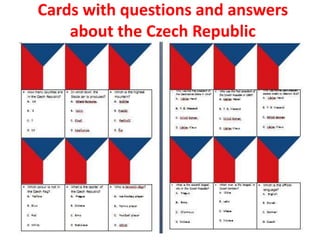
• To write 40 questions about the Czech Republic
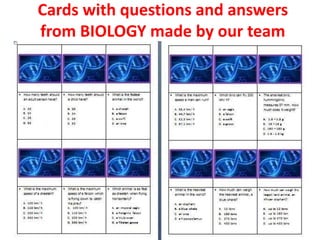
• To write 40 questions from Biology
• To write these questions into templates
prepared by Belgium team
• To write the correct answer in bold in the
template
• To write 3 wrong options for each question in
the template
TEAM WORK
• We invited pupils from classes 7. A, 7. B, 8. A and 8. B to help us
to write questions about our country
• We divided them in small mixed groups and each group wrote
almost 40 questions and answers during two lessons
• We compared their questions and used those which were
asked by each or most groups
• By this method we hope that we collected facts which Czech
pupils think people should now from our history, geography
and culture
• Our team added the wrong options and the missing questions
• Biology questions were limited by the terminology. We decided
to find the fastest, biggest, heaviest, smallest and so on
animals, birds, fish, and plants
• Our biology questions we tried out in class 6. A, pupils also
practiced the superlative forms of English adjectives which is
part of their curriculum
Cards with questions and answers
about the Czech Republic
Cards with questions and answers
from BIOLOGY made by our team
Playing TRIVIAL GAME in mixed
international groups - PETR
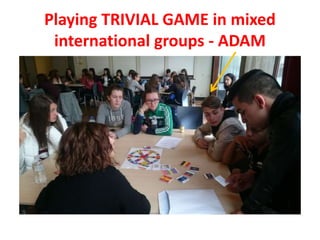
Playing TRIVIAL GAME in mixed
international groups - ADAM
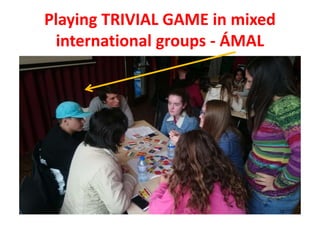
Playing TRIVIAL GAME in mixed
international groups - ÁMAL
Playing TRIVIAL GAME in mixed
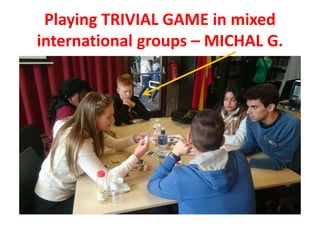
international groups – MICHAL G.
Playing TRIVIAL GAME in mixed
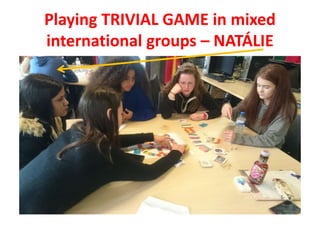
international groups – NATÁLIE
Playing TRIVIAL GAME in mixed
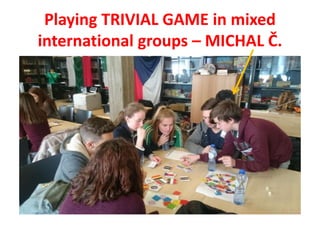
international groups – MICHAL Č.
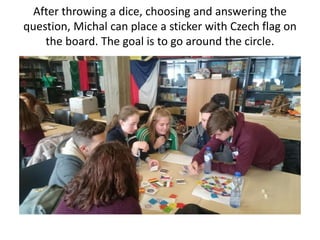
After throwing a dice, choosing and answering the
question, Michal can place a sticker with Czech flag on
the board. The goal is to go around the circle.
Recycling – using our questions in P. E.
lesson for Belgium pupils
• We worked really hard on our questions and writing them in the templates was
also time consuming
• We are skeptical about playing TRIVIAL GAME very often and we wanted to find
another way how to use the questions
• First way was to implement our questions into English curriculum in our school
• Then we decided to use them in our P. E. lesson because we planned to have a
relay and also ask pupils questions and give them points and make them run
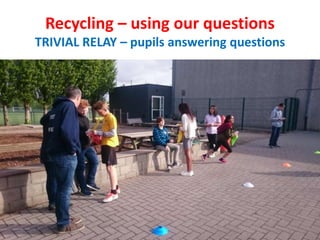
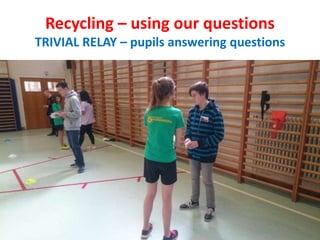
• So the result is that we give the pupils a task. When they get to the end, there is
a team member for each group holding our question cards.
• Pupils who answer correctly, gain the card.
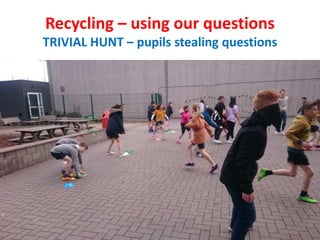
• When the relay is over, pupils don´t have all cards. So there is game called
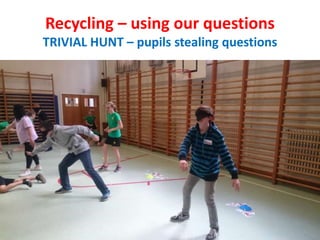
TRIVIAL HUNT. Cards are guarded by our blind folded team members and two
our team members are hunters who throwing soft balls at the pupils. Pupils
who are caught or hit, must squat and wait for rescue
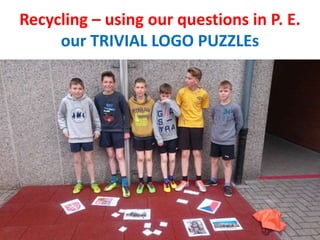
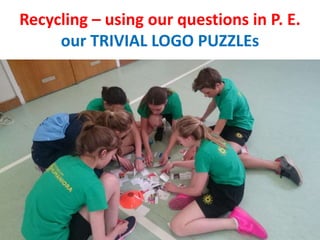
• Finally, when the time is over, pupils turn over the cards and solve the puzzles
with Czech state symbols and sights. We wanted to have puzzle in our P. E.
lesson anyway, so we used our cards but we change the template, also the
correct answers are not written in bold as we let the pupils to read them
Recycling – using our questions
TRIVIAL RELAY – pupils answering questions
Recycling – using our questions
TRIVIAL RELAY – pupils answering questions
Recycling – using our questions
TRIVIAL HUNT – pupils stealing questions
Recycling – using our questions
TRIVIAL HUNT – pupils stealing questions
Recycling – using our questions in P. E.
our TRIVIAL LOGO PUZZLEs
Recycling – using our questions in P. E.
our TRIVIAL LOGO PUZZLEs

TRIVIAL GAME – czech team role

  • 1.
    TRIVIAL GAME Teaching: Aneffective key to self-learning This project was funded by European Union. PRESENTATION OF INTERNATIONAL TEAM COOPERATION
  • 2.
    Tasks for theCzech team: • To write 40 questions about the Czech Republic • To write 40 questions from Biology • To write these questions into templates prepared by Belgium team • To write the correct answer in bold in the template • To write 3 wrong options for each question in the template
  • 3.
    TEAM WORK • Weinvited pupils from classes 7. A, 7. B, 8. A and 8. B to help us to write questions about our country • We divided them in small mixed groups and each group wrote almost 40 questions and answers during two lessons • We compared their questions and used those which were asked by each or most groups • By this method we hope that we collected facts which Czech pupils think people should now from our history, geography and culture • Our team added the wrong options and the missing questions • Biology questions were limited by the terminology. We decided to find the fastest, biggest, heaviest, smallest and so on animals, birds, fish, and plants • Our biology questions we tried out in class 6. A, pupils also practiced the superlative forms of English adjectives which is part of their curriculum
  • 4.
    Cards with questionsand answers about the Czech Republic
  • 5.
    Cards with questionsand answers from BIOLOGY made by our team
  • 6.
    Playing TRIVIAL GAMEin mixed international groups - PETR
  • 7.
    Playing TRIVIAL GAMEin mixed international groups - ADAM
  • 8.
    Playing TRIVIAL GAMEin mixed international groups - ÁMAL
  • 9.
    Playing TRIVIAL GAMEin mixed international groups – MICHAL G.
  • 10.
    Playing TRIVIAL GAMEin mixed international groups – NATÁLIE
  • 11.
    Playing TRIVIAL GAMEin mixed international groups – MICHAL Č.
  • 12.
    After throwing adice, choosing and answering the question, Michal can place a sticker with Czech flag on the board. The goal is to go around the circle.
  • 13.
    Recycling – usingour questions in P. E. lesson for Belgium pupils • We worked really hard on our questions and writing them in the templates was also time consuming • We are skeptical about playing TRIVIAL GAME very often and we wanted to find another way how to use the questions • First way was to implement our questions into English curriculum in our school • Then we decided to use them in our P. E. lesson because we planned to have a relay and also ask pupils questions and give them points and make them run • So the result is that we give the pupils a task. When they get to the end, there is a team member for each group holding our question cards. • Pupils who answer correctly, gain the card. • When the relay is over, pupils don´t have all cards. So there is game called TRIVIAL HUNT. Cards are guarded by our blind folded team members and two our team members are hunters who throwing soft balls at the pupils. Pupils who are caught or hit, must squat and wait for rescue • Finally, when the time is over, pupils turn over the cards and solve the puzzles with Czech state symbols and sights. We wanted to have puzzle in our P. E. lesson anyway, so we used our cards but we change the template, also the correct answers are not written in bold as we let the pupils to read them
  • 14.
    Recycling – usingour questions TRIVIAL RELAY – pupils answering questions
  • 15.
    Recycling – usingour questions TRIVIAL RELAY – pupils answering questions
  • 16.
    Recycling – usingour questions TRIVIAL HUNT – pupils stealing questions
  • 17.
    Recycling – usingour questions TRIVIAL HUNT – pupils stealing questions
  • 18.
    Recycling – usingour questions in P. E. our TRIVIAL LOGO PUZZLEs
  • 19.
    Recycling – usingour questions in P. E. our TRIVIAL LOGO PUZZLEs

Editor's Notes

  • #2 The name of our lesson is Chemistry in the kitchen